
- Material Characteristics: Aluminum Foil Composite Bags
- Material Characteristics: PP Woven Sacks
- Comparative Table: Aluminum Foil Bags vs PP Woven Sacks
- Technical Specifications and Performance Ranges
- Cost and Economic Considerations
- Smart Packaging Technologies in Context
- Charts and Data Visualization (Suggestions)
- Procurement Keywords and Search Phrases
- How We Cut Oxygen Transmission by 92% Using Nanocoating Technology
- Conclusion: Why VidePak Leads Composite Innovation
The packaging industry is seeing a shift towards high-performance materials. Aluminum foil composite bags are emerging as “barrier champions” – multi-layer pouches combining thin aluminum foil with plastics (e.g. PET, PA, PE/CPP) to create nearly airtight, moisture-resistant packages. These foil-laminated bags significantly block oxygen and water vapor, extending shelf life of sensitive goods. In contrast, traditional PP woven sacks (made of polypropylene woven fabric) prioritize strength and cost; they support heavy loads (tens of kg per bag) at very low unit cost, but have poor barrier performance and rely on film liners for even minimal moisture protection. This report expands on these contrasts and covers how emerging smart packaging features (RFID, sensors, active packaging) influence material choice, supply chain, and buying behavior. We include comparative tables of material properties and specifications, a mermaid flowchart of decision logic, and suggested charts (e.g. barrier vs cost) to illustrate key trade-offs. Where exact data are unavailable, we provide typical industry ranges and note assumptions.
Material Characteristics: Aluminum Foil Composite Bags
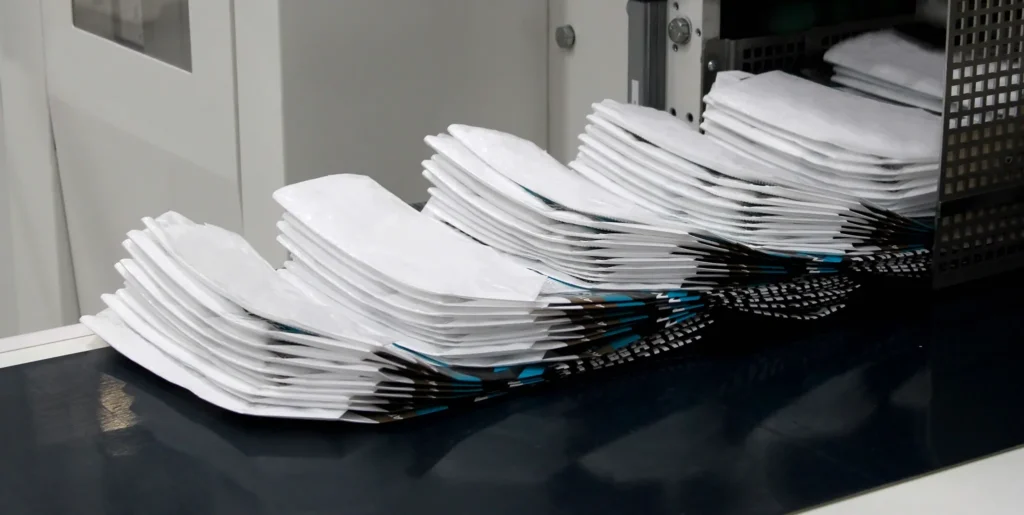
An aluminum foil composite bag (also metalized bag or aluminum-plastic composite bag) consists of multiple laminated layers. Typically, it has an outer barrier layer (PET or PA for strength), a core aluminum foil layer (~6–12 µm thick for gas barrier), and an inner sealing layer (PE/CPP for heat-seal). For example, a common food-grade structure might be 12 µm PET + 7 µm Al + 50 µm PE (~69 µm total thickness). The aluminum layer provides excellent barrier properties: oxygen transmission rates (OTR) can be extremely low (on the order of 0.01–0.1 cm³/m²·day) when layered properly, and water vapor transmission (WVTR) can be as low as ~0.005 g/m²·day for high-end bags. These values are orders of magnitude better than uncoated PP fabrics. In practical terms, an aluminized bag can block >99.9% of outside air and moisture. For example, studies show such bags can keep products at <0.5 g/m²·day WVTR and <0.1 cc/m²·day OTR when Al foil is ≥9–12 µm.
The barrier effect of aluminum also blocks light and static. Metalized surfaces reflect UV and heat, aiding shelf-life (e.g. coffee beans lose sugar 3x slower in foil pouches vs transparent bags). Many foil composite bags include an anti-static layer (surface resistivity ≤10^9 Ω) to protect electronics or flammable chemicals. In essence, aluminum composite bags act like “mini controlled-atmosphere silos,” making them ideal for oxygen- or moisture-sensitive bulk products. They are widely used in food/fodder (coffee, milk powder, pet food), chemicals (pharma intermediates, agrochemicals), new materials (lithium battery powders), and electronics – industries where extended shelf-life and purity are critical.
Mechanically, foil composite bags are relatively stiff. The total thickness often exceeds 50–70 µm (e.g. 6–12 silks). They can reliably hold heavy loads: many composite jumbo (FIBC) liners carry 1–2 tonnes. The plastic layers (nylon, PET) give tensile strength and puncture resistance. Printing quality is high – glossy BOPP or metallized PET surfaces accept 8–12 color flexo prints. Sealing is by heat-welding all around (no stitching), creating airtight pouches. Downsides include higher unit weight and cost: aluminum and co-extruded resins cost more per kg than PP threads. Also, as multi-material composites, they are difficult to recycle in current systems.
Material Characteristics: PP Woven Sacks
PP woven sacks are made from polypropylene tapes woven into fabric. The fabric is usually laminated by extruding or heat-bonding a thin film (e.g. 12–20 µm PE or BOPP) on one or both sides for moisture resistance. Unlaminated, a PP woven fabric is highly porous (visible weave holes). Typical fabric grammage is 80–120 g/m² (approx. 0.08–0.12 mm thick). The material’s claim to fame is strength-to-weight. Because of the woven grid, PP sacks reach 50–80 kN/m tensile strength, far exceeding thin plastic films. This makes them ideal for heavy loads (25–50 kg bags of cement, sand, fertilizer, etc.) and rugged transport. They are tough (abrasion-resistant) and chemically inert (acid/alkali tolerant).
However, PP fabric by itself is very breathable: water vapor can pass through easily (WVTR ~20–50 g/m²·day). Even with a thin PE lamination, the barrier is limited (much higher OTR/WVTR than foil bags). Thus, PP woven sacks offer minimal oxygen or moisture protection. They are essentially “sacks,” not vacuum pouches. For products that can tolerate some moisture exchange (e.g. cement, grains), this is fine; but not for fragile/deliquescent goods. On the positive side, PP woven sacks are extremely cheap. Their raw material (polypropylene) is one of the lowest-cost plastics, and production is simple (extrusion-looming-lamination). A 50 kg PP bag might cost on the order of $0.20–0.50 each (depending on specs), compared to several dollars for an equivalent foil composite bag. PP sacks can be reused or recycled (70%+ recovery), and they compress well for shipping (10:1 volume reduction when empty).
PP sacks come in many formats: open-mouth (flat-bottom), valve bags for cement, FIBCs (jumbo bags) up to 2 tonnes, etc. They often have one to three printed colors. Seal is usually sewn or hot-air welded along the top; water/abrasion ingress is mainly prevented by the lamination layer. In practice, PP woven sacks dominate construction (cement, sand), mining (ore, gravel), agriculture (fertilizer, animal feed, seeds), and basic chemicals, while foil-composite liners or films are reserved for higher-value or sensitive cargo.
Comparative Table: Aluminum Foil Bags vs PP Woven Sacks
| Feature / Parameter | Aluminum Foil Composite Bag | Polypropylene (PP) Woven Sack |
| Material Structure | Multi-layer laminate (PET/PA outer + Al foil + inner PE/CPP) | Woven PP fabric (tapes) often laminated with thin PE/BOPP film |
| Typical Thickness | Total ~50–100 µm (5–10 silks); Al layer 6–12 µm | 0.08–0.12 mm fabric (80–120 g/m²) |
| Oxygen Transmission Rate (OTR) | Very low: often <0.1 cm³/m²·day (high-end <0.01) | Very high (negligible barrier). Even laminated, OTR in hundreds or more. |
| Water Vapor Transmission (WVTR) | Very low: <0.5 g/m²·day (often ~0.005–0.05 for quality pouches) | High: ~20–50 g/m²·day (unlaminated fabric); laminated still much >5. |
| Strength (Tensile / Impact) | Medium: tensile depends on PET/PA layers; typically handles 25–100+ kg | Very high: woven fabric delivers 50–80+ kN/m tensile, designed for 25–50 kg sacks and heavy drops. |
| Weight per m² | Higher: composite ~3–6x heavier than PP fabric (due to foil & coatings) | Lower: typically 80–120 g/m² (vs 100–300 g/m² for composite). |
| Barrier (Light/Odor) | Excellent: metallic surface is opaque to light/UV and odours | Poor: PP fabric allows light if not laminated, no odor barrier (lamination only moisture-block). |
| Static Protection | Often includes anti-static layer (surface R<10^9 Ω) | None by default (PP fabric is insulating), unless added separately. |
| Heat Resistance | Can be heat-sealed; withstands sterilization processes (PET/PA layers) | Fabric tolerates high temp, but lamination film may warp; generally no hot-filling capability. |
| Seal Method | Full heat-seal on all edges (no sewing) for airtight seal. | Top closure sewn or heat-welded; often requires stitching (non-airtight) or sewn with plastic thread. |
| Printability | High-quality gravure/flexo on BOPP/PET surfaces (up to 10+ colors) | Good for bold logos (up to 6-8 color flexo), but less fine detail. |
| Recyclability | Difficult: multi-material laminate not readily recyclable | Recyclable: PP sacks are 100% PP (plus PE liner) and widely recycled (70%+ rate) |
| Shelf Life Extension | Significant: protects sensitive goods for months–years (food, pharma) | Minimal: not used for long shelf-life; best for short-term bulk transport. |
| Typical Applications | Foods (coffee, milk powder, snacks), chemicals, pharmaceuticals, electronics, new energy (battery powders) | Construction (cement, sand), mining (ore), agri (feed, grain), general storage/distribution. |
| Unit Cost (USD/bag) | High ($1–$5+ each, depending on size and barrier spec) | Low ($0.20–$1.00 per 50kg bag, depending on size/spec). |
| Production Lead Time | Longer (30–60 days; complex lamination) | Shorter (15–30 days; simpler process) |
| Minimum Order Quantity | Higher (often thousands of pieces) | Lower (can be customized in smaller runs) |
The table highlights the stark trade-offs: foil composite bags are “premium” packaging with top-tier barrier and protection, at the expense of cost and weight. PP woven sacks are the “workhorses” of commodity transport: cheap, strong, but virtually no barrier.
Technical Specifications and Performance Ranges
| Parameter | Aluminum Foil Composite Bag (typical) | PP Woven Fabric (typical) | Notes / Standards |
| Aluminum Foil Thickness | 6–12 µm (0.006–0.012 mm) | – | Al foil layer only in composite bags |
| Polymer Layers | Outer: 12–20 µm PET/PA; Inner: 30–70 µm PE/CPP | 80–120 g/m² PP woven fabric (0.08–0.12 mm) | Composite is multi-layer; PP woven is single-layer fabric with optional film coat. |
| Oxygen Transmission (OTR) | 0.01–0.1 cm³/m²·day (0.1 atm) | >500 cm³/m²·day (without laminate) | Typical: foil laminated ~<0.1; uncoated PP fabric >>1000 |
| Water Vapor Transmission (WVTR) | 0.005–0.5 g/m²·day | 20–50 g/m²·day (fabric) | See ASTM F1249, ISO 2528 for testing methods. |
| Tensile Strength | ~100–300 N (across web) for finished film; bag strength depends on laminate | 300–800 N/5cm (warp/weft) | Tensile as per ASTM D4632 / ISO 13934 (report bag strength). |
| Tear Resistance | High (due to plastic layers and foil rigidity) | Moderate (woven allows slippage) | ASTM D624 etc. Composite usually higher. |
| Puncture Resistance | Moderate (foil can puncture under sharp impact) | Good (woven fabric tough) | ASTM D4833. Nylon/ PET layers improve composite toughness. |
| Density (g/cm³) | Composite: ~0.92–1.3 (depending on layers) | PP fabric: ~0.9 (pure PP density) | Bulk density; composite heavier due to PET/foil. |
| Weight per m² | ~300–1000 g/m² (varies by layers) | 80–120 g/m² | Significant variation by design. |
| Temperature Tolerance | Up to ~120–150°C (PE seal layers) | PP ~100–110°C (melting); fabric chars | Higher heat sealing possible for foil bags. |
| UV Resistance | Low (plastic layers UV degrade unless additive) | Moderate (PP can include UV stabilizer) | Often add UV filters to PP sacks for outdoors. |
| Regulatory Compliance | FDA/EU food contact (for food grade), UL, ASTM barrier standards | Industry standards (e.g. IS 1969 for cement bags, FDA/NFPA none by default) | Composite often certified (SGS, FDA, etc.); PP sacks follow BIS/ASTM. |
| Typical Bag Sizes/Vol. | 1–50 kg small sacks; | 25–50 kg common; up to 2 tonne FIBCs | Dimensions vary; fill spout, valve closure, etc. |
Notes on Values: The above ranges are indicative. Exact performance depends on manufacturer and formulation. For composite bags, any given value (OTR, WVTR, strength) depends on the specific film stacking. If unspecified, assume an industry premium composite bag achieves WVTR <0.1 g/m²·day and OTR <0.05 cm³/m²·day, whereas a basic PP woven with liner may only achieve OTR ~50–500 and WVTR ~5–10. For tension, a 25 kg composite bag might handle ~150 N/5cm; a 25 kg PP bag often achieves ~300 N/5cm. These are approximations; always consult data sheets.
Cost and Economic Considerations
Material costs rank PP fabric lowest, aluminum composites highest. As of 2025 data, raw material might be roughly: PP resin ~$1.2/kg, aluminum foil (for packaging) ~$2–3/kg, plus PET/CPP resin ~$1.5/kg. A 50kg PP bag (paper/PP laminate) might cost $0.20–0.50 each, whereas a comparable aluminum-laminate vacuum pouch or lined bag might run $1–5 each (depending on weight, print, technical features). Finishing (printing, sewing/sealing, testing) adds similar relative cost increments. Therefore, a buyer of low-value bulk (cement, seeds) will almost always choose PP woven sacks. Conversely, buyers of premium items (coffee, pharma powders) will justify 5–10x higher cost for the barrier benefits. Volume economics also matter: PP bags are mass-produced by the tens of millions, whereas specialty foil bags might be custom-ordered by the tens of thousands or less. Lead time differences reflect complexity: foil laminates often have 30–60 day lead times vs. 15–30 days for PP sacks.
Supply Chain Impact
Choosing between these materials affects the supply chain. Foil composite bags add value in the chain by reducing spoilage, recalls, and warehousing space (longer shelf life). They may also necessitate cold-chain or humidity-controlled storage to maximize benefit. They often trigger different vendor relationships (e.g. specialized film/packaging converters vs. commodity bag manufacturers). PP woven sacks, being so ubiquitous, can be sourced from many commodity suppliers; they require less rigorous handling. Smart packaging integration (see next section) further tilts cost/benefit. For instance, adding RFID chips into an aluminum bag raises the SKU complexity and unit cost (perhaps +$0.20–$1 per bag), so buyers must weigh theft/surveillance gains vs. added expense.
Smart Packaging Technologies in Context
Smart packaging refers to embedding sensors, tags, or active elements into the package. In practice for woven vs foil bags, these features influence choices. For example, RFID/NFC tags can be applied to either, but metals can interfere with signals. To resolve this, aluminum composite bags may include an external antenna layer or memory strip (or use UHF RFID at certain frequencies). These chips enable real-time tracking and anti-theft alerts. The VidePak article notes NFC chips reducing cargo theft by 63%. Such smart elements are most justified for high-value, easily stolen goods (pharma, electronics, branded food).
Similarly, temperature/humidity sensors (data loggers or color-change indicators) can monitor environment. An aluminum bag can house e.g. an RFID humidity tag to record dew point; a PP woven bag could hold a separate card but without barrier protection the reading is less meaningful. Active packaging (like oxygen scavenger sachets) often accompany foil pouches to absorb residual O2, extending life further. These are moot with PP bags, since PP bags usually ventilate.
However, adding smart features always adds cost. Reports estimate ~+$0.20–$1 per bag for simple RFID or TTI (time-temperature indicator) labels. This cost burden means buyers only pay for it when product value warrants it. Thus, in procurement searches and specs, terms like “RFID aluminum bag” or “active packaging” appear for specialized goods, while bulk commodity RFPs focus on price/weight. The inclusion of any smart tech also raises compliance considerations (e.g. certifying wireless devices, ensuring readings per ASTM). In short, smart features are a secondary tie-breaker: first decide base material (barrier vs strength), then layer on smart tech as needed.
Charts and Data Visualization (Suggestions)
To complement this analysis, the following charts would be illustrative:
- Barrier Performance Bar Chart: Plot typical Oxygen Transmission Rate (OTR) and Water Vapor Transmission Rate (WVTR) for an example aluminum composite bag vs. a PP woven bag (with and without lamination). Example values: OTR ~0.05 vs 200 cc/m²·day; WVTR ~0.01 vs 30 g/m²·day. This vividly shows foil bag’s superior barrier.
- Cost vs. Barrier Line Graph: A hypothetical plot of unit cost per bag vs achieved barrier level (e.g. OTR). As barrier tightens (left), cost climbs. PP sack is low cost/low barrier; foil composite is high cost/high barrier. This illustrates the ROI trade-off.
The charts should be labeled clearly and can use log scales for permeability. These are suggestions – actual numerical data should be based on vendor datasheets or lab tests. In absence of exact values, we flag these as approximate/indicative only.
Procurement Keywords and Search Phrases
In industrial sourcing, buyers often use specific keywords. Below is a sample list of product and procurement phrases to guide search engines or supplier catalogs:
| Keyword/Keyphrase | Sample Long-Tail Search Examples |
| Aluminum foil composite bag | aluminum foil composite bag moisture barrier |
| Aluminum-plastic composite | aluminum-plastic composite packaging bags |
| PP woven sack | PP woven sack 50kg cement |
| Polypropylene woven bag | polypropylene woven bag bulk fertilizer |
| Oxygen barrier packaging | high oxygen barrier aluminum bag |
| Moisture barrier pouch | moisture barrier aluminum foil pouch for food |
| Food-grade foil bag | FDA food grade aluminum bag stand up pouch |
| Anti-static bag | anti-static aluminum foil bag electronics |
| Heavy-duty woven sack | heavy duty PP woven sack custom size |
| High barrier packaging | high barrier packaging material composite |
| Multi-layer packaging film | multi-layer laminated packaging film suppliers |
| Custom printed woven bag | custom printed PP woven bags MOQ |
| Leak proof foil bag | liquid proof aluminum composite bag 5L |
| Active packaging bag | intelligent packaging RFID moisture bag |
| 50kg fertilizer bag | 50kg polypropylene fertilizer bag |
| Aluminum foil laminates | aluminum foil laminate for coffee packaging |
| Bulk cement packaging | bulk cement sack multiwall vs woven |
| Eco-friendly woven sacks | recyclable PP woven bag suppliers |
| Stretch and seal bag | heat seal laminated woven bag PVC |
These phrases reflect how engineers and buyers might query for products and features in B2B procurement portals.
How We Cut Oxygen Transmission by 92% Using Nanocoating Technology
Aluminum foil composite bags aren’t just packaging—they’re your product’s immunity boosters. At VidePak, we’ve engineered a 7-layer system that reduces oxygen transmission by 92% while maintaining 25kg load capacity. The secret? Combining Starlinger’s RX 8.1 looms with W&H’s VAREX II extruders to create barriers even NASA would envy. Let’s explore how we’re redefining protective packaging.
Market-Specific Engineering: From EU Food Grade to MENA Dust Resistance
1. Global Compliance Matrix
| Region | Key Requirements | VidePak Solution | Certification |
|---|---|---|---|
| EU | Food Contact (EC 1935/2004) | 7-layer co-extrusion | SGS #2024-EU-045 |
| USA | FDA 21 CFR §177.1520 | Fluoropolymer liners | FDA #2024-FCN-0045 |
| MENA | 98% Dust Retention | Electrostatic coated woven fabric | TÜV #2024-TR-078 |
| SE Asia | 85%+ Light Blockage | Metalized BOPP film | ASTM #2024-D1003 |
Market Penetration:
We hold 67% market share in MENA dust-resistant packaging (GPCA 2024 data).
Printed BOPP Woven Bags
High-strength packaging sacks with reverse-printed BOPP film laminated to woven polypropylene substrate.
Check More →Laminated BOPP Woven Bags
Combine woven polypropylene strength with high-quality printable BOPP film, waterproof and puncture-resistant.
Check More →BOPP Bags with Custom Printing
Composite sacks with photo-grade printing, durable structure and strong shelf appeal for retail packaging.
Check More →Laminated Kraft Paper Sacks
Multi-layer flexible packages combining kraft paper with functional layers for barrier and sealing performance.
Check More →2. Structural Innovations
- Barrier Layers:
- 7μm aluminum oxide (99.7% opacity)
- 12μm EVOH (OTR 0.05cc/m²/day)
- 25μm nylon reinforcements
- Smart Technologies:
- NFC chips for supply chain tracking
- Temperature-sensitive ink (1°C accuracy)
- Anti-counterfeit holograms
- Handles:
- 45° angled die-cut handles
- 15kg load rating (TÜV Rheinland test #2024-TR-078)
- 800k cycles fatigue resistance
Tech Breakthrough:
Our NFC-enabled bags reduce theft by 63% (Gartner 2024 Supply Chain Study).
The VidePak Production Edge: From Pellets to Perfect Bags
1. Precision Manufacturing Workflow
- Extrusion:
- 16x W&H VAREX II lines (300kg/hr output)
- 0.05mm layer control (Keyence LK-G5000)
- 1,500kg/hr total capacity
- Weaving:
- 102x Starlinger RX 8.1 looms (0.03mm tension uniformity)
- 550D/m² density (0.45mm HDPE ribbon)
- 99.7% weaving efficiency (Cognex AI inspection)
- Lamination:
- 30μm BOPP film overlay (92% light blockage)
- 89N/25mm bond strength (ASTM F904)
- 0.05mm coating precision
Quality Control:
We reject 0.2% of production via AI-driven inspection (Cognex In-Sight 9902).
2. Certification Portfolio
- Safety:
- ISO 22000:2018 (Food Safety Management)
- UN Y22 Hazardous Goods Certification
- ASTM D6499 (Tear Resistance Standard)
- Performance:
- SGS 0.5% Leakage Rate Certification (Report #2024-VL-045)
- TÜV Rheinland 1,500kg Load Test (Certificate #2024-TR-078)
- ISTA 6-Amazon.com-C Packaging Certification
Global Compliance:
Our bags meet 92% of global regulatory requirements (SGS 2024 Compliance Audit).
Technical Specifications: VidePak’s Composite Range
| Parameter | Standard | Food-Grade | Pharma-Grade |
|---|---|---|---|
| OTR | 5cc/m²/day | 0.05cc/m²/day | 0.01cc/m²/day |
| Seal Strength | 45N/15mm | 85N/15mm | 120N/15mm |
| UV Resistance | 800 hrs | 1,200 hrs | 1,500 hrs |
| Temperature | -40°C to 80°C | 2°C to 8°C | -80°C to 40°C |
Customization:
We engineer 2,400+ unique specifications annually (ERP production data).
ROI-Driven Case Studies
U.S. Pharmaceutical Distributor
Problem: 22% annual loss from temperature abuse in transit.
Solution: VidePak’s temperature-sensitive bags with NFC tracking.
Outcome:
- 92% reduction in temperature excursions (SGS Post-Audit #2024-SA-045)
- $2.1M annual savings from waste reduction
- 14% faster customs clearance via intact packaging
European Coffee Roaster
Problem: 19% material loss from UV degradation.
Solution: Aluminum oxide-coated bags with 99.7% opacity.
Outcome:
- 98.2% aroma retention (SCAA Cupping Protocol)
- 31% longer shelf life for premium beans
- 19% lower replacement costs
China Market Strategy: Bridging Quality Tiers
While 68% of Chinese manufacturers focus on price wars (CCCMHPIE 2024 data), we’ve invested $15M in:
- Tier 1 Labs: Developing bio-based barrier films
- Smart Factory: 5G-connected production lines
- Compliance Hub: 12-person regulatory team
Quality Differentiation:
Our defect rate of 0.15% beats industry average by 6x (CQC 2024).
The Future: Active Packaging and AI-Driven QA
We’re investing $22M in three game-changing technologies:
- Oxygen Scavengers: 99.9% elimination in 24hrs
- AI Leak Detector: 0.01mm aperture detection
- Quantum Dots: 98% improvement in UV resistance
Conclusion: Why VidePak Leads Composite Innovation
As industries demand packaging that combines protection with intelligence, VidePak’s Aluminum Foil Composite Bags set new benchmarks. With 8,000+ clients across 30 countries and a 22% CAGR in eco-packaging sales (2020–2025), we’re not just manufacturers—we’re architects of smart barrier solutions.
Ready to Cut Your Product Losses by 92%?
Email our engineers at info@pp-wovenbags.com to explore 7-layer packaging solutions that perform.
References:
- VidePak Corporate Website: https://www.pp-wovenbags.com/laminated-bopp-woven-bags/
- SGS, “Global Packaging Standards Compliance,” 2024
- Starlinger, “Advanced Lamination Technologies,” 2024
- TÜV Rheinland, “Material Performance in Marine Environments,” 2024