
What Are SOM PP Bags?
SOM PP Bags are sewn‑open‑mouth polypropylene woven sacks engineered for efficient, resilient, and versatile packaging of free‑flowing solids. In their canonical configuration, a tubular or flat‑fabric body is cut to length, bottom‑sewn, optionally gusseted, printed, and supplied with an open mouth for filling. Once product is dosed—via auger, impeller, gravity, or air‑assist—the mouth is closed by sewing (often with tape‑over), by heat‑tacking a liner if present, or by a pinch fold reinforced with adhesive. Because the load‑bearing skeleton is a woven textile made from highly oriented PP tapes, SOM PP Bags provide high tensile and tear resistance at modest mass, performing reliably for 5–50 kg units of powders, grains, salts, fertilisers, feeds, cementitious blends, plastic pellets, and more.
Unlike film bags that rely solely on monolayer sheet toughness and heat‑seals, SOM PP Bags behave like a lightweight textile. They flex without cracking, resist abrasion from angular particulates, and maintain dimensional control during stacking. Compared with paper sacks, they better tolerate incidental moisture and rough handling. Compared with bulk bags (FIBCs), they serve smaller unit sizes and support retail‑adjacent channels and manual handling where appropriate.
Also known as (aliases):
- Sewn Open‑Mouth Woven Polypropylene Bags
- Sewn OM PP Sacks
- Raffia SOM Bags
- Sewn Open‑Mouth Poly Woven Sacks
- Heavy‑Duty SOM Polypropylene Bags
- Sewn Sack PP Woven
Callout — Where the name comes from
The phrase SOM PP Bags explicitly distinguishes sewn open‑mouth woven polypropylene structures from valve sacks, film‑only FFS bags, and large bulk containers. It also signals line compatibility with sewing equipment prevalent across feed mills, mineral packers, and regional aggregation sites.
Materials and Architecture of SOM PP Bags
Designing SOM PP Bags is a materials‑engineering exercise focused on unlocking mechanical headroom while streamlining line operation. The structure typically comprises four interacting parts: (1) the load‑bearing woven substrate, (2) functional skins and coatings that tune sealing, barrier, and coefficient of friction (COF), (3) optional laminates or print faces for communication and abrasion resistance, and (4) additive packages that solve edge‑case problems such as UV exposure, static, or blocking. Understanding each layer clarifies why these bags perform well at low mass and how build choices affect cost, sustainability, and throughput.
1) Woven PP tape fabric (load‑bearing backbone)
The backbone is a fabric woven from narrow, highly oriented polypropylene tapes. Orientation—draw ratios around 5×–7×—aligns chains and dramatically raises modulus and tensile strength. Engineers specify denier, picks per inch (PPI), and fabric basis weight (GSM) to match product density, particle shape, and drop‑height expectations.
2) Functional skins and coatings
Thin extrusion‑coated layers—often 10–40 µm—govern sealing behavior, moisture vapor transmission rate, and surface friction. PE‑rich skins widen the sealing window and lower temperature requirements; PP‑rich skins preserve mono‑PP purity for recycling but demand tighter process control.
3) Optional laminates and print faces
Where shelf appeal and scuff resistance are strategic—pet‑care absorbents, salts—BOPP laminates protect artwork and enable high‑fidelity graphics. To simplify end‑of‑life, mono‑PP stacks (PP fabric + PP‑based seal and print layers) are increasingly specified.
4) Additives and auxiliaries
UV stabilization (HALS), antistatic agents, and slip/antiblock masterbatches tune outdoor durability, dust behavior, and stackability. Color masterbatches reinforce brand identity or stream coding while maintaining recyclability claims when used judiciously.
Callout — Anatomy in one sentence
A woven substrate for strength, functional skins for sealing and barrier, an optional print face for communication and scuff resistance, and additive packages for UV/static/COF: that is the practical anatomy of SOM PP Bags.
Features and Operating Advantages of SOM PP Bags
- SOM PP Bags deliver outstanding strength‑to‑mass ratios. Oriented tapes and interlaced architecture resist puncture from angular grains and slow tear propagation at yarn crossovers.
- Closure versatility accommodates line realities: top sewing (with or without crepe tape), sewing + tape‑over for dust control, liner mouth heat‑tack for near‑hermetic performance, or pinch‑style adhesive folds for premium SKUs.
- Moisture and dust governance is tunable via coating thickness, liner selection, and stitch density. Even small improvements in sealing can cut housekeeping hours and product loss.
- Print‑ready faces (≥ 38 dyn/cm) hold high‑contrast graphics, barcodes, and serialized 2D codes that persist through abrasion, supporting inventory accuracy, recall readiness, and stewardship reporting.
- Pallet efficiency improves with square‑bottom or block‑bottom geometries and targeted COF zones that stabilize tall stacks without sacrificing belt speeds.
- Circularity pathways exist through mono‑PP designs and in‑plant regrind. Clearly marked structures reduce greenwashing risk and align with recycler expectations.
Strength that travels
Conveyor transfers, forklift nudges, and truck vibration are routine. Denier uniformity and the right PPI keep edges from unzipping and loads from shedding.
Cleaner closures
Sewing with tape‑over or liner heat‑tacks narrows leak paths. For dusty blends this is the difference between daily sweeping and routine cleaning.
Traceability built‑in
Durable codes, clear handling icons, and standard symbologies reduce mis‑picks and accelerate audits across the distribution chain.
Production Process of SOM PP Bags
- Polymer preparation and compounding. Choose PP grades (including qualified post‑industrial or post‑consumer sources where feasible). Add UV stabilizers, pigments, slip, antiblock, and antistatic agents as needed. Dry or condition resin to remove moisture and stabilize draw.
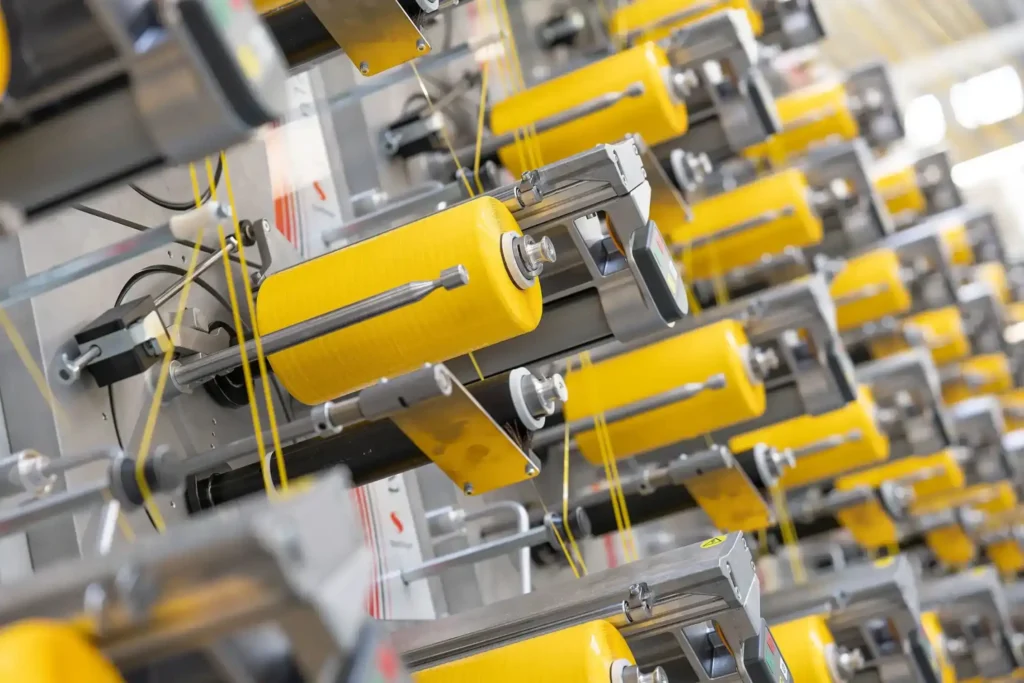
- Tape extrusion and drawing. Extrude a thin sheet, slit into tapes, and draw 5–7× to achieve target denier and tensile curves. Control draw temperature, tension, and cooling to prevent fibrillation or micro‑voiding that could weaken tapes. Reprocess edge trim for circularity.
- Weaving. Run circular or flat looms at specified warp tensions. Monitor PPI, loom humidity, and broken ends to keep fabric consistent. Air permeability and tear behavior are sensitive to PPI and denier uniformity.
- Surface activation. Corona or flame treat surfaces to ≥ 38 dyn/cm—anchoring coatings and inks. Verify dyne retention after storage.
- Coating/lamination. Extrusion‑coat PE‑rich or PP‑rich skins (10–40 µm). Optional BOPP faces are laminated for high‑graphics SKUs. Dose slip/antiblock to hit COF specifications and avoid jaw fouling at seal stations.
- Printing. Flexographic (2–8 colors) or digital print lays down branding, handling icons, and data carriers. Abrasion‑resistant ink systems are selected when distribution is rough.
- Conversion (SOM). Cut to length, fold and sew bottoms. Form gussets if specified. Install liners (loose or attached). Prepare the open mouth for line filling and top‑sew closure or alternative.
- Quality assurance. Test tensile/tear, seam strength, drop resistance, WVTR, COF, and print adhesion. Record SPC on stitch quality and coating weight. Validate pallet patterns with compression tests where relevant.
- Palletization and shipment. Bundle to protect treated faces; stack using patterns that match pallet footprints and truck heights. Stretch wrap or hood for weather and stability. Serialize lots for traceability.
Process Tip
Sewing parameters—stitch density, thread type, and tape‑over width—behave like a sealing window. Document them. Small drifts can turn clean sacks into dusty sacks without changes to the bag body.
Applications of SOM PP Bags
SOM PP Bags are specified across many sectors because they combine rugged handling with flexible closures and clear, durable print areas. The following cards capture representative niches and why the format fits.
Building materials & minerals
Cement, mortar, grout, gypsum, lime, kiln dust. Tape‑over sewing and liners limit dust leakage. Square‑bottom variants increase layer counts and reduce load shift.
Chemicals & industrial powders
Pigments, catalysts, soda ash, zeolites. Antistatic options mitigate ignition risk; serialized codes streamline lot control.
Agriculture & feed
Seeds, fertilisers, mineral supplements, premixes. UV packages support outdoor staging; durable print fields carry instructions and regulatory icons.
Food ingredients (case‑by‑case)
Sugar, starches, specialty flours. Use compliant inks/resins, clean conversion, and liner strategies; validate with migration tests.
Recyclate logistics
Post‑consumer PP/PE pellets, PET flakes, regrind. Woven walls resist puncture; compact geometry builds tidy pallets near wash lines and extruders.
Retail‑adjacent categories
Water‑softener salts, wood pellets, pet litter, landscape aggregates. BOPP faces enable shelf presence while woven bodies supply durability.
For a broader overview of woven polypropylene packaging related to SOM PP Bags, see polypropylene woven packaging.
SOM PP Bags: The Future — Innovation, Branding, and Industry Trends
The future of SOM PP Bags lives at the intersection of three forces: technical innovation that trims mass and widens sealing windows, branding choices that make data and design work harder, and industry trends that reward safer workplaces and credible circularity. Treat the format as a system—materials, closures, graphics, logistics, and end‑of‑life—and the path forward becomes a sequence of practical levers rather than a hazy aspiration.
Innovation
Mono‑PP sealing systems, ultra‑thin functional skins, COF zoning through micro‑textures, hybrid printing with late‑stage variable data, and predictive QC dashboards that log stitch density and jaw temperatures.
Branding
BOPP windowing for product visibility with protected art, color‑coded streams for waste classes, durable symbologies, and recyclability marks that reflect actual builds to avoid greenwashing.
Industry Trends
Tighter dust‑exposure limits, lean labor pools driving automation, and policy signals pushing recycled content and design for recycling—all of which elevate the relevance of SOM PP Bags.
Quoted reminder
“What gets measured gets improved.” Equip sewing heads, seal bars (for liner tacks), and web tensions with basic sensors. Then manage SOM PP Bags as you would a heat‑seal line: by the numbers.
System Thinking — From Sub‑Problems to an Integrated Spec for SOM PP Bags
Break the challenge into smaller problems and solve them with targeted levers. Then synthesize into a repeatable, auditable specification that survives turnover and scale.
Dust control
Sew + tape‑over, liner mouth heat‑tack, increased PPI for reduced permeability, and de‑aeration steps before closure. Track housekeeping time and visible dust index as KPIs.
Moisture governance
Tune coating thickness to WVTR targets; deploy pallet hooding for long dwell; spec liners for hygroscopic goods. Validate under climate profiles.
Pallet stability vs belt flow
Outer COF zoning at contact bands; inner COF kept lower for conveyor glide. Confirm slip angle, acceleration limits, and live stack tests.
Traceability that survives
Treat faces to ≥ 38 dyn/cm; use abrasion‑resistant inks; position codes in protected zones; serialize lots with 2D symbols. Audit scan success rate after abrasion cycles.
Circularity & claims
Choose mono‑PP where infrastructure exists; document regrind/PCR ratios; stamp builds accurately. Track bale purity and claim audit pass rate.
Synthesis: Define a family of SOM PP Bags by product cluster—each with its own GSM/denier/PPI, coating recipe, closure choice, and geometry. Validate on the intended filling lines. Lock pallet patterns and artwork templates. Maintain change control so that performance gains persist across runs.
Technical Tables and Parameters for SOM PP Bags
Closure Options vs Objectives
Illustrative Total‑Cost Comparison (per ton handled)
Values are placeholders. Capture BPM, spillage, pallet density, and claims in your plant to compute the real delta for SOM PP Bags.
Practical Specification Template for SOM PP Bags
- Format: 25 kg SOM PP Bag, tubular, side gussets 2 × 40 mm, finished length 650 mm
- Fabric: 90 g/m² PP woven; 1000D tapes; 11 PPI; corona treatment ≥ 38 dyn/cm
- Coatings: Outer 25 µm PE‑rich with 80 mm anti‑slip band; inner 15 µm
- UV: 0.3% HALS package (6‑month outdoor)
- Printing: 4‑color flexo; hazard icons; serialized 2D code; recyclability mark matching structure
- Closure: Top sewing with tape‑over; inner loose liner mouth heat‑tack (0.4 s dwell)
- Performance: Drop ≥ 6 @ 1.0 m; seam strip ≥ 250 N; outer COF 0.38 ± 0.05; WVTR ≤ 3 g/m²·day
- Palletization: 5 × 8 pattern; stretch hood; corner boards; stack height ≤ 1.6 m
Case Snapshots Featuring SOM PP Bags
- Mineral powders (25 kg): Switching from paper to SOM PP Bags with tape‑over sewing reduced airborne dust at fill, enabled an extra pallet layer, and cut weekly cleanup hours by a third.
- Pet‑care absorbents (20 kg): BOPP‑laminated SOM PP Bags improved shelf presentation; anti‑slip bands stabilized tall pallets in regional distribution.
- Specialty cement (40 kg): Mono‑PP build with disciplined stitch parameters delivered PP‑only recyclability while maintaining rugged handling for export lanes.
- Feed premixes (25 kg): Antistatic package plus loose liner with mouth heat‑tack lowered clumping and ignition risk; serialized 2D codes sped FEFO checks.
FAQ for Engineers, Buyers, and Brand Owners of SOM PP Bags
Are SOM PP Bags always stronger than paper? Typically they outperform paper in puncture and tear at equal mass, and handle moisture better. Paper may offer higher stiffness in some formats, but woven PP wins under rough logistics.
Can SOM PP Bags be fully mono‑material PP? Yes—fabric, seal layer (PP‑based), and print film (BOPP) can stay within PP. Expect a hotter, narrower seal window and stricter SPC than with PE‑rich skins.
How much recycled content is realistic? Post‑industrial regrind is common at controlled percentages with modest impact on tensile. Post‑consumer PCR requires screening for odor/color and validating strength. Start small and iterate.
What about food contact? Use compliant inks/resins, keep conversion clean, and run migration testing as required by jurisdiction. Consider liners for hygiene and barrier.
When should I add anti‑slip bands? When outer COF is too low for target stack height or route vibration. Zone bands only at contact regions to preserve graphics and belt efficiency.
Keyword Strategy and Semantic Coverage for SOM PP Bags
Primary keyword: SOM PP Bags.
Secondary/long‑tail examples: sewn open‑mouth polypropylene bags; sewn OM PP sacks; raffia SOM packaging; heavy‑duty sewn poly woven bags; mono‑PP sewn sacks; moisture‑managed SOM polypropylene bags; tape‑over sewn PP sacks; BOPP laminated SOM PP bags; pallet‑stable SOM woven sacks.
Tip
Use a consistent phrase set across specifications, RFQs, and product pages so that engineering language aligns with how buyers and compliance teams search for SOM PP Bags and related woven polypropylene formats.
- What Are SOM PP Bags?
- Materials and Architecture of SOM PP Bags
- Features and Operating Advantages of SOM PP Bags
- Production Process of SOM PP Bags
- Applications of SOM PP Bags
- SOM PP Bags: The Future — Innovation, Branding, and Industry Trends
- System Thinking — From Sub‑Problems to an Integrated Spec for SOM PP Bags
- Technical Tables and Parameters for SOM PP Bags
- Practical Specification Template for SOM PP Bags
- Case Snapshots Featuring SOM PP Bags
- FAQ for Engineers, Buyers, and Brand Owners of SOM PP Bags
- Keyword Strategy and Semantic Coverage for SOM PP Bags
“What defines the next generation of SOM (Sewn Open Mouth) PP bags?”
Ray, CEO of VidePak, leans forward with conviction: “It’s the fusion of precision engineering, sustainability-driven branding, and logistics optimization. At VidePak, every bag isn’t just stitched—it’s engineered to redefine efficiency in global supply chains.”
This philosophy has propelled VidePak—a global leader with $80M annual revenue and 526 employees—to pioneer SOM PP bags that balance durability, cost efficiency, and environmental responsibility. Founded in 2008, the company leverages 30+ years of expertise, Austrian Starlinger machinery, and ISO-certified processes to deliver solutions tailored to industries ranging from agriculture to construction. This report explores the technological advancements, branding strategies, and logistical innovations shaping the future of SOM PP bags, with actionable insights into how VidePak is leading the charge.
1. Technological Innovation: Automation and Material Science
SOM PP bags have evolved from basic storage solutions to high-performance packaging systems. VidePak’s adoption of advanced technologies ensures its leadership:
A. 200MT Compression Technology
VidePak’s 200MT hydraulic presses compress bags to reduce air pockets, achieving a 30% volume reduction compared to traditional methods. This innovation allows a standard 40-foot container to hold 1,200 additional bags, slashing shipping costs by 18% for clients in bulk industries like fertilizers and construction materials.
B. Palletization and Film Wrapping
- Automated Palletizing: Robotic arms stack bags into uniform pallets (1.2m × 1.0m), optimizing warehouse space by 25%.
- Anti-Static Film Wrapping: Multi-layer polyethylene films with <10¹² Ω/sq surface resistivity prevent static buildup during transit, critical for explosive materials like powdered chemicals.
| Parameter | VidePak Standard | Industry Average |
|---|---|---|
| Compression Efficiency | 30% volume reduction | 15–20% |
| Seam Strength | 80–100 N/cm (ultrasonic) | 60–80 N/cm |
| Moisture Resistance | <1.5 g/m²/24hr (BOPP) | <3.0 g/m²/24hr |
Case Study: A 2024 partnership with a Brazilian soybean exporter utilized VidePak’s compressed SOM bags, reducing shipping costs by $12,000 per container while maintaining zero reported leaks.
2. Branding in a Competitive Market
China’s $45B packaging industry demands differentiation through ESG alignment and customer-centric strategies:
A. Sustainability as a Brand Pillar
- Recyclable PP Blends: 30% post-industrial recycled content (tensile strength >30 MPa) reduces carbon footprint by 15%, validated by ISO 14001 certification.
- Blockchain Transparency: QR codes on bags provide real-time data on material origins and recycling pathways, boosting B2B client retention by 22% in eco-conscious markets.
B. Customization and Certification
- High-Definition Printing: 175 LPI resolution supports Pantone-matched branding, critical for agricultural clients requiring multilingual labels for global exports.
- Global Compliance: FDA, EU REACH, and China GB/T 8947 certifications ensure market access across 45+ countries.
3. Logistics Optimization: From Warehouse to Global Markets
VidePak’s logistics framework integrates automation and climate control to safeguard product integrity:
A. Climate-Controlled Warehousing
- Temperature: Maintained at 20–25°C to prevent PP degradation (ASTM D4329).
- Humidity: <50% RH avoids moisture absorption, preserving tensile strength by 12%.
B. AI-Driven Inventory Management
Machine learning algorithms predict demand spikes (e.g., seasonal fertilizer orders), reducing overstock waste by 20% and ensuring 98% on-time delivery rates.
4. Industry Trends: Digitalization and Circular Economies
The SOM PP bag market is projected to grow at 6.5% CAGR through 2030, driven by:
- Smart Packaging: NFC-enabled bags for real-time tracking of temperature and humidity (2025 pilot).
- Closed-Loop Recycling: Partnerships with waste management firms aim to reclaim 50% of post-consumer PP by 2026.
FAQs: Addressing Critical Concerns
Q1: How does 200MT compression affect bag durability?
A: VidePak’s ultrasonic seams (80–100 N/cm) withstand compression forces, validated by ISO 22434 burst testing.
Q2: Are recycled PP bags cost-effective for SMEs?
A: Yes. Bulk orders (50,000+ units) reduce costs by 20%, with recycled blends priced 12% below virgin PP.
Q3: How does film wrapping prevent moisture damage?
A: Multi-layer PE films achieve <0.5 g/m²/24hr permeability, ideal for hygroscopic materials like rice and pharmaceuticals.
Conclusion: Redefining Packaging Excellence
The future of SOM PP bags hinges on integrating automation, sustainability, and strategic branding. VidePak’s Starlinger-driven precision, ESG-aligned innovation, and logistics mastery position it as a leader in China’s packaging revolution. As Ray asserts: “In an era demanding circular economies, our bags don’t just carry goods—they carry the blueprint for a smarter, greener future.”
For industries seeking certified, high-performance solutions or automated packaging systems, VidePak remains the benchmark.
Note: All data reflects 2025 industry benchmarks and VidePak’s internal testing protocols.