
What Are Poly‑paper Bags in the Food Industry: A Reliable Packaging Solution for Food Ingredients and Products?
Poly‑paper Bags in the Food Industry: A Reliable Packaging Solution for Food Ingredients and Products are composite sacks that bond high‑tenacity woven polypropylene (PP) fabric to a food‑grade kraft paper outer—creating a single, strong, printable package for 5–50 kg ingredients. In day‑to‑day use you’ll also hear Poly‑paper Bags in the Food Industry: A Reliable Packaging Solution for Food Ingredients and Products called paper‑poly composite bags, kraft‑paper laminated woven sacks, pinch‑bottom open‑mouth (PBOM) bags, pasted‑valve (AD‑style) bags, or sewn open‑mouth (SOM) paper‑woven bags. Different nicknames, same backbone: a woven PP core delivers tensile strength; a kraft outer face provides a natural, low‑gloss canvas for crisp, food‑safe graphics; and a thin PP extrusion layer (or tie‑adhesive) fuses the structure so it behaves as one on high‑tempo filling lines. In short—the bag looks like premium paper, performs like durable woven, and protects like barrier packaging.
From a food‑safety and operations lens, Poly‑paper Bags in the Food Industry: A Reliable Packaging Solution for Food Ingredients and Products live where materials science meets HACCP thinking. The woven grid resists tears and drops, the paper face communicates clearly at a distance, and the bond line seals fines and moisture so quality arrives intact—whether you’re moving flour, sugar, rice, dairy powders, spices, or functional blends.
What Are the Features of Poly‑paper Bags in the Food Industry: A Reliable Packaging Solution for Food Ingredients and Products?
Food‑safe by design. Contact layers and adhesives are specified to align with widely recognized food‑contact frameworks (e.g., selections capable of meeting 21 CFR 177.1520 and EU 10/2011 when applicable), while inks remain non‑contact on the paper exterior or protected under a film window. Traceable lot IDs make audits swift.
Strength without excess weight. Drawn PP tapes (commonly 700D–1200D) are woven into a high‑tenacity substrate at efficient GSM (≈60–110 g/m²). The result is dependable drop and tear performance without over‑packaging—mass where it matters, efficiency where it counts.
Moisture and sift control. A PP extrusion coat (~18–30 g/m²) closes fabric interstices to reduce fines egress; optional PE/PP liners (≈30–90 µm) manage shelf‑life for hygroscopic salts, dairy proteins, or oil‑bearing mixes. Pinch‑bottom seams create needle‑hole‑free closures for powders that love to escape.
Print that sells and guides. Water‑based flexography on kraft yields bold nutrition anchors, allergen icons, and GS1‑standard barcodes. If photo‑grade branding is vital, a selective BOPP window (15–25 µm, reverse‑printed) can be laminated to a panel—keeping the overall “paper look” while delivering high‑impact shelf presence.
Stacking discipline built in. Block‑bottom geometry lowers the center of gravity; anti‑slip lacquer bands target a static COF ≥ 0.4; low‑creep woven cores keep pallets square through long routes and temperature swings. A quiet truck and a clean dock are design outcomes, not lucky breaks.
Clean handling, clean floors. Valve options pair with screw/air packers for fast fills and low dust; open‑mouth versions with EZ‑open tapes suit mixed manual/automated sites. Clearly printed date/lot windows stay legible under LED glare and flour dust alike.
Horizontally, these attributes braid polymer physics × food‑safety systems × warehouse ergonomics. Vertically, they cascade resin → tape → fabric → lamination → seam architecture → pallet behavior → retail performance—exactly where Poly‑paper Bags in the Food Industry: A Reliable Packaging Solution for Food Ingredients and Products excel.
What Is the Production Process of Poly‑paper Bags in the Food Industry: A Reliable Packaging Solution for Food Ingredients and Products?
1) Raw‑material qualification. Virgin PP pellets (stable MFI ≈ 2–4 g/10 min at 230 °C/2.16 kg) and sack‑kraft papers (70–120 g/m²) arrive with COAs and are batch‑tested for purity, moisture, and hue/ΔE. Films, inks, and adhesives are screened for food‑contact suitability where relevant.
2) Tape extrusion & drawing. PP is extruded as a thin film, slit to tapes, and drawn ≈ 5–7× to align molecular chains. Narrow denier variation yields even fabric GSM and predictable seam bite.
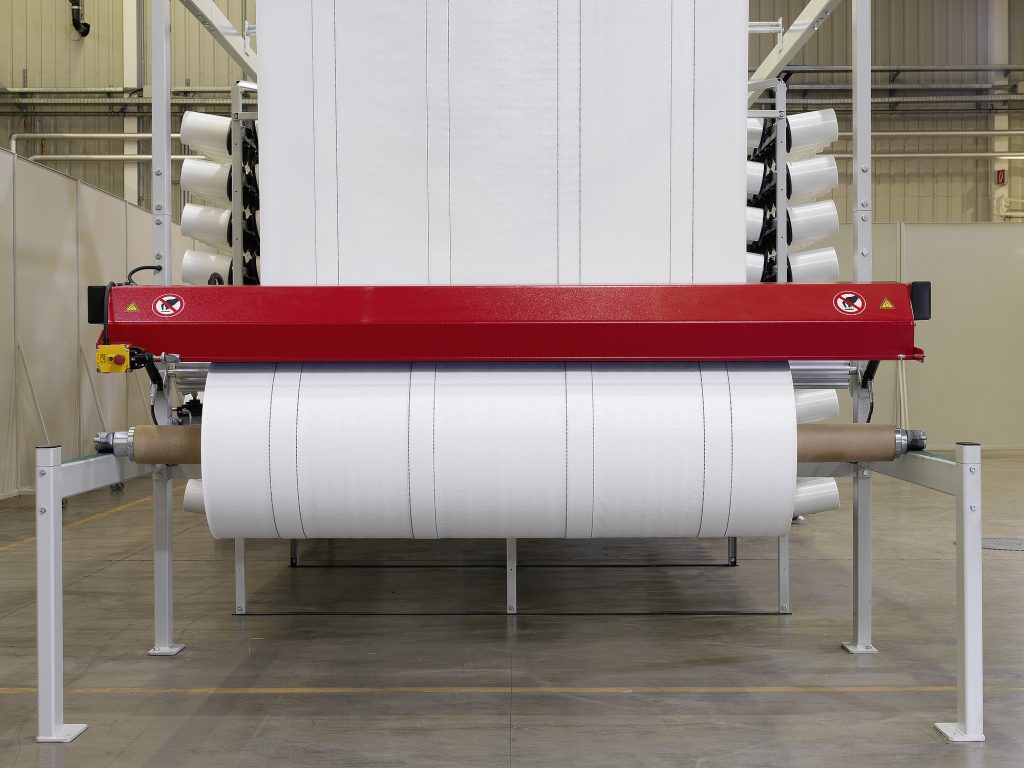
3) Weaving the substrate. Circular or flat looms interlace tapes at ≈ 10×10–12×12 picks per inch for 10–50 kg formats; heavy‑duty builds tighten toward ≈ 12×12–14×14. Flatness and clean selvedges matter—they govern bond uniformity and final squareness.
4) Lamination (the bond line). PP extrusion lamination (~18–30 g/m²) couples the woven cloth to kraft paper. Bond strength is validated via peel and cross‑hatch tests to avoid orange‑peel, tunneling, or micro‑blisters. Selective lamination leaves breathing zones where needed.
5) Printing (the signal system). Water‑based flexography on kraft provides high‑contrast panels for ingredients, allergens, handling icons, and large 1D/2D codes. Optional reverse‑printed BOPP windows (15–25 µm) add photo‑grade imagery without surrendering a paper‑first aesthetic.
6) Conversion & closures.
- PBOM (Pinch‑Bottom Open‑Mouth): heat‑activated adhesive creates a sift‑proof, tamper‑evident seal.
- Pasted Valve (AD‑style): fast, dust‑controlled dosing; flap pastes closed automatically.
- SOM (Sewn Open‑Mouth): rugged chain stitching (optionally with filler cord) for industrial lanes.
7) QA & release. Grammage audits by roll; raveled‑strip tensile and seam/valve integrity by lot; Cobb60 on kraft faces (typ. 30–50 g/m², lower with barrier sizing); COF before/after anti‑slip; drop tests (~0.8–1.2 m multi‑cycle); barcode legibility under dust and LED glare. Only tight inputs yield calm pallets.
What Is the Application of Poly‑paper Bags in the Food Industry: A Reliable Packaging Solution for Food Ingredients and Products?
Dry staples & milled grains. Flour (bread, pastry), semolina, rice, pulses, and cornmeal benefit from sift‑proof PBOM builds and bold, scannable panels for fast receiving.
Sugars & salts. Refined sugar, brown sugar, dextrose, and fine salt need moisture logic; liners and tighter weaves keep clumping and caking at bay, while paper faces stay clean for retail.
Dairy, nutrition & proteins. WPC/WPI, caseinates, collagen, plant proteins: choose liner‑through‑valve builds to protect functionality and manage residual oils.
Bakery, blends & mixes. Pancake/waffle mixes, cake premixes, batter bases—pinch‑bottom closures keep powders inside; selective film windows earn shelf attention.
Spices & specialty ingredients. Fine spices and seasonings love to sift; needle‑hole‑free closures and anti‑sifter layers protect both aroma and housekeeping.
Across these lanes, the horizontal logic ties HACCP plans, labeling compliance, and operations; the vertical logic links spec → filler settings → pallet map → route outcomes—how Poly‑paper Bags in the Food Industry: A Reliable Packaging Solution for Food Ingredients and Products convert line speed into shelf certainty.
VidePak at a Glance — Capacity Behind Poly‑paper Bags in the Food Industry: A Reliable Packaging Solution for Food Ingredients and Products
Founded in 2008, VidePak is driven by a core team with 30+ years in woven packaging. Our 568 colleagues operate equipment from industry leaders—Germany’s W&H presses/laminators and Austria’s Starlinger weaving/converting lines—across more than 100 circular looms, 16 extrusion lines, and 30+ lamination and printing machines. We manufacture exclusively with virgin raw materials, support customization and multi‑color artwork, and ship globally: the United States, Europe, Brazil, South America, Southeast Asia, Japan, South Korea, Central Asia, the MENA Region, East Africa, and South Africa. Annual sales are about USD 80 million. Scale + discipline = Poly‑paper Bags in the Food Industry: A Reliable Packaging Solution for Food Ingredients and Products delivered on spec, on schedule.
Technical Parameters — Poly‑paper Bags in the Food Industry: A Reliable Packaging Solution for Food Ingredients and Products
The bands below reflect realistic, orderable specs commonly published for food‑grade paper‑poly composite sacks. Treat them as a starting brief; we tune every project to product rheology, climate, and handling method.
| Parameter | Typical Options / Ranges for Poly‑paper Bags in the Food Industry: A Reliable Packaging Solution for Food Ingredients and Products |
|---|---|
| Nominal Capacity | 5 kg, 10 kg, 15 kg, 20 kg, 25 kg, 40 kg, 50 kg |
| Common Bag Size (L × W × Bottom/Gusset) | 45×30×10 cm (10 kg); 50×32×12 cm (20 kg); 55×35×12 cm (25 kg); 60×40×14 cm (40 kg) |
| Woven Fabric GSM (uncoated) | ≈ 60–110 g/m² (heavier toward 50 kg or abrasive contents) |
| Weave Density | ≈ 10×10 to 12×12 picks per inch (up to ≈ 14×14 heavy‑duty) |
| Outer Kraft Grade | Sack kraft 70–120 g/m² (natural or bleached) |
| Cobb60 (kraft face) | ≈ 30–50 g/m² (barrier‑sized options can target < 25 g/m²) |
| Bond / Lamination | PP extrusion ≈ 18–30 g/m²; selective or full‑coverage coupling |
| Printing | Water‑based flexography up to 6 colors on kraft; optional BOPP window 15–25 µm (gravure) |
| Closure Types | PBOM (pinch‑bottom), pasted valve (AD‑style), SOM (sewn open‑mouth) |
| Liner Options | PE/PP 30–90 µm; inserted or liner‑through‑valve |
| Anti‑Slip (COF) | Target static COF ≥ 0.4 via patterned lacquer bands |
| Venting | Localized micro‑perfs where required; avoid seal paths |
| Drop Test (guide) | Typical pass 0.8–1.2 m, multi‑cycle (specify by SKU/lane) |
| UV Stabilization | Optional packages for outdoor staging |
Figures are indicative, not idealized; they mirror what buyers of Poly‑paper Bags in the Food Industry: A Reliable Packaging Solution for Food Ingredients and Products routinely order for flour, sugar, dairy proteins, blends, and specialty ingredients.
Engineering & Compliance Notes for Poly‑paper Bags in the Food Industry: A Reliable Packaging Solution for Food Ingredients and Products
- Reserve matte quiet zones around barcodes/QR to protect scan rates in dusty light.
- Place allergen and nutrition anchors high on the principal display panel; duplicate lot/batch on a side gusset for redundancy.
- For fine powders, prefer PBOM to eliminate needle holes; for fast lines, specify pasted‑valve with dust flaps and liner‑through‑valve.
- Align documentation to recognized food‑contact declarations when required; keep inks strictly non‑contact.
How to Specify Poly‑paper Bags in the Food Industry: A Reliable Packaging Solution for Food Ingredients and Products for Your Line
Start with four practical questions. What’s the product’s bulk density and particle size? How moisture‑ or oil‑sensitive is it over storage time? What’s the harshest handling event—fast valve fill, tall stack, long export? What must the label survive—dust, rain, LED glare? With those answers, VidePak will set GSM, weave, kraft grade, bond line, closure style, liner gauge, and anti‑slip plan—then validate with a short line trial. When the line runs calm and pallets ride quiet, lock the spec. That’s Poly‑paper Bags in the Food Industry: A Reliable Packaging Solution for Food Ingredients and Products done right.
- What Are Poly‑paper Bags in the Food Industry: A Reliable Packaging Solution for Food Ingredients and Products?
- What Are the Features of Poly‑paper Bags in the Food Industry: A Reliable Packaging Solution for Food Ingredients and Products?
- What Is the Production Process of Poly‑paper Bags in the Food Industry: A Reliable Packaging Solution for Food Ingredients and Products?
- What Is the Application of Poly‑paper Bags in the Food Industry: A Reliable Packaging Solution for Food Ingredients and Products?
- VidePak at a Glance — Capacity Behind Poly‑paper Bags in the Food Industry: A Reliable Packaging Solution for Food Ingredients and Products
- Technical Parameters — Poly‑paper Bags in the Food Industry: A Reliable Packaging Solution for Food Ingredients and Products
- Engineering & Compliance Notes for Poly‑paper Bags in the Food Industry: A Reliable Packaging Solution for Food Ingredients and Products
- How to Specify Poly‑paper Bags in the Food Industry: A Reliable Packaging Solution for Food Ingredients and Products for Your Line
Poly-paper bags are a cornerstone of modern food packaging, combining the durability of woven polypropylene (PP) or polyethylene (PE) with the smooth, printable surface of paper. This hybrid design offers unmatched strength, moisture resistance, and branding potential, making it a dependable choice for food ingredients and products. This report delves into the essential features of poly-paper bags, their quality standards, and VidePak’s innovative production practices.
Why Poly-paper Bags Excel in Food Packaging
Poly-paper bags are uniquely engineered to meet the rigorous demands of the food industry, where safety, durability, and branding are critical.
Durability and Burst Resistance
Poly-paper bags excel in strength due to their construction from virgin PP and PE pellets, which ensure uniform quality and robust mechanical properties. The use of these premium materials eliminates weaknesses that could lead to bursting under heavy loads. Coupled with Starlinger’s advanced equipment, VidePak achieves consistent thickness and strong seams, providing unmatched reliability in handling and storage.
Customization and Branding
VidePak employs state-of-the-art printing technology to ensure long-lasting, vibrant designs resistant to fading. The UV-resistant printing process not only enhances branding visibility but also maintains legibility in harsh conditions, such as prolonged exposure to sunlight or moisture. This is particularly valuable for regulatory labeling on food products like flour, sugar, and grains.
Moisture Protection
The optional lamination and inner liners provide an additional barrier against moisture, which is critical for maintaining the quality of sensitive food products. This feature ensures freshness and extends shelf life, making the bags suitable for applications like processed ingredients and powdered food additives.
Quality Control and Standardization at VidePak
VidePak’s commitment to quality is evident in its meticulous production processes and adherence to global standards. The use of Starlinger machinery, a benchmark for precision and reliability, ensures consistent product output. Below are the critical aspects of quality control that set VidePak apart:
| Parameter | Specification |
|---|---|
| Material Type | Virgin PP/PE |
| Thickness | 80–120 microns |
| Load Capacity | Up to 50 kg |
| Printing Durability | UV-resistant, non-fading |
| Lamination Options | Waterproof and moisture-proof |
Rigorous Standards
VidePak implements positive tolerance standards, ensuring that bags meet or exceed the required thickness and weight for each application. This reduces the risk of failure during transportation or storage, providing confidence in the product’s reliability.
Advanced Manufacturing
Starlinger’s machinery enables precise control over weaving, lamination, and printing processes. This results in uniform bags with smooth surfaces, strong seams, and excellent load-bearing capacity. These qualities are essential for food packaging where structural integrity cannot be compromised.
Applications in the Food Industry
Poly-paper bags cater to diverse food products, each with specific packaging needs.
For Dry Ingredients:
Products like flour and sugar demand strong, moisture-resistant bags. Poly-paper bags’ lamination ensures these ingredients remain dry, even in humid conditions.
For Spices and Additives:
The high-definition printing capability allows clear labeling of ingredients and compliance with regulatory requirements. The laminated surface resists scuffing during transportation.
For Bulk Processed Products:
Inner liners add an extra layer of protection against contamination, ensuring the safety and freshness of bulk food products.
Features Tailored to Food Packaging
Poly-paper bags offer a wide range of customizable features:
- Thickness: Adjustable based on the weight and type of the product.
- Inner Liners: Essential for moisture-sensitive or powdered products.
- Durability: High tensile strength for heavy loads.
- Printing: Vibrant, non-fading designs for branding and compliance.
Sustainability: VidePak’s Commitment to the Environment
Sustainability is a cornerstone of VidePak’s operations, aligning with global Environmental, Social, and Governance (ESG) standards. The company’s efforts to minimize environmental impact are reflected in its manufacturing practices.
Solar-powered Operations
VidePak operates a 2MW rooftop solar energy system, reducing carbon emissions and ensuring that production processes rely on renewable energy sources.
Recyclable and Eco-friendly Materials
Poly-paper bags are made from fully recyclable materials, contributing to a circular economy. VidePak continuously explores new biodegradable alternatives to further enhance its environmental impact.
Social Responsibility
Beyond production, VidePak actively supports workers and their families in underprivileged areas, funding education and improving living conditions. These initiatives align with ESG principles, ensuring the company remains socially responsible while meeting global market demands.
Discover more about VidePak’s ESG initiatives.
Innovations in the Industry
VidePak stays ahead of industry trends, ensuring its products meet the evolving demands of the food industry.
Biodegradable Materials
Research into biodegradable polymers aims to reduce long-term environmental impact, paving the way for greener packaging solutions.
Enhanced Traceability
Advanced digital printing enables QR codes and traceability features, ensuring compliance with food safety regulations and providing valuable information to consumers.
Global Recycling Systems
VidePak is exploring partnerships to establish robust recycling systems, ensuring that poly-paper bags are recovered and reused effectively.
Learn about innovative materials in food packaging.
FAQs About Poly-paper Bags
Q: How are poly-paper bags different from traditional woven bags?
Poly-paper bags combine the durability of woven material with the smooth finish of paper, providing both strength and excellent printability.
Q: Are they suitable for food packaging?
Yes, poly-paper bags meet international food safety standards, making them ideal for products like flour, sugar, and additives.
Q: What ensures their durability?
The use of virgin PP and PE materials, coupled with precise manufacturing techniques, ensures high tensile strength and resistance to bursting.
Q: Are these bags eco-friendly?
Absolutely. Poly-paper bags are fully recyclable, and VidePak is actively researching biodegradable alternatives.
Conclusion
Poly-paper bags are an essential solution for food packaging, combining durability, customizability, and sustainability. VidePak’s commitment to quality and innovation ensures these bags meet the highest standards for safety and performance. By leveraging cutting-edge technology and sustainable practices, VidePak continues to deliver reliable packaging solutions while reducing its environmental footprint.