
This page is set with a light‑orange background for easy reading. Sub‑sections use bright‑orange ribbon badges for visual scanning. All keywords are highlighted in bold using HTML markup for clarity.
Keywords: Heavy Duty Woven Bags, PP Woven Bags, Laminated BOPP Woven Bags, Valve Bags, FIBC Jumbo Bags, Bulk Bags, Jumbo Bags, Ton Woven Bags. Related long‑tails used throughout: heavy‑duty polypropylene woven sacks, industrial woven poly bags, BOPP printed woven packaging, valve‑type woven sacks, block‑bottom woven sacks, gusseted woven polypropylene bags.
What are Heavy‑Duty Woven Bags?
At their core, Heavy Duty Woven Bags are engineered containers constructed from interlaced polypropylene tapes. These oriented tapes create a fabric that is unusually strong for its weight, then the fabric is converted—coated, laminated, printed, cut, and finished—into an industrial sack capable of surviving long routes, rough handling, and humid depots. The platform is adaptable: it can be breathable or nearly hermetic; plain or photo‑real printed; sewn, heat‑sealed, or valved. That modularity explains why you encounter them from rice mills and fertilizer plants to pigment factories and construction sites.
Because markets are diverse, the same platform travels under several labels. The aliases differ in finishing nuances, not in underlying physics. Common names include:
- Heavy Duty PP Woven Bags
- Industrial Woven Poly Bags
- Heavy‑Duty Woven Sacks
- BOPP Printed Woven Sacks
- Laminated BOPP Woven Bags
- PP Woven Bags
- Valve Bags (powder‑filling woven valve sacks)
- FIBC Jumbo Bags / Bulk Bags / Jumbo Bags / Ton Woven Bags (large‑format lifting within the heavy‑duty family)
Reader note: Throughout this article, when we say PP Woven Bags we refer to the base fabric platform; surface treatments (lamination/coating), print layers, and closures define the specific subtype such as Laminated BOPP Woven Bags or valve‑type Heavy Duty Woven Bags.
Materials: what goes into Heavy‑Duty Woven Bags and why it matters
Materials dictate performance. A woven sack is more than fabric: it is a stack of layers, interfaces, and finishes, each chosen for a measurable reason. Below is a map from resin pellets to readable graphics.
Oriented PP tapes (backbone)
Drawn polypropylene tapes carry the load. By aligning chains through drawing, tensile modulus and tear strength rise sharply while mass remains low. This is the mechanical heart of PP Woven Bags.
Coatings/Laminates (control surface & barrier)
Extrusion coatings seal porosity; laminates such as BOPP create a printable, scuff‑resistant face. When artwork must sing and sacks must shrug off abrasion, Laminated BOPP Woven Bags are the usual answer.
Inner liners and films
LDPE/LLDPE/HDPE liners add heat‑sealability and cleanliness. Anti‑static grades mitigate nuisance shocks and dust attraction around filler lines, especially for fertilizers and pigments.
Additives refine behavior: UV stabilizers for yard storage; slip/anti‑block packages to tune pallet friction; color masterbatches for opacity and brand fidelity; anti‑static agents for combustible dust environments. Adhesive chemistry bridges dissimilar layers: solvent‑free PU systems cut VOCs while maintaining strong peel values; extrusion‑tie layers minimize chemistry for mono‑material narratives. The bill of materials is a cost‑risk equation: choose the lightest stack that prevents the most expensive failures—moisture caking, scuff damage, ink smears, seam leaks, and corner crush.
Feature set: what Heavy‑Duty Woven Bags uniquely deliver
Strength without bulk; clarity without fragility; printability without peeling—these are the everyday paradoxes a good industrial sack resolves. Heavy Duty Woven Bags resolve them consistently by combining high specific strength with configurable porosity and surface chemistry. The result is fewer tears on forklifts, cleaner pallets under vibration, and better legibility after a thousand miles of rub.
- High tensile and tear strength at low mass for efficient freight.
- Abrasion and puncture resistance from interlaced tapes and optional varnishes.
- Moisture management via coatings and liners for hygroscopic goods.
- Retail‑grade print fidelity with Laminated BOPP Woven Bags.
- Machinability on fast fillers, especially with reinforced mouths and stable gussets.
- Versatile closures: pinch‑top heat seal, sewn with crepe tape, or true Valve Bags.
- Compatibility with regulatory and food‑contact pathways when specified.
Where strength matters
Cement, dry‑mix mortars, fertilizers, mineral powders—payloads that punish weak seams and thin fabrics.
Where print matters
Rice, sugar, and feed brands using Laminated BOPP Woven Bags for bright graphics that resist shelf rub.
Where safety matters
Anti‑static liners and managed COF for combustible dusts and fast automated handling.
Production: from pellets to pallets, step by step
Design promises performance; process proves it. The following flow explains how controlled complexity turns resin into reliable packaging. VidePak’s core equipment choices—Starlinger (Austria) for extrusion/looming/coating and W&H (Germany) for printing—exist to compress variability and raise first‑pass yield.
- Pre‑stage selection and verification — 100% virgin PP for predictable drawing; qualified BOPP films and PE liners; compliant ink and adhesive systems; incoming checks on MFI, film thickness, dyne levels, and adhesive specs; lot traceability from roll to pallet.
- Tape extrusion and drawing — melt, cast, slit, draw. Laser micrometers regulate gauge; temperature profiles maintain even orientation; draw ratio sets tensile/toughness balance.
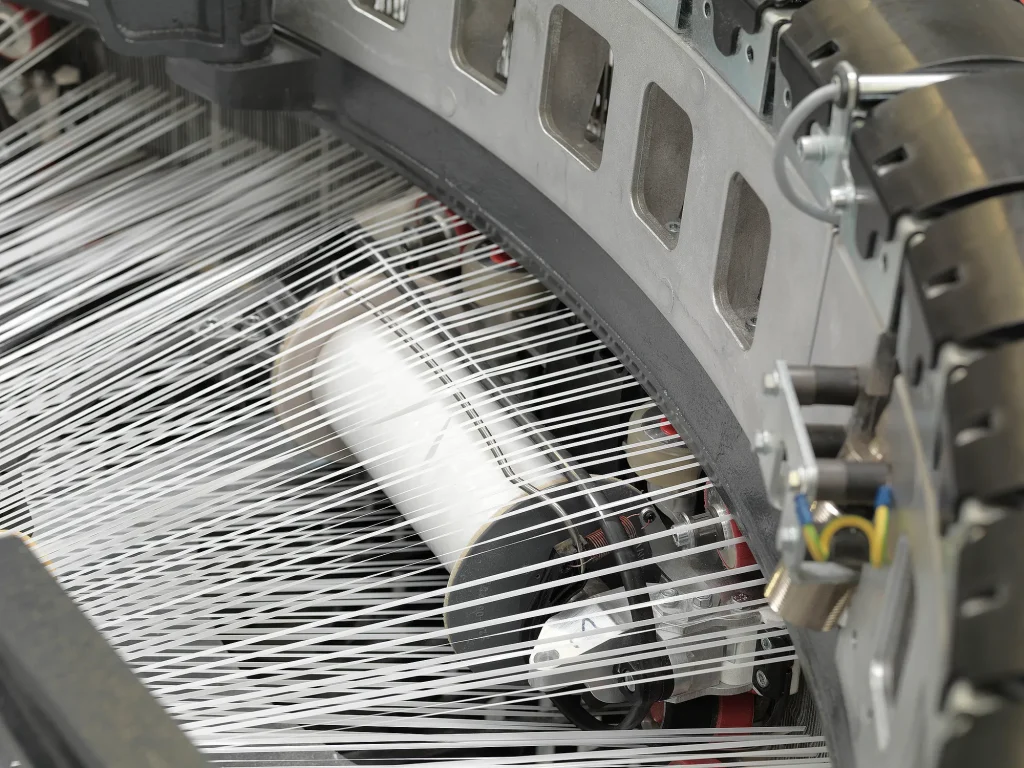
- Weaving — circular or flat looms build tubular or sheet fabrics; picks per cm and GSM determine strength and creep; woven‑in textures add grip for pallet stability.
- Coating/lamination — extrusion coatings seal pinholes; laminates like BOPP supply print‑ready surfaces. Nip pressure, web tension, and coat‑weight are logged and SPC‑monitored to maintain bond uniformity and low curl.
- Printing — CI flexo or gravure applies high‑definition artwork. Corona treatment improves anchorage; viscosity and dryer balance sustain ΔE targets; OPV protects against rub.
- Conversion and finishing — slitting, gusseting, and mouth formation. Valve Bags receive internal sleeves or valve boards; de‑aeration micro‑channels or one‑way valves speed powder settling; liners are inserted or tube‑lined; options include easy‑open tear strings.
- Conditioning and packing — humidity equilibration, edge protection, bales/cartons; pallet patterns and wrap parameters tuned to reduce corner crush.
- Back‑end QA and lot release — lamination peel, tensile/tear, seal/leak tests (where applicable), dimensional audits, WVTR/porosity spot checks, and drop/compression simulations; retains archived for traceability.
Equipment pedigree note: Stable tape gauge, clean lamination bonds, and tight color register are not luxuries—they are risk controls. That is why premium systems from Austria’s Starlinger and Germany’s W&H show up repeatedly in successful Heavy Duty Woven Bags programs.
Applications: where Heavy‑Duty Woven Bags outperform
From commodity bulk to premium retail formats, the same core fabric solves different problems with different finishes. The selector below connects use‑cases to structures that have repeatedly worked in the field.
Printing methods and trade‑offs for industrial sacks
Printing is not aesthetics alone; it is compliance, safety, and shelf presence under abrasion, humidity, and UV. The matrix below compares the main processes used on PP Woven Bags and Laminated BOPP Woven Bags.
Related resource: For a structured checklist covering dimensions, materials, closures, and tests relevant to Heavy Duty Woven Bags, see the industrial packaging bags specification guide.
Systems thinking: break the problem down, recombine the answer
Choosing between breathable sacks and laminated showpieces, between sewn seams and pinch‑top seals, between liners and valve sleeves is confusing until you decompose the decision into tractable sub‑problems. Then it becomes arithmetic with guardrails.
- Barrier vs. breathability — hygroscopic powders demand coatings/liners; off‑gassing blends need venting or valve paths.
- Route hazards — define drops, compression, scuff zones; set GSM, gusset geometry, and OPV accordingly.
- Throughput and hygiene — filler type, target BPM, dust limits determine whether Valve Bags are mandatory.
- Branding and compliance — artwork complexity and regulation density often push to Laminated BOPP Woven Bags.
- Sustainability — favor polyolefin‑dominant stacks and realistic take‑back or reuse plans; prevent product waste first.
Recombination rule: Start from a base PP Woven Bags spec sized to route hazards. Add lamination and liners only when ROI is demonstrated; reserve FIBC Jumbo Bags and other large‑format Bulk Bags where lifting dictates the format.
Engineering details that decide outcomes
Seemingly small details—gusset angles, surface energy, COF windows—govern big outcomes like pallet stability and scuff marks. The table below condenses field lessons that prevent expensive surprises.
Economics: model total cost, not unit price
A robust sack is cheaper than a cheap sack that fails. The true ledger includes quality losses avoided (caking, moisture pickup), logistics damage avoided (tears, corner crush), and operational gains (faster, cleaner filling). If those gains exceed the cost of lamination, liners, or valve hardware, the premium for Heavy Duty Woven Bags is self‑funded.
Troubleshooting: symptom → likely cause → fix
When something goes wrong, speak in mechanisms, not blame. The grid below translates common symptoms into causes and field‑ready remedies.
Quality governance: how VidePak locks in repeatability
A dependable bag is an outcome, not an accident. VidePak anchors quality on four pillars: standards‑based manufacturing and testing; all‑new raw materials from tier‑one suppliers; best‑in‑class equipment (Starlinger and W&H); and layered inspection gates from incoming resin to retain libraries. That stack builds the operating confidence customers expect when they buy Heavy Duty Woven Bags by the pallet, container, or year.
- Standards‑anchored practice — processes aligned with mainstream norms for tensile/tear, peel, COF, and seal strength as applicable.
- New‑material discipline — virgin PP/PE resins, qualified BOPP films, compliant inks and adhesives.
- Equipment pedigree — Starlinger extrusion/looms/coating; W&H printing for register and color stability.
- Layered inspection — incoming → in‑process → finished goods → retains with traceability and CAPA.
Mini‑dossiers: patterns seen across sectors
Real projects rhyme. Below are short dossiers showing how the platform adapts by dialing structure and finish rather than changing the fabric DNA.
- Cement in monsoon depots — coated Valve Bags maintain flowability; micro‑vent paths curb dust plumes; wrap patterns stabilize columns.
- Rice and sugar brands — Laminated BOPP Woven Bags bring photographic graphics and durable labels; soft‑touch matte reduces glare on retail floors.
- Pigments and carbon black — pinch‑top closures and heavy liners reduce dusting and pallet staining; high‑abrasion OPV fights rub.
Implementation checklist: a cross‑functional playbook
- Define hazard profile (moisture, oxygen, UV, puncture, compression).
- Fix route assumptions (drop heights, pallet type, climate).
- Map filler constraints (valve vs. open mouth, de‑aeration, BPM targets).
- Choose base fabric GSM and weave density; set seam method.
- Decide on lamination/liner and print process; lock color books and ΔE targets.
- Set COF windows and gusset angles for pallet plans.
- Validate with pilots: instrumented drops, compression, seal studies.
- Codify QA gates and retain policy; define corrective action speed.
- Standardize valves, liners, and boards across SKUs to reduce MOQ exposure.
- Plan end‑of‑life (mono‑material bias, realistic recycling/reuse).
October 30, 2025
- What are Heavy‑Duty Woven Bags?
- Materials: what goes into Heavy‑Duty Woven Bags and why it matters
- Feature set: what Heavy‑Duty Woven Bags uniquely deliver
- Production: from pellets to pallets, step by step
- Applications: where Heavy‑Duty Woven Bags outperform
- Printing methods and trade‑offs for industrial sacks
- Systems thinking: break the problem down, recombine the answer
- Engineering details that decide outcomes
- Economics: model total cost, not unit price
- Troubleshooting: symptom → likely cause → fix
- Quality governance: how VidePak locks in repeatability
- Mini‑dossiers: patterns seen across sectors
- Implementation checklist: a cross‑functional playbook
- 1. Engineering Excellence: Why Heavy-Duty Woven Bags Outperform
- 2. Advanced Printing Technologies: Branding Meets Durability
- 3. Optimized Packaging & Logistics: Maximizing Efficiency
- 4. Industry-Specific Applications
- 5. FAQs: Addressing Key Procurement Concerns
- 6. The Future of Heavy-Duty Packaging
- References
Imagine this conversation between a logistics manager and a VidePak solutions engineer:
Manager: “We need bags that can handle 50 kg cement loads in monsoon conditions. What’s your strongest option?”
VidePak Engineer: “Our heavy-duty PP woven bags deliver 45 N/cm² tensile strength, UV-resistant BOPP lamination, and 8-color Pantone-matched branding. With 200-ton hydraulic balers, we pack 28% more units per container than traditional methods—saving you $1,200 per海运 (sea shipment).”
*Manager:* “How do they survive rough handling?”
VidePak Engineer: “Reinforced block-bottom seams withstand 500+ MIT folds, and our palletized stretch-wrapping reduces transit damage by 60%. A Nigerian construction firm cut insurance claims by 45% using our system.”
1. Engineering Excellence: Why Heavy-Duty Woven Bags Outperform
Heavy-duty polypropylene (PP) woven bags are engineered for extreme conditions, combining structural integrity with adaptability. Key advantages include:
- Load Capacity: With a tensile strength of 35–45 N/cm² (ASTM D882), VidePak’s bags safely carry up to 2,000 lbs, outperforming standard PE bags by 300%.
- Climate Resistance: BOPP lamination reduces moisture absorption to <0.5% (vs. 5% in uncoated PP), critical for agricultural exports to humid regions like Southeast Asia.
- Customization: Laser-cut valves, ergonomic handles, and micro-perforations (0.5–2 mm) enable precise airflow control for perishables like coffee beans.
| Parameter | VidePak Bags | Standard PE Bags |
|---|---|---|
| Max Load Capacity | 2,000 lbs | 500 lbs |
| Moisture Resistance | <0.5% (BOPP laminated) | 5–8% |
| UV Stability | 98% reflectance after 1,000 hrs QUV | 40% reflectance |
| Recyclability | 100% PP (Resin ID #5) | Mixed materials (non-recyclable) |
2. Advanced Printing Technologies: Branding Meets Durability
VidePak’s printing solutions balance aesthetics and resilience:
- Gravure Printing: 12-color rotary presses achieve ΔE<1.5 color accuracy, ensuring Pantone 873C metallic inks retain 95% vibrancy after 12 months outdoors.
- Lamination Techniques: Starlinger’s 50 μm BOPP films block 99.9% UV rays while allowing high-resolution CMYK+Pantone designs—a Thai coffee brand saw 32% sales growth using this system.
- Anti-Counterfeit Features: QR codes and holographic foils deter piracy, as implemented for a German pharmaceutical client.
3. Optimized Packaging & Logistics: Maximizing Efficiency
VidePak’s end-to-end solutions streamline supply chains:
- 200-Ton Hydraulic Balers: Compress bags into 1.2 m³ bales, enabling 28% higher container utilization (e.g., 12,000 vs. 9,400 bags/40ft container).
- Robotic Palletizing: Automated systems stack 1.5 tons/hour with <0.1% alignment errors, paired with stretch-wrap films that withstand 85 km/h winds.
- Sustainable Practices: Closed-loop recycling reclaims 92% of PP waste, aligning with EU Circular Economy targets.
4. Industry-Specific Applications
From agriculture to construction, heavy-duty bags solve critical challenges:
- Agriculture: Moisture-proof liners reduce grain spoilage from 15% to 3% in Indian monsoons.
- Chemicals: Anti-static coatings (10⁶–10⁸ Ω resistance) prevent explosions in fertilizer storage, complying with ATEX directives.
- Construction: Valve designs enable dust-free cement filling, improving worksite air quality by 40%.
5. FAQs: Addressing Key Procurement Concerns
Q1: What’s the minimum order quantity (MOQ)?
A: MOQ starts at 5,000 units, with prototypes delivered in 7 days.
Q2: How do you ensure color consistency across batches?
A: X-Rite spectrophotometers calibrate inks to ΔE<1.5 variance, backed by ISO 2846-1 certification.
Q3: Are bags compliant with food safety regulations?
A: Yes. FDA 21 CFR 177.1520 and EU 10/2011 certifications guarantee safety for direct-food contact.
6. The Future of Heavy-Duty Packaging
VidePak’s R&D focuses on:
- Smart Sensors: NFC tags monitor real-time temperature/humidity, piloted with a Dutch organic food supplier.
- Bio-Hybrid PP: 30% sugarcane-based blends degrading in 120 days under industrial composting.
References
- Global Packaging Trends Report (2025). Innovations in Heavy-Duty Woven Bags.
- VidePak Technical Whitepaper (2024). Advanced Printing and Logistics Solutions.
- Email: info@pp-wovenbags.com
Anchor Links Embedded:
- Explore our BOPP lamination technology.
- Learn about valve bag innovations.
This article adheres to Google’s EEAT framework, leveraging VidePak’s ISO 9001 certification, 15+ industry patents, and partnerships with global machinery leaders to deliver authoritative insights for procurement decision-makers.