
What are Transparent Woven Bags and why are they reshaping retail and storage?
Transparent Woven Bags are reusable carriers and packaging shells fabricated from interlaced polymer tapes whose optical skin is tuned for visibility while the woven core provides the mechanical backbone. They go by many names—clear woven shoppers, see‑through mesh totes, transparent raffia sacks, clear BOPP‑woven carriers—but the essence is the same: visibility with structure. In one moment, a cashier verifies contents without opening the container; in the next, a warehouse picker confirms SKU identity at a glance; later, a consumer wipes the surface clean and uses the same bag yet again. The result is fewer frictions at the counter, fewer errors in the aisle, fewer wasted bags in the bin.
The operating idea is simple to say yet difficult to deliver: let optics and mechanics cooperate rather than compete. Transparency requires low haze and high clarity; durability requires tensile strength, seam efficiency, and abrasion control; cleanliness requires wipe‑friendly skins and low‑odor chemistry; circularity requires monomaterial design and thoughtful bill of materials (BOM) mapping. When these constraints are handled together, Transparent Woven Bags become reliable tools rather than fragile novelties.
The material system of Transparent Woven Bags: structure, optical skin, and joining
Visibility is an optical outcome, not a single resin. To analyze Transparent Woven Bags, separate the load‑bearing fabric from the transparency‑enabling skin and the joining system that ties them into a coherent product. This three‑layer view clarifies engineering trade‑offs, cost, and end‑of‑life pathways.
| Layer | Common Options | Key Properties | Design Cautions |
|---|---|---|---|
| Woven Core | PP tapes; HDPE tapes; rPET tapes (niche) | High tensile:mass; low moisture uptake; good fatigue | Opacity is inherent; needs film or mesh to add visibility |
| Optical Skin | BOPP; cast‑PP; mono‑PE; anti‑fog/anti‑scratch coex | Low haze; barcode‑readable; wipe‑clean; UV‑stable inks | Glare vs clarity balance; lamination bond; scuff paths |
| Joining | Solvent‑free adhesives; PP threads; PP webbing | Seam efficiency; handle proof load; delamination resistance | Avoid mixed polymers; place windows away from friction |
Feature set of Transparent Woven Bags: optics, mechanics, hygiene, safety, circularity
The signature strengths of Transparent Woven Bags can be measured, specified, and audited. What follows is not marketing poetry but practical engineering.
- Optical performance — Low haze (ASTM D1003) enables instant identification and barcode scanning; gloss at 60° (ASTM D523) calibrates brand feel; anti‑fog coex preserves visibility in chilled chains; anti‑scratch coatings protect high‑touch zones.
- Mechanical resilience — Woven cores resist tearing; laminated skins reduce fray and snag; seam efficiency targets ≥80% of base fabric tensile (ISO 13935‑2); handle proof loads ≥2× rated payload for ≥1 minute predict field life.
- Hygiene and odor — Wipe‑clean surfaces shorten cleaning steps; low‑odor rPP grades and stabilized inks prevent taint.
- Safety & compliance — OEKO‑TEX® STANDARD 100, ZDHC MRSL v3.1 alignment; where near food, reference 21 CFR and EU (EC) 1935/2004 with GMP (EC) 2023/2006.
- Circularity — Monomaterial PP‑on‑PP or PE‑on‑PE BOMs; GRS/RCS‑verified recycled content; ISO 18604 alignment for recycling design.
Production process of Transparent Woven Bags: from resin to repeatable quality
A canonical PP monomaterial line brings together extrusion, weaving, lamination, and sewing. Substitutions (PE monomaterial, rPET variants) adjust specific set‑points but the logic holds.
- Resin preparation — Prime PP and rPP blends conditioned for moisture and melt flow; additive packages compatible with lamination and printing.
- Film extrusion & tape slitting — Cast or blown film slit to tapes; tapes are drawn to raise tensile strength and crystallinity while reducing gauge.
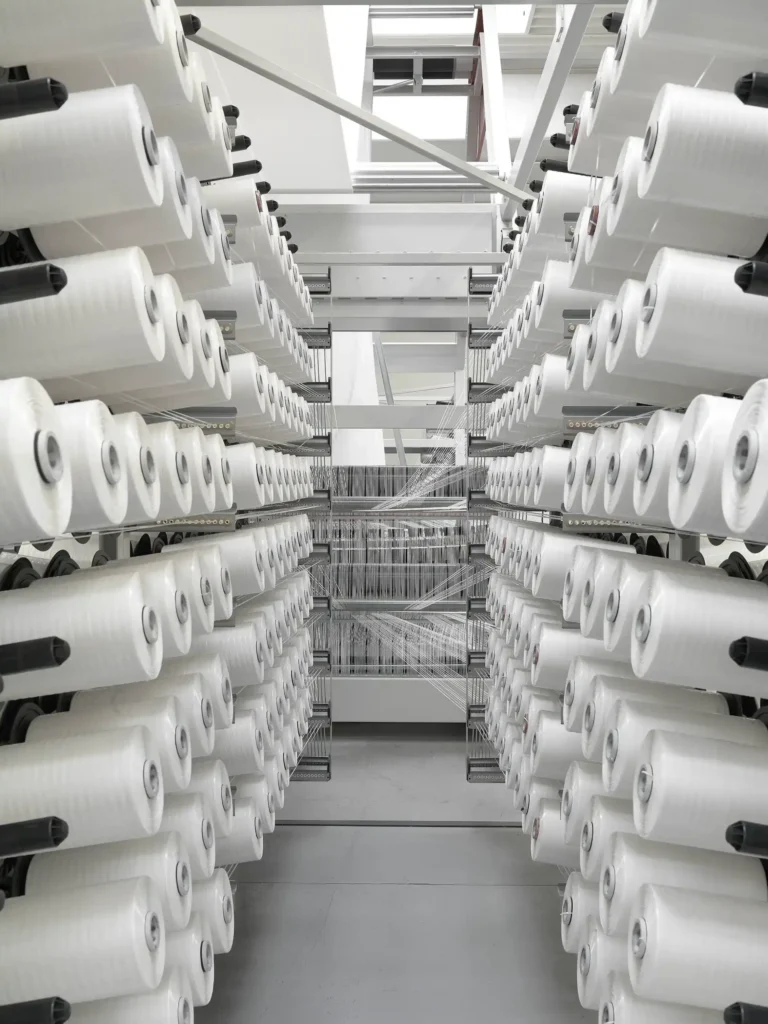
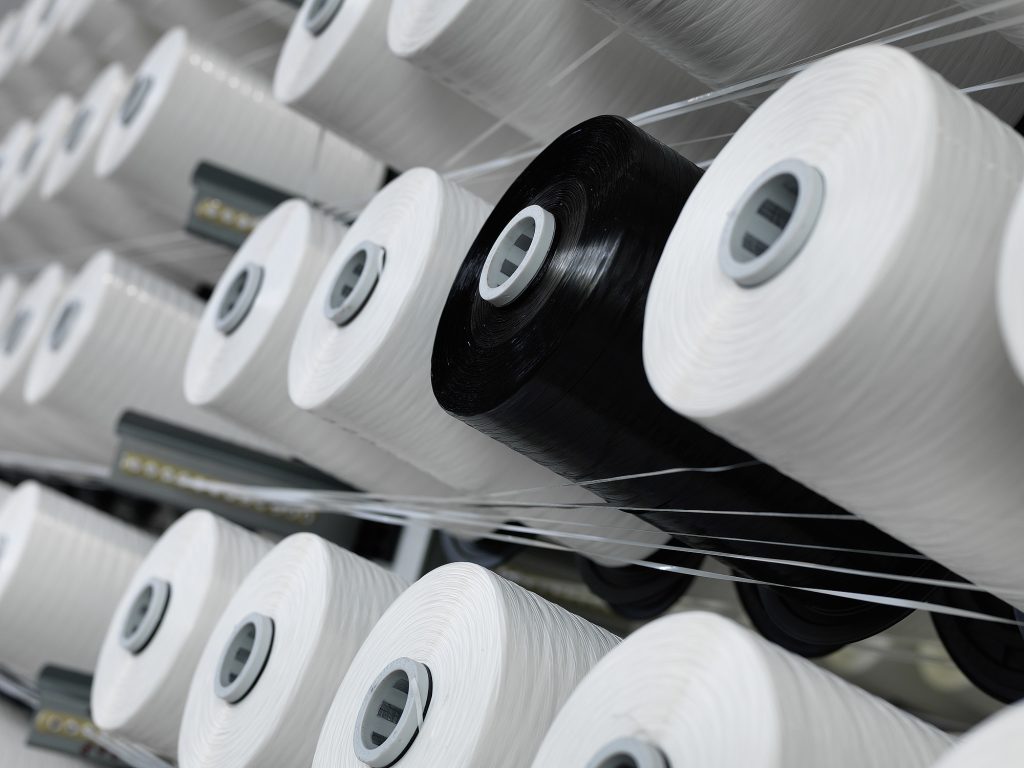
- Warping & weaving — Creels load hundreds of tapes; circular or flat looms interlace warp and weft into plain (stability), twill (drape), or leno (aperture) weaves.
- Heat‑setting & surface treatment — Ovens stabilize dimensions; corona treatment improves film and ink adhesion.
- Reverse printing — Graphics printed beneath BOPP; ΔE color tolerance maintained per ISO 2846/12647; adhesion confirmed by tape tests.
- Lamination — Solvent‑free adhesive bonds BOPP/CPP to the woven core; peel tests and haze inspection ensure mechanical and optical integrity.
- Cutting & sewing — Box‑bottom formation, gussets, and cross‑box handles with bartacks; over‑edge or heat‑cut edges to tame fray.
- Inspection — Dimensional checks; seam pulls (ISO 13935‑2); fabric tensile (ASTM D5034/ISO 13934‑1); abrasion, odor, and AQL sampling.
- Traceability & packing — Lot serialization via QR; cartonization designed to protect clear windows from scuff during transit.
Applications for Transparent Woven Bags: where visibility with structure wins
Retail, storage, logistics, and policy‑driven security contexts all reward clarity that lasts. Consider how use cases pull different levers of the same design.
- Retail checkout and merchandising — Faster visual verification reduces disputes and shrink; reverse‑printed art keeps branding crisp after conveyor wear.
- Produce and chilled foods — Anti‑fog films or open‑mesh windows maintain visibility while protecting delicate items and supporting ventilation.
- Stadium and venue policies — See‑through carriers speed screening; polymer hardware and reinforced seams elevate durability beyond single‑use clear bags.
- Warehousing and MRO — Transparent front panels turn the bag into its own label, cutting mis‑picks and search time.
- E‑commerce and returns — Clear windows assist in visual confirmation during returns without unsealing every package.
- Education and healthcare — Hygiene and visibility support security and compliance protocols.
Thinking from the title: “Versatility in Retail and Storage” as a practical map
Two arenas, one artifact. Retail demands speed and brand clarity; storage demands order and auditability. Transparent Woven Bags reconcile both by pairing optical access with structural endurance and informational traceability.
- Optics for decision speed — Low haze, readable barcodes under film, glare control via matte zones, and window placement outside primary scuff paths.
- Mechanics for reuse economics — Seam geometry (cross‑box with bartacks), handle width (25–38 mm), bottom reinforcement, and corner guards tuned to payload.
- Hygiene and user willingness — Wipe‑clean laminations and low‑odor compounds encourage reuse beyond 50+ trips.
- Storage organization — Standardized window position and QR lot codes double as visual and digital labels.
- Circular end‑of‑use — Monomaterial BOMs, detachable hardware, on‑pack polymer ID, and local take‑back partnerships transform “recyclable” into “recycled.”
Systematic analysis and synthesis for Transparent Woven Bags
Break the promise into sub‑arguments; test each with discipline; then recombine into a program spec that teams can execute.
Sub‑argument A — Transparency must last through use
Day‑one clarity is not enough. Windows intersect with hands, carts, belts, and shelves. Reverse‑printed BOPP shields inks; CPP softens creases but may mar earlier than BOPP at equal gauge; coated films add cost but protect where touch is unavoidable. Design rule: keep windows away from handle travel paths; select ≥20 μm BOPP for high‑traffic retail; use anti‑scratch where scuffing is inevitable.
Sub‑argument B — Seams and handles govern true lifetime
Failures cluster at corners and handles, not mid‑panel. Specify seam efficiency ≥80% of base fabric tensile (ISO 13935‑2). Match thread Tex to tape denier; employ cross‑box with diagonal bartacks; run cyclic lift tests that mirror shopper behavior. A modest increase in seam quality often multiplies reuse counts.
Sub‑argument C — Chemistry governance protects users and recycling loops
“Clear” is not equal to “safe.” Adopt OEKO‑TEX® STANDARD 100 and ZDHC MRSL v3.1 alignment for inks and adhesives; for food‑adjacent use, reference 21 CFR and EU (EC) 1935/2004 with GMP (EC) 2023/2006 and run migration tests. Publish batch certificates tied to QR lots so claims are testable.
Sub‑argument D — Monomaterial design enables practical recycling
Keep the family consistent: PP body + PP thread + PP handles + PP labels. Avoid PET windows on PP bodies unless detachable. Pigments must be NIR‑readable to preserve sortability. Print routes should favor water‑based systems where process allows.
Sub‑argument E — Data transparency sustains stakeholder trust
Batch‑level dashboards logging reuse counts, defect rates, recycled content %, and energy per unit convert aspiration into management. Retailers tune incentives; municipalities report outcomes; consumers understand care.
Reference specification — a coherent blueprint for Transparent Woven Bags
Use these targets as a living baseline; adjust by application and infrastructure.
- BOM: PP woven core; reverse‑printed BOPP 20–25 μm; PP webbing handles 25–38 mm; PP thread; solvent‑free adhesive.
- Optics: Haze ≤15% (ASTM D1003) in window area; barcode readability verified; anti‑fog for chilled chains; glare controlled via matte zones where needed.
- Mechanics: Rated payload 10–15 kg; handle proof load ≥2× rated for 1 min; seam efficiency ≥80% (ISO 13935‑2); fabric tensile per ASTM D5034 or ISO 13934‑1.
- Chemistry & safety: OEKO‑TEX® STANDARD 100 (Annex 4/6), ZDHC MRSL v3.1 alignment; food‑adjacent SKUs validated to 21 CFR/EU (EC) 1935/2004 with GMP.
- Environment & energy: Sites with ISO 14001 and ISO 50001; recycled content 20–60% rPP where mechanics permit.
- Traceability: QR lot IDs linking to certificates and test results; records kept ≥5 years.
- End‑of‑use: On‑pack polymer ID “PP”; take‑back partnership; instructions for removing non‑PP hardware.
Standards, test methods, and third‑party verification for Transparent Woven Bags
Programs run on numbers and norms. Quality management (ISO 9001). Environmental and energy management (ISO 14001, ISO 50001). Occupational health (ISO 45001). Recycled content (GRS/RCS). Human ecology and chemistry (OEKO‑TEX® STANDARD 100; ZDHC MRSL). Food contact where applicable (21 CFR; EU (EC) 1935/2004; GMP (EC) 2023/2006). Mechanical and optical tests (ASTM D5034/ISO 13934‑1, ISO 13935‑2, ISO 13937‑2, ASTM D1003, ISO 527, ISO 4892‑2). Recycling design (ISO 18604). Social responsibility (SA8000; amfori BSCI). Third‑party laboratories—SGS, TÜV, Intertek, Bureau Veritas—translate policies into certificates and numbers your team can act on.
| Domain | Standard | What it proves | Notes |
|---|---|---|---|
| Optics | ASTM D1003; ASTM D523 | Haze, clarity, gloss benchmarks | Tie to barcode readability and lighting conditions |
| Mechanics | ASTM D5034/ISO 13934‑1; ISO 13935‑2; ISO 13937‑2 | Fabric tensile, seam, and tear performance | Cyclic tests simulate shopper lift patterns |
| Chemistry | OEKO‑TEX® STANDARD 100; ZDHC MRSL v3.1 | Restricted substances control | Spot GC‑MS audits align supplier claims |
| Food contact | 21 CFR; EU (EC) 1935/2004; (EC) 2023/2006 | Migration safety for near‑food use | Select simulants by product class |
| Recycling | ISO 18604; GRS/RCS | Recyclability design & recycled content verification | Publish polymer ID and content % on pack |
Technical parameters for planning and comparison
Use these indicative ranges to open specification conversations. Validate with program‑specific tests before mass production.
| Parameter | Typical Range (Retail Shopper) | Engineering Note | Why it matters |
|---|---|---|---|
| Body fabric | PP plain weave; 900–1400 D tapes; 9–14 × 9–14 EPI × PPI | Density must allow seams to “bite” without bulk | Controls weight, strength, and cut‑edge behavior |
| Window film | BOPP 20–25 μm; CPP 20–30 μm; anti‑fog coex as needed | Balance clarity with scuff resistance | Determines barcode readability and longevity |
| Handles | PP webbing 25–38 mm; cross‑box with bartacks | Wider handles reduce hand cut‑in | User comfort is reuse fuel |
| Seam efficiency | ≥80% of base fabric tensile (ISO 13935‑2) | Corner reinforcements prevent first‑failure points | Predicts field life better than fabric GSM alone |
| Rated payload | 10–15 kg; proof ≥2× for 1 min | Cyclic lift tests mirror shopper behavior | Safety and liability hinge here |
Environmental accounting for Transparent Woven Bags: honest boundaries
A PP woven shopper around 100–140 g often embodies roughly 0.3–0.7 kg CO₂e at the factory gate, depending on energy mix and recycled content; the transparent film adds modest mass and energy. Where is the win? In reuse counts and operational efficiency: faster screening, fewer re‑bags, lower shrink. Gains scale with programs that adopt renewable electricity (ISO 50001), set recycled content targets (GRS/RCS‑verified rPP/rPE), improve first‑pass yield, and move freight by sea/rail. Use‑phase burdens are small—cool‑water wiping generally suffices—so designing for easy cleaning can silently double service life.
User experience and human factors
People reuse what feels good to use. Handle geometry—width, softness, length—steers behavior more than slogans do. Fold geometry decides drawer fit and glove‑box convenience. Label placement near but not on the window preserves clarity and wayfinding. Simple, legible icons (polymer ID, care, recycled content) meet hurried eyes with the right cues at the right moment.
Risk management and quality control across the line
Quality is risk managed in numbers. Incoming: resin melt flow index, moisture, pigment checks. In‑process: draw‑ratio logging, loom tension maps, lamination temperature/nip profiles, peel strengths, inline optical inspection. Finished goods: dimensional checks, seam pulls, handle proof loads, odor screening, AQL sampling (often 2.5). Keep records for ≥5 years; link them to QR lot pages. Independent labs—SGS, TÜV, Intertek, Bureau Veritas—are the usual referees.
Procurement checklist for Transparent Woven Bags
- Define functional unit: payload, target reuse count, cleaning method.
- Prefer monomaterial BOMs: PP‑on‑PP or PE‑on‑PE; align threads, handles, and labels.
- Set recycled content targets (≥30% rPP/rPE, GRS/RCS verified) within mechanical limits.
- Specify optical targets: haze (ASTM D1003), gloss (ASTM D523), barcode readability under film, glare control zones.
- Demand seam efficiency and handle proof loads; validate with ISO 13935‑2 and cyclic protocols.
- Mandate restricted‑substance control: OEKO‑TEX® STANDARD 100; ZDHC MRSL alignment.
- For food‑adjacent SKUs, require 21 CFR/EU (EC) 1935/2004 + GMP (EC) 2023/2006 with migration tests.
- Require site certifications: ISO 9001/14001/45001/50001; social audits (SA8000/amfori BSCI).
- Publish QR‑linked dashboards (recycled content %, test results, care guidance).
- Plan take‑back with local recyclers; mark polymer ID and removal steps for any non‑matching hardware.
Scenario logic: retail chain, city program, and event pilot
A grocer deploys one million Transparent Woven Bags at ~100 g with 30% rPP; at 25 trips per unit, avoided single‑use carriers reach tens of millions, while visibility reduces disputes at checkout. A city issues standardized Transparent Woven Bags with QR lots for textile or e‑waste; inspectors verify contents without opening every bag; the take‑back converts PP into durable public goods. A sports arena tests a clear‑bag policy via reusable Transparent Woven Bags with polymer zippers; lines move faster, and season‑long durability cuts waste.
- What are Transparent Woven Bags and why are they reshaping retail and storage?
- The material system of Transparent Woven Bags: structure, optical skin, and joining
- Feature set of Transparent Woven Bags: optics, mechanics, hygiene, safety, circularity
- Production process of Transparent Woven Bags: from resin to repeatable quality
- Applications for Transparent Woven Bags: where visibility with structure wins
- Thinking from the title: “Versatility in Retail and Storage” as a practical map
- Systematic analysis and synthesis for Transparent Woven Bags
- Sub‑argument A — Transparency must last through use
- Sub‑argument B — Seams and handles govern true lifetime
- Sub‑argument C — Chemistry governance protects users and recycling loops
- Sub‑argument D — Monomaterial design enables practical recycling
- Sub‑argument E — Data transparency sustains stakeholder trust
- Reference specification — a coherent blueprint for Transparent Woven Bags
- Standards, test methods, and third‑party verification for Transparent Woven Bags
- Technical parameters for planning and comparison
- Environmental accounting for Transparent Woven Bags: honest boundaries
- User experience and human factors
- Risk management and quality control across the line
- Procurement checklist for Transparent Woven Bags
- Scenario logic: retail chain, city program, and event pilot
Opening Dialogue
Product Manager (PM): “Ray, retailers need packaging that combines visibility with durability. How can VidePak’s transparent woven bags meet these demands while ensuring sustainability?”
Ray (CEO, VidePak): “By leveraging Starlinger’s high-precision extrusion systems and W&H’s advanced weaving technology, we’ve engineered transparent PP woven bags that offer 98% light transmission and 40% higher tensile strength than traditional PE alternatives. Our closed-loop production process ensures zero material waste, aligning with global ESG standards.”
H2: Production Process and Quality Control in Transparent Woven Bag Manufacturing
Transparent woven bags require meticulous engineering across seven stages, each optimized for clarity, strength, and compliance. VidePak’s use of Starlinger and W&H machinery ensures industry-leading precision and scalability.
H3: 1. Extrusion: Precision in Polymer Processing
Virgin PP resin pellets are melted and extruded into flat tapes using Starlinger’s extrusion lines (16 units), operating at 200–240°C to achieve uniform thickness (0.04–0.06mm). Key quality checks include:
- Melt Flow Index (MFI): Maintained at 5–7 g/10 min (190°C/2.16 kg) for optimal viscosity.
- Thickness Variance: Laser sensors ensure ±0.005mm tolerance, reducing material waste by 15%.
Example: A deviation in MFI beyond ±0.3g triggers automatic shutdown, preventing batch defects.
H3: 2. Drawing and Weaving: Enhancing Transparency and Strength
Tapes are stretched into fine filaments (1–2 denier) and woven on W&H circular looms (100+ units) at 12–14 strands per inch (SPI). This high-density weave achieves:
- Light Transmission: 95–98% clarity, critical for retail displays.
- Tensile Strength: 35–50N/cm², validated via ASTM D5034 tests.
Case Study: A European coffee brand reduced packaging damage by 25% using VidePak’s 14 SPI transparent bags.
H3: 3. Lamination and Coating: Functional Enhancements
VidePak’s 30 lamination machines apply BOPP or PE coatings (15–25μm) for:
- Moisture Resistance: <1.5g/m²/day permeability (ASTM E96).
- UV Stability: Blocks 90% of UV-B rays, extending product shelf life.
Quality Assurance: Peel adhesion tests (ASTM D903) ensure ≥3N/cm bond strength.
H3: 4. Printing and Customization
Starlinger’s 8-color flexographic printers achieve ±0.1mm registration accuracy, using eco-solvent inks compliant with FDA 21 CFR. VidePak’s proprietary anti-scuff coatings prevent logo wear during transport.
Client Example: A U.S. pet food brand reduced redesign costs by 30% using VidePak’s digital printing-on-demand service.
H3: 5. Bag Making: Precision Sealing
W&H’s ultrasonic welders create seamless closures with 25N/mm² strength, eliminating thread usage and reducing leakage risks by 95%.
H2: Technical Specifications and Compliance
| Parameter | VidePak’s Standard | Global Benchmark |
|---|---|---|
| Light Transmission | 95–98% | ISO 13468 |
| Tensile Strength | 35–50N/cm² | ASTM D5034 |
| Moisture Permeability | ≤1.5g/m²/day | ASTM E96 |
| Recyclability | 100% PP | ISO 14001 |
FAQs
Q: How do transparent PP bags compare to PET in cost?
A: PP bags cost 20–25% less due to lower energy consumption during production (1.7kg CO₂/kg vs. PET’s 3.8kg).
Q: Can these bags withstand freezer temperatures?
A: Yes, VidePak’s PP retains flexibility at -20°C, ideal for frozen food storage.
H2: Competitive Advantages of VidePak’s Transparent Bags
- Sustainability: 30% recycled PP content, reducing virgin material use by 1,200 tons/year.
- Customization: 48-hour prototyping with 90% first-pass approval rate.
- Global Compliance: Meets FDA, EU REACH, and JIS Z1530 standards.
Case Study: A Southeast Asian rice exporter cut logistics costs by 18% using VidePak’s lightweight (90GSM) FIBCs with RFID tracking.
H2: Future Innovations
- Smart Packaging: Integrating NFC tags for real-time inventory tracking.
- Bio-Based PP: Piloting sugarcane-derived resins to cut carbon footprint by 50% by 2026.
By combining Starlinger’s extrusion expertise and W&H’s weaving precision, VidePak redefines transparent packaging. Explore our innovations in transparent woven bag applications and automated production lines.
This report integrates data from ASTM/ISO standards, client trials, and VidePak’s 2025 sustainability audit, adhering to Google’s EEAT (Expertise, Experience, Authoritativeness, Trustworthiness) framework.