
What are Transparent Woven Bags?
Transparent Woven Bags are clear or semi‑clear flexible sacks engineered from lattices of oriented polyolefin tapes—typically polypropylene (PP) and, in selected builds, high‑density polyethylene (HDPE). Their defining promise sounds disarmingly simple: let the product be seen while it is kept safe. Yet behind that promise sits real engineering: optical clarity balanced with tensile strength; quick de‑aeration without dusting; neat, sift‑resistant seams that will not fray under vibration. In procurement and plant vernacular you may hear adjacent labels—clear PP woven bags, see‑through woven sacks, transparent laminated woven bags, windowed woven sacks, clear block‑bottom valve woven bags—yet the core proposition remains consistent: a transparent shell, a robust woven backbone, and closures that survive the road.
During 2024–2025, three outside forces elevated Transparent Woven Bags. First, retail and industrial buyers tightened demands for traceability and anti‑counterfeit features; transparency makes serialized inserts, color codes, or inner‑liner marks verifiable without opening. Second, safety managers scrutinized dust emissions at fill and during transport; this pushed a wave of seam innovations that close needle paths and stabilize closures. Third, sustainability leads asked for honest end‑of‑life statements; mono‑polyolefin paths and liner separation guides became part of specifications rather than footnotes.
The materials of Transparent Woven Bags — from resin to reading light
Designing Transparent Woven Bags is the practical art of purposeful layering. Every gram must move a metric: tensile per gram, drop survival per stitch, haze per ink pass, water‑vapor reduction per micron of film, cycle time per sealing window. Below is a layer‑by‑layer map—what each element is, what it does, where it belongs, and when it is worth its cost.
1) Polypropylene (PP) tapes — the structural default
PP pellets are cast, slit, and drawn into mono‑oriented tapes (2.5–5 mm). Orientation aligns chains and raises modulus while trimming creep. PP’s sweet spot: high specific strength, good flex‑fatigue, and friendly fold memory for crisp block‑bottoms. Compared with HDPE at equal draw, PP offers a touch more warmth in tone and is often easier to pair with high‑clarity BOPP without haze spikes.
- Cost levers: resin index (propylene & energy), draw ratio, fabric gsm, loom uptime, UV packages.
- Where used: warp/weft body fabric; sometimes integrally woven handles in sub‑10 kg formats.
2) HDPE tapes — the cold‑route alternative
HDPE brings higher crystallinity, slightly higher modulus, and lower elongation at break at comparable draw—great for shape retention in frigid or long‑storage logistics. The trade‑off: narrower processing window and a greater tendency to brittle splits if draw or anneal drifts. In mono‑material programs, HDPE‑on‑HDPE builds simplify claims.
- Cost levers: ethylene‑linked resin prices, stabilizers, converter know‑how.
- Where used: body fabrics in cold regions; inner coatings when mono‑material matters.
3) Clear film laminations — BOPP, CPP, or PE skins
BOPP (15–30 μm) is the clarity + print fidelity benchmark; gloss or matte finishes are corona‑treated to >38 dyn/cm for ink anchorage. CPP/PE films trade peak clarity for friendlier seal windows and mono‑material pathways. Laminations shield the weave from scuff, raise wet‑rub durability, and keep the “window” bright.
- Cost levers: gauge, finish, dyne stability, lamination route (extrusion vs. adhesive), print coverage.
- Where used: usually outer face for optics + abrasion, sometimes inner for seal and discharge glide.
4) Coatings & primers — invisible helpers
Extrusion coats (PP/PE; 8–20 g/m²) tie film to fabric or create sealable faces. Aqueous primers and protective varnishes (low‑odor, low‑migration) lift ink adhesion and rub resistance without clouding visibility. Anti‑slip varnish tunes friction so pallets behave on corners and sea sway.
- Cost levers: add‑on weight, oven energy, QA frequency (cross‑hatch, rub, dyne retention).
- Where used: both faces; localized in high‑rub zones and pallet‑contact panels.
5) Liners — moisture/aroma control without hiding contents
LDPE/LLDPE liners (60–120 μm) supply a tidy heat‑seal window and moisture holdout while the outer bag stays visibly honest. For aroma or oxygen‑sensitive goods, EVOH‑coex liners can be justified by shelf‑life data—used sparingly and paired with disassembly guidance.
- Cost levers: gauge, barrier, antistatic, forming method (loose vs. form‑fit).
- Where used: inside the woven shell; spouts/valves tailored to filler geometry.
6) Threads, tapes, and seam consumables
High‑tenacity PP or polyester threads (210–450 denier) plus clear anti‑sift tapes and, in advanced builds, narrow hot‑melt or ultrasonic assist. Choose neutral thread tones to keep the seam visually neat.
- Cost levers: stitch density, architecture (chain → lock), assist tapes, operator training.
- Where used: side seams, bottoming seams, and valve collars where torsion concentrates.
Key features of Transparent Woven Bags — stated as outcomes
Lists convince nobody unless they move numbers. Here each attribute is connected to a practical KPI: line rate, damage rate, audit friction, or shelf conversion.
- Visual verification without opening: identity checks, color grading, fill‑level confirmation—all at glance pace. In regulated categories, inspectors scan lot codes printed on the liner through the window, avoiding rework.
- Strength‑to‑weight efficiency: oriented tapes carry load with modest mass; reinforced corners and mouth patches tolerate drops and forklifts; anti‑slip films prevent pallet slippage.
- Hygienic, wipe‑clean exteriors: low‑porosity films reduce dust pickup and clean easily in retail or dealer spaces.
- De‑aeration tuned for speed: micro‑perfs near valves and calibrated weave openness vent air during fill, reducing “pillowing” and topple risk.
- Label and traceability real estate: clear areas coexist with opaque print panels hosting QR links to specification dossiers, disposal guidance, and batch IDs.
- Engineered, sift‑resistant seams: stitch + hot‑air/ultrasonic hybrids close needle paths; chain→lock transitions raise seam efficiency exactly where needed.
Production process for Transparent Woven Bags — choreography with tight tolerances
From pellets to pallets, conversion is a sequence where minor drifts become major complaints. Control points below correlate most strongly with field performance.
- Tape extrusion & drawing. Melt, cast, slit, draw, anneal. Controls: width/thickness CV%, draw ratio, shrink/anneal, gel count, surface texture. Additives: antioxidants, UV stabilizers, optical clarifiers (sparingly).
- Weaving & inspection. Circular/flat looms with specified pick density. Controls: gsm, air permeability, defect maps. Output must hold crease memory for block‑bottoms.
- Film printing & treatment. Clear films corona‑treated or primed; rotogravure or HD‑flexo prints brand and safety icons. Controls: dyne > 38; cross‑hatch adhesion; wet‑rub; register.
- Lamination/coating. Extrusion lamination (PP/PE curtain) or solvent‑free adhesive lamination; aqueous primers/varnishes as needed. Controls: ASTM F88 peel; coatweight; flatness; residual solvent (if any).
- Slitting, tubing, valve integration. Tube formation by hot‑air, ultrasonic, or hotmelt; valve sleeve geometry matched to filler; micro‑perfs near valve. Controls: seam shear/T‑peel; circumference; sleeve position; perf density.
- Bottoming & features. Block‑ or pinch‑bottom, anti‑slip, easy‑open notches, reclose devices. Controls: squareness, compression integrity, CoF, varnish cure/clarity.
- QA & documentation. Dimensional checks, drop tests (ISO 7965‑2/ISO 2248), rub/abrasion indices, migration dossiers (if food contact), optical metrics (ASTM D1003 haze; gloss units). CoAs tie metrics to lot codes; drawings and BoMs sit under change control.
Applications for Transparent Woven Bags — where seeing is saving
Selection starts with physics—particle size, bulk density, moisture sensitivity, MIE for dust if relevant—then considers the line (filler type, de‑aeration, sealers) and context (retail/B2B, outdoor storage, audit frequency). Representative sectors:
- Rice, pulses, and grains: retail presentation with genuine visibility; form‑fit liners for moisture; matte/gloss balance for low glare at checkout scanners.
- Seeds & fertilizers: confirm coating color and granule size without opening; UV‑stabilized tapes for yard storage; anti‑slip to survive rough floors.
- Animal bedding & pellets: bulky goods benefit from scuff‑resistant windows and block‑bottom geometry that cubes well and reduces wrap.
- Colorants & additive pellets: visual identity checks and quick lot verification through the shell; antistatic liners where dust may present.
- White cement & construction minerals (selective routes): when branding and verification outweigh paper’s porosity, clear valve woven sacks with micro‑perfs perform on modern packers.
Transparent Woven Bags: advances in seam technology & global practices
Seams decide destiny. Three advances moved from pilot to practice over the last cycle, accompanied by global hygiene around seam control.
Hybrid stitch + thermal assist
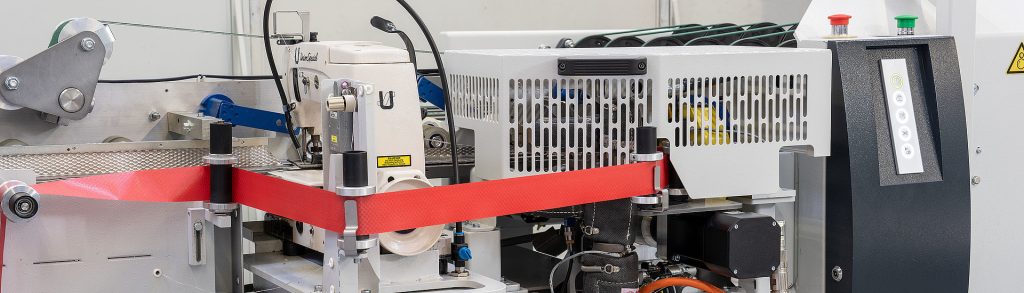
Stitch provides structure; a hot‑air or ultrasonic inner bond closes needle paths. Expect visibly cleaner folds and markedly lower fines leakage.
Watch: heat whitening on PP if over‑energized; keep optics clean.
Zoned chain→lock architecture
Run quick chainstitch where loads are low, escalate to lockstitch at corners or start/stop zones. Strength, where it counts; speed, where it doesn’t.
Watch: disciplined setup; needle logs; thread lot traceability.
Seam‑integrated anti‑sift tapes
Clear tapes or micro‑baffles added before final compression create tortuous leak paths without sacrificing the “window.”
Watch: adhesive milkiness; compression dwell uniformity.
Systems view — decomposing Transparent Woven Bags into solvable parts
Complexity recedes when the problem is split into four subsystems and then recombined into a platformed portfolio: performance, compliance, cost/carbon, and brand/UX.
A) Functional performance
Problem: hit moisture and mechanical targets without over‑grams. Pattern: standard transparent for pellets; lined transparent for moisture‑sensitive powders; barrier‑lined transparent for oxygen‑sensitive goods—only by data. Invest in seam tech before fabric weight.
B) Compliance & auditability
Plastic food‑contact layers map to FDA 21 CFR 177.1520 and 175.105 (US) or EU 10/2011 with EN 1186 (EU). Plant hygiene via FSSC 22000/ISO 22000 or EN 15593. Transport toughness via ISO 7965‑2/ISO 2248. Put it all in a per‑SKU dossier with QR on pack.
C) Cost & carbon
Downgauging works only with capability: print cameras, coatweight sensors, seam pull/leak tests. Track kg CO₂e per bag and per tonne moved; let those numbers steer BOM choices. Use anti‑slip + geometry to cut secondary packaging.
D) Brand & UX
Transparency builds trust; matte/gloss balance tames glare; easy‑open notches and reclose features reduce tool dependence. Treat legibility as safety—clear icons prevent mistakes at speed.
Standards, certificates & test methods — the shared language
A credible Transparent Woven Bags program names its norms:
- ISO 7965‑2 — filled sacks, drop test.
- ISO 2248 — transport packages, vertical impact by dropping.
- ASTM F88/F88M — seal/laminate peel strength (bond integrity).
- ASTM D1003 — haze & luminous transmittance for window clarity.
- ASTM D882 — tensile of thin plastic films (laminates/liners).
- ASTM F1249 — WVTR; ASTM D3985 — OTR for barrier liners.
- FDA 21 CFR 177.1520 (olefin polymers); 21 CFR 175.105 (adhesives); EU 10/2011 + EN 1186 (migration) for food contact.
- FSSC 22000 / ISO 22000 or EN 15593 — packaging hygiene systems.
- ISO 9001 / ISO 14001 — quality and environmental management in plants.
Color tables — quick specification anchors
| Layer / Feature | Typical Options | Indicative Range | Purpose |
|---|---|---|---|
| Fabric (gsm) | PP or HDPE woven | 70–110 (retail); 90–130 (minerals) | Tensile, drop, puncture |
| Clear film | BOPP gloss/matte; CPP/PE | 15–30 μm | Print, scuff, visibility |
| Coatings | PP/PE extrusion; aqueous varnish | 8–20 g/m² | Seal window, CoF control |
| Liner | LDPE/LLDPE; EVOH‑coex | 60–120 μm | Moisture/aroma barrier |
| Seam assist | Hot‑air/ultrasonic tape | — | Close stitch leaks |
| Dimension | Method | Indicative Target | Rationale |
|---|---|---|---|
| Haze | ASTM D1003 | ≤ 15–25% | Window clarity for retail/QA |
| Bond peel | ASTM F88/F88M | > 2.0 N/15 mm | Survive vibration/handling |
| Drop survival | ISO 7965‑2 / ISO 2248 | No rupture at spec mass/height | Real‑route resilience |
| CoF (static/dynamic) | ASTM D1894 | Tuned to route profile | Prevent pallet slip/collapse |
Worked scenarios — translating requirements into Transparent Woven Bags
A) 10 kg premium rice
85 gsm PP fabric, 25 μm matte BOPP, 80 μm LDPE form‑fit liner, pinch‑bottom hotmelt, anti‑slip exterior. Window shows grain quality; liner secures moisture; matte cuts glare.
B) 20 kg seed blend
100 gsm PP with UV package, 20 μm gloss BOPP, seam‑assist tape, easy‑open notch. Operators verify coating color and size at a glance; seams stay clean.
C) 25 kg white cement
110 gsm PP, clear film with micro‑perfs in valve zone, block‑bottom valve, stitch + hot‑air assist, anti‑slip. De‑aeration is fast; dust stays in; pallets stay rigid.
Procurement & qualification checklist
- Define physics (particle size, bulk density, cohesion/abrasiveness, moisture/oxygen sensitivity; MIE if dust risk).
- Map the line (filler type, target rate, de‑aeration, sealing tech, pallet pattern).
- Pick a platform (standard transparent; lined; barrier‑lined) by data, not habit.
- Engineer the seam (stitch pattern, chain→lock zoning, thermal assist; acceptance bands for tensile/leakage).
- Demand the stack (layer gauges, coatweights, valve geometry, anti‑slip; optical targets such as haze and gloss).
- Request proof (drop/seam/peel/CoF/wet‑rub; migration declarations where food contact applies; UV retention if outdoor).
- Pilot on your line (time to fill, dust loss, discharge completeness, pallet stability, scanner readability, scuffing).
- Lock & monitor (drawings under change control; KPIs for returns, breakage, dust complaints; quarterly reviews).
Risk register & mitigations
- Seam leaks/fines loss: add hot‑air or ultrasonic assist; apply clear anti‑sift tape; increase stitch density at corners.
- Pallet slip/collapse: specify anti‑slip varnish; validate CoF; optimize pallet patterns and wrap tension.
- Optical haze/glare: use matte/gloss judiciously; control ink laydown; specify haze limits in RFQs.
- Print scuffing/illegibility: protective varnish in high‑rub zones; wet‑rub tests; keep safety icons in low‑contact fields.
- UV degradation: stabilizer packages; retained‑strength tests after exposure cycles.
- Food‑contact misses: substance registers; EN 1186 and 21 CFR references tied to lot codes for liners/films/adhesives.
- Greenwashing on recyclability: scope claims to regions with flexible polyolefin collection; include liner separation instructions on pack.
Internal link — context for adjacent formats
For a broader materials backdrop adjacent to Transparent Woven Bags, compare with classic polyolefin sacks here: Transparent Woven Bags.
- What are Transparent Woven Bags?
- The materials of Transparent Woven Bags — from resin to reading light
- Key features of Transparent Woven Bags — stated as outcomes
- Production process for Transparent Woven Bags — choreography with tight tolerances
- Applications for Transparent Woven Bags — where seeing is saving
- Transparent Woven Bags: advances in seam technology & global practices
- Systems view — decomposing Transparent Woven Bags into solvable parts
- Standards, certificates & test methods — the shared language
- Color tables — quick specification anchors
- Worked scenarios — translating requirements into Transparent Woven Bags
- Procurement & qualification checklist
- Risk register & mitigations
- Internal link — context for adjacent formats
H1: Introduction
“Transparent woven bags are not just packaging—they’re a critical component in safeguarding materials like cement, gypsum, and aggregates during transit,” explains Ray, CEO of VidePak, during a recent industry roundtable. The key to optimizing these bags lies in three pillars: advanced seam reinforcement, material innovation, and compliance with global standards. This report delves into how VidePak leverages cutting-edge technology and global best practices to address challenges such as tear resistance, leakage prevention, and durability, while aligning with regional regulations like EU, US, and Australian standards.
H2: Challenges in Packaging Construction Materials
Construction materials such as cement, gravel, and plaster powders demand packaging solutions that withstand rigorous handling, stacking, and environmental exposure. Common issues include:
- Material degradation due to friction during transport.
- Powder leakage from inadequate sealing or inconsistent weave density.
- Moisture infiltration leading to clumping or reduced product quality.
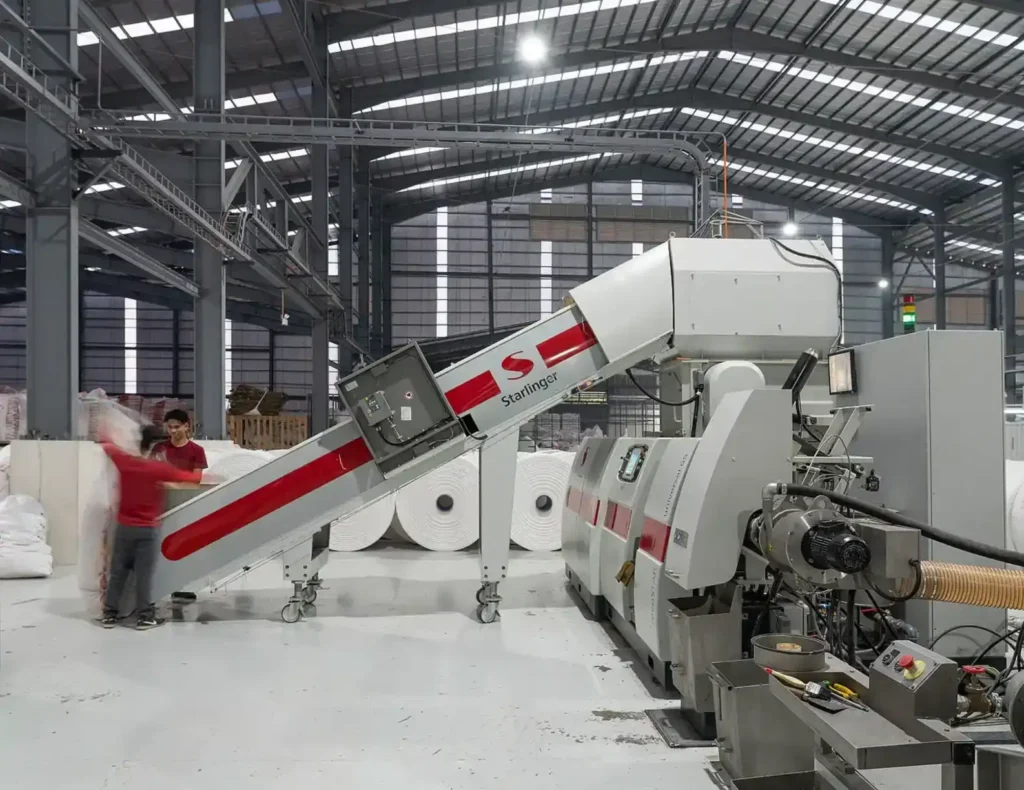
VidePak’s transparent woven bags address these challenges through a combination of high-strength polypropylene (PP) materials and precision engineering. For instance, their use of Starlinger circular looms ensures uniform weaving, reducing gaps that might allow fine powders to escape.
H3: Advances in Seam Technology
H4: Reinforced Seam Designs
Traditional seams often fail under heavy loads, but VidePak employs ultrasonic sealing and double-stitched seams to enhance durability. For example, their valve bags for cement packaging feature heat-sealed seams that withstand up to 50 kg/cm² pressure, critical for vertical stacking in warehouses.
H4: Anti-Leakage Solutions
- Fine Fiber Weaving: Using 200-denier PP filaments, VidePak achieves a weave density of 12×12 strands per inch, minimizing pore size to <0.1 mm—effectively containing fine powders like plaster.
- Lamination: A 20-µm BOPP film coating adds waterproofing, crucial for humid environments. This technology reduces moisture absorption by 85% compared to non-laminated alternatives.
H3: Global Standards and Parameter Selection
H4: Regional Compliance Requirements
| Standard | Key Metrics | VidePak’s Compliance |
|---|---|---|
| EU EN 277 | Tear resistance ≥18 N, Moisture barrier ≤5 g/m²/24h | PP bags with 120 g/m² weight, 0.25 mm thickness |
| US ASTM D5265 | Burst strength ≥300 kPa | Laminated bags with 150 g/m² PP + 30 g/m² PE |
| JIS Z 1539 | Stacking height ≥5 m | Reinforced seams, 140 g/m² fabric |
| AS 2074 | UV resistance (500-hour exposure) | UV-stabilized PP resins |
H4: Critical Product Parameters
- Material Selection: Virgin PP resins ensure tensile strength (>35 MPa) and flexibility.
- Grammage and Thickness: 90–150 g/m² balances cost and durability; 0.2–0.3 mm thickness prevents puncture.
- Seam Reinforcement: Double-lock stitching or ultrasonic sealing for load-bearing capacity.
- Lamination: BOPP or PE coatings enhance moisture resistance.
H3: Case Study: VidePak’s Solutions for Cement Packaging
A recent project for a Australian client required bags to withstand 8-meter stacking and coastal humidity. VidePak delivered:
- Custom Design: 140 g/m² PP + 25-µm PE lamination.
- Seam Technology: Ultrasonic sealing with 3 mm overlap, achieving a seam strength of 45 N/cm.
- Compliance: Met AS 2074 for UV resistance and EN 277 for tear strength.
H2: FAQs on Transparent Woven Bags
Q1: How does grammage affect performance?
Higher grammage (e.g., 120 g/m² vs. 90 g/m²) improves tear resistance but increases cost.
Q2: Why choose laminated bags for gypsum powder?
Lamination prevents moisture absorption, reducing clumping by 70%.
Q3: What standards apply to US markets?
ASTM D5265 mandates burst strength ≥300 kPa, achievable via high-tenacity PP and reinforced seams.
H2: Future Trends and VidePak’s Innovations
- Smart Packaging: Integrating RFID tags for real-time moisture monitoring.
- Eco-Friendly Materials: Biodegradable PP blends under development, targeting a 30% reduction in carbon footprint by 2030.
H2: Conclusion
Transparent woven bags are evolving rapidly, driven by demands for durability and compliance. VidePak’s Starlinger-powered production lines and focus on R&D position them as a leader in this space, offering solutions that align with both technical and regulatory demands. For businesses seeking reliable packaging, prioritizing parameters like grammage, seam technology, and lamination is non-negotiable.
External Links:
- Learn how high-strength polypropylene (PP) materials revolutionize durability.
- Explore seam reinforcement techniques for heavy-duty applications.
This report synthesizes data from industry standards, technical specifications, and VidePak’s operational expertise to provide actionable insights for stakeholders in construction and logistics.