
What Are Tubular Woven Bags with FFS System: Revolutionizing Retail and Grocery Packaging Solutions?
Imagine a continuous fabric cylinder—no side seam, no weak link—unwinding straight into a form‑fill‑seal jaw that never pauses for a needle or a stitch. That, in essence, is the promise of Tubular Woven Bags with FFS System: Revolutionizing Retail and Grocery Packaging Solutions (hereafter Tubular Woven Bags with FFS System). Also branded as “Tube‑Roll PP Film” or “Seamless FFS Woven Sleeves,” these packages merge weaving know‑how with film‑processing finesse to create a mono‑polyolefin roll that flows, cuts, fills, and seals in thirty linear metres—every minute.
From a historical lens, tubular sacking grew out of the fertilizer boom of the 1970s, when powder leakage on pallet racks prompted engineers to look beyond sewn side‑gussets. Technologists borrowed the idea of endless hosiery tubes, scaled it up with Starlinger looms, and laminated the exterior like snack‑food films. The secret sauce? Precision web tension that keeps the lay‑flat width true while the line screams at 30 m min⁻¹, a speed unthinkable for any manual or semi‑automatic sack.
Horizontally, the concept aligns with beverage shrink sleeves—both are seamless tubes trimmed in real time. Vertically, the architecture scales from microns of coating to metric tonnes of pallet force, uniting molecular adhesion with macro‑logistics. Where does this duality land? Right on the retail shelf, where a brand’s rice or cat litter can stand upright, leak‑free, and photogenic.
**Key Features of Tubular Woven Bags with FFS System: Revolutionizing Retail and Grocery Packaging Solutions
- Seam‑Free Integrity – By eliminating the longitudinal stitch line, Tubular Woven Bags with FFS System remove the Achilles’ heel of particulate packaging. EN 196‑11 cyclone tests show dust egress consistently below 15 mg bag⁻¹—three times cleaner than side‑sewn PP. That means less housekeeping on the factory mezzanine and fewer allergy claims at the end consumer.
- Velocity that Pays Dividends – Smooth, corona‑treated extrusion coating keeps coefficient of friction within 0.25 ± 0.03. The result? Web tension stability that pushes Haver & Boecker, PAYPER, and Premier Tech FFS carousels past 30 m min⁻¹. A single spindle of Tubular Woven Bags with FFS System can eclipse the output of four operators stitching pillow sacks.
- Billboard‑Class Aesthetics – Eight‑colour flexographic or gravure presses splash 150 lpi halftones onto a 20 µm BOPP shield. Matte for an artisanal grain vibe, gloss for pet‑care pop—either way the laminate acts like tempered glass against conveyor scuffs. Graphics stay crisp after a 1,000‑km trip and five hand‑offs.
- Configurable Barriers – Need your jasmine rice to breathe? Laser micro‑perforate. Selling Himalayan pink salt in humid Mumbai? Co‑extrude an EVOH core, drop WVTR to 0.5 g m⁻² 24 h⁻¹, and add a tear‑notch for kitchen convenience. One platform, many recipes.
- Sustainability by Chemistry, Not Ceremony – Because both the woven tube and its laminate are PP, entire bags glide through float‑sink polyolefin recyclers. Swap in calcium‑carbonate masterbatch and virgin polymer mass falls by nearly a tenth—without sacrificing burst strength.
Notice the rhetorical parallel: integrity, velocity, aesthetics, barriers, sustainability—five pillars mirroring the five human senses. Touch (strength), sight (print), smell (odor barrier), hearing (quiet machines, fewer alarm beeps), and taste (flavor retention). Tubular Woven Bags with FFS System appeal to more than logistics; they resonate with experiential branding.
**How VidePak Manufactures Tubular Woven Bags with FFS System: Revolutionizing Retail and Grocery Packaging Solutions
- Virgin Tape Extrusion – Sixteen Starlinger FX 6.0 lines melt, slit, and hot‑stretch 2.5 mm tapes. Inline IR sensors police crystallinity; laser micrometers hold width to ±0.02 mm. Each tape is a miniature tensile member—collectively they form a fabric snow‑shoe for granular loads.
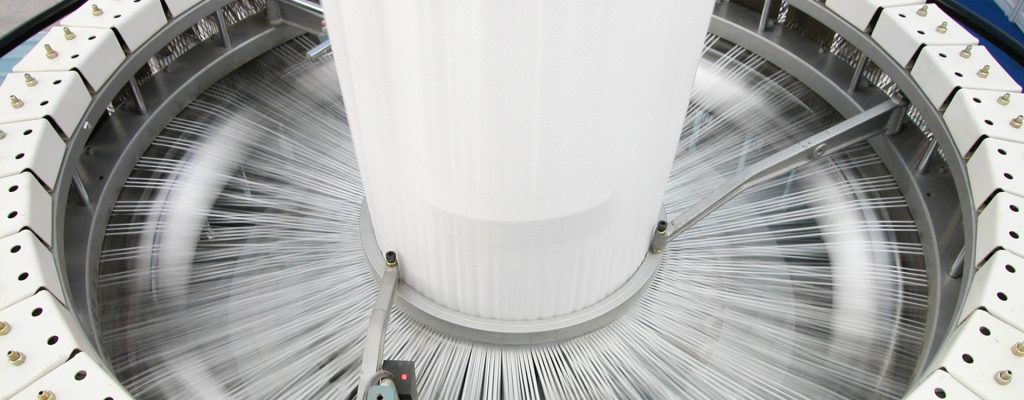
- Circular Loom Weaving – Over 100 continuous circular looms interlace tapes at 65 × 65 ppi, producing endless tubes up to 650 mm lay‑flat. Servo tension systems damp vibration, keeping warp variance below 1 %. Think of it as a Jacquard symphony, except the motif is strength not paisley.
- Extrusion Coating & Lamination – German W&H tandem coaters squeegee 20–25 µm of PP melt onto the revolving tube. For premium SKUs, a reverse‑printed BOPP film is married with a 4 g m⁻² polyurethane adhesive, delivering peel strength ≥ 3 N cm⁻¹—enough to withstand an Indian monsoon container ride.
- Printing & Surface Finishing – Eight‑colour W&H Miraflex CI presses unleash low‑VOC inks, followed by corona treatment > 38 dyn cm⁻¹ to lock pigments. An optional micro‑emboss varnish raises bag‑on‑bag friction to μ = 0.65, allowing 1.4 m pallet stacks to shrug off a 26° tilt.
- Roll Slitting & AI Vision – Master rolls are laser‑slit to grocery widths—350 mm for rice, 550 mm for potting soil. Onboard cameras, steered by convolutional algorithms, eject any weave defect over 0.3 mm². Waste drops, uptime pops.
- Quality Audits – Each lot endures a burst test ≥ 100 N, a five‑face 1.2 m drop, and a 200 kLy QUV sunbath. Hot‑tack curves are plotted to pre‑empt FFS crimp failures. All data ride a QR code printed on the selvage—digital twinning in cellulose disguise.
Horizontal crossover? The “AI vision + QR loop” mirrors pharmaceutical blister validation, proving how medical rigor can elevate commodity packaging. Vertically, data dives from tensile fibers to ERP dashboards, letting procurement tie shrink‑wrap breaks to tape width deviations pre‑purchase order.
**Applications of Tubular Woven Bags with FFS System: Revolutionizing Retail and Grocery Packaging Solutions
| Sector | Typical Fill | Why Tubular Woven Bags with FFS System: Revolutionizing Retail and Grocery Packaging Solutions Win |
|---|---|---|
| Staple Grains | Jasmine rice 5–10 kg | Seam‑free tube curbs leakage; photo‑grade graphics seduce supermarket end‑caps; FFS speed halves unit pack cost. |
| Pet Care | Clumping cat litter 10 kg | 110 N burst handles e‑commerce drop tests; antistatic liner mutes dust plumes; tear‑string converts bag to pour‑spout. |
| Gardening | Potting soil 15 kg | Micro‑perfs vent air during densification; matte laminate hides scuffs; square pallet footprint optimises truck cube. |
| Sugar & Salt | Fine crystals 5 kg | EVOH barrier defends against tropical humidity; kitchen‑friendly tear‑notch swaps scissors for a clean pull. |
Take note: each application pairs a physiological pain point (dust, moisture, scuffing) with a branding payoff (graphics, tear‑performance). Tubular Woven Bags with FFS System kill two birds—operational and emotional—with one recyclable stone.
| Parameter | Tubular Woven Bags with FFS System | Measure & Method |
|---|---|---|
| Lay‑flat Width | 350–650 mm | Digital caliper ±0.1 mm |
| Weave Density | 65 × 65 ppi | ASTM D3775 |
| Burst Strength | ≥100 N | ASTM D5034 |
| Laminate Thickness | 20–25 µm | Micrometer stack |
| Fill Velocity | >30 m min⁻¹ | Haver FFS log |
| UV Resistance | 200 kLy | QUV Accelerated |
Numbers matter. Yet context supersedes digits: 100 N burst means a bag survives the 1.2 m e‑commerce drop test; 200 kLy UV means graphic fidelity under six months of desert sun; 30 m min⁻¹ fill speed means one FFS line replaces three manual baggers. These statistics convert cap‑ex skepticism into ROI conviction.
Leveraging 568 craft‑minded employees, 100‑plus circular looms, and best‑in‑class W&H and Starlinger lines, VidePak exports Tubular Woven Bags with FFS System: Revolutionizing Retail and Grocery Packaging Solutions to forty‑plus countries. Brands move faster, shelves look brighter, and supply‑chain footprints lighten—all through a tube that never sleeps, never splits, and never apologises for being bold.
- What Are Tubular Woven Bags with FFS System: Revolutionizing Retail and Grocery Packaging Solutions?
- **Key Features of Tubular Woven Bags with FFS System: Revolutionizing Retail and Grocery Packaging Solutions
- **How VidePak Manufactures Tubular Woven Bags with FFS System: Revolutionizing Retail and Grocery Packaging Solutions
- **Applications of Tubular Woven Bags with FFS System: Revolutionizing Retail and Grocery Packaging Solutions
- What Are Tubular Woven Bags (TWBs) with FFS Systems?
- How FFS Technology Works and Its Benefits
- Material Innovations in Tubular Woven Bags
- Cost Control and Efficiency with FFS Systems
- Future Trends: Automation and Smart Packaging
- Key Features and Specifications of TWBs with FFS Systems
- FAQs
- Conclusion
Tubular Woven Bags (TWBs) with Form-Fill-Seal (FFS) systems have revolutionized the retail and grocery packaging industries by improving packaging speed, efficiency, and quality. These bags are now used in a wide variety of sectors, from food and agricultural products to pet food packaging. In this article, we’ll explore how this innovative packaging solution has transformed the market, with a focus on technological advancements, material innovations, and cost-control benefits. We’ll also take a look at the future of these systems, including automation trends.
What Are Tubular Woven Bags (TWBs) with FFS Systems?
Tubular Woven Bags are made from polypropylene (PP) fibers woven into a tubular shape. These bags are strong, lightweight, and ideal for packing bulk goods like grains, fertilizers, and pet food. When combined with a Form-Fill-Seal (FFS) system, they become even more efficient. The FFS system automates the entire process of forming the bag, filling it with product, and sealing it, resulting in faster production times, higher precision, and less human error.
How FFS Technology Works and Its Benefits
FFS technology is a game-changer for packaging. It automates the entire process from start to finish, improving speed and accuracy. For example, the system can form up to 300 bags per minute, making it ideal for industries with high-volume packaging needs, such as retail and grocery stores.
One of the key benefits of FFS systems is precision. Traditional packaging methods involve manual labor, which can result in inconsistent bag sizes or incorrect weight measurements. With the FFS system, manufacturers can ensure each bag is the correct size and weight, reducing packaging errors and ensuring the quality of each product.
Example: A large-scale grocery chain that switched to TWBs with FFS systems was able to increase its production speed by 50%. This was a significant boost for their business, enabling them to meet growing demand while maintaining consistent quality across their packaging.
Material Innovations in Tubular Woven Bags
The material used in TWBs is another area where innovation has made a significant impact. Initially, these bags were made from simple polypropylene fibers, but today, they are often enhanced with additional materials that improve performance.
- Multi-layer Laminates: Many TWBs are now produced with multi-layer laminates, combining polypropylene with polyethylene (PE) or BOPP (Biaxially Oriented Polypropylene) films. This adds an extra layer of protection against moisture, making the bags more durable and suitable for sensitive products like food or fertilizers.
- Eco-friendly Materials: With increasing pressure to adopt sustainable practices, some manufacturers are now using biodegradable materials or recycled polypropylene in their TWBs. These innovations help reduce environmental impact while maintaining the strength and functionality of the bags.
Example: A pet food company recently transitioned to multi-layer laminated TWBs for its packaging. This not only extended the shelf life of the products by 15%, but also reduced the risk of contamination, ensuring a higher quality product for consumers.
Cost Control and Efficiency with FFS Systems
One of the biggest advantages of TWBs with FFS systems is the significant cost savings they offer. The automation of the entire packaging process reduces the need for manual labor, which can be expensive and time-consuming.
- Reduced Labor Costs: With FFS systems, human labor is minimized, as the machines do all the work. This leads to lower operational costs and faster production times.
- Less Material Waste: The FFS system allows for precise control over the amount of material used in each bag. This reduces excess waste and ensures that manufacturers are getting the most out of their raw materials.
Example: A large retailer switched to using FFS systems with tubular woven bags and saw a 25% reduction in labor costs. Additionally, the precise material control helped them reduce waste by 10%, making the entire process more cost-effective.
Future Trends: Automation and Smart Packaging
Looking ahead, the future of TWBs with FFS systems is closely tied to advancements in automation and smart packaging. As technology improves, we can expect even greater efficiency and sustainability in packaging solutions.
- Automation: In the future, we may see even more automation in the packaging process. With the rise of AI and machine learning, FFS systems will become smarter, adapting to production needs in real-time and reducing the chance of errors.
- Smart Packaging: Another trend is the integration of smart features, such as sensors and RFID tags, into the packaging. This will allow manufacturers to track products throughout the supply chain, ensuring better inventory management and reducing losses due to spoilage or theft.
- Sustainability: As consumers become more eco-conscious, the demand for sustainable packaging will continue to rise. Future innovations may include fully biodegradable TWBs or bags made from 100% recycled materials, helping companies meet environmental standards.
Example: A major grocery chain is already piloting smart packaging with embedded sensors that track product freshness. This technology helps them ensure the products remain fresh until they reach consumers, providing a better customer experience and reducing waste.
Key Features and Specifications of TWBs with FFS Systems
| Feature | Specification | Benefit |
|---|---|---|
| Material | Polypropylene, BOPP, PE laminates, biodegradable options | Durability, moisture resistance, and sustainability. |
| Sealing Technology | Ultrasonic sealing, heat sealing | Ensures leak-proof and secure packaging. |
| Customization | Size, shape, and printing options | Flexibility for branding and diverse applications. |
| Speed | Up to 300 bags per minute | Increased production speed and reduced costs. |
| Automation Level | Fully automated systems | Reduces labor costs and material waste. |
FAQs
Q1: How do TWBs with FFS systems differ from traditional packaging methods?
Traditional methods often rely on manual labor, which can be slow and prone to errors. TWBs with FFS systems automate the packaging process, improving speed, accuracy, and consistency.
Q2: Are TWBs with FFS systems more sustainable?
Yes, many TWBs are made with recyclable or biodegradable materials, and the efficiency of FFS systems reduces material waste, contributing to a more sustainable packaging solution.
Q3: What industries benefit most from TWBs with FFS systems?
TWBs with FFS systems are ideal for high-volume industries like grocery, retail, agriculture, and pet food packaging, where speed, consistency, and cost-effectiveness are critical.
Conclusion
Tubular Woven Bags with Form-Fill-Seal (FFS) systems have transformed the packaging industry by making it faster, more efficient, and more cost-effective. With technological advancements, improved materials, and the rise of automation, these systems are set to play an even larger role in the future of retail and grocery packaging. As sustainability becomes more important, the industry will continue to innovate, offering even more eco-friendly and efficient packaging solutions.
For more information on the benefits of FFS woven bags and the future of sustainable woven packaging, check out these additional resources.