
What exactly are Anti‑Bulge FIBC Bags?
Anti‑Bulge FIBC Bags are engineered, form‑stable Flexible Intermediate Bulk Containers designed to preserve a near‑rectangular footprint under load. Where ordinary big bags swell into a cylinder and squander pallet real estate, Anti‑Bulge FIBC Bags remain cubic by using internal baffles or strategically reinforced wall architecture that redirects lateral pressures during filling, storage, and transport. This geometry does more than look tidy: it improves container utilization, raises stacking stability, and curbs in‑warehouse drift that can compromise safety aisles and racking clearances.
In many facilities, the first thing operators notice after switching to Anti‑Bulge FIBC Bags is not a line‑speed change but the newfound calm of squared stacks, predictable forklift pick‑ups, and pallets that finally match their CAD drawings.
Across shop floors and docks, the same product is referenced by several everyday names—baffle bags, Q‑bags, form‑stable FIBCs, square jumbo bags, anti‑swell big bags, form‑lock bulk bags. Different terms, one intent: a bulk container that resists ballooning, slots neatly on pallets, and stacks with the poise of a shipping crate.
Why the industry keeps returning to the same question
Why do filled bags bulge in the first place? Why do some powders behave like liquids one moment and like stubborn sandcastles the next? And why do designers insist that a few strips of fabric stitched inside a sack could transform a chaotic granular flow into a square‑shouldered monolith? The answer is part physics, part architecture, part common sense. Granular materials transmit stress along shifting arches; seams live or die where those arches converge. Anti‑Bulge FIBC Bags use baffles to fracture those arches, encourage corner fill, and spread load paths more evenly. The result feels almost paradoxical: a soft container that stands its ground.
Aliases in daily use
Baffle bags · Q‑bags · Form‑stable FIBCs · Square jumbo bags · Anti‑swell big bags · Form‑lock bulk bags
Typical payload
500–2,000 kg per unit, depending on Safe Working Load and Safety Factor specification
Where they shine
Chemicals, fertilizers, minerals, building products, food & feed, and rapidly expanding battery material chains
From resin to architecture: materials that make form stability possible
Anti‑Bulge FIBC Bags are assemblies, not monoliths. Every component—fabric, baffle, liner, loop, seam—carries a clear job description. The bill of materials flexes with use case (industrial, food‑contact, static‑protected, UN‑rated), yet the logic stays constant: strength where loads accumulate, barriers where moisture intrudes, conductivity where charge builds, and workmanship where all of it must hold together for one more lift, one more stack, one more ocean crossing.
1) Woven polypropylene (PP) body fabric
Produced by extruding isotactic PP into films, slitting into tapes, and drawing for strength, the woven body offers a high strength‑to‑weight ratio and low moisture uptake. It is light enough to save mass per unit payload and tough enough to tolerate dynamic loads from forklifts, conveyors, and bouncing trailer decks. UV stabilizers extend outdoor life; extrusion coating can add moisture resistance. In Anti‑Bulge FIBC Bags, this fabric forms the side panels, top/bottom panels, and often the baffles themselves.
2) The baffle system—where geometry is born
Internal baffles are stitched to the side panels and perforated with apertures. Those apertures do double duty: they allow product to flow into corners while throttling lateral expansion. Too few or too small, and you slow fill rates; too many or too large, and the bag begins to round out. The right pattern is tuned to particle size, cohesiveness, and angle of repose. In powders that bridge easily, designers may stagger apertures or add soft reinforcements at cut‑out edges to prevent fines shedding.
3) Liners and barriers—clarity, purity, control
Liners in LDPE/LLDPE/HDPE add moisture control; co‑extruded barriers (for example with EVOH or PA layers) protect aroma and oxygen‑sensitive goods. Where static risk is present, antistatic liners are selected; where geometry matters most, form‑fit liners mirror the baffle shape so the cube stays a cube. In Anti‑Bulge FIBC Bags, attachment can be loose, tabbed, or fully formed to the internal architecture.
4) Static‑control elements—Types A/B/C/D
Powders accumulate charge as they move. Type B fabrics are designed to limit energetic discharges but are not groundable; Type C fabrics incorporate conductive yarns and demand a firm connection to earth during filling and emptying; Type D fabrics bleed charge to the atmosphere without a grounding lead. Choosing the right static class is not an accessory decision; it is core safety engineering. Anti‑Bulge FIBC Bags can be built in any of these classes when specifications and operating discipline align.
5) Sewing thread, filler cord, loops, and small parts
High‑tenacity PP or polyester threads maintain seam integrity under dynamic loads. Filler cords or felt strips occupy needle holes to contain sifting powders. Lifting loops—side‑seam, cross‑corner, or full‑belt—translate sling and tine forces into stable load paths that protect the bag’s geometry. Ancillaries such as document pockets, traceability labels, and tamper ties round out the bill of materials.
6) Coatings and UV packages—because bags live outdoors
Extrusion coatings in the 20–40 g/m² range reduce dusting and moisture ingress; surface treatment enhances print adhesion. UV packages are selected for expected dwell time and latitude; for bags stored under harsh sun, stabilizer loadings are increased accordingly. In coastal export corridors, salt‑laden air and humidity tilt the decision toward coated fabrics and sealed seams.
| Component | Material | Primary function | Notes |
|---|---|---|---|
| Body panels | Woven PP (130–220 g/m²) | Strength, durability, print surface | May be coated for dust/moisture control |
| Baffles | Uncoated or coated PP | Shape retention; corner fill | Apertures tuned to powder flow |
| Liner | LDPE/LLDPE/HDPE; barrier co‑ex | Moisture/oxygen control; purity | Form‑fit keeps the cube truly cubic |
| Loops | Woven PP or PET | Safe lifting and handling | Cross‑corner loops ease forklift entry |
| Seams | PP/PET thread + filler cord | Integrity under dynamic loads | Dust‑proofing to limit sifting |
Features that matter when forklifts meet physics
What helps a warehouse manager sleep at night? Pallets that sit square on the floor, loads that stack without lean, containers that close without arguments. Anti‑Bulge FIBC Bags were not invented to win a beauty contest; they exist to deliver these outcomes repeatedly, across shifts, seasons, and shipping routes.
- Form stability that holds edges and transfers vertical loads cleanly through the stack.
- Higher pallet and container utilization because sidewalls don’t balloon into the aisle or into the container door geometry.
- Predictable filling and discharge with aperture patterns that guide material into corners and avoid central bridging.
- Safer handling in static‑risk zones when bags are correctly specified as Type B, C, or D and used with the proper procedures.
- Low‑sift hygiene through coatings, filler cords, and, where needed, form‑fit liners that keep product where it belongs.
- Traceable repeatability using lot coding, handling pictograms, and (in many programs) digital tags for instant certificate access.
Will baffles slow down filling?
Not when apertures are correctly sized. The right total aperture area preserves fill rates while keeping the bag boxy.
Will liners ruin the cube?
Loose liners can. Form‑fit or tabbed liners are the fix; they prevent internal ballooning that rounds the shape.
Type C or Type D?
Groundable Type C is excellent where bonding to earth is enforced. Type D helps when reliable grounding is impractical.
How Anti‑Bulge FIBC Bags are manufactured
Manufacturing Anti‑Bulge FIBC Bags is a choreography of extrusion, weaving, coating, cutting, sewing, inspection, and documentation. Each stage is measurable, repeatable, and traceable—and each stage creates the conditions for the next one to succeed.
- Resin prep & tape extrusion. PP resin with masterbatches (UV, color, antistatic if required) is extruded into films, slit into tapes, and drawn for tensile strength.
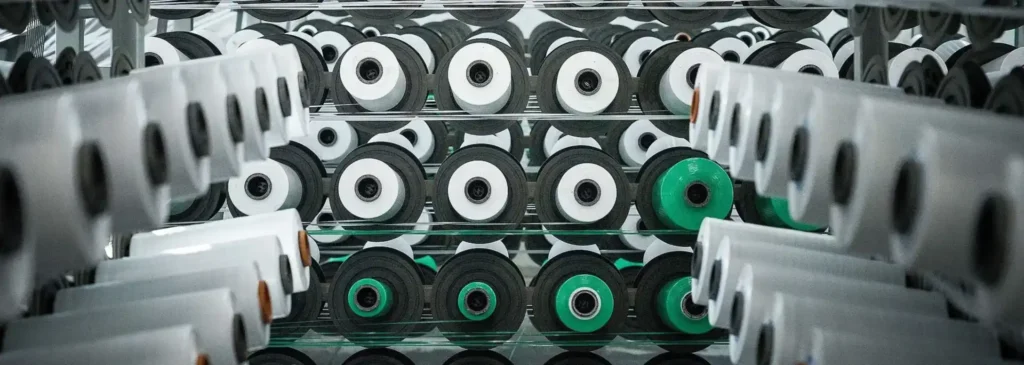
- Weaving. Circular or flat looms turn tapes into fabric; GSM, pick counts, and defects are controlled statistically.
- Coating/lamination. Extrusion coaters apply thin PP films that reduce sifting; surface energy is raised for clean printing.
- Cutting & printing. Computer‑guided cutters produce panels, spouts, and baffles; flexographic printing applies marks and instructions.
- Baffle fabrication. Apertures are die‑cut and reinforced where needed; edge sealing prevents fray and fines release.
- Sewing & assembly. 4‑ or 6‑panel bodies are stitched, loops attached, stress points bartacked; liners are inserted and secured.
- Testing & inspection. Top‑lift, stack, drop, and topple tests verify the design; static continuity is checked for Type C; labeling confirms usage zones.
- Cleanroom build (when specified). Food/pharma variants follow hygiene SOPs, with metal detection or X‑ray screening before bagging.
- Palletization & documentation. Bundles are strapped for export; certificates and lot codes enable end‑to‑end traceability.
| Test | Purpose | What to watch |
|---|---|---|
| Top‑lift | Loop and seam integrity at SWL×SF | Loop elongation, seam opening, thread breaks |
| Stacking | Creep under long‑duration compression | Dimensional drift, bulge reappearance, lean |
| Drop & topple | Impact resistance and stability | Panel tears, seam bursts, liner integrity |
| Static checks | Ignition risk control | Grounding continuity (Type C), fabric behavior (Type D) |
Where Anti‑Bulge FIBC Bags excel
Consider the range: polymer pellets and masterbatches that prefer clean corners, fertilizers that punish seams with dense loads, cements and fly ash that flow like slow liquid, sugars and starches that hate humidity, lithium salts and graphite that demand static discipline. The same family of containers—Anti‑Bulge FIBC Bags—can be tuned for all of them with the right mix of fabric, liner, and safety type.
- Chemicals & polymers: polyethylene, polypropylene, pigments, additives, catalyst carriers.
- Fertilizers & agro: urea, NPK blends, seed and grain programs, feed premixes.
- Minerals & building products: cement, fly ash, silica sand, calcium carbonate, gypsum.
- Food & ingredients: sugar, salt, flour, starch, cocoa, coffee; moisture and odor protection via liners.
- New‑energy materials: lithium carbonate/hydroxide, cathode/anode powders, battery‑grade graphite where Type C or D safety is vital.
- Recycling & waste: plastic regrind, rubber crumb, metal powders; cubic stacking reduces floor cost per ton.
A single program often mixes several builds: an industrial‑grade bag for domestic lanes, a food‑contact variant for export, and a static‑protected bag for flammable vapor zones—yet all share the same baffle geometry so warehouse processes stay uniform.
Choosing specifications without over‑engineering
Specification is a balancing act. Under‑spec and you court failure; over‑spec and you buy weight you never use. The art of Anti‑Bulge FIBC Bags is to match fabric GSM, seam pattern, baffle aperture area, and liner gauge to the actual product and the real route—forklift patterns, stacking heights, humidity, and the physics of your plant’s filling and discharge stations.
| Parameter | Typical range | Why it matters |
|---|---|---|
| SWL | 500–2,000 kg | Aligns with bulk density and route handling |
| Safety Factor | 5:1 single‑trip; 6:1 multi‑trip | Defines reuse window and margin to failure |
| Fabric GSM | 130–220 g/m² | Strength without unnecessary mass |
| Coating | 0/20/30/40 g/m² | Trade‑off between breathability and barrier |
| Liner thickness | 60–150 μm | Barrier level vs. discharge behavior |
| Static class | A/B/C/D | Hazard zone compatibility |
A framework for selection and validation
Start with the product: bulk density, particle morphology, humidity sensitivity, flammability. Build the safety envelope: SWL, Safety Factor, static class. Choose geometry: pallet footprint and height for racking, anti‑bulge baffles for cubic fidelity. Decide on barriers: liner type and gauge. Add handling: top filling (spout, duffle, open), bottom discharge (spout, cone, flat). Specify cleanliness: industrial, food, or pharma. Then test. Pilot runs reveal what drawings cannot: corner fill, spout compatibility, discharge time, floor behavior during stacking.
Internal reference
Many teams keep a simple matrix: product line × bag variant × test results. It avoids the silent creep of over‑spec—an extra 20 g/m² here, a thicker liner there—that adds cost without adding safety.
Comparing anti‑bulge and standard builds
| Criterion | Anti‑bulge (baffle/Q‑bag) | Standard bag |
|---|---|---|
| Shape retention | Square edges preserved | Pronounced side bulging |
| Pallet fit | Tight; often higher case count | Loose; lower utilization |
| Container utilization | Often +5–15% | Baseline |
| Stack stability | Improved vertical load path | More lean/creep risk |
| Unit cost | Slightly higher | Lower |
Logistics arithmetic that changes margins
Imagine a free‑flowing polymer at 0.75 t/m³ packed into 1,000 kg units. A standard bag plan loads 20 pallets into a 40’ HC container. The same footprint, rendered cubic by Anti‑Bulge FIBC Bags, often fits 22 pallets under compliant loading rules. The math is unromantic and decisive: if ocean freight is 3,000 USD per container, the rate per ton drops from 150 USD/t to 136 USD/t. Repeat that line after line, quarter after quarter, and you have a logistical dividend large enough to fund better testing, better labels, better training—and still show a saving.
A system view of packaging in a manufacturing powerhouse
Industrial packaging sits where policy meets physics. The system is bigger than a bag: it includes petrochemical capacity, weaving clusters, testing labs, white‑room facilities, port logistics, and recycling infrastructure. Anti‑Bulge FIBC Bags fit into this system as lightweight enablers of density, safety, and traceability. When factories standardize specifications, when distributors align on labeling, when ports require documentation that can be scanned in seconds, the whole network moves faster.
Standardization momentum
Clearer stacking protocols, stronger labeling conventions, and more rigorous type testing narrow variability and build trust across borders.
Static‑safety differentiation
Type C and D builds anchor programs for combustible dusts and flammable vapor zones; training turns labels into behavior.
Sustainability arc
Mono‑material recoverability and take‑back pilots convert lightweight efficiency into credible end‑of‑life stories.
Cost discipline
Index‑linked resin contracts and right‑sized specs mute volatility without blunting competitiveness.
Practical playbook: from inquiry to first shipment
Define the product and hazards; set SWL/SF; choose geometry; specify barriers; select handling features; lock in cleanliness; run pilots; log results; iterate. Then codify everything into a one‑page specification that your buyers, plant operators, and 3PL partners can all understand at a glance. The prize is repeatability without rigidity—Anti‑Bulge FIBC Bags that are consistent across lots but agile across product lines.
- Gather data: density, particle size, angle of repose, humidity sensitivity, flammability class.
- Set safety: SWL, Safety Factor, static class; confirm grounding procedures if Type C.
- Pick geometry: anti‑bulge with baffles sized to flow; pallet footprint and overall height for racking.
- Choose barriers: liner material, thickness, and attachment method.
- Match top/bottom: spouts and cones tailored to your filling and discharge hardware.
- Decide cleanliness: industrial vs. food vs. pharma; white‑room steps if required.
- Prototype and pilot: observe fill times, corner formation, discharge behavior, and stack performance.
- Freeze and document: material list, stitch programs, test certificates, and labeling.
Long‑tail phrasing and everyday terms, together on purpose
To be findable to engineers and buyers alike, language must stretch comfortably from the technical to the ordinary. That is why this guide uses both specialist tags—UN 31H2, Type C, Type D—and conversational handles—baffle bags, Q‑bags, square jumbo bags. Whether the query is “form‑stable FIBC for lithium carbonate,” “cubic bulk bag for container optimization,” or simply “square big bag,” the answer can still be the same: Anti‑Bulge FIBC Bags.
For a concise overview of related products and build options, see this reference on form‑stable bulk bags, which outlines families of FIBC designs often used alongside Anti‑Bulge FIBC Bags in mixed fleets.
Risk controls that actually work on the floor
Risk control is not a PDF; it is muscle memory. Labels matter, but so do daily walk‑arounds, grounding checks, and the discipline to retire a bag that looks tired. A simple rule helps: when in doubt, swap it out. Static safety is a behavior as much as a material class, and stacking safety is a plan as much as a test.
- Ground Type C bags at all connection points before filling or discharge; verify continuity.
- Keep Type D bags away from contamination with conductive grime that can short dissipative behavior.
- Respect maximum stack heights and compressive dwell times; track creep over season changes.
- Inspect loops, seams, and baffle anchor points before each reuse; retire on visible damage.
- Document lot codes on receiving; link to certificates for traceable investigations when needed.
Cost, mass, and the quiet power of total cost of ownership
Fabric grams matter; liner microns matter; coating grams per square meter matter. But the quiet variable, the one that dominates in the ledger, is space. If Anti‑Bulge FIBC Bags buy you even a few more pallets per container or a safer extra layer in the rack, the dividend dwarfs small material deltas. Unit price is visible; TCO is decisive.
| Cost driver | Adds cost | Reduces cost |
|---|---|---|
| Fabric & GSM | Heavier fabrics, premium masterbatches | Optimized GSM and mono‑material designs |
| Liner/barrier | Thick or multi‑layer barriers | Right‑sized gauge; form‑fit only where needed |
| Static class | Type C/D fabrics and hardware | Use A/B when safe; avoid over‑spec |
| Cleanliness | White‑room, metal detection, extra bagging | Industrial grade where appropriate |
| Logistics | Inefficient load plans and stack rules | Cubic fidelity from baffles and better stacking |
Glossary for everyday alignment
- Baffle apertures: cut‑outs in internal walls that guide powder into corners for a cubic shape.
- Form‑fit liner: a liner shaped to the bag interior so it does not round the cube.
- Safety Factor: ratio of failure load to SWL; often 5:1 for single‑trip, 6:1 for multi‑trip.
- Angle of repose: the natural slope angle of a piled powder; informs aperture design.
- UN 31H1/31H2: codes for woven plastic FIBCs without/with liners used for dangerous goods.
- Cross‑corner loops: corner‑sewn loops that make forklift tine entry easier and more stable.
- Creep: long‑term deformation under compressive load that influences safe stacking limits.
- What exactly are Anti‑Bulge FIBC Bags?
- Why the industry keeps returning to the same question
- From resin to architecture: materials that make form stability possible
- Features that matter when forklifts meet physics
- How Anti‑Bulge FIBC Bags are manufactured
- Where Anti‑Bulge FIBC Bags excel
- Choosing specifications without over‑engineering
- A framework for selection and validation
- Comparing anti‑bulge and standard builds
- Logistics arithmetic that changes margins
- A system view of packaging in a manufacturing powerhouse
- Practical playbook: from inquiry to first shipment
- Long‑tail phrasing and everyday terms, together on purpose
- Risk controls that actually work on the floor
- Cost, mass, and the quiet power of total cost of ownership
- Glossary for everyday alignment
“How can anti-bulge FIBC bags address the dual challenges of load stability and sustainability in China’s rapidly evolving packaging sector?” This question, posed by a logistics director at a recent industry summit, highlights the critical need for innovation in bulk material handling. The answer lies in advanced material engineering, strategic customization, and robust quality control systems—principles that VidePak, a global leader in woven packaging since 2008, has mastered through its integration of Austrian Starlinger machinery and ISO-certified processes.
1. The Rise of Anti-Bulge FIBC Bags in China’s Packaging Landscape
China’s packaging industry, valued at $180 billion in 2024, is projected to grow at a 6.5% CAGR through 2030, driven by e-commerce, construction, and agricultural sectors. Anti-bulge FIBC (Flexible Intermediate Bulk Container) bags, designed to resist lateral expansion under heavy loads (up to 2,000 kg), have emerged as a cornerstone of this growth. VidePak’s FIBC bags, produced using Starlinger circular looms, achieve fabric densities of 14–16 threads/cm², ensuring tensile strengths of 2,500 N/5 cm (ISO 527-3)—25% higher than industry averages.
1.1 Market Drivers
- Construction Boom: China’s infrastructure projects demand bags that withstand abrasive materials like cement and sand. VidePak’s UV-stabilized PP retains 90% strength after 500 hours of sunlight exposure (ASTM G154).
- Agricultural Storage: Moisture-resistant FIBCs with PE liners reduce grain spoilage by 40% in humid climates like Guangdong.
2. Customization and Warehouse Management Innovations
Anti-bulge FIBC bags are not just functional containers but tools for operational efficiency. VidePak’s customization strategies include:
2.1 Color-Coded Labeling Systems
- Color Strips: Integrated blue, red, or green strips enable instant category identification (e.g., blue for chemicals, red for flammables).
- QR Code Integration: Laser-printed QR codes allow real-time inventory tracking via RFID, reducing warehouse errors by 25%.
2.2 Structural Enhancements
| Feature | VidePak Design | Industry Standard |
|---|---|---|
| Load Capacity | 2,000 kg (6:1 safety factor) | 1,500 kg |
| Seam Strength | 35 N/mm² (ultrasonic welding) | 25 N/mm² |
| Moisture Barrier | <5 g/m²/day (PE-lined) | <15 g/m²/day |
3. Material Science and Quality Assurance
VidePak’s FIBC bags undergo a 15-stage testing protocol, aligning with ISO 9001 and ASTM standards:
- Tensile Strength: 2,500 N/5 cm warp/weft (ISO 527-3), validated in abrasive mineral storage.
- Anti-Static Properties: Surface resistivity <10⁸ Ω/m² (ASTM D257), critical for electronics packaging.
- Seam Integrity: Withstands 30 kPa pressure without delamination (ISO 13937-2).
3.1 Sustainability Alignment
- Recycled PP: 30% post-industrial recycled content reduces carbon footprint by 20%.
- Circular Economy: Bags are 100% recyclable, complying with EU Packaging Waste Directive 94/62/EC.
4. Strategic Advantages for Chinese Manufacturers
VidePak’s dominance stems from:
| Factor | VidePak Advantage | Competitor Benchmark |
|---|---|---|
| Production Speed | 200 bags/hour (Starlinger AD 7350) | 120 bags/hour |
| Customization | 7-day lead time for color strips/QR | 15–20 days |
| Global Reach | 50+ countries, 20,000 tons shipped/year | Limited to regional markets |
5. FAQs: Addressing Industry Concerns
Q1: How do anti-bulge FIBCs compare to standard FIBCs?
A: Anti-bulge designs reduce lateral expansion by 50%, preventing stack collapses in warehouses.
Q2: Can these bags withstand maritime humidity?
A: Yes. PE-lined variants achieve <5 g/m²/day moisture permeability (ASTM E96).
Q3: Are custom prints durable?
A: High-definition flexography retains 95% vibrancy after 10,000 handling cycles.
6. Future Trends: Smart Packaging and Automation
- IoT Integration: Temperature/humidity sensors embedded in liners, piloted with EU agro-firms.
- Biodegradable Blends: PLA-PP hybrids targeting 50% biodegradability by 2026.
External Resources:
- Explore how anti-bulge FIBC designs enhance logistics safety.
- Learn about sustainable FIBC production practices.
Conclusion
Anti-bulge FIBC bags are redefining China’s packaging industry through engineering precision and sustainability. VidePak’s fusion of Starlinger automation, multi-layered testing, and client-driven innovation positions it as a global leader. As industries prioritize efficiency and eco-compliance, VidePak’s solutions will remain pivotal in shaping the future of bulk logistics.