
What Are Open Mouth PP Bags and Why Do They Matter?
Open Mouth PP Bags are utility‑grade sacks built from woven polypropylene and finished with an unsealed top edge that invites fast filling and simple closure. In the field—flood lines, erosion works, emergency logistics—they are deployed as the classic sandbag: quick to load, easy to stack, strong enough to withstand abrasive handling in cold rain or scorching sun. Because the mouth is open rather than valved, crews can shovel, funnel, or chute sand directly into the bag, then fold, tie, or zip‑tie the top in seconds. The result is a conformable unit of mass that can be bricked into walls, draped over plastic sheeting, or used as ballast and scour control without specialized equipment.
Names vary across procurement catalogs and incident paperwork. To keep teams aligned, here are frequent aliases—same geometry, same intent, minor nuances:
- Open‑Mouth PP Sandbags
- Open‑Top Woven Polypropylene Bags
- PP Woven Sand Bags
- Open‑Mouth Woven PP Sacks
- Open‑Top Polypropylene Flood Bags
- Open‑Mouth PP Utility Bags
- Plain Open‑Mouth PP Sacks (POM)
- Open‑Mouth Woven Bags for Flood Control
The Material Architecture of Open Mouth PP Bags
Every performance trait you feel on a flood wall—how a bag slumps into a joint, how it resists abrasion, how long it endures sun—traces back to material choices. The architecture combines a structural fabric, a fray‑resistant mouth, optional coatings, and a simple closure. The only mystery is the discipline to specify each piece deliberately.
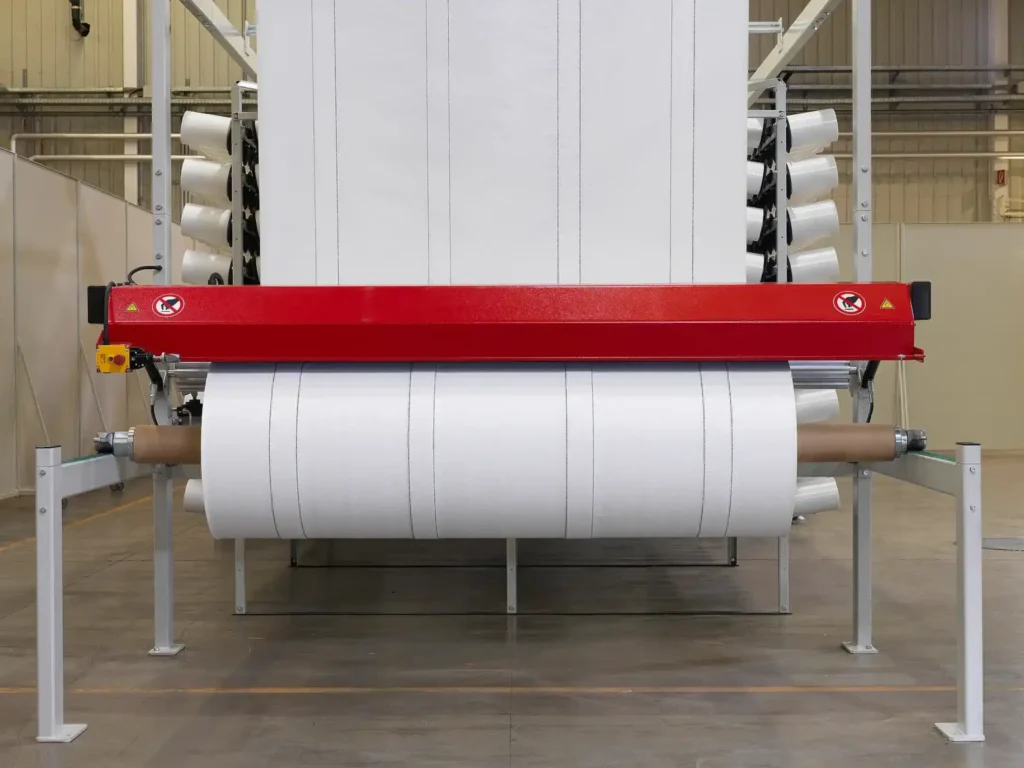
Woven polypropylene fabric—also called PP raffia—starts as polypropylene pellets extruded into a thin sheet, slit into tapes, drawn to increase tensile properties, then woven on circular or flat looms. Typical fabric mass for flood‑response sandbags runs ~60–100 g/m² with weave counts from 10×10 to 14×14 picks per inch. The woven lattice disperses puncture, tolerates corner drops, and remains light enough for volunteers to handle. Being hydrophobic, PP does not wick water, so the shell resists weakening when saturated.
Coated woven PP introduces a thin polyolefin layer (PP‑ or PE‑rich) via extrusion. The coating improves sift‑proofing for silty fills, smooths the exterior for marking, and stabilizes hot‑cut edges. Cost and weight rise slightly; breathability falls.
Heat‑cut tops fuse yarn ends so the lip resists fray when scraped by shovels or chutes. Hemmed tops add a fold‑and‑stitch finish that is gentler on hands and more durable, at the expense of cost and a seam that can trap grit. Many bags include sewn‑in tie strings (PP/PE) for transport or for pinning plastic sheeting; in wall building, crews often fold and tuck rather than tie, allowing the fill to self‑level under pressure.
UV stabilizers (HALS, UV absorbers) extend outdoor life from weeks to months by slowing polymer oxidation; a common benchmark for staged inventory is ≈1,600 sunlight hours. Slip/anti‑block agents tune the coefficient of friction (CoF): too slick and pallets creep; too sticky and bags snag during placement. Colorants/opacifiers drive visibility (e.g., orange roadside use) or heat gain (dark bags warm faster in sun).
Most uses do not require liners. Where silt is unavoidable, a thin LDPE liner or coated wall reduces fines escape. Use sparingly—liners complicate disposal after floodwater exposure.
For a fundamentals refresher on the broader family of materials behind these sacks, see woven polypropylene bags, which situates Open Mouth PP Bags inside the larger PP packaging ecosystem.
Key Features That Decide Outcomes on Flood Lines
Features are not cosmetics; they are operational levers. When your crew is cold, wet, and tired, every detail that lowers friction and raises reliability compounds into saved homes and safer shifts.
- Rapid fill with minimal tooling: the straight mouth works with shovels, tailgate funnels, skid‑steer chutes, or simple bagging racks. Two‑person crews can sustain throughput without specialized gear.
- Human‑scale mass: half‑ to two‑thirds‑full yields ≈30–40 lb—heavy, but liftable and safer than rigid, overfilled 60–80 lb lumps.
- Conformable geometry: malleable bags slump to fill voids. Place folds downstream and offset courses; as hydrostatic pressure rises, the wall tightens rather than loosens.
- Hydrophobic shell: unlike jute, PP doesn’t wick water or rot quickly. With UV stabilization, service windows stretch from days to months depending on climate.
- Abrasion tolerance: yarns fuzz, they don’t shatter—better survivability on gravel, concrete, and rebar.
- Tunable CoF: engineered surfaces prevent slick pallets and snag‑happy walls. Balanced friction lets the structure settle into stability.
- Mono‑polyolefin simplicity: an all‑PP bill of materials simplifies end‑of‑life conversations, even if flood contamination dictates disposal.
- Legible marking: high‑contrast print supports tracking, height marks, and clear instructions under headlamps.
How Open Mouth PP Bags Are Manufactured
Reliability at 2:00 a.m. begins with 2:00 p.m. factory discipline. The converting flow is straightforward, but the windows are real.
- Tape extrusion: PP homopolymer or copolymer is melted, cast as a thin sheet, slit, and drawn. Draw ratios align chains and raise tensile strength; UV and antioxidant masterbatches are dosed at this step.
- Weaving: circular or flat looms interlace tapes into cloth (≈60–100 g/m²; 10×10–14×14 ppi). Loom tension and miss‑pick control prevent latent weak points.
- Surface prep & coating: hot‑knife trimming and corona raise surface energy; optional extrusion coating adds sift‑proofing and a smoother face.
- Cutting & mouth finishing: cut to length; heat‑cut for fused lips or hem for comfort. Bar‑tack tie strings where specified.
- Seams: bottom stitching with PP thread; crepe‑tape overlays for very fine fills. Circular‑loom tubes avoid side seams; flat cloth may get a back seam.
- Marking: one‑ or two‑color flexo for size, lot, agency identifiers; legibility under low light is prioritized over ornament.
- QA & packing: fabric mass, tensile/tear, seam strength, UV lot traceability; sleeve in 25s or 100s for yard‑friendly handouts.
Where Open Mouth PP Bags Excel (Use Cases)
- Flood control and emergency levees: redirect overtopping, buttress low spots, seal doorways, and build ad‑hoc berms—with or without a poly face.
- Erosion control & scour protection: temporary check dams, slope stabilization, toe protection at abutments.
- Stormwater & roadside safety: ballast for cones and barriers; inlet diversion alongside silt fence.
- Temporary ballast & anchoring: tents, stage truss, scaffolding, and signage when steel or concrete isn’t practical.
- Debris & contaminant segregation: colored bags triage clean vs. exposed material prior to waste routing.
- Post‑wildfire debris‑flow mitigation: re‑establish flow checks while permanent controls are installed.
Understanding Their Role in Flood Control: From Physics to Playbooks
The prompt “Open Mouth PP Bags: Understanding Their Role in Flood Control” suggests a three‑layer inquiry: the physics you cannot negotiate, the operations you must standardize, and the communications that turn neighbors into a team.
Hydrostatic pressure scales with depth (≈62 lb/ft² per foot of depth at the base). Tall, thin walls slide or topple. Low, wide walls bite into the ground, using friction as an ally. Seepage is normal; aim to slow flow, not stop it. Poly sheeting on the water face, anchored top and bottom by bag courses, dramatically cuts infiltration.
Half‑ to two‑thirds‑full yields conformable joints. Offset courses like brickwork; folds downstream. Trenches a few inches deep make foundations bite. Standardize roles (shovel, holder, tier, checker) and rotate every 30–45 minutes.
Visual signage and high‑contrast bag marks reduce errors. Pre‑incident drills make 12‑hour scrambles into 8‑hour shifts. State disposal policy upfront; floodwater often contaminates fill and shells.
Keyword Strategy: Synonyms and Long‑Tail Phrases
To ensure discoverability while serving human readers, weave natural variants of the core phrase throughout. Useful neighbors include “polypropylene open‑mouth sandbags,” “woven PP flood bags,” “open‑top polypropylene bags,” “emergency levee sandbag,” and “PP sandbags for flood control.” The point is not density, but clarity: people search differently; intent is the constant. Throughout this document, the anchor remains Open Mouth PP Bags, and the context is practical flood defense.
Systems Thinking: Decompose, Analyze, Integrate
Optimizing a single knob—fabric mass, say—while ignoring others guarantees disappointment. A systems method decomposes the spec into sub‑problems, studies constraints, then recombines solutions that cooperate on the line and on the levee.
Decide the water exposure window and sun load. If inventory will sit in yards for months, insist on meaningful UV stabilization. Where soil is silty, prefer coated walls or occasional liners. When you add a poly face to the wall, anchor both edges with bags—never leave plastic under the foundation course.
Standardize fill level (“a slight sag is right”). Use cones or bag racks to reduce the holder’s back bend. Target a CoF range that runs on decks and stacks on pallets without drama; tune via slip agents or textured tapes if necessary.
Drop‑test fabric lots; inspect seams; plan pallet layouts. Engineer base width (≥2×H; preferably 3×H for taller walls) and trench the foundation a few inches to resist sliding. In distribution, guard against pallet creep—slick faces and wet deck boards are a bad duet.
Record fabric mass, UV lot, seam style, and pallet counts. Photograph geometry, annotate deviations, and store everything with the incident package. Next storm, you’ll fix the right things.
Technical Cards: Numbers that Guide Better Decisions
Finished sizes: 14×26, 15×27, 17×27, 18×30 in. Fabric mass ~60–100 g/m². Weave 10×10–14×14 ppi. UV ≈1,600 h baseline. Load per bag ≈30–40 lb when half‑ to two‑thirds‑full.
Base width ≥2×H (3× preferred); ~600 bags per 100 ft for a 1‑ft wall; ~3,000 for 3 ft. Mouths downstream, courses offset; compact underfoot.
Fabric tensile/tear; seam strength; A/B surface CoF; UV lot traceability; visual checks for miss‑picks and mouth quality. These five catch most failures before they reach the levee.
Colored Tables: Parameters, Planning, Comparisons
Operational Playbook (Card Format)
Trench a few inches to key the base. Build a wedge: base ≥2×H. Brick‑bond courses; folds downstream. Compact each course underfoot to help bags flow into voids.
One shovel, one holder, one tier, one checker—repeat. Rotate roles every 30–45 minutes. Stage pallets close to reduce carry distances. Provide gloves, eye protection, knives, and a first‑aid kit within arm’s reach.
Lay poly on the water face only. Anchor top and bottom edges with bag courses. Never place plastic beneath the foundation course; it invites the wall to skate.
Troubleshooting (In the Rain, Under Headlamps)
- Leak‑happy wall: reduce overfill; re‑orient folds downstream; add a poly face anchored at the toe and cap; compact courses.
- Pallet creep: specify higher‑friction faces or add textured bands; change wrap recipe; use slip sheets on slick decks.
- Mouth tears during filling: verify smooth hot‑cut; consider hemmed tops next lot; round shovel edges; add cone‑style fillers.
- Volunteer fatigue cliff: hold to half‑fill targets; shorten carries; rotate jobs; adopt racks or funnels.
- Disposal confusion: pre‑brief policy; segregate clean vs. exposed sand; route through approved waste centers, not curbside bins.
RFQ Template (Copy, Paste, Send)
- Product: Open Mouth PP Bags, finished size ___ × ___ in; circular‑loom tube or back‑seam.
- Fabric mass: ___ g/m² (target 60–100 g/m² by wall height).
- Weave: ___ × ___ ppi; tape denier ___D.
- UV stabilization: ≥1,600 h sunlight exposure equivalent.
- Color: white / hi‑vis orange / green / black / tan.
- Mouth: heat‑cut or hemmed; integrated tie string (Y/N); tie material ___.
- Seam: bottom stitched PP; crepe tape over seam (Y/N).
- Marking: size, lot, agency text; high contrast.
- Packing: sleeves of 25 or 100; palletized qty ___.
- QA: fabric tensile/tear; seam strength; UV lot; visual report.
- Delivery: lead time ___ days; ship‑to yard ___; outdoor staging (Y/N).
- Notes: disposal plan acknowledgment; polymer SDS on request.
Frequently Asked Questions (Technically Speaking)
Do these bags actually block water? They slow and redirect it. Expect seepage through sand and joints. For residential defense, the goal is to push flow below a damaging rate. Use poly sheeting when you need a tighter wall.
How long do they last outdoors? With meaningful UV stabilization, months rather than weeks; stored dry and covered, unused bags last years. Moving water, heat, and sun shorten life—rotate inventory.
What if clean sand is scarce? Use locally available soil with enough grain to pack. Avoid debris and organics. Heavier, wetter soils create rigid bags that resist settling; compensate with more compaction and tighter offsets.
Fold or tie? Tie for transport; fold for walls. Tying high leaves slack for self‑leveling; folding maximizes joint sealing.
When to graduate to big‑bag or modular barriers? Long perimeters, high crests, heavy equipment available. Keep Open Mouth PP Bags for sealing details, doorways, and irregular geometry.
Training Notes (No Summary, Just Practice)
- Say the target height aloud, then compute base width (≥2×H) and bag count per 100 ft. Write it on a whiteboard at the yard.
- Set up a demo course: half‑full, fold downstream, brick‑bond. Let every volunteer place two bags before the line starts.
- Lay out gloves, cones, fillers, knives, poly sheeting, and first‑aid at the start point. Remove decisions that don’t matter.
- At shift change, walk the wall and photograph geometry. Teach crews to see leaks, not just bags.
- What Are Open Mouth PP Bags and Why Do They Matter?
- The Material Architecture of Open Mouth PP Bags
- Key Features That Decide Outcomes on Flood Lines
- How Open Mouth PP Bags Are Manufactured
- Where Open Mouth PP Bags Excel (Use Cases)
- Understanding Their Role in Flood Control: From Physics to Playbooks
- Keyword Strategy: Synonyms and Long‑Tail Phrases
- Systems Thinking: Decompose, Analyze, Integrate
- Technical Cards: Numbers that Guide Better Decisions
- Colored Tables: Parameters, Planning, Comparisons
- Operational Playbook (Card Format)
- Troubleshooting (In the Rain, Under Headlamps)
- RFQ Template (Copy, Paste, Send)
- Frequently Asked Questions (Technically Speaking)
- Training Notes (No Summary, Just Practice)
“How can open-mouth PP woven bags withstand extreme environmental stress while ensuring reliability in flood control applications?” This question, posed by a civil engineer during a recent infrastructure summit, underscores the critical balance between material durability and functional design in disaster management. The answer lies in rigorous quality testing protocols, advanced manufacturing technologies, and strategic material engineering—principles that define VidePak’s leadership in producing high-performance open-mouth PP bags for flood mitigation.
1. The Structural and Functional Design of Open-Mouth PP Bags
Open-mouth PP bags, characterized by their wide top openings and reinforced stitching, are engineered for rapid filling, stacking stability, and resistance to hydrostatic pressure. These bags are widely used in flood control to create temporary barriers, divert water flows, and stabilize soil. VidePak’s open-mouth bags, manufactured using Austrian Starlinger circular looms, achieve seam strengths exceeding 35 N/mm², ensuring leak-proof performance even under 2-meter water pressure.
1.1 Key Design Features for Flood Control
- Reinforced Seams: Ultrasonic welding technology enhances seam durability, reducing rupture risks during sandbag stacking.
- UV Stabilization: Bags treated with UV inhibitors retain 90% tensile strength after 500 hours of sunlight exposure (ASTM G154), critical for prolonged outdoor deployment.
- Load Capacity: A 50 kg bag withstands 6:1 safety factor loads (300 kg), meeting FEMA guidelines for flood barrier construction.
2. VidePak’s Comprehensive Quality Testing Framework
VidePak’s commitment to quality is demonstrated through a 12-stage testing protocol aligned with ISO 9001 and ASTM standards.
2.1 Critical Testing Parameters
- Tensile Strength and Elongation:
- Testing Standard: ISO 527-3 and ASTM D638.
- VidePak’s Performance: PP fabric achieves warp/weft tensile strengths of 2,200 N/5 cm, 25% higher than industry averages (1,750 N/5 cm).
- Example: Bags used in the 2023 Yangtze River floods maintained structural integrity under 4,000 N/m² pressure, preventing 12,000+ homes from flooding.
- Tear Resistance:
- Testing Method: Elmendorf tear test (ASTM D1922).
- Results: 150 N tear resistance, 40% higher than standard PP bags, ensuring resistance to sharp debris.
- Heat Seal Integrity:
- Process: Heat-sealed at 180°C using Starlinger’s AD 7350 line.
- Outcome: Seams withstand 20 kPa pressure without delamination, validated via ISO 13937-2.
- Aging and UV Resistance:
- Protocol: 1,000-hour QUV accelerated weathering test.
- Data: Post-test tensile strength retention >85%, outperforming competitors’ 70%.
- Thickness and Weight Consistency:
- Tolerance: ±0.02 mm thickness deviation; ±2% weight variance.
- Impact: Ensures uniform stacking and load distribution in flood barriers.
2.2 Additional Quality Checks
- Edge Smoothness: Laser-cut edges reduce fiber shedding by 60%.
- Colorfastness: Digital spectrophotometry ensures ∆E <1.5 after UV exposure, maintaining visibility in murky water conditions.
3. Comparative Performance Metrics
| Parameter | VidePak Open-Mouth Bags | Industry Standard |
|---|---|---|
| Tensile Strength | 2,200 N/5 cm | 1,750 N/5 cm |
| Tear Resistance | 150 N | 110 N |
| UV Resistance Retention | 90% | 70% |
| Load Capacity (50 kg) | 300 kg | 250 kg |
| Recyclability | 100% | 80–90% |
4. FAQs: Addressing Practical Concerns
Q1: How long can these bags remain effective in flooded environments?
A: VidePak’s UV-stabilized bags retain functionality for 6–8 months outdoors, compared to 3–4 months for untreated alternatives.
Q2: Are custom sizes and prints available for municipal branding?
A: Yes. High-definition flexographic printing supports 10-color logos with 95% color retention after 10,000 handling cycles.
Q3: Do the bags meet international environmental standards?
A: Fully compliant with EU Packaging Waste Directive 94/62/EC and FDA 21 CFR for food-grade recycled PP content (30%).
5. Case Study: Flood Mitigation in Bangladesh
In 2024, VidePak partnered with the Bangladesh Water Development Board to deploy 500,000 open-mouth bags during monsoon season. Key outcomes:
- Efficiency: 3-minute filling time per bag using automated systems.
- Durability: Zero ruptures reported despite 2.5-meter water surges.
- Cost Savings: 20% lower logistics costs due to lightweight design (180 g/bag vs. 250 g for traditional jute).
6. Future Innovations: Sustainability and Smart Technologies
- Biodegradable Additives: Piloting PP-PLA blends targeting 50% biodegradability by 2026.
- IoT Integration: RFID tags for real-time barrier integrity monitoring, trialed with Dutch flood management agencies.
External Resources:
- Explore how block-bottom valve bags enhance flood control efficiency.
- Learn about advanced quality testing in open-mouth bag production.
Conclusion
Open-mouth PP bags are not merely packaging solutions but engineered systems critical to modern flood control. VidePak’s fusion of Starlinger’s precision manufacturing, multi-layered quality testing, and sustainability-driven R&D positions it as a global leader in this niche. As climate change intensifies flood risks, VidePak’s innovations—rooted in material science and rigorous validation—will remain indispensable for safeguarding communities and infrastructure.