
Orientation: why Sewn Open Mouth PP Bags quietly define modern pet‑food packaging
At first glance, packaging for dry kibbles and mixed feeds looks like a simple container choice. In practice it is a chain of causes. Pallet leaning, label scuffing, zipper failure, oil bleed, stale aromas—each outcome traces back to a spec the market calls by a deceptively modest name: Sewn Open Mouth PP Bags. This format combines a woven polypropylene body for mechanical strength, optional surface laminations for print and barrier, and a top opening that is filled from the mouth and then closed by sewing (often over a crepe tape) or by a pinch‑style hot melt fold. When engineered well, Sewn Open Mouth PP Bags reshape economics and experience: faster bagging, calmer stacks, longer shelf life, cleaner retail presence. When engineered poorly, the very same silhouette surrenders to dust, grease, and gravity.
What are Sewn Open Mouth PP Bags and what are they also called?
In straightforward terms, Sewn Open Mouth PP Bags (often abbreviated “SOM PP bags”) are industrial sacks produced from woven polypropylene fabric that are filled from the top opening and then closed by a stitching operation. They are the workhorse for 5–25 kg premium pet‑food formats (and up to 40 kg for farm feeds). By design, they combine tensile efficiency, puncture resistance, and print impact. The open mouth grants compatibility with a wide array of auger, gravity, and vibratory fillers; the sewn top offers a robust, field‑proven closure that tolerates minor surges in headspace dust and fats without letting go.
Common aliases that refer to the same construction or close variants:
- Open‑Mouth Woven Polypropylene Bags
- Woven PP SOM Sacks
- Stitched Top PP Feed Bags
- Woven Poly Bags with Sewn Closure
- BOPP Laminated Woven Pet‑Food Bags
- Easy‑Open Sewn PP Bags
Different names, same proposition: a high‑tenacity woven skeleton, a surface that carries brand graphics cleanly, and a closure that can be opened by consumers without tools yet resists transit abuse. The bag is judged by the days it preserves crunch, the grams it keeps in, and the meters it holds shape.
Materials and architecture of Sewn Open Mouth PP Bags
Packaging behavior is material science made visible. Change the resin grade, shift the draw ratio, increase coating weight, add a laminate layer, or insert a liner—and pallets behave differently. What follows is a practical anatomy lesson, tuned to pet‑food realities like oil migration, oxygen ingress, aroma retention, abrasion, and shelf impact.
Woven polypropylene base fabric (the load‑bearing skeleton)
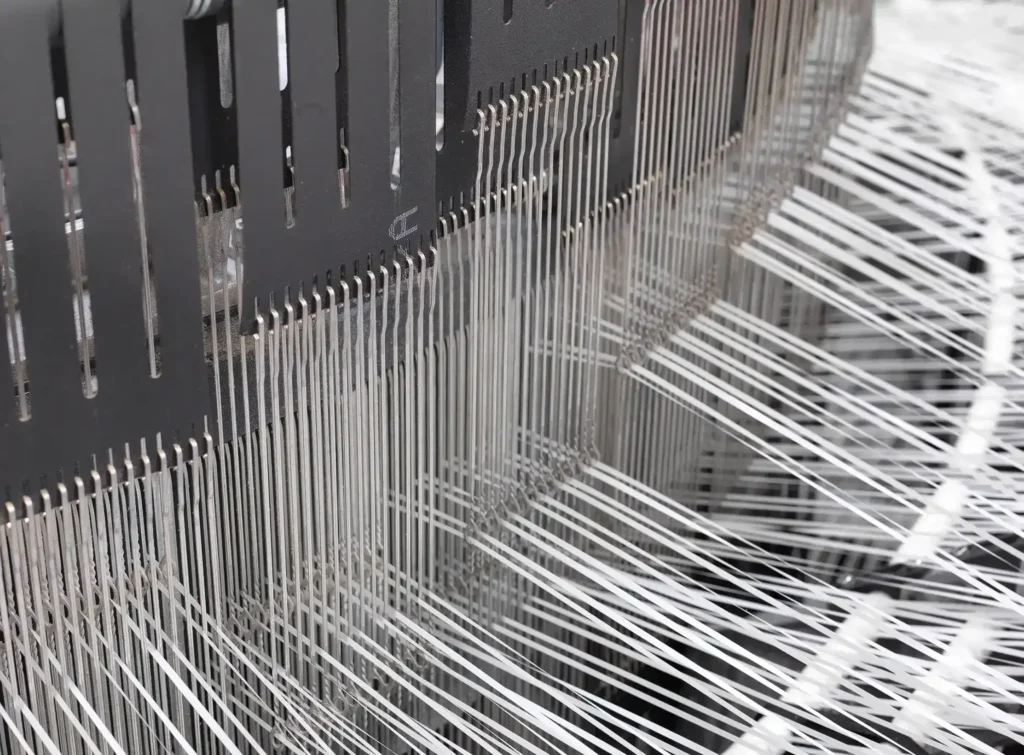
Isotactic polypropylene is extruded into a film, slit into tapes, and drawn to align polymer chains, lifting tenacity while controlling elongation. These tapes are woven—often on circular looms for tubular bodies or flat looms for block‑bottom patterns—at basis weights from 55 to 105 g/m² for most pet‑food duties. Higher GSM calms stacks and resists puncture from kibble edges or pallet splinters; lower GSM saves mass and cost when routes are short and stacks are low. PP’s hydrophobicity (low water uptake) and resistance to many salts and cleaning chemicals make it a sensible default for food‑adjacent logistics.
Surface systems: coated PP versus BOPP lamination
Two dominant face constructions are used on Sewn Open Mouth PP Bags. A coated PP face extrudes a thin polyethylene skin (typically 18–35 g/m²) onto the fabric to lower porosity and provide a printable surface for flexographic inks. A BOPP lamination bonds a biaxially oriented polypropylene film (often 18–25 μm) to the fabric, yielding superior graphic fidelity (photographic quality), improved scuff resistance with the right varnish, and a smoother feel in hand. BOPP can be glossy, matte, or even registered matte‑spot to create premium contrast on shelf. For oil‑rich recipes, BOPP’s tighter surface can reduce grease shadowing, while coated PP keeps costs lean for value lines.
Internal barrier: liners and laminar stacks
Kibble needs a moisture and oxygen regime that owns the shelf‑life curve. Options range from a simple LDPE tubed liner (60–100 μm) to custom coextrusions (e.g., PE/tie/EVOH/tie/PE) where oxygen transmission rates must be pushed down to mitigate fat oxidation. Some premium builds insert a gusseted liner that is hem‑tacked to the mouth so the consumer sees a clean opening after they pull the easy‑open tape. Others prefer a form‑fit liner that tracks the bag’s corners and avoids pleating at discharge. The choice depends on recipe oil load, target shelf life, and climate band.
Closure ecosystem: sewing, tapes, and easy‑open
The “open mouth” is closed by a sewn seam that bites through the bag wall (and liner, if present). Over the seam, a crepe paper tape cushions the needle path and absorbs minor oil bleed; a poly tape can add tear resistance. For consumer convenience, an easy‑open tear strip is sewn into the top: pull the string, release the seam, pour. The alternative is a pinch‑top (hot‑melt) fold that can be co‑engineered with a woven body when lamination layers are present; this hybrid is rarer but valued where needle holes are unacceptable.
Inks, coatings, and tactile finishes
Pet‑parents buy with eyes and hands. Abrasion‑resistant flexo or gravure inks provide color fastness. Varnishes (matte, soft‑touch, or sand‑grit anti‑slip) tune both shelf aesthetics and pallet friction. High‑contrast data plates supporting variable information (batch, lot, best‑by) protect traceability. For outdoor logistics, UV stabilization packages keep whites white and blues blue.
| Layer | What it does | Primary knobs | Trade‑offs |
|---|---|---|---|
| Woven PP fabric | Carries load, resists puncture, governs stack shape | GSM, weave density, tenacity, elongation | Higher GSM calms stacks but adds mass and cost |
| Face (coated PP or BOPP) | Print fidelity, scuff resistance, moisture surface barrier | Coating g/m² or BOPP μm; varnish type | BOPP lifts cost but upgrades shelf presence |
| Internal liner | Moisture/oxygen control; odor retention; grease barrier | Polymer family, thickness, gusset vs. form‑fit | Form‑fit handles beautifully but adds cost and handling steps |
| Sewn closure | Primary tamper resistance; consumer openability | Stitch density (SPI), thread tex, tape type, easy‑open | Needle holes must be managed if a liner is present |
Feature set that makes Sewn Open Mouth PP Bags outperform look‑alikes
Speed with control; moisture governance; print charisma; stack stability; consumer openability; recyclability within the polyolefin family: these are not slogans, they are levers. Pull them in sequence and the line runs faster and cleaner, complaints ebb, and shelf presence sharpens. Ignore them and the same line ships fines, grease marks, and headaches.
Production process for Sewn Open Mouth PP Bags and why equipment pedigree matters
Reliability is the sum of controlled steps. Inputs are verified, tapes are drawn, fabrics are woven, faces are laminated or coated, graphics are anchored, patterns are cut, liners are inserted, mouths are sewn, and pallets are built. Each link can hold or fail. The difference is process capability and machine discipline—especially when running oil‑rich recipes and long‑haul climates.
- Front‑end checks: PP melt flow, tape tenacity/elongation, coating weight or BOPP adhesion, ink rub, liner WVTR/OTR, and easy‑open string tensile. Incoming COAs are matched and retains archived.
- Tape extrusion: a sheet is slit into tapes; draw ratios are tuned to balance strength with flexibility; winders build packages that feed looms without breaks.
- Weaving: circular or flat looms hold mesh density and width; defects are trapped early with automatic vision or disciplined patrol inspection.
- Coating/lamination: a melt curtain of PE is extruded or a BOPP film is bonded; grams‑per‑square‑meter and bond strength are monitored; corona energy is set to hold inks and labels.
- Printing: high‑fidelity flexo or gravure; abrasion‑resistant ink sets; registration control for data windows and matte‑spot effects.
- Cutting & conversion: panels and bases are cut; liners are hem‑tacked or left free; block‑bottom folds formed where specified.
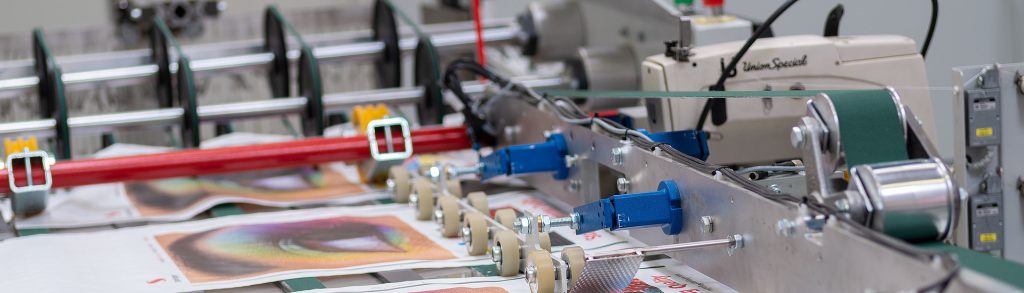
- Sewing & easy‑open: stitch density (SPI), thread tex, and seam class are matched to load; crepe tape placement is verified; easy‑open tear cord seating is checked.
- Finishing & palletizing: counting, bundling, corner boards, and wraps; documentation pockets are applied; barcode readability is spot‑checked.
- Final tests: tear/tensile, burst, top‑load deformation, seam strength, needle path leakage (with talc), rub resistance, and liner leak for barrier builds.
Applications: where Sewn Open Mouth PP Bags excel in pet‑food and adjacent categories
The geometry that made open‑mouth sacks a staple in feeds now anchors premium pet‑food portfolios. In kibbles, the emphasis is moisture and oxygen control plus irresistible shelf presence. In treats and mixed inclusions, it’s crumb management and resealability. In farm feeds, it’s tear resistance and tolerant closures. Across all, pallet truth matters: neat stacks that resist leaning, travel well, and face cleanly on shelves.
- Companion‑animal kibbles: chicken, salmon, lamb recipes; oil management via BOPP + liner; easy‑open for kitchen convenience
- High‑meat or high‑fat lines: EVOH liners to slow oxidation; sew‑over‑tape to guard needle paths
- Cat litters and absorbents: woven PP skeleton resists puncture; anti‑slip keeps pallets safe
- Farm feeds and supplements: coarse meal and pellets; plain coated PP faces with robust sewing
- Adjacencies: rice and grains; birdseed mixes; horticultural blends; where strength meets shelf appeal
How VidePak guarantees Sewn Open Mouth PP Bags quality from spec to shipment
Quality is choreography—and repetition. VidePak’s four‑pillar model turns specifications into behavior the field can trust.
“Sewn Open Mouth PP Bags: Utilization in Pet Food Packaging” — a structured walk‑through
When teams hear the phrase above, they sketch the same whiteboard: environment, recipe, route, packer interface, retail shelf, and consumer moment. Specifications only matter if they map cleanly to those pressures. Below is a translation chart turned into action.
Specification core
- Capacity: 5–25 kg core retail; 10–40 kg for bulk and kennel; dimensions matched to density and pallet plan
- Fabric: 65–95 g/m² for premium pet food; climb for tall stacks or abrasive inclusions
- Face: BOPP 18–25 μm for brand graphics; or coated PP 20–30 g/m² for value lines
- Liner: 70–100 μm PE for moisture; add EVOH coex for extended shelf; gusseted or form‑fit based on discharge
- Closure: sewn over crepe tape with easy‑open string; or pinch‑top hybrid when needle paths are unacceptable
- Friction: anti‑slip lacquer or sand‑finish stripes to protect tall stacks
- Data: high‑contrast batch and best‑by windows with scuff‑resistant varnish
Application‑driven tweaks
- High‑fat salmon recipe: BOPP matte face + EVOH liner; sew over crepe tape; QA focus on oxygen ingress
- Chicken & rice mainstream: coated PP face; PE liner 80 μm; easy‑open string; anti‑slip stripe for warehouse safety
- Working‑dog 25 kg: heavier fabric (90+ g/m²); tough thread; reinforced sew patterns; block‑bottom for cube
- Treats and mix‑ins: BOPP gloss with varnish windows; easy‑open for frequent reseal (consumer transfers to bins)
Decision narrative
If humidity dominates, bias the barrier stack (face + liner) and ensure needle path management. If oxygen‑driven rancidity is the limiter, trial EVOH and map OTR under worst‑case climate. If shelf presence is decisive, favor BOPP with matte‑spot and tactile varnishes. If pallet incidents loom, upgrade anti‑slip and body GSM. The mistake is to optimize for last year’s complaint while ignoring next quarter’s climate and route.
Systems thinking: from sub‑problems to a cohesive spec for Sewn Open Mouth PP Bags
Break the design into physics (humidity ingress, oxygen diffusion, oil migration, abrasion), structure (fabric GSM, face, liner, mouth geometry), process (extrusion → weaving → coating/lamination → printing → conversion → sewing), regulation (labeling, traceability), and economics (bag price vs. delivered cost). Assign a measurable to each: WVTR, OTR, seam strength, rub resistance, top‑load deformation, fill‑cycle time. Pilot under the climate your route actually sees, not the climate your office enjoys. Integrate with buffers: enough barrier for storm delays, enough stiffness for bumpy floors, enough ink durability for rough rail legs. That is how specs stop being optimistic artifacts and start being operational safeguards.
Technical tables for Sewn Open Mouth PP Bags
| Parameter | Typical options / ranges | Engineering notes |
|---|---|---|
| Bag capacity | 5–25 kg retail; 10–40 kg working‑dog/farm | Match footprint to density and pallet plan |
| Fabric GSM | 55–105 g/m² | Increase for tall stacks or abrasive recipes |
| Face construction | Coated PP 18–35 g/m²; BOPP 18–25 μm | BOPP for premium graphics and scuff control |
| Liner options | PE 70–100 μm; PE/EVOH/PE 60–90 μm | Choose by oil load and shelf‑life target |
| Closure | Sewn over crepe tape; easy‑open; pinch‑top hybrid | Manage needle path when liners are present |
| Anti‑slip | Stripe or full‑surface textures | Protects tall stacks and container loads |
| UV stabilization | 200–500 h class | Match to likely outdoor dwell |
| Component | Illustrative spec | Function |
|---|---|---|
| Woven PP fabric | 80 g/m²; 100 cm layflat; high mesh | Mechanical strength; puncture resistance |
| BOPP face | 20 μm; matte‑spot; soft‑touch varnish | Premium graphics; scuff resistance; tactile appeal |
| Liner | PE/EVOH/PE 80 μm; gusseted; hem‑tacked | Moisture and oxygen control; odor retention |
| Sewn closure | 8–10 SPI; crepe tape; easy‑open string | Tamper resistance; consumer convenience |
| Anti‑slip | Sand‑finish stripes; coefficient uplift | Stack stability; pallet safety |
Failure modes and controls for fielded Sewn Open Mouth PP Bags
Grease halos on panels? Reduce surface energy mismatch, upgrade to BOPP, and consider an inner grease barrier. Stale aroma complaints? Push OTR down with EVOH and validate needle path management. Leaning pallets? Raise GSM or anti‑slip and verify stack height. Scuffed labels? Use rub‑resistant inks and protective varnish. The pattern is simple but non‑negotiable: name the risk, select the control, then verify with tests that mirror your route.
| Risk | Primary control | Secondary control |
|---|---|---|
| Oil migration / grease halos | BOPP face; liner upgrade | Crepe tape under seam; low‑temp storage |
| Rancidity / aroma loss | EVOH liner; tight needle path control | Cool chain; limit dwell at high RH/heat |
| Pallet lean / bulge | Higher GSM; anti‑slip; block‑bottom | Pallet stiffness; wrap spec |
| Scuffed graphics / unreadable barcodes | Rub‑resistant inks; protective varnish | Data plate placement; over‑laminate |
Cost levers, value levers, and the ROI of Sewn Open Mouth PP Bags
A unit price is a small number that masks large consequences. Fabric GSM, BOPP lamination, liner architecture, and easy‑open hardware do move the line item. But pallet stability reduces wrap and rework; premium faces lift shelf conversion; faster fills cut labor; lower claims protect margins; and extended shelf life can trim write‑offs. Well‑aimed grams of barrier or GSM often repay themselves by the first reorder.
Sustainability pathway for Sewn Open Mouth PP Bags without sacrificing safety
Mono‑material thinking helps. Keep the structural family in polypropylene, use polyethylene for faces or liners, and design for separation at end‑of‑life. Avoid dark masterbatches that depress recyclate value; print recycling guidance onto data plates via QR. In operation, high strength‑to‑mass ratios and block‑bottom cube efficiency reduce transport emissions per ton. Where rules permit, controlled recycled content can enter non‑food adjunct SKUs—but only with stout QA and evidence that safety margins remain intact.
Procurement checklist tailored to Sewn Open Mouth PP Bags
- Define target fill weights and pallet/stack pattern by route.
- Choose face: coated PP for value lines; BOPP for premium branding.
- Select fabric GSM matched to stack height and abrasion risk.
- Engineer the barrier: liner type and thickness; map WVTR/OTR to shelf life.
- Lock the closure: stitch density, crepe tape, easy‑open string, or pinch‑top hybrid.
- Specify anti‑slip and pallet stiffness to suit warehouse practices.
- Define print windows, barcode contrast, and data plate protection.
- List tests: tear/tensile, seams, burst, WVTR/OTR spot, rub, barcode scan.
- Pilot bags on actual fill and stack workflows before scale‑up.
- Collect field data; iterate specs; train line operators.
Appendix: example specification snapshot for export‑grade Sewn Open Mouth PP Bags
- Format: 15 kg and 20 kg pet‑food SKUs; block‑bottom woven body
- Fabric: 85–90 g/m² PP; high mesh; UV‑stabilized
- Face: 20 μm BOPP with matte‑spot and soft‑touch varnish
- Liner: PE/EVOH/PE 80 μm; gusseted; hem‑tacked; easy‑open string routed above liner hem
- Closure: sewn over crepe tape; 9 SPI; polyester/cotton thread; pull‑to‑open cord
- Friction: dual sand‑finish stripes; target static friction uplift for pallet safety
- Data: high‑contrast batch/best‑by plate; abrasion‑resistant ink set
- Palletizing: heat‑treated pallets; edge boards; wrap spec matched to stack height
- Tests: seam and burst; top‑load deformation; WVTR/OTR spot; print rub; barcode verification
October 20, 2025
- Orientation: why Sewn Open Mouth PP Bags quietly define modern pet‑food packaging
- What are Sewn Open Mouth PP Bags and what are they also called?
- Materials and architecture of Sewn Open Mouth PP Bags
- Feature set that makes Sewn Open Mouth PP Bags outperform look‑alikes
- Production process for Sewn Open Mouth PP Bags and why equipment pedigree matters
- Applications: where Sewn Open Mouth PP Bags excel in pet‑food and adjacent categories
- How VidePak guarantees Sewn Open Mouth PP Bags quality from spec to shipment
- “Sewn Open Mouth PP Bags: Utilization in Pet Food Packaging” — a structured walk‑through
- Systems thinking: from sub‑problems to a cohesive spec for Sewn Open Mouth PP Bags
- Technical tables for Sewn Open Mouth PP Bags
- Failure modes and controls for fielded Sewn Open Mouth PP Bags
- Cost levers, value levers, and the ROI of Sewn Open Mouth PP Bags
- Sustainability pathway for Sewn Open Mouth PP Bags without sacrificing safety
- Procurement checklist tailored to Sewn Open Mouth PP Bags
- Appendix: example specification snapshot for export‑grade Sewn Open Mouth PP Bags
- 1. Anatomy of Sewn Open Mouth PP Bags: Engineering for Pet Food Safety
- 2. Precision Sewing Technologies: Stitch by Stitch Analysis
- 3. Bag Mouth Designs: Functional Diversity
- 4. Material Innovations: Beyond Basic PP
- 5. Storage and Handling Protocols
- 6. FAQs: Addressing Industry Pain Points
- 7. Sustainability: The Next Frontier
- 8. Conclusion
“Why are sewn open mouth (SOM) PP bags increasingly replacing traditional packaging for premium pet food brands?” This question underscores a pivotal shift toward durable, customizable solutions in the $110 billion global pet food market. The answer lies in their superior seal integrity, adaptability to automated filling systems, and cost-efficiency—capabilities VidePak has refined through 30+ years of expertise in advanced sewing technologies and material science. With 526 employees and $80 million in annual revenue, VidePak combines Austrian Starlinger machinery with proprietary sewing techniques to deliver SOM bags that balance performance and aesthetics.
1. Anatomy of Sewn Open Mouth PP Bags: Engineering for Pet Food Safety
Sewn open mouth PP bags feature a woven polypropylene body with stitched closures, offering:
- Load capacity: 5–25 kg, ideal for dry kibble and treats.
- Moisture resistance: BOPP-laminated variants achieve 0.02 g/m²/24h WVTR (ASTM E96).
- Printability: Up to 10 Pantone-matched colors for brand differentiation.
The global SOM bag market is projected to grow at 5.1% CAGR through 2030, driven by premium pet food demand (Grand View Research, 2023).
2. Precision Sewing Technologies: Stitch by Stitch Analysis
2.1 Stitching Methods: Mechanical vs. Thermal
| Method | Speed (bags/hour) | Seal Strength (N/cm) | Ideal Application |
|---|---|---|---|
| Lockstitch | 600–800 | 35–45 (ISO 13935-2) | General-purpose dry food |
| Chainstitch | 1,000–1,200 | 25–35 | Lightweight treats |
| Ultrasonic Welding | 400–600 | 50–60 | High-fat content diets |
Case Study: A U.S. pet food brand reduced packaging failures by 52% after switching to VidePak’s ultrasonic-sealed bags for salmon oil-infused kibble.
2.2 Thread Selection: Balancing Strength and Compliance
VidePak uses:
- PP multifilament: 1,200–1,500 denier, 45 N tensile strength (ASTM D2256).
- Polyester-core spun threads: For FDA-compliant food contact (21 CFR §177.1520).
3. Bag Mouth Designs: Functional Diversity
3.1 Open Mouth with Sewn Closure
- Stitch density: 8–12 stitches/inch (SPI) for 25 kg loads.
- Reinforced gussets: 3–5 cm fold width to prevent bursting.
3.2 Valve vs. Heat-Sealed Designs
| Feature | Sewn Valve | Heat-Sealed |
|---|---|---|
| Filling Speed | 1,200 bags/hour | 800 bags/hour |
| Dust Control | 95% efficiency | 99%+ with HEPA filters |
| Reopenability | Requires cutting | Peelable seals |
4. Material Innovations: Beyond Basic PP
4.1 Lamination Options
- BOPP: 15–30 µm layer for fat resistance (≤0.5% lipid migration).
- PE liners: 20–40 µm FDA-grade film for moisture-sensitive formulas.
4.2 Anti-Static Treatments
Carbon-infused threads (10⁸–10¹⁰ Ω/sq) prevent dust explosions during filling (IEC 61340-4-4).
5. Storage and Handling Protocols
VidePak recommends:
- Temperature: <30°C to prevent PP fiber relaxation.
- Stacking: ≤8 layers for stitch integrity.
6. FAQs: Addressing Industry Pain Points
Q1: How to choose between sewing and heat sealing?
A: Sewing suits coarse textures; heat sealing excels for powders. See food-grade sealing guidelines.
Q2: What’s the MOQ for custom-printed SOM bags?
A: 5,000 units with 10-day lead time for 8-color HD prints.
Q3: Can bags withstand -20°C freezing?
A: Yes. VidePak’s cold-crack resistant PP retains 90% tensile strength at -25°C (ASTM D746).
7. Sustainability: The Next Frontier
VidePak’s eco-initiatives include:
- 30% PCR-PP blends: Matching virgin material performance (ISO 14021).
- Biodegradable threads: PLA-based options decomposing in 180 days (ASTM D6400).
8. Conclusion
In an industry where packaging directly impacts shelf appeal and nutritional integrity, VidePak’s SOM PP bags offer a science-backed solution. By integrating ultrasonic welding technologies and FDA-compliant materials, CEO Ray Chiang’s team has positioned the company as the partner of choice for global pet food giants—evidenced by their 40% market share in North America’s premium segment.
For brands prioritizing safety, efficiency, and sustainability, VidePak proves that every stitch matters.