
Sewn Open Mouth PP Bags: What They Are, Why They Matter, and How They Evolved
Sewn Open Mouth PP Bags represent a pragmatic, field‑proven family of woven‑polypropylene sacks built with a factory‑closed bottom and an open top that is stitched after filling. In construction supply chains, where dust meets wind, moisture meets pallets, and speed meets safety, these bags are not judged by slogans but by measurable outcomes: fill rate, leak control, drop survival, barcode clarity, and pallet discipline. The open mouth accepts gravity or auger dosing with minimal changeover; operators can visually verify headspace; the stitched seam converts the folded mouth into a load‑bearing member. All of that is by design, not by accident.
Also known as (aliases):
- Stitched Open‑Mouth PP Woven Bags
- Woven PP SOM Bags (SOM = Sewn Open Mouth)
- Open Top Sewn Polypropylene Sacks
- Sewn Mouth Woven Poly Sacks
- Open‑Mouth Stitched PP Sacks
- Sewn‑Top Woven Polypropylene Packaging
- Construction‑grade Sewn Open Mouth PP Sacks
Material Architecture of Sewn Open Mouth PP Bags
A Sewn Open Mouth PP Bag is more than a fabric tube with stitches. It is a layered system in which each constituent earns its place by contributing mechanical strength, dust control, print fidelity, or barrier. Because the closure is sewn, the mouth region must be engineered as carefully as the body—hem depth, fold strategy, and stitch class dictate how bending loads are carried at the top edge during handling and drop events. The following map connects materials to functions and trade‑offs.
Woven Polypropylene Fabric — The Structural Backbone
Raffia‑style polypropylene (PP) tapes are extruded from virgin resin, slit, mono‑oriented to unlock tenacity, and interlaced on circular or flat looms into tubular or sheet fabric. Working windows for construction use commonly span 55–100 g/m² fabric mass and 45–60 picks per 10 cm. This lattice carries tensile and tear loads, resists puncture, and survives flex‑fatigue across dosing, haulage, and stacking. The weave also sets natural breathability—more open lattices vent air quickly but, if unchecked, may invite dust sifting. Higher GSM improves durability but adds resin cost and can slow de‑aeration unless compensated by micro‑perforation maps.
Coatings and Laminates — Optics, Dust, and Barrier
Three options dominate: (a) uncoated breathable fabric; (b) thin PP/PE coatings that reduce yarn hairiness and anchor ink; (c) BOPP laminates that deliver photo‑quality branding and moisture resistance. For Sewn Open Mouth PP Bags, coated or laminated faces should be intelligently re‑vented (hot‑needle, laser micro‑perfs, or breathable windows) whenever entrained air or product respiration creates bloat. Mono‑PP stacks (woven PP + BOPP + PP‑compatible ties) simplify downstream recovery and support circular‑economy claims.
Hem and Mouth Engineering — Where Loads Converge
Hem styles include single fold, double fold, and turned hem; typical depths range 20–40 mm. Deeper hems distribute bending loads more evenly and reduce crack initiators at the fold radius. Stitch classes matter: two‑thread chainstitch (class 401) favors speed and tolerance to movement, while lockstitch (class 301) is non‑raveling and flatter—useful for crystalline dusts like salt. Stitch density (stitches per inch, SPI) typically 7–12 is tuned to minimize sifting without creating a perforation line. Under‑seam adjuncts—crepe tape, hot‑melt—can seal needle holes for fines control. The mouth is where many drop failures originate; intelligent hem geometry often fixes more than simply hiking fabric GSM.
Optional Liners (PP or PE) — Barrier and Hygiene
Loose‑insert or gusseted liners, often 20–60 μm in PP or PE, raise moisture and odor control and provide a clean interior surface for dust‑critical powders. Antistatic grades help with fine pigments. Thicker liners improve barrier but reduce breathability and can influence pallet COF through added face stiffness—balance gauge with climate, route, and pallet plan.
Threads, Tapes, and Closures — Small Mass, Big Consequence
Sewing thread (PP or polyester) is chosen for seam efficiency and abrasion resistance; crepe tape or hot‑melt under the seam closes needle paths; needle geometry aims to avoid yarn cutting. Beyond the standard two‑thread chainstitch, lockstitch may be specified where non‑raveling security is paramount. These seemingly minor choices often determine whether a pallet finishes the lane without rework.
Additives and Masterbatches — Hidden Tuners
- UV stabilizers for outdoor yard storage (typical 1,600–2,000 h UVI targets).
- Antistatic agents to reduce dust cling and nuisance shocks.
- Slip/anti‑block to tune coefficient of friction for conveyors versus pallets.
- White/color MB to control opacity and brand color while aligning with recycling guidance.
Signature Features of Sewn Open Mouth PP Bags
Features matter only insofar as they move real KPIs—speed, cleanliness, stack stability, and yield. Below, each feature is tied to a measurable effect and a practical decision.
Mouth Geometry That Carries Loads
The mouth fold acts like a short cantilever in corner drops. Deeper hems (30–40 mm) widen the neutral axis and lower stress at the stitch line. Turned hems add fibers where bending peaks, preventing crack initiation.
Stitch Architecture Tuned to Reality
Two‑thread chainstitch (401) favors throughput and tolerates bag movement; lockstitch (301) resists raveling and lays flat under tapes. SPI is calibrated to balance sifting versus perforation‑line risks.
Fabric Architecture With Predictable Strength
Within 55–100 g/m² and balanced picks, tensile/tear is reliable at low mass. Coatings and laminates improve print discipline and dust control; re‑vent where needed to avoid bloat.
Anti‑Sift Toolkit
Crepe tape or hot‑melt under the seam; liner selection for ultra‑fine powders; correct needle systems. These combine to reduce sweep‑ups, improve housekeeping, and protect yield.
Wet‑Dock Toughness
Woven polypropylene maintains tear and puncture resistance after splash events that would debilitate multiwall paper sacks, an advantage in monsoon seasons and coastal transfers.
Audit‑Ready for Food‑Adjacent Ingredients
With compliant polymers, low‑migration inks, and documented GMP, Sewn Open Mouth PP Bags meet modern distributor expectations for construction admixtures that touch food‑standard environments.
From Resin to Pallet: Production Process and Controls
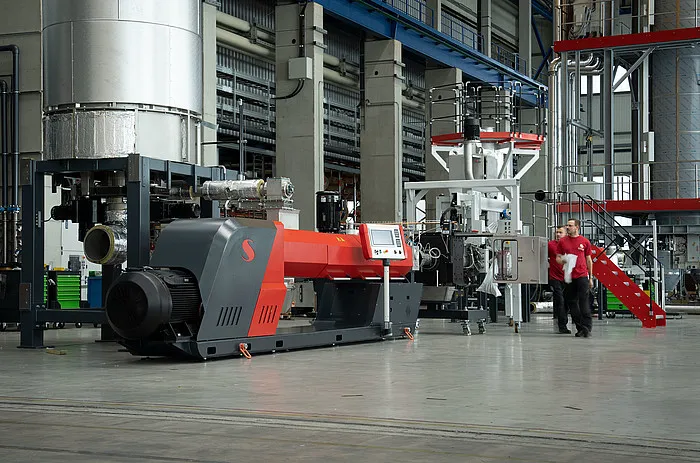
VidePak operates an industrial flow anchored by benchmark equipment: Starlinger for extrusion, tape orientation, and weaving; Windmöller & Hölscher (W&H) for printing, lamination, and precision conversion. The line is tuned for consistency: measured inputs, stable unit operations, and end‑of‑line verification.
Pre‑Material Qualification and Incoming Testing
- PP resin (virgin): Verify MFI, isotacticity, ash, odor, moisture (Karl Fischer), gel count. Lot barcodes tie silos to bales.
- Fabric/film inputs: Surface dyne (≥38 dyn/cm), hairiness; BOPP thickness 18–35 μm, haze/gloss, COF, heat‑shrink, cleanliness.
- Inks/adhesives: Viscosity windows, solids %, solvent ratios, residual controls; low‑migration stacks when needed.
- Additives/masterbatches: UV hour targets, antistatic decay time, slip levels, color ΔE to master swatches.
- Sewing pack: Thread tensile/abrasion, crepe tape/hot‑melt tack and flow, needle geometry fit for fabric and product fineness.
Core Unit Operations
- Extrusion and Tape Orientation (Starlinger). PP pellets are plastified, cast as a thin sheet, slit into tapes, and mono‑oriented through hot draw and anneal to unlock molecular strength. Controls cover denier uniformity, tape width, DSC crystallinity, and tensile/elongation.
- Weaving (Starlinger circular/flat looms). Tapes interlace into tubular or flat fabric with target GSM and pick counts. Monitored: picks/inch, loom speed, broken‑end rate, and defect maps. Flatness and pick balance dictate downstream print and seam quality.
- Surface Treatment. Corona/plasma pushes dyne levels to ≥38 dyn/cm on print and lamination faces; this anchors inks and ties.
- Printing. Route A: Direct flexo on coated fabric for breathable workhorses. Route B: Reverse print on BOPP using W&H gravure or HD‑flexo for photo‑grade imagery. Register, ink density, and varnish mapping (matte barcode windows; high‑build edge varnish) are controlled.
- Lamination. Extrusion coating (PP/PE ties) or solventless PU lamination bonds film to fabric. Targets: bond strength, residuals, curl, register. PP‑compatible ties simplify mono‑material recovery messaging.
- Cutting and Mouth Preparation. Lengths are cut; bevel trims remove notch starters; single/double/turned hems formed to precise depths for bending load distribution. Present a straight, predictable edge to the sewing head.
- Sewing and Seam Engineering. Two‑thread chainstitch (401) for speed; lockstitch (301) for non‑raveling security. SPI 7–12 is tuned to product fineness and seam tape presence. Apply crepe tape or hot‑melt under the seam when fines control is critical.
- Liner Insertion (if specified). Loose‑insert or gusseted liners placed for ultra‑fine powders or odor/grease control; gauge and antistatic set to product behavior.
- Perforation / De‑aeration Engineering. When coated/laminated, vent maps (hot‑needle or laser micro‑perfs) evacuate entrained air during fill while protecting in‑service moisture resistance. Keep perfs away from high‑visibility graphics and rain paths.
- In‑Line Inspection and Baling. Vision verifies register and code legibility; seam integrity checked; automatic counting and baling with bar‑coded labels.
End‑of‑Line QA and Compliance
- Mechanical suite: tensile/tear/burst; multi‑orientation drop tests (e.g., 5× at 0.8–1.2 m corner/edge/flat).
- Leak/tightness: Simulated fill pressure with timed leak‑down; acceptance typically ≤0.5% mass loss.
- COF/stackability: Static/kinetic COF tuned to the application window (0.30–0.45 typical) for conveyor flow vs. pallet grip.
- Barrier: WVTR/OTR validation for linered/laminated builds (ASTM/ISO methods).
- Dimensional audits: Width/length/bottom depth tolerance, GSM, and bale counts.
- Regulatory: Migration testing for food‑adjacent SKUs; retention samples, GMP logs, cradle‑to‑pallet traceability.
Applications Across Construction and Adjacent Sectors
Sewn Open Mouth PP Bags thrive where flexible filling, resew capability, and wet‑dock toughness outweigh the need for valve de‑aeration or the capital intensity of FFS systems. The following lanes illustrate how configuration choices map to outcomes.
- Cement and dry mortar. Double‑fold hems (30–35 mm), 9–10 SPI chainstitch, and crepe‑taped seams suppress sifting; breathable windows prevent bloat in humid yards.
- Gypsum and plaster. Laminated faces with re‑venting manage humidity swings; optional liners protect against ambient moisture; lockstitch may be selected for non‑raveling seams.
- Aggregates and specialty minerals. Higher GSM and turned hems survive rough handling; anti‑slip stripes stabilize pallets. Stitch and needle selection avoids yarn cutting near crystalline dusts.
- Pigments and admixtures. Antistatic liners, tight seam tapes, and matte barcode windows keep filling rooms clean and scanners happy. Reverse‑printed BOPP protects high‑resolution graphics.
- Construction chemicals. Liner gauge and closure style are tuned to grease/odor content and powder fineness; leak targets ≤0.5% are validated on the actual line.
- Job‑site logistics kits. Breathable builds enable quick fill/close cycles (e.g., sandbags) and survive intermittent rain better than paper alternatives.
Quality Architecture at VidePak: Four Reinforcing Pillars
- Standards‑driven manufacturing and testing. Tensile, tear, burst, drop, COF, WVTR/OTR, print adhesion, and migration are executed through documented SOPs mapped to ISO/ASTM/EN/JIS. SPC runs on denier, pick rate, lamination bond, print register, and seam tensile; AQL sampling and CAPA loops reinforce discipline; PPAP‑style validations are used when required by key accounts.
- Virgin, big‑brand materials (qualified PCR when specified). 100% virgin PP resin or approved PCR blends; certified BOPP film; food‑safe liners; approved additives with SDS/CoC. Lots are traceable from silo and roll to bale labels; out‑of‑tolerance lots auto‑quarantine.
- Equipment pedigree: Austrian Starlinger + German W&H. Starlinger’s extrusion/tape/loom stack stabilizes fabric fundamentals; W&H’s presses/laminators/converting lines hold register and bond strength over long runs.
- Full‑path test coverage: Incoming → In‑process → Outgoing. Incoming verification of resin/film/inks/adhesives; in‑process vision, seam peel tests, on‑line length/weight, and defect Pareto; outgoing drop/leak/COF/WVTR/dimensions, pallet compression where specified, and labeled retention samples for forensic reference.
Systems Thinking: Decompose Decisions, Recombine Specifications
Engineering the “right” Sewn Open Mouth PP Bag follows a pattern: understand the powder, characterize the line, define brand and compliance boundaries, then synthesize a spec you can pilot, measure, and scale. Below, each sub‑problem is reduced to checkpoints that survive contact with the plant floor.
Sub‑Problem A — Powder and Process Characterization
- Crop/product physics: particle size distribution, bulk density (loose/tapped), angle of repose, hygroscopicity, oil/odor content.
- Filler mechanics: nozzle or sewing head setup, aeration path, target BPM, allowable dust ppm.
- Environment: humidity/temperature, UV exposure, road quality, stacking heights, port dwell.
Checkpoints. Tune weave openness and perf density to hit fill rate with acceptable dust; match sewing head to bag movement; select SPI to balance anti‑sift behavior with needle‑hole risks; choose COF and bottom style for conveyor flow and pallet grip.
Sub‑Problem B — Brand, Regulatory, and Circular Intent
- Brand: photography vs. vector; matte vs. gloss; tactile varnishes; color targets.
- Regulatory: food‑adjacent contact, migration limits, origin and lot traceability.
- Circular: mono‑PP aim, recycled content, recycling marks and return instructions.
Checkpoints. Pick reverse‑printed BOPP for premium panels; lock Pantone and ΔE≤2; document migration for food‑adjacent uses; print material IDs and channel return guidance.
Sub‑Problem C — TCO and Operational Risk
- Direct costs: resin/film, plates/cylinders, adhesive energy, press time.
- Indirect costs: dust cleanups, product loss, pallet collapses, returns, rewraps.
- Logistics: pallet density, container cube, wrap usage, claim rates.
Checkpoints. Model pallet patterns and container loads; compare pillow vs. block‑bottom ROI; validate leak/tightness and dust ppm on the actual line; pilot 500–2,000 bags and instrument BPM, dust, seam metrics, and pallet audits.
Integrated Path — Step‑by‑Step
- Intake: product data + line specs + brand/regulatory/circular constraints.
- Concept short‑list: (a) breathable SOM with coated fabric; (b) laminated SOM with re‑venting; (c) linered SOM for high‑barrier needs.
- DFMEA: rank mouth mis‑fold, stitch pull‑through, delamination, scuffed panels, pallet slip, code glare.
- Pilot: run on the actual filler; iterate hem depth, SPI, perf map, varnish placement, and COF tuning.
- Finalize spec: lock GSM, hem geometry, stitch type/SPI, print route, liner gauge, COF, and QA plan.
- Scale: SPC on denier, pick rate, bond strength, register, seam tensile; AQL sampling; retention swatches and samples.
- Review: down‑gauging experiments, recycled‑content pilots (non‑food), UV‑hour updates, artwork refresh governance.
Technical Windows and Reference Tables
Typical ranges and targets used to anchor decisions and acceptance criteria.
| Attribute | Typical Range | Notes |
|---|---|---|
| Capacity | 5–50 kg (25/50 kg dominate) | Align to filler tooling and pallet plan |
| Fabric GSM | 55–100 g/m² | Validate drop matrix for lane severity |
| BOPP Film | 18–35 μm (matte/gloss) | Matte for barcodes; gloss for shelf depth |
| Hem Depth | 20–40 mm | Deeper hems improve seam efficiency |
| Stitch Density | 7–12 SPI (401/301) | Balance anti‑sift vs perforation lines |
| Liner Gauge | 20–60 μm (PP/PE) | Higher barrier, less breathability |
| Attribute | Target/Method | Why It Matters |
|---|---|---|
| Drop Performance | 5× at 0.8–1.2 m (corner/edge/flat) | Predicts transit survival |
| Leak/Tightness | ≤0.5% mass loss at set pressure/time | Cleanliness and yield |
| COF (static/kinetic) | 0.30–0.45 window (app‑dependent) | Conveyor flow vs pallet stability |
| WVTR/OTR | Application‑specific | Moisture/oxygen control |
| Barcode Grade | ISO/IEC 15416 B or better | Scan reliability |
Case‑Style Scenarios: Problem → Intervention → Outcome
A — Dusty Dry‑Mortar Fills in Windy Yards
Problem: Operator complaints, sweep‑ups, and time‑consuming top‑offs.
Intervention: Switch to Sewn Open Mouth PP Bags with double‑fold hem (30–35 mm), 9–10 SPI chainstitch, crepe‑taped seam, and engineered vent windows; COF tuned to 0.35–0.40.
Outcome: Faster BPM, cleaner air, fewer pallet slumps.
B — Coastal Gypsum Caking and Claim Rates
Problem: Hygroscopic uptake drives clumps and seam stress.
Intervention: Laminated SOM with 40–50 μm liner; WVTR validation; UV‑stabilized masterbatch; matte barcode windows.
Outcome: Lower caking rate, stable scan grades, resilient yard stacks.
C — Pigment Fines and Nuisance Static
Problem: Dust cling and shocks at the filler.
Intervention: Antistatic liner, grounded spouts/conveyors, seam tape under stitches; vent maps away from high‑visibility faces.
Outcome: Safer operator zone and improved housekeeping metrics.
D — Corner Splits During Drop Tests
Problem: Failures cluster at the mouth fold; mid‑panel remains intact.
Intervention: Increase hem depth from 25 mm to 35–40 mm; switch to turned hem for critical SKUs; verify with 5× drop at 1.0–1.2 m.
Outcome: Passes without raising fabric GSM; TCO gains.
E — Barcode Failures at Intake
Problem: Gloss glare and color drift cause low grades.
Intervention: Matte windows over code zones; lock ΔE≤2 via calibrated prepress and ink management; add high‑build varnish on edges only.
Outcome: ISO/IEC 15416 grade B or better under warehouse lighting.
Sizing, Pallet Patterns, and Logistics Discipline
- Size selection: work backward from bulk density × target mass; allocate headspace for de‑aeration and seam formation.
- Pallet pattern: brick‑bond for square/block‑bottom formats; align graphics for retail‑adjacent lines.
- Compression: confirm unit‑load compression targets; add interlayers for very smooth faces; match COF to stretch‑wrap recipe.
- Containerization: tune bag/pallet dimensions for 20’/40’ cube; square bottoms improve utilization.
- Traceability: print lot/QR codes; maintain retention samples for 12–24 months depending on duty.
Purchasing Checklist: Data That Nails the Spec
- Powder or granule description, PSD, loose/tapped bulk density, hygroscopicity, odor/grease notes.
- Line data: nozzle or sewing head model, clamp style, target BPM, aeration method, allowable dust ppm.
- Logistics: pallet heights, container goals, outdoor dwell time, climate profile, warehouse COF requirements.
- Compliance: food‑adjacent contact? migration plan? traceability label format?
- Branding: art complexity, matte vs. gloss accents, Pantone targets, anti‑counterfeit cues.
- Sustainability: mono‑PP claim, down‑gauging targets, recycled content policy.
- Performance: drop matrix, leak limit, COF window, WVTR cap, UV hours.
Troubleshooting Matrix
| Symptom | Likely Cause | Corrective Action |
|---|---|---|
| Barcode fails at intake | Gloss glare; color drift; low contrast | Matte windows; lock ΔE; adjust ink density; protect with varnish |
| Delamination blisters | Low dyne; residual solvent; poor lamination | Raise treatment; extend drying; tune nip temperature/pressure |
| Pallet slippage | COF too low; glossy face + wrap synergy | Add texture/strips; tune COF; adjust wrap recipe; interlayers |
| Dust during filling | Weak de‑aeration; seam not taped; liner gaps | Add perfs; add crepe/hot‑melt; adjust liner fit |
| Corner ruptures | Hem too shallow; needle cutting yarns | Increase to 35–40 mm; change needle; re‑verify drops |
| Caking after storage | WVTR too high; liner too thin | Increase liner gauge; improve seam tape; validate climate WVTR |
Frequently Asked Engineering Questions
Do sewn open mouth formats always beat valve sacks? Not always. Where high‑speed, low‑dust filling dominates and valve gear exists, valve sacks shine. Sewn Open Mouth PP Bags win where flexible filling, resew after sampling, and wet‑dock toughness are decisive, or where valve machinery is unavailable.
Which stitch should we choose? Two‑thread chainstitch (401) for throughput and tolerance to movement; lockstitch (301) where non‑raveling security is essential. Validate SPI (7–12) against fines sifting and seam pull‑through on your powder.
Does a thicker film or liner always mean safer product? Beyond a point, extra stiffness reduces pallet friction and can curl edges. Balance gauge with WVTR goals, COF targets, and converting behavior.
How small can barcodes be and still scan reliably? With matte windows, tight register, and ΔE≤2 across lots, ISO/IEC 15416 grade B or better is attainable. Validate under your warehouse lighting and scanner fleet.
What KPIs signal continuous improvement? Reprint rate, ΔE drift, first‑pass barcode rate, drop‑test pass %, COF stability, leak‑test yield, WVTR stability, and dust ppm during pilots.
Example Integrated Specifications
Use Case A — 25 kg Dry Mortar, Humid Coastal Region
- Fabric: woven PP 85–90 g/m² (UV‑stabilized).
- Face: BOPP 25 μm matte reverse‑print (6 colors).
- Hem/Seam: double‑fold at 35 mm; chainstitch 401 at 9–10 SPI; crepe tape under seam.
- Liner: PP 40 μm antistatic.
- Venting: engineered perfs away from rain paths.
- COF: 0.35–0.40. QA: UV ≥1,600 h; leak ≤0.5%; 5× drop at 1.2 m; ΔE≤2.
Use Case B — 50 kg Gypsum/Plaster, Yard Storage
- Fabric: 100–110 g/m² with UV masterbatch; laminated face 30 μm gloss with edge varnish.
- Hem/Seam: turned hem 35–40 mm; lockstitch 301 at 10–12 SPI.
- Liner: PP 50 μm; SIT tuned to thermal bar closure.
- Pallet: brick‑bond; interlayers for glossy faces. QA: WVTR to target; COF 0.35; barcode ≥B.
Use Case C — 20 kg Pigments/Admixtures, High Value
- Fabric: 80–85 g/m² with antistatic MB.
- Face: BOPP 25 μm matte/gloss mix; microtext anti‑counterfeit.
- Hem/Seam: double‑fold 30–35 mm; chainstitch 401 at 10–11 SPI; hot‑melt seam tape.
- Liner: PP 40–50 μm (antistatic). QA: serialized QR; leak ≤0.3%; ΔE≤2 across seasonal reprints.
- Sewn Open Mouth PP Bags: What They Are, Why They Matter, and How They Evolved
- Material Architecture of Sewn Open Mouth PP Bags
- Signature Features of Sewn Open Mouth PP Bags
- From Resin to Pallet: Production Process and Controls
- Applications Across Construction and Adjacent Sectors
- Quality Architecture at VidePak: Four Reinforcing Pillars
- Systems Thinking: Decompose Decisions, Recombine Specifications
- Technical Windows and Reference Tables
- Case‑Style Scenarios: Problem → Intervention → Outcome
- Sizing, Pallet Patterns, and Logistics Discipline
- Purchasing Checklist: Data That Nails the Spec
- Troubleshooting Matrix
- Frequently Asked Engineering Questions
- Example Integrated Specifications
- 1. The Role of Sewn Open Mouth PP Bags in Modern Construction
- 2. Market Dynamics: China’s Construction Sector and VidePak’s Strategic Positioning
- 3. Technical Specifications and Customization Options
- 4. Future Trends: Branding and Sustainability
- 5. Why Choose VidePak?
- References
The construction industry relies on durable, customizable, and cost-effective packaging solutions, and sewn open mouth (SOM) PP woven bags have emerged as a cornerstone for transporting bulk materials like cement, sand, and aggregates. With over 15 years of expertise, VidePak has pioneered high-performance SOM PP bags, combining Austrian Starlinger technology, 100% virgin polypropylene, and multi-color printing capabilities to deliver products that withstand rigorous industrial demands while enhancing brand visibility.
1. The Role of Sewn Open Mouth PP Bags in Modern Construction
Sewn open mouth PP bags are designed for efficiency and durability. Their reinforced stitching and woven polypropylene fabric ensure a tensile strength of 8–12 N/cm², capable of holding 25–50 kg of construction materials without tearing. Unlike traditional sacks, SOM bags feature a wide opening for easy filling and discharge, making them ideal for automated batching systems in cement plants or construction sites.
VidePak’s Innovation:
- Material Integrity: Using virgin PP resin (MFI: 3–5 g/10 min) ensures resistance to UV degradation and moisture, critical for outdoor storage.
- Customization: Advanced printing machines support up to 8 colors, enabling logos, safety labels, and multilingual instructions to be printed with 150–200 DPI resolution.
- Sustainability: Recyclable materials align with global green construction trends, reducing waste by 30% compared to laminated alternatives[citation:9].
2. Market Dynamics: China’s Construction Sector and VidePak’s Strategic Positioning
China’s construction industry, valued at $1.1 trillion in 2024, drives demand for reliable packaging. However, many local manufacturers prioritize low-cost production, compromising on material quality and durability. VidePak distinguishes itself through:
Brand-Centric Approach:
- Long-Term Partnerships: Collaborating with global clients like LafargeHolcim and HeidelbergCement, VidePak ensures consistent quality across 50+ countries.
- Certifications: ISO 9001, ISO 14001, and Oeko-Tex certifications validate compliance with safety and environmental standards.
- Scalability: With 100+ circular looms and 30+ lamination machines, VidePak produces 120 million bags annually, ensuring rapid order fulfillment.
Case Study: A Chinese cement producer reduced bag breakage rates from 5% to 0.8% after switching to VidePak’s SOM bags, saving $250,000 annually in material losses.
3. Technical Specifications and Customization Options
Product Parameters Table
| Feature | Specification | Industry Standard |
|---|---|---|
| Fabric Weight | 80–120 g/m² | ASTM D5261 |
| Bag Dimensions | 50–100 cm (L) × 30–60 cm (W) | Customizable |
| Load Capacity | 25–50 kg | EN ISO 2234 |
| Printing Options | Up to 8 colors, CMYK/Pantone | ISO 2836 |
| MOQ | 50,000 bags | Flexible for bulk orders |
FAQs for Buyers
Q: Can SOM bags handle abrasive materials like sand?
A: Yes. VidePak’s bags incorporate anti-abrasion coatings, increasing lifespan by 40% in high-friction environments.
Q: What is the lead time for custom designs?
A: Standard orders ship in 15–20 days; urgent batches (100,000+ units) expedite to 10 days.
Q: Are VidePak’s bags compatible with valve-filling systems?
A: Absolutely. Custom valve adaptations are available for seamless integration.
4. Future Trends: Branding and Sustainability
The shift toward branded packaging in construction reflects a broader industry trend. VidePak’s BOPP-laminated SOM bags, for instance, combine durability with glossy finishes that enhance brand recognition. Meanwhile, eco-friendly initiatives include:
- Recycled PP Blends: Reducing carbon footprint by 25% without sacrificing strength.
- Smart Packaging: QR codes for tracking batch numbers and safety data, adopted by 30% of European clients[citation:9][citation:10].
Competitive Edge: While rivals focus on price wars, VidePak invests in R&D, allocating 6% of annual revenue ($480,000) to develop fire-retardant and anti-static variants for niche markets.
5. Why Choose VidePak?
- Proven Expertise: Founded in 2008, CEO Ray’s 30+ years in packaging ensure deep industry insights.
- Global Reach: Serving 80+ countries with localized warehouses in Dubai, Rotterdam, and Houston.
- Quality Assurance: Every batch undergoes 12+ tests, including drop tests (1.5 m height) and seam strength checks.
References
- VidePak Official Website: https://www.pp-wovenbags.com/
- Email: info@pp-wovenbags.com
- Industry Standards: ASTM, ISO, and EN guidelines for woven polypropylene bags.
External Resources:
- For insights into SOM PP bag applications in construction waste management, explore our technical guide.
- Learn about custom printing techniques for industrial packaging.
This article underscores VidePak’s commitment to innovation, quality, and sustainability, positioning SOM PP bags as indispensable tools for modern construction logistics.