
Square Bottom Valve Bags: Engineering Durability and Efficiency in Bulk Packaging

# Square Bottom Valve Bags: A Systematic Guide to High‑Performance Bulk Packaging ## What Are Square Bottom Valve Bags? Square bottom valve bags are a specialized type of industrial packaging designed for fast, dust‑reduced filling and highly stable stacking. Instead of a traditional pillow or circular bottom, the base of the bag is folded and formed so that it creates a rigid, rectangular “block” or “square” footprint. During palletizing, these square bottoms interlock neatly with one another, which is why square bottom valve bags have become a preferred choice in industries such as cement, building materials, chemicals, food powders, animal feed, and many others. Structurally, a square bottom valve bag combines two core ideas: 1. **A valve opening for efficient filling.** The valve is usually placed in an upper corner, allowing quick connection to a filling spout. After filling, the internal pressure of the product—or an additional sealing step—closes and secures the valve. 2. **A block or square bottom for stacking stability.** The folded and sealed bottom creates a flat base that behaves more like a box than a traditional sack, enabling higher and safer stacking heights. In the marketplace, square bottom valve bags are often referred to by several closely related product names. These names are not completely identical from a technical standpoint, but they are often used interchangeably by buyers and sellers: 1. **Square Bottom PP Bags** 2. **Square Bottom Valve Bags** 3. **Square Bottom Valve Sacks** 4. **Square Bottom Woven Bags** 5. **Valve Bags** 6. **Valve PP Bags** Among these, **Square Bottom Valve Bags** and **Square Bottom Valve Sacks** are typically used when the presence of a filling valve and a formed bottom are both essential. **Square Bottom PP Bags** and **Square Bottom Woven Bags** emphasize the polypropylene woven fabric base, while **Valve PP Bags** and simple **Valve Bags** highlight the filling system and may include both square‑bottom and other designs. In this article, we will mainly use **square bottom valve bags** as the central term, while naturally incorporating its related names and long‑tail expressions, such as *square bottom PP woven valve bags* and *block bottom valve sacks*. From an engineering perspective, these bags are not just containers. They are mechanical interfaces between filling equipment, transport systems, and warehouse operations. A well‑designed square bottom valve bag must align with powder flow properties, palletizing patterns, forklift handling, climatic conditions, and regulatory requirements. This is why leading producers like VidePak treat square bottom valve bags as a system, not as a single product. ## The Material of Square Bottom Valve Bags: Polypropylene Fabrics, Films, and Functional Layers Although square bottom valve bags are usually described in a simple phrase, the actual material structure is multi‑layered and carefully engineered. Most **square bottom PP bags** and **valve PP bags** produced by VidePak use polypropylene (PP) as the primary raw material, sometimes combined with other films, liners, and coatings to achieve specific performance targets. ### 1. Polypropylene Tapes and Woven Fabric The backbone of square bottom valve sacks is the polypropylene tape fabric. * **Base resin:** Polypropylene homopolymer or random copolymer pellets are selected based on their melt flow index (MFI), impact resistance, and process stability. Industrial‑grade PP for woven fabrics typically balances stiffness and toughness so the tapes can be stretched and woven without tearing. * **Tape formation:** In extrusion lines, PP pellets are melted, extruded into a thin sheet, then slit into narrow tapes. These tapes are stretched to orient the polymer chains, significantly enhancing tensile strength while maintaining adequate elongation. This is the classic material skeleton of PP woven bags. * **Woven structure:** The stretched tapes are woven on circular or flat looms to produce a fabric that combines light weight with high tensile strength, puncture resistance, and dimensional stability. Weave density (tapes per inch) and tape width are tuned according to the target bag capacity (for example, 25 kg vs. 50 kg loads). In square bottom woven bags, this PP fabric is used for: * The **main body** (tube) of the bag * The **square bottom panels and gussets** * Often, the **valve sleeve** or at least its supporting structure Because the woven structure naturally allows a certain degree of breathability, it is particularly useful for powders that release air during filling, preventing over‑pressurization and improving filling speed. ### 2. BOPP and PE Films for Lamination and Barrier Performance Many high‑value square bottom valve bags are not just simple woven sacks; they are **laminated BOPP woven bags** or **coated valve PP bags**. * **BOPP (Biaxially Oriented Polypropylene) film** provides excellent printability, gloss, and moisture resistance. When laminated to the outer surface of square bottom PP bags, BOPP allows high‑definition graphics and brand information, while also protecting the fabric from abrasion and moisture. * **PE (Polyethylene) coatings or liners** can be added for improved sealability, food contact compliance, or enhanced chemical resistance. In some designs, a co‑extruded PE layer is applied to the inside of the woven fabric or used as a separate inner liner. These films and coatings are usually bonded to the woven PP fabric via extrusion coating or adhesive lamination. The choice of film thickness, coating weight, and bonding method directly influences: * Moisture barrier performance * Print quality and scuff resistance * Flex‑crack durability during transport * Cost per bag and recyclability In VidePak’s portfolio, laminated square bottom valve sacks are common in sectors where brand visibility and moisture control are critical—for example, flour, rice, pet food, and premium construction materials. ### 3. Additives: UV Stabilizers, Anti‑Static Agents, and Slip Modifiers Raw materials for square bottom valve bags are not just PP and films. Additive masterbatches are strategically used to fine‑tune performance: * **UV stabilizers** extend outdoor life, protecting bags stored in yards or transported in open trucks. * **Anti‑static agents** reduce the risk of dust ignition and improve safety in explosive atmospheres, especially in chemical and pigment applications. * **Slip and anti‑block agents** control the surface friction between bags, ensuring that they can be stacked securely yet still slide on conveyor belts when needed. These additives may be blended into the PP resin for tapes, or applied in coatings and films. Correct dosage is a delicate balance: too little and performance is insufficient; too much and processing or recyclability can be negatively affected. ### 4. Valve Components, Sewing Threads, and Hot‑Melt Adhesives The valve itself is an engineered sub‑component within a square bottom valve bag system. * **Valve sleeve material:** Often made from PP fabric, PE film, or composite structures that ensure compatibility with the main body and provide an appropriate friction coefficient against the filling spout. * **Reinforcement patches:** Additional layers around the valve area distribute stress and prevent tearing during high‑speed filling. * **Sewing threads and hot‑melt adhesives:** Used in forming the square bottom and attaching the valve, these materials must be compatible with PP and any heat‑sealing operations. Taken together, these raw materials make up a composite structure: a woven PP skeleton, laminated or coated surfaces, engineered valve components, and functional additives. The end result is a **square bottom PP woven valve bag** that is light, strong, customizable, and optimized for industrial filling and logistics. ## What Are the Features of Square Bottom Valve Bags? Square bottom valve bags have risen to prominence because they solve a set of recurring problems in bulk packaging: instability in stacking, inefficiencies in filling, dust pollution, and packaging failures in harsh conditions. Compared with traditional open‑mouth sacks or tubular bags, **square bottom valve sacks** present several distinctive features. ### 1. Superior Stacking Stability and Space Utilization The most visible advantage is stacking performance. Thanks to the block‑shaped bottom and the ability of the filled bag to stand upright, pallets of square bottom woven bags can be stacked higher and more uniformly than traditional pillow‑type bags. * The **flat, box‑like base** reduces the tendency of bags to roll or slip. * Pallet patterns (such as interlocking or brick stacking) become more stable, improving warehouse safety. * Better cube efficiency means more product per pallet, lowering transport cost per ton. For companies handling high‑density powders such as cement, mineral fillers, or fertilizers, even a modest increase in stacking height and stability can translate into significant savings across thousands of pallets per year. ### 2. High‑Speed, Low‑Dust Filling via the Valve System Square bottom valve bags are explicitly designed for mechanized filling. The valve—often positioned in a top corner—is compatible with a variety of filling spouts, from gravity and impeller packers to air packers and screw conveyors. Key functional advantages include: * **Rapid bag placement and removal** on the filling spout, minimizing cycle time. * **Self‑closing or heat‑sealable valves** that reduce dust escape after filling. * The ability to **adjust valve design** (length, diameter, inner flap, or hot‑melt coating) according to product flow properties and filling machine type. In many plants, replacing traditional sewn open‑mouth bags with square bottom valve bags has led to measurable reductions in dust levels, improved operator safety, and cleaner bag exteriors—especially important for branded products. ### 3. Robust Mechanical Performance Because square bottom valve bags are usually made from oriented PP woven fabric, they offer high tensile strength and puncture resistance relative to their weight. The block bottom design adds additional reinforcement to the corners and edges, which are common failure points in simpler sacks. Typical performance advantages include: * **Resistance to dropping and impact** during handling. * **Puncture resistance** against sharp granules or edges. * **Good flex‑crack resistance**, maintaining integrity over long transport distances. Where required, additional reinforcements—such as double‑folded bottoms, extra patches around the valve, or higher weave densities—can be specified for especially demanding applications. ### 4. Customization of Appearance and Function Modern square bottom PP bags are also a canvas for branding and functional differentiation. * **Printing options:** From simple one‑color logos to full‑coverage photographic images achieved through BOPP lamination. * **Color coding:** Different colors of fabric, valves, or print help distinguish product grades or brands. * **Functional variations:** Anti‑static bags, moisture‑barrier bags, breathable bags for agricultural products, or high‑barrier multi‑layer bags for oxygen‑sensitive goods. This combination of structural performance and design flexibility makes **square bottom valve sacks** a multi‑purpose solution that can be tailored to very different industries while maintaining a consistent basic geometry. ## What Is the Production Process of Square Bottom Valve Bags? Although square bottom valve bags may appear simple at first glance, producing them economically and consistently at industrial scale requires a sophisticated production chain. VidePak’s process can be viewed in three major stages: **front‑end raw material selection and testing**, **core manufacturing steps**, and **back‑end quality inspection and packaging**. A key differentiator for VidePak is its investment in top‑tier equipment: extrusion and weaving lines from **Austrian Starlinger** and converting/printing technology from **German W&H (Windmöller & Hölscher)**. These machines provide the precision and repeatability needed to deliver tight tolerances on bag weight, dimensions, and performance. ### 1. Front‑End Raw Material Selection and Testing The process begins long before a single bag is produced. 1. **Supplier qualification:** VidePak sources PP resins, BOPP films, PE materials, and masterbatches from major, reputable producers whose quality systems meet international benchmarks. 2. **Incoming inspection:** Each batch of resin and film is tested for key parameters such as melt flow index, density, moisture content, tensile properties, and visual cleanliness. 3. **Additive verification:** UV masterbatches, anti‑static agents, and color concentrates are checked for dispersion quality and performance in small trial runs. Only after passing these tests are materials released to production. This reduces variability and sets a stable foundation for downstream process control. ### 2. Extrusion and Tape Stretching On Starlinger extrusion lines, PP pellets are melted and extruded into a thin film, which is then slit into narrow tapes. * **Temperature control** in the extruder ensures uniform melt quality. * **Die design and pressure control** help maintain consistent thickness across the sheet. * **Tape stretching** at carefully defined ratios aligns polymer chains, enhancing tensile strength and minimizing breakage during weaving. In‑line monitoring systems track tape width, thickness, and break frequency, feeding data back to operators and control systems for real‑time adjustments. ### 3. Weaving of the PP Fabric The stretched tapes are fed into Starlinger circular looms to produce woven fabric tubes or into flat looms for sheet fabric. * **Loom speed, pick density, and tension** are tuned to the required bag strength and fabric weight. * **Automatic warp/weft monitoring** detects broken tapes and helps prevent defective fabric rolls. The woven fabric is then wound into large rolls, which become the base material for **square bottom woven bags**. ### 4. Lamination, Coating, and Printing If the final product is a laminated square bottom valve sack or a printed BOPP woven bag, additional processes are applied: 1. **Extrusion coating or lamination:** PE or BOPP films are bonded to the woven fabric using heat and pressure. Parameters like coating weight and bonding temperature directly affect adhesion and barrier performance. 2. **Printing:** On high‑precision flexographic or gravure presses—often from German W&H—graphics, barcodes, and regulatory information are applied. Registration accuracy, ink density, and color consistency are closely monitored. At this stage, visual inspection and adhesion tests are performed on a sampling basis to detect early problems before fabric is converted into bags. ### 5. Tube Formation, Valve Construction, and Square Bottom Forming Converting the laminated or un‑laminated fabric into finished **square bottom PP bags** involves several sub‑steps: 1. **Tube cutting:** The woven fabric is cut into precise lengths according to the desired bag height. 2. **Side gusseting:** Fabric is folded inward to create gussets that will form the square bottom geometry. 3. **Valve insertion:** A pre‑formed valve sleeve—made of PP, PE, or composite structures—is inserted into the top corner. Its dimensions and materials are matched to the filling equipment and product. 4. **Bottom forming:** Using specialized machinery, the bottom is folded into a block shape and closed by sewing, heat sealing, or a combination of both. Reinforcement patches may be added where needed. The accuracy of these steps determines how well the bags will stand, how smoothly they will be filled, and how reliably they will withstand handling. ### 6. Back‑End Quality Inspection and Packaging Before bags are released to customers, VidePak implements several layers of inspection: * **Dimensional checks:** Length, width, bottom width, valve size, and bag weight. * **Mechanical tests:** Tensile strength, seam strength, drop tests, and, where relevant, burst or puncture tests. * **Visual inspection:** Print quality, lamination defects, contamination, and general workmanship. Only bags that pass these criteria are bundled and palletized for shipment. Because all major processes—from tape extrusion to conversion—are integrated and performed on **Starlinger** and **W&H** equipment, process data can be traced back to specific machine runs, enabling continuous improvement and traceability. ## What Is the Application of Square Bottom Valve Bags? Square bottom valve bags are used wherever free‑flowing powders and granules must be packed quickly, transported safely, and presented professionally. Thanks to their versatility, **square bottom PP bags**, **square bottom valve sacks**, and **valve PP bags** have become a backbone solution in multiple sectors. ### 1. Cement and Building Materials In the construction industry, square bottom valve bags have all but become the default packaging for cement and many dry mortars. * The **stable, brick‑like shape** aligns perfectly with palletizing systems. * The **valve design** matches standard cement packers, enabling continuous high‑speed filling. * **Robust woven fabric** handles the high density and abrasive nature of cement and mineral powders. Ready‑mix mortars, tile adhesives, gypsum, and similar products also benefit from these bags, often with additional moisture protection via laminated films. ### 2. Chemicals and Minerals For chemicals, pigments, and mineral fillers, a combination of mechanical strength and safety is essential. * **Anti‑static square bottom valve bags** mitigate ignition risks in dusty environments. * **High‑barrier variants** protect hygroscopic or sensitive products. * The **block bottom layout** improves stacking uniformity in automated warehouses. These applications often require strict compliance with international regulations, making VidePak’s focus on standards and traceability especially important. ### 3. Food Powders and Animal Feed With appropriate materials (food‑grade PP, PE liners, BOPP films, and certified inks), square bottom woven bags can safely package food powders such as flour, starch, sugar, premixes, and instant beverage powders. * **Clean, low‑dust filling** keeps both product and packaging surfaces hygienic. * **Attractive printed designs** on laminated bags enhance shelf appeal. * **Consistent dimensions** support automated bagging and palletizing lines. Animal feeds—especially pelleted or powdered feeds—also widely use square bottom PP woven valve bags, leveraging their combination of breathability and mechanical robustness. ### 4. Agriculture and Fertilizers Fertilizers and agricultural inputs (like seeds, soil conditioners, and micronutrient blends) require durable packaging that can withstand handling in fields, warehouses, and distribution networks. * **UV‑stabilized fabrics** resist degradation from sunlight. * **Custom valve designs** accommodate varying bulk densities and granule sizes. * **Color coding and printing** help farmers quickly distinguish between fertilizer grades and formulations. ### 5. Other Industrial Applications Beyond the sectors above, **square bottom PP woven valve bags** are used wherever powder or granular products must move through a modern supply chain: charcoal, plastic resin, de‑icing salts, fire retardants, and more. The versatility of the format allows VidePak to adapt bag structures, valve systems, and graphic designs to each industry’s specific needs. ## How VidePak Controls and Guarantees the Quality of Square Bottom Valve Bags Producing a good bag once is not difficult; producing **millions of square bottom valve bags** with consistent quality is the true challenge. VidePak addresses this challenge through a structured, standards‑driven quality assurance system. This system can be summarized in four pillars. ### 1. Standards‑Based Design, Production, and Testing First, VidePak aligns its bag designs and testing methods with mainstream international standards such as **ISO**, **ASTM**, **EN**, and **JIS** where applicable. This standards‑based approach covers: * **Material characterization:** Tensile strength, elongation, and impact resistance of tapes and fabrics are tested according to recognized methods. * **Bag performance:** Drop tests, seam strength tests, and stacking tests are conducted in line with relevant packaging standards. * **Food contact and safety compliance:** For food and feed applications, materials can be selected to comply with regulations such as FDA and EU food contact guidelines. By respecting these frameworks, VidePak ensures that square bottom valve bags are not only “strong enough” in a general sense, but also demonstrably compliant with established benchmarks. ### 2. Use of 100% New Raw Materials from Large, Reputable Suppliers Second, VidePak emphasizes raw material integrity. Instead of relying on uncontrolled recycled materials, the company prioritizes **100% new PP resins and films** from major producers. * **Stable resin quality** reduces process fluctuations and defects. * **Consistent additive masterbatches** ensure predictable UV resistance, color, and anti‑static performance. * **Traceable supply chains** simplify audits and support customer certifications. Where recycling is integrated—for example, in post‑industrial recycling loops—quality is managed tightly so that the performance of the final **square bottom PP bags** remains within specification. ### 3. Investment in the Best Equipment: Starlinger and W&H Third, VidePak invests heavily in top‑tier machinery. This is not merely a marketing claim; it is a technical foundation for quality. * **Austrian Starlinger** lines handle tape extrusion and fabric weaving with high precision and efficiency. Their advanced controls keep tape thickness, width, and strength within narrow tolerances. * **German W&H (Windmöller & Hölscher)** technology in printing and converting ensures accurate registration, minimal waste, and stable operation at high speeds. Because all major steps—from raw PP to finished **square bottom valve sacks**—are executed on this class of equipment, VidePak can control critical parameters far more tightly than would be possible on generic or outdated machines. ### 4. Comprehensive Inspection: Incoming, In‑Process, Finished Goods, and Sampling Finally, VidePak implements a layered inspection regime that covers the entire value chain: 1. **Incoming inspection:** As described earlier, PP, films, inks, and additives are tested upon arrival. 2. **In‑process control:** Operators and quality technicians monitor key parameters on extrusion, weaving, lamination, printing, and conversion lines. Non‑conforming rolls or bag lots are isolated and analyzed. 3. **Finished product inspection:** Before shipment, bags are checked for dimensions, appearance, print quality, and mechanical performance. 4. **Sampling plans and data analysis:** Statistically designed sampling plans ensure that inspection is both effective and efficient. Data from tests are analyzed to identify trends, enabling continuous improvement. Through these four pillars—standards, virgin materials, world‑class equipment, and comprehensive inspection—VidePak constructs a robust quality system that supports long‑term partnerships with demanding customers. ## Systematic Analysis: Viewing Square Bottom Valve Bags as an Integrated System To move beyond a simple feature list, it is useful to apply **system thinking** to square bottom valve bags. Instead of viewing each parameter in isolation, we can consider the bag as an integrated system composed of multiple subsystems: 1. **Structural subsystem:** Fabric strength, seam design, bottom geometry, and valve configuration. 2. **Material subsystem:** Resin types, films, coatings, liners, and additives. 3. **Process subsystem:** Extrusion, stretching, weaving, lamination, printing, tube formation, valve insertion, and bottom forming. 4. **Performance subsystem:** Filling behavior, stacking stability, resistance to environmental stresses, and consumer perception. 5. **Regulatory and sustainability subsystem:** Compliance with standards, recyclability, and environmental impact. For each subsystem, design decisions generate trade‑offs that must be balanced at the system level. ### 1. Structural Subsystem: Balancing Strength and Functionality The structural design of **square bottom PP woven valve bags** must reconcile multiple goals: * **High mechanical strength** to resist drops and stacking loads. * **Good filling behavior** through the valve, including venting of air. * **Stable standing ability** due to the block bottom geometry. For example, increasing the bottom width can improve standing stability but may slightly reduce palletizing efficiency if pallet dimensions are fixed. Similarly, reinforcing the valve area can improve durability during filling but may add cost and complexity. ### 2. Material Subsystem: Performance vs. Cost and Sustainability Material choices directly affect cost, recyclability, and performance: * **Heavier fabrics and thicker films** enhance strength and barrier properties but increase material consumption. * **Specialty additives** like anti‑static or high‑performance UV stabilizers improve safety and outdoor life but add cost. * **Multi‑layer laminates** can offer outstanding barrier performance but may complicate recycling. System thinking encourages a holistic view: rather than automatically choosing the “strongest” materials, the designer chooses the *right* combination for the application. VidePak works with customers to define target performance levels and then selects materials that meet those targets without unnecessary over‑specification. ### 3. Process Subsystem: Precision, Repeatability, and Data The performance of the final **square bottom valve sacks** is intimately linked to process control. * Variation in tape thickness or weave density can lead to weak spots. * Inconsistent lamination temperature can produce delamination or poor barrier performance. * Uneven bottom folding can affect bag standing ability and stacking. By using Starlinger and W&H equipment, VidePak can integrate advanced process controls and data collection. This data can then be used to refine setpoints, detect anomalies early, and support continuous improvement initiatives. ### 4. Performance Subsystem: From Filling Line to Customer Warehouse Ultimately, the success of a square bottom valve bag is measured not in the factory, but in the customer’s plant and distribution chain. System thinking asks questions such as: * How does the bag perform on the existing filling line? Does it reduce cycle times or downtime? * How stable are pallets during transport and in multi‑level warehouses? * What is the perception of end users when they see and handle the bag? VidePak conducts trials and collaborates with customers to observe real‑world performance, then adjusts bag design to optimize the entire supply chain, not just a single test parameter. ### 5. Regulatory and Sustainability Subsystem Industrial packaging is increasingly shaped by sustainability goals and regulatory pressures. * Customers are seeking **recyclable packaging structures** that still deliver high performance. * Regulations influence permissible materials, printing inks, and additives. By designing square bottom valve bags that use PP as a dominant material and by exploring optimized mono‑material or recyclable structures, VidePak aligns performance with emerging circular‑economy requirements. ## Technical Parameters and Design Options: A Practical Summary The variety of available options for square bottom PP woven valve bags can be overwhelming. The following table summarizes some typical parameters and choices. These are indicative ranges, not strict limits, and VidePak can customize beyond them as needed. | Parameter | Typical Range / Options | Relevance for the User | | ——————– | ——————————————— | ————————————————– | | Bag capacity | 10–50 kg (common), up to ~60 kg in some cases | Determines fabric weight and seam design | | Fabric weight | 60–120 g/m² | Higher weight = higher strength, higher cost | | Weave density | 10–14 tapes per inch | Balances strength, breathability, and flexibility | | Valve type | Standard, extended, self‑sealing, PE‑coated | Influences filling speed and dust control | | Valve material | PP fabric, PE film, composite structures | Must match product flow and sealing method | | Bottom width | 8–18 cm (typical for 25–50 kg bags) | Affects standing stability and pallet pattern | | Lamination / coating | Un‑laminated, BOPP laminated, PE coated | Tailored to moisture, barrier, and printing needs | | Additives | UV, anti‑static, anti‑slip, color masterbatch | Align with outdoor storage, safety, and branding | | Printing | 1–8 colors or more (flexo/gravure) | Supports simple logos to high‑impact brand visuals | | Compliance options | Food‑grade, anti‑static, specific regulations | Critical for food, feed, and chemical industries | Beyond these generic parameters, VidePak works with customers to define more detailed specifications such as seam strength requirements, drop test criteria, pallet patterns, and storage conditions. This ensures that each **square bottom valve sack** is not just a generic container but an engineered component of the user’s process. ## Future Trends and Innovation in Square Bottom Valve Bags Square bottom valve bags are a mature technology in many respects, but they continue to evolve in response to new market and regulatory pressures. ### 1. Smarter Packaging and Supply‑Chain Visibility One area of innovation is **smart packaging**—integrating elements like QR codes, RFID tags, or printed batch‑tracking systems on **square bottom PP bags**. * These tools support traceability from production to end user. * They simplify recall management and inventory control. * They can even be tied to digital platforms that provide product information or safety instructions. ### 2. Enhanced Sustainability and Circular Economy Alignment Sustainability is another major driver. Several directions are under active development in the valve bag market: * **Material simplification:** Moving toward mono‑material PP structures that are easier to recycle. * **Recycled content:** Introducing controlled amounts of high‑quality recycled PP while maintaining performance. * **Resource‑efficient design:** Optimizing bag dimensions and fabric weights to reduce material consumption without compromising safety. VidePak’s system‑thinking approach means that sustainability is considered alongside mechanical performance, cost, and regulatory compliance, not in isolation. ### 3. Advanced Functionalities and Niche Applications Finally, innovations in **block bottom valve bags** are increasingly application‑specific: * High‑barrier structures for oxygen‑sensitive food or chemical products. * Specialized anti‑static or conductive designs for high‑risk environments. * Breathable constructions tailored to agricultural products that release gas or moisture. As industries demand more from their packaging—higher speeds, greater safety, lower environmental footprints—square bottom valve bags will continue to be refined as an integrated engineering solution. ## Conclusion Square bottom valve bags, including their related forms such as **square bottom PP bags**, **square bottom valve sacks**, **square bottom woven bags**, and **valve PP bags**, represent far more than a simple commodity product. They are the result of carefully chosen materials, finely tuned manufacturing processes, and system‑level optimization for filling lines, logistics, and regulatory environments. By understanding the raw materials (PP tapes, BOPP and PE films, functional additives), the structural features (block bottoms, engineered valves), the production stages (extrusion, weaving, lamination, printing, conversion), and the quality systems (international standards, virgin materials, Starlinger and W&H equipment, multi‑stage inspection), buyers can make more informed decisions about their packaging. VidePak’s role in this landscape is to act not just as a supplier of bags, but as a technical partner—helping customers transform the generic concept of a “bag” into a tailored, high‑performance **square bottom PP woven valve bag** that supports their products, protects their brands, and strengthens their supply chains.

Square bottom valve bags achieve 30% higher stacking stability than traditional designs, with their structural integrity rooted in precision extrusion, stretching, and weaving processes that optimize polypropylene’s (PP) molecular alignment. At VidePak, our Austrian Starlinger extrusion lines produce PP tapes with ±0.02 mm thickness consistency, enabling woven fabrics that withstand 50 kg loads while maintaining 180° folding endurance. For example, our BOPP-coated valve bags reduced transport damages by 22% for a Mexican cement client, while anti-static variants prevented dust explosions in a Korean chemical plant.


1. Manufacturing Processes: Extrusion, Stretching, and Weaving Explained

Extrusion: Precision in Polymer Processing

Extrusion converts PP pellets into uniform tapes, where parameters like temperature (220–250°C) and screw speed (90–120 rpm) determine tape quality:

  • Melt Flow Index (MFI): 8–12 g/10min ensures smooth surfaces (Ra <1.2 μm), critical for print adhesion.
  • Thickness Tolerance: Starlinger’s iQ5 extruders maintain ±0.03 mm accuracy, eliminating weak points.

Impact on Durability: Consistent thickness prevents stress concentration, enhancing burst strength by 15–20%.

Tape Stretching: Balancing Strength and Flexibility

Post-extrusion tapes undergo monoaxial stretching (4:1–6:1 ratio) to align polymer chains:

  • Higher Ratios: 6:1 stretching boosts tensile strength to 50 N/cm² but reduces elongation to 15%.
  • Controlled Cooling: Prevents brittleness, crucial for valve bags requiring repeated handling.

Case Study: A 5:1 stretch ratio in our UV-resistant FIBC bags extended outdoor use by 40% in Middle Eastern climates.

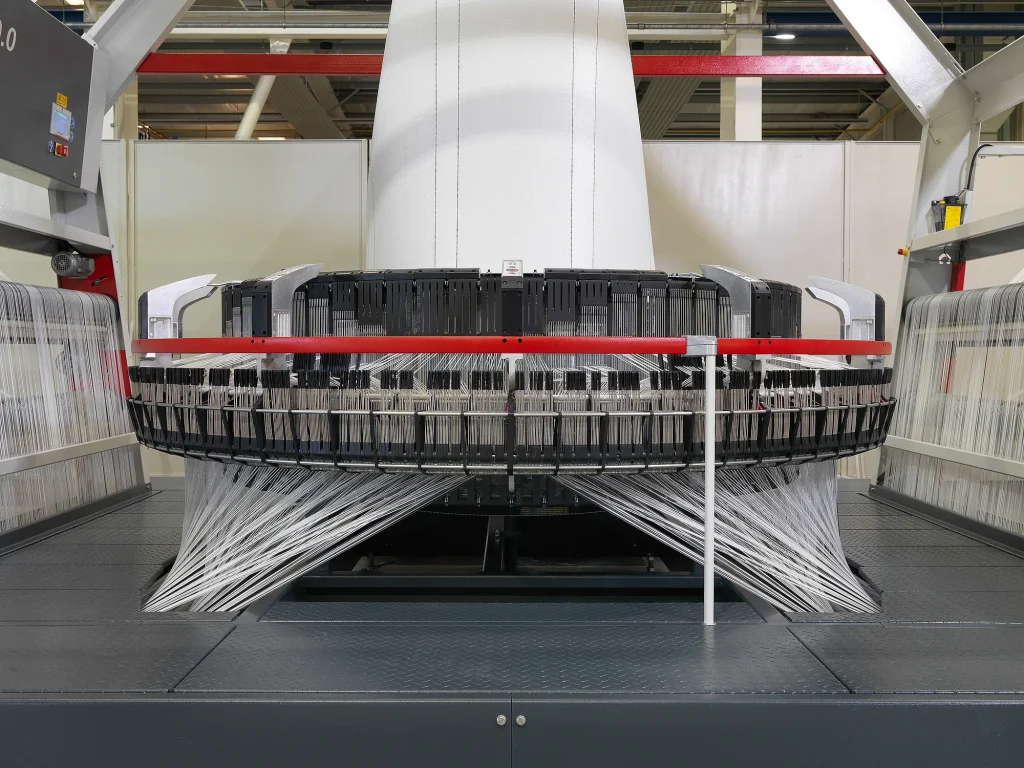
Weaving: Structural Integrity Through Interlacing

Circular looms interlace tapes into fabrics, with weave density (10–14 tapes/inch) dictating performance:

  • Tighter Weaves (14/inch): Achieve 4,000+ Rub abrasion resistance (ISO 4649) for abrasive materials.
  • Leno Weave Patterns: Enhance breathability for agricultural products like fertilizers.

Performance Comparison Table

Process ParameterImpact on DurabilityImpact on Flexibility
Extrusion MFI±5% tensile strength varianceSurface smoothness for printing
Stretch Ratio+30% tensile strength-20% elongation capacity
Weave Density+25% puncture resistance-15% fold endurance

2. Square Bottom Valve Bags: Design Advantages and Customization

Structural Benefits

  • Stacking Efficiency: Flat bottoms enable 2.5 m stable stacking vs. 1.8 m for round-bottom bags.
  • Valve Precision: Laser-cut valves ensure ±1 mm filling accuracy, reducing spillage by 18%.

Customization Options

FeatureTechnical SpecificationsApplications
Valve TypesSpout, pinch-seal, degassingCement, food powders
ReinforcementsDouble-stitched seams, corner guardsSharp-edged minerals
CoatingsBOPP (moisture), PE (FDA-grade)Pharmaceuticals, animal feed

Example: A Canadian flour mill boosted efficiency by 25% using our anti-microbial BOPP bags with 0.5 mm precision valves.


3. Technical Specifications and Compliance

Material Properties

ParameterStandard GradePremium Grade
Tensile Strength35 N/cm²55 N/cm²
Elongation at Break25%18%
Valve Diameter50–150 mmCustomizable
Cost per 1,000$180–$250$280–$350

Compliance Standards

  • Food Safety: FDA 21 CFR, EU Regulation 10/2011.
  • Explosive Environments: ATEX-certified anti-static liners (<10^8 Ω surface resistivity).

4. FAQs: Addressing Industrial Concerns

Q1: How do extrusion temperatures affect chemical resistance?

  • A: Processing at 240°C enhances crystallinity, improving resistance to acids (pH 2–5) and alkalis (pH 10–12).

Q2: Can these bags withstand freezer storage?

  • A: Yes. VidePak’s PP formulations retain 85% flexibility at -30°C (ASTM D746 tested).

Q3: What’s the MOQ for custom valve designs?

  • A: 5,000 units (10-day lead time) via 100+ looms and 30 printing machines.

5. VidePak’s Manufacturing Excellence

Founded in 2008 by CEO Ray, VidePak combines 30+ years of expertise with:

  • Scale: 568 employees, 16 extrusion lines, 100+ Starlinger circular looms.
  • Sustainability: 100% recyclable PP, 20% post-industrial recycled content by 2025.
  • Certifications: ISO 9001, ISO 14001, Oeko-Tex® for food-grade solutions.

Case Study: A Brazilian coffee exporter reduced waste by 30% using our degassing valve bags with 9-layer foil barriers.


6. Industry Trends and Innovations

  • Smart Packaging: QR codes and RFID integration for supply chain tracking.
  • Circular Economy: Bio-PP blends (15% sugarcane-based) under development for 2025 launch.

References

  • VidePak Woven Bags. (2025). Understanding Block Bottom Valve Bags: High-Performance Industrial Packaging.
  • VidePak Woven Bags. (2025). The Craftsmanship Behind BOPP Woven Bags: VidePak’s Commitment to Excellence.
  • Industry Standards: ASTM D5265, ISO 4649, FDA 21 CFR.

Contact

  • Website: https://www.pp-wovenbags.com/
  • Email: info@pp-wovenbags.com

For specialized applications like FIBC bulk bags in construction waste management or high-barrier valve solutions, explore our resources on valve bag innovations and heavy-duty FIBC solutions.

Leave a Comment

Your email address will not be published. Required fields are marked *

Scroll to Top