
What Are Kraft Paper Laminated Woven Bags? Definitions, Synonyms, and Practical Stakes
Kraft Paper Laminated Woven Bags are engineered, multi‑layer industrial sacks that combine a woven polypropylene (PP) fabric spine with a laminated kraft paper face. This paper–poly architecture is designed to reconcile what production lines often treat as trade‑offs: the woven substrate delivers tensile capacity, tear resistance, and drop robustness; the paper lamination supplies a matte, low‑glare, print‑friendly surface; optional coatings and micro‑perforation maps regulate moisture and de‑aeration during high‑speed filling. In other words, these hybrid sacks aim to be fast on the packer, stable on the pallet, and legible on the shelf.
- Kraft Laminated PP Woven Bags
- Paper–Poly Laminated Woven Sacks
- Paper Laminated Polypropylene Woven Bags
- Kraft Laminated Woven Valve Bags (when a self‑closing valve mouth is specified)
- Paper‑Lam PP Block‑Bottom Bags (square‑base conversions)
- Poly‑Paper Hybrid Industrial Bags
Where do Kraft Paper Laminated Woven Bags sit in the packaging ecosystem? Picture a continuum. At one pole, all‑paper multiwall sacks: elegant recyclability, excellent printability, modest wet strength. At the other pole, monomaterial polyolefin sacks: rugged, water‑tolerant, sometimes prone to glare and scanning inconsistency. The hybrid paper–poly family occupies the middle, giving operations a way to dial properties without buying a new form‑fill‑seal line or accepting illegible codes. Why choose between strength and story, speed and clarity, moisture tuning and runnability—when a carefully balanced stack can serve all three?
Architecture and Materials: How the Hybrid Stack Works and Why Each Layer Exists
A robust specification is not a list of ingredients; it is a rationale. Each layer in Kraft Paper Laminated Woven Bags earns its place by solving a measurable problem—load containment, dust management, moisture behavior, surface legibility, pallet friction. Overbuilding wastes resin and money. Underbuilding shifts cost into rework, downtime, and product loss. The craft is proportionality, the science is testable behavior.
1) Woven Polypropylene Fabric — Structural Spine
- What it is: Virgin PP resin is melted, cast as sheet, slit into tapes, and drawn (oriented) to align polymer chains. These oriented tapes are woven on circular or flat looms into the sack substrate. Typical basis weights: 60–120 g/m² for 10–50 kg programs; heavier when handling abrasives.
- What it does: Provides tensile strength and tear resistance with high strength‑per‑gram, absorbs drop energy, shields corners on docks, and stabilizes dimensions under compressive load.
- Cost logic: Denier and weave density dominate raw material cost. The goal is performance per gram, not maximum grams.
2) Kraft Paper Lamination — Print Face and Tactile Signal
- What it is: White or brown kraft (70–120 g/m²) laminated to the fabric via extrusion‑coated polyolefin ties or adhesive systems.
- What it does: Creates a matte, low‑glare surface for dense regulatory text and machine codes; elevates shelf presence with a familiar paper touch; adds scuff masking.
- Trade‑offs: Raises unit cost and stiffness slightly, influences moisture pathways; in return, improves readability and perceived quality.
3) Films, Coatings, and Tie Layers — Barrier and Bond
- Extrusion coatings (PP/PE) seal weave porosity and provide an anchor for inks.
- BOPP laminations (≈18–25 µm) can be added for photo‑grade graphics and wipe‑clean durability.
- Tie layers couple kraft to fabric while balancing end‑of‑life options where PP streams exist.
- Micro‑perforation zones near the mouth vent trapped air during fast fills.
4) Valve Sleeve and Mouth — If a Valve Program Is Specified
- Materials include PP/PE films or PE‑coated paper; sleeve may be internal, external, tuck‑in, or heat‑seal.
- Interface tuning keeps sleeve stiffness and friction consistent with filler type (impeller, screw, air) and powder bulk density.
- Under head pressure, the mouth collapses to self‑seal—minimizing dust plumes and post‑fill labor.
- Fabric: woven PP 80 g/m² with UV package
- Face: white kraft 90 g/m² laminated via 20 g/m² polyolefin tie
- Optional: BOPP 20 µm reverse‑printed, with matte windows reserved under codes
- Valve sleeve (if used): PE film 100 µm, internal self‑seal with heat‑tack patch
- Finishes: anti‑slip stripes; antistatic and antiblock for consistent line behavior
Field Behaviors That Matter: From Fill Speeds to Scan Rates
A feature is only real if it shows up in the shift report. Faster fills, smaller dust plumes, straighter stacks, higher first‑pass scan rates—Kraft Paper Laminated Woven Bags should convert design intent into operational outcomes. Consider the following behaviors as acceptance criteria.
Brick‑Like Stack Stability
Block‑bottom geometry and controlled friction produce planar layer‑to‑layer contact. Interlocking patterns resist column buckling and route vibration, reducing dock rebuilds.
Low‑Glare, High‑Contrast Legibility
The kraft face supports crisp text and scannable codes. Reserved matte windows neutralize glare over barcodes and QR, preserving scan consistency in bright aisles.
Moisture Tuning Without Over‑Stiffening
Extrusion coats and optional films lower MVTR enough for the corridor while avoiding stiffness that harms magazine feeding and crease memory.
- Better barcode contrast → faster scans → fewer mis‑picks.
- Paper touch + durable laminate → premium shelf feel without easy scuffing.
- Stable base + tuned friction → fewer re‑stacks and less stretch‑wrap usage.
Environmental Position: Efficiency First, Then End‑of‑Life
Environmental impact is a corridor story, not just a bin story. Kraft Paper Laminated Woven Bags create value by preventing product loss, cutting rework, and right‑sizing material—before we even discuss recovery pathways. Packaging mass matters, but lost product often matters more.
- Material right‑sizing: high strength‑per‑gram fabrics enable lighter sacks that still pass drop and stack specs.
- Information survivability: low‑glare faces reduce reprint waste and scan failures, trimming logistics emissions.
- Product‑loss prevention: robust seams and tuned valves minimize leakage and caking, which typically dwarf packaging in life‑cycle footprints.
- Recovery options: monomaterial designs (paper‑light or delamination‑friendly) can fit PP streams where available; where mixed formats are unavoidable, design for separation.
From Pellets to Pallets: The Production Chain (and Why Equipment Choice Shows Up on Your Dock)
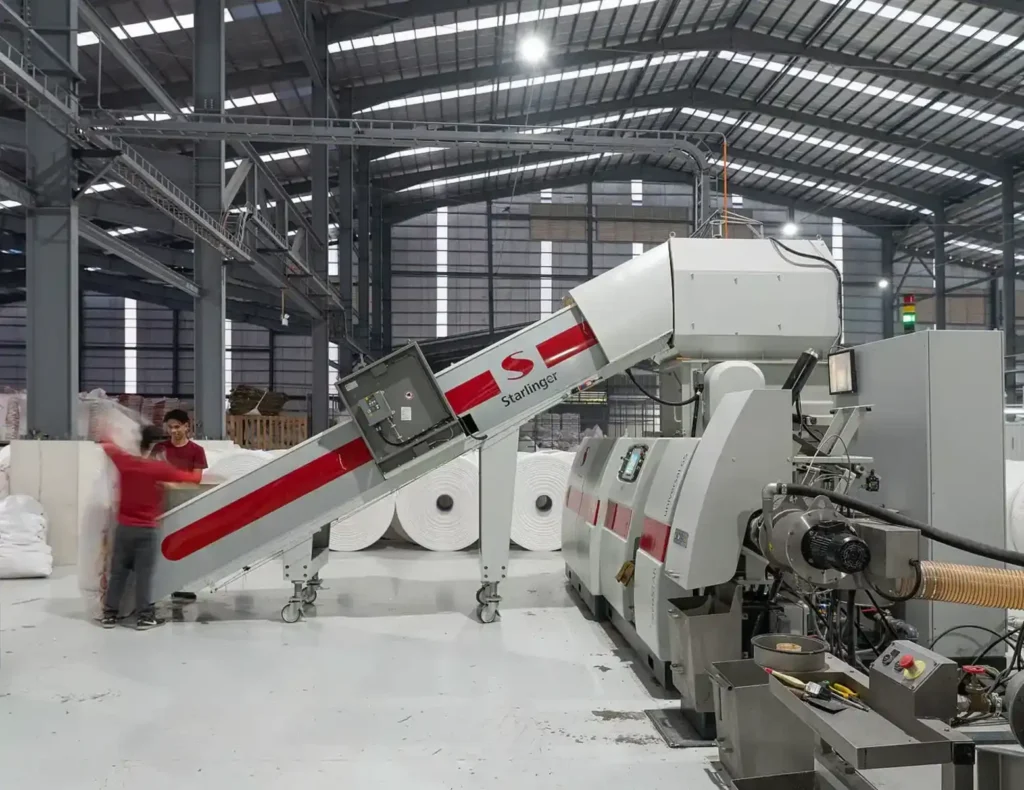
Great sacks are built upstream, not salvaged at inspection. VidePak deploys Austrian Starlinger and German W&H (Windmöller & Hölscher) platforms end‑to‑end—extrusion, weaving, coating/lamination, printing, and conversion—because tight web control, consistent gsm, and crisp registration are the roots of field reliability.
Gate A — Front‑End: Raw Materials and Incoming Tests
- PP resin: verify MFI, moisture, ash; dry to spec before tape drawing to curtail gels and brittle tapes.
- Kraft paper: check GSM, moisture, Cobb, porosity; confirm surface formation for print fidelity and lamination bond.
- Films & ties: gauge uniformity, dyne level, haze/gloss, and peel strength; ensure compatibility with inks/adhesives.
- Inks/adhesives: validate compliance; confirm heat/rub resistance consistent with dock handling.
- Valve components (if used): sleeve gauge/stiffness matched to spout; bench tacking and leak snapshots.
Gate B — Mid‑Stream: Fabrication, Lamination, Printing, Conversion
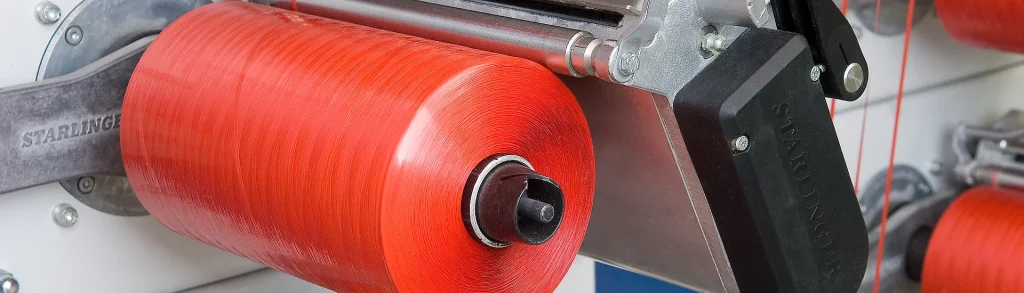
- Tape extrusion & orientation: cast sheet → slit → draw 5–7×; monitor fibrillation, break ratio, width/thickness tolerances, and denier uniformity.
- Weaving: circular or flat looms; ends × picks per cm² define tensile balance and porosity; broken‑end detection boosts uptime.
- Surface engineering: extrusion coat or laminate to couple paper and fabric; verify coating weight, pinholes, and peel (bond) strength.
- Printing: CI flexo on kraft or reverse gravure under BOPP; manage registration, dot gain, ΔE drift, barcode grade, and ink adhesion.
- Bottom formation: block‑bottom (square base) or pinch‑bottom; glue pattern, temperature, and pressure tuned for durability.
- Valve insertion: internal/external/tuck‑in sleeves; optional heat patches; verify sleeve length and overlap for self‑seal behavior.
- Cutting & finishing: hot‑knife edges to prevent fray; gusset memory tuned for magazine feed; apply anti‑slip stripes as specified.
Gate C — Back‑End: QA and Release
- Mechanical: MD/CD tensile, seam/valve pull, burst, and drop matrices by fill mass and height.
- Functional: de‑aeration time index, MVTR on barrier builds, barcode grade, scuff/rub resistance.
- Visual & dimensional: length/width/gusset tolerances; registration and ΔE controls; pallet count and label integrity.
- Traceability: lot coding links resin → fabric roll → conversion lot → inspector signature.
Starlinger extrusion/weaving and W&H printing/converting platforms deliver steadier web paths, tighter gsm control, and stable registration. Upstream stability becomes downstream predictability—fewer weak zones, fewer print drifts, fewer field failures.
Applications: Where the Hybrid Wins and Why
Use‑cases crystallize wherever powders and granules demand speed, legibility, and stack stability—especially when yards are rough or docks are wet. The following domains frequently specify Kraft Paper Laminated Woven Bags.
Construction & Minerals
Cement, mortar, gypsum, lime, limestone powder. De‑aeration control near the mouth, block‑bottom geometry for pallet cube, matte faces for code reliability.
- External sleeves compatible with high‑speed air packers
- Reinforced corners for harsh yard handling
- Anti‑slip finishes to tame route vibration
Agri‑Inputs & Chemicals
Fertilizers, soil amendments, pigments, carbonates. UV packages for yard storage; optional liners for hygroscopic blends; hazard panels on the kraft face.
- Micro‑perf maps for airy powders
- Block‑bottoms for tall, stable stacks
- Color coding by grade for instant visual separation
Food & Pet Nutrition
Starches, sugars, flours, salts, pet kibbles. Paper faces elevate perceived quality; liners support hygiene; matte code windows keep scan grade under bright lights.
- Low‑migration inks/adhesives when applicable
- Reverse‑printed BOPP for retail‑grade artwork
- Easy‑open features for safe access
Specialty Powders
Hydrated lime, fine silica, titanium dioxide. Engineer sleeve friction and micro‑perf density to manage dust; reinforce valve zones for repeated handling.
- Heat‑seal valves for stringent dust corridors
- Matte varnish panes under barcodes
- Lot codes with abrasion‑resistant overprint
Quality Governance: How VidePak Controls and Guarantees Performance
- Standards‑aligned production & testing: specifications and QA reference ISO/ASTM/EN/JIS for tensile/tear, drop/burst, MVTR, and barcode grading—supporting third‑party comparability and audit‑ready records.
- 100% virgin raw materials: stable MFI and cleanliness reduce gels and color drift; sourcing from major vendors improves lot‑to‑lot consistency and tape strength.
- All‑tier equipment from Starlinger & W&H: tighter basis‑weight control, steady web handling, and crisp registration across extrusion, weaving, coating/lamination, printing, and conversion.
- Closed‑loop inspection: incoming COAs → in‑process gsm/peel/ΔE/seam/valve checks → final AQL sampling with functional tests (drop/burst/de‑aeration) before release.
System Thinking: Decompose the Problem, Then Recompose a Cohesive Spec
Specifying Kraft Paper Laminated Woven Bags means reconciling tensions: barrier vs. runnability, mass vs. cost, gloss vs. scan grade, speed vs. dust. The productive path breaks the task into sub‑problems with measurable levers, then recombines the tuned solutions into a single, test‑validated specification.
Sub‑Problems and Local Levers
- Mechanical containment: fabric gsm, seam/adhesive maps, base style (block vs. pinch).
- De‑aeration & dust: sleeve friction window, micro‑perf density, vent pathways near the mouth.
- Brand & compliance: face smoothness, ΔE targets, barcode grade, reserved quiet zones.
- Throughput: mouth flatness, crease memory, wicket/header options for magazine feed.
- Sustainability: resin per unit function, mono‑family materials, end‑of‑life channels.
- Economics: unit price vs. total delivered cost (breakage, rework, downtime, returns).
Integrated Solution Pattern
- Define powder physics (bulk density, particle size, oil/fat content, hygroscopicity).
- Choose sleeve/valve type per filler (impeller/screw/air) and dust behavior.
- Fix fabric gsm and base geometry for drop spec and pallet pattern.
- Select coating/laminate and optional liner for barrier + print objectives.
- Lock color system and barcode windows; reserve matte panels under machine codes.
- Trial on the line; measure OEE, dust index, scan grade, pallet stability; adjust and freeze.
Engineering Tables: Materials, Barrier Options, Valve Types, Code Control
Printing Strategy and Information Survivability
Crisp logos and scan‑stable codes are the product of disciplined prepress, substrate control, and press checks. Proof on the actual kraft‑laminate stack, not lab stock. Reserve quiet zones around machine codes; avoid placing them across fold lines or high‑wear corners. Track ΔE on production samples and verify adhesion with cross‑hatch checks. A bag that reads the first time is a bag that moves the first time.
Palletization and Warehouse Engineering
Unit loads do not fail on CAD screens; they fail on docks. Engineer the stack pattern to your stiffness and vibration profile, harmonize anti‑slip finishes with stretch‑wrap tension, add top caps and cornerboards for long corridors, and validate with lean snapshots after a 24‑hour dwell. Design the unit load—not just the bag.
Failure Modes and RCCA (Prevent, Detect, Correct)
Comparative Frames: What the Hybrid Is—and Is Not
vs. All‑Paper Multiwall
Recycling pathways are simpler for paper, but wet strength and drop survival are lower in rough yards. The hybrid trades modest complexity for a durable face and stronger spine.
vs. Bare PP Woven Sacks
Bare PP wins on ruggedness but risks glare and inconsistent code readability. The kraft lamination restores legibility, improves shelf feel, and protects codes with matte windows.
vs. Fully Film‑Based Sacks
Film‑only sacks can be ultra‑fast and highly moisture resistant, but may require capital‑intensive FFS lines. Hybrids retrofit to existing valve packers while preserving a tactile paper face.
Case Narratives (Illustrative)
- White Cement, 40 kg: all‑paper sacks scuffed and failed at dock corners. Switching to Kraft Paper Laminated Woven Bags with block‑bottoms and external sleeves cut drop failures by 70% and preserved barcode grade after transit.
- Fertilizer Blend, 25 kg: hygroscopic product caked under dew cycles. A laminated kraft face with BOPP overprint near labels and an internal patch near the mouth stabilized MVTR and reduced housekeeping hours.
- Premium Pet Kibble, 12 kg: retail complaints on smudged art. Reverse‑printed BOPP over kraft, reserved matte windows, and anti‑slip bands improved shelf presence and sustained scanner performance.
KPI Dashboard: Measure What Matters
- Bag failure rate (ppm) in line and transit
- Drop test survivals by height and fill mass
- Dust index near filler (mg/m³ baseline)
- Scan success rate and average barcode grade
- Pallet stability incidents per 1,000 shipments
- CO₂e per shipped tonne (packaging + product loss)
- Lead time and OTIF (on time in full)
Procurement Checklist for Kraft Paper Laminated Woven Bags
- Product physics: density, particle size, oil content, hygroscopicity
- Filler hardware: impeller/screw/air; spout geometry; target rates
- Valve design: sleeve material & stiffness; patch; seal logic (self‑seal vs. heat‑seal)
- Bottom geometry: block‑bottom dimensions; gusset; anti‑slip finishes
- Print & codes: color references, ΔE, barcode grade, matte windows
- QA: drop matrix, de‑aeration, dust index, AQL sampling, traceability
Frequently Asked Questions
- Are these recyclable? Design choices matter. Monomaterial PP paths can fit PP‑stream recovery; paper–poly hybrids should be designed for easy separation where feasible.
- Do we always need micro‑perforation? No. Use it for airy powders that trap air at high filling rates; coarse granules vent naturally via interstices.
- Heat‑seal or self‑seal valves? Heat‑seal maximizes dust control (common for food); self‑seal sleeves are robust for minerals and general industry.
- What’s the right film gauge? The thinnest coating or lamination that meets MVTR and scuff targets while preserving runnability.
For broader sourcing context around paper‑faced woven solutions, see this trusted kraft paper woven bag producer overview, which complements the paper–poly hybrid approach discussed here.
October 30, 2025
- What Are Kraft Paper Laminated Woven Bags? Definitions, Synonyms, and Practical Stakes
- Architecture and Materials: How the Hybrid Stack Works and Why Each Layer Exists
- Field Behaviors That Matter: From Fill Speeds to Scan Rates
- Environmental Position: Efficiency First, Then End‑of‑Life
- From Pellets to Pallets: The Production Chain (and Why Equipment Choice Shows Up on Your Dock)
- Applications: Where the Hybrid Wins and Why
- Quality Governance: How VidePak Controls and Guarantees Performance
- System Thinking: Decompose the Problem, Then Recompose a Cohesive Spec
- Engineering Tables: Materials, Barrier Options, Valve Types, Code Control
- Printing Strategy and Information Survivability
- Palletization and Warehouse Engineering
- Failure Modes and RCCA (Prevent, Detect, Correct)
- Comparative Frames: What the Hybrid Is—and Is Not
- Case Narratives (Illustrative)
- KPI Dashboard: Measure What Matters
- Procurement Checklist for Kraft Paper Laminated Woven Bags
- Frequently Asked Questions
Imagine a client asking: “Why should I choose kraft paper laminated woven bags over traditional plastic packaging?” The answer lies in three critical factors: durability, eco-friendliness, and advanced technical specifications. These bags combine the strength of polypropylene (PP) woven fabric with the biodegradability of kraft paper, offering a sustainable solution without compromising performance. Backed by cutting-edge manufacturing processes and rigorous quality control, VidePak’s kraft paper laminated woven bags are engineered to meet diverse industrial demands while aligning with global sustainability goals.*
Technical Specifications: Precision in Design
1. Thickness, Grammage, and Size Ranges
VidePak’s kraft paper laminated woven bags are tailored to meet specific load-bearing and application requirements. Here’s a breakdown of their key parameters:
| Parameter | Range | Application Examples |
|---|---|---|
| Thickness | 80–200 microns (lamination layer) | Heavy-duty industrial goods, chemicals |
| Grammage | 90–150 gsm (kraft paper layer) | Agricultural products, construction materials |
| Bag Dimensions | 20 cm × 30 cm to 120 cm × 180 cm | Retail packaging, bulk storage |
For instance, a 120 gsm kraft paper layer laminated to a 160-micron PP woven fabric provides optimal tear resistance for transporting construction materials like cement or sand. Custom sizing ensures compatibility with automated filling systems, reducing operational bottlenecks[citation:21].
2. Anti-Static Technology: Safeguarding Sensitive Contents
Electrostatic discharge (ESD) poses risks in industries handling flammable powders or electronic components. VidePak integrates carbon-based conductive fibers into the PP woven fabric during extrusion, creating a continuous anti-static network. This technology dissipates static charges at a rate of <10^8 ohms/sq, complying with international standards such as IEC 61340-4-4. For example, in pharmaceutical packaging, these bags prevent powder aggregation and ignition risks, ensuring safe handling and storage[citation:33][citation:45].
3. Load Capacity: Engineered for Strength
The bags’ load-bearing capacity ranges from 25 kg to 2,000 kg, depending on the lamination structure and stitching design. A triple-layered kraft paper-PP composite with reinforced seams can withstand up to 10:1 safety ratios, ideal for FIBC (Flexible Intermediate Bulk Container) applications. Case studies in the chemical industry demonstrate that VidePak’s bags reliably transport 1-ton batches of granular fertilizers without seam failure[citation:18][citation:29].
Environmental Advantages: Aligning with Circular Economy Principles
1. Biodegradability and Recyclability
Unlike conventional plastic bags, kraft paper laminated woven bags feature a 70–80% biodegradable composition. The kraft paper layer decomposes within 2–6 months under industrial composting conditions, while the PP woven fabric can be recycled into pellets for reuse in non-food packaging. VidePak’s partnership with EU-certified recycling facilities ensures a closed-loop system, reducing landfill waste by up to 60% compared to single-use plastics[citation:27].
2. Carbon Footprint Reduction
A lifecycle analysis reveals that producing 1,000 kraft paper laminated bags generates 35% fewer CO2 emissions than equivalent plastic bags. This stems from energy-efficient manufacturing using Austria’s Starlinger machines, which consume 20% less electricity per ton of output. Additionally, the use of recycled PP resin in 40% of production lines further lowers resource consumption[citation:12][citation:44].
3. Regulatory Compliance
VidePak’s bags meet stringent global standards, including REACH (EU), FDA (US), and GB/T 8946 (China). For example, the kraft paper layer is sourced from FSC-certified forests, ensuring responsible forestry practices. This compliance not only mitigates legal risks but also enhances brand reputation for eco-conscious clients[citation:37][citation:50].
FAQs: Addressing Client Concerns
Q1: How does the lamination process enhance durability?
The lamination bonds kraft paper to PP fabric using food-grade adhesives, creating a moisture-resistant barrier. This prevents delamination even under humid conditions, extending shelf life for hygroscopic materials like fertilizers.
Q2: Are custom printing options available?
Yes. VidePak’s 30+ printing machines support up to 8-color HD printing, ideal for branding or hazard warnings. Digital proofing ensures design accuracy before mass production.
Q3: What is the lead time for bulk orders?
Standard orders ship within 15 days, leveraging 100+ circular looms and 16 extrusion lines. Expedited services are available for urgent demands.
Why Choose VidePak?
Founded in 2008 and led by CEO Ray Chiang, VidePak combines 30+ years of industry expertise with state-of-the-art technology. Our 568-member team serves clients across 50+ countries, delivering 8,000+ metric tons of packaging monthly. With certifications like ISO 9001 and Sedex, we prioritize quality, sustainability, and ethical production.
References
- VidePak Corporate Profile: https://www.pp-wovenbags.com/
- Email: info@pp-wovenbags.com
- Sustainable Packaging Solutions: A 2024 Market Analysis
- Advances in Anti-Static Polymer Technologies (Journal of Materials Science, 2023)
External Resources
- Learn more about customizable kraft paper laminated bags for specialized needs.
- Explore anti-static solutions in industrial packaging.
Empower your supply chain with VidePak’s innovation—where sustainability meets strength.