
What are Valve Woven Bags and why does material control decide their real performance?
In working plants—where powders surge, conveyors scuff, and pallets travel farther than anyone planned—packaging is not a brochure promise; it is a chain of controlled variables. Valve Woven Bags—also called PP valve sacks, valve‑type polywoven sacks, or paper–poly valve bags—combine a woven polypropylene skeleton, a tailored surface system (kraft or BOPP), and an integrated valve spout to create a package that fills fast, sheds dust, resists impact, and communicates clearly. The thesis of this rewrite is simple and demanding: performance comes from material control. Not slogans. Not anecdotes. Controlled tapes, controlled laminations, controlled valves, controlled coatings. When each variable is defined, measured, and governed, Valve Woven Bags routinely deliver fewer split incidents, steadier stacks, cleaner air, and more predictable throughput across 10–50 kg formats for cement, gypsum, calcium carbonate, fertilizers, premixes, animal feed, and industrial additives.
To make this practical, the narrative below deconstructs the system into interacting sub‑systems—mechanics, barrier & hygiene, valve productivity, and brand & compliance—then rebuilds them into a single, testable specification. Each section integrates three lenses: Data Reinforcement (standards, test anchors, target numbers), Case Analysis (what happened when plants changed one variable), and Comparative Study (trade‑offs versus neighboring formats). The aim is not to admire the bag; it is to engineer it.
What are the features of Valve Woven Bags?
Feature lists become more useful when they are treated as adjustable dials rather than fixed labels. Raise denier and you may change fold memory; add matte coating and you may alter friction; introduce a liner and you may slow filler venting. The features of Valve Woven Bags are best understood as four coupled dimensions—mechanical integrity, barrier & hygiene, valve‑enabled productivity, and brand & compliance—whose interactions must be balanced against product flow, climate, and equipment realities.
- Tensile & elongation: ISO 13934‑1 / ASTM D5035; fabric tear: ISO 13937; seam efficiency: ASTM D1683 analogs for tape fabrics.
- Drop survivability: ISO 2206/2248 at 0.8–1.2 m for 25 kg fills; compression: ASTM D642 on palletized stacks; COF: ASTM D1894 against your pallet films and corrugate.
- Moisture: ASTM F1249 (WVTR) for liners/films; print rub: ASTM D5264; barcode grading: ISO/IEC 15416; color accuracy: ISO 12647.
Now, three realities that often get ignored: First, numbers outlive names—a “premium” sack without denier, picks/inch, and peel strength is a story, not a spec. Second, interfaces carry risk—valve fit, bottom geometry, and pallet film interactions create more downtime than fabric alone. Third, climate argues back—designs that excel in dry seasons stumble in monsoons unless liners and anti‑slip are tuned. Material control turns these realities into levers you can pull on purpose.
How are Valve Woven Bags produced when quality is governed end‑to‑end?
From resin to pallet, each step sets the limits of the next. If the draw ratio drifts, seams will pay. If the adhesive choice changes, migration and odor move with it. If valve sleeves vary, dust monitors will tell you first. A controlled process for Valve Woven Bags looks like this:
- Resin & masterbatch. High‑grade PP with antioxidant packages anchors ductility and stress‑crack resistance. Colorants are documented to FDA 21 CFR 178.3297 and (EU) 10/2011 SMLs. Tracer yarns enable SKU coding and counterfeit deterrence.
- Tape extrusion & orientation. Film casting → slitting → drawing sets denier (≈700D–1200D) and elongation. Rounded tape edges reduce nick initiation; narrow denier distributions simplify seam tuning and reduce variability in strip tensile data.
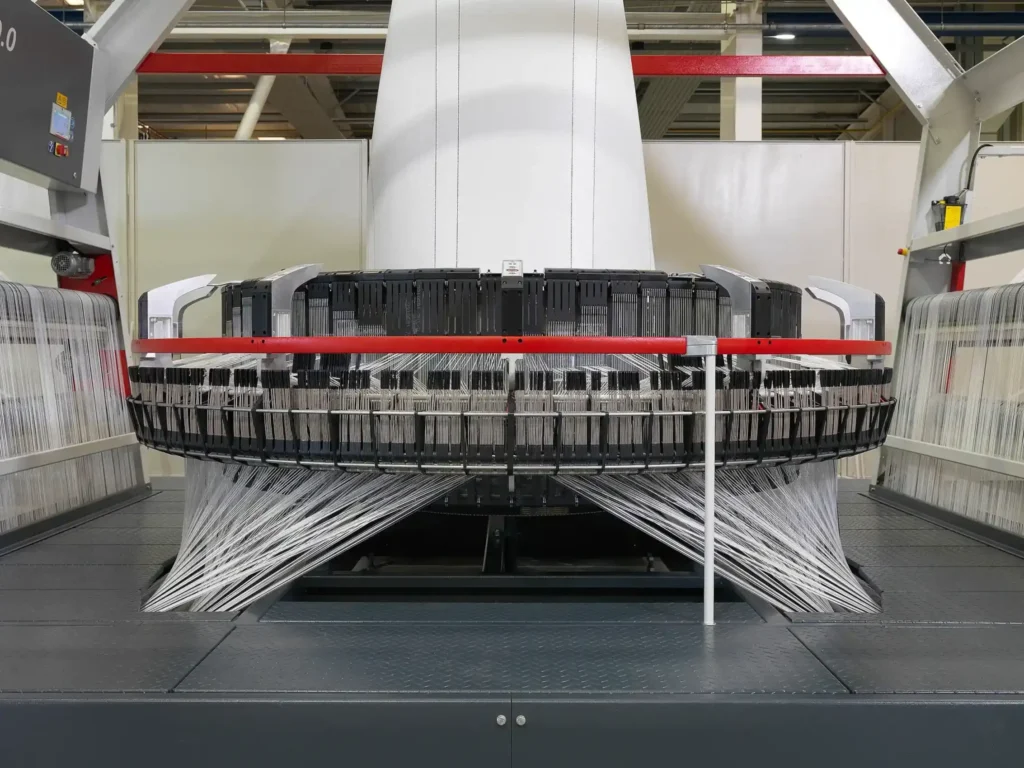
- Weaving. Flat or circular looms build ~8×8–12×12 picks/inch fabric. Higher counts improve surface smoothness and burst resistance but slow native venting at fillers; lower counts vent better but demand more attention to seam program and bottom design.
- Lamination & printing. Extrusion lamination maximizes bond and moisture continuity on BOPP or kraft faces; adhesive lamination reduces heat and odor for sensitive graphics. Flexo/offset on kraft; gravure on BOPP; ISO 12647 color control with spectrophotometric checks. Matte coats protect barcode zones from glare.
- Tube forming & valve insertion. Longitudinal seams define the tube. Internal or external valve sleeves are inserted; valve diameter (≈35–55 mm), sleeve stiffness, and vent path are matched to particle flow. Micro‑perfs are positioned above headspace to vent air without lifting fines.
- Bottoming & closing. Pinch block‑bottom (dust‑tight, square stance), heat‑seal, or sewn + crepe—selected by risk profile and equipment. Bottom turn depth is set to restrain peel under edge drops; anti‑slip is applied where forklift contact is likely to create sliding planes.
- Quality assurance. Routine tests include ISO 13934‑1/ASTM D5035 (tensile), ISO 13937 (tear), ISO 2206/2248 (drop), ASTM D642 (compression), ASTM D1894 (COF), ASTM D903 (peel), ASTM F1249 (WVTR for liners), and ASTM D5264 (print rub). Documentation: DoCs (FDA/EU), REACH SVHC statements, EU 94/62/EC heavy‑metals totals, first‑article approvals for valve fit and bottom geometry, retained samples by lot under ISO 9001 traceability.
Two choices deserve slow thinking. First, extrusion vs. adhesive lamination: extrusion dominates when bond strength and moisture continuity are critical; adhesive earns its keep when odor, ink sensitivity, or temperature limits are binding. Second, full‑face film vs. patch lamination: full‑face film brings scuff resistance and photographic print but may require micro‑perfs to keep filler speed; patch lamination preserves breathability while concentrating brand impact. In both cases, bench data must graduate to plant data—peel strength, WVTR, drop, and filler rate—before a plant‑wide change.
Where do Valve Woven Bags excel—and why?
Applications cluster wherever quick, clean filling collides with heavy handling and strict labeling. Because the value stems from both mechanics and governance, Valve Woven Bags scale across industrial powders, agrochemicals, and food/feed ingredients.
- Construction powders. Cement, gypsum, mortar: internal valves cut dust; block‑bottoms stand square; anti‑slip faces harmonize with pallet films during long hauls.
- Industrial minerals & pigments. Calcium carbonate, TiO₂, fillers: liner + tuned micro‑perfs balance moisture control and filler speed; abrasion‑resistant denier protects seams during rough loading.
- Fertilizers & agrochemicals. Valve tops with pinch‑bottoms keep stacks from leaning; regulatory panels remain legible on matte kraft faces or protected BOPP prints.
- Food/feed ingredients. Flour, sugar, premixes: low‑odor inks and adhesives protect sensory quality; barcode and small‑type legibility is higher on matte zones than on glossy panels under barn lighting.
Material control: the hidden engine behind fewer losses
The phrase in the theme—Ensuring Quality through Material Control—is not decorative. It is operational. It means specifying the polymer grade and stabilizer package, documenting the denier window and pick count, locking lamination bonds, validating anti‑slip, tuning valves to powder rheology, and treating color and barcode as process controls rather than artwork. What does that look like, concretely?
Failure modes you can preempt with specification discipline
Bags do not fail mysteriously; they fail specifically. A heat‑cut top with a micro‑nick becomes a running tear after 300 km of vibration. A glossy panel that delights marketing becomes a skating rink under stretch wrap. A wonderful liner slows a filler whose spout can’t vent. Naming the failure gives you a lever.
- Edge nicks & tear propagation. Maintain sharp slitting blades; round tape edges; specify double‑turned bottoms; test to ISO 13937 alongside ISO 13934‑1/ASTM D5035.
- Slippery stacks after print upgrades. Add anti‑slip where wrap overlaps; validate COF via ASTM D1894 on actual pallets; monitor incident rate at docks to confirm change effect.
- Slow fills with liners. Move micro‑perfs above headspace; measure WVTR (ASTM F1249) to keep barrier on target; consider short vacuum assist at spout for dusty blends.
- Sun‑brittle returns. Target 200–300 kLy UV stabilization; screen with ASTM G154/ISO 4892‑3; quarantine early chalking lots; update masterbatch records.
Specifications & test anchors (color‑coded table)
| Parameter | Typical Range / Option | Method / Note |
|---|---|---|
| Capacity | 10–50 kg (common 20/25/40/50 kg) | ISO 2206/2248 drop orientations |
| Fabric density | ~8×8–12×12 picks/inch | Visual + tensile correlation |
| Tape denier | 700D–1200D (warp/weft) | ISO 13934‑1 / ASTM D5035 |
| Valve type | Internal or external; 35–55 mm spout | Plant SOP dust capture; fill‑rate timing |
| Bottom style | Pinch block‑bottom; sewn + crepe; heat‑seal | Drop + dust checks |
| Liner | PE 30–70 μm; optional EVOH | ASTM F1249 (WVTR) |
| COF | Anti‑slip tuned to ~0.4–0.6 | ASTM D1894 (on actual pallet film) |
| UV stability | Target 200–300 kLy (outdoor staging) | ASTM G154 / ISO 4892‑3 |
| Printing | Flexo/offset on kraft; gravure on BOPP | ISO 12647; ASTM D5264 |
| Compliance | ISO 9001/14001; ISO 22000/FSSC 22000 (when applicable); FDA 21 CFR; EU 1935/2004; (EU) 10/2011; EU 94/62/EC; REACH 1907/2006 | Certificates & DoCs |
Integrated solution blueprint (from risks to requirements to results)
The following blueprint translates typical hazards into parameters, parameters into tests, and tests into governance. Adopt it as a living document—numbers will evolve as lanes, seasons, and product mixes change.
Economic & environmental rationale (why fewer split bags beats lighter film)
Every split bag wastes more than packaging—it wastes product, labor, freight, and credibility. By reducing splits, stabilizing pallets, and protecting legibility, Valve Woven Bags lower emissions per kilogram delivered. Mass‑right engineering typically beats mass‑reduction slogans: a slightly heavier, stable bag can produce a smaller total footprint than a lighter, failure‑prone one once returns and rework are counted. Mono‑polymer pathways (PP fabric + PE liner) ease end‑of‑life handling where polyolefin streams exist; documentation simplifies audits and accelerates border crossings.
Implementation roadmap (procurement × production × QA)
A plant‑ready transition plan avoids the two classic failures—under‑tested heroics and analysis paralysis. The roadmap below moves a site from concept to controlled supply without sacrificing uptime.
- Define the load. Document particle size distribution, bulk density, and moisture window by SKU; flag molasses content, sharp mineral geometries, and seasonal humidity peaks.
- Draft the spec. Convert risks into numbers: denier, picks/inch, valve diameter, sleeve stiffness, liner thickness, micro‑perf count, bottom turn depth, COF target, UV package, color ΔE, barcode grade target (≥ 3.0 under ISO/IEC 15416).
- Pilot smartly. Two pallets per SKU through full orientation drops; COF on actual pallet films; filler timing with and without micro‑perfs; dust capture at the spout; rub cycles on print/label zones; barcode grading after rub.
- Govern the change. Issue controlled drawings; lock first‑article approvals; define re‑qualification triggers (resin grade, denier shift, adhesive chemistry, coating weight, valve material); keep retained samples and CoAs per lot.
- Roll out. Phase by lane and season; track outcome metrics: split incidents, pallet leans, returns, dust alarms, barcode mis‑scans, and dock rework minutes; hold quarterly spec reviews with suppliers.
Why VidePak
We are not selling nouns; we are engineering outcomes. With Valve Woven Bags we tune laminate stacks, denier, seam programs, and valve geometries to the powder you run, the fillers you own, and the lanes you ship. Our documentation packs—DoCs, migration tests, CoAs, change control—mirror ISO 9001/14001 and FDA/EU frameworks so audits are predictable and border checks are quick.
Share the product, particle size, moisture window, and route conditions. We will return a Valve Woven Bags specification—laminate stack, valve geometry, liner plan, bottom style, anti‑slip target, and color/barcode program—plus a validation matrix (drop/compression/WVTR/COF/dust/rub) your plant can run without slowing production.
In the competitive packaging industry, Valve Woven Bags have become essential for various sectors, from agriculture to construction. At VidePak, we understand the critical role that these bags play in protecting and transporting products safely. The quality of these bags hinges on the materials used in their production, particularly high-density polyethylene (HDPE) and polypropylene (PP). Therefore, we maintain strict quality control over our raw materials, starting from procurement to storage, ensuring that every batch meets our exacting standards.
The Importance of Quality Raw Materials
The durability and reliability of Valve Woven Bags are directly tied to the quality of the raw materials used in their production. We exclusively use 100% virgin HDPE and PP resin, sourced from trusted suppliers globally. This commitment to quality begins at the procurement stage, where we conduct thorough assessments of potential suppliers. Our team evaluates suppliers based on their reputation, production capabilities, and history of compliance with international quality standards.
Using new PE and PP resin instead of recycled materials is crucial for several reasons. Firstly, virgin resins have consistent physical and mechanical properties, ensuring that the final Valve PP Bags possess uniform strength, flexibility, and durability. Secondly, virgin materials are free from contaminants that could compromise the integrity of the bags, such as impurities or inconsistent polymer blends. This attention to detail is why VidePak’s Valve Woven Bags stand out in the market, providing unmatched reliability.
Procurement Process: Ensuring High Standards
Our procurement process is designed to ensure that only the highest quality raw materials enter our production line. When selecting suppliers, we consider various factors, including their production processes, quality control measures, and capacity to deliver consistent materials. We also assess their ability to provide materials that meet specific requirements, such as tensile strength, elongation at break, and thermal stability.
Before finalizing any purchase, we request detailed specifications and samples from potential suppliers. These samples undergo rigorous testing in our in-house laboratory, where we evaluate their mechanical properties, such as tensile strength, elasticity, and impact resistance. Additionally, we test the consistency of the material’s molecular structure to ensure that it aligns with the standards required for Valve sacks production.
Only after passing these stringent tests do we approve a supplier and place bulk orders. Even after establishing a supplier relationship, we continue to monitor their performance through regular audits and random sampling of their materials. This ongoing scrutiny guarantees that every batch of HDPE and PP resin we receive meets our high standards.
Batch Inspection: A Pillar of Quality Assurance
Upon arrival at our facilities, each batch of raw material undergoes a thorough inspection process before it is accepted into our production line. We conduct a series of tests to verify the material’s quality, including visual inspections and advanced analytical techniques. The visual inspection allows us to detect any obvious defects, such as color inconsistencies or the presence of foreign particles.
More importantly, we conduct mechanical and chemical testing to ensure that the materials conform to the required specifications. We measure key properties such as melt flow index (MFI), which indicates the material’s flow characteristics during the extrusion process. A consistent MFI is critical for producing Valve PP Bags with uniform wall thickness and strength. We also assess the material’s tensile strength and elongation at break, both of which are crucial for ensuring the durability of the final product.
If any batch fails to meet our standards, it is rejected and returned to the supplier. This strict adherence to quality control ensures that only the best materials are used in our Valve Woven Bags, providing our customers with products they can trust.
Advanced Storage Solutions: Preserving Material Integrity
Proper storage of raw materials is as critical as their initial selection and testing. At VidePak, we have invested in state-of-the-art storage facilities that are designed to preserve the quality of our HDPE and PP resins. These facilities are climate-controlled, maintaining optimal temperature and humidity levels to prevent material degradation.
HDPE and PP resins are sensitive to environmental factors such as temperature, moisture, and UV exposure. Prolonged exposure to these elements can cause the materials to lose their mechanical properties, leading to weaker, less durable bags. To mitigate these risks, we store our raw materials in sealed containers within our climate-controlled warehouses. This approach minimizes the risk of contamination or degradation, ensuring that the materials retain their properties until they are ready for use in production.
Moreover, we operate a first-in, first-out (FIFO) inventory system, which ensures that older materials are used before newer ones, preventing any potential degradation over time. This system is crucial for maintaining the consistency and quality of our Valve Woven Bags.
Continuous Improvement: The Path to Excellence
Quality control is not a one-time effort but an ongoing commitment at VidePak. We continuously review and improve our processes to ensure that our Valve bags remain at the forefront of the industry. Our research and development team works closely with our quality assurance department to identify areas for improvement, whether in material selection, testing methodologies, or storage solutions.
We also stay abreast of advancements in polymer technology, exploring new materials and additives that can enhance the performance of our Valve sacks. By incorporating the latest innovations, we ensure that our products not only meet but exceed the expectations of our customers.
Conclusion
The integrity and performance of Valve Woven Bags are deeply rooted in the quality of the raw materials used in their production. At VidePak, we take a comprehensive approach to quality control, from the careful selection of suppliers to the meticulous testing and storage of our materials. By prioritizing the use of 100% virgin HDPE and PP resins, we guarantee that our Valve PP Bags are reliable, durable, and capable of meeting the demands of various industries. This commitment to quality is what sets us apart as a leading Valve bags manufacturer in the global market.