

What are FIBC Bags? A clear definition, scope, and common aliases
FIBC Bags — short for Flexible Intermediate Bulk Containers — are collapsible industrial containers used to store, stage, and transport dry flowable materials at construction sites and allied industries. Built predominantly from woven polypropylene fabric, these bulk containers combine a remarkably high payload‑to‑tare ratio with robust dimensional stability under compression. Depending on safety‑factor design and use environment, a single unit can handle 500–2,000 kilograms, interface with forklifts, telehandlers, or cranes, and collapse flat after discharge for compact return or disposal.
Because the category is global, the same object is described by different names. Each alias reflects regional practice or sector tradition while pointing to the same engineering intent: maximize safe payload, minimize tare, and simplify handling.
Also known as (aliases):
- Bulk bags
- Ton bags
- Jumbo bags
- Super sacks
- Flexible bulk containers
- Big bags
- One‑ton FIBCs
Callout — Why construction teams adopt FIBC Bags:
Rapid material staging near point‑of‑use, fewer forklift cycles compared with smaller sacks, lower packaging mass per kilogram delivered, and better jobsite housekeeping due to controlled discharge options.
The materials of FIBC Bags — polymers, textiles, liners, and accessories
Specifying FIBC Bags is less about buying a single object and more about orchestrating a layered material system. The woven shell, sewing threads, webbing loops, closures, and optional liners each influence performance, cost, and after‑use options. Below, the material families are mapped to the properties construction teams actually depend on in the field.
1) Woven polypropylene fabric: the structural backbone
Polypropylene homopolymer tapes. The standard shell is woven from oriented PP tapes. Orientation (draw) raises tensile modulus and decreases creep, enabling tall stacks and long dwell times in warehouses or laydown yards without excessive deformation. Typical basis weights for construction‑grade shells range from 120 to 240 g/m²; heavier fabrics are used when abrasives or sharp aggregates are common.
Weave density and denier. Ends × picks (warp × weft counts) and tape width govern tensile behavior, permeability, and the smoothness needed for reliable printing. Denser counts elevate tensile and reduce sifting through the shell; lighter counts reduce grams but may require liners or filler cords at seams for powders.
UV stabilization. Out‑of‑doors exposure at sites is routine. Hindered amine light stabilizers (HALS) and pigmented masterbatches slow UV embrittlement, preserving loop and seam integrity across seasons.
2) Sewing threads, webbing, and lifting loops
Threads. Polypropylene or polyester threads are selected for seam strength and chemical compatibility. Ticket size and stitch geometry (double‑thread chain, lockstitch, or combinations) are tuned to avoid cut‑through under cyclic loading.
Loops and webbing. Lifting strength concentrates where loops join the body. Cross‑corner, side‑seam, or full‑lift loop geometries are matched to forklift tines, crane hooks, or spreader bars. High‑tenacity polyester webbing is sometimes specified when a safety factor above commodity norms is required.
3) Liners and barrier options
LDPE/LLDPE liners. Common for moisture‑sensitive powders (cement, fly ash, gypsum). Loose insert liners are economical; form‑fit liners with tabbed fixtures maintain shape during discharge and resist “ballooning.”
Antistatic and conductive liners. Where combustible dusts may be present, liners are paired with Type C (conductive, grounded) or Type D (dissipative) shells to control electrostatic discharge risk during fill and discharge.
4) Closures, discharge features, and add‑ons
Top styles. Open top for coarse aggregates; spout tops for powder lines; duffle (skirt) tops where varied product sizes or quick visual inspection is needed; conical tops for better headspace use.
Bottom styles. Flat for one‑time use where residue is acceptable; discharge spouts for controlled emptying; “star” closures or conical bottoms for difficult‑flow powders.
Document pockets and label zones. Clear pockets protect safety data sheets and batch cards; high‑contrast zones improve barcode/QR scanning under jobsite lighting.
5) Cost levers and trade‑offs
- Resin cost dominates; fabric weight is the primary mass driver.
- Loop/webbing specification and liners are secondary costs with outsized impact on safety and dust/moisture control.
- Printing complexity is discretionary; functional labeling often suffices for construction materials.
Function card — moisture moderation
Pair form‑fit liners with powders having caking risk; for aggregates tolerant to humidity, omit liners and rely on tarps to preserve recyclability.
Function card — discharge control
Size spout diameter to your hopper throat; specify choke ties and dust socks to minimize plumes at the mixer.
Function card — static safety
When powders have low minimum ignition energy, select Type C or Type D builds and document bonding/grounding procedures.
What are the features of FIBC Bags? Field‑relevant advantages
Translating the material stack into jobsite value reveals why FIBC Bags dominate construction packaging for granular and powdered goods.
- High payload at very low tare. One container can carry a metric ton while weighing only a fraction of that mass, dramatically lowering packaging grams per delivered kilogram.
- Modular handling. Loops engage forklifts, cranes, or telehandlers; cross‑corner designs pair well with spreader bars for level lifting.
- Stackability and cube efficiency. Q‑baffle variants create square profiles for better warehouse cube and safer trucking.
- Dust and moisture control. Tight weaves, filler cords, seam tapes, and liners keep fines contained and mitigate humidity ingress.
- Controlled discharge. Spouts, star closures, and accessory dust socks reduce loss and cleanup at hoppers and mixers.
- Safety‑rated designs. Safety factors (5:1 single‑use, 6:1 multi‑use) align with standardized lift, cyclic, drop, and tear tests.
- Repairability and reuse (where governed). Multi‑trip designs support controlled reuse under documented inspection and reconditioning.
Prompt insight:
If your team struggles with dust during hopper fills, test spout‑top FIBC Bags with form‑fit liners and choke ties; the combination increases throughput while improving housekeeping and safety.
What is the production process of FIBC Bags? From polymer to jobsite
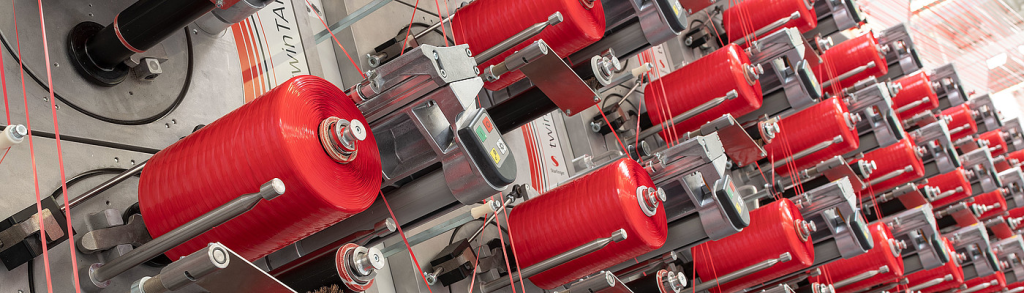
- Resin handling and extrusion. PP pellets are compounded with stabilizers and pigments, cast into sheet, slit, and drawn into oriented tapes with narrow width and gauge tolerances.
- Weaving. Tapes feed flat or circular looms; loom counts, tensions, and take‑up are controlled to deliver consistent tensile properties and uniform dimensions across rolls.
- Cutting and printing. Fabric is cut to panels and marked; optional graphics, handling symbols, and variable data are printed in high‑contrast zones to aid scanning on site.
- Sewing and assembly. Panels, webbing loops, reinforcements, filler cords, and baffle panels are stitched; seam geometries are chosen to prevent cut‑through and provide sift‑proofing for powders.
- Liner integration. Loose, form‑fit, antistatic, or conductive liners are inserted and secured with tabs; earthing points are added for Type C builds.
- Quality assurance. Top‑lift, cyclic loading, drop, seam strength, dust‑sift assessments, and visual inspections confirm the intended safety factor and feature set.
- Palletization and dispatch. Bundles are counted, labeled, and palletized with anti‑slip sheets and corner boards for safe transit and yard storage.
What is the application of FIBC Bags? A construction‑focused map
Aggregates and fill materials
Sand, gravel, crushed stone, ballast, and topsoil are routine cargos for FIBC Bags. Open‑top or duffle‑top designs enable fast fills, while Q‑baffle variants stabilize stacks for warehouse cube and predictable truck loading.
Cementitious and mineral powders
Cement, fly ash, ground granulated blast‑furnace slag, lime, gypsum, and bentonite benefit from liners, seam filler cords, and discharge spouts. Measured discharge rates reduce losses and dust when feeding into silos, mixers, or pumps.
Specialty materials and admixtures
Pigments, silica fume, microfibers, perlite, and lightweight beads demand dust control and sometimes ESD management. Type C or D configurations with antistatic liners mitigate ignition hazards and improve transfer efficiency.
Site logistics and waste streams
Beyond inbound materials, FIBC Bags act as convenient containers for demolition debris, segregated waste, or contaminated soils, simplifying crane lifts and skip‑loader cycles.
Analysis framed by the title — FIBC Bags: Understanding Their Applications in Construction
The title suggests a practical plan: understand where FIBC Bags create measurable advantages and how to tune specifications for distinct construction scenarios. The agenda below mirrors how foremen, project engineers, and procurement teams think when time is tight and space is scarce.
- Material staging. Bulk containers place sand, ballast, and cement at the exact point of work, reducing internal haul distances and crane or forklift cycles. Color‑coded labels accelerate identification during pours and deck work.
- Weather and moisture. Liners moderate humidity for powders; aggregates tolerate breathable shells. Tarps, sheds, or temporary covers augment protection without complicating recycling for mono‑material shells.
- Dust and housekeeping. Spout discharge plus choke ties and dust socks limit clouds at mixers; less cleanup means faster turnovers and better safety.
- Lift planning and safety. Loop geometry must match lifting equipment. Spreader bars reduce loop abrasion and sling‑angle forces. Rated slings and written lift plans cut incident risk.
| Construction | Fabric (gsm) | Top | Bottom | Liner | Loops | Typical payload | Use case |
|---|---|---|---|---|---|---|---|
| Open‑top, flat bottom | 140–180 | Open | Flat | None | 4 cross‑corner | 1,000–1,500 kg | Sand, gravel, soil |
| Spout‑top, discharge spout | 160–220 | Spout | Spout | Optional | 4 side‑seam | 1,000–1,500 kg | Cement, fly ash, lime |
| Duffle‑top, spout discharge | 160–220 | Duffle | Spout | Optional | 4 cross‑corner | 1,000–2,000 kg | Aggregates with varied lumps |
| Q‑baffle bag | 180–240 | Spout | Spout | Optional | 4 cross‑corner | 1,000–1,500 kg | Square stacking for cube |
| Type C (conductive) | 180–240 | Spout | Spout | Conductive | 4 with earthing tabs | As rated | Combustible powders |
| Type D (dissipative) | 180–240 | Spout | Spout | Dissipative | 4 | As rated | Static‑prone products |
Systems approach — decompose the problem, recombine the specification
Sub‑problem A — Payload vs. handling safety
Question. How do we maximize payload without exceeding safe lift thresholds? Levers. Fabric gsm, loop geometry, base reinforcement, safety factor (5:1 vs. 6:1), palletized vs. bare lifts. Response. Size units to the heaviest routine lift your crane/forklift can safely execute; prefer 4‑loop cross‑corner with spreader bars for cranes; keep inspection logs for multi‑trip bags.
Sub‑problem B — Dust control vs. fill/discharge speed
Question. Can we minimize dust while keeping fill/discharge fast? Levers. Liner form‑fit vs. loose, filler cords, spout diameter and length, discharge closure design. Response. For fine powders, combine form‑fit liners with choke ties; pilot discharge rates on your actual hoppers before committing to volume orders.
Sub‑problem C — Moisture moderation vs. recyclability
Question. How much humidity control is necessary? Levers. Mono‑material shells vs. multi‑material liners, tarping/storage practices, desiccant packs. Response. Use liners only when quality demands it; otherwise keep shells mono‑material PP and add external covers to preserve recycling options.
Sub‑problem D — Stack stability vs. load flexibility
Question. How do we stabilize stacks with variable contents? Levers. Q‑baffles, base reinforcements, palletization, anti‑slip sheets, corner boards. Response. Choose Q‑bags for warehouse cube and road stability; add corner boards above three tiers; train crews on staggered stack patterns where pallets are unavailable.
Sub‑problem E — Static risk vs. cost
Question. Are antistatic or conductive builds necessary? Levers. Particle size and MIE, humidity, grounding infrastructure, liner type. Response. For powders with low MIE or volatile vapors, specify Type C or D; document bonding and grounding at fill and discharge racks.
Case studies — from bid specs to field results
A. Urban high‑rise concrete works
Challenge. Crane time is constrained; staging must be precise. Spec. Q‑baffle FIBC Bags with spout tops for cement and sand; color‑coded labels; spout diameter matched to hopper throat. Result. Fewer crane cycles per pour, lower dust cleanup, clear deck organization.
B. Coastal infrastructure repairs
Challenge. High humidity compromises powder flow. Spec. Spout‑top FIBC Bags with form‑fit liners and desiccant pouches; UV‑stabilized shells. Result. Lower caking rates, predictable discharge into mobile batch plants, preserved fabric strength after outdoor storage.
C. Industrial flooring with silica fillers
Challenge. Static hazards during pneumatic transfer. Spec. Type C (conductive) FIBC Bags with grounded filling racks; antistatic form‑fit liners. Result. No ESD events, faster transfer, improved dust control.
Risk register and mitigations for construction sites
- Loop abrasion at crane hooks. Use spreader bars and rounded shackles; inspect loops daily.
- Dust plumes at discharge. Fit choke ties and dust socks; add local extraction at hoppers.
- Stack instability on uneven ground. Palletize, use anti‑slip sheets and corner boards; keep tiers within guidance.
- UV‑driven embrittlement. Specify UV packages; rotate stock; cover with tarps.
- Mislabeling or missing documentation. Use protected document pockets and mandatory barcode scans at receiving.
- Liner collapse during discharge. Use form‑fit liners with tabs; vent appropriately to maintain flow.
Frequently asked technical questions (concise)
- Are FIBC Bags food‑contact compliant? Construction use rarely requires it, but compliant materials can be sourced for specialty applications.
- Can FIBC Bags be reused? Multi‑trip 6:1 designs can, under documented inspection and reconditioning. Single‑trip 5:1 designs should not be reused for lifting.
- How are they recycled? Mono‑material PP shells are technically recyclable where PP collection exists; liners may require separate handling and must match local infrastructure.
- Do I need a spreader bar? Often yes for crane lifts: it reduces sling‑angle forces and loop abrasion while keeping loads level.
- What controls static hazards? Type C (conductive, grounded) or Type D (dissipative) configurations matched to powder MIE and site grounding practices.
Practical checklist for specifiers and buyers
- Define the heaviest routine payload and your lifting equipment’s limits.
- Choose fabric gsm and loop geometry to meet safety factor and ergonomics.
- Decide on liners based on moisture and dust behavior of your product.
- Select top/bottom constructions that match filling and discharge hardware.
- Consider Q‑baffles when warehouse cube or truck stack stability matters.
- If powders can ignite, specify Type C or D and document grounding procedures.
- Standardize label zones with barcodes/QR and use document pockets.
- Validate discharge rates on the exact hoppers or mixers in use.
- Train crews on sling angles, spreader bars, and loop protection.
- Set inspection and retirement criteria for multi‑trip bags.
Keyword plan and long‑tail placement
Primary keyword woven throughout: FIBC Bags. Natural variants included: bulk bags, jumbo bags, ton bags, super sacks, flexible intermediate bulk containers, big bags for construction, FIBC for cement, FIBC for aggregates, Q‑bags for square stacking, antistatic bulk bags, conductive FIBCs, lined bulk bags for powders. These phrases mirror how procurement teams and site engineers actually search for compatible containers and options.
Construction‑ready spec template (starter)
Product: FIBC Bags for cement and sand
Size & volume: Sized to 1,200 kg payload with Q‑baffles for cube
Fabric: PP woven, 180–200 g/m², UV stabilized
Loops: 4 cross‑corner heavy webbing, compatible with spreader bar
Top/Bottom: Spout top, discharge spout with choke tie
Liner: LDPE form‑fit, 100 μm, tabbed fixation
Seams: Double chain‑lock with filler cord; seam strength ≥ specified fraction of body tensile
Labeling: High‑contrast zone with barcode/QR; clear document pocket
Testing: Top lift to safety factor; cyclic loading; drop test; dust‑sift check
Palletization: Anti‑slip sheets and corner boards; tarp protocol for outdoor storage
ESD: For silica or fly ash variants, Type C with grounding points and verified continuity
For adjacent packaging categories and materials context, see the overview of FIBC bulk bags which helps situate design options and safety classifications alongside the construction‑focused use cases discussed here.
- What are FIBC Bags? A clear definition, scope, and common aliases
- The materials of FIBC Bags — polymers, textiles, liners, and accessories
- What are the features of FIBC Bags? Field‑relevant advantages
- What is the production process of FIBC Bags? From polymer to jobsite
- What is the application of FIBC Bags? A construction‑focused map
- Analysis framed by the title — FIBC Bags: Understanding Their Applications in Construction
- Systems approach — decompose the problem, recombine the specification
- Case studies — from bid specs to field results
- Risk register and mitigations for construction sites
- Frequently asked technical questions (concise)
- Practical checklist for specifiers and buyers
- Keyword plan and long‑tail placement
- Construction‑ready spec template (starter)
- 1. FIBC Bags in Construction: Market Dynamics and Applications
- 2. Technological Innovations and Quality Assurance
- 3. Branding Strategy: VidePak’s Differentiation in China
- 4. Future Trends: Automation and ESG Integration
- 5. FAQs: Addressing Industry Concerns
- 6. Conclusion: Redefining Construction Logistics
Introduction
In the rapidly evolving construction industry, Flexible Intermediate Bulk Containers (FIBCs) have emerged as indispensable tools for transporting and storing bulk materials like cement, sand, and aggregates, offering unmatched durability, cost efficiency, and sustainability. As China’s construction sector grows at a CAGR of 5.2% (2025–2030), driven by infrastructure projects and urbanization, FIBC bags are becoming critical for modern logistics. For manufacturers like VidePak, which combines Austrian Starlinger technology with a long-term brand-building strategy, the success of FIBC solutions lies in their ability to balance technical excellence with environmental responsibility, setting them apart from competitors focused on short-term gains.
Ray, CEO of VidePak, remarks: “When a Chinese construction firm reduced spillage costs by 40% using our anti-static FIBC bags, it wasn’t just about the product—it was proof that quality-driven branding and innovation can redefine industry standards.”
1. FIBC Bags in Construction: Market Dynamics and Applications
1.1 Key Applications and Regional Demand
FIBC bags are widely used in construction for:
- Cement and Concrete Transport: Laminated PP bags with UV-resistant coatings prevent moisture ingress, critical in humid regions like Southern China.
- Waste Management: Heavy-duty FIBCs with PE liners handle abrasive debris like demolition waste, reducing landfill costs by 30%.
- Chemical Storage: Anti-static FIBCs (Type C and D) safely store flammable powders, complying with OSHA and EU safety standards.
China’s FIBC market is projected to grow at 6.8% CAGR through 2030, fueled by infrastructure investments in the Belt and Road Initiative and urban renewal projects in cities like Shanghai and Shenzhen.
1.2 Competitive Landscape
While Chinese manufacturers dominate 65% of the global FIBC market, many prioritize low-cost production over quality. VidePak differentiates itself through:
- Advanced Manufacturing: 100+ Starlinger circular looms produce FIBC fabrics with tensile strengths of 12–14 N/mm², 25% higher than industry averages.
- Customization: Multi-layer laminations (e.g., PE, aluminum foil) and RFID tracking tags cater to niche demands like temperature-sensitive adhesives.
2. Technological Innovations and Quality Assurance
2.1 Material and Design Innovations
- Recycled PP Blends: VidePak’s FIBCs incorporate 30% post-consumer recycled PP, reducing carbon footprints by 40% while maintaining load capacities up to 2,000 kg.
- Ultrasonic Seaming: Ensures airtight closures for powders, eliminating spillage risks. A case study with a Jiangsu cement plant reported a 50% reduction in material loss.
| Parameter | Standard FIBCs | VidePak FIBCs |
|---|---|---|
| Tensile Strength | 8–10 N/mm² | 12–14 N/mm² |
| Recyclability Rate | 70% | 95% |
| Moisture Permeability | 10 g/m²/day | <5 g/m²/day (PE-coated) |
2.2 Quality Control Protocols
VidePak’s 12-step inspection process includes:
- Seam Strength Testing: Cyclic load tests up to 10,000 cycles (ASTM D5260).
- Static Dissipation: Type D bags achieve surface resistivity <10^8 ohms, critical for chemical safety.
3. Branding Strategy: VidePak’s Differentiation in China
3.1 Long-Term Vision vs. Short-Term Gains
Unlike competitors prioritizing cost-cutting, VidePak invests in:
- Sustainability: A 2MW solar array powers 40% of production, aligning with China’s 2060 carbon neutrality goals.
- Certifications: ISO 9001 and FDA compliance, enhancing trust in regulated markets like the EU and North America.
3.2 Localized Branding and Global Expansion
- Cultural Resonance: Incorporating Chinese design motifs (e.g., dragon patterns) in custom prints for domestic clients.
- International Outreach: Partnering with European logistics firms to promote FIBCs in the “China-EU Green Packaging Initiative”.
4. Future Trends: Automation and ESG Integration
4.1 Smart Packaging
- IoT-Enabled Bags: Embedded sensors monitor humidity and temperature, reducing spoilage in concrete storage by 25%.
- Blockchain Traceability: QR codes linked to blockchain platforms ensure supply chain transparency, demanded by 70% of Fortune 500 construction firms.
4.2 Regulatory and Market Shifts
- EU Plastic Tax: FIBCs with >50% recycled content will gain tariff advantages, positioning VidePak for growth in Europe.
- Circular Economy: Closed-loop recycling partnerships with Chinese municipalities aim to reclaim 1,000+ tons of PP waste annually by 2030.
5. FAQs: Addressing Industry Concerns
Q1: How do FIBC bags compare to traditional metal containers?
A: FIBCs reduce logistics costs by 30% due to lighter weight and stackability, while offering comparable durability (12+ reuse cycles).
Q2: Are VidePak’s FIBCs suitable for hazardous materials?
A: Yes. Type C FIBC bags and Type D FIBC bags meet UN certification for flammable powders, with anti-static liners tested to 10^8 ohms.
Q3: Can small construction firms afford custom FIBC orders?
A: VidePak’s MOQ starts at 500 units, with rapid prototyping via 30+ printing machines supporting Pantone colors and QR codes.
6. Conclusion: Redefining Construction Logistics
As China’s construction sector embraces sustainability and automation, FIBC bags will remain pivotal in bridging efficiency and ecological accountability. VidePak’s brand-first approach—prioritizing quality, innovation, and ESG alignment—positions it as a leader in the global shift toward intelligent, sustainable packaging.
External Resources
- Explore sustainable FIBC solutions: Sustainable Practices with FIBC Bags
- Learn about advanced material innovations: Multi-wall Laminated Woven Bags
By merging cutting-edge technology with a commitment to long-term value, VidePak exemplifies how FIBCs can drive both operational excellence and environmental stewardship in the construction industry.