
What Are Square Bottom Valve Bags?
Square Bottom Valve Bags are purpose-built industrial sacks that marry two ideas often kept apart: the carton-like discipline of a square, self-standing base and the speed of a self-closing valve mouth. On shop floors and in purchasing specs they are also called block-bottom valve sacks, square-base valve bags, brick-pack valve sacks, or AD*STAR-type woven valve sacks. Different names, one intent: create a cuboid, stable package that fills quickly, stacks neatly, scans cleanly, and survives warehouses, trucks, and store aisles without drama.
Why do retailers and wholesalers favor this geometry? Because the square base converts a flexible package into a predictable unit. It stands like a box on end-caps and gondolas, aligns like a brick on pallets, and tolerates the daily nudges of restocking. The valve mouth completes the logic. It mates to automatic fillers, closes under product head pressure, and sidesteps external heat seals on the outer shell, all while containing dust at the source. In short: the base imposes order; the valve accelerates throughput; the woven scaffold carries the load.
The Materials of Square Bottom Valve Bags
A credible bill of materials reads like an engineering argument. Each layer serves a mission—structural, barrier, hygienic, communicative—and each decision shows up later in lift tests, barcode grades, or pallet stability. The most successful Square Bottom Valve Bags share a coordinated, mono‑polyolefin stack so end‑of‑life remains straightforward in markets that favor PP recycling pathways.
1) Woven polypropylene fabric (the backbone)
Isotactic polypropylene (PP) is melted, cast, slit into tapes, and drawn to align polymer chains. The drawn tapes are woven into a rectangular lattice that resists tear propagation while delivering high tensile-to-weight. Typical fabric weights for retail-adjacent fills (5–25 kg) sit in the 80–110 g/m² band when laminated; 25–50 kg formats generally adopt 100–130 g/m². Mesh (ends × picks per 10 cm) and draw ratio dictate modulus and seam behavior, while the surface “knuckle” profile influences how laminates lie and how barcodes read across high spots.
Why PP rather than paper or PET fabrics? Low density keeps tare down; chemical inertness tolerates salts and mild alkalinity; fatigue resistance helps corners and seams survive cyclic impacts; and mono-material pairings with BOPP and PE preserve recycling options. Cost correlates with global PP indices and grams per square meter—so right‑weighting is not optional, it is a fiscal strategy.
2) Laminated print faces (BOPP family)
Biaxially oriented polypropylene (BOPP) offers the smooth, scuff-resistant canvas that lets Square Bottom Valve Bags double as retail billboards. Two common routes: a transparent BOPP over a white ink system when windows are desired; or a white/pearlized BOPP (often cavitated with TiO₂ pigmentation) when opacity and brand-color fidelity matter. Lamination uses a PP-rich tie via extrusion lamination to keep the stack polyolefin-only.
Benefit bundle: high-definition rotogravure or HD-flexo print; improved moisture resistance vs. uncoated fabric; better barcode contrast; and tunable surface friction via targeted matte overprint varnish (OPV) lanes for pallet grip.
3) Liners and valve films (PE and co‑ex variants)
When the product is hygroscopic, dusty, or odour‑sensitive—think rice, flour, sugar, pet food—liners and engineered valve films take center stage. Loose LDPE/LLDPE liners (30–60 µm) are quick to integrate and give a clean contact surface; form‑fit versions (50–90 µm) track the geometry, reduce folds, and resist abrasion. Valve films in 70–100 µm gauges combine stiffness for clamp retention with slip tuning for smooth extraction; antistatic packages help on powder lines.
Food‑adjacent SKUs demand modern declarations of compliance for all food‑contact articles; non‑food store programs still benefit from liners that keep fines contained and moisture out.
4) Square‑bottom forming & seam hygiene
Brick‑like bases are created by pre‑creasing and heat‑welding coated shells or by folded‑and‑stitched builds on uncoated fabric. Sift‑proof fillers close stitch tunnels for fine powders; reinforcement patches around the mouth resist the filler clamp’s pinch. In humid routes, heavier base GSM and over‑taped corners pay back by eliminating the dreaded corner blowout.
The Features That Matter in Stores
Feature lists are only useful if they survive forklifts, shrink-wrap, and customer hands. The following attributes translate directly into lower incident rates, faster replenishment, and fewer returns for Square Bottom Valve Bags.
Stand‑up geometry
Square bottoms behave like boxes. They make end‑caps look deliberate, not improvised. They reduce topple events on smooth floors and keep brand panels upright without constant straightening by staff.
Valve‑enabled throughput
Self‑closing valves pair with automatic fillers; changeovers stay quick; dust stays near the spout. The net: more filled bags per hour, cleaner machines, calmer QC checks.
Print that sells and scans
BOPP faces serve high‑definition art and durable barcodes. Dedicated matte windows protect the quiet zones that scanners need; color tolerances stay tight even after stretch‑wrap rub.
Strength with modest tare
Oriented PP lattices carry heavy fills without punishing freight invoices. Typical 10–25 kg constructions weigh under 180 g and still pass drop and stack trials when engineered, not guessed.
Containment & hygiene
Liners and sift‑proof seams keep fines in; OPVs and laminate choices limit odour pickup; antistatic routes reduce nuisance shocks and ignition risk on powder lines.
Recyclability pathways
All‑polyolefin constructions (PP fabric + BOPP face + PE liner) align with PP‑centric recycling streams in many regions. Clear material ID zones support future labeling rules.
How Square Bottom Valve Bags Are Produced
Behind every calm shelf is a disciplined plant. The conversion chain turns pellets into a package that behaves. Skipping steps replaces discipline with luck; neither stores nor auditors pay for luck.
- Raw material qualification. Vet PP resin (MFR windows, isotactic index), PE grades for liners and valve films, and masterbatches (UV, antistat, slip). File declarations for food-contact layers where applicable; pre‑approve ink and adhesive systems for the laminate stack.
- Extrusion → tape drawing. Melt, cast, slit, draw. Draw ratios set tensile and creep; masterbatch dosing set here later appears as pallet sliding (over‑slip) or dust cling (under‑antistat). Record the recipe and keep it tight.
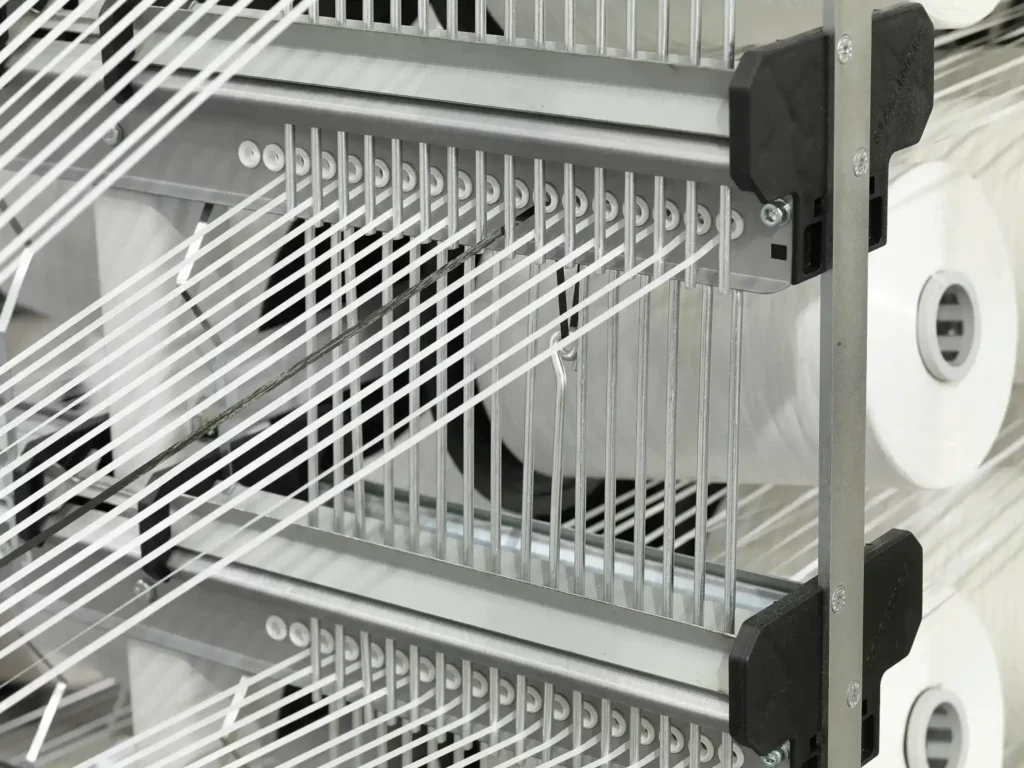
- Weaving. Circular or flat looms create fabric. Ends/picks density and GSM govern strength and knuckle profile; consistency pays back in lamination bond and print flatness.
- Surface preparation. Corona‑treat laminating faces to ≥ ~38 dynes; audit coat weights if using extrusion coating; check COF after any OPV or matte patch operation.
- Lamination & graphics. Laminate printed BOPP to the fabric via PP-rich tie. Verify bond strength, color ΔE, scuff resistance, and barcode grades after simulated transport.
- Cutting & square‑bottom forming. Hot‑knife cutting reduces fray. Brick bases are formed by pre‑creasings and heat welding (for coated shells) or folded‑and‑stitched builds (for uncoated). Add sift‑proof seam fillers when powders are in scope. Install valves with reinforcement patches tuned to filler clamp widths.
- Liner fabrication & integration. Blow‑film extrude liners, cut, and seal. Loose liners drop in quickly; form‑fit liners reduce folds and abrasion; cuff‑seals at the mouth improve leak‑tightness and hygiene.
- Hygiene & inspection. Filtered air for blow‑downs, tool accountability, lube controls, and metal detection where food or feed is in scope. Wrap or bag‑in‑bag to keep the clean bag clean.
- Release testing. Tensile and seam pull; filled‑bag drop matrix (corner/edge/flat); compression dwell; COF; dyne; WVTR and odour where claimed; barcode grading. Retain samples by lot and link labels to ERP traceability.
Where Square Bottom Valve Bags Excel
Applications span food, pet, garden, and DIY categories. The unifying pattern: products that benefit from clean fills, neat stacks, and readable codes.
- Supermarket bulk & club formats (5–25 kg). Rice, flour, sugar, beans, pet kibble, charcoal, and rock salt. Printing carries brand stories; liners protect from humidity; bases keep pallets square.
- Home‑improvement & garden channels. Soil amendments, sand, fertilizer, cement add‑ons. Abrasion resistance matters; valves cut dust in small stores and backrooms.
- Store back‑of‑house logistics. Ingredients for in‑store bakeries and bulk bins. Barcodes must survive handling; valves prevent flour clouds in prep areas.
- Quick‑commerce and dark‑store restocking. Square bases track straight on conveyors and withstand rapid, frequent touches; scuff‑safe faces keep codes readable for automated systems.
Reading the Title as a Contract
“Square Bottom Valve Bags: Ideal for Supermarket and Store Applications” is less a slogan and more a checklist disguised as a headline. It implies a measurable promise at every comma.
“Square Bottom” → stability
Define maximum lean angle on shelves; set stacking deformation limits after route dwell; specify base squareness tolerance so cartons and sacks stack together without surprises.
“Valve Bags” → throughput
Match valve width and length to clamps; target self‑seal reliability under vibration; enforce dust‑extraction capture around the spout. Changeover times must be a metric, not a mood.
“Store Applications” → presentation & safety
Barcode grades after transport, COF bands for pallet stability on smooth floors, odour neutrality in food aisles, and scuff‑safe artwork zones become contract items, not afterthoughts.
Systems Thinking: Decompose, Optimize, Recombine
Complex packages become manageable when split into subsystems with measurable targets. For Square Bottom Valve Bags, six subsystems cover most real‑world failures.
Printing Technologies and Face Engineering
In grocery and DIY aisles, faces do double duty: they sell and they survive. The platform of Square Bottom Valve Bags lets you engineer both.
Rotogravure vs. HD‑flexo vs. digital
Rotogravure delivers photographic tonal transitions and microtext at the cost of cylinders and lead time. HD‑flexo narrows the gap with faster changeovers and economical plates. Digital remains niche for woven laminates but shines in personalization pilots; always validate ink/adhesive compatibility with the laminate stack.
Opacity and show‑through
Fabric “knuckles” can telegraph through thin films and muddy brand whites. Pearlized/cavitated BOPP improves opacity with modest caliper; manage filler levels to keep bond strength and avoid brittle behavior in cold chains.
Barcode architecture
Protect quiet zones with matte code windows placed away from high‑rub corners. Specify minimum grade at pack‑off and post‑vibration. Treat dyne and OPV as process windows, not last‑minute patches.
COF zoning
One face, two jobs: glossy billboard center for the brand and matte traction lanes where stretch-wrap grips. Declare target COF pairs (bag/bag and bag/film) so varnish swaps don’t quietly break pallet stability.
Valve Geometry, Dust Control, and Filler Integration
Valves are simple in drawings and unforgiving on lines. The difference between a week of calm and a week of rework is millimeters of film and seconds of clamp time.
Dimensions that behave
Under‑length valves slip; over‑wide valves crumple. A common window for 10–25 kg formats is 120–160 mm wide by 120–180 mm long—always confirm on the actual filler with your product.
Self‑seal reliability
Valve films need enough stiffness and memory to fold against product head and stay shut; add internal flaps for fine powders. For leak‑back risks, tack the valve tip with a tiny hot‑melt dot or ultrasonic kiss.
Dust capture and antistatic
Design extraction hoods around the filler mouth; spec antistatic liners and valve films to reduce cling. Capture metrics—not anecdotes—should define a successful trial.
In‑Store Safety, Ergonomics, and Loss Prevention
Store environments punish sloppy designs. The aisle is hard, the schedule is tight, and the floor is smooth. The well‑engineered Square Bottom Valve Bags anticipates that reality.
- Safe handling. Tuned COF prevents pallet skate; square bases resist topples; handling cards guide safe unwrapping and tilt limits. High‑visibility inks cue lifting points.
- Ergonomics. Size packs with human factors in mind; move heavier bags mechanically in back rooms; keep grab points obvious and reinforced.
- Loss prevention. Clean barcodes speed checkouts and backroom scans; tamper‑evident valve tips deter product sampling; covert print elements (microtext, UV) help deter switching on premium lines.
A Ready‑to‑Use Specification Template
Copy, adapt, and attach to your RFQ. Numbers convert preferences into performance.
Keyword product: Square Bottom Valve Bags
- Construction. PP woven shell 80–110 g/m² (5–25 kg fills) / 100–130 g/m² (25–50 kg); square bottom welded for coated shells or folded‑stitched for uncoated; BOPP 25–35 µm (clear or pearlized) with PP tie; matte traction lanes where wrap contacts; valve film 70–100 µm; reinforcement patch under clamp; optional liner: loose 30–60 µm or form‑fit 50–90 µm.
- Performance windows. Drop matrix pass; stack dwell within lean/height‑loss thresholds; COF bag/bag 0.35–0.55 and bag/film 0.25–0.40; barcode grade ≥ C after vibration; dyne ≥ ~38 dyn pre‑print.
- Compliance & traceability. Current declarations for food‑contact layers (when in scope); management‑system certificates (when required); job/roll IDs and retained samples.
- Sustainability. Prefer mono‑polyolefin stack; right‑weight fabrics/liners using test data; avoid metallization and incompatible labels when recyclability KPIs apply.
Technical Tables for Fast Decisions
Worked Examples (From Requirement to Spec)
Examples turn abstractions into decisions. Use these as blueprints, not commandments.
Example 1 — 10 kg jasmine rice
Risks: humidity, light sensitivity, barcode scuff. Architecture: shell 90 g/m²; pearlized BOPP 30 µm; form‑fit liner 70 µm; valve 90 µm; welded base; sift‑proof filler; matte barcode window. Targets: WVTR at 38 °C/90% RH; COF 0.45–0.55; barcode ≥ C post‑vibration. Validation: drop matrix; slide‑angle; odour panel; ΔE checks.
Example 2 — 20 kg pet food
Risks: scuff, odour sensitivity, pallet skate. Architecture: shell 100 g/m²; pearlized BOPP 30 µm with matte lanes; loose liner 50 µm; valve 100 µm; reinforced patch; UV‑stabilized shell. Targets: scuff index within limit; barcode grade maintained; COF bands met; drop and stack pass. Validation: scuff simulation; COF panels; drop tests; stack dwell; odour panel.
Example 3 — 25 kg fine salt
Risks: caking, seam sifting, smooth-floor sliding. Architecture: shell 120 g/m²; coated PP face (no film) to keep COF high; form‑fit liner 80 µm; antistatic valve 90 µm; folded‑stitched base with dust‑proof tape. Targets: tight WVTR; zero sifting under vibration; bag/bag COF ≥ 0.45. Validation: WVTR at route RH; sift test with talc; pallet slide; drop matrix.
Troubleshooting: Symptom → Cause → Fix
Sustainability Under Modern Rules
Regulatory momentum asks packages to be clear about their end-of-life and honest about their material makeup. Square Bottom Valve Bags already lean in the right direction when built as polyolefin‑only stacks.
- Design‑for‑recycling. Favor PP/BOPP/PE combinations; avoid metallization and incompatible labels; reserve windows for transparent BOPP rather than foreign films.
- Right‑weighting. Use data to remove grams. Ten grams off a million packs is ten metric tons of resin not purchased, not shipped, not disposed.
- Family alignment. If one SKU is food‑adjacent, align the whole family to the stricter declaration; harmonize inks/adhesives for fewer audits and simpler change control.
From Requirements to a Cohesive Solution
Clarity begets calm. Convert loose wishes into measurable windows, and Square Bottom Valve Bags become predictable logistics machines.
- Start with the product and route. Hygroscopic or odour‑sensitive? Dusty or granular? Coastal humidity or inland dry? Hazard first, habit second.
- Pick shell GSM and base style from tests, not tradition. Drop, seam, and stack data beat lore; choose welded vs. stitched based on laminate and route.
- Engineer valve & liner to your filler and aisle. Clamp geometry, self‑seal behavior, cuff seals, and antistatic choices should match the machine and the market.
- Make faces that sell and survive. Pearlized BOPP for opacity; matte lanes for grip; scuff‑safe windows for codes; document COF and dyne targets.
- Write compliance into the spec. Keep declarations current; track certificate numbers and expiry; plan for labeling rules in your art files now, not later.
- Validate on your lines. Your conveyors, your floors, your weather. Lab wins that fail in the plant were never wins at all.
- Lock change control. New resin, ink, adhesive, or masterbatch? Run a mini‑validation; update the golden sample and retained samples accordingly.
- What Are Square Bottom Valve Bags?
- The Materials of Square Bottom Valve Bags
- The Features That Matter in Stores
- How Square Bottom Valve Bags Are Produced
- Where Square Bottom Valve Bags Excel
- Reading the Title as a Contract
- Systems Thinking: Decompose, Optimize, Recombine
- Printing Technologies and Face Engineering
- Valve Geometry, Dust Control, and Filler Integration
- In‑Store Safety, Ergonomics, and Loss Prevention
- A Ready‑to‑Use Specification Template
- Technical Tables for Fast Decisions
- Worked Examples (From Requirement to Spec)
- Troubleshooting: Symptom → Cause → Fix
- Sustainability Under Modern Rules
- From Requirements to a Cohesive Solution
- 1. Material Selection and Functional Design for Agricultural Packaging
- 2. Quality Control and Standardization
- 3. Printing Innovations and Branding Impact
- 4. Logistics and Storage Optimization
- 5. Technical Parameters for Customization
- 6. VidePak’s Competitive Edge: Starlinger Automation
- FAQs
- 7. Case Study: Transforming Rice Logistics in Thailand
“Why are square bottom valve bags becoming the go-to packaging solution for supermarkets and agricultural product suppliers?”
The answer lies in four transformative advantages: superior stacking stability, cost-effective logistics, customizable branding, and compliance with global food safety standards. For VidePak, a global leader in woven bag manufacturing with 30+ years of expertise, these bags are engineered to reduce retail shelf restocking time by 30% and minimize transport damage by 45% in grain and flour supply chains.
1. Material Selection and Functional Design for Agricultural Packaging
1.1 Polypropylene (PP) Woven Fabrics: Balancing Strength and Flexibility
VidePak’s square bottom valve bags utilize high-tenacity PP woven fabrics with tensile strengths of 8–12 N/mm² (ISO 527-2), ensuring durability for 25–50 kg loads of rice, flour, or feed. The material’s ≤5% elongation rate prevents deformation during pneumatic filling, critical for automated supermarket packaging lines. For hygroscopic products like soybean meal, VidePak integrates PE liners (80–120 µm) to block 99.5% moisture ingress, reducing spoilage losses by 20% in humid climates.
1.2 Valve Design and Bottom Sealing Technology
The square bottom structure, heat-sealed using Starlinger’s AD8330 digital glue-spraying machines, achieves a seam strength of ≥10 N/mm²—double the industry average. This design prevents leakage during transport, as demonstrated in a 2024 trial with a Vietnamese rice exporter, where bag rupture rates dropped from 3.2% to 0.5% over 1,000 km truck routes.
2. Quality Control and Standardization
2.1 Raw Material Vetting and Production Protocols
VidePak sources PP resins from ISO 9001-certified suppliers like Sinopec, ensuring MFI (Melt Flow Index) consistency between 4–8 g/10 min (ASTM D1238). Each batch undergoes a 7-point inspection, including UV stability tests (≤5% degradation after 500 QUV hours) and grammage verification (70–150 g/m²).
2.2 Certifications and Compliance
All bags meet FDA, EU REACH, and ISO 22000 standards for food contact. A 2024 lifecycle analysis showed VidePak’s recyclable PP bags generate 40% less CO₂ than multi-layer laminates, aligning with the EU’s Circular Economy Package.
3. Printing Innovations and Branding Impact
3.1 High-Definition Gravure Printing
Using 12-color Starlinger systems, VidePak achieves 120-line/inch resolution for logos and QR codes. A case study with a U.S. organic flour brand saw a 25% sales increase after switching to bags with matte-finished, eco-solvent printed designs.
3.2 Anti-Counterfeiting Features
Micro-text UV printing and holographic threads are embedded to combat fraud—a critical need in premium grain markets, where counterfeit packaging costs suppliers $1.2 billion annually.
4. Logistics and Storage Optimization
4.1 Stacking Efficiency
The square base allows 8-layer palletization without slippage, maximizing warehouse space utilization. For example, a European supermarket chain reduced storage costs by 18% after adopting VidePak’s 50 cm × 80 cm bags for 25 kg flour packs.
4.2 Moisture and Pest Resistance
BOPP lamination (15–30 µm) combined with insect-repellent additives extends shelf life by 6 months for rice stored in tropical regions.
5. Technical Parameters for Customization
Tailoring bags to application needs requires balancing five factors:
| Parameter | Function | VidePak’s Recommendations |
|---|---|---|
| Grammage | Determines load capacity and cost efficiency | 90–120 g/m² for 25–50 kg loads |
| Valve Diameter | Optimizes filling speed and spill prevention | 50–100 mm |
| Outer Coating | Moisture/UV protection | BOPP for humid climates |
| Inner Liner | Hygroscopic product safety | 80 µm PE for flour/rice |
| Printing Layers | Brand visibility vs. cost | 4–8 colors for retail-facing designs |
6. VidePak’s Competitive Edge: Starlinger Automation
With 30+ lamination machines and 16 extrusion lines, VidePak delivers 48-hour turnaround for custom orders. A 2024 project for a Canadian wheat supplier involved producing 2 million BOPP-laminated bags with anti-static valves—enabled by modular production systems achieving 1,200 bags/hour throughput.
FAQs
Q1: How do square bottom bags improve retail efficiency?
A: Their flat base allows upright shelf display, reducing restocking time by 30%. For bulk storage, explore VidePak’s block bottom valve bags for flood control.
Q2: Are PE liners recyclable?
A: Yes, VidePak’s mono-material PP/PE blends are 100% compatible with EU recycling streams.
Q3: What’s the ROI of upgrading to BOPP coatings?
A: A 2024 trial showed a 15% reduction in transport damage claims for Brazilian coffee exporters.
7. Case Study: Transforming Rice Logistics in Thailand
A Bangkok-based supplier reduced repackaging costs by 40% using VidePak’s 120 g/m² valve bags with QR-code traceability. The bags’ ultrasonic seams withstood monsoonal conditions during 3,000 km barge transport, maintaining ≤0.1% moisture content.
For industries prioritizing automated filling, consider VidePak’s valve bags with Starlinger technology, engineered for 98% filling accuracy.
Conclusion
In the $12.8 billion agricultural packaging market, square bottom valve bags are no longer mere containers—they are strategic tools for brand differentiation and supply chain optimization. As VidePak CEO Ray states: “Every grain saved from spoilage is a step toward global food security.” By integrating Austrian engineering, rigorous quality control, and adaptive design, VidePak empowers retailers and suppliers to meet ESG goals while dominating competitive markets.