
In the realm of packaging solutions, Woven Bags with PE Liner represent a sophisticated approach to combining durability with flexibility. These bags are engineered to meet the highest standards of strength while incorporating advanced material properties that enhance their functionality. At VidePak, we are committed to pushing the boundaries of what woven bags can achieve by integrating PE Liners with cutting-edge modified materials to deliver superior performance.
What is Woven Bags with PE Liner? (Definition & Aliases)
Woven Bags with PE Liner are hybrid sacks that marry an outer polypropylene (PP) woven fabric with an inner polyethylene (PE) liner—loose, tubular, or gusseted—to add a controlled barrier against moisture, dust, and grease. In day‑to‑day sourcing you will also encounter PP woven sacks with PE liner, laminated PP woven bags with inner PE, valve PP bags with PE liner, and, for bulk formats, FIBCs with liners. Same orchestra, different sections: the woven PP shell carries the load and preserves stack geometry; the PE liner seals, shields, and keeps fines exactly where they belong. For valve‑filling use cases and powder de‑aeration, see Woven Bags with PE Liner, often paired with internal liners for speed and cleanliness.
From a field‑knowledge lens, Woven Bags with PE Liner sit at the intersection of polymer choice (olefin families and additive stewardship), textile architecture (mesh, denier, gsm), liner engineering (resin grade, thickness, geometry), and print converting (corona treatment, dyne control, ΔE color management). Regulatory rails keep the train on the track: FDA 21 CFR §177.1520 specifies olefin polymer compliance for U.S. food contact; EU No 10/2011 sets the overall migration limit (OML 10 mg/dm²) and substance‑specific limits, with NIAS oversight; EC No 2023/2006 defines Good Manufacturing Practice; hygiene systems align to BRCGS Packaging Materials, Issue 7 and/or ISO 22000:2018 / FSSC 22000. Mechanical integrity of the outer textile is commonly verified via ASTM D5035 (strip tensile), while plastic woven sack fundamentals map to GB/T 8946‑2013.
Horizontal and vertical analysis. Horizontally, textiles provide tenacity and seam logic; PE films contribute sealability and water‑vapor control; printing brings storytelling that survives scuff; warehousing imposes pallet stability and creep resistance. Vertically, cause‑and‑effect stack up: resin → tape → fabric → (optional) lamination → liner selection → bag geometry → pallet behavior. Change one dial and the music shifts. A liner move from 30 μm to 60 μm lengthens seal dwell, raises stiffness, and lowers WVTR; a mesh move from 9×9 to 12×12 hardens puncture resistance and sharpens halftones. Nothing changes in isolation.
Data reinforcement. Across Made‑in‑China and Alibaba listings, realistic corridors recur: woven PP outer fabrics at mesh 8×8–14×14, denier 650D–1500D, fabric 55–140 g/m²; optional PP/BOPP lamination 20–50 μm; widths 260–750 mm for 5–50 kg fills. PE liners—LDPE, LLDPE, HDPE, or blends—commonly range 25–80 μm and come loose‑insert, stitched‑in, or valve‑locked.
Case analysis. A coastal flour brand shifted from paper multiwall to Woven Bags with PE Liner configured at 12×12 mesh, ~900D, ~95 g/m² outer fabric, 25 μm BOPP face, 35 μm loose‑insert liner. Valve‑filler stoppages dropped, humidity‑driven caking receded, and shelf pick‑up rose thanks to photographic printing.
Comparative study. Paper is warm to the touch but regains moisture in monsoon seasons; pure PE film hermetically seals yet creeps at height. Woven Bags with PE Liner reconcile strength with sealability, barrier with print, cost with compliance—one chassis, multiple wins.
What is the features of Woven Bags with PE Liner? (Performance, Hygiene & Adaptability)
Dual‑layer strength + barrier. The woven PP shell supplies high tensile with controlled elongation; the PE liner curbs moisture ingress, dust escape, and fat migration. Outer textiles validated by ASTM D5035 keep seams intact under impact; liners qualified by heat‑seal curves deliver closure integrity with predictable dwell times and pressures. Strong outside, clean inside—form and function in duet.
Printability without apology. When a 20–50 μm PP or BOPP laminate is added, surfaces become smooth, scuff‑resistant, and photo‑ready. Maintaining corona treatment at ≥38 dynes stabilizes ink anchorage across long runs; ΔE targets keep brand tones faithful under varied retail lighting. What persuades on the shelf must also survive the truck.
Food‑contact credibility. Woven Bags with PE Liner are chosen against FDA 21 CFR §177.1520 and EU No 10/2011 (OML 10 mg/dm², SMLs, NIAS). Dossiers typically include Declarations of Compliance, migration results, and supplier CoAs for additives; site hygiene under BRCGS Issue 7/FSSC 22000 closes the loop.
Automation readiness. Valve styles de‑aerate powders quicker; anti‑slip coatings elevate inter‑layer friction; UV packages protect open‑yard storage. Liners can be perforated for air release, antistatic to dissipate charge, or metal‑detectable where hazard analysis calls for it.
Sustainability vector. Even with a liner, the build remains olefin‑only (PP outer + PE inner), easing sortation versus paper/PE composites. Where safety permits, outer fabric may include rPP and liners may include recycled PE; credibility is retained with GRS v4.0 chain‑of‑custody and confirmed with migration testing prior to scale.
Horizontal and vertical analysis. Horizontally, benchmark against kraft multiwall (tear energy per gram and moisture resilience favor woven PP/PE) and against PE film alone (long‑term creep under heat favors woven PP). Vertically, tune micro‑parameters—mesh, denier, gsm, laminate thickness, liner gauge—and watch macro outcomes shift: drop performance, seal repeatability, pallet height, retail gloss.
Data reinforcement. For 25‑kg food/fertilizer SKUs, credible bands cluster at mesh 9×9–14×14, denier 800D–1200D, fabric 80–110 g/m², lamination 25–35 μm; PE liners 30–60 μm with seal windows ~130–160 °C depending on resin and hardware.
Case analysis. A sugar packer adopted a 40 μm tubular liner in a block‑bottom construction and logged ~35% fewer complaints. Dust stayed in, stacks stayed upright, the brand stayed consistent.
Comparative study. Where oxygen barrier or aroma retention is paramount, specialty coex liners may be mandated; where humidity, stacking height, and scuff dominate, the PP‑outer/PE‑inner ensemble often sits on the efficient frontier for cost and reliability.
What is the production process of Woven Bags with PE Liner? (From Resin to Retail‑Ready)
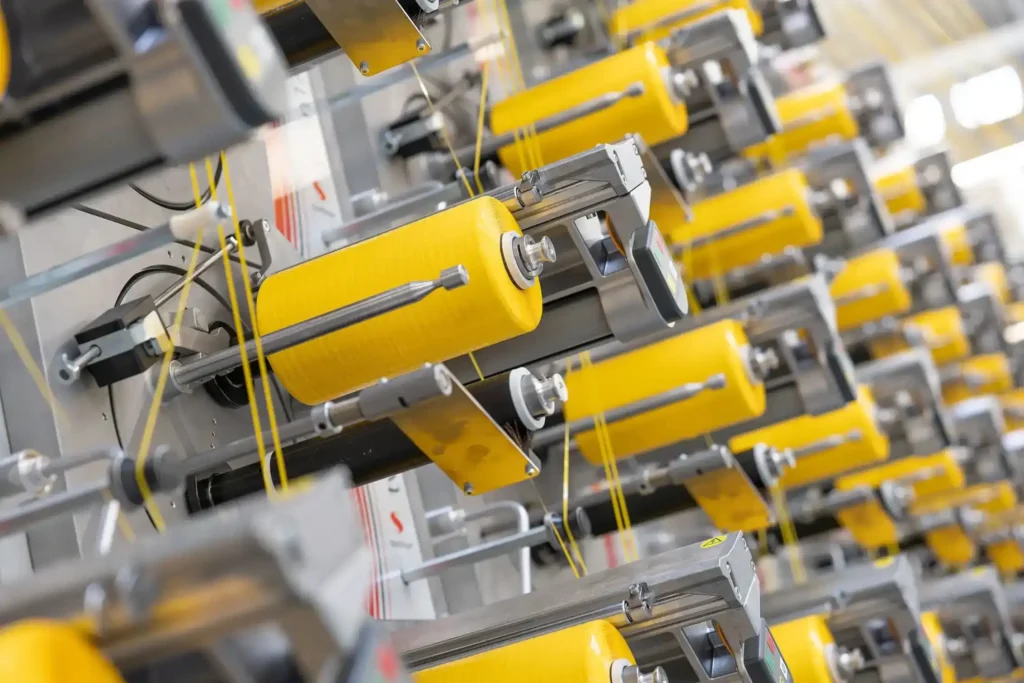
Outer fabric—resin prep & extrusion. Food‑grade PP (optionally with rPP) is compounded and extruded into slit tapes. Melt‑flow index is tracked under ASTM D1238 to match die and draw conditions; antioxidant and UV packages are verified against CoAs.
Outer fabric—orientation & weaving. Tapes are stretched to raise crystallinity and tenacity, then heat‑set for dimensional stability. Circular/flat looms produce the base cloth to target mesh/denier/gsm. Pick density and tape uniformity dominate puncture resistance and print smoothness.
Outer face—surface activation & lamination (optional). Corona treatment lifts surface energy to ≥38 dynes. A PP or BOPP film (~20–50 μm) may be laminated; bond strength (e.g., peel ≥1.5 N/15 mm) and curl are tuned for downstream forming and flat lay.
Liner fabrication. PE liners—LDPE/LLDPE/HDPE blends—are blown or cast to 25–80 μm and supplied as tubular, gusseted, or cut‑and‑seal sleeves. Options include micro‑perforation, antistatic masterbatch, slip additives, and traceability inks.
Bag forming & integration. Liners are loose‑inserted, stitched‑in, or valve‑locked inside the woven body. Open‑mouth, block‑bottom, and valve geometries are selected to match product flow and filler configuration. Stitch architecture—single/double fold; stitches per inch—governs seam performance and dust leakage.
Printing & decoration. Rotogravure (8–10 colors typical) or high‑resolution digital presses apply brand assets to laminated faces. Color ΔE limits, rub resistance (e.g., ASTM D5264 Sutherland rub), and scuff tests protect shelf aesthetics through distribution.
Quality & compliance checks. Fabric tensile (ASTM D5035), seam strength, liner gauge verification, and seal curves (temperature/time/pressure) are documented. Migration testing to EU No 10/2011 and material conformance to FDA 21 CFR §177.1520 complete the technical file; hygiene to BRCGS Issue 7/FSSC 22000 validates plant readiness.
Horizontal and vertical analysis. Horizontally, converting borrows dyne/peel logic from film shops, uptime discipline from textile mills, and HACCP zoning from food plants. Vertically, drift propagates: dyne decay → ink pick‑off; under‑drawn tapes → warehouse elongation; thin liners → weak seals; low stitch density → seam splits. A line is a choir—when one voice wanders, the harmony fails.
Data reinforcement. In‑line dyne meters, SPC on MFR, standardized peel targets, stitch‑density windows per GB/T 8946‑2013, and heat‑seal curves by liner lot reduce variance and rework.
Case analysis. Installing live dyne telemetry and seal‑curve monitoring cut print defects by more than half and reduced seal‑related rejects in a partner plant—less waste, tighter color, smoother audits.
Comparative study. Keeping the structure olefin‑only (PP outer + PE inner) simplifies sortation relative to paper/PE composites that drift into multi‑material categories and complicate recycling.
What is the application of Woven Bags with PE Liner? (Core Sectors & Line Speed)
Staples & grains. Rice, flour, pulses, sugar, salt—the commodities that punish weak packaging—benefit from humidity control, puncture toughness, and dust‑tight seams. Woven Bags with PE Liner support high‑speed valve filling and retain stack geometry in unconditioned warehouses.
Dairy & premix. Milk powder, whey, vitamin/mineral blends demand low dusting, reliable seals, and traceable hygiene. Liners curb fat migration; laminated faces resist scuff and keep graphics intact.
Pet nutrition & snacks. High‑fat kibbles and coated snacks stress packs with grease and abrasion. Liners prevent panel bleed; scuff‑tolerant laminated faces preserve brand equity.
Industrial & agro inputs. Fertilizers, micronutrients, seeds, resins—all benefit from anti‑slip coatings, UV stabilization, and perforated liners for de‑aeration; valve formats keep lines fast and floors clean.
Data reinforcement. Common SKUs cluster at 10 / 25 / 50 kg with outer widths 300–700 mm; outer parameters mesh 10×10–14×14, denier 800D–1200D, fabric 80–110 g/m²; liner 30–60 μm tubular or gusseted.
Case analysis. A northern feed mill moved to block‑bottom Woven Bags with PE Liner plus anti‑slip emboss and safely increased pallet height from seven to nine layers—damage fell, truck cube improved, forklift cycles dropped.
Comparative study. Against paper multiwall, moisture regain and tear energy tilt toward woven PP/PE; against film‑only PE, long‑term stack geometry and seam durability favor the hybrid at heat and height.
What is the application of Woven Bags with PE Liner? (Export, Compliance & Specialized Use)
ASEAN & South Asia. Humid corridors and long dwell times reward the PP‑outer/PE‑inner build for rice and fertilizer—barrier and stack safety under one label.
EU & UK retail. Acceptance accelerates with EU No 10/2011 migration data, EC No 2023/2006 GMP, and plant hygiene (BRCGS Issue 7). The mono‑olefin narrative resonates where PP/PE recycling lines operate.
Americas. Summer heat loads make creep resistance decisive for flour, pet food, and lawn & garden. Woven PP’s lower creep versus thin films preserves pallet geometry during hot‑warehouse dwell.
Bulk cousins. FIBC relatives (500–2,000 kg) using inner liners reference ISO 21898:2024 for safety factors; liner chemistries and hazards mirror those of smaller sacks, simplifying multi‑format programs.
Data reinforcement. Export RFQs frequently require tensile and seam certificates, OML 10 mg/dm² migration reports, liner seal windows, and third‑party verifications (SGS/Intertek/TÜV). Increasingly, retailers ask for allergen and foreign‑matter risk assessments tied to packaging.
Case analysis. A coastal sugar exporter upgraded to anti‑slip, block‑bottom Woven Bags with PE Liner and raised container pallet height by two layers without lean; compression stayed within limits and claims dropped.
Comparative study. Where hermetic sealing or oxygen barrier is non‑negotiable, specialty barrier liners (e.g., EVOH coex) may be mandated; where humidity, stacking height, and scuff coexist, the PP‑outer/PE‑inner platform remains the surer compromise.
Quick Spec Sheet (Typical, Commercially Verifiable)
| Parameter | Typical range / option | Technical note |
|---|---|---|
| Outer fabric weight | 55–140 g/m² | Select by bulk density and drop‑test target; avoid over‑engineering beyond creep needs |
| Mesh (warp×weft) | 8×8 – 14×14 | Higher mesh refines puncture resistance and print laydown |
| Denier (tapes) | 650D – 1500D | Heavier denier for abrasive contents or taller stacks |
| Lamination (PP/BOPP, optional) | 20–50 μm | 25–35 μm common for retail gloss and moisture control |
| Liner thickness (PE) | 25–80 μm | LDPE/LLDPE/HDPE blends; tubular/gusseted/cut‑and‑seal options |
| Width (outer bag) | 260–750 mm | Typical for 5–50 kg fills and block‑bottom geometry |
| Printing | Rotogravure / digital | Maintain dyne ≥38; manage ΔE; verify rub via ASTM D5264 |
| Testing | ASTM D5035 (tensile); seam & seal tests | Strip tensile + sewn joint validation; define heat‑seal windows by liner lot |
| Sack standard | GB/T 8946‑2013 | General technical requirements and inspection rules for plastic woven sacks |
| Food‑contact | FDA 21 CFR §177.1520; EU No 10/2011; EC No 2023/2006 | OML 10 mg/dm²; SML/NIAS controls; GMP documented |
| Hygiene system | BRCGS Packaging Materials (Issue 7); ISO 22000:2018/FSSC 22000 | GFSI‑benchmarked hygiene & HACCP alignment |
| Bulk reference | ISO 21898:2024 | For 500–2,000 kg FIBCs with liners |
Figures mirror live supplier listings and widely used lab methods. Final specs must be verified via tensile, seam, drop, creep, and migration tests tuned to product, climate, and route risk. Seal windows (temperature/time/pressure) should be established for each liner resin and machine family.
A Systems‑Thinking Synthesis: VidePak’s End‑to‑End Solution
Sub‑problem A — Chemistry & compliance control. Lock polymer/additive recipes to FDA 21 CFR §177.1520 and EU No 10/2011; document EC No 2023/2006 GMP; maintain REACH‑compliant inventories with change control. Solution: approved‑supplier lists, incoming MFR checks, lot‑level DoC/CoA, periodic migration audits.
Sub‑problem B — Strength vs. weight vs. barrier. Navigate the mesh/denier/gsm grid and liner gauge with designed experiments; validate via ASTM D5035, seam tests, heat‑seal curves, and pallet creep checks at temperature. Solution: baselines for 25‑kg duty at 10×10 / 900D / 90–100 g/m² outer + 30–50 μm liner, then tune to density and route stress.
Sub‑problem C — Print quality vs. recyclability vs. speed. Keep olefin‑only (PP/BOPP outer + PE inner); enforce dyne ≥38; set ΔE and rub benchmarks; right‑size lamination at 25–35 μm when retail gloss is needed. Solution: in‑line corona, live dyne telemetry, color control loops, solvent capture.
Sub‑problem D — Audit readiness & traceability. Operate to BRCGS Issue 7/FSSC 22000 with allergen/foreign‑matter prevention and mock recalls. Solution: batch genealogy from resin to pallet, retain samples, CAPA discipline, and audit dry‑runs.
Integrated outcome. A durable, audit‑ready, shelf‑worthy platform—Woven Bags with PE Liner—that carries product safely, seals cleanly, prints convincingly, and supports credible end‑of‑life narratives. Specification, verification, repetition.
The Role of PE Liners in Woven Bags
Woven Bags with PE Liner offer a unique advantage in packaging by combining the robustness of woven polypropylene with the protective benefits of polyethylene. The PE liner serves several key functions:
- Moisture Protection: The PE liner acts as a barrier against moisture, preventing the ingress of water that can damage the contents of the bag. This is particularly important for products sensitive to humidity, such as chemicals, powders, and grains.
- Contamination Prevention: The liner helps in preventing contamination from external sources, ensuring that the contents remain clean and uncontaminated during storage and transport.
- Enhanced Strength: The addition of a PE liner can improve the overall strength and rigidity of the bag, making it suitable for handling heavy or abrasive materials without compromising its integrity.
Advanced Material Modifications for Enhanced Performance
At VidePak, we go beyond the standard by using modified raw materials to enhance the performance of our Woven Sacks with Liner. Our approach involves integrating specialized additives and formulations that provide several benefits:
1. Improved Strength and Durability
We use advanced polymer formulations and additives to improve the tensile strength and durability of our Aluminum Liner Bags. These modifications ensure that the bags can withstand heavy loads and rough handling without tearing or breaking. The result is a product that offers enhanced reliability and longevity in demanding environments.
2. Enhanced Flexibility and Elongation
Our modified materials are designed to provide excellent elongation properties, which means that the bags can stretch and adapt to the shape of their contents without losing their strength. This flexibility is crucial for applications where the bag needs to conform to varying shapes and sizes, ensuring a snug fit and reducing the risk of bulging or rupture.
3. Additive Formulations
The use of specialized additives in our Liner PE Bags is essential for optimizing their performance. These additives are carefully selected to meet industry standards and enhance key properties such as UV resistance, chemical resistance, and impact strength. By incorporating these additives, we ensure that our bags deliver consistent performance and reliability across a wide range of applications.
The Manufacturing Process at VidePak
Our manufacturing process for Woven Bags with PE Liner is designed to ensure that every bag meets the highest standards of quality and performance. Here’s a look at how we achieve this:
1. Raw Material Selection
We start with the selection of high-quality polypropylene and polyethylene resins, which form the basis of our woven and liner materials. Our resins are sourced from reputable suppliers and undergo rigorous quality checks to ensure they meet our performance criteria.
2. Weaving and Liner Integration
The polypropylene is woven into fabric using advanced weaving technology, creating a robust and flexible material. The PE liner is then integrated into the woven structure, providing an additional layer of protection. This process involves precision engineering to ensure that the liner is securely bonded and aligned with the woven fabric.
3. Additive Incorporation
During the manufacturing process, we incorporate various additives into the resin to enhance the properties of the final product. These additives are mixed thoroughly to ensure uniform distribution and optimal performance.
4. Quality Control
Each batch of Woven Bags with PE Liner undergoes stringent quality control checks to ensure that it meets our high standards. We test for various factors, including tensile strength, elongation, and moisture resistance, to ensure that every bag performs reliably in its intended application.
Applications and Benefits
Woven Bags with PE Liner are versatile and suitable for a wide range of applications:
- Agricultural Products: Ideal for packaging grains, seeds, and fertilizers, where protection from moisture and contamination is crucial.
- Chemical Industry: Suitable for storing and transporting chemicals and powders, offering an additional layer of safety and stability.
- Construction Materials: Effective for handling abrasive materials like sand, gravel, and cement, where durability and strength are essential.
VidePak’s Commitment to Excellence
With over two decades of experience in the packaging industry, VidePak stands out as a leader in producing high-quality Woven Bags with PE Liner. Our commitment to innovation, quality, and customer satisfaction drives us to continually enhance our products and processes. By leveraging advanced material modifications and manufacturing techniques, we deliver solutions that meet the highest standards of performance and reliability.
Our focus on integrating advanced technologies and materials ensures that our bags not only meet but exceed industry expectations. Whether you require Woven Sacks with Liner for agricultural, chemical, or construction applications, VidePak provides a product that delivers exceptional strength, flexibility, and protection.
For companies looking to enhance their packaging solutions, VidePak offers a range of products that combine the durability of woven polypropylene with the protective benefits of PE Liners, ensuring that your materials are securely packaged and delivered in optimal condition.