##
What are **Woven Poly Sacks**?
**Woven Poly Sacks**—often encountered under adjacent terms such as Woven Polypropylene Sacks, PP woven sacks, or PP/HDPE woven sacks—are engineered containers produced by interlacing drawn polyolefin tapes into a fabric, then converting that fabric into robust bags with options such as open‑mouth, gusseted, and block‑bottom valve formats. In the building materials value chain, these sacks routinely handle dense powders and granular mixes including cement, gypsum, lime, blended mortars, sand, and small aggregates. While the familiar 25 kg and 50 kg sizes dominate job sites, their relevance is less about the nominal weight and more about the confluence of properties that protect product performance, streamline line throughput, and stabilize pallets in transit.
To define them only by strength would be reductive. They are a balanced system: orientation‑induced tensile capacity without unnecessary mass; controllable air permeability without letting moisture ingress; graphics that carry regulatory information without compromising friction; and a geometry that locks on a pallet yet opens willingly under the packer’s rhythm. The result? Bags that seem simple, but behave like finely tuned components within a larger production‑logistics‑construction ecosystem.
Callout — Why this matters for building materials
Powdered binders are sensitive to humidity, compaction, and cross‑contamination. The packaging is not cosmetic: it is an extension of the product’s functional spec. **Woven Poly Sacks** preserve flow, preserve strength, and preserve reputation.
##
Key characteristics that shape performance
**Strength‑to‑weight optimization.** Drawn polypropylene tapes reveal high specific tensile and tear capacity due to molecular orientation. The advantage is subtle yet decisive: thinner fabrics can achieve the same security as heavier alternatives, which reduces resin use, eases creasing at folds, and improves pallet layer conformity. The structural behavior is less about absolute thickness and more about how draw ratio, tape denier, and weave density combine to distribute loads at seams and corners.
**Dimensional stability under load.** When dense powders settle, they create non‑uniform internal stress. Gussets, block‑bottom formats, and consistent fabric grammage help manage this, producing predictable bag geometry after filling and de‑aeration. Stability is not merely a convenience for stacking; it prevents creeping damage in transport where micro‑slips escalate into pallet tilt.
**Moisture moderation with purpose.** Coating and lamination tactics act like selective gates: they inhibit water vapor ingress while allowing enough air permeability to evacuate trapped air during filling. Inner liners can be added for climates with persistent humidity or when prolonged outdoor storage is expected. The right balance preserves cement reactivity and mortar workability, minimizing the risk of caking and strength loss on site.
**Clarity in printing and on‑site labeling.** High‑contrast, abrasion‑resistant graphics ensure that dosing instructions, hazard statements, and batch codes remain legible after loading, hauling, and yard handling. Printing here isn’t vanity; it is communication under stress—forklift abrasion, pallet strap pressure, rain and grit.
**Operational reliability in diverse filling environments.** Valve‑top solutions synchronize with rotary packers; hemmed or heat‑cut open mouths suit semi‑manual lines. Both can be tuned through air permeability, valve throat geometry, and anti‑skid finishes to control dust, improve weighment accuracy, and shorten fill cycles.
Feature card — Air & moisture
Permeability must be high enough to vent filling air yet low enough to resist humid air exchange during storage. **Woven Poly Sacks** use fabric weave plus coating/lamination to hit that balance.
Feature card — Edge integrity
Seam design spreads load at high‑stress corners. Stitches, hot‑air welds, or ultrasonic seams are chosen based on the sack format and expected transport regime.
Feature card — Pallet friction
Printed lacquers and textured coatings raise surface friction, helping each layer resist sliding without aggressive strapping that can crush corners.
##
Production flow and why each stage matters
**Material selection and compounding.** Polypropylene is the go‑to matrix because it crystallizes in a way that supports high draw ratios while keeping density low. UV stabilizers help the sacks withstand sunlit yards; slip additives control the handling feel; anti‑block agents avoid sheet stickiness during lamination. The question isn’t just “PP or not?”—it’s “Which PP grade, which additive pack, and what processing window?” because these choices define fatigue behavior, puncture resistance, and long‑term creep.
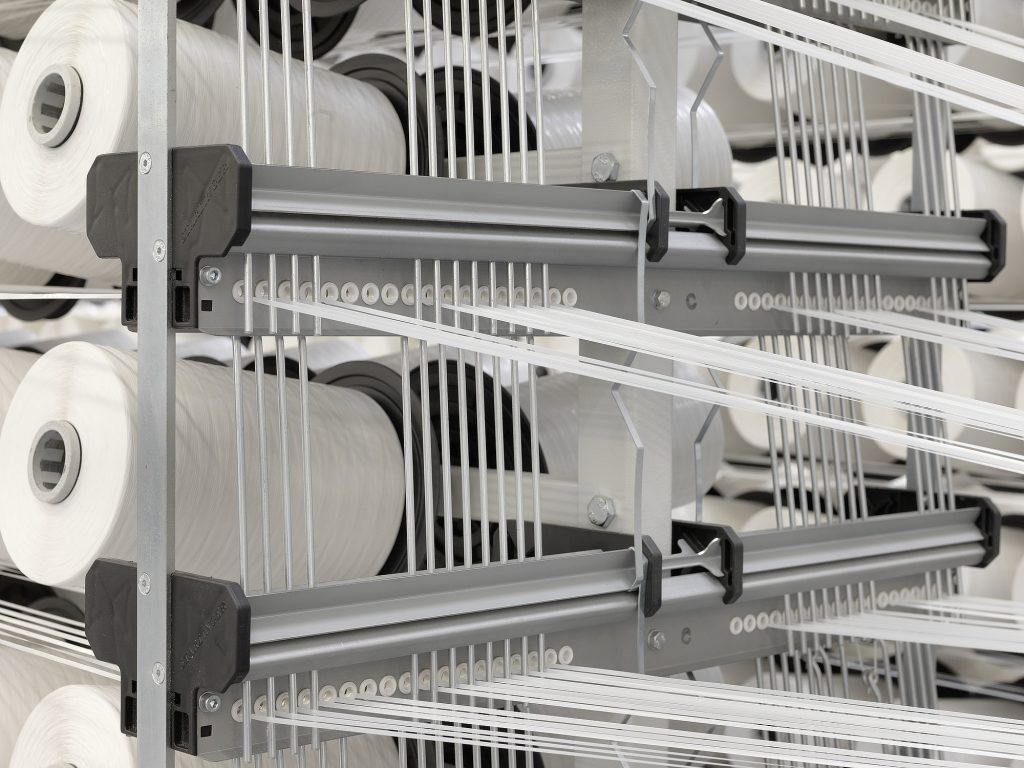
**Extrusion into films and precision slitting.** The resin becomes a thin film that is then slit into tapes of specified denier. Slitting precision determines later uniformity; tape width variability becomes weave variability, which becomes unpredictable load paths at the seam. Small errors multiply. The discipline here lays the groundwork for every property measured later.
**Drawing for orientation and strength.** Tapes are drawn—stretched beyond their original length—to align polymer chains. Alignment creates strength; strength enables weight reduction; weight reduction improves flexibility without compromising safety. Under‑drawn tapes are forgiving during weaving but underperform in service; over‑drawn tapes excel in tests yet may split under shock. The right draw ratio is therefore both a science and a craft.
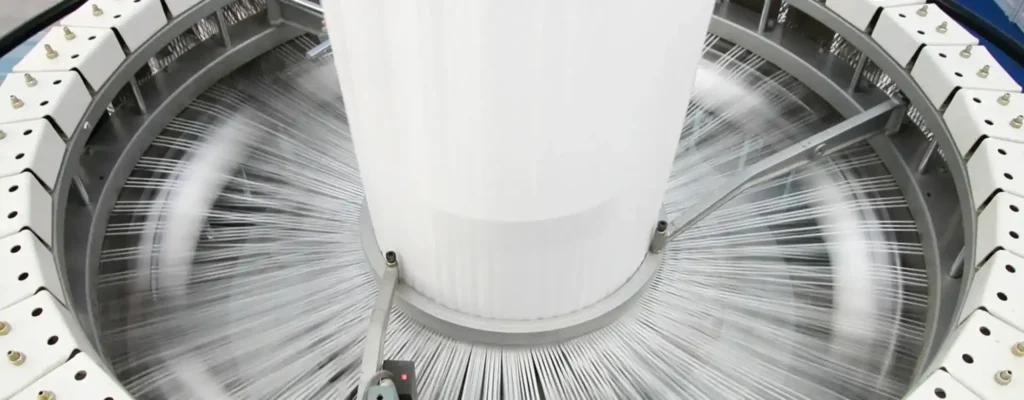
**Weaving for structural behavior.** Circular or flat looms interlace tapes at defined densities such as 10×10, 12×12, or 14×14. A denser mesh increases burst strength and reduces pinholing, but if combined with high denier tapes it can become overly stiff, complicating pallet corner formation. The fabric, in effect, is a truss of polymer tapes: alter the members, alter the outcome.
**Coating and lamination as barrier engineering.** A PP coating or a lamination layer (e.g., PE or BOPP) equips the fabric with barrier and print anchorage. Choose coating weight too low and you invite vapor ingress; choose it too high and you could starve the filling line of de‑aeration. BOPP enhances print fidelity and scuff resistance; PE offers robust heat‑seal response for valve edges and liners. Balance again—performance is negotiated, not gifted.
**Conversion: cutting, forming, sealing.** Edges can be heat‑cut to reduce fray, hems can be stitched for reliability, bottoms can be folded and welded to form a stable block geometry. If the sack is valve‑type, the valve’s angle, length, and reinforcement dictate how it mates with the packer spout and how it closes under product back‑pressure.
**Graphics and quality assurance.** High‑contrast prints communicate clearly on dirty sites. QA routines—dimensional checks, seam strength, drop tests from multiple heights, cyclic stacking trials—turn manufacturing choices into outcomes you can trust in trucks and on scaffolds.
Process map (textual)
Resin → Film → Slit tapes → Draw → Weave → Coat/Laminate → Convert (form valve/open‑mouth) → Print → QA → Palletize.
##
Where **Woven Poly Sacks** excel
**Cement and blended binders.** Valve‑type block‑bottom sacks excel in high‑throughput rotary packers. Lamination defends against humidity; micro‑perforations enable controlled venting during fill. The reason professionals prefer this setup is not fashion but flow: more tons per hour with less dust per ton.
**Dry mortar and gypsum mixes.** Stability matters because skewed sacks waste cube and stress stretch‑wrap. The block‑bottom design populates pallets with brick‑like regularity, while anti‑slip finishes raise the friction coefficient between layers, decreasing tilt incidents in mixed‑mode transport.
**Sand and aggregates.** Open‑mouth sacks with reinforced seams are favored, often with UV stabilization for open‑yard storage. Impact energy from drop loading is mitigated by fabric elasticity; the sacks absorb, flex, and recover.
**Industrial powders and speciality blends.** Lime, refractory powders, additives: each has a different fines profile and moisture affinity. Valve throat size and fabric breathability must match these profiles so that fill speed, weight accuracy, and dust collection work in concert rather than conflict.
Callout — Cross‑functional objectives
Production wants fast, clean fills. Logistics wants stable pallets. Quality wants consistent weights. Sales wants legible branding. **Woven Poly Sacks** reconcile these goals by turning materials science into practical geometry and repeatable process control.
##
Interplay of materials, mechanics, and climate
Consider how heat, humidity, and handling shape performance. PP softens above ambient temperatures found in hot yards, yet it resists creep when tapes are correctly drawn and seams are properly reinforced. Humidity challenges are amplified for cement: a small uptick in moisture content can trigger caking and impaired concrete strength. Hence the barrier strategy—coating weights, lamination choices, and optional liners—is not cosmetic but contractually significant. Meanwhile, handling pressures from pallet straps, forklift tines, and dock plates drive abrasion resistance needs. On‑bag graphics must endure this gauntlet to remain readable.
In other words: climate loads the dice, mechanics decide the roll, materials call the game. **Woven Poly Sacks** succeed by aligning all three.
##
Performance levers you can actually tune
| Lever |
Typical options |
Implications |
| Tape denier |
650D–1200D for building‑grade sacks |
Higher denier raises puncture resistance but can reduce flexibility and corner conformity. |
| Weave density |
10×10 to 14×14 |
Denser weave lowers pinholing and increases burst strength; adjust with denier for balanced stiffness. |
| Fabric mass |
Approx. 60–110 gsm |
Sets baseline strength; over‑spec wastes resin and worsens fold behavior. |
| Barrier stack |
PP coating; PE/BOPP lamination; optional liner |
Balances humidity defense with fill venting; lamination adds print quality. |
| Sack format |
Open‑mouth; block‑bottom valve |
Open‑mouth suits manual/semi‑auto lines; valve aligns with rotary packer throughput. |
| Friction surface |
Matte lacquers; micro‑texture |
Reduces layer slip; helps maintain pallet geometry without crushing corners with straps. |
##
Filling lines, dust behavior, and metrology
The behavior of fines during filling is influenced by their particle size distribution, surface chemistry, and temperature. When powders enter the sack, air must escape in a controlled manner to avoid “ballooning,” dust escapes, or short‑weights. **Woven Poly Sacks** can be tuned by adjusting fabric breathability and micro‑perforation patterns; the valve throat geometry then governs how residual air leaves as the sack self‑seals.
Weighments depend on calmness in the last seconds of the fill. Turbulence caused by trapped air yields oscillating scale readings; turbulence reduced by well‑matched permeability yields tighter distributions around the setpoint. Clean environments are not only healthier but also more accurate.
Callout — Practical tuning checklist
- Match fabric permeability to powder fineness to avoid ballooning and dust plumes.
- Select valve reinforcement that closes under product back‑pressure without manual tucks.
- Use anti‑skid print varnish where pallet tilt has been observed.
##
Stacking behavior and transit risk
Pallet stability is an outcome of bag geometry, surface friction, and wrap strategy. Block‑bottom sacks act like bricks, encouraging uniform layers; open‑mouth sacks can behave similarly if gusseted and stacked with cross‑layered patterns. Friction is the silent ally—printed lacquers increase cohesion between sacks, and corner protection prevents straps from biting through.
Transport introduces variable frequency vibrations. Small slips become big shifts if friction is inadequate or if sack dimensions vary between batches. The mitigation is procedural as much as material: standardized stacking patterns, fixed target pallet heights, and use of anti‑slip sheets where routes involve sharp curves or mixed rail/road intermodal transfers.
##
Visual communication that survives the yard
Legibility after abrasion, drizzle, and dust storms is not a matter of style—it is a duty of care. On‑bag safety pictograms, dosage charts, and batch codes must remain clear. **Woven Poly Sacks** with BOPP laminations deliver sharp print, while PP coatings provide durable anchorage for flexo or rotogravure inks. Overprint lacquers serve a double function: they protect graphics and add micro‑roughness for pallet friction.
##
Environmental considerations and field life
Outdoor yards expose sacks to UV radiation and temperature cycles. UV packages in the resin slow surface embrittlement; lighter‑colored prints reflect heat; lamination shields the fabric from grime that might attract moisture. When projects extend over months, field life matters: sacks must not chalk, crack, or shed fibers that contaminate mixes. Selecting stabilizers and surface finishes accordingly turns a good sack into a reliable one.
Card — Circularity cues
Material reduction via higher orientation lowers resin consumption. Clean print systems and mono‑material constructions (PP/PP) improve recyclability streams compared to mixed substrates.
##
Selecting the right configuration for each use case
A builder’s gypsums are not a cement producer’s blends; a coastal yard is not a dry inland depot. Matching sack specification to context is strategic. Consider three representative portraits:
1.
Coastal cement with high humidity — Choose laminated block‑bottom valve sacks; consider an inner liner for monsoon storage. Prioritize de‑aeration features during fill and maintain high‑contrast, water‑resistant graphics for regulatory markings.
2.
Dry mortar with diversified SKUs — Favor open‑mouth gusseted sacks where quick format changes reduce downtime. Anti‑slip surface treatment supports mixed pallets in hardware distribution.
3.
Aggregates with outdoor yard storage — Opt for UV stabilized open‑mouth designs; strengthen seams for drop loads. Printing can be simpler; durability and legibility remain non‑negotiable.
##
From risk to response: a layered reasoning model
Risks include moisture ingress, dust at fill, seam failure, pallet slip, UV degradation, and label illegibility. Responses include barrier design, permeability tuning, seam engineering, friction management, stabilization packages, and abrasion‑resistant graphics. The bridge between risk and response is measurement: humidity profiles, particle size distributions, drop‑test energies, coefficient of friction targets, UV exposure indices, and rub resistance thresholds. **Woven Poly Sacks** function as the locus where these measurements turn into material choices.
| Risk |
Measurement |
Response in **Woven Poly Sacks** |
| Humidity exposure |
Ambient RH profiles, product moisture sensitivity |
Coating weight selection; PE/BOPP lamination; optional liners. |
| Dust during fill |
Stack light scattering, workplace dust monitoring |
Permeability tuning; valve geometry; micro‑perfs concentrated near spout impact zone. |
| Seam stress |
Drop test energy, stitch density audits |
Stitch patterns and hot‑air welding to spread loads; corner reinforcements. |
| Pallet slip |
Friction testing, tilt table results |
Anti‑slip overprint lacquers; block‑bottom geometry; consistent dimensions. |
| UV degradation |
Accelerated weathering indices |
UV stabilizer packages; lighter‑tone print palettes. |
| Label abrasion |
Rub resistance, scuff tests |
BOPP surfaces; protective varnishes with microroughness for friction. |
##
Contrasts, parallels, and what they reveal
A contrast worth considering is between mono‑material PP sacks and multi‑layer composite alternatives that include paper outer plies. Mono‑material designs simplify recycling streams and are less susceptible to layer separation in humidity; composite sacks can deliver a familiar tactile feel and printable surfaces but must be carefully specified to avoid delamination when exposed to rain or condensation. Another useful parallel lies between valve and open‑mouth formats: one maximizes factory throughput under a rotary packer, the other maximizes flexibility for varied SKUs and manual processes. The choice is contextual, not doctrinal.
Rhetorically, ask: should a sack be “strong,” or should it be “right”? Strength without controlled permeability will clog a line. Barrier without friction will slide a pallet. Print without rub resistance will disappear in a week. **Woven Poly Sacks** are persuasive precisely because they integrate attributes that would otherwise compete.
##
Pragmatic configuration matrix
| Use case |
Sack format |
Barrier strategy |
Filling focus |
Logistics focus |
| Cement (humid climates) |
Block‑bottom valve |
PE/BOPP lamination + optional liner |
Venting without dust; valve closure under back‑pressure |
Anti‑slip lacquer; consistent dimensions |
| Dry mortar (many SKUs) |
Open‑mouth gusseted |
PP coating |
Quick changeovers; manual assist feasible |
Cross‑layer stack patterns |
| Aggregates (outdoor yards) |
Open‑mouth |
UV stabilized coating |
Reinforced seams for drop impacts |
Edge guards; robust wrap |
##
A note on capacities and geometry
Although 25 kg and 50 kg remain standard, the geometry dictates more than the number on the print. Dimensions around roughly 46 × 37 × 11 cm (for many 50 kg block‑bottom sacks) allow efficient interlocking of layers; deviation without reason is a hidden tax on the supply chain. For open‑mouth sacks, gusset width often determines whether layers compress evenly or lean under strap tension. Small design decisions echo loudly on the truck.
##
Integration with site practice
On site, speed is safety. Bags that open predictably, pour cleanly, and share consistent batch information help crews maintain rhythm. When **Woven Poly Sacks** are specified with textured surfaces, gloves gain purchase; when the graphics are sharp, dosing mistakes fall; when seam placement avoids grip zones, strain is reduced. Packaging here becomes human‑factored equipment.
##
Single internal link for further exploration
To explore design variants and application notes related to **
Woven Poly Sacks**, see the reference hub focused on PP woven solutions.
##
From specification to outcome—why this approach scales
Scalability is not merely running more looms; it is repeating success across product lines, shifts, and seasons. A specification that ties denier, mesh, GSM, seam method, barrier stack, and print system to measurable performance targets will scale because it evacuates ambiguity. Factories can maintain it; logistics can rely on it; sites can trust it. **Woven Poly Sacks** become part of the method statement, not an afterthought.
Checklist — Converting spec to practice
- Fix draw ratio windows and audit tape denier variability.
- Specify weave density with acceptable tolerance bands.
- Define coating or lamination weight ranges and test adhesion.
- Standardize seam patterns and confirm corner reinforcement.
- Set print legibility and rub resistance criteria relevant to yard exposure.
- Adopt stacking and wrap SOPs with tilt‑table verification.
##
Closing perspective
The job of a sack is deceptively simple: contain, communicate, and cooperate. Contain the product without failure. Communicate instructions without fading. Cooperate with machines, pallets, and people. **Woven Poly Sacks** succeed where elemental properties and practical design intersect—where the weave remembers the load path, where the coating remembers the weather, and where the print remembers the foreman’s glance. Not louder; not heavier; simply better organized for the realities of building materials.
The building materials industry relies on durable, cost-effective packaging to transport abrasive and hygroscopic products like cement, sand, and gravel. Woven poly sacks, made from polypropylene (PP) tapes, offer tensile strengths exceeding 45 N/cm² and load capacities of up to 50 kg—making them ideal for harsh environments. VidePak’s annual production of 5 million sacks caters to global clients, including LEED-certified construction projects in the U.S. and EU.
VidePak’s quality assurance framework spans the entire supply chain, ensuring raw material integrity and process consistency.
The global construction packaging market is projected to grow at 6.8% CAGR, driven by:
Woven poly sacks are more than packaging—they are engineered safety nets for the construction industry. By mastering raw material science and digital quality management, VidePak sets a benchmark in reliability, proving that excellence begins long before the first stitch.