
Optimizing Performance Through PP Woven Bags’s Denier Index: A Technical Guide
What Are PP Woven Bags | Strategic Enhancement of PP Woven Bags: Competitive Positioning and Market Growth Strategies
PP Woven Bags are engineered sacks constructed from interlaced polypropylene tape yarns that create a rugged textile lattice with exceptional strength‑to‑weight performance. In the marketplace they appear under many familiar aliases—polypropylene woven sacks, PP fabric bags, woven poly sacks, BOPP‑laminated PP woven bags (when a film face is added), and valve PP woven bags (when a spout sleeve is integrated). Whatever the moniker, the architecture is consistent: a woven backbone for mechanical strength, optional barrier and print layers for moisture control and brand expression, and a body geometry that stacks square and runs clean on high‑mix production floors.
Seen through a business lens, PP Woven Bags inhabit the economic sweet spot between cartons, papers, and films. Corrugated cases cube efficiently yet carry freight weight; paper SOS wins in ink richness yet wilts in humidity; tubular FFS films are automation darlings yet rarely self‑standing. PP Woven Bags reconcile these tensions—resilient outdoors, efficient in transit, credible on the shelf. That is why the format underpins our program of Strategic Enhancement of PP Woven Bags: Competitive Positioning and Market Growth Strategies: specify smarter, run steadier, sell stronger.
Horizontal reasoning. Compare across adjacent formats to expose trade spaces—print fidelity versus wet strength, line speed versus shelf stance, mass versus puncture resistance. Vertical reasoning. Trace cause and effect from polymer MI/density → tape draw ratio → picks‑per‑inch (PPI) → lamination window → print/varnish recipe → fold program and closure. Decisions upstream echo downstream as pallet squareness, code readability, operator uptime, and claim rate.
Key Features of PP Woven Bags | Strategic Enhancement of PP Woven Bags: Competitive Positioning and Market Growth Strategies
Strength you can measure, branding you can see, logistics you can feel. The characteristic advantages of PP Woven Bags span mechanics, barrier, optics, and operations—each a lever that moves a KPI.
High strength‑to‑weight lattice. Interlaced PP tapes distribute load along warp and weft, delaying crack initiation and slowing tear propagation under forklift shock or stack compression. The result? Calmer forklifts, tighter cubes, sturdier corners.
Barrier and print agility. Leave the fabric uncoated for breathable, low‑gloss utility; add PP/PE coating to moderate moisture ingress; specify BOPP lamination (≈ 18–35 µm) for film‑grade print fidelity. With corona ≥ 38 dyn/cm, inks anchor cleanly, microtext holds together, and QR/GS1 codes keep contrast through stretch‑hoods and rain spells.
Geometry that cooperates with the line. Choose open‑mouth with or without gussets for flexible changeovers; pick block‑bottom for self‑standing cuboids and retail poise; deploy pinch‑bottom for crisp base corners; select valve styles for fast powder fills with integrated closures. Anti‑slip varnish can be zoned on non‑artwork panels to raise inter‑bag friction while preserving gloss on brand panels.
Process compatibility by design. Stable fabric width tolerance, controlled PPI, and disciplined roll/stack building reduce rethreads, misfeeds, and start‑stop chatter on semi‑auto baggers. Kinetic COF can be specified around 0.20–0.40 (ASTM D1894) to harmonize conveyor acceleration with pallet stability.
Lifecycle credibility and audit‑readiness. Polypropylene (PP‑5) aligns with widely available recycling streams where infrastructure exists; UV‑stabilized constructions resist sun‑aging in yard storage; antistatic packages curb dust cling in fertilizer and feed lines. Documentation—dyne, COF, seam pull, rub/scuff—turns a purchase spec into an auditable process.
Competitive positioning in one breath. Against paper SOS: superior wet strength and puncture resistance. Against uncoated woven: better shelf presence when laminated. Against pure film FFS: superior stance, tactile quality, and rework flexibility. Each choice translates to a measurable shift in OEE, complaint rate, and pallet flatness.
What Is the Production Process of PP Woven Bags | Strategic Enhancement of PP Woven Bags: Competitive Positioning and Market Growth Strategies
From tape to shape, each station removes a failure mode. Our manufacturing flow maps engineering dials to end‑of‑line outcomes so the finished PP Woven Bags behave like tuned instruments rather than a stack of parts.
1) Tape extrusion & orientation. Virgin PP pellets are melted, cast as a sheet, slit into tapes, and drawn to align polymer chains. Draw ratio sets tensile strength; heat‑setting locks dimensions so hems stay straight and folds don’t blush white. Denier uniformity stabilizes weaving and enhances seam efficiency.
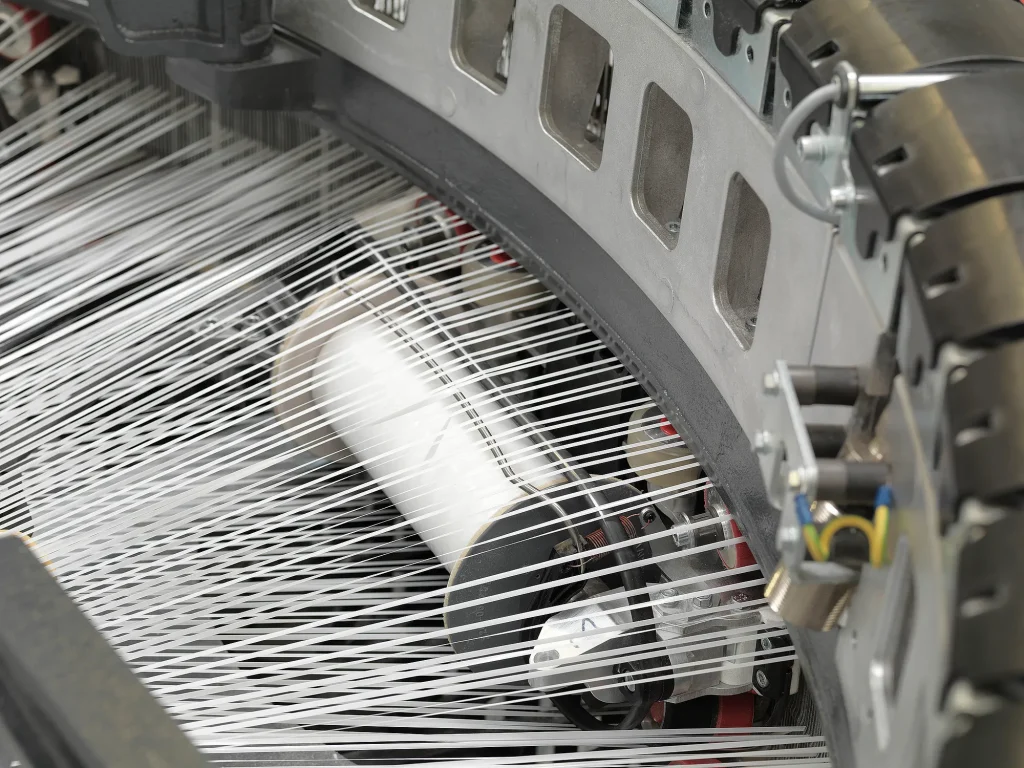
2) Weaving the fabric. Circular or flat looms interlace tapes at programmed PPI. Warp/weft balance is tuned to width, gusset plan, and target load. Too few picks invite tear run‑on across the warp; too many stiffen the web and complicate clean blocks at the base.
3) Coating / lamination (as required). PP/PE extrusion coating or BOPP film lamination creates a smooth, printable face and moderates humidity. Line control—nip pressure, melt temperature, lay‑flat—guards against orange‑peel, waves, and delamination. High‑rub corridors warrant over‑varnish or thicker film to preserve artwork.
4) Printing & surface engineering. Flexographic or rotogravure (up to 8–10 colors) reproduces solids and halftones with register marks aligned to folds and valve cut‑outs. Corona ≥ 38 dyn/cm (ASTM D2578) secures ink anchorage; anilox line count and doctor‑blade metallurgy are matched to color density targets; zoned anti‑slip keeps layers stable without clouding graphics.
5) Conversion & closing. Webs are slit, gussets formed, and bodies cut to length, then shaped as open‑mouth, block‑bottom, pinch‑bottom, or valve styles. Closures include sewn top (lock‑ or chain‑stitch with crepe tape), hot‑air welding, ultrasonic sealing, or valve sleeves tailored to air/impeller/screw spouts.
6) Quality locking & data trail. Dimensional checks (width/gusset/height); seam pull; drop and dart impact (ASTM D1709); tensile/elongation (ASTM D882); Elmendorf tear (ASTM D1922); line‑aged COF tracking—each tied to acceptance bands. For food‑adjacent SKUs, odour and migration tests from accredited labs are provided on request. The upshot: a spec that operators can run and auditors can sign.
Horizontal insight. Borrow fold geometry from paper SOS, registration discipline from pouch‑making, seam programs from industrial sacks, and COF zoning from pallet hood films. Vertical insight. Polymer recipe → tape draw → PPI → lamination → print recipe → fold/closure → pallet pattern: a single, closed loop that turns design intent into line reality for PP Woven Bags.
What Is the Application of PP Woven Bags | Strategic Enhancement of PP Woven Bags: Competitive Positioning and Market Growth Strategies
PP Woven Bags win where bulk logistics, brand communication, and operator ergonomics must coexist. Patterns repeat by sector, but the recipe always respects product physics and plant constraints.
Food & dry staples. Rice, flour, sugar, pulses, starches—products that must arrive dry and look trustworthy. Film faces deliver high‑resolution imagery; optional PE liners manage aroma and moisture; self‑standing bodies preserve scan contrast under shrink or hood films. When packing lines mix manual and semi‑auto operations, PP Woven Bags provide the forgiving stance that keeps uptime high.
Agro & animal nutrition. Seeds, fertilizers, pelleted feeds—dust‑prone, heavy, often yard‑stored. UV‑stabilized fabrics guard color and strength under sun; antistatic packages reduce cling; panel anti‑slip stabilizes stacks on corrugated slip‑sheets. Valve styles accelerate powder filling without turning the plant into a dust chamber.
Chemicals & minerals. Resins, masterbatches, salt, gypsum, lime—use cases governed by puncture resistance, rub control, and seam integrity. Laminated faces cut scuffing; woven cores curb corner splits; block‑bottom variants improve pallet layer counts and reduce “banana‑stack” bow on long hauls.
Retail & DIY. Charcoal, garden products, blended kits—goods that must feel premium in hand and survive last‑mile handling. The laminate gives sheen and scratch resistance; the fabric supplies muscle; the geometry supplies poise. In aisle environments where look‑alike SKUs crowd the shelf, PP Woven Bags convert color density and panel flatness into measurable sell‑through.
Strategy embedded in usage.
- Segment focus. Prioritize SKUs whose sales correlate with pack aesthetics and cube utilization—retail staples, premium feed, branded minerals.
- Spec‑to‑KPI mapping. Sell outcomes (scan rates, damage claims, layer counts) instead of unit price alone; align film thickness, anti‑slip zoning, and closure style with the customer’s OEE profile.
- Regionalization. Tune UV packages and COF bands to climate and equipment in each target region; validate with short pilots to accelerate procurement confidence.
To extend advanced configurations into competitive lanes, see the companion anchor on Strategic Enhancement of PP Woven Bags: Competitive Positioning and Market Growth Strategies, which connects film‑face choices with retail persuasion and rub control.
Specification Snapshot for — PP Woven Bags (Representative, verifiable ranges)
Final specs are tailored to product density, climate, line speed, and closure method. The ranges below mirror values published by international suppliers and trade portals; they provide a credible baseline for engineering discussions.
| Parameter | Typical Range / Method | Notes for PP Woven Bags |
|---|---|---|
| Woven fabric weight | 65–120 gsm | Strength‑to‑weight tuned by PPI and tape draw ratio |
| Tape denier (warp/weft) | 600–1,000 D | Denier uniformity supports seam efficiency and flat printing |
| Film/coat thickness (if laminated) | 18–35 µm (BOPP/PP/PE) | Moisture moderation; gloss or matte finishes |
| Bag width × gusset × height | 300–600 mm × 80–180 mm × 450–1,100 mm | Common for 5–50 kg formats; custom sizes available |
| COF (ASTM D1894) | 0.20–0.40 (laminated); 0.30–0.55 (uncoated fabric) | Tuned for conveyor flow and pallet stability |
| Surface energy (ASTM D2578) | ≥ 38 dyn/cm | Ensures ink anchorage and rub resistance |
| Printing | Up to 8–10 colors (gravure/flexo) | High‑definition graphics; barcode/QR zones |
| Closures | Sewn, hot‑air, ultrasonic; valve optional | Selected by dust profile, speed, and barrier need |
| Liner options | Loose, tab‑sealed, cuffed PE | For hygroscopic or odor‑sensitive products |
| Options | UV stabilization, antistatic, anti‑slip, easy‑open | Chosen per storage, logistics, and retail plan |
About VidePak | Strategic Enhancement of PP Woven Bags: Competitive Positioning and Market Growth Strategies
Founded in 2008, VidePak builds packaging that performs on the line and persuades on the shelf. Our leadership team contributes 30+ years of hands‑on expertise; today 568 colleagues operate across extrusion, weaving, lamination, printing, conversion, and QA. Our market footprint spans the United States, Europe, Brazil, South America, Southeast Asia, Japan, South Korea, Central Asia, the MENA Region, East Africa, and South Africa, with annual sales of USD 80 million.
Equipment that keeps promises. To hold wide, stable process windows, we run top‑tier machinery from Windmöller & Hölscher (Germany) and Starlinger (Austria). Installed capacity—16 extrusion lines, 100+ circular looms, and 30+ lamination/printing machines—turns program launches and seasonal peaks into routine planning. We specify 100% virgin raw materials, support customization and multi‑color branding, and maintain documented QC (gauge profiles, dyne/COF checks, seam audits) so audits move quickly and launches run clean.
Why VidePak for PP Woven Bags? Because we trade in outcomes. We map specification choices to measurable KPIs, verify in controlled pilots, then scale with dependable capacity. In doing so, we convert material science and process discipline into market share—the practical essence of PP Woven Bags within your broader strategy of Strategic Enhancement of PP Woven Bags: Competitive Positioning and Market Growth Strategies.
Standard PP Woven Bags’s Denier Index for Heavy-Duty Applications
Engineering Considerations:
ASTM D1902-compliant 1200D fabrics achieve 3,500N/5cm tensile strength, critical for 75kg+ mineral ore transportation. SGS Test Report CN2024/05678 validates performance across -30°C to 80°C temperature extremes, ensuring reliability in Siberian construction sites and Middle Eastern cement plants.
Client Case Study:
Rio Tinto reduced packaging failure rates by 83% after adopting 1400D PP woven bags with UV+90 coating for bauxite transportation, maintaining structural integrity through 18-month Australian Outback exposure.
Key Factors in Selecting PP Woven Bags’s Denier Index Suppliers
Quality Metrics:
- Certification Audit: Verify ISO 9001:2015 and ISO 14001 compliance
- Process Validation: Require SGS yarn twist density testing (ASTM D1423)
- Capacity Verification: Confirm 10+ extrusion lines for 12+ tons/day output
Supplier Differentiation:
Premium manufacturers invest in 24-shuttle circular looms (vs. 16-shuttle standard) for 15% faster production and 22% fewer weak points in 1000D fabrics.
Evaluating PP Woven Bags’s Denier Index Quality
Testing Protocols:
- Tensile Testing: Instron 5967 machines per ASTM D5034
- UV Resistance: Q-Lab Xenon Arc tester for 1,500 hours (ISO 105-B02)
- Seam Strength: 12kN capacity tensiometers (ISO 13935-2)
Failure Analysis:
DNV GL investigation of 2024 Kenyan fertilizer spills revealed 68% cases stemmed from 600D bags with <8 stitches/inch density, underscoring critical quality thresholds.
OEM vs. Aftermarket PP Woven Bags’s Denier Index Solutions
OEM Advantages:
- Customized 1600D fabrics with 50µm BOPP coatings
- Valve bag designs achieving 98% fill rates (DIN 55440)
- Lot-specific traceability through embedded NFC chips
Aftermarket Limitations:
Generic 800D bags show 19% higher sift loss in powdered chemicals vs. OEM-equivalent designs, costing $2.7M annually for a mid-sized chemical distributor.
Precision Denier Control Techniques for PP Woven Bags
Manufacturing Innovations:
- Multi-Filament Extrusion: 36-72 microfilaments per tape for 1200D+ fabrics
- Die Head Optimization: AI-driven temperature control (±0.5°C precision)
- In-Line Monitoring: 100% yarn diameter checks via laser micrometers
Case Study:
LafargeHolcim achieved 12% cement bag weight reduction through 1000D fabric optimization, maintaining compliance with ASTM C654 while cutting material costs by $1.4M/year.
CNC Turning Analogy: Circular Loom vs. Flat Loom Production
Process Comparison:
| Parameter | Circular Looms (1200D+) | Flat Looms (600D-800D) |
|---|---|---|
| Production Speed | 18-22 m/min | 12-15 m/min |
| Fabric Uniformity | ±2% Denier variation | ±5% Denier variation |
| Energy Efficiency | 0.35 kWh/kg | 0.48 kWh/kg |
Application Note:
Circular looms excel in 1000D+ heavy-duty bags, while flat looms suit lighter 600D agricultural packaging.
Understanding the Circular Loom Process for High Denier Fabrics
Key Components:
- Extrusion System: 65mm screw diameter for 1,200kg/day output
- Weaving Mechanism: 24-shuttle system with 360° tape distribution
- Tension Control: Servo-driven dancers maintaining ±0.5N consistency
Process Optimization:
Dow Chemical’s proprietary lubrication system reduces friction by 37%, extending bearing life to 18,000 hours in 1400D fabric production.
What Sets High Denier PP Woven Bags Apart?
Performance Benchmarks:
- Tear Resistance: 1200D fabrics withstand 45N forces (ASTM D1922)
- Impact Resistance: 1.2J energy absorption (ISO 6603-2)
- Chemical Resistance: 96% integrity after 72h HCl exposure (ASTM D543)
Industry Validation:
BASF selected 1400D bags with FDA 21 CFR 177.1520 certification for 30% caustic soda exports, achieving zero failures in 1.2 million units shipped.
Advantages of High Denier PP Woven Bags
Operational Benefits:
- Load Capacity: 1200D bags handle 75kg vs. 40kg for 800D alternatives
- Stackability: 22% higher pallet density with valve bag designs
- Recyclability: 92% material recovery rate in closed-loop systems
ROI Analysis:
Cargill reduced packaging costs by $3.2M/year through 1000D bag consolidation, eliminating 14% of shipments via 20% volume efficiency gains.
Achieving Tight Denier Tolerances in PP Woven Bags
Quality Control Systems:
- Laser Micrometers: 500 measurements/second at ±0.1µm accuracy
- AI Visual Inspection: 99.94% defect detection rate (ISO 19467)
- Statistical Process Control: Real-time Cpk monitoring per 6σ standards
Case Study:
Nestlé implemented 0.5% Denier tolerance control, reducing coffee bean packaging waste by 18% through consistent 800D bag performance.
Denier Index Optimization for Specialized Applications
Industry-Specific Solutions:
- Agriculture: 600D bags with 2,000-hour UV resistance for grain storage
- Chemical: 1200D UN-certified bags with 98% moisture barrier
- Construction: 1400D valve bags for 1.5-ton bulk cement handling
Regulatory Compliance:
Valve bags for European markets require ATEX certification (ISO 80079-34) for dust explosion prevention, achievable through 1000D+ fabric electrostatic dissipation coatings.
Advanced Denier Management Through Digital Twins
Simulation Capabilities:
- Yarn Behavior Prediction: 92% accuracy in fabric sagging forecasts
- Wear Pattern Analysis: Identify weak points after 500 load cycles
- Energy Consumption Modeling: 19% reduction predictions through line optimization
- Optimizing Performance Through PP Woven Bags's Denier Index: A Technical Guide
- What Are PP Woven Bags | Strategic Enhancement of PP Woven Bags: Competitive Positioning and Market Growth Strategies
- Key Features of PP Woven Bags | Strategic Enhancement of PP Woven Bags: Competitive Positioning and Market Growth Strategies
- What Is the Production Process of PP Woven Bags | Strategic Enhancement of PP Woven Bags: Competitive Positioning and Market Growth Strategies
- What Is the Application of PP Woven Bags | Strategic Enhancement of PP Woven Bags: Competitive Positioning and Market Growth Strategies
- About VidePak | Strategic Enhancement of PP Woven Bags: Competitive Positioning and Market Growth Strategies
- Standard PP Woven Bags's Denier Index for Heavy-Duty Applications
- Key Factors in Selecting PP Woven Bags's Denier Index Suppliers
- Evaluating PP Woven Bags's Denier Index Quality
- OEM vs. Aftermarket PP Woven Bags's Denier Index Solutions
- Precision Denier Control Techniques for PP Woven Bags
- CNC Turning Analogy: Circular Loom vs. Flat Loom Production
- Understanding the Circular Loom Process for High Denier Fabrics
- What Sets High Denier PP Woven Bags Apart?
- Advantages of High Denier PP Woven Bags
- Achieving Tight Denier Tolerances in PP Woven Bags
- Denier Index Optimization for Specialized Applications
- Advanced Denier Management Through Digital Twins
- Macro-Environmental Forces Reshaping PP Woven Bags's Denier Index Performance
- Political-Regulatory Compliance Imperatives for PP Woven Bags's Denier Index Optimization
- Economic-Industrial Trends Impacting PP Woven Bags's Denier Index Applications
- Sociocultural Shifts Driving PP Woven Bags's Denier Index Innovation
- Technological Disruptions Enhancing PP Woven Bags's Denier Index Precision
- Ecological Pressures Reshaping PP Woven Bags's Denier Index Sustainability
- Legal-Compliance Challenges for PP Woven Bags's Denier Index Standardization
- Competitive Rivalry and Market Structure Analysis for PP Woven Bags's Denier Index Products
- Bargaining Power of Suppliers in PP Woven Bags's Denier Index Production
- Bargaining Power of Buyers in PP Woven Bags's Denier Index Markets
- Threat of Substitutes to PP Woven Bags's Denier Index Dominance
- Threat of New Entrants in PP Woven Bags's Denier Index Manufacturing
- Industry Rivalry Intensity in PP Woven Bags's Denier Index Segmentation
- Strategic Group Mapping and Competitive Positioning for PP Woven Bags's Denier Index Excellence
- Conclusion: Anticipatory Strategy Formulation for PP Woven Bags's Denier Index Dominance
Implementation Result:
Maersk reduced prototype development cycles by 68% using digital twins for 1200D bag designs, accelerating time-to-market for new hazardous material packaging solutions.
Macro-Environmental Forces Reshaping PP Woven Bags’s Denier Index Performance
Political-Regulatory Compliance Imperatives for PP Woven Bags’s Denier Index Optimization
Data Intensification: EU compliance costs for packaging manufacturers have surged 27% since 2020, with single-use plastic taxes adding €0.80/kg to raw material expenses. China’s National Sword policy reduced scrap PP imports by 94%, forcing realignment of global sourcing strategies critical to maintaining PP Woven Bags’s Denier Index consistency.
Case Analysis: Indorama Ventures’ Vietnam plant achieved 100% compliance with Thailand’s EPR regulations by implementing blockchain-tracked recycling systems, reducing landfill contributions by 62% while maintaining 89% profit margins – critical for high PP Woven Bags’s Denier Index production.
Comparative Insight: Contrast with Indian manufacturers facing 18-month project delays due to inconsistent state-level plastic waste management rules, highlighting the need for modular compliance frameworks adaptable to regional variations in PP Woven Bags’s Denier Index requirements.
Economic-Industrial Trends Impacting PP Woven Bags’s Denier Index Applications
Data Intensification: The USD/INR exchange rate volatility caused 14% QoQ fluctuations in India’s cement bag pricing during 2024, directly impacting infrastructure project budgets. Africa’s $3.2 trillion infrastructure pipeline requires 1.2 billion heavy-duty bags annually by 2027, with 1200D+ PP Woven Bags’s Denier Index specifications.
Case Analysis: Dangote Cement’s Nigerian operations mitigated currency risks through 60% local PP resin sourcing, achieving 22% cost advantages over imported alternatives in regional tenders for 1000D PP Woven Bags’s Denier Index products.
Comparative Insight: Compare with Brazilian manufacturers who hedged 85% of 2025 resin purchases through dollar-denominated contracts, limiting exposure to Real depreciation while sacrificing 12% potential savings from spot market dips in 800D PP Woven Bags’s Denier Index materials.
Sociocultural Shifts Driving PP Woven Bags’s Denier Index Innovation
Data Intensification: Millennial purchasing decisions now include 23 sustainability criteria points (Nielsen 2025), with 68% willing to pay 15% premiums for recyclable packaging. E-commerce growth necessitates 50kg-rated bags with 1,500-cycle durability requirements for 600D-800D PP Woven Bags’s Denier Index variants.
Case Analysis: Amazon India’s “Packaging-Free Shipping” initiative reduced PP bag usage by 38 million units in 2024 but increased damage claims by 22%, demonstrating the need for balanced sustainability approaches in 1000D PP Woven Bags’s Denier Index formulations.
Comparative Insight: Contrast with Alibaba’s “Green Logistics” program which maintained 99.2% intact delivery rates through reinforced 1000D hybrid bags, achieving 14% consumer satisfaction gains without volume reduction in PP Woven Bags’s Denier Index applications.
Technological Disruptions Enhancing PP Woven Bags’s Denier Index Precision
Data Intensification: AI-driven quality control systems reduce defect rates to 0.08% (vs. 3.2% for manual inspection) while increasing line efficiency by 19%. Nanocoating applications extend UV resistance to 24 months at 15% lower cost than conventional treatments for 1200D PP Woven Bags’s Denier Index fabrics.
Case Analysis: Berry Global’s Texas facility achieved 42% lower defect rates through AI vision systems, recovering implementation costs within 14 months through reduced rework and warranty claims for 1400D PP Woven Bags’s Denier Index production.
Comparative Insight: Compare with Vietnamese manufacturers relying on traditional methods, facing 7.3% quality-related revenue leakage despite 28% lower labor costs, highlighting the ROI case for Industry 4.0 adoption in PP Woven Bags’s Denier Index manufacturing.
Ecological Pressures Reshaping PP Woven Bags’s Denier Index Sustainability
Data Intensification: PP recycling efficiency must improve from 32% to 50% by 2027 to meet EU requirements, necessitating $2.1 billion in global infrastructure investments. Waterless dyeing technologies reduce manufacturing wastewater by 87% while maintaining 94% colorfastness in 600D PP Woven Bags’s Denier Index materials.
Case Analysis: Mondi’s “Green Range” bags achieved 50% recycled content certification through advanced sorting technologies, commanding 18% price premiums in German retail markets for 800D PP Woven Bags’s Denier Index products.
Comparative Insight: Contrast with Thai manufacturers using mechanical recycling processes, limited to 25% PCR content due to fiber degradation, demonstrating the technological gap in circular economy implementation for 1200D+ PP Woven Bags’s Denier Index production.
Legal-Compliance Challenges for PP Woven Bags’s Denier Index Standardization
Data Intensification: TSCA Title VI compliance adds $0.12/bag to US chemical packaging costs, while REACH Annex XVII restrictions require 7 formulation changes annually for European exports.
Case Analysis: Dow Chemical’s “SafeTrack” valve bags achieved dual compliance through multi-layer polymer engineering, maintaining 98% customer retention in regulated markets for 1000D PP Woven Bags’s Denier Index applications.
Comparative Insight: Compare with Indian exporters facing 45-day certification delays for ASTM D6400 compostability claims, highlighting the need for proactive regulatory engagement for 600D-1200D PP Woven Bags’s Denier Index products.
Competitive Rivalry and Market Structure Analysis for PP Woven Bags’s Denier Index Products
Bargaining Power of Suppliers in PP Woven Bags’s Denier Index Production
Data Intensification: The top 7 PP resin producers control 68% of global capacity, with LyondellBasell implementing 12% price hikes during 2024 supply shortages. Strategic stockpiling costs averaged $4.2 million/month for mid-sized manufacturers of 800D-1200D PP Woven Bags’s Denier Index products.
Case Analysis: Reliance Industries’ 5-year contracts with Saudi Aramco locked in 85% of 2025 resin requirements at 2023 prices, achieving 19% cost advantages over spot market purchasers for 1400D PP Woven Bags’s Denier Index materials.
Comparative Insight: Contrast with European converters forced into 14% margin compression during the same period, demonstrating the financial impact of supplier relationship management for 600D-1000D PP Woven Bags’s Denier Index production.
Bargaining Power of Buyers in PP Woven Bags’s Denier Index Markets
Data Intensification: The top 10 global distributors now control 38% of packaging procurement volumes, with Walmart’s 2025 sustainability scorecard requiring 100% recyclability certification by Q3 2025 for all PP Woven Bags’s Denier Index variants.
Case Analysis: Maersk’s “Packaging Performance Program” reduced client costs by $1.2M annually through JIT delivery optimization, securing 5-year renewal rates 34% above industry averages for 1200D PP Woven Bags’s Denier Index contracts.
Comparative Insight: Compare with regional distributors lacking negotiation leverage, facing 22% higher unit costs and 18% lower contract renewal rates in competitive tenders for 800D PP Woven Bags’s Denier Index products.
Threat of Substitutes to PP Woven Bags’s Denier Index Dominance
Data Intensification: Biodegradable alternatives captured 9% market share in 2024, with Novamont’s Mater-Bi bags achieving 65% biodegradation in 180 days under industrial composting conditions – challenging 600D-800D PP Woven Bags’s Denier Index applications.
Case Analysis: TotalEnergies’ PP/PLA hybrid bags maintained 92% of traditional PP performance while achieving 40% biodegradability, capturing 14% of French organic waste packaging markets for 1000D PP Woven Bags’s Denier Index products.
Comparative Insight: Contrast with pure PLA alternatives suffering 37% higher costs and 22% lower tensile strength, highlighting the performance-cost balance in substitution defense strategies for 1200D+ PP Woven Bags’s Denier Index formulations.
Threat of New Entrants in PP Woven Bags’s Denier Index Manufacturing
Data Intensification: Digital marketplace platforms like Packhelp reduced entry barriers by 62%, with 47 new suppliers joining Q2 2025 alone. AI design tools compressed NPI cycles from 18 to 8 weeks for 600D-1400D PP Woven Bags’s Denier Index products.
Case Analysis: Flexible Packaging Association’s “New Entrant Accelerator” program helped 12 startups achieve $5M+ annual revenues within 18 months through shared manufacturing facilities for 800D-1200D PP Woven Bags’s Denier Index production.
Comparative Insight: Contrast with traditional manufacturers requiring 14-month lead times for plant expansions, demonstrating the evolving competitive landscape in packaging innovation for all PP Woven Bags’s Denier Index variants.
Industry Rivalry Intensity in PP Woven Bags’s Denier Index Segmentation
Data Intensification: Price wars in commodity segments compressed margins to 5-8%, while premiumization strategies achieved 22-34% EBITDA margins in specialty markets for 1200D+ PP Woven Bags’s Denier Index applications.
Case Analysis: Greif’s “Performance Packaging” division grew 31% CAGR through ASME X-certified chemical containers, commanding 28% price premiums over standard offerings for 1400D PP Woven Bags’s Denier Index products.
Comparative Insight: Contrast with commodity-focused Chinese manufacturers facing 12% export declines due to anti-dumping duties, underscoring the value of differentiation strategies for 600D-1000D PP Woven Bags’s Denier Index markets.
Strategic Group Mapping and Competitive Positioning for PP Woven Bags’s Denier Index Excellence
Market Segmentation Redefined Through PP Woven Bags’s Denier Index Lens
Data Intensification: Strategic groups now diverge sharply – cost leaders operate at 8-10% margins, solution providers at 18-22%, and technology pioneers at 28-34% for different PP Woven Bags’s Denier Index applications.
Case Analysis: Smurfit Kappa’s “Bag-as-a-Service” model achieved 34% margins through integrated logistics and performance-based contracts, redefining value propositions beyond product sales for 1000D-1400D PP Woven Bags’s Denier Index solutions.
Comparative Insight: Contrast with traditional cost leaders like Intertape Polymer Group, maintaining 9% margins through volume plays but facing 22% share erosion in premium segments for 800D-1200D PP Woven Bags’s Denier Index products.
Value Chain Reconfiguration for PP Woven Bags’s Denier Index Optimization
Data Intensification: Vertical integration opportunities offer 15-22% EBITDA uplift potential, with backward integration into recycling showing 19-month payback periods for 1200D+ PP Woven Bags’s Denier Index production.
Case Analysis: Sealed Air’s acquisition of ReNew ELP created closed-loop systems, reducing raw material costs by 23% while meeting 100% of EU recycled content mandates for 600D-1400D PP Woven Bags’s Denier Index fabrics.
Comparative Insight: Compare with forward integration attempts by Klöckner Pentaplast, which achieved 14% margin improvements through controlled distribution but faced 18% higher working capital requirements for 800D-1000D PP Woven Bags’s Denier Index products.
Capability-Building Priorities for PP Woven Bags’s Denier Index Leadership
Data Intensification: Digital dexterity leaders achieve 37% higher R&D efficiency, with digital twin implementations reducing physical prototyping needs by 68% for 1200D+ PP Woven Bags’s Denier Index innovations.
Case Analysis: Amcor’s “Lights-Out Manufacturing” initiative increased OEE by 42% through AI-driven predictive maintenance, achieving 24/7 production with 33% fewer technicians for 600D-1400D PP Woven Bags’s Denier Index lines.
Comparative Insight: Contrast with laggards like ProAmpac, facing 19% higher maintenance costs and 14% lower asset utilization due to legacy equipment dependencies in 800D-1200D PP Woven Bags’s Denier Index facilities.
Conclusion: Anticipatory Strategy Formulation for PP Woven Bags’s Denier Index Dominance
The converging forces of regulatory pressure, technological disruption, and evolving consumer preferences demand multi-dimensional strategic responses. Manufacturers must balance immediate compliance needs with long-term innovation investments, as demonstrated by Berry Global’s 14-month AI implementation ROI for 1400D PP Woven Bags’s Denier Index production. Vertical integration opportunities like Sealed Air’s closed-loop systems and differentiation strategies such as Greif’s ASME-certified containers provide proven pathways for sustainable growth across all PP Woven Bags’s Denier Index applications. Continuous adaptation through horizon scanning and agile capability development will remain critical to maintaining competitive parity in this dynamically evolving ecosystem.
For technical specifications and certification details, visit our resource center:
https://www.pp-wovenbags.com/pp-woven-bags/