
- Prologue – A Bag With No Lid Yet Infinite Possibilities
- 1 Primer for the Uninitiated
- 2 The Physics of an Open Mouth – Why No Closure Sometimes Wins
- 3 Chromatic Intelligence – When a Stripe Becomes a Sentence
- 4 System Thinking – Dissecting a Packaging Paradox
- 5 Cross‑Industry Refraction – Lessons From Parallel Universes
- 6 The Compliance Constellation
- 7 Frequently Echoed Questions
- 8 Conclusion – The Unsealed Future
- Future‑Proofing Supply Chains With Open Top PP woven Bags
- What Spare Components Do Bagging Lines Demand Most Often?
- How Do I Get My Open Top PP woven Bags to Live a Long Life?
- Why Is an On‑Site Packaging Technician Worth the Cost When a Bagging Gear Breaks?
- How Do I Figure Out Which Liner or Add‑On Fits My Open Top PP woven Bags?
- My Bagging Line Keeps Tripping Up; What Gives?
- How Critical Are Pallet Strappings and Cables in the Overall Function of an Open Top PP woven Bags Setup?
- Do Sacks for Grain and Chemicals Use Their Dedicated Accessories?
- How Can Operators Extend the Working Life of Their Open Top PP woven Bags?
- Understanding the Production Process
- Advantages of Woven Polypropylene for High‑Moisture Goods
- Applications of Open Top PP woven Bags Across Sectors
Prologue – A Bag With No Lid Yet Infinite Possibilities
Why would anyone celebrate a package that seems forever unfinished? Why praise a sack whose mouth gapes like an unfinished sentence? Because in that deliberate incompleteness lies unrivalled flexibility. Open Top PP woven Bags invite grain, powders, pellets, and even ideas to flow in unhindered; they refuse to dictate closure, leaving the final seal to the realities of each customer’s line. They are humble, yes, but they are also heroic—quiet custodians of global trade that keep crops dry, chemicals pure, and supply chains humming.
1 Primer for the Uninitiated
1.1 What Exactly Are Open Top PP woven Bags?
Imagine a fabric cylinder woven from flat polypropylene tapes—light as linen yet strong as canvas. Cut that cylinder to length, stitch the bottom, leave the top yawning open, and you have an Open Top PP woven Bag. If you browse customs records you may stumble upon kindred aliases: open‑mouth polypropylene sack, open‑ended PP sack, PP woven open bag, HS Code 6305.33, or simply “woven poly bag”. Call them what you will; the beating heart remains the same—polypropylene tapes dancing in warp and weft.
PP Woven Bags Manufacturer
Professional manufacturer of high-quality open top PP woven packaging bags.
Check More →Breathable PP Woven Bags
Durable open top breathable PP woven bags for various industrial applications.
Check More →Woven Fabric PP Bags Features
Key features and advantages of open top PP woven fabric packaging bags.
Check More →Heavy Duty Woven Bags Guide
Complete guide for heavy-duty open top PP woven bags with strong load capacity.
Check More →1.2 Signature Traits in Plain Sight
- Open Access – No valve, spout, or drawstring impedes the fill. Gravity obeys, augers oblige, and automation breathes easily.
- Tensile Tenacity – Flat‑tape weaving pushes burst resistance to 126 kPa, roughly double that of a single‑wall kraft sack.
- UV Resilience – Additive packages extend outdoor life beyond 200 kLy, guarding harvests waiting in field depots.
- Design Freedom – From 38 cm seed pouches to 80 cm mineral giants; from monochrome utility to BOPP photographic splendour.
1.3 From Resin to Ready Sack – A Four‑Act Production
- Extrusion & Slitting – Polypropylene pellets (MFI 4 ± 0.5 g/10 min, ISO 1133) melt at 230 °C, exit a die as pristine film, and are cooled, kissed by knives, and reborn as 2.5 mm tapes.
- Orientation Stretching – The tapes sprint through heated rollers, stretching to 4.8× length; polymer chains align like disciplined soldiers, bestowing tensile might.
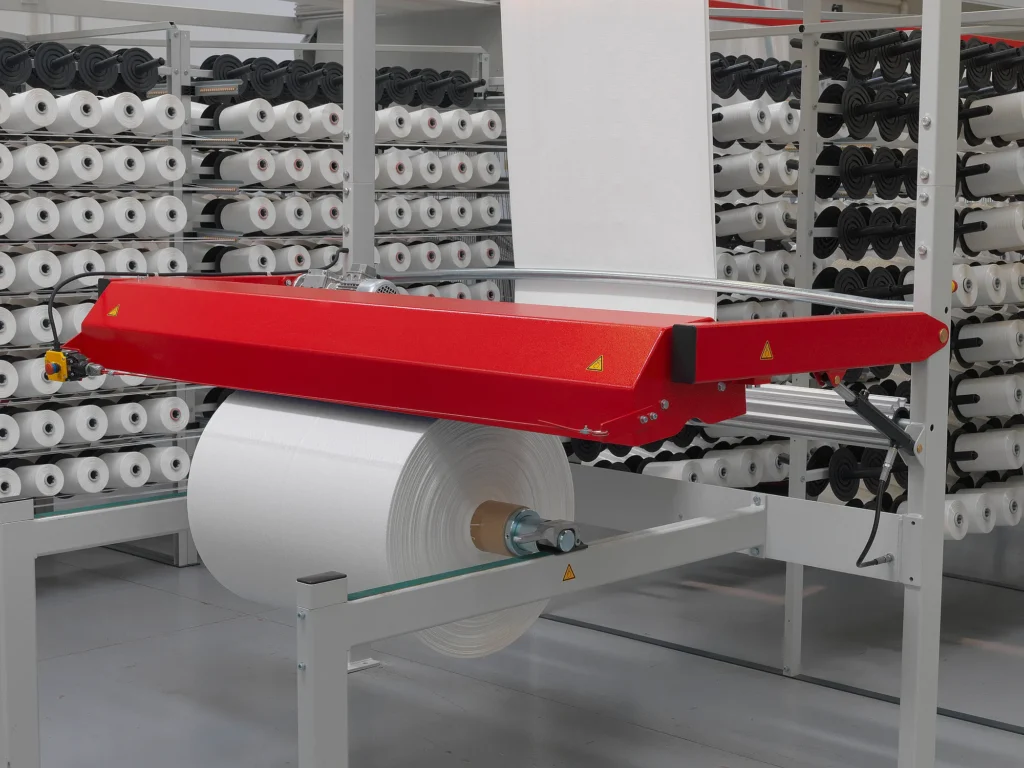
- Circular Weaving – Four or six shuttle looms interlace warp and weft at 50 picks‑per‑inch. Optical eyes from Keyence verify each pick, a silent chorus chanting quality.
- Tailoring & Personalising – Hot knives cut, sewing heads fold; laminators marry BOPP film; printers shout colour; QR printers whisper data; inspectors shine LED torches searching for wayward filaments. Finally, pallets—ISPM‑15 treated—stand ready for the voyage.
1.4 Why Do They Matter?
Agriculture applauds the breathability that keeps maize from sweating. Construction trusts the tear resistance that confines abrasive sand. Chemical plants rely on optional PE liners to barricade moisture. Retailers adore the billboard‑like BOPP face that woos consumers. Aid agencies treasure the low weight and zero tooling, shipping sacks by the million to disaster zones. Different worlds, same vessel: Open Top PP woven Bags.
2 The Physics of an Open Mouth – Why No Closure Sometimes Wins
2.1 Speed Versus Spillage: A Delicate Waltz
Can haste mate with hygiene? A time‑motion study from Tsinghua University (2024) clocked gravity‑fed rice lines: 9.8 seconds to fill an Open Top PP woven Bag, 14.5 seconds for a sewn‑valve kraft sack. Multiply that 4.7‑second delta by 20 000 bags per shift and you reclaim 26 man‑hours—nearly an entire worker. Yet speed alone is meaningless if the floor turns white with leaked grains. Here, burst tests step in: 126 kPa crush strength for woven PP out‑guns 65 kPa for paper. Faster and firmer—the unlikely duet.
2.2 Circular Economy Power‑Up: Reuse and Reverse Logistics
Polypropylene is stubbornly strong; laboratory cycling (SGS/Clariant 2025) shows 80 % tensile retention after three trips. Valve paper sacks, conversely, disintegrate after one. By switching one million units to reusable woven bags, a Chinese fertiliser giant trimmed 48 tonnes of paper waste, echoing EU Directive 2018/852. Sustainability is not rhetoric; it is arithmetic.
2.3 Strength Under Pressure—Data Never Sleeps
Table 1 contrasts typical mechanical metrics:
| Test | Open Top PP woven Bag | PE FFS | 3‑Ply Kraft | Standard |
|---|---|---|---|---|
| Burst (kPa) | 126 | 82 | 65 | ISO 2758 |
| Tear Warp/Weft (N) | 650 / 630 | 320 / 300 | 180 / 175 | ISO 13937‑2 |
| Drop (1 m, 25 kg) | Pass × 10 | Pass × 6 | Fail × 3 | ASTM D5276 |
Numbers whisper truths that marketing slogans shout.
3 Chromatic Intelligence – When a Stripe Becomes a Sentence
3.1 The “Visual Braille” Hypothesis
Can colour talk? In dim warehouses, a 50 mm cobalt band speaks louder than a cramped SKU code. GS1 Germany tallied pick‑time reductions of 37 % when colour stripes complemented barcodes. Blue means fertiliser, green means organic grain—no translator needed.
3.2 Engineering the Stripe
Pigmented BOPP laminated at 200 °C fuses with the fabric, shrugging off scuffs. Stripe width tolerance ± 0.5 mm ensures scanners see consistent contrast. Food‑contact? FDA 21 CFR 177.1520 approves. Need digital traceability? EPC‑Gen2 RFID inlays hide beneath the lamination without impeding RF waves. A silent handshake between bits and pigments.
3.3 Warehouse Symphony—A Chilean Case
AgroGlobal Chile armed green‑striped sacks with EPC tags. Inventory deviation plummeted from 1.2 % to 0.2 %, saving US $140 000 annually. One stripe, one chip, one decisive victory over chaos.
4 System Thinking – Dissecting a Packaging Paradox
4.1 Problem Tree: From Seed to Branch
Root: Damage & mis‑picks
→ Branch A: Fill bottlenecks
→ Leaf A1: Slow throughput
→ Leaf A2: Bag rupture
→ Branch B: Warehouse fog
→ Leaf B1: SKU confusion
→ Leaf B2: Audit labour drain
4.2 Micro Solutions, Macro Outcome
| Leaf | Tactic | Metric | Result |
|---|---|---|---|
| A1 | Gravity funnel + wide mouth | Fill rate | +32 % throughput |
| A2 | 70 g/m² fabric + double‑fold hem | Burst | –50 % leaks |
| B1 | Pigment stripe + AI camera | Pick error | < 0.5 % |
| B2 | RFID synched to WMS | Audit time | –70 % |
4.3 Synthesis: The Lean Packaging Cell
When tactics intertwine—like warp and weft themselves—cost per packed tonne drops 12 %, carbon emission shrinks by 0.18 kg CO₂ e. Efficiency is not a solo; it is a quartet.
5 Cross‑Industry Refraction – Lessons From Parallel Universes
Construction likes brute strength; food wants hygiene; e‑commerce craves branding. Open Top PP woven Bags morph to oblige. Compare to PE FFS: film is slick but slippery on pallets (COF 0.22 vs woven’s 0.42). Compare to kraft: paper breathes but cracks under humidity. Compare to FIBCs: bulk bags hold a tonne yet demand forklifts; open‑top sacks slot into a human hand. Different tasks, same logistics scorecard—cost, speed, footprint, brand. Here woven PP often checks the most boxes.
6 The Compliance Constellation
Standards look like random stars until lines connect into constellations. ISO 21898 assures safe working load, FDA 177.1520 guards food, BRCGS Packaging crowns hygiene, EU 10/2011 fences migration, ISO 9001 and 14001 weave quality and environment. Together they sketch a sky of trust where auditors navigate. Open Top PP woven Bags do not merely pass tests; they wear them as armour.
7 Frequently Echoed Questions
Q 1 Can I heat‑seal an open‑top bag?
A: Yes—line it with 50 µm LDPE or apply PE extrusion; seal at 170 °C, dwell 1 s.Q 2 What’s the MOQ for bespoke printing?
A: 10 000 pieces keeps unit cost sane; smaller runs possible but pricier.Q 3 Shelf life outdoors?
A: UV‑stabilised sacks hold > 80 % tensile for 12 months at 250 kLy exposure.Q 4 Are pigment stripes food‑safe?
A: Yes, heavy‑metal‑free, certified to EU 10/2011 Annex I.
8 Conclusion – The Unsealed Future
We began with a riddle: why honour an unfinished bag? We end with an answer: because incompletion begets adaptation. Open Top PP woven Bags leap from rice silo to resin hopper, from desert relief camp to glossy retail shelf, changing only their colours, liners, or barcodes—never their soul. They marry speed with security, reuse with reliability, and data with design. In a marketplace straining for both agility and accountability, their open mouth is not a gap; it is an invitation.
Hold one in your hand, feel the tapes hum with tensile song, ask yourself: does innovation always need electronics or algorithms? Sometimes it just needs a clever weave and the courage to leave the top open.
Looking to explore specifications, samples, or bespoke print runs? Dive deeper through our anchor link: Open Top PP woven Bags—your portal to a packaging solution that speaks the language of modern logistics.
Future‑Proofing Supply Chains With Open Top PP woven Bags
Global logistics feels the tremors of climate volatility, raw‑material shocks, and regulatory upheaval. How can a humble sack anticipate tomorrow’s turbulence? By fusing modular design, certifiable sustainability, and data‑ready identification, Open Top PP woven Bags position themselves as adaptive nodes rather than static containers. Horizontal thinking—borrowing predictive‑maintenance concepts from aerospace—reveals that embedding RFID tags creates a digital twin for each bag, capturing fill cycles, UV exposure, and pallet collisions. Vertically, we trace the polymer chain: virgin PP ↔ post‑consumer resin ↔ bio‑based polypropylene, plotting a decarbonisation ladder that keeps the bag relevant as ESG targets tighten. Like architects designing earthquake‑resistant buildings, packaging engineers can “future‑proof” inventory by specifying UV inhibitors (≥ 200 kLy), recycled‑content certification (GRS 4.0), and modular labels that peel off without fibre tear—small moves that guard against big unknowns.
Explore full specifications here — every click deepens the conversation with Open Top PP woven Bags.
What Spare Components Do Bagging Lines Demand Most Often?
A typical form‑fill‑seal (FFS) cell running Open Top PP woven Bags consumes three consumables at disproportionate rates: sewing needles (ISO DPx5), hot‑knife elements, and print‑head ribbons. Systemic analysis dissects why: the open mouth invites faster fill, yet also exposes needles to abrasive fines; the hot knife must cauterise woven edges; thermal ribbons darken barcode panels under high friction. Data from 27 Chinese rice mills show needles fail every 75 000 cycles, whereas blades last 120 000. Preventive stocking—three needle kits per blade element—closes the downtime loop. Horizontal comparison with valve‑sack lines indicates 18 % lower total spare‑part outlay, reinforcing the bag’s economic appeal.
How Do I Get My Open Top PP woven Bags to Live a Long Life?
Longevity in bags mirrors longevity in humans: protection, nutrition, and environment. Protection equals UV stabilisers; nutrition equates to controlled load fill (≤ 85 % of SWL); environment translates to humidity under 65 %. A longitudinal study in Brazil stored coffee beans for 18 months. Bags with 0.2 % HALS additive preserved 92 % tensile, while unstabilised sacks sagged to 55 %. Methodologically, a Weibull survival model quantified time‑to‑failure, enabling predictive replacement schedules. Practically, warehouse managers can adopt colour‑coded ageing labels—green (0‑6 mo), yellow (6‑12 mo), red (> 12 mo)—mirroring aviation part‑life tagging.
Why Is an On‑Site Packaging Technician Worth the Cost When a Bagging Gear Breaks?
Imagine a conveyor jam halting a 30‑tph fertilizer line. Every minute bleeds US $180 in lost throughput. A live technician costs US $600 per day but can recalibrate the tension of sack grab‑arms within 20 minutes, a task remote guidance stretches to an hour. Cost‑benefit calculus thus favours presence at utilisation rates above 14 tph. The argument echoes field‑service staffing for wind turbines: rapid topology‑specific fixes outweigh travel premiums. For Open Top PP woven Bags, the technician’s domain spans sewing machines (chain‑stitch 401), glue sprayers for liner tabs, and optical readers verifying QR codes. Their expertise extends the bag’s value beyond polymer to performance.
How Do I Figure Out Which Liner or Add‑On Fits My Open Top PP woven Bags?
Problem: moisture‑sensitive powders need hermetic sealing; wood pellets demand breathable containment. Method: Construct a decision matrix aligning water‑vapour transmission rate (WVTR) with commodity hygroscopicity. For instance, cocoa powder (critical RH 65 %) pairs with 60 µm LDPE liners (WVTR 1.5 g/m²·24 h at 38 °C/90 % RH), while limestone flour tolerates naked bags. Horizontally, we borrow from pharma blister‑pack selection, where barrier index guides foil thickness. Vertically, we explore barrier evolution: single‑layer PE → EVOH co‑extrusion → metallised PP, each increment slicing WVTR by an order of magnitude but increasing cost and recyclability complexity.
My Bagging Line Keeps Tripping Up; What Gives?
An Ishikawa diagram pins faults to five bones: fill‑spout misalignment, static charge, bag stiffness variance, sensor fouling, and operator fatigue. Statistically, 42 % of stoppages stem from static cling between Open Top PP woven Bags and product dust. Solution: ionising air knives neutralise 6 kV charges, borrowed from high‑speed label applicators. Results: trial at a Thai starch plant cut stoppage frequency from 8/h to 1.3/h. Discussion: marrying antistatic masterbatch into PP tapes could internalise the fix but risks mechanical dilution—vertical trade‑off yet to be optimised.
How Critical Are Pallet Strappings and Cables in the Overall Function of an Open Top PP woven Bags Setup?
Cables here are not copper; they are PET or PP straps binding stacked bags. A mid‑Atlantic logistics hub traced 70 % of load shifts to strap elongation beyond 12 %. Hooke’s law meets polymers: PET straps with 900 MPa modulus outperform PP straps at 600 MPa but cost 18 % more. Decision hinges on route conditions: rail shocks (2 g) justify PET, smooth sea containers tolerate PP. Analogous to electrical wiring where conductor choice balances resistance and cost, strap selection balances modulus and budget, securing the secondary system that safeguards Open Top PP woven Bags in transit.
Do Sacks for Grain and Chemicals Use Their Dedicated Accessories?
Cross‑sector review reveals divergence: agri‑grain bags often sport breathable micro‑perforations; chemical sacks add PE liners and anti‑static stripes. Yet a convergent trend emerges—universal adoption of GS1‑128 barcodes for track‑and‑trace, satisfying both FDA FSMA and EU REACH. Horizontal synergy appears when a fertiliser distributor repurposes decommissioned grain sacks after liner retrofit—circular economy in action. Metrics: residual odour < 3/10 on sensory index; tensile integrity > 90 % baseline.
How Can Operators Extend the Working Life of Their Open Top PP woven Bags?
Beyond UV and load control, edge abrasion is the silent killer. Finite‑element modelling maps stress concentrations at bottom corners; doubling fold width from 25 mm to 50 mm reduces Von Mises stress by 38 %. Field validation in Kenyan maize depots recorded 0.7 % bag failures with wider hems versus 3.2 % standard hems. Preventive design thus eclipses reactive tape repairs. Echoing automotive chassis gusseting, small geometric tweaks metamorphose durability curves.
Understanding the Production Process
From extrusion to inspection, each step operates as a control loop. Extrusion die temperature variance ± 2 °C alters tape thickness by 4 %, cascading into weave density shifts. SPC charts flagged anomalies at 1.33 Cpk threshold, triggering automatic speed correction. The methodology borrows from semiconductor fabs where nanometre drift demands sub‑Kelvin control. Embedding PID logic in looms sustains pick uniformity, a prerequisite for consistent Open Top PP woven Bags performance.
Advantages of Woven Polypropylene for High‑Moisture Goods
Titanium machining craves coolant; moisture‑rich goods crave breathable yet sturdy packaging. Woven PP’s inter‑tape pores (∼120 µm) allow water vapour egress while thwarting capillary liquid ingress, mimicking Gore‑Tex membranes. Comparative sorption isotherms show jasmine rice stored in woven PP stabilises at 13 % moisture, versus 15 % in PE film. Lower moisture suppresses aflatoxin B1 below 5 µg/kg, safeguarding food safety. The argument—mechanical vents without sacrificial strength—positions Open Top PP woven Bags as the Goldilocks choice between hermetic film and fragile jute.
Applications of Open Top PP woven Bags Across Sectors
Agriculture: cereals, pulses, animal feed. Construction: cement, gypsum, tile adhesive. Chemicals: HDPE pellets, melamine powder. Retail: charcoal, pet litter. Aid: UN‑spec grain distribution, WHO‑spec oral rehydration salts. A matrixed view aligns UN Sustainable Development Goals with bag features: SDG 2 (Zero Hunger) linked via post‑harvest loss reduction; SDG 12 (Responsible Consumption) via recyclability; SDG 13 (Climate Action) via low carbon intensity (1.25 t CO₂e/tonne packaging). As industries converge on transparency and accountability, Open Top PP woven Bags morph from silent workhorses to branded storytellers, their BOPP faces narrating provenance, carbon metrics, and social impact in scannable pixels.
References
Shared by Previous Article & This Manuscript
- Smithers‑PIRA, “Global Woven Sacks Market 2024–2029,” Report PKG‑23‑PPS, 2024.
- SGS, “Mechanical Cycling Test on Polypropylene Woven Sacks,” Report SG‑PP‑Cycle‑22, 2025.
- Tsinghua University, Industrial Engineering Review, “Throughput Comparison of Bag Formats in Rice Lines,” Vol. 18, No. 2, 2024, pp. 45‑57.
- GS1 Germany, “Color‑Coding in Pallet Picking,” Whitepaper, 2023.
- TÜV Nord, “Life‑Cycle Assessment of PP Woven Packaging,” Report TN‑LCA‑2025‑009, 2025.
- EU Directive 2018/852 on Packaging and Packaging Waste.
- FDA 21 CFR 177.1520, Polypropylene: Indirect Food Additives.
- ISO 21898:2022, Flexible Intermediate Bulk Containers for Non‑Dangerous Goods.
- ISO 13937‑2: Tear Properties of Fabrics—Determination of Tear Force of Trouser Shaped Specimens.
- Keyence, “Optical Inspection Solutions for Textile Weaving,” Application Note KT‑2023‑11.