
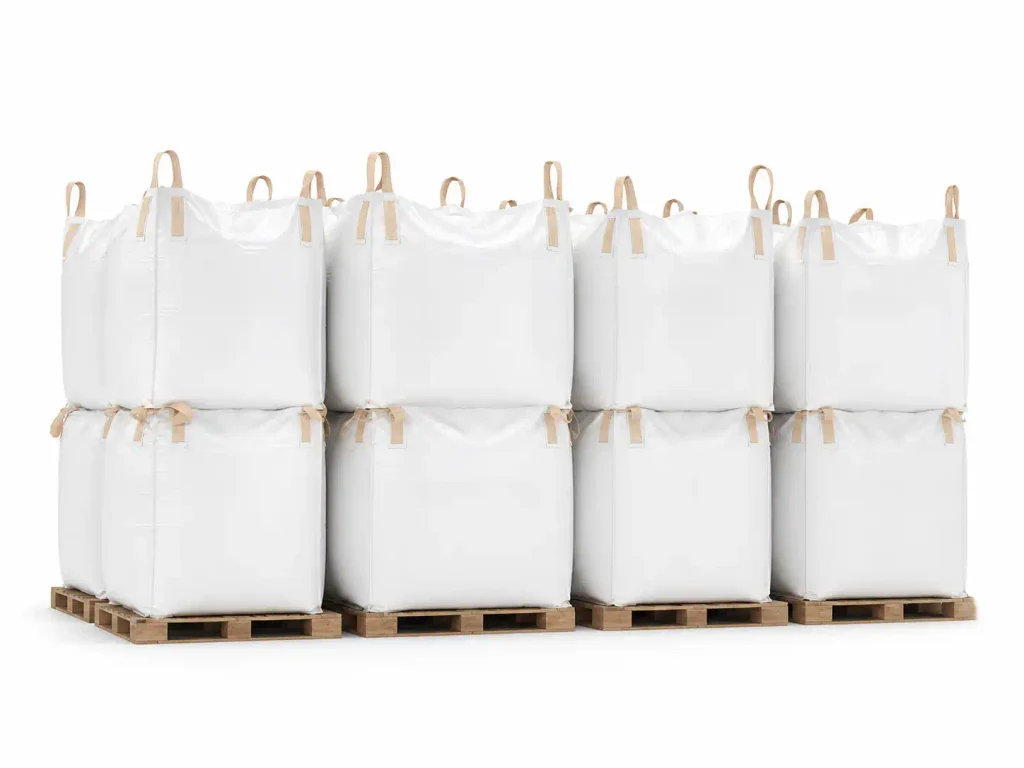
VIDEPAK FIBC Bags: Versatile Bulk Packaging Solutions
VIDEPAK’s flexible intermediate bulk containers (FIBC bags) are engineered for the toughest bulk handling needs. These large woven polypropylene bags can safely transport hundreds to thousands of kilograms of material. Whether handling grains, minerals, chemicals, or food-grade powders, our FIBC bags withstand repeated lifting, stacking, and transport. The robust woven fabric provides superior strength and abrasion resistance, and optional UV protection guards against sun damage.
- Widely used in agriculture, mining, chemical, and food industries.
- Designed for use with forklifts, hoists, and automated filling systems.
- Customizable top closures: open tops, spout tops, fill caps, and more.
These bulk bags maximize efficiency in industrial workflows. When empty, FIBC bags fold flat for compact storage and easy handling. Once filled, a standard FIBC often carries up to 2,000 kg and uses multiple heavy-duty loops for secure crane or forklift lifting. Each bag’s strength is carefully calculated: typically, our bags have a safety factor of 5:1, meaning they are tested to hold at least five times the normal working load.
Quality, Safety and Customization
At VIDEPAK, we emphasize high-quality materials and strict manufacturing standards. Each bag is tailored to its application: we offer single-loop or four-loop lifting configurations, coated or uncoated fabrics, and optional inner liners for dust-free transport. All seams are double-stitched with high-tenacity threads, and corners are reinforced or fused for extra support. We also conduct in-house testing on every batch. Fabric strength and weight are checked by the meter before production, and finished bags undergo rigorous lift tests to verify capacity. These steps ensure consistency and compliance with industry safety standards.
- Durable woven polypropylene fabric, UV-treated for weather resistance.
- Choice of closures and designs to match different materials and filling systems.
- Integrated lifting loops and load-tested construction (5:1 safety factor).
- Optional inner liners, special coatings or conductive threads for specialized use.
Key Point: A carefully selected bag design maximizes efficiency. For example, the diameter of a typical discharge spout usually ranges from 250–500 mm, which allows precise flow control for powders and granules. Properly engineered bottom options, such as spouts, duffle skirts, or flaps, ensure safer, cleaner discharge and can greatly improve emptying time.
Flat Bottom Bulk Bags (Plain Bottom)
Flat-bottom FIBC bags, also called plain-bottom bags, have a simple flat base with no built-in outlet. This straightforward design offers excellent stability: once filled, the bag stands upright on its own, much like a rectangular box. Flat-bottom bags are typically an economical choice and are ideal for single-trip scenarios. In practice, they are used for bulk materials where rapid unloading is needed without reuse of the container, such as cement, minerals, grains, or plastic resins.
Because there is no discharge spout, emptying a flat-bottom bag requires tipping it on its side or carefully cutting open the base panel. This results in an uncontrolled dump of the contents. That makes flat-bottom bags very efficient when speed is more important than reuse of the bag. After unloading, the bag is usually discarded or recycled. Many operations use a designated discharge frame or tarp beneath the bag to catch all material and prevent mess during this dump.
Special care is taken when handling flat-bottom FIBCs. Operators often use mechanical lifts or tippers to manage the heavy bag safely. Some facilities install cutting tables or frames to open the base in a controlled way, capturing the entire load cleanly. Unlike reusable bag designs, flat-bottom bags are not intended to survive this discharge. The benefit, however, is clear: simplicity and low cost. These bags carry the load securely until you are ready to release it all at once, making them ideal for operations requiring a one-time dump of bulk material.
Note: Flat-bottom bags are prized for stability. They remain upright on pallets or floors, preventing spillage before discharge. However, they cannot be reused since the base must be cut or opened to empty the contents. Always use proper equipment (bag tippers or cutting stations) and safety procedures when working with these bags.
Duffle Bottom Bulk Bags
Duffle-bottom FIBC bags offer a broad discharge opening by transforming most of the bag’s base into an extendable skirt. The duffle bottom is tied shut during transport and storage. When it’s time to empty the bag, the operator unties or releases the drawstrings around the perimeter. This action causes the skirt to fall away, creating a very large, flexible outlet that releases material as a wide wave rather than through a narrow tube.
The advantage of a duffle bottom is its speed and completeness of discharge. Sticky, fibrous, or slow-flowing materials often stick inside a spout or flat bag, but the duffle design ensures that nearly the entire load comes out in one action. Granular materials, wood chips, or bulky waste that might jam in a small opening will instead pour out when the skirt is released. This means the bag empties quickly and leaves little residue. The trade-off is control: once unsealed, the contents flood out rapidly, so the receiving hopper must be ready for a sudden surge.
VIDEPAK duffle bags typically include a heavy-duty drawcord at the base and may use an extra strap to keep the folded skirt compact during handling. During transport, some operations place an inner liner over the tied skirt to contain dust. When unloading, you first loosen any secondary strap, then untie the main drawcord. The entire bottom panel then opens smoothly. This mechanism is like dropping a side curtain: once it is pulled back, gravity takes over and the bulk material drops freely into the hopper or receiving equipment.
Highlight: The duffle bottom’s wide outlet is ideal for difficult-flow materials. When you untie the perimeter skirt, a large section of the base opens all at once. This means the bag can empty faster and more completely, compared to a simple spout. Operators should ensure the receiving hopper can handle the high-volume surge.
Bulk Bags with Discharge Spout
Discharge-spout FIBC bags have a central cylindrical outlet sewn into the base. This circular spout typically protrudes from the bottom and is closed by a tie or clamp when the bag is filled. To empty the bag, the operator lifts the bag by its loops, hangs it over a receiving station (such as a hopper or conveyor), and then unties or unclamps the spout. The product then flows through the tube under gravity. Because the spout can be tied off, this design provides precise flow control during discharge.
The primary benefit of a discharge spout is control and reusability. The bag itself remains largely intact during unloading, so it can often be used multiple times – an option not possible with a flat bottom. Spout diameters commonly range from about 250 to 500 mm (10–20 inches), and lengths around 300 to 600 mm (12–24 inches), though VIDEPAK can adapt these to customer needs. A narrower spout slows the flow (good for accuracy), whereas a wider spout allows faster flow (good for high-volume unloading).
In practice, spout-bottom bags are the workhorses of many industries. They are used for powders, granules, pellets, and other free-flowing materials. Because the spout fits into a hopper or machine, discharge is clean and dust is minimized. After tying off the spout following filling, one simply releases it at the discharge point. The material then pours in a controlled stream directly into the next process. For example, a cement plant might hang multiple spout-bottom bags at once, each feeding a different receiving hopper in turn.
Tip: Discharge spouts bring precision to bulk handling. By tightening the spout or adding a clamp, operators can pause or slow the flow mid-unload. This keeps the bag intact and reduces waste. Such bags are popular when multiple cycles are needed or when pouring directly into machinery.
Bulk Bags with Discharge Spout and Flap
A discharge spout with flap combines the standard spout design with an extra protective panel. In this design, a fabric flap covers the tied spout (and often the surrounding base) during transit and storage. The flap is tied or strapped shut before moving the bag. When unloading, the operator first unties the flap (lifting it like a door) to reveal the spout. Then the spout is opened as usual. The flap itself does not affect the flow of material; it simply shields the outlet until you are ready to discharge.
The benefit of this design is cleanliness and safety. The flap shields the spout from dust, moisture, abrasion and accidental snags when the bag is on the floor or pallet. It keeps the tucked-in spout clean until it’s needed. Industries with high hygiene or safety requirements often specify a spout-flap combination. For example, food ingredient processors use the flap to prevent contamination, and chemical handlers use it to avoid spills during transport. In effect, the flap works like a protective lid for the outlet.
VIDEPAK’s spout-flap bags may feature a square or shaped flap panel that matches the base outline. Some flaps attach with Velcro or snap buttons for quick access. This two-step opening (flap then spout) adds a layer of safety: operators never have to reach underneath the bag while a bottom is being opened. The flap also provides extra fabric that can protect the corners of the base from abrasion when the bag rests on the ground.
Insight: Think of the flap as a safety cover for the spout. It acts like a lid, holding contaminants out until you are ready to unload. With the flap closed, the bag maintains a neat, sealed base. When open, the flap provides easy access and keeps the work area cleaner by minimizing dust as the spout is released.
Comparison of FIBC Bottom Designs
VIDEPAK’s product range includes the bottom styles summarized below. This comparison highlights each design’s opening type, flow characteristics, and ideal applications. It can help in selecting the best FIBC configuration for your materials and equipment.
| Bottom Type | Opening | Flow Control | Best For | Key Note |
|---|---|---|---|---|
| Flat (Plain) Bottom | Closed flat base (no outlet) | None (open dump) | Stable storage; single-trip use | Most stable, lowest cost per bag |
| Duffle Bottom | Full perimeter skirt | Low (rapid bulk dump) | Sticky, fibrous or heavy loads | Empties very quickly; plan for surge |
| Spout Bottom | Central cylindrical tube | Medium (operator-controlled) | Powders, granules; reusable | General-purpose choice; versatile |
| Spout + Flap | Tube + protective cover | Medium (with extra protection) | Fine or hygiene-sensitive powders | Flap keeps outlet clean and contained |
Choosing the Right VIDEPAK FIBC Solution
Selecting the appropriate bulk bag design is critical for optimizing material flow, safety, and overall efficiency. VIDEPAK’s experienced engineers work with customers to match bag features to the product’s behavior and the unloading process. A stable flat-bottom bag may be perfect for simple single-use transport, while a spout-bottom bag is better for controlled discharge and reuse. For especially cohesive or moist loads, a duffle-bottom or conical design can minimize residue. If hygiene and containment are critical, adding a flap or cover helps keep the product protected.
As one rule of thumb: “Strong does not have to mean slow, and fast does not have to mean weak.” With VIDEPAK designs, the load-carrying strength of the bag is always balanced with an efficient opening. Our engineering ensures that the load path and discharge mechanism work together seamlessly. For instance, we can apply reinforced tapes around any outlet to distribute weight more evenly. This way, a bag with a large, quick-open outlet still meets stringent safety standards.
In practice, the choice depends on your material and process requirements. Ask: Do you need rapid bulk dumping or precise dosing? Is the same bag reused, or disposed? VIDEPAK provides guidance by analyzing factors like particle size, bulk density, and flow behavior. Once a design is selected, we handle all the custom details – from inner liners and special coatings to static-dissipative yarns and UV protection. We even offer specialized fittings (such as valve attachments or filling spouts) to integrate with your existing equipment.
- Flat-bottom bags are cost-effective and stable, but are generally single-use.
- Duffle-bottom bags empty the quickest and work well for clumpy, non-free-flowing products.
- Spout-bottom bags give the best combination of flow control and reusability.
- Spout-with-flap bags add cleanliness and safety for dust-sensitive or high-value materials.
Whether your priority is speed, cleanliness, or reuse, VIDEPAK has an FIBC bag style to fit. Our commitment to quality and innovation means we constantly refine designs and develop new features in response to customer needs. By understanding how each bottom type affects discharge, flow and operator access, users can leverage VIDEPAK’s fibc bag technology to improve throughput, reduce waste, and achieve greater peace of mind in daily operations. In short, VIDEPAK FIBC bags are more than just containers – they are engineered solutions designed to work in harmony with the entire material handling process.
How Anti-Bulge FIBC Bags Are Produced
Production is choreography. Virgin PP pellets—snow-white, odour-free—cascade into Austrian Starlinger extrusion lines. Heated to 230 °C, the polymer becomes taffy, then cools on Teflon-coated rolls before razor slits carve 3 mm tapes. Drawn 1 ∶ 6.8, molecules align like soldiers—tensile glory baked at the molecular frontier.
More than 100 circular looms (each revolving at 160 rpm) intertwine these tapes into 190 gsm fabric. LED pick detectors eject any rogue weft wider than ±12 µm. German Windmöller & Hölscher coaters add a 25 µm PP laminate, sealing pinholes smaller than a coffee-ground yet leaving the cloth breathable.
Then the alchemy happens: CNC tables kiss-cut panels to ±2 mm, while programmable bar-tack machines insert baffles in a crosshatch. Each stitch sequence follows a digital twin—software originally written for automotive seatbelts—guaranteeing symmetry even when operators swap bobbins. For static-sensitive cargos, silver-grey carbon filaments weave through base fabric; continuity meters confirm resistance below 10⁷ Ω loop-to-loop.
The bag receives its identity at the finishing carousel: label pockets, document sleeves, colour-coded loop covers for quick SWL recognition. Finally, an overhead drop rig slams sample bags from 0.8 m with SWL payloads—any seam weeping a gram of dust is culled. VidePak logs these tests into an SPC dashboard; control charts must hug a CpK > 1.67 or the line halts.
Anti-Bulge FIBC Bags Capacity
Custom anti-bulge FIBC bags improving weight capacity and secure bulk handling efficiency.
Check More →FIBC Jumbo Bags Solutions
Complete customized FIBC bag solutions for safe and efficient industrial bulk material handling.
Check More →FIBC Bags Manufacturing
Production process of anti-bulge FIBC bags ensuring stable structure and reliable bulk handling.
Check More →Heavy-Duty Woven Bags Guide
Guide to heavy-duty FIBC woven bags with anti-bulge design for secure bulk packaging.
Check More →Vertical elegance: five steps, one facility, zero subcontract detours. Horizontal resonance: the CNC-guided sewing borrows from air-bag deployment patterns, echoing automotive safety tech.
Where Anti-Bulge FIBC Bags Excel
Warehouse Geometry – In Dutch fertiliser depots, pallets stack five layers high; traditional bags belly outward, demanding plywood shims. With Anti-Bulge FIBC Bags, the shim budget vanished, and forklift routes widened by 18 cm—enough clearance to cut mishaps 12 % year-over-year.
Sea-Freight Economics – West African cocoa nibs once sailed loose in containers, shifting like dunes and bruising beans. Cube-steady Anti-Bulge FIBC Bags hold shape so tightly that 20 % more weight fits per TEU, trimming freight spend by USD 37 per tonne on the Abidjan–Hamburg lane.
Process Throughput – Titanium-dioxide pigment flows begrudgingly; bridging at hopper necks is common. Internal baffles inside the bag funnel product to the spout, boosting discharge 12 %. That marginal speed compounds: a paint-resin plant reclaimed 41 production hours in one quarter—enough to delay a capital expenditure on a second silo.
Brand Canvas – Flat side panels welcome six-colour flexo. One Japanese agro-chem company prints QR codes linking to farm-safety videos—an interaction impossible on wrinkled U-panels.
Safety & Compliance – reduced bulge means walkways stay uncluttered; fewer protrusions translate to fewer tears, which means less fugitive dust and lower explosion risks in sugar mills. EH&S managers breathe easier; insurers too.
VidePak—since 2008—has spun polymer and pragmatism into 2.5 million Anti-Bulge FIBC Bags annually. Sixteen extrusion lines, a hundred looms, thirty lamination & print cells, and 568 people who speak the dialect of tensile curves and logistics ledgers. When your load needs the discipline of a cube and the soul of efficiency, we stitch the answer—one baffle at a time.

- VIDEPAK FIBC Bags: Versatile Bulk Packaging Solutions
- Flat Bottom Bulk Bags (Plain Bottom)
- Duffle Bottom Bulk Bags
- Bulk Bags with Discharge Spout
- Bulk Bags with Discharge Spout and Flap
- Comparison of FIBC Bottom Designs
- Choosing the Right VIDEPAK FIBC Solution
When it comes to industrial packaging, ensuring both safety and efficiency in transporting and storing bulk materials is crucial. Anti-Bulge FIBC (Flexible Intermediate Bulk Container) bags have emerged as a leading solution, addressing common packaging issues like bulging and instability. These bags offer customized solutions that ensure secure packaging for various industries, from chemicals to agriculture.
What Are Anti-Bulge FIBC Bags?
Anti-Bulge FIBC bags are specially designed bulk bags that prevent bulging during the transportation and storage of goods. Bulging happens when the contents inside the bag are unstable, causing uneven weight distribution. This can lead to risks such as spills, bag rupture, or difficulty in handling. Anti-bulge bags are designed to maintain their shape and integrity, ensuring the contents stay secure.
For example, imagine transporting grains or powders that could easily shift inside a traditional bag, causing it to bulge and spill. An Anti-Bulge FIBC bag solves this by using internal baffles—fabric dividers that keep the bag from expanding. These baffles distribute the weight evenly, preventing the bag from changing shape and improving its stability.
Key Features and Benefits
1. Improved Stability:
Anti-bulge bags prevent the typical bulging or instability that can occur during storage or transportation. By distributing the contents evenly, these bags maintain their shape and avoid expansion. For example, bags used to transport construction materials like sand or gravel benefit from this design, as it ensures the contents stay compact and stable.
2. Customization Options:
These bags can be customized to meet the specific needs of different industries. For instance, a company may need bags with UV protection for outdoor storage, or a food company may require a food-safe liner to keep products fresh. Tailoring the bag to fit these needs ensures better protection and compliance with industry standards.
3. Cost-Effectiveness:
Although Anti-Bulge FIBC bags may cost a bit more upfront due to their specialized design, they offer long-term savings. By preventing bulging, these bags reduce the risk of product loss, spoilage, or damage during transit. Over time, the efficiency of these bags can lead to lower costs and fewer disruptions.
4. Eco-Friendly Solutions:
Sustainability is a key focus for many companies today. Anti-Bulge FIBC bags are available in recyclable materials, making them an environmentally friendly option. This is especially important for companies aiming to meet sustainability goals while still providing reliable packaging. Choosing eco-friendly bags helps reduce the environmental impact of packaging waste.
Applications Across Different Industries
1. Chemical Industry:
In the chemical sector, Anti-Bulge FIBC bags are used to safely transport hazardous materials. The stable structure of these bags prevents spills and accidents, ensuring that chemicals are contained securely. Some bags are also designed with antistatic properties to prevent fires or explosions when dealing with flammable materials.
2. Agriculture:
For agricultural products like grains, fertilizers, and seeds, Anti-Bulge FIBC bags provide a safe and efficient way to store and transport these goods. The stability of the bags ensures that the products are not damaged during handling, and the bags can be customized with food-safe liners to ensure the freshness and safety of edible items.
3. Construction Industry:
Anti-Bulge FIBC bags are also widely used in construction for materials like cement, sand, and gravel. The robust design ensures that heavy-duty items are securely packed and transported without risk of the bag bursting or bulging under the weight.
Product Parameters
| Feature | Description |
|---|---|
| Material | High-strength woven polypropylene (PP) |
| Capacity | Can carry up to 2000 kg (depending on design) |
| Dimensions | Customizable based on customer needs |
| UV Protection | Available for outdoor storage |
| Closure Type | Options include tie, pinch, or discharge valve |
| Baffle Type | Internal baffles to prevent bulging |
| Liner Type | Optional PE liner for added protection |
FAQs
1. What are internal baffles in Anti-Bulge FIBC bags?
Internal baffles are fabric dividers sewn inside the bag to help maintain its shape and prevent it from bulging. These baffles help distribute the weight evenly, ensuring that the bag stays compact and stable during storage and transportation.
2. Are Anti-Bulge FIBC bags suitable for all types of products?
Yes, these bags can be customized to suit various products, including chemicals, grains, construction materials, and more. Custom features, such as food-safe liners or antistatic properties, can be added to meet specific industry needs.
3. Can Anti-Bulge FIBC bags be reused?
Yes, these bags are durable and can be reused multiple times, as long as they are properly cleaned and maintained. This helps reduce the cost of packaging in the long run.
4. How do customized features affect the cost of Anti-Bulge FIBC bags?
Customization, such as adding UV protection or choosing specific liner types, may increase the initial cost. However, the benefits of better product protection and improved efficiency usually make the higher cost worthwhile.
5. Are these bags environmentally friendly?
Yes, many manufacturers offer Anti-Bulge FIBC bags made from recyclable materials, helping companies meet sustainability goals and reduce packaging waste.
Trends and Innovations
With growing demand for sustainable and efficient packaging, the development of Anti-Bulge FIBC bags continues to evolve. New materials, such as biodegradable plastics, and innovative manufacturing methods are improving the performance of these bags. Additionally, ultrasonic sealing technology has enhanced the durability and strength of Anti-Bulge FIBC bags, making them even more reliable for a wider range of applications.
To learn more about innovations in sustainable packaging, check out the role of FIBC bags in enhancing environmental sustainability.
Conclusion
Anti-Bulge FIBC bags are a highly reliable and customizable packaging solution for industries that deal with bulk goods. They offer stability, reduce the risk of damage, and provide environmentally friendly options that meet sustainability goals. By preventing bulging, these bags ensure that products are transported and stored safely and efficiently, making them an essential choice for a variety of industries.
For further insights into bulk packaging, explore how FIBC bags are revolutionizing bulk packaging.