
How Open Mouth Paper Bags Create Better Filling, Stronger Pallets, and Clearer Brand Value
Market insight: The best industrial package is not simply the bag with the most layers, the thickest liner, or the strongest claim. It is the bag that matches the product, the filling line, the closure method, the pallet pattern, and the customer’s recovery route. For that reason, VIDEPAK treats Open Mouth Paper Bags as an engineered packaging system rather than a standard commodity.
Open Mouth Paper Bags are among the most direct and flexible forms of industrial packaging. One end is closed during bag production, while the other end remains fully open for filling by gravity, auger, belt, or vertical spout. After the target weight is reached, the packer closes the mouth by sewing, gluing, taping, or heat-activating a prepared adhesive area. Industry definitions distinguish open mouth sacks from valve sacks mainly by the filling method: open-mouth formats receive product through the full top opening, while valve formats receive product through a smaller filling sleeve.
That simple difference changes almost everything. A wide open mouth can make bag placement easier, allow operators to see the product flow, support manual or automatic filling, and accept coarse particles, pellets, granules, powders, and mixed ingredients. Yet the same wide open mouth also means the closing step must be selected with care. A good package must fill quickly, release trapped air, resist sifting, hold its shape, protect print, survive handling, and open cleanly at the customer’s site. Strong paper alone cannot solve every problem. Smart structure can.
What Are Open Mouth Paper Bags?
A Full-Width Filling Format Built Around Practical Control
In industrial use, Open Mouth Paper Bags are usually made from one or more plies of sack kraft paper, sometimes combined with a free-film liner, coated paper, laminated layer, grease-resistant sheet, or other functional barrier. The bag manufacturer closes the bottom or one end in advance. The filler then places the open end under a hopper or vertical filling nozzle, doses the product, settles or deaerates the pack when needed, and closes the remaining end. Multiwall sacks are defined by the use of multiple paper plies or protective layers, while the exact construction is customized around the packed product and the supply chain.
The word “open” describes the filling access, not weak protection. Properly designed Paper Bags can include stepped ends, pasted seams, inner liners, moisture barriers, sift-resistant tapes, easy-open features, anti-slip surfaces, high-contrast printing, and controlled venting. The package can be simple when the product is forgiving, or highly engineered when humidity, odor, oil, dust, or long-distance transport creates risk. This range is why Open Mouth Paper Bags are used for food ingredients, feed, seeds, minerals, building materials, charcoal, biomass products, and many other dry goods. VIDEPAK’s published product framework places common industrial capacities broadly from 5 kg to 50 kg, with 25 kg widely used in industrial programs, while actual dimensions and material recipes should be confirmed by filling trials.
Wide Filling Access
The full mouth accepts many dosing methods and lets the packer manage product flow before closure.
Flexible Closure
Sewing, adhesive, tape, and heat-seal options can be matched to speed, dust, hygiene, and opening needs.
Large Print Area
Broad faces support branding, barcodes, instructions, batch data, warning marks, and warehouse color coding.
Tunable Protection
Paper plies, liners, coatings, vents, seams, and bottom geometry can be adjusted as one system.
How the Packaging Process Works
The open mouth is presented to the filler.
Material enters by hopper or vertical spout.
Porosity or vents help the pack settle.
The top is sewn, pasted, taped, or heat sealed.
Bag shape and friction control stack quality.
Open mouth packing can suit basic semi-automatic lines as well as more advanced systems. In a typical gross-weight setup, a bag is placed under a controlled hopper, filled to target weight, released to a conveyor, and transferred to a closing station. The equipment may be simple; the specification should not be. Bag mouth stiffness affects placement. Venting affects speed. Bottom shape affects stability. Closure quality affects dust. Print location affects traceability. Each choice touches the next.
Common Bottom Types and End Constructions
The market often uses “bottom type,” “bag style,” and “closure type” as if they mean the same thing. They do not. Block Bottom mainly describes a formed, flat base. Pinch Bottom mainly describes a stepped end that is folded and adhesively sealed. A sewn open mouth sack mainly describes thread closure at an end. These features may overlap: a package can have a pasted square base and a sewn top, or a square base and a heat-sealed pinch top. Clear terms prevent costly mistakes.
Pasted Block Bottom: Shape, Stability, and Presentation
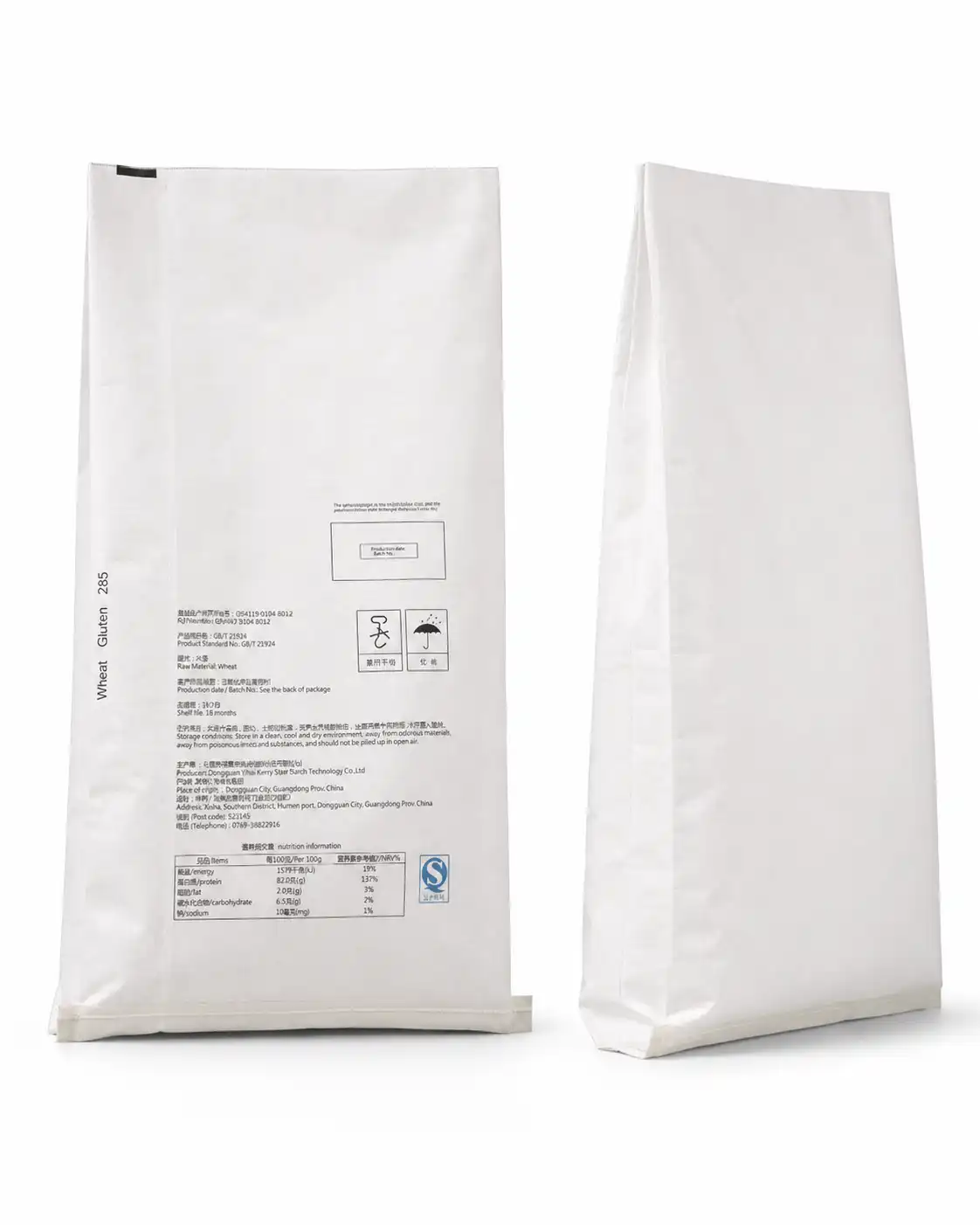
Pasted Block Bottom bags use folded base panels joined with adhesive to create a flat rectangular footing. When side gussets are included, the empty bag can open into a box-like form and stand more easily during filling. The broad base spreads the product load, helps the filled pack keep square shoulders, and supports orderly pallet patterns. Industry terminology also distinguishes a non-gusseted pasted satchel bottom from a gusseted self-opening square bottom, so the buyer should confirm geometry rather than depend on a short product name.
For VIDEPAK, the commercial value of this construction is visible at three points. First, on the line, a stable base can improve bag presentation and reduce twisting. Second, in the warehouse, squarer packs can create cleaner pallet faces and reduce soft, rounded gaps. Third, in the market, the package presents more like a carton while retaining the efficient material use of flexible packaging. It stands, stacks, and sells. That parallel matters for pet food, specialty grain, charcoal, pellets, and other products where the bag is both a transport unit and a brand surface.
Pasted Bottom Paper Bags are not automatically the best answer for every powder. A very fine or dusty product may still require a taped sewing line, a stepped pasted mouth, a liner, a barrier ply, or carefully designed venting. A square base improves geometry; it does not by itself create a hermetic package. Adhesive coverage, fold accuracy, paper stiffness, product bulk density, drop height, and pallet compression all influence performance. VIDEPAK therefore evaluates the base as a load-bearing subsystem, not as a decorative fold.
Best-fit signal: Choose a pasted Block Bottom when stable standing, square pallet shape, large front panels, and a premium shelf profile matter as much as basic containment. Add the right top closure and barrier; do not ask the bottom alone to perform every task.
Pinch Bottom: Clean Adhesive Sealing for Sift Control
A Pinch Bottom open-mouth sack normally uses a stepped end construction. The layers are cut at different lengths so they overlap in a controlled pattern when folded. One end is factory closed; after filling, the remaining stepped mouth is folded and sealed, often by reactivating pre-applied hot-melt adhesive with heated air or a sealing unit. The result is a flat, neat end without a line of sewing holes. Industry references identify the stepped-end pasted sack as a sift-resistant construction and describe both stepped and flat-top presentations, depending on the selected design.
The marketing advantage is a clean panel. The operating advantage is controlled closure. The protection advantage is reduced paths for fine particles to escape. For powdered food, additives, premixes, specialty chemicals, and odor-sensitive materials, a properly engineered Pinch Bottom can deliver a more finished appearance than sewing and can work with coated papers or inner liners. It can also avoid loose thread at the customer’s opening point. Clean outside, controlled inside.
However, the filler needs compatible closing equipment, stable heat settings, correct dwell time, and disciplined mouth preparation. Product contamination in the adhesive zone can weaken the seal. Too little heat may leave incomplete bonding; too much may damage a heat-sensitive layer or slow the line. For this reason, VIDEPAK recommends confirming the actual product temperature, dust behavior, fill height, top air space, and sealer settings during trials. A strong closure is not created by adhesive alone. It is created by adhesive, pressure, temperature, time, and clean contact working together.
Performance note: A Pinch Bottom design is especially attractive when the buyer wants a smooth top edge, stronger sift control, barrier options, and a polished retail or industrial appearance. It is less attractive when the plant does not have a suitable heat-sealing process or when frequent product dust enters the seal area.
Sewn Open Mouth Bag: Familiar, Flexible, and Easy to Integrate
A sewn open-mouth sack has one end pre-closed and a flush-cut open end that the customer closes with sewing thread after filling. The body may be flat or gusseted, and the sewing line may be combined with crepe paper tape, a barrier tape, or an easy-open feature. This is one of the most familiar industrial styles because it works with common sewing heads and can handle a broad range of dry, flowable products.
The strength of sewing is not elegance; it is adaptability. A production team can see the mouth, trim the fill, guide the top, and close the bag in a continuous step. Changeovers can be practical, maintenance knowledge is widely available, and the closure can be designed for easy opening. For grain, seed, feed, pellets, coarse minerals, and many building products, that balance can be more valuable than a highly sealed top.
The trade-off appears around fine dust and moisture. Needle holes create potential sift paths, and an uncovered stitch line is not a moisture barrier. Crepe tape over the seam can help contain fines; a film-backed tape can improve moisture resistance; an inner liner can protect the product; and a well-designed easy-open tape can improve customer use. In other words, sewing is a platform. Basic sewing gives speed and simplicity. Reinforced sewing gives better control. The correct choice depends on what must stay in, what must stay out, and how the customer wants to open the package.
Engineering the Bag from Product Contact to Printed Face
Paper Plies: Give Every Layer a Job
Buyers often ask for “three-ply” or “four-ply” Paper Bags before defining the real risk. Ply count matters, but function matters more. The inner ply may support food contact or resist abrasion. A middle ply may add tear strength or carry a free-film barrier. The outer ply must survive rubbing, hold print, and present the brand. VIDEPAK’s market-realistic reference range for multiwall constructions is commonly two to six plies, often using sack kraft papers in roughly the 70–100 g/m² range per ply, but the correct recipe depends on drop performance, bag size, bulk density, humidity, and handling.
More paper is not always better. Extra material can increase cost, make folding harder, slow air release, and reduce the efficiency of the package. Less paper is not always smarter either. An under-built bag may burst, scuff, bulge, or lose pallet shape. The engineering goal is balanced material use: enough tensile strength for carrying, enough tear resistance for handling, enough stiffness for machineability, and enough surface quality for printing. Strong where needed. Lean where possible.
Liners, Coatings, and Venting: Protection Without Blind Over-Specification
Moisture-sensitive powders may need a polyethylene tube, coated ply, laminated barrier, or another product-contact layer. Greasy or aromatic contents may need grease or odor control. At the same time, trapped air must escape during filling. A fully closed barrier can improve moisture protection but slow deaeration; aggressive perforation can speed filling but weaken barrier performance. The bag therefore needs a controlled air path, not simply “more holes” or “more plastic.” VIDEPAK’s published reference window includes optional PE liners around 20–80 μm, but final thickness, tacking, vent pattern, and seal method must be based on the actual product and shelf-life target.
This is where horizontal thinking becomes useful. Change the liner, and filling speed may change. Change perforation, and dust may change. Change paper stiffness, and mouth opening may change. Change the closure, and usable bag length may change. A specification is a chain, not a shopping list.
Dimensions, Printing, and Surface Control
Industrial sack dimensions are normally customized and should be stated in a consistent order: face width, gusset where applicable, finished length, and bottom or top dimensions where required. Industry purchasing guidance stresses that there are no universal standard sizes and that the construction should be listed ply by ply from inside to outside.
For brand owners, the printed face is not decoration placed after engineering. It is part of operation. Barcodes need quiet zones and contrast. Batch panels need reachable positions. Regulatory marks need legibility after the bag is filled and curved. Color bands can separate formulas across a large SKU range. Anti-scuff treatment can protect dark solids and fine text. Anti-slip treatment can support pallet stability. VIDEPAK can treat graphics as a warehouse language: one face for selling, one face for scanning, one gusset for identification, one top area for filling and closure control.
Application Analysis: Matching Structure to Real Product Behavior
The correct bag style starts with the packed product, but it cannot end there. Two powders with the same weight may need different packages because one is dense and free-flowing while the other is light, dusty, hygroscopic, or abrasive. The filling line, warehouse climate, transport distance, pallet height, retail role, opening method, and local recycling system all matter.
| Product Group | Main Packaging Risk | Recommended Direction |
|---|---|---|
| Flour, starch, sugar, food blends | Humidity, fine dust, hygiene, clean opening | Pinch Bottom or taped sewn closure; optional liner or barrier after shelf-life testing |
| Feed, premix, seed, grain | SKU confusion, rough handling, variable particle size | Sewn open mouth or pasted Block Bottom with strong color coding and optional easy-open tape |
| Dry mortar, gypsum, minerals | Abrasion, dust, drop stress, yard humidity | Tough multiwall Paper Bags with controlled venting, reinforced closure, and anti-slip surface |
| Charcoal and biomass pellets | Bag ballooning, display shape, puncture, dust | Pasted Block Bottom, tuned venting, strong outer ply, bold retail printing |
| Specialty additives and chemicals | Sifting, moisture, odor, traceability | Pinch Bottom with a validated barrier system and prominent batch identification |
For food and feed, clean closure and traceability often lead the discussion. For construction products, drop strength, dust control, and filling rate may dominate. For charcoal and pellets, air release and shelf appearance can be equally important. For specialty ingredients, barrier performance and seal integrity may decide the project. One format cannot be called “best” without a use case. The strongest answer is the most specific answer.
A Practical Selection Framework for Buyers
Start with Five Questions
Is it coarse, fine, abrasive, oily, dusty, hot, or moisture-sensitive?
How is it dosed, settled, deaerated, and closed?
What must stay in, and what must stay out?
How high, how far, and under what climate will it travel?
How must it scan, display, open, and recover after use?
If stable standing and a clean retail face lead the project, begin with a pasted Block Bottom. If sift resistance and a smooth adhesive-sealed end lead, begin with a Pinch Bottom. If broad compatibility, simple integration, and easy-open sewing lead, begin with a sewn open-mouth style. Then add the paper recipe, barrier, venting, print, and pallet features. Choose the architecture first; tune the materials second.
Use Trials to Turn Assumptions into Evidence
A laboratory data sheet cannot fully predict performance on a customer’s line. VIDEPAK recommends a staged validation: confirm empty-bag dimensions and mouth handling; test filling speed and weight accuracy; inspect dust and product contamination around the closure; perform drop and compression checks; build a full pallet; expose samples to expected humidity; then evaluate opening and emptying at the end user. The final bag should be judged as a filled package, not as a flat sample.
Useful acceptance measures include bag-opening consistency, bags per minute, closure defect rate, visible dust, filled dimensions, pallet lean, print rub, barcode readability, drop survival, moisture change, and customer opening time. This evidence creates a stronger purchasing decision than vague terms such as “heavy duty” or “premium quality.” It also creates a repeatable standard for future orders.
VIDEPAK recommendation: Do not approve Open Mouth Paper Bags from appearance alone. Approve the bag, the filling process, the closure settings, and the pallet pattern together. A bag can pass a hand test and fail a factory. A well-run trial closes that gap.
Sustainability, Recyclability, and Honest Material Choices
Paper Bags begin with a strong material story, but responsible claims must follow the complete design. European industry groups describe paper sacks as renewable and recyclable and report continuing reductions in the fossil carbon intensity of average European paper sacks. A 2024 industry study found high recyclability scores for most tested unused sacks and a strong score for an emptied cement sack, while also showing that a thick plastic tube could create repulpability problems if it was not removed. The lesson is direct: fibre helps, but unnecessary non-paper content can reduce recovery performance.
For VIDEPAK, sustainable design means using the least complex structure that still protects the product. A liner should solve a measured moisture or contamination risk. A coating should have a clear function. Adhesive and ink systems should be selected with converting, performance, and recovery in mind. Where a removable liner is required, the opening and emptying process should help the customer separate it. Where a fibre-based barrier can meet the target, it may simplify recovery. But no material should be removed merely to improve a claim if product loss will rise. Preventing damaged goods can be more valuable than reducing a small amount of packaging material.
Recycling rules and mill capabilities differ by country, and contamination from the packed product can affect acceptance. Therefore, claims should be linked to the actual structure and destination market. “Designed for recycling where facilities accept it” is more useful than an absolute promise. Honest language builds trust; tested design builds proof.
VIDEPAK Specification Blueprint and Market Position
VIDEPAK’s role is not to push every buyer toward the same bag. It is to convert commercial needs into measurable packaging choices. For Pasted Bottom Paper Bags, that means defining the base geometry, face width, finished length, bottom width, ply recipe, adhesive system, opening method, and pallet target. For Pinch Bottom projects, it also means defining the stepped-end pattern, heat-activation window, top fold, seal cleanliness, and barrier interaction. For sewn projects, it means selecting stitch type, tape, thread, easy-open feature, and sift-control level.
A practical starting window for VIDEPAK programs may include two to six paper plies, customized bag dimensions, optional liners, and multi-color flexographic printing, but these are design ranges rather than universal promises. Public VIDEPAK guidance lists examples such as 300–800 mm width, 500–1100 mm length, 90–160 mm bottom width, and 5–50 kg capacity. Such figures help early planning; only samples and line trials can confirm the final specification.
The market message is therefore clear. Open Mouth Paper Bags offer wide filling access. Pasted Block Bottom designs offer shape and shelf presence. Pinch Bottom designs offer a clean adhesive seal. Sewn formats offer flexible, familiar closing. The highest-value package combines the right features rather than selecting a style by name alone.
Final Product Position
VIDEPAK develops Paper Bags around measurable customer outcomes: steady filling, clean closure, strong handling, stable pallets, readable identification, attractive presentation, and responsible material use. The bag should not merely contain the product. It should improve the way the product is packed, moved, recognized, sold, opened, and recovered.
- How Open Mouth Paper Bags Create Better Filling, Stronger Pallets, and Clearer Brand Value
- What Are Open Mouth Paper Bags?
- Common Bottom Types and End Constructions
- Engineering the Bag from Product Contact to Printed Face
- Application Analysis: Matching Structure to Real Product Behavior
- A Practical Selection Framework for Buyers
- Sustainability, Recyclability, and Honest Material Choices
- VIDEPAK Specification Blueprint and Market Position
- What is Pasted Open Mouth Paper Bags?
- Why Pasted Open Mouth Paper Bags? A closure that reshapes the packing line
- References
UN 5M2 Compliant Pasted Open Mouth Paper Bags
High-quality pasted open mouth paper bags meeting UN 5M2 transportation standards.
Check More →Multiwall Paper Bags Manufacturer
Professional factory producing pasted open mouth and multiwall paper packaging bags.
Check More →Laminated Kraft Paper Sacks
Durable laminated kraft paper bags available in pasted open mouth design.
Check More →Pinch Bottom Open Mouth Paper Bags
PBOM open mouth paper bags with sturdy pasted bottom for industrial bulk packaging.
Check More →What is Pasted Open Mouth Paper Bags?
Pasted Open Mouth Paper Bags are multi‑wall kraft sacks built with a pasted bottom (factory‑glued base panels that form a flat, square footing) and an open mouth at the top for filling. After dosing, the open mouth is closed by sewing (with or without crepe tape), by sewing plus PE tape for better dust control, or—if the top ply carries a heat‑sealable layer—by pinch‑sealing on a hot bar. In the trade you will also see aliases such as Sewn‑Open‑Mouth pasted bags, SOS pasted open‑mouth sacks, square‑bottom open‑mouth bags, multi‑wall paper sacks (pasted bottom), and for heat‑seal variants PBOM (pinch‑bottom open mouth) paper bags. Although the labels vary, the purpose is consistent: deliver tidy, stack‑stable packaging for dry, free‑flowing goods.
Key features of Pasted Open Mouth Paper Bags include a carton‑like base that resists bulging, breathable walls that allow trapped air to escape, high‑contrast printable faces for branding and regulatory information, and flexible closure choices that match manual or automated lines. Options extend from PE tubular liners (≈ 20–80 µm) for moisture‑sensitive products to aqueous barrier coatings when repulpability is prioritized. Typical capacities range from 5 kg to 50 kg, with 25 kg the most common industrial SKU.
How are Pasted Open Mouth Paper Bags produced? Converters draw reels of kraft paper (often 70–100 g/m² per ply), build 2–6‑ply tubes, paste a square bottom with water‑based or hot‑melt adhesives, cut to length, insert optional liners, and prepare the open mouth for the chosen closure. Printing is typically water‑based flexography up to 6–8 colors. Each lot undergoes visual, dimensional, and strength checks before bundling and palletizing.
Where are Pasted Open Mouth Paper Bags used? They excel in flour, sugar, and milled grains, animal feed and premixes, retail‑facing charcoal and biomass pellets, gypsum, lime, and dry mortars, mineral powders and additives, seeds and agricultural inputs, and specialty chemicals that are free‑flowing and can tolerate or benefit from breathable walls. For an overview of related paper formats and finishing options, see our kraft series page: Pasted Open Mouth Paper Bags.
Why Pasted Open Mouth Paper Bags? A closure that reshapes the packing line
A valve bag hides complexity in a corner sleeve; a form‑fill‑seal film asks the machine to fabricate the bag live. Pasted Open Mouth Paper Bags choose a third path—a ready‑made, square‑bottom sack with a wide, open inlet. That single design decision changes the shop‑floor calculus: simpler dosing funnels, fewer change parts, easier visual inspection of fill level, and mouth closures that maintenance teams already know.
Start with the physics. Free‑flowing particles bring air with them. Paper’s porosity lets that air migrate out of the stack, so the pallet settles faster, tilts less, and needs less wrap. Consider the optics. A paper face accepts water‑based inks beautifully—deep blacks for barcodes, natural fibers for a premium finish. And do not ignore ergonomics. Operators can see the fill cone, clear a bridge, or add a sample scoop without fighting a valve sleeve.
Where does this closure shine? When dust is moderate, when breathability helps (flour, semolina, sugar), when warehouse teams value big, legible labels and color stripes for fast identification, and when the brand wants square shoulders on the retail face.
References
ISO 535: Paper and board — Determination of water absorptiveness (Cobb method).
ISO 1924‑2: Paper and board — Determination of tensile properties (constant rate of elongation method).
ISO 1974 / TAPPI T414: Paper — Determination of tearing resistance (Elmendorf method).
TAPPI T410 / T411 / T810: Basis weight, thickness (caliper), and bursting strength of paper.
ISO 21898: Packaging — Sacks — Performance requirements and tests.
ASTM D5264: Standard Test Method for Abrasion Resistance of Printed Materials by the Sutherland Rub Tester.
ASTM E1164 / ASTM E313: Spectrophotometric color measurement; whiteness and yellowness indices.
ISO/IEC 15416: Bar code print quality test specification — Linear symbols.
BfR XXXVI: Paper and board for food contact.
FDA 21 CFR 176.170 / 176.180: Components of paper and paperboard in contact with aqueous and fatty foods.
ISO 18604: Packaging and the environment — Material recycling.
Directive 94/62/EC: Packaging and packaging waste (heavy metal limits and essential requirements).