
VIDEPAK Polypropylene Woven Sacks: A Practical Guide to Open Mouth, Valve, Block Bottom and Pinch Bottom Packaging
Industrial packaging looks simple from a distance. A sack holds a product, the product moves from the filling plant to a warehouse, and the warehouse sends it to the next customer. Yet anyone who operates a filling line knows that the real picture is more demanding. Powder traps air. Granules push against seams. Pallets lean. Printed surfaces rub against each other. Humidity reaches places that looked perfectly dry when the shipment left the factory. For this reason, VIDEPAK approaches Polypropylene Woven Sacks not as one standard bag, but as a configurable packaging system in which fabric, opening, bottom, coating, liner, printing and filling method must work together.
The basic structure starts with polypropylene tapes woven into a strong fabric. The woven construction provides strength without requiring a heavy package, while different conversion methods allow Polypropylene Woven Sacks to be made for grains, feed, fertilizers, minerals, building materials, resins, powders and many other dry products. VIDEPAK publishes customizable PP woven bag ranges including approximately 80–150 GSM, sizes from about 40 × 60 cm to 120 × 180 cm, and common carrying capacities from 5 kg to 50 kg; actual specifications should always be engineered around the packed material, filling equipment and distribution route rather than selected from a range alone.
The central idea is simple: a good sack should not only survive a laboratory test. It should fill cleanly, close consistently, move smoothly, stack predictably and arrive in a condition that protects both the product and the customer’s brand. That is why the choice between Open Mouth, Valve, Block Bottom and Pinch Bottom matters so much.
The Engineering Platform Behind VIDEPAK Polypropylene Woven Sacks
Strength Starts with Woven Structure
Polypropylene Woven Sacks are produced from polypropylene resin that is converted into tapes and then woven into fabric. The basic process follows a clear path: resin becomes film, film becomes oriented tapes, tapes become woven fabric, and woven fabric becomes finished packaging through coating, printing, cutting, folding and closing operations. Tape orientation contributes to tensile performance, while weave construction, fabric weight and tape size influence the balance between strength, flexibility, air permeability and package weight.
This is important because “stronger” does not simply mean “thicker.” A successful specification is a balance. A tightly constructed sack may provide excellent containment, yet a product that carries a large amount of air during filling may also need controlled deaeration. A highly breathable fabric may fill comfortably, yet a moisture-sensitive powder may require coating or a PE liner. One variable pushes; another pulls. Good packaging brings them back into balance.
VIDEPAK Published Product Window
Fabric grammage: VIDEPAK lists approximately 80–150 GSM as a customizable range on its main PP woven bag product page.
Typical sizes: customizable formats include examples from approximately 40 × 60 cm to 120 × 180 cm.
Typical capacity: approximately 5–50 kg for standard industrial woven bag formats.
Construction choices: flat or gusseted sides, stitched or reinforced closures, optional PE protection, laminated surfaces, Open Mouth, Valve, Block Bottom and Pinch Bottom configurations can be selected according to the application.
From Material to Finished Sack
Material control
Draw and orient
Build fabric
Tune barrier and appearance
Open Mouth / Valve / Block Bottom / Pinch Bottom
VIDEPAK states that it was established in Shanghai in 2008 and today operates with more than 500 employees, more than 100 circular looms, 16 extrusion lines and more than 30 lamination and printing machines. The company also states that its products have reached more than 70 countries and that its quality management system follows ISO 9001:2015 together with production and testing practices referencing ASTM, JIS and EN requirements. These capabilities matter because repeatable industrial packaging depends on controlling tape, weave, coating, print and conversion from one production batch to the next.
Open Mouth Polypropylene Woven Sacks: Flexible Filling Without Unnecessary Complexity
What Is an Open Mouth Sack?
An Open Mouth design leaves the full top of the sack available for filling. After the required weight is reached, the mouth can be closed by sewing or by another closure system selected for the material structure. VIDEPAK describes sewn Open Mouth construction as a practical solution for manual and semi-automatic filling because the wide opening accepts product easily and does not require a dedicated Valve filling spout.
This flexibility is the main reason Open Mouth Polypropylene Woven Sacks remain important for grain, rice, seeds, feed, pellets, fertilizer and many other free-flowing products. Different products can often run through similar filling concepts, and changing from one SKU to another can be relatively straightforward. That makes the Open Mouth format attractive when a packing operation values versatility more than maximum automation.
Best-fit question: Is your product free-flowing, is your filling process manual or semi-automatic, and do you need frequent product changes? When the answer is yes, Open Mouth Polypropylene Woven Sacks are often the natural starting point. When dust, trapped air and filling speed dominate the problem, a Valve structure deserves closer consideration.
How the Open Mouth Edge Can Be Improved
The simplest Open Mouth sack can be heat cut, but the mouth can also be hemmed or double folded to create a cleaner and more stable edge. VIDEPAK’s published construction options include folded and stitched edges as well as reinforced closure methods. A stable edge can reduce fraying, guide the bag more smoothly through filling and sewing operations, and create a more professional finished appearance.
For dusty products, however, an Open Mouth design requires careful thinking beyond the opening itself. Sewing produces needle holes. A coarse woven structure provides natural air paths. Fine powder finds small spaces. Therefore, a customer may combine Open Mouth Polypropylene Woven Sacks with a coating, PE liner, reinforced seam or a heat-sealable inner layer when better sift resistance or moisture control is required.
Where Open Mouth Delivers the Most Value
Open Mouth wins through simplicity. The format can be economical, adaptable and easy to understand on the production floor. It works especially well when the packed material falls freely by gravity and when operators need direct access to the mouth before final closure. Open Mouth also makes sense when product variety is high, because the packaging line is less dependent on one carefully dimensioned filling sleeve. In other words: fewer constraints, more flexibility.
But flexibility has a price. Compared with a well-engineered Valve system, Open Mouth packing can require a separate closing step and can expose more of the filling area to dust. Compared with Block Bottom, a basic pillow-shaped sack may also create a less rectangular filled package. The correct choice is therefore not “simple versus advanced.” It is “simple where simplicity helps, engineered where engineering pays.”
Valve Polypropylene Woven Sacks: Built Around Filling Speed, Air Control and Cleaner Handling
How the Valve Concept Works
A Valve sack replaces the full-width filling mouth with a smaller sleeve positioned at a corner of the bag. The filling spout enters this Valve area and sends product into the sack. Once filling is complete, the internal construction is designed to close as the filled material presses against it, although the exact degree of closure depends on the chosen Valve type and product. VIDEPAK offers woven PP Valve sacks together with several Valve closure options for different containment and filling needs.
Why does that matter? Because powders do not enter an empty sack alone; air enters with them. At higher filling speeds, trapped air can make a package balloon, distort its shape and slow downstream palletizing. A well-designed Valve system can be combined with controlled micro-perforation or other deaeration features so that air escapes while product loss is managed. Faster filling, less uncontrolled dust, more predictable package shape: these are the core reasons customers evaluate Valve Polypropylene Woven Sacks.
Standard Self-Closing Valve
Designed for quick filling with minimal extra handling after the sack leaves the filler. Suitable when operational speed is the main goal and the product does not demand a separate high-integrity final seal.
Tuck-In Valve
Adds a section that can be manually tucked into the sack after filling, giving the operator another way to protect the opening during storage and transport.
Sealable Valve
Heat or sonic sealing can be designed into the Valve area when better closure integrity is required, especially for fine powders or applications where leakage control receives greater attention.
Valve and Product Characteristics Must Be Matched
A Valve is not automatically the best answer for every material. The sleeve dimension has to fit the filling spout. The product must flow correctly through the opening. The sack must release filling air without losing unacceptable amounts of powder. The final closure must match the required protection level. This is why VIDEPAK recommends treating product fineness and filling speed as key questions during Valve selection.
For cement-like powders, dry mortar, minerals and other dusty products, the combination of Valve filling and controlled deaeration can be particularly useful. For coarse pellets or products packed on simple gravity lines, Open Mouth may remain the more practical answer. The objective is not to install more technology. The objective is to remove the problems that cost time, product and labor.
Block Bottom Polypropylene Woven Sacks: Turn Better Geometry into Better Logistics
Why Bottom Geometry Changes the Whole Package
A conventional sack tends to form a pillow-like shape after filling. A Block Bottom construction is designed to create a flatter, more rectangular base. VIDEPAK identifies this shape as an option intended to improve upright stability and space efficiency, while technical descriptions of coated woven PP Block Bottom sacks likewise identify both Valve and open-top versions as established industrial formats.
The benefit continues long after filling. A squarer package can create a more regular pallet. A more regular pallet can be easier to wrap and arrange in storage. Flat faces can also provide a cleaner surface for printed information. This is the hidden strength of Block Bottom: the bottom is only one component, but its geometry influences the entire logistics unit.
Think beyond the sack: a buyer does not actually ship individual bags. A buyer ships layers, pallets, truckloads and containers. When Block Bottom geometry helps the filled sack behave more like a brick and less like a pillow, package design becomes logistics design.
Block Bottom with Valve
The combination of Block Bottom and Valve is especially relevant for industrial powders. The Valve supports filling through a controlled opening; the Block Bottom supports a rectangular final form. Add carefully located venting, and the sack can release trapped air while it is being filled. These functions reinforce one another: controlled entry, controlled air release, controlled geometry.
VIDEPAK lists Block Bottom among the customization options for its Valve products and also offers Block Bottom in the broader PP woven bag range. Depending on the application, the design can be paired with coating or laminated structures, printed surfaces, anti-slip treatment or other functional elements.
Block Bottom Does Not Always Mean Valve
A common purchasing mistake is to treat Block Bottom and Valve as if they were one feature. They are not. Block Bottom describes the geometry at the base; Valve describes the filling opening. A Block Bottom sack can also be designed with an open top, while an industrial Valve sack can be produced in other constructions. Separating these functions makes specification discussions much clearer.
That distinction also creates useful freedom. Customers that like the stacking advantages of Block Bottom but still need the access and flexibility of Open Mouth filling can evaluate an open-top Block Bottom format. Customers that prioritize automation and powder handling can move toward Block Bottom plus Valve. The same bottom idea can therefore serve two very different filling philosophies.
Pinch Bottom Polypropylene Woven Sacks: A Cleaner Path to Sealed Packaging
What Makes Pinch Bottom Different?
Pinch Bottom construction focuses on creating a broad sealed area rather than relying only on a conventional stitched closing line. In a typical Pinch Bottom Open Mouth concept, one end is prepared by the bag manufacturer and the customer fills through the remaining Open Mouth; after filling, the prepared closing area can be activated by heat and pressure when the structure and adhesive system are designed for that process.
This makes Pinch Bottom attractive when buyers want a neat, flat closure and improved resistance to powder sifting compared with a simple sewn mouth. VIDEPAK describes Pinch Bottom Open Mouth as a closure option that supports heat sealing and a clean, uniform final package. The result can be visually refined without giving up the mechanical strength of woven polypropylene underneath.
Where Pinch Bottom earns its place: when ordinary sewing leaves too many potential sifting paths, yet a customer still wants the broad filling access associated with Open Mouth, Pinch Bottom offers a useful middle ground: open for filling, engineered for sealing.
Process Control Matters More with Pinch Bottom
The advantage of Pinch Bottom depends on the sealing process being controlled. Heat, pressure, dwell time and sealing-surface cleanliness must work together. A theoretically excellent sealing layer will not perform consistently if the customer’s filling and closing line cannot activate it in a repeatable way. This is why Pinch Bottom selection should include actual filling trials whenever production conditions are demanding.
The same principle applies to laminated Polypropylene Woven Sacks. BOPP film can improve print quality, surface smoothness and resistance of graphics to rubbing, while the woven PP substrate remains responsible for much of the package’s mechanical strength. When a premium printed surface is combined with Pinch Bottom construction, the package can serve both operational and marketing goals: strong in the warehouse, clean on the shelf.
Pinch Bottom Versus Valve
Pinch Bottom and Valve solve different problems. Valve is designed primarily around controlled machine filling through a small sleeve and can reduce the need for a conventional full-width closing step. Pinch Bottom keeps the broader Open Mouth filling principle but changes how the final mouth is sealed. For a plant with suitable heat-sealing equipment and a need for a smooth closure, Pinch Bottom may be attractive. For a highly automated powder operation built around spout filling, Valve may fit the process better.
Compare Open Mouth, Valve, Block Bottom and Pinch Bottom at a Glance
A useful specification starts by separating three questions: How will the product enter the bag? How will the package close? What shape should the filled bag hold? Open Mouth and Valve primarily answer the filling question. Block Bottom primarily answers the geometry question. Pinch Bottom primarily answers the closure question. Once those roles are clear, combinations become easier to design.
The comparison also shows why phrases such as “Which bag is best?” are incomplete. An Open Mouth sack may be best for a grain processor that changes products every day. A Valve sack may be better for a high-volume powder line. Block Bottom may become essential when pallet geometry is creating logistics problems. Pinch Bottom may be the most valuable upgrade when a fine product is sifting through stitched closure areas. Different problem, different answer.
Typical Specification Elements to Discuss with VIDEPAK
How to Specify VIDEPAK Polypropylene Woven Sacks for Real Filling and Logistics Conditions
Start with the Product, Not the Bag
The first specification question should be about the material being packed. Is it powder, granule, pellet or grain? Does it absorb moisture? Does it generate dust? Does it trap a large volume of air during filling? Does it have sharp particles that can stress the fabric? These answers determine whether breathable Polypropylene Woven Sacks, coated Polypropylene Woven Sacks, lined constructions or more tightly sealed structures deserve priority.
For a free-flowing grain, a conventional Open Mouth design may give the plant everything it needs. For a fine powder that fills under pressure, a Valve design with engineered deaeration may deliver better control. For a product whose pallets regularly lean, Block Bottom can address the geometry directly. For fine material that escapes through sewing areas, Pinch Bottom may provide a cleaner route toward containment. The specification becomes easier when every feature has a reason to exist.
Then Study the Filling Line
The existing filling line often decides more than a catalog does. Gravity filling naturally favors many Open Mouth applications, while impeller, air or specialized spout filling can favor Valve configurations for aerated powders. Pinch Bottom requires compatible closing equipment and controlled sealing conditions. Block Bottom must be dimensioned so the filling, conveying and palletizing system can benefit from its geometry rather than fight against it.
A Better Buying Sequence
Product behavior → filling process → required closure → pallet geometry → barrier requirement → printing requirement → validation.
Following this order prevents a common purchasing problem: choosing an attractive bag first, then discovering that its Open Mouth, Valve, Block Bottom or Pinch Bottom structure does not fit the actual production line.
Plan the Barrier and Deaeration Together
Barrier and air release are often opposites. Coating and liners reduce moisture transfer and fine-particle migration, while perforations and breathable weave structures allow filling air to escape. A package that maximizes barrier everywhere can become difficult to fill quickly; a package that maximizes breathing everywhere can expose moisture-sensitive contents. Therefore, VIDEPAK can combine woven fabric, coatings, PE liners and controlled ventilation according to the product and filling process.
This issue becomes particularly important for Valve Polypropylene Woven Sacks. The Valve gives product a controlled entry point, but the trapped air still needs a controlled exit path. With Open Mouth, the wide top naturally offers more air escape during filling, but after closing, the woven structure and seam must deliver the required protection. Pinch Bottom changes the final sealing strategy, while Block Bottom changes shape. Each feature solves part of the system; none should be evaluated alone.
Validate Instead of Assuming
Recognized standards provide useful frameworks for assessing packaging performance. ISO 23560, for example, specifies general characteristics, requirements and test methods for woven polypropylene sacks intended for bulk packaging of foodstuffs. VIDEPAK also states that its quality system applies ISO 9001:2015 and references ASTM, JIS, EN and ISO-related production and testing practices. Final acceptance criteria, however, should always be tied to the exact bag construction and the customer’s regulatory and performance requirements.
A practical approval process should therefore examine dimensions, fabric consistency, seam or seal performance, filling behavior, air release, leakage, printing, pallet pattern and handling under representative conditions. A sample that looks correct when empty is only the beginning. The meaningful test is how the finished Polypropylene Woven Sacks behave after they meet the real product, the real filler and the real route.
Why VIDEPAK Builds Polypropylene Woven Sacks as a System, Not a Commodity
VIDEPAK’s value in Polypropylene Woven Sacks lies in the ability to combine different functional decisions inside one manufacturing platform. A buyer can specify Open Mouth for easy filling, add a gusset for controlled expansion, select coating or a liner for better barrier performance, or move toward Block Bottom when stacking geometry becomes critical. Another buyer can start with Valve filling, add micro-perforation for deaeration, combine it with Block Bottom for a squarer pallet, and select a sealable Valve when higher closure integrity is required.
A third customer may prefer Pinch Bottom because the main concern is a neat, broad closure with fewer traditional stitch-hole pathways at the sealing area. The product platform is the same woven polypropylene concept, yet the package that emerges can behave very differently. This modular approach is precisely why Polypropylene Woven Sacks remain useful across such a wide range of industrial markets: the fabric supplies the foundation, while the details define the job.
VIDEPAK selection logic: choose Open Mouth when flexibility leads; choose Valve when controlled high-efficiency filling leads; choose Block Bottom when package geometry and pallet stability lead; choose Pinch Bottom when a clean sealed closure leads. Then combine the chosen structure with the right fabric, coating, liner, venting, printing and dimensions.
VIDEPAK states that it has manufactured industrial packaging since 2008, operates a large in-house production base and supplies customers in more than 70 countries. Its published PP woven product portfolio includes standard woven bags, laminated structures, bags with PE inner liners, multiple opening constructions and several bottom designs. That breadth allows the discussion to begin with the customer’s application rather than forcing the customer into one fixed format.
For procurement teams, this changes the conversation. Instead of asking only for “a 25 kg woven sack,” the buyer can define a 25 kg Open Mouth Polypropylene Woven Sacks program for grains, a coated Valve Polypropylene Woven Sacks program for powder, a Block Bottom format for stronger pallet geometry, or a Pinch Bottom format for a cleaner sealed finish. The weight may be identical. The packaging logic is completely different.
That is the final point, and perhaps the most important one. Industrial packaging should not be designed around a bag in isolation. It should be designed around a journey: from hopper to filler, from filler to conveyor, from conveyor to pallet, from pallet to container, from container to warehouse, and finally from warehouse to the person who opens the package. When every stage is considered, Open Mouth, Valve, Block Bottom and Pinch Bottom stop being catalog terms and become practical engineering choices.
Polypropylene Woven Sacks should fill well. They should close well. They should stack well. They should travel well. And when the application demands more, the structure should be ready to do more. That is the purpose behind VIDEPAK’s configurable approach to Polypropylene Woven Sacks: the right Open Mouth, the right Valve, the right Block Bottom, the right Pinch Bottom—not features added for decoration, but features selected for performance.
A 50 kilogram fill weight looks “standard” only on paper. In practice, it is a demanding middle ground: heavy enough that seam design and pallet geometry decide whether you ship confidently or apologize later, yet common enough that every minute of bagging time and every gram of packaging cost will be judged by reality—day after day.
That is why a polypropylene woven bag should be treated as a packaging system, not a single SKU. Bottom and opening types, fabric construction, coatings/lamination, liners, venting, and printing do not sit side by side; they interact like parts of one machine. When they reinforce each other, you get clean filling, stable stacking, and predictable delivery. When they fight each other, you get dust, complaints, and rework.
This product introduction is written for buyers who want to specify—and consistently receive—25 kg PP woven bags that run smoothly in production, protect product in transit, and present professionally in the market. It explains common bottom and opening constructions, then expands to the practical options that decide performance: gussets, micro-perforation, breathable versus barrier builds, inner liners, BOPP lamination, kraft paper composites, and the related polyethylene tubular FFS film formats used on high-speed automated lines.
- VIDEPAK Polypropylene Woven Sacks: A Practical Guide to Open Mouth, Valve, Block Bottom and Pinch Bottom Packaging
- The Engineering Platform Behind VIDEPAK Polypropylene Woven Sacks
- Open Mouth Polypropylene Woven Sacks: Flexible Filling Without Unnecessary Complexity
- Valve Polypropylene Woven Sacks: Built Around Filling Speed, Air Control and Cleaner Handling
- Block Bottom Polypropylene Woven Sacks: Turn Better Geometry into Better Logistics
- Pinch Bottom Polypropylene Woven Sacks: A Cleaner Path to Sealed Packaging
- Compare Open Mouth, Valve, Block Bottom and Pinch Bottom at a Glance
- How to Specify VIDEPAK Polypropylene Woven Sacks for Real Filling and Logistics Conditions
- Why VIDEPAK Builds Polypropylene Woven Sacks as a System, Not a Commodity
- What makes a strong PP woven bag for standard bulk packs
- Bottom constructions that define strength, stability, and leakage risk
- Opening Types that control filling speed, dust, and end-user handling
What makes a strong PP woven bag for standard bulk packs
PP woven bags are manufactured by weaving polypropylene tapes into a fabric, creating a structure that is lightweight yet mechanically robust for handling and transport. This woven construction—strength through structure rather than thickness alone—is why PP woven sacks remain common across agriculture, construction, chemical, and food-related bulk categories.
PP Woven Bags Manufacturer
Professional manufacturer providing standard and customized polypropylene woven bags with complete specifications.
Check More →Breathable PP Woven Bags Supplier
China-based supplier offering breathable polypropylene woven bags with detailed specifications and customization.
Check More →Woven Fabric PP Bags Features
Complete features and specifications of polypropylene woven fabric bags for industrial and commercial use.
Check More →Heavy-Duty Woven Bags Guide
Comprehensive guide for heavy-duty polypropylene woven bags including specifications and application scenarios.
Check More →At a 25 kg net fill, performance rarely depends on a single headline feature. It is determined by the “triangle” of load, air, and environment. Load asks: will the bottom and seams survive drop shocks, drag abrasion, and stacking pressure? Air asks: can you fill fast without ballooning, bulging, or dusting? Environment asks: will humidity and scuffing change the bag’s behavior before the customer even opens it?
So the correct buyer question is not “What is your lowest price for a 25 kg bag?” It is “Which structure will protect my product, protect my filling line, and protect my shipment geometry?” Price still matters. But price without fit is a false economy: cheap today, expensive tomorrow.
Bottom constructions that define strength, stability, and leakage risk
The bottom is where gravity concentrates stress. It is also where many leakage problems start, especially with powders and dusty blends. Bottom design therefore has four simultaneous jobs: carry load, resist shocks, keep shape under stacking, and minimize leakage paths.
Folded bottom seam
Folded bottom seam (single-folded or double-folded) is the standard construction for many woven sacks. The bottom edge is folded up—often called out at about three centimeters—and secured with one or two parallel stitch lines. It is popular because it is straightforward, cost-efficient, and widely compatible with common conversion and sewing methods.
For 25 kg granular and pelletized products, a well-specified folded seam can be highly reliable. It supports flexible production scheduling (manual or semi-automatic filling, routine sewing closure) and tolerates frequent SKU changes because it does not demand a specialized valve infrastructure.
Yet the weakness is structural and obvious: stitch holes are still holes. If the product is fine enough to sift—or if handling cycles create repeated flexing at the seam—the bottom becomes a risk area unless reinforcement or barrier measures are added. The bag does not “choose” to leak; the product physics chooses for it.
Hemmed bottom with tape
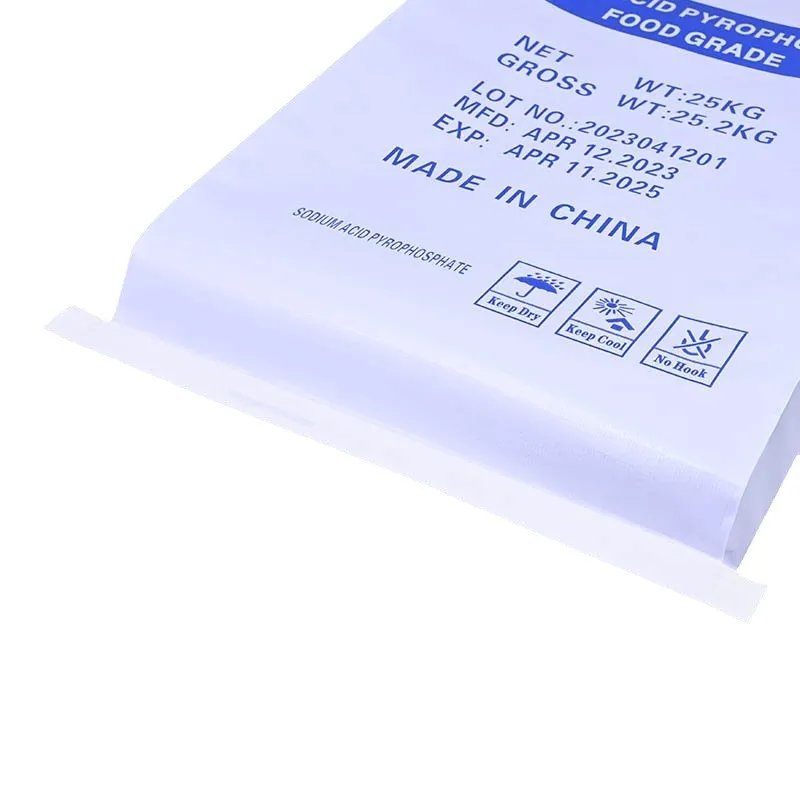
Hemming is a reinforcement technique that covers the folded bottom (and often the top) with an additional PP woven tape or laminated strip before sewing. Industry descriptions note that this approach is commonly used on laminated woven bags and on sacks carrying powder products, because it strengthens the edge and reduces leakage at seam interfaces.
Block bottom
Block bottom (also called box bottom) construction forms a rectangular base that lets the bag stand upright more easily and stack more squarely. Industry sources repeatedly associate block bottom formats with improved handling and pallet stability, and with demanding dusty/powder applications where clean filling and stable stacking matter.
This matters because pallet geometry is not just aesthetics. A pallet that stacks like bricks is easier to wrap, easier to store, and less likely to tilt during transport shocks. Better geometry also means more consistent presentation and better readability of printed panels. Stability becomes efficiency.
In many modern block-bottom systems, the base is sealed by welding rather than stitched, reducing leakage pathways created by needle holes. The principle is not “welded is always better.” The principle is “closure method must match product fineness and filling speed.”
Pinch bottom – PBOM Bags
Pinch-bottom open-mouth concepts emphasize sealed geometry rather than open stitching pathways. In many pinch-bottom constructions, the manufacturer end is sealed by the bag maker, while the customer end is sealed after filling by heat-activating a pre-applied adhesive layer—an approach described in technical discussions of pinch-bottom bag designs. In industrial packaging terminology, pinch-bottom sacks are closely linked to heat-reactivation closures and hot-melt adhesive systems that bond after filling, producing a more sift-resistant closure than simple stitching in many cases.

Opening Types that control filling speed, dust, and end-user handling
If the bottom manages load, the opening manages air. Filling is always a negotiation between product flow and air escape: vent too little and the bag balloons; vent too freely and dust escapes (or moisture enters later). Opening design—open mouth, valve, easy-open features—largely controls how that negotiation ends.
Open mouth (SOM type)
Open mouth is the most common format: the top is left open for filling, then sealed by sewing, tying, or (when materials allow) heat sealing. It remains widely used because it is flexible across manual and semi-automatic operations and supports frequent SKU changes without specialized valve filling equipment.
Open mouth with double-folded edge
A double-folded edge at the opening is a finishing method: the cut edge is folded and stitched, producing a smoother, reinforced mouth. This improves appearance and reduces fraying and snagging at the fill or sewing stage, which can be valuable when bags run through higher-friction equipment paths.
Valve Top – designed like AD*Star Block Bottom Valve Bags
Valve bags are designed for faster, cleaner filling. Product is injected through a valve sleeve connected to the filling spout, and the valve closes as internal pressure builds, reducing spillage. Industry explanations emphasize this self-closing behavior as a key mechanism for minimizing leakage and dust during high-volume packing.
In the woven PP category, block bottom valve sacks are often produced on specialized machinery platforms. Starlinger describes its AD*STAR block bottom valve sack as being made from coated polypropylene fabric and produced exclusively on Starlinger machines.
Extended/tuck-in sleeve valves add an outer sleeve extension that can be folded and tucked in after filling, improving sift resistance versus a basic opening. Valve reference guides define tuck-in sleeves as outer sleeve extensions intended to be folded and tucked by hand after filling, often with an optional thumb notch to aid handling.
Self-closing internal sleeves are commonly used because they avoid an extra closing step; product pressure helps the sleeve close. This supports fast filling, but buyers should recognize that “self-closing” is not always the same as “airtight,” especially for very fine powders or highly moisture-sensitive goods.
Ultrasonic/sonic-seal sleeves target higher closure integrity. Valve reference materials describe sonic-seal sleeves as extensions designed for ultrasonic hermetic sealing, and sealing equipment suppliers highlight ultrasonic systems that seal filled valve bags equipped with sealable sleeves.
Easy-open top
Easy-open features (often tear-tape style) exist because the customer must open the bag in the real world—sometimes with gloves, sometimes in a hurry, sometimes without a clean cutting surface. Premium woven packaging suppliers commonly offer easy-open options alongside standard closures, especially in customer-facing categories.