
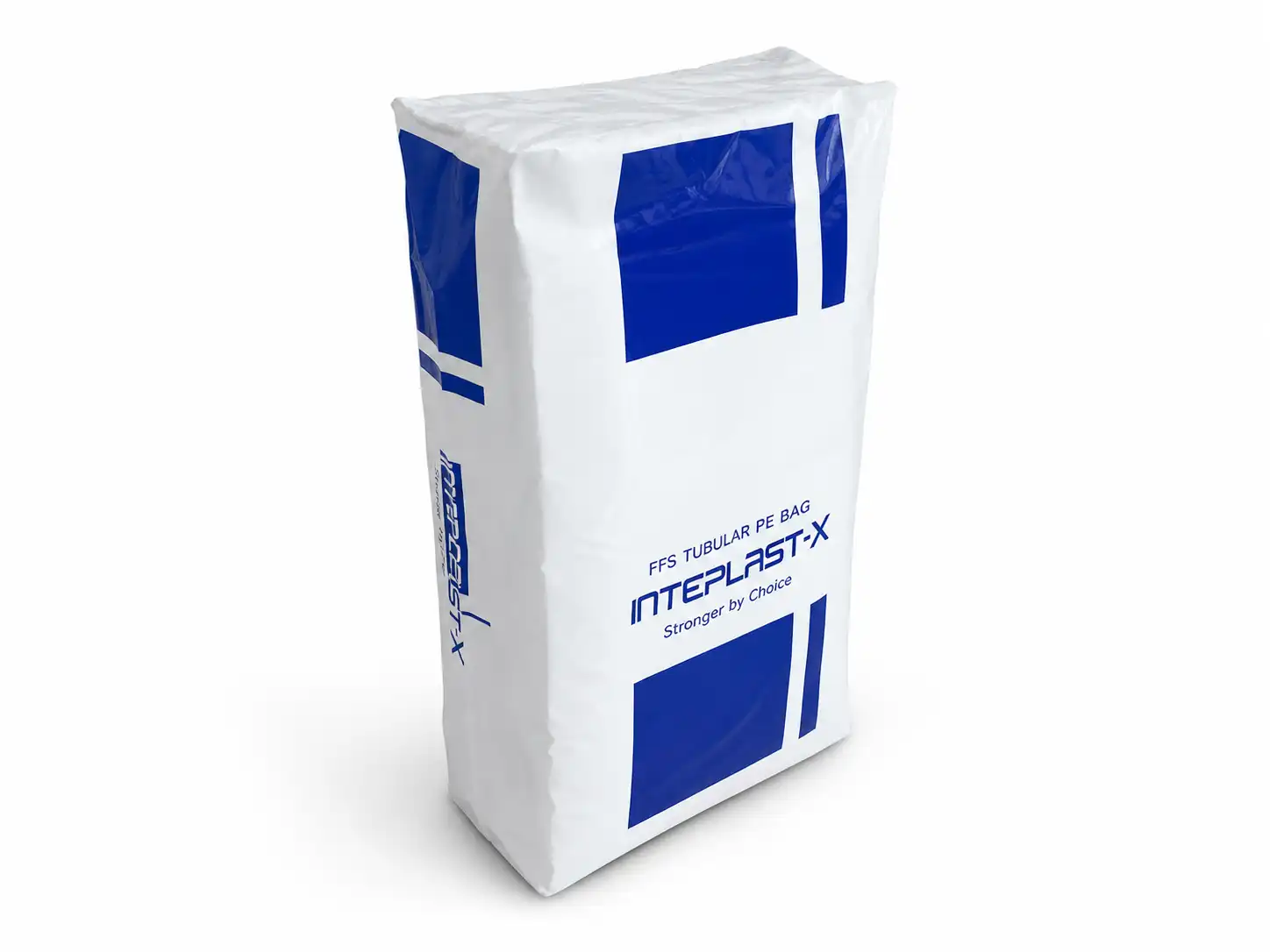
VIDEPAK PE Valve Bags: Engineered polyethylene Packaging
For industrial powders, granules, pellets, minerals, food ingredients, chemical materials, and other dry products, packaging is not simply the last step before shipment. It is part of the production system. A bag must accept product quickly, release displaced air in a controlled way, protect the contents during transport, stack with confidence, carry clear graphics, and work consistently from one production batch to the next. This is the operating environment in which VIDEPAK develops PE Valve Bags.
VIDEPAK approaches PE Valve Bags as an integrated combination of filling geometry, polyethylene film engineering, valve design, de-aeration, sealing, surface control, printing, and pallet performance. VIDEPAK’s published heavy-duty PE packaging platform includes widths of approximately 35–65 cm, film thicknesses of approximately 0.10–0.25 mm, customized lengths, printing up to 10 colors, flat or M-gusset formats, micro-perforation, embossing, heat-seal construction, block-bottom options, and multi-layer structures of up to nine co-extruded layers. The final specification is selected around the product and filling process rather than copied from a one-size-fits-all catalogue.
Packaging Principle: Do not select PE Valve Bags by thickness alone. Select them as a complete operating system. The right polyethylene structure must balance film strength, valve fit, air release, seal behavior, surface friction, filled shape, printing requirements, pallet pattern, and the realities of your transport route. In industrial packaging, thicker is not automatically better; better engineered is better.
What Are PE Valve Bags and Why Do Industrial Buyers Use Them?
PE Valve Bags are heavy-duty sacks made from polyethylene film and equipped with a purpose-designed valve, usually positioned near a top corner of the bag. Instead of opening the entire top of the package, the filling machine introduces powder or granules through this valve sleeve. As the product enters, the bag expands toward its designed shape; after filling, the valve can flatten and close under the pressure of the packed material, or the valve can be finished with an additional compatible sealing method when a tighter closure is required. VIDEPAK describes valve bags as packages designed to connect directly with filling spouts and to support fast filling, cleaner handling, and stable pallet formation.
That apparently simple change—from a full open mouth to a controlled valve—has important operating consequences. The filling interface becomes smaller and more defined. Product flow can be directed through a known opening. Dust management can be designed together with air evacuation. The bag does not require the same wide-open filling mouth as a conventional open-mouth sack. In properly matched applications, the result can be a cleaner and more controlled filling operation. This is one reason PE Valve Bags are particularly relevant for fine powders and free-flowing industrial products.
Controlled Filling
The valve is designed around the filling spout, helping PE Valve Bags become part of automatic or semi-automatic industrial packing systems rather than merely acting as passive containers.
Air Management
Micro-perforation and related air-release designs can help displaced air leave the package during filling, which matters because trapped air can make a powder-filled sack remain swollen and harder to palletize.
Pallet-Friendly Geometry
Block-bottom and gusset configurations can help the filled bag develop a more regular footprint. Geometry, however, must be matched to product bulk density, fill volume, venting, and target pallet dimensions.
The Valve, the Film, and the Filled Shape Must Work as One
Think of an industrial valve bag as three systems meeting at one point. The valve controls entry. The film controls containment. The bag geometry controls what happens after filling. Weakness in any one of these areas can cancel the strength of the other two. A very strong polyethylene wall cannot compensate for a valve that does not match the filler spout. A precisely fitted valve cannot prevent pallet problems if the package traps excessive air. Excellent venting cannot correct dimensions that create too much unused headspace. Good PE Valve Bags are therefore designed from the process outward, not from the bag inward. VIDEPAK’s technical guidance similarly treats valve geometry, micro-perforation, multi-layer film, and surface grip as connected design variables.
This systems approach is particularly important for powders. When material moves rapidly through a filling spout, it may carry air into the package. If that air cannot leave at a suitable rate, the bag can temporarily inflate. If air release is too aggressive, on the other hand, fine material may escape through poorly chosen openings. Therefore, the objective is not “maximum perforation.” It is controlled de-aeration. The particle size, dust behavior, filling method, target filling speed, valve dimensions, and required barrier all need to be considered together.
After filling, geometry becomes equally important. A well-designed block-bottom or gusset structure helps the package move from an empty flat form toward a more controlled three-dimensional shape. Better shape can support more regular pallet patterns, but no bottom design works in isolation. Bulk density changes the volume required for a given net weight; headspace changes how tightly the product settles; venting affects bag firmness; surface treatment influences bag-to-bag movement. Four variables can produce four very different pallets even when nominal bag dimensions are identical.
Buyer Alert: When requesting PE Valve Bags, provide more than width, length, and target weight. A professional PE valve bags manufacturer should also understand the product’s bulk density, particle form, filling-spout dimensions, filling method, desired line speed, air-release requirement, storage conditions, pallet layout, transport route, and closure expectation. The better the input, the better the bag.
Why polyethylene and Co-Extruded Film Matter
The performance of PE Valve Bags begins before a valve is formed, before a bag is printed, and before a bottom is welded. It begins with polyethylene. VIDEPAK’s heavy-duty PE platform uses multiple PE resin families and multi-layer co-extrusion so different parts of a single film can be designed to perform different jobs. Its current technical materials describe structures based on combinations including LDPE, LLDPE, MDPE, and related PE grades, while its product platform can be configured with as many as nine co-extruded layers.
This is the practical value of a Co-Extruded structure: one layer does not have to solve every problem. The outside of the film may need print compatibility, handling resistance, and suitable friction. An internal layer may contribute toughness and mechanical balance. The inside surface may be designed around sealing behavior. Additional layers can refine stiffness, flexibility, processing stability, or other application-specific properties. During co-extrusion, these molten polymer streams are brought together as one integrated film structure rather than being converted into several separate finished films and then mechanically stacked. VIDEPAK emphasizes this division of functions as a key reason for using multi-layer film in heavy-duty polyethylene packaging.
The result is not “more layers for the sake of more layers.” It is controlled specialization. Tough where the bag needs toughness. Sealable where the bag needs sealing. Printable where information must remain readable. Flexible enough to absorb handling, yet controlled enough to run through a filling and converting process. This balance is central to Co-Extruded PE Valve Bags.
How a Co-Extruded Layer Stack Creates Functional Balance
That architecture also explains why gauge alone is an incomplete buying specification. Two films can both measure 180 μm and still perform differently because layer ratios, resin selection, surface treatment, sealing behavior, and film uniformity differ. For the buyer, the better question is not simply “How thick is the film?” but “What must this film survive and what must it do on my line?” VIDEPAK’s published specification window of approximately 0.10–0.25 mm should therefore be treated as an engineering range from which a project-specific structure is selected.
Simple comparison. Important difference.
A monolayer asks one resin blend to satisfy many competing demands. A Co-Extruded film can distribute those demands. One wall, several jobs. One bag, several functions. That is why VIDEPAK treats Co-Extruded technology as an engineering platform for heavy-duty PE Valve Bags, not as a decorative specification.
For food-related applications, resin family alone is not sufficient to establish compliance. The intended food, contact conditions, additives, inks, and complete material construction need appropriate documentation for the destination market. The European Union’s plastics food-contact framework covers plastic materials made exclusively of plastics as well as structures composed of several plastic layers, while U.S. food-contact guidance addresses polyolefins and coextrusions under defined conditions of use. This is why a responsible PE valve bags manufacturer should discuss regulatory requirements at the specification stage rather than attaching “food grade” as an undefined label after production.
VIDEPAK PE Valve Bags: Specifications, Options, and Application Logic
Industrial packaging should begin with the packed product and move backward toward the film specification. A 25 kg fine mineral powder and a 25 kg polymer granule may have the same net mass, but they can differ greatly in volume, dust generation, particle shape, puncture risk, air entrainment, moisture sensitivity, and settling behavior. Consequently, the same nominal PE Valve Bags specification should not automatically be applied to both products.
VIDEPAK’s published PE packaging range provides a practical engineering starting point. Current product information lists approximately 35–65 cm width, approximately 0.10–0.25 mm thickness, customized length, up to 10-color printing, flat and M-gusset options, embossing strips, micro-perforation, optional air-release features, heat sealing, block-bottom construction, and up to nine-layer co-extrusion. VIDEPAK also states that its heavy-duty PE platform supports packages of 5 kg and above, while the actual safe filling weight must be validated against bag geometry, product density, film structure, seals, handling conditions, and testing.
These values describe capability windows, not a promise that every parameter can or should be combined with every other parameter. A 0.25 mm film is not automatically required for a heavier product; a nine-layer structure is not automatically superior to a simpler structure; maximum printing colors are not necessary for every industrial shipment. Specification is optimization. Add what creates value. Remove what does not.
A Practical Selection Matrix for PE Valve Bags
The same logic applies across common applications. Chemical powders may prioritize clean containment, seal consistency, and clear hazard information. Fertilizers may demand strength, moisture management, and reliable outdoor or warehouse handling. Minerals can create abrasion and high local loads. Polymer pellets may require clean filling, good seal control, and smooth discharge. Food ingredients introduce additional hygiene and regulatory documentation requirements. In each case, PE Valve Bags remain the packaging format, but the correct polyethylene recipe and converting design change with the job. VIDEPAK identifies chemicals, foods, and building materials among the applications served by its heavy-duty PE packaging platform.
Surface friction deserves special attention because a bag does not end its journey when filling is complete. It moves through conveyors, palletizers, forklifts, warehouses, containers, trucks, and customer storage. A very smooth surface can run well at one point yet move too easily in a stack. Too much friction can create other handling issues. VIDEPAK therefore offers embossing as a functional option rather than treating surface texture as a cosmetic detail. The goal is controlled interaction between bag and machine, bag and bag, pallet and transport route.
Printing has a similar operational role. Up to 10-color capability provides room for strong branding, but industrial graphics also carry product names, lot information, handling instructions, warning panels, barcodes, and other logistics data. The useful question is not simply “How many colors?” It is “What information must remain visible after filling, stacking, rubbing, shipping, and storage?” That is the difference between decoration and industrial communication. VIDEPAK’s current PE product platform lists printing in up to 10 colors.
Why VIDEPAK as Your PE valve bags manufacturer?
A professional PE valve bags manufacturer should do more than make an empty sack. It should control the transformation from resin requirements to finished package, understand how the package interacts with the customer’s line, and verify the characteristics that matter in real distribution. This is the basis of VIDEPAK’s approach to PE Valve Bags.
VIDEPAK’s current PE packaging information states annual production exceeding 500 million PE bags for heavy-duty applications of 5 kg and above. Scale matters because industrial buyers rarely need one perfect sample; they need the hundred-thousandth or millionth bag to behave like the approved sample. Width consistency, gauge control, valve placement, welding, perforation pattern, surface treatment, print positioning, and packaging of finished bags all become commercially important when production volume increases.
↓
↓
↓
↓
↓
Quality, Scale, and the Questions a Good PE valve bags manufacturer Should Ask
Quality control for flexible industrial packaging is strongest when laboratory measurements are connected with complete-bag performance. ASTM D882 addresses tensile properties of thin plastic film and sheeting, while ASTM D1709 measures film impact resistance through a free-falling dart method. ASTM F88/F88M addresses seal strength for flexible barrier materials. For complete sacks, ISO 7965-2 specifies a vertical impact drop-test method for sacks made from thermoplastic flexible film. These standards do not replace customer-specific filling trials, but they provide recognized methods for turning broad statements such as “strong film” or “good seal” into measurable evidence.
For VIDEPAK, this is an important distinction. Film tensile performance matters, but the customer does not ship a tensile specimen. Dart impact matters, but the customer does not warehouse a square of film. Seal strength matters, but the bag still has a valve, bottom, print surface, and filled geometry. The true package is the combination. Therefore, development of PE Valve Bags should move from material data to converted-bag inspection, from converted-bag inspection to filling-line evaluation, and from filling-line evaluation to pallet and transport performance.
A Strong RFQ Creates a Stronger Bag
For a new PE Valve Bags project, send VIDEPAK the product form, target net weight, bulk density, particle size or powder behavior, moisture sensitivity, fill temperature, filling-machine type, filling-spout dimensions, target bags per minute, preferred valve closure, required air release, existing bag dimensions, pallet size, stacking pattern, storage environment, transport route, printing artwork, and any known failure mode with the current package. A technically complete RFQ allows a PE valve bags manufacturer to engineer rather than guess.
Sustainability should be treated with the same discipline. Because VIDEPAK can build multi-layer structures within the polyethylene family, projects can be designed around mono-material PE principles where performance and local recycling systems permit. That can simplify material architecture compared with combinations that depend on several fundamentally different material families. However, recyclability is not created by the word “PE” alone: collection infrastructure, inks, additives, contamination, local acceptance rules, and the final construction all matter. The sound objective is therefore design for practical circularity while maintaining the protection needed to prevent product loss. VIDEPAK’s product information identifies mono-material design as part of its sustainability approach.
There is also a commercial reason to optimize rather than overbuild. Packaging material carries cost every time a bag is produced; damaged product carries cost every time a bag fails. The best specification sits between those extremes. Too little performance creates rupture, leakage, dust, downtime, and claims. Too much unnecessary material creates avoidable cost and resource use. A capable PE valve bags manufacturer works inside that tension—reduce unnecessary material where data allows, reinforce performance where the route demands it, and validate before scale-up.
This is why VIDEPAK does not define PE Valve Bags by one feature. Not only the valve. Not only the polyethylene. Not only the number of Co-Extruded layers. Not only the block bottom. The package earns its value when these parts cooperate.
PE Valve Bags should fill cleanly and settle correctly. They should be strong, but not blindly overbuilt. They should release air, but not carelessly release product. They should grip a pallet, but still move through machinery. They should carry a brand, but also carry instructions. They should protect the product, while supporting efficient use of packaging material. Contrast creates the requirement; balance creates the solution.
For chemical powders, minerals, fertilizers, polymer materials, food ingredients, building materials, and other industrial dry goods, that balance starts with the right questions: What is being filled? How does it flow? How much air enters with it? How will the valve close? What will the bag experience after it leaves the filler? What must the film protect against? What will happen on the pallet? What will happen after weeks of transport?
Then comes the engineering answer: a properly selected polyethylene recipe; a purposeful Co-Extruded structure; a valve matched to the filling interface; controlled air release; suitable bottom and gusset geometry; appropriate surface friction; durable printing; measurable quality control; and production consistency at industrial scale.
VIDEPAK Product Philosophy
Not simply thicker film, but film engineered where performance is needed. Not simply more perforation, but controlled air release. Not simply more layers, but purposeful Co-Extruded architecture. Not simply a valve, but a filling interface. Not simply a polyethylene sack, but a packaging system designed around production, palletizing, storage, transport, and customer use.
For buyers searching for dependable PE Valve Bags and a technically capable PE valve bags manufacturer, VIDEPAK combines heavy-duty polyethylene engineering, multi-layer Co-Extruded technology, functional customization, industrial-scale production, and standards-based quality thinking into one objective: packaging that works from pellet to film, from film to bag, from filler to pallet, and from factory to destination.
- VIDEPAK PE Valve Bags: Engineered polyethylene Packaging
- The Valve, the Film, and the Filled Shape Must Work as One
- Why polyethylene and Co-Extruded Film Matter
- VIDEPAK PE Valve Bags: Specifications, Options, and Application Logic
- Why VIDEPAK as Your PE valve bags manufacturer?
- What Are PE valve bags?
- The Problem Landscape: Why PE valve bags exist
- How PE valve bags Work: Valve Mechanics in Plain Language
- Materials and Film Architecture: The Engine Under the Hood
- Manufacturing, Step by Step: From Resin to Ready‑to‑Run
- Specification Windows You Can Work With
What Are PE valve bags?
Definition. PE valve bags are heavy‑duty industrial sacks made from polyethylene film structures that incorporate a short sleeve or corner valve for rapid, dust‑controlled filling. Once filled, internal product pressure and the valve geometry collapse the sleeve; the package closes without a separate heat‑seal step, delivering a clean, self‑sealing unit ready for palletizing and transport.
In the marketplace you will also encounter poly valve bags, PE block‑bottom valve sacks, poly film valve bags, and plastic valve sacks—synonyms that all point to the same principle: fast, neat filling with stable stacks and resilient graphics.
In a single sentence: PE valve bags are built for throughput, cleanliness, and legibility. Their co‑extruded films resist puncture, their exteriors can be embossed for grip, their surfaces are tuned for the right coefficient of friction (COF) on the machine face and on the pallet face, and their graphics—often reverse‑printed beneath a clear layer—survive abrasion, rain, and handling. Options such as micro‑venting, anti‑sift seam geometry, matte/gloss patches, and registered anti‑slip stripes allow each SKU to be tailored to its product and route.
Typical production follows a disciplined chain: (1) multi‑layer blown‑film co‑extrusion with HDPE/LLDPE blends; (2) corona or primer activation to raise surface energy; (3) reverse gravure or CI‑flexo printing with controlled LAB targets; (4) valve formation; (5) block‑bottom or cross‑bottom conversion via ultrasonic or thermal welding; (6) micro‑perforation and anti‑sift features as required; (7) final cutting, stacking, and bundle packing, with lot serialization and QC sign‑off.
Common applications for PE valve bags include chemicals and engineered resins, industrial minerals (cement, fly ash, limestone, silica sand), fertilizers and soil amendments, food ingredients such as salt, sugar, and starches, animal nutrition, charcoal and fuel briquettes, and filter media and carbon black. Where dust control, moisture defense, pallet stability, and durable identification matter, PE valve bags earn their keep. For related heavy‑duty PE formats, see the anchor here: PE valve bags.
The Problem Landscape: Why PE valve bags exist
Forklift tines nudge corners; clamp trucks squeeze stacks; monsoon humidity sneaks into porous seams; conveyors abrade printed faces until warnings fade. Meanwhile, operators are judged on bags‑per‑minute, not on how pretty the last pallet looked. In this hard reality, packaging cannot be delicate. PE valve bags were invented to remove failure modes that plagued traditional sacks: messy fill nozzles, dusty seams, smudged pictograms, leaning pallets, and barcodes that refuse to scan at receiving. A single format addressing cleanliness, speed, and stack geometry is not a luxury—it’s table stakes for modern bulk‑solids logistics.
China Leading PE Valve Bags Manufacturer
Top-tier manufacturer specializing in high-quality PE valve bags for industrial packaging solutions.
Check More →PE Valve Bags 2025 Guide
Complete 2025 guide covering specifications, applications and production of PE valve bags.
Check More →PE Valve Bags
Durable and reliable polyethylene valve bags manufactured for bulk material packaging.
Check More →Multi-Layer Polyethylene Valve Bags
High-strength multi-layer PE valve bags with enhanced protection and performance.
Check More →How PE valve bags Work: Valve Mechanics in Plain Language
At the filler, the valve sleeve of a PE valve bags engages a horizontal spout. As powder or pellets enter, trapped air finds outlet paths—controlled micro‑perfs, porous patches, or a labyrinth vent zone—so the package does not balloon. When the target weight is reached, product pressure and sleeve design collapse the valve against the interior panel. The bag is now closed. No secondary heat‑seal step; no cloud of fines; no operator with a tape gun. This is why properly tuned PE valve bags raise bagger uptime and reduce housekeeping.
Materials and Film Architecture: The Engine Under the Hood
The performance of PE valve bags begins in the polymer kitchen. Blends of LLDPE and HDPE are co‑extruded into two, three, or five layers. A common architecture places a tougher outer skin for abrasion, a puncture‑absorbing core, and a seal‑friendly inner layer. Gauge windows for heavy‑duty duty typically land around 120–200 μm, with abrasive fillers often specified near 0.175 mm. To keep stacks square without excess gauge, converters may introduce machine‑direction orientation (MDO) to boost modulus. Additives—slip, antiblock, UV packages—are dosed deliberately: too much slip and lines run fast but pallets slide; too little and formers choke.
Manufacturing, Step by Step: From Resin to Ready‑to‑Run
1) Co‑extrusion. Resin pellets are dried as needed and fed to multi‑manifold dies. Melt temperature, blow‑up ratio, frost‑line height, and haul‑off speed are dialed in to lock the gauge profile and mechanical properties. Online scanners map thickness continuously; off‑line films are checked for dart impact (ASTM D1709) and tensile/elongation (ASTM D882).
2) Surface preparation. Films pass over corona treaters or receive a primer layer. The goal is simple: an ink that wets and stays. A target dyne level is documented for every roll.
3) Printing. Reverse rotogravure or CI‑flexo lays imagery on the inside face of a clear outer layer, sheltering inks from rub. Pantone spots cover brand solids; process builds handle photography. LAB targets and ΔE* tolerances keep lots consistent.
4) Valve and bottom formation. Converters fold and weld to create block‑ or cross‑bottoms and weld the valve sleeve—internal, external, or extended variants depending on filler geometry. Ultrasonic or heat welding is selected according to film and speed requirements.
5) Venting and anti‑sift design. Micro‑perfs, porous patches, or tortuous vents allow air out while keeping fines in. The dust index is tuned to the product: vacuum‑fine carbon black needs a stricter geometry than coarse salt.
6) QC and packing. Panel‑wise COF (ASTM D1894), tear (ASTM D1922), rub life (ASTM D5264), WVTR (ASTM F1249 when barrier is specified), and simulated drop (ASTM D5276) are verified against the spec. Bundles are labeled with lot and date; splice maps and roll histories remain on file.
Specification Windows You Can Work With
- Capacity & geometry. 20–50 kg is the mainstream. A widely used block‑bottom footprint is ~650 × 550 × 185 mm for powders in the 0.7–1.2 g/cc density band.
- Film gauge. 120–200 μm total, with 0.175 mm a common choice for abrasive minerals.
- Valve styles. Internal sleeve (standard), external sleeve (easy coupling), and extended valves (to evacuate more air on fluffy powders). Some fillers prefer ultrasonic‑ready sleeves for consistent shut‑off.
- Friction management. Machine‑face COF target 0.25–0.35 (glide); pallet‑face 0.45–0.60 (grip). Achieved via emboss, lacquers, or registered anti‑slip stripes.
- Venting. Micro‑perforation patterns, porous vents, or labyrinth paths; specify by dust index and bagger BPM.
- Printing. Up to 8–10 colors; reverse print under PE film; matte windows to protect scanner contrast; defined barcode quiet zones.
- Palletization. Unit loads matched to container cube; reinforced corners for clamp handling; wrap recipes documented alongside stack height limits.
These ranges are not brochure poetry; they are the numbers buyers see on real quotes and operators see on real lines.