
What are SOS PP Bags?
SOS PP Bags—short for Self‑Opening Square Polypropylene Bags—are block‑bottom, square‑standing sacks built on a woven‑PP backbone and finished with a sealable face (either a PE extrusion coating or a BOPP laminate). In day‑to‑day use, SOS PP Bags open by themselves, stand by themselves, and—thanks to billboard‑flat panels—very often sell by themselves. The squared base simplifies packout; the woven core bears weight with quiet confidence; the printable outer broadcasts your brand with clarity across warehouses and retail floors alike. In different markets, SOS PP Bags may also be called self‑opening square PP sacks, block‑bottom woven PP bags, SOS woven poly bags, or SOS laminated PP bags. Different names, one intent: a mono‑polyolefin workhorse engineered to look premium on shelf and behave predictably on the line.
Why shine the spotlight on SOS PP Bags now? Because the spec has changed. Operations teams push for faster changeovers, cleaner fills, and pallets that arrive square; brand leaders insist on photo‑true panels that survive conveyor rub; sustainability officers prioritize designs that fit PP (#5) recycling pathways where infrastructure exists. SOS PP Bags answer in chorus—structure for strength, coating for sealability, geometry for stability. Strength, shelf appeal, and sustainability potential—all on the same pallet. For an at‑a‑glance category touchpoint, see SOS PP Bags.
From a horizontal lens, SOS PP Bags sit between paper SOS sacks (breathable look and feel, reduced wet strength) and heavy‑duty PE film sacks (excellent hermetic seals, lower puncture resistance at equal tare). From a vertical lens, follow the cause chain: isotactic PP → tape orientation → fabric modulus → lamination integrity → bottom‑fold geometry → pallet stability → claims rate. Change a micron in lamination caliper and, kilometers later, a forklift driver notices: fewer split corners. That is not coincidence; that is design echoing through logistics.
What are the features of SOS PP Bags?
Square base, square business. The self‑opening square (SOS) block‑bottom forms a brick‑like footprint. It stands without support during filling, stacks tighter on pallets, and resists “stack creep” in warm, humid yards. The outcome is visible: straighter columns, cleaner aisles, fewer re‑stacks. Upright in the plant, upright on the truck, upright on the shelf.
Strength‑to‑weight that earns its keep. Woven PP tapes convert molecular orientation into tensile strength and puncture resistance at modest grammage. In the 5–50 kg class typical of grains, fertilizers, minerals, and chemicals, SOS PP Bags shrug off chute impacts, belt transfers, and clamp handling. Corners stay crisp; seams stay sealed; COF targets keep stacks from skating. In practice, the bag behaves like a truss: local shocks are spread across a load‑bearing mesh rather than concentrated at a seam.
Clean surfaces with moisture moderation. A PE coating (≈20–35 µm) or BOPP laminate (≈15–35 µm) drops surface porosity. Moisture ingress slows; dust egress falls; inks resist scuffing. Where fast filling entrains air, zoned micro‑perforation vent maps provide the compromise modern lines need—vent when you must, protect when you can. The rhetorical question writes itself: why choose between clean graphics and clean fills when a tuned vent pattern can give both?
Graphics that persuade and persist. Reverse rotogravure on BOPP or high‑line‑count flexo on PE‑coated faces yields dense solids, fine type, and scan‑reliable barcodes/QR. Gloss for showroom sheen, matte for low‑glare readability, or a mixed finish for tactile contrast—proof that packaging can both persuade and endure. A bag becomes a billboard; a billboard becomes a standard; a standard becomes trust.
Formats that fit your line. SOS PP Bags are supplied as open‑mouth block‑bottom, valve block‑bottom, or pinch‑top variants. Easy‑open tapes minimize blades on the floor; anti‑skid textures raise bag‑to‑bag friction into the ≈0.35–0.55 range; document pouches and color‑coded panels keep SDS/REACH paperwork visible. Horizontal thinking compares these options with FFS film and paper valve sacks; vertical thinking tunes valve sleeve length, angle, and material to the back‑pressure profile of your filler.
Designed with recyclability in mind. Keep the structure in the family: PP fabric + BOPP film + PP/PE tie layers. This mono‑polyolefin logic reduces sorting complexity and supports PP‑aligned recovery streams where available. It is not a slogan; it is a blueprint that, over time, feeds audit‑ready ESG indicators.
Outdoors ready. UV‑stabilized tapes and films help preserve mechanical properties during yard staging. Hemmed tops, rounded corners, and edge guards cut snag risk on hooks and rails. Add in anti‑skid and controlled COF and you have a stack that ships square and lands square.
Cross‑category perspective clarifies the trade‑offs: paper SOS sacks breathe but wilt in drizzle; FFS film lines run fast but stacks can slip; SOS PP Bags bring the square stance of bricks, the grip of paper, and the resilience of woven poly—three virtues in one frame.
What is the production process of SOS PP Bags?
1) PP tape extrusion & orientation. Virgin polypropylene is melted, slit, and drawn—commonly 5:1–7:1—to align polymer chains. Annealing then “locks in” tenacity for repeatable strength. Additive packages (HALS UV for outdoor staging, slip/anti‑block for converting) are dosed to service conditions. Stretch to strengthen, cool to set, anneal to keep—the classic triad.
2) Fabric weaving. Tapes run on circular or flat looms to a target weave density—typically 10×10 to 14×14 threads/inch. Tension, pick count, and tape denier co‑determine surface flatness (critical for tight lamination and crisp printing) and modulus (which governs how bottoms fold and seams carry load).
3) Surface engineering (sealable face).
- PE extrusion coating applies a 20–35 µm PE layer with a PP/PE tie. Result: heat‑sealable faces, moderated porosity, robust ink holdout for flexo.
- BOPP lamination bonds a 15–35 µm gloss or matte film via extrusion. Films are corona‑treated to raise surface energy for ink anchorage and reverse‑printed for photographic graphics protected beneath the film.
4) Printing.
- Rotogravure (reverse) on BOPP for photo‑grade imagery. The image lives beneath the film after lamination, resisting conveyor rub and solvent wipes.
- Flexographic on PE‑coated faces for high‑contrast industrial art. Registration systems keep GS1 barcodes, hazard diamonds, and QR capture boxes exactly where scanners expect them.
5) Tubing & SOS bottom forming. Laminated webs are cut, tubed with side gussets, and folded into a block‑bottom. Bottom closures are stitched or heat‑sealed depending on the laminate stack. For valve variants, a sleeve (PP‑coated paper or PE film) is inserted and tacked—its dimensions tuned to the filler spout so back‑pressure vents without dust plumes.
6) Vent strategy & options. Laser/pin micro‑perforation maps support high‑speed deaeration without turning faces into dust traps. Anti‑skid coatings lift bag‑to‑bag COF; easy‑open features enable controlled decanting; label windows and document pouches keep compliance visible through the chain of custody.
7) Quality assurance. Routine controls include seam efficiency, tensile/burst strength, COF (ASTM D1894) for bag‑to‑bag and bag‑to‑metal friction, color ΔE versus proof, UV retention, and drop behavior (commonly 0.8–1.2 m with conditioned loads). Valve integrity and air‑release profiles are correlated to filler SOPs, converting settings feed back to lamination, and lamination caliper feeds back to extrusion—closed‑loop control turning craft into capability.
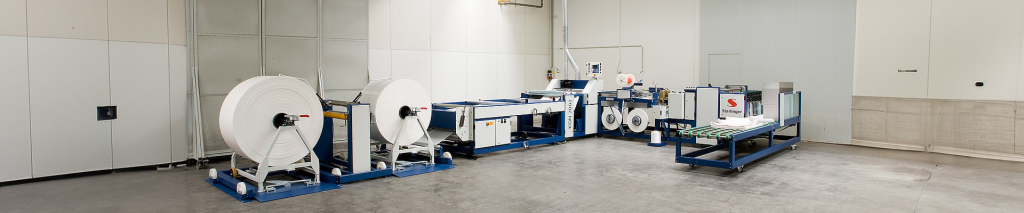
At VidePak, this choreography runs on top‑tier assets from Germany’s W&H and Austria’s Starlinger. With >100 circular looms, 16 extrusion lines, and >30 lamination/printing machines, capacity scales without sacrificing gauge control, registration, or seam tolerances. Founded in 2008 and guided by a core team with 30+ years in woven packaging, we tune draw ratios, weave density, coating caliper, and vent maps to your actual powders and pellets—not to a theoretical chart.
What is the application of SOS PP Bags?
Staple foods & retail grains. Rice, flour, pulses, sugar: upright, square‑stacking SOS PP Bags look trustworthy on shelf and behave predictably in transit. Transparent windows (where permitted) turn the package into proof—what you see is what you buy—and scan‑reliable barcodes support frictionless checkout and inventory.
Fertilizers & soil amendments. Hygroscopic NPK blends and urea demand moisture moderation and pallet stability. The SOS bottom delivers both; micro‑perfs tame trapped air; UV‑stabilized faces keep graphics readable after yard staging under hard sun.
Animal feed & seeds. Pellets and premixes benefit from laminates that limit dusting. Block‑bottom geometry builds square pallets for narrow aisles; dosing charts and batch codes remain legible after long conveyor paths.
Chemicals & intermediates. Resins, pigments, masterbatch, mineral fillers—dense, abrasive products that punish weak seams—meet their match in woven cores. Meanwhile, BOPP or coated faces keep hazard pictograms and QR/GS1 codes crisp.
Building materials. Tile adhesive, grout, gypsum, and calibrated sands push edges and corners hard. SOS PP Bags maintain brick‑like geometry, not balloon‑like bulges, so pallets cube efficiently and stacks resist creep.
Retail bulk & specialty. Charcoal, pet food, garden substrates: a natural‑looking face with an industrial‑grade skeleton—persuasive on shelf, protective in supply chains. When marketing says “premium,” distribution nods in agreement.
Across geographies—the United States, Europe, Brazil and South America, Southeast Asia, Japan, Korea, Central Asia, the MENA Region, East Africa, and South Africa—VidePak localizes fabric GSM, laminate stacks, COF targets, and artwork to climate, regulation, and route risk. With 568 employees and annual sales near US$80 million, we match enterprise scale with responsive scheduling and disciplined QA.
Typical Parameters for SOS PP Bags
The ranges below reflect widely used, real‑world specifications for SOS‑style woven PP sacks in food, fertilizer, chemical, and building‑materials supply chains. Select to match filler design, product rheology, climate, and logistics. (Values are application‑dependent and customizable.)
| Parameter | Typical Options / Range |
|---|---|
| Product | SOS PP Bags (open‑mouth block‑bottom / valve block‑bottom / pinch‑top) |
| Fabric (GSM) | ~70–110 g/m² woven PP (application‑dependent) |
| Weave Density | 10×10 to 14×14 (warp×weft, threads/inch) |
| Coating / Laminate | PE 20–35 µm extrusion coat or BOPP 15–35 µm reverse‑printed |
| Common Bag Capacities | 5–50 kg (25 kg and 50 kg frequent in industry) |
| Common 50‑kg Size | ≈50 × 80 cm (±1–2 cm by filler spec) |
| Valve Opening (if valve) | ≈10–17 cm (matched to filler spout) |
| Micro‑Perforation | Zoned pin/laser patterns for deaeration during fast fills |
| Coefficient of Friction | ≈0.35–0.55 with anti‑skid textures |
| Printing | Flexographic multi‑color (PE face) or rotogravure (BOPP); barcode/QR capable |
| UV Stabilization | Options up to ≈3,000 h (storage profile dependent) |
| Liner Options | LDPE/HDPE 20–80 µm loose liners where hygiene/barrier is required |
| Drop Test Reference | 0.8–1.2 m (load‑ and spec‑dependent), conditioned samples |
Why VidePak for SOS PP Bags
- Engineering depth. We align draw ratios, weave density, laminate caliper, seam geometry, vent maps, and COF with your powder rheology and filler hardware—so seals hold, pallets square, and dust stays inside. Horizontal analysis guides material selection; vertical analysis ties microns to metrics.
- Equipment pedigree. German W&H and Austrian Starlinger lines underpin repeatable gauge control, color registration, and seam efficiency—run after run, week after week.
- Capacity that scales. >100 circular looms, 16 extrusion lines, >30 lamination/printing machines—designed for multi‑SKU rollouts without bottlenecks, whether you’re launching a regional SKU set or global portfolio.
- Materials & customization. 100% virgin raw materials as the structural default; multi‑color printing; anti‑skid, easy‑open, windows, valves, and liners tailored to region and route. Specifications are localized to climate, regulation, and handling norms.
Partner with VidePak to specify SOS PP Bags that carry your product securely, carry your brand convincingly, and carry your sustainability goals forward—without carrying excess cost.
Main Answer: SOS (Self-Opening Sack) PP bags are redefining China’s packaging industry by integrating recyclable/biodegradable materials and hyper-customized designs tailored to diverse industries, ensuring compliance with global sustainability goals while addressing niche market demands.
Introduction
China’s packaging sector, responsible for 28% of global plastic production (Statista 2023), faces mounting pressure to adopt eco-friendly alternatives. Enter SOS PP bags—polypropylene-based packaging with self-opening features—now evolving into a sustainable powerhouse. The future of SOS PP bags hinges on three pillars: recyclability, biodegradability, and industry-specific customization. Supported by cutting-edge material science and smart manufacturing, these bags are poised to dominate sectors from agriculture to pharmaceuticals.
Recyclable PP: Closing the Loop in Circular Economies
Recyclable PP resins allow SOS bags to be reprocessed 5–7 times without significant degradation. Advances in mechanical recycling and chemical depolymerization are key.
Example: Jiangsu GreenPack uses 30% post-consumer recycled (PCR) PP in its SOS bags for fertilizer packaging, reducing virgin plastic consumption by 1,200 tons annually. A 2023 China National Packaging Association study confirmed that PCR-based SOS bags retain 90% of their tensile strength after three recycling cycles.
Q: Does recyclability compromise durability?
A: No—blending virgin PP with 20–30% PCR resin maintains tear resistance (>15 N/mm²) while lowering carbon footprints by 40% (Packaging Digest).
Biodegradable PP: Bridging the Gap Between Function and Ecology
Oxo-degradable and bio-based PP variants decompose within 2–5 years under industrial composting, addressing landfill overflow.
Case Study: Guangdong EcoFlex launched SOS bags with bio-PP derived from sugarcane, achieving 85% biodegradation within 18 months (per ASTM D5511). These bags are now mandatory in Shanghai’s municipal waste management contracts.
| Material Type | Decomposition Time | Strength Retention |
|---|---|---|
| Conventional PP | 500+ years | 100% |
| Oxo-degradable PP | 2–3 years | 85% |
| Bio-based PP | 1–2 years | 75% |
Customization: Meeting Industry-Specific Demands
SOS PP bags are no longer one-size-fits-all. Tailored designs address unique challenges across sectors:
- Agriculture: Breathable weaves (8×10 strands/inch) prevent mold in grain storage.
- Shandong AgroPack’s SOS bags reduce post-harvest losses by 12% for rice farmers.
- Chemicals: Multi-layer laminations (PP + PE) resist acidic leaks.
- Sinochem Group uses SOS bags with 0.1 mm PE liners for pesticide transport, complying with UN 6.1 hazardous material standards.
- E-commerce: RFID-enabled SOS bags streamline inventory tracking.
- Alibaba’s Cainiao Network reports a 30% efficiency gain in warehouse operations using smart bags.
Q: How scalable is customization?
A: Modular production lines (e.g., Starlinger’s ad:star systems) allow rapid design switches, enabling batches as small as 5,000 units without cost spikes.
Future Trends: Smart Tech and Policy Synergy
- AI-Driven Design: Algorithms predict optimal weave patterns for target loads, reducing material waste by 22% (MIT Sustainable Packaging Report).
- Policy Incentives: China’s 2025 Plastic Pollution Action Plan subsidizes biodegradable SOS bag R&D, with a $150M fund for manufacturers.
Challenges and Solutions
Challenge: Higher costs for biodegradable resins (2–3x conventional PP).
Solution: Hybrid blends (e.g., 50% bio-PP + 50% PCR PP) cut costs by 25% while meeting EU’s EN 13432 standards.
FAQs
- Are biodegradable SOS bags waterproof?
Yes—additives like nano-silica coatings achieve IP65 water resistance without affecting decomposition. - Can SOS bags handle 50kg+ loads?
Reinforced seams and 12×14 weaves support up to 80kg, ideal for construction materials (see heavy-duty woven bags). - How do customized designs impact lead times?
Advanced CAD/CAM systems reduce prototyping from 14 days to 48 hours.
Conclusion
SOS PP bags are not just packaging—they’re a blueprint for China’s sustainable industrial future. By prioritizing recyclability, biodegradability, and precision customization, manufacturers can meet both regulatory mandates and consumer expectations. As automation and material science advance, these bags will cement their role as the backbone of eco-conscious logistics.
External Links:
- Explore innovations in recyclable PP bags here.
- Discover how custom-printed woven bags enhance branding here.
This analysis integrates data from industry reports, academic studies, and manufacturer whitepapers to ensure technical accuracy and market relevance.