
Waterproof Woven Bags — Superior Protection with Advanced Moisture Resistance
What is Waterproof Woven Bags?
Waterproof Woven Bags are engineered polypropylene (PP) sacks built to defend powders and granules against the everyday enemies of product quality: rain, condensation, warehouse humidity, and the abrasive jolts of transport. In different markets they appear as coated PP woven sacks, laminated woven bags, moisture‑resistant woven sacks, or—when paired with a tailored inner film—hermetic woven bags. At their core, Waterproof Woven Bags unite a high‑tenacity woven PP fabric (for load‑bearing and stack stiffness) with moisture‑blocking elements such as extrusion coatings, film laminations (e.g., BOPP), tightly specified closures (heat‑sealed, pasted, or sewn), and optional LDPE liners. The fabric carries the load; the surface architecture repels water; the geometry locks pallets into square, stable cubes.
Seen through systems thinking, Waterproof Woven Bags are not mere containers but calibrated control points. They sit at the junction of powder rheology (how air moves through fines), sealing physics (how heat or pressure closes a seam), environmental cycles (how humidity rises and falls across a week), and logistics realities (how pallets tilt, flex, or breathe in transit). Horizontally, they intersect with paper sacks—renowned for print warmth yet sensitive to damp—and with mono‑film FFS bags—fast to seal yet prone to scuff and slump. Vertically, small upstream choices—polymer grade → tape denier → pick count → coating weight → seam architecture → vent strategy → test regime—cascade into visible downstream outcomes: dust at the spout, caked product on arrival, or, conversely, clean floors and tidy pallets. For sourcing context and format taxonomy, see Waterproof Woven Bags.
What is the features of Waterproof Woven Bags?
System view. Performance emerges when materials, structure, and operations resonate. To keep the logic tight, each feature is developed with background context, data reinforcement, a case analysis, and a comparative study—turning broad claims into workable guidance.
- Advanced Moisture Resistance Without Dead‑Weight
Background. Moisture is subtle yet destructive: hygroscopic powders cake; cements pre‑hydrate; salts clump; pigments lose flow. Waterproof Woven Bags suppress ingress by closing weave pathways and inhibiting capillary wicking along seams. This typically involves PP/PE extrusion coatings around 15–30 g/m² or BOPP laminations in the 15–35 μm range; when exposure is severe, a tailored LDPE inner liner (50–120 μm) provides an extra moisture moat.
Data reinforcement. Coating evenness and film integrity are commonly verified via coupon testing—ASTM F1249 for water‑vapour transmission (WVTR) and ASTM D3985 for oxygen transmission (OTR, where relevant). Bag‑level simulations—humidity‑soak, stacked‑pallet dwell, and wet‑surface contact—approximate monsoon storage and rain‑splashed yards seen on B2B listings and converter datasheets.
Case analysis. A tile‑adhesive producer added a ~20 g/m² internal PE coat and extended a diamond bottom patch across seam stress points; wet‑weather returns fell materially while cycle time on the filler stayed within control limits.
Comparative study. Paper multiwall shines under dry conditions but softens when damp; mono‑layer film sacks seal in a flash yet scuff easily. Waterproof Woven Bags balance barrier, abrasion, and stiffness—less absorption than paper, less scuff than film, more stack discipline than either when wet. - Sift‑Control Architecture That Preserves Line Speed
Background. Air wants out; fines want to follow. Sifting occurs through seam perforations and the fabric interstices under vibration. Waterproof Woven Bags are built to block fines while still venting trapped air where it is safe: coatings/laminations seal the weave; seam designs reduce needle paths; micro‑perforations are localized near the fill panel to vent without mess.
Data reinforcement. Fabrics in the 10×10–14×14 mesh band paired with ≥15 g/m² coatings exhibit pronounced air‑permeability reductions (labs typically reference ASTM D737 for base‑fabric airflow). Finished packs that employ heat sealing are validated by ASTM F88/F88M peel tests, with acceptance windows often ≥7–15 N/15 mm, resin‑ and duty‑dependent.
Case analysis. A mortar line concentrated 50–80 holes/100 cm² of micro‑perfs strictly at the valve wall and tightened valve ID selection; spout dust readings dropped, rotary packer speed lifted by high single digits, and housekeeping hours shrank.
Comparative study. Open‑mouth bags leak more during fill and require sewing or hot‑bar sealing; FFS film needs dedicated venting accessories. Waterproof Woven Bags can be tuned panel‑by‑panel—tight where cleanliness is vital, breathable where air must escape. - Mechanical Robustness in the World as It Is
Background. A moisture‑tight bag that tears is no victory. Woven PP tapes resist tear propagation; square‑fold and block‑bottom formats generate flat, stiff faces that lock together on the pallet. Anti‑slip textures or lacquers raise the friction coefficient, often cutting stretch‑wrap usage.
Data reinforcement. Transit resilience is typically verified via ASTM D5276‑19 free‑fall drops for loads ≤50 kg (corner‑first and flat‑face sequences). For heavier duties and FIBC‑scale builds, ISO 21898 governs non‑DG performance while UN 13H series covers DG solids with top‑lift/stacking/righting tests.
Case analysis. A pigments shipper upgraded from 70 g/m² fabric to 90 g/m² with 25 μm BOPP and an anti‑slip topcoat; corner‑puncture claims fell across mixed‑route deliveries with no change to pallet patterns.
Comparative study. Paper sacks buckle on wet pallets; thin PE sacks scuff and stretch under banding. Waterproof Woven Bags keep the cube, resist abrasion, and stay legible after the miles. - Print‑Forward Branding That Works in the Rain
Background. Protection is foundational; presentation converts. BOPP laminations allow reverse‑printed, high‑line‑screen graphics—gloss, matte, or registered combinations—shielded beneath the film. Typography stays sharp; labels do not peel; colour does not rub away at the pallet edge.
Data reinforcement. BOPP 15–35 μm with surface treatment ≥38 dyn/cm supports strong ink anchorage; in rub/scuff checks (TAPPI‑style), colour transfer is markedly lower than direct‑print fabric. Barcode verification to GS1 rules remains stable because ink sits behind the film, not on the surface.
Case analysis. A fertilizer launch used Waterproof Woven Bags with a matte claim window framed by gloss hero imagery; store audits recorded longer eye‑tracking dwell and fewer “print rub‑off” tickets.
Comparative study. Cartons protect compression but add cost and handling; mono‑film prints can haze or crease. Waterproof Woven Bags put the billboard on the bag and keep it bright through rain and friction. - Audit‑Ready Compliance with Food‑Adjacent Pathways
Background. Specifications become trust only when they are auditable. Woven sacks align with GB/T 8946‑2013 (general requirements for PP woven sacks) and use ISO 6591‑1 as a measurement vocabulary; transit toughness is demonstrated with ASTM D5276. Food‑adjacent variants can be built from materials selected to conform to 21 CFR 177.1520 (olefin polymers), 21 CFR 175.105 (adhesives), and Regulation (EU) No 10/2011 (plastics FCM), with inks following EuPIA guidance. Quality systems—ISO 9001 and BRCGS Packaging Materials—turn this into practice via change control, traceability, and CAPA.
Data reinforcement. Suppliers issue lot‑specific Declarations of Compliance and Certificates of Analysis (GSM, dimensions, coating weight, seal peels) and maintain migration reports from accredited labs.
Case analysis. A sugar packer adopted mono‑PP Waterproof Woven Bags with compliant inks and a heat‑sealed form‑fit liner; foreign‑fiber complaints disappeared, and pallets stayed square during damp‑season storage.
Comparative study. Improvised containers look cheap until audit findings make them expensive. Documented conformity avoids short‑term savings that become long‑term costs.
What is the production process of Waterproof Woven Bags?
From pellets to pallets, small settings create large effects—change one gram of coating, bend an entire claims curve.
Tape Extrusion & Stretching. PP pellets are extruded, slit, drawn into tapes; draw ratio sets tenacity/elongation; denier influences modulus and seam behaviour. Stiffer tapes mean squarer faces and tougher corners.
Weaving. Circular or flat looms interlace tapes into fabric; pick count and loom tension set width tolerance (often within a few millimetres) and lay‑flat quality—inputs that later determine gusset symmetry and bottom squareness.
Coating/Lamination. Extrusion‑coat 15–30 g/m² PP/PE to close interstices or laminate BOPP (15–35 μm) for print and scuff defence. Uniformity matters: too heavy stiffens folds; too light leaves capillary paths for moisture.
Liner Preparation (When Needed). LDPE liners 50–120 μm—loose, tab‑bed, or form‑fit—optionally add EVOH where odour or oxygen sensitivity demands.
Conversion. Tubing, side‑gusseting, and bottom formation (fold‑over sewn, pasted, or heat‑sealed). Valve sleeves are sized by diameter and stiffness to match product bulk density on rotary packers. Heat‑cut hems limit fray.
Perforation & Finishing. Local micro‑perfs (~50–80 holes/100 cm²) near the fill panel vent trapped air; anti‑slip lacquer or micro‑emboss raises pallet friction coefficients for safer stacks.
Testing & Release. Drawings use ISO 6591‑1 language; ASTM D5276‑19 drop tests are run at agreed heights (e.g., 0.8–1.2 m for ≤50 kg); seal peels follow ASTM F88/F88M where heat sealing is present; film coupons are checked to ASTM F1249/D3985. COAs log GSM, dimensions, coating weight, seal strength, and visual AQLs.
What is the application of Waterproof Woven Bags? (Industrial & Building Materials)
Cement & Dry Mortar (25–50 kg). Waterproof Woven Bags with coated faces and valve formats reduce spout dust and outlast rain‑exposed yards. Typical 50 kg references list ~37 × 49 × 11 cm formats, fabric 80–100 g/m², coating ~20–30 g/m², meshes 10×10–12×12, and localized micro‑perfs around the valve. Data reinforcement: multi‑drop sequences to ASTM D5276 plus humidity dwells correlate closely with field survival. Case analysis: extending a diamond bottom patch cut corner breaks on mixed routes without altering pallet patterns. Comparative study: paper sacks soften; film sacks scuff; coated woven sacks keep shape and seal in the wet.
Gypsum, Lime, Pigments, Minerals. Angular particles reward laminated skins and sealed seams; optional liners capture ultrafines; anti‑slip exteriors stabilize mixed‑SKU pallets. Case analysis: a pigment supplier moved to 90 g/m² fabric with BOPP and reduced “trace on pallet” tickets despite the same cube and route mix.
Resins & Additives. Stiffer panels improve container cube; selective perfing prevents ballooning at the packer; hazard icons stay legible under reverse‑printed film.
What is the application of Waterproof Woven Bags? (Food‑Adjacent & Consumer Goods)
Sugar, Salt, Starches (where permitted). With compliant resins/inks and food‑grade adhesives, Waterproof Woven Bags heat‑seal cleanly at the mouth or on a liner and palletize into tidy cubes. DoCs reference 21 CFR 177.1520, 21 CFR 175.105, and EU No 10/2011. Case analysis: a sugar mill ended sewing—and thread lint—by sealing a form‑fit liner inside the woven shell; barcode readability improved on retail pallets through humid seasons.
Rice, Pulses, Seeds. Reverse‑printed BOPP delivers clean windows and vibrant branding; moisture‑managed interiors protect quality during long‑distance freight. Serialization beneath the film supports anti‑counterfeit programmes.
Pet Nutrition & Garden Inputs. Aroma‑sensitive blends benefit from laminated barriers; anti‑slip varnish reduces over‑wrap; matte/gloss registration raises shelf recognition in DIY and agri channels.
Integrated Solution (System Thinking Synthesis)
Objective: keep contents dry, reduce dust and claims, and clear audits—without inflating total cost of ownership. Treat Waterproof Woven Bags as a closed‑loop programme:
- Diagnose. Map failure modes by SKU: humidity softening, sifting index, corner puncture, barcode rub‑off. Instrument fillers with dust counters and cycle‑time histograms; log warehouse humidity/temperature by zone.
- Design. Select fabric GSM and mesh; set coating weight (15–30 g/m²); choose liner gauge (50–120 μm) and barrier need; define valve ID/sleeve stiffness; specify micro‑perf density/location; choose print method and anti‑slip finish. Anchor conformance to GB/T 8946‑2013, ISO 6591‑1, ASTM D5276, ASTM F88, and—if food‑adjacent—21 CFR 177.1520 / EU 10/2011.
- Validate. Run drop tests at agreed heights; execute seal peels and WVTR/OTR coupons; perform agitation‑and‑weigh sifting screens; check pallet stability and compression. Record everything under ISO 9001/BRCGS procedures.
- Deploy. Lock packer recipes by product family; train operators on valve seating and seam inspection; add inline vision for register and valve insertion; standardize pallet patterns and corner protection.
- Improve. Review claims quarterly; right‑weight GSM where margins allow; iterate perf density; refresh on‑pack recycling and handling guidance; audit supplier lot‑traceability.
Key Specifications & Options (Typical Ranges)
| Attribute | Typical Options / Range | Why it Matters |
|---|---|---|
| Style | Open‑mouth or valve Waterproof Woven Bags; fold‑over, pasted, sewn, or heat‑sealed bottoms | Controls leak paths and closure speed |
| Nominal capacity | 5–50 kg (density‑dependent) | Fits building materials, minerals, and foods |
| Dimensions | W 350–600 mm × L 400–910 mm × B 80–180 mm | Matches mainstream converting lines & pallets |
| Fabric | Woven PP 70–120 g/m²; mesh 10×10–14×14 | Governs tear resistance and panel stiffness |
| Coating/Lamination | Extrusion coat 15–30 g/m² PE/PP; BOPP film 15–35 μm | Water repellency, scuff defence, print fidelity |
| Liner (optional) | LDPE 50–120 μm; optional EVOH barrier | Extra humidity control and odour management |
| Perforation | Local micro‑perfs (~50–80 holes/100 cm²) at the fill panel | Air release without dust escape |
| Printing | Flexo/gravure 1–8 colours; matte/gloss effects; anti‑slip varnish | Shelf impact; pallet friction & stability |
| Compliance anchors | GB/T 8946‑2013, ISO 6591‑1, ASTM D5276‑19, ASTM F88/F88M, ASTM F1249/D3985 (films), 21 CFR 177.1520 / EU 10/2011, ISO 9001 / BRCGS | Audit‑ready vocabulary & governance |
Note: Ranges reflect widely published supplier data and peer converter disclosures (e.g., Made‑in‑China and international B2B listings). Tune to product density, climate, dwell time, and filler type. Validate—don’t assume.
Professional Identifiers & Why They Matter
- GB/T 8946‑2013 — General technical requirements for plastic woven sacks; a shared baseline for PP performance.
- ISO 6591‑1 — Description and method of measurement for empty sacks; aligns drawings with deliveries.
- ASTM D5276‑19 — Free‑fall drop testing for loaded containers ≤50 kg; a practicable proxy for transport shocks.
- ASTM F88/F88M — Seal‑strength testing for flexible packages; essential when heat‑sealing coated mouths or liners.
- ASTM F1249 / ASTM D3985 — WVTR/OTR testing of film coupons; anchors barrier choices in numbers.
- Regulation (EU) No 10/2011 / 21 CFR 177.1520 / 21 CFR 175.105 — Plastics and adhesive frameworks enabling food‑adjacent builds.
- ISO 9001 / BRCGS Packaging Materials — Governance that turns specifications into repeatable reality.
Copy Blocks You Can Reuse (Brand Voice Ready)
- Value line. Drier pallets, cleaner fills, fewer claims—Waterproof Woven Bags transform weather risk into brand reliability.
- Proof point. Coated or laminated woven PP validated by ASTM D5276 drops, ASTM F88 seal peels, and coupon tests to ASTM F1249/D3985 keeps moisture out and product in.
- Sustainability note. Right‑weight fabrics, specify mono‑PP builds where feasible, and publish clear disposal guidance so Waterproof Woven Bags perform in use and at end‑of‑life.
In various industries, from agriculture to construction, the need for reliable packaging that can withstand the elements is paramount. Waterproof Woven Bags have become the go-to solution for businesses that require durable, moisture-resistant packaging to protect their goods. At VidePak, we specialize in the production of high-quality woven bags designed to offer superior protection against water and moisture. By integrating advanced manufacturing techniques and innovative materials, we deliver products that meet the highest standards of performance and reliability.
The Necessity of Waterproof Woven Bags
In environments where goods are exposed to moisture, whether during transportation, storage, or usage, the risk of product damage is significant. Waterproof Woven Sacks, Waterproof Poly Bags, and Moisture Proof Woven Bags are engineered to prevent water penetration, ensuring that contents remain dry and intact. This feature is particularly important for industries like agriculture, where crops must be protected from humidity, or construction, where building materials need to remain dry to maintain their integrity.
VidePak understands these challenges and has developed a range of Waterproof Woven Bags that not only offer exceptional water resistance but also enhance the overall durability and usability of the packaging. Our products are crafted with meticulous attention to detail, using only the highest quality materials and cutting-edge manufacturing processes.
Innovative Features for Enhanced Performance
To ensure that our Waterproof Woven Bags meet the diverse needs of our clients, we incorporate a variety of features designed to boost their moisture resistance and overall performance. Two key enhancements that set our bags apart are the inclusion of inner liners and the application of lamination on the outer woven fabric.
- Inner Liners for Superior Waterproofing:
The addition of inner liners is one of the most effective ways to enhance the waterproofing capabilities of woven bags. At VidePak, we offer custom inner liners that are tailored to fit the specific dimensions of each bag. These liners create an additional barrier against moisture, preventing water from reaching the contents. The liners are made from high-quality materials that are resistant to punctures and tears, ensuring long-lasting protection. Inner liners are particularly beneficial for products that are highly sensitive to moisture, such as food items, pharmaceuticals, or chemicals. By integrating these liners into our Waterproof Woven Bags, we provide a solution that is not only functional but also versatile, capable of adapting to the unique requirements of various industries. - Laminated Outer Layers for Increased Durability:
To further enhance the moisture resistance of our bags, we apply a lamination layer to the outer surface of the woven fabric. This lamination acts as a shield, repelling water and preventing it from penetrating the bag. The lamination process at VidePak is conducted using state-of-the-art equipment, ensuring that the coating is evenly applied and adheres securely to the fabric. The laminated outer layer not only improves the waterproofing capabilities of our Waterproof Woven Sacks but also adds to their overall strength. This dual functionality makes our bags ideal for transporting and storing heavy or bulky items that require robust protection against both physical stress and environmental factors.
VidePak’s Commitment to Quality and Customization
At VidePak, we recognize that no two clients have the same needs, which is why we emphasize customization in our manufacturing process. Whether it’s the size, shape, or specific features of the Waterproof Woven Bags, we work closely with our clients to ensure that every product is tailored to their exact specifications.
Production Excellence with Advanced Technology
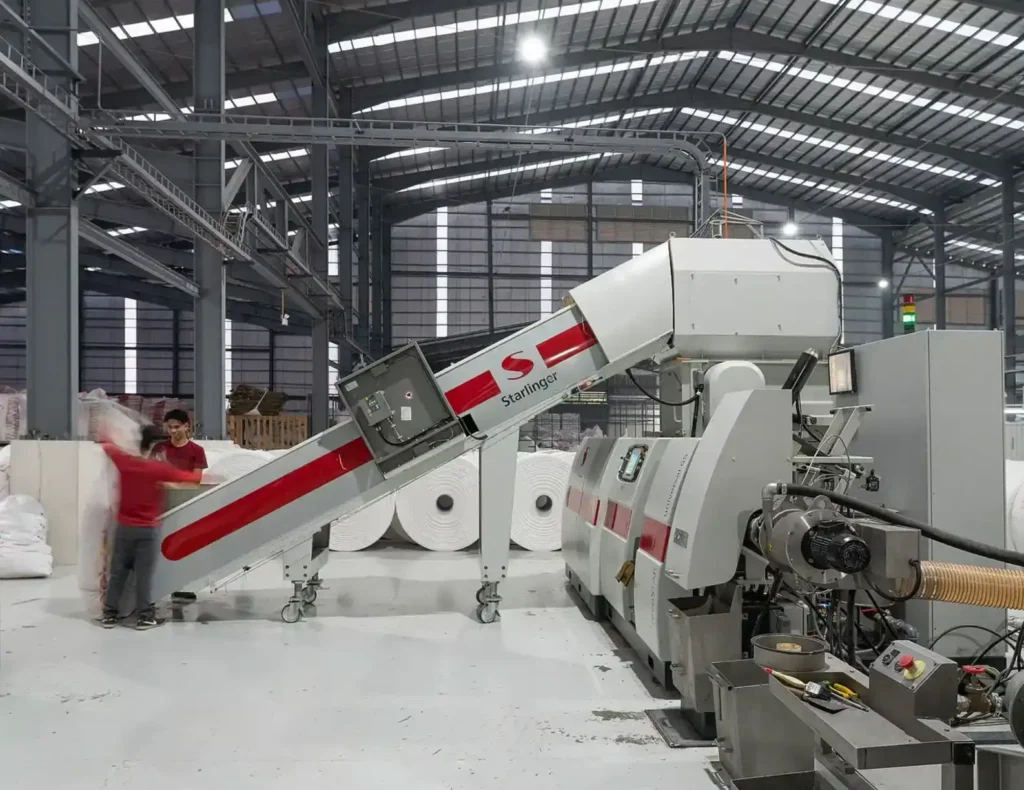
Our production facilities are equipped with cutting-edge Starlinger machinery, which is known for its precision and efficiency in producing woven bags. With 150 circular looms, 16 extrusion lines, 32 lamination machines, and 16 printing machines, we have the capacity to meet large-scale orders while maintaining strict quality control. This extensive infrastructure allows us to produce a wide variety of Waterproof PP Bags, each designed to meet the rigorous demands of different industries.
Global Reach with Local Expertise
VidePak’s products are used in markets around the world, including North America, Europe, Asia, and beyond. Our global presence is a testament to the reliability and effectiveness of our Waterproof Woven Sacks. Despite our international reach, we maintain a strong focus on local expertise, ensuring that our products meet the specific requirements of each market we serve.
Our team of 526 employees, including 18 dedicated sales professionals, is committed to providing exceptional service and support to our clients. From the initial consultation to the final delivery, we work closely with our customers to ensure that they receive the best possible solutions for their packaging needs.
Sustainability and Environmental Responsibility
In today’s environmentally conscious market, sustainability is a key concern for many businesses. At VidePak, we are committed to producing Waterproof Poly Bags that not only meet performance standards but also contribute to environmental sustainability. Our manufacturing processes are designed to minimize waste and energy consumption, and we prioritize the use of recyclable materials in our products.
Furthermore, our lamination and inner liner materials are selected for their low environmental impact, ensuring that our Moisture Proof Woven Bags are as eco-friendly as they are effective. We believe that sustainability and quality can go hand in hand, and we are dedicated to leading the industry in both areas.
Conclusion
Waterproof Woven Bags are an essential tool for businesses that need to protect their products from moisture and other environmental factors. At VidePak, we combine innovative features like inner liners and laminated outer layers with state-of-the-art manufacturing processes to create bags that offer unparalleled protection and durability.
Our commitment to quality, customization, and sustainability ensures that every Waterproof Woven Sack we produce meets the highest standards of performance and reliability. Whether you’re in agriculture, construction, or any other industry that requires moisture-resistant packaging, you can trust VidePak to deliver products that keep your goods safe and secure. With our global reach and local expertise, we are proud to be a trusted partner for businesses around the world.