
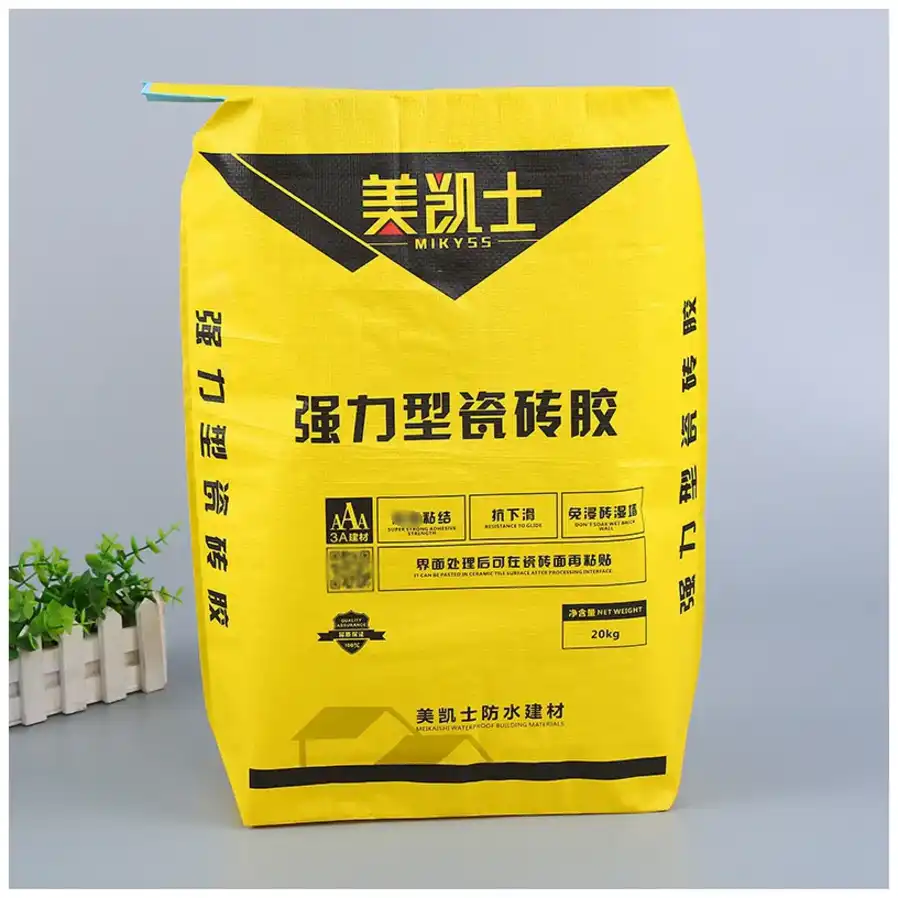
Pasted Valve Bags have become a preferred choice for packaging across various industries due to their durability and effective sealing capabilities. These bags, known for their robust construction and secure closure, are extensively used for packaging products such as chemicals, grains, and powders. In this article, we’ll explore the customization options for printed designs on pasted valve bags, including color systems and full-surface printing, while comparing practices and trends in different countries, including Europe, the United States, India, and Southeast Asia.
What are Pasted Valve Bags?
Pasted Valve Bags are multi‑ply sacks engineered for high‑speed, low‑dust filling and brick‑like stacking. The defining architecture is consistent across suppliers: a precision‑tubed body, a pasted (glued) block or stepped‑end bottom that creates a square footprint, and a pre‑inserted valve sleeve that couples directly to rotary or impeller packers. In day‑to‑day usage they are also described as pasted valve paper sacks, multiwall valve bags, brick‑pack valve sacks, and—by analogy to plastic—the AD*STAR‑style block‑bottom polypropylene valve sack. Regardless of naming nuance, the job to be done stays the same: fill fast, close cleanly, stack safely, and protect powdery or granular goods from the silo to the shelf.
Callout — one‑line definition
A Pasted Valve Bag is a multi‑ply sack with a glued square bottom and a self‑closing or heat‑sealable valve sleeve that enables rapid, low‑emission filling of powders and granules.
Why does this format matter now? In 2024–2025, three forces converged on bag specifications globally: (1) operational pressure to run cleaner and faster with fewer stoppages and lower fugitive dust; (2) regulatory and retailer scrutiny over labeling clarity, food‑contact hygiene, and factory management systems; (3) market demands for honest circularity claims, repulpability where feasible, and disclosed carbon intensity per tonne moved. Pasted Valve Bags sit at the junction of those forces, particularly in paper‑first builds where dispersion barriers and heat‑seal coatings provide protection while keeping end‑of‑life pathways straightforward.
The Materials of Pasted Valve Bags — From Fibers to Films to Finishes
Designing Pasted Valve Bags is an exercise in purposeful layering rather than additive complexity. Each ply and each chemistry must earn its keep—contributing measurable gains in tensile, tear, drop survival, moisture control, or print durability. The sections below unpack the typical bill of materials, outlining property levers, cost drivers, and trade‑offs.
1) Sack Kraft Paper
Engineered via sulfate pulping for long‑fiber strength, high TEA, and robust tear. Typical basis weights 70–110 g/m² per ply. Unbleached grades are cost‑efficient and tough; bleached grades carry premium print and brighter brand palettes.
2) Valve Sleeve
Pre‑formed sleeve in paper, PE, or PP. Geometry (diameter/length/taper) and stiffness govern nozzle coupling, fill rate, and post‑fill leakage. Options include self‑closing flaps or heat‑sealable constructions for premium moisture performance.
3) Films & Liners
In‑ply PE films (10–30 µm) temper dusting and moisture; separate liners (60–120 µm LDPE/LLDPE) establish a continuous sealable surface. EVOH‑coex liners are selectively used for oxygen‑sensitive goods; BOPP faces elevate print but affect repulpability.
4) Dispersion & Heat‑Seal Coats
Aqueous polymer‑mineral dispersions deliver grease and moisture resistance with repulpability; heat‑seal coats enable mono‑paper sealing at the mouth and base where specs allow.
5) Adhesives & Pastes
Starch/dextrin systems for fiber‑fiber bonds; water‑borne PVA/PVOH for fast tack and humidity‑resilient seams; selective hotmelt patches in valve zones. Cure profile determines sift‑proof integrity under vibration.
6) Inks & Varnishes
Water‑based flexo ink sets (low‑odor, low‑migration variants for food); matte or satin over‑varnish tuned for wet‑rub resistance and pallet‑rub survival through export cycles.
Tip for spec writers
Start with a repulpable dispersion‑coated outer ply. Escalate to films or liners only when shelf‑life or hygiene data demand it. Every extra layer must move a measurable KPI.
What are the Features of Pasted Valve Bags?
Features mean little until they improve outcomes on the line, in the warehouse, and in audit rooms. The signature advantages of Pasted Valve Bags align to five operational outcomes: faster fills, cleaner floors, tighter pallets, clearer labels, and smoother approvals.
- High‑speed, low‑dust filling. Valve‑sleeve geometry plus tuned micro‑porosity allows trapped air to escape while product flows in. Self‑closing valves remove a sealing step; heat‑seal sleeves push toward near‑hermetic performance where moisture control is critical.
- Brick‑like stacking. Pasted block or stepped ends produce true rectangles; anti‑slip exteriors raise friction angles and curb collapse under braking, cornering, or maritime sway.
- Strength‑to‑weight efficiency. Sack kraft exhibits high TEA and cross‑direction tear strength; with thin PE layers or dispersion coats, sacks resist warehouse humidity and light rain without becoming heavy sponges.
- Brand‑forward, audit‑ready print. Water‑based flexo delivers high coverage; over‑varnish protects hazard icons and batch codes. Large faces accommodate QR‑linked dossiers and disposal guidance.
- Compatibility with standard tests. Performance can be demonstrated using internationally recognized methods for drop, transport shock, wet‑rub, and hygiene management—accelerating qualification.
What is the Production Process of Pasted Valve Bags?
Conversion turns reels into bricks. The choreography is deliberate: printing for clarity, tubing for precision, valve insertion for speed, bottoming for squareness, finishing for protection, and testing for proof. Small deviations—a dyne point here, a millimeter there—become big in the field. Control is therefore the product.
- Paper conditioning. Reels equilibrate moisture to stabilize caliper and print density. Chain‑of‑custody (FSC®/PEFC) and hygiene prerequisites (for food runs) are verified before release.
- Printing. CI or stack flexo applies water‑based inks; viscosity, anilox, and drying parameters are governed by color coverage and substrate porosity. Rub resistance is checked before tubing.
- Tubing & valve insertion. Tubers paste longitudinal seams; valve sleeves are inserted to tight tolerances for nozzle fit and self‑sealing behavior. Micro‑perforations may be added near the valve to balance de‑aeration.
- Bottoming. Glue patterns and compression dwell create a block or stepped‑end base with sift‑proof overlaps. Squareness and spring‑back are managed by glue rheology and press settings.
- Features & finishing. Heat‑seal patches, anti‑slip varnish, handle cut‑outs (small sizes), and unit coding (QR/Datamatrix) are applied where specified. Hybrid paper/film variants often add dispersion/film layers prior to bottoming.
- QA & release. Dimensional checks, seam integrity tests, and filled‑bag drops (per agreed protocols) precede shipment. Food‑adjacent runs attach migration dossiers and hygiene certificates to the lot file.
Process controls that predict field success
Glue temperature and coatweight; sleeve geometry tolerance; porosity windows near the valve; varnish cure; compression dwell at bottoming; and sampling plans tied to lot codes. When these are stable, complaint rates fall—dramatically.
What is the Application of Pasted Valve Bags?
Pasted Valve Bags are chosen whenever powders or granules must be packed rapidly, stacked tightly, and delivered intact—cement to construction sites, flour to bakeries, pigments to plants, kibbles to stores. The logic is physics first (particle size, cohesiveness, hygroscopicity), line second (filler type, de‑aeration, sealing window), and context third (humidity exposure, label legibility, retail handling).
Cement & Minerals
Cement, gypsum, calcium carbonate, kaolin, TiO₂. Valve filling with micro‑perfs keeps pillows at bay. Anti‑slip and crisp block bottoms protect pallets in intermodal routes.
Fertilizers
Abrasive, sometimes hygroscopic granules (urea, NPK). Thin PE layers or dispersion coats reduce sifting and moisture pick‑up; hazard icons stay legible under varnish.
Food Ingredients
Flour, sugar, starches, premixes, rice. Food‑contact pathways employ low‑migration inks, compliant liners or heat‑seal coats, and documented hygiene systems.
Feed & Pet Nutrition
Grease‑resistant exteriors, premium graphics, optional reclose at smaller counts. Valve or open‑mouth chosen by filler. Liner governs aroma where needed.
Specialty Chemicals
Where oxygen or odor matters, EVOH‑coex liners are selectively used; otherwise moisture and dust control dominate spec choices.
Pasted Valve Bags: Custom Printing and Global Trends
Across 2024–2025, the global conversation about Pasted Valve Bags has revolved around print quality without fragility, repulpable barriers without performance gaps, and documentation without administrative drag. The most consequential shifts are pragmatic rather than ideological.
- Repulpable first. Polymer‑mineral dispersion coats are replacing thick films in many dry‑food and QSR‑adjacent applications, keeping fiber streams viable while delivering KIT‑rated grease holdout and meaningful WVTR gains.
- Documentation as a product feature. RFQs increasingly require a live dossier per SKU—drawings, BoM, drop/seam data, migration declarations, and a carbon line expressed both per bag and per tonne moved. QR on pack routes auditors to proof in seconds.
- Capability‑driven downgauging. Plants using print cameras and coatweight sensors are taking grams out of outer plies, films, and varnishes while maintaining rub and drop indices. Less mass, same outcome—because process capability, not hope, backed the change.
- Custom printing that survives the route. High‑coverage water‑based flexo, low‑odor ink sets, and protective varnishes now travel reliably through export profiles; late‑stage digital accents add regional codes or traceability tokens without plate swaps.
- Conditional material choices. Head‑to‑head trials with woven‑poly valve sacks show paper wins in temperate, low‑humidity routes on dust control and stack integrity; woven poly wins in tropical exposure and heavy abrasion. Smart buyers keep dual qualified specs and select by route physics.
Internal link
Learn more about valve formats adjacent to paper sacks here: Pasted Valve Bags .
Systems Thinking — Break the Problem Down, Then Synthesize a Portfolio
To keep specifications coherent as requirements multiply, it helps to view Pasted Valve Bags through four interacting subsystems: functional performance, compliance, cost/carbon, and brand/UX. Each subsystem has specific levers and tangible proofs. The synthesis is a platformed portfolio rather than a forest of one‑off SKUs.
Subsystem A — Functional
Moisture threat only? Favor dispersion‑coated paper with heat‑seal. Aroma/oxygen risk? Add liners judiciously. Pallet collapse? Prioritize anti‑slip and crisp block bottoms before adding grammage.
Subsystem B — Compliance
Anchor food‑contact claims to recognizable clauses; maintain hygiene certificates; run drop/transport tests to named methods. Put the living dossier behind a QR to shorten audits.
Subsystem C — Cost & Carbon
Downgauge only with SPC‑proven stability. Prefer repulpable coats to films where performance allows. Report kg CO₂e per bag and per tonne moved; decide with both numbers visible.
Subsystem D — Brand & UX
Use water‑based flexo + protective varnish for durable coverage; add easy‑open features at consumer sizes; standardize icons for grounding, lifting, disposal.
Professional Standards, Identifiers, and Test Methods
Credible programs for Pasted Valve Bags reference specific standards and identifiers. These codes are the shared language of RFQs, audits, and inter‑company QA.
- ISO 7965‑2 — Sack testing: drop test of filled sacks from a specified height.
- ISO 2248 — Packaging: complete, filled transport packages—vertical impact test by dropping.
- EN 15593 — Packaging hygiene management for food‑related packs.
- FDA 21 CFR 176.170 — Components of paper and paperboard in contact with aqueous and fatty foods (U.S.).
- EU 10/2011 + EN 1186 — Plastics in contact with food: migration testing, overall and specific.
- FSSC 22000 / ISO 22000 — Food‑safety management systems for packaging manufacturers.
- ISO 9001 / ISO 14001 — Quality and environmental management systems.
Why these matter
They convert marketing promises into testable statements: “no rupture at height X,” “legible label after Y rub cycles,” “OML ≤ 10 mg/dm²,” “hygiene plan audited to EN 15593.” Proof beats persuasion.
Colored Tables — Structure, Performance, and Compliance
Worked Scenarios — Turning Requirements into Structures
Scenario A — 25 kg White Cement (Export)
Objective: clean rotary valve fill, low dust, cube‑stable pallets through sea/road legs. Structure: 3‑ply unbleached kraft (80/80/80 g/m²) with thin internal PE coat; block‑bottom valve; anti‑slip varnish. Targets: pass ISO 7965‑2 drop at ≥ 1.2 m; valve leakage < 0.5% mass after vibration; stable pallet through intermodal shocks. Rationale: the PE layer curbs dust and moisture; micro‑porosity and sleeve geometry maintain line speed; anti‑slip prevents slide.
Scenario B — 10 kg Strong Flour (Food‑Adjacent)
Objective: six‑month moisture control, food‑contact compliance, premium print. Structure: 2‑ply (100/80 g/m²) bleached outer with repulpable dispersion barrier + heat‑seal coat; pasted stepped‑end bottom; self‑closing valve; low‑migration inks; EN 15593 hygiene system. Targets: WVTR validated on coated paper; overall migration per EN 1186 (for any plastic layer); rub index retained post‑distribution simulation. Rationale: repulpable outer meets circularity aims while delivering moisture holdout; no separate film simplifies end‑of‑life.
Scenario C — 15 kg Dry Pet Kibble (Retail)
Objective: grease resistance, aroma management, high‑coverage graphics. Structure: 2‑ply sack kraft with hybrid BOPP face for print + 80 µm LDPE liner; block bottom; reclose feature at consumer sizes. Targets: no grease strike‑through; OTR/WVTR governed by liner; print legible and unscuffed after route. Rationale: hybrid face for branding; liner for barrier; block bottom for neat pallets.
Procurement & Qualification Checklist
- Define physics. Particle size, bulk density, hygroscopicity, cohesion/abrasiveness, any odor/oxygen sensitivity.
- Map the line. Filler type (gravity, auger, pneumatic), target rate, de‑aeration need, sealing options.
- Pick the platform. Repulpable paper first; hybrid paper//PE only by data; enhanced‑barrier lined by exception.
- Demand the stack. Ply‑by‑ply gauges and coatweights; sleeve materials and geometry; bottom style; varnish/anti‑slip.
- Request proof. Drop and seam data; WVTR/grease metrics; rub indices; food‑contact declarations; hygiene certificates.
- Pilot on your line. Measure fill time, dust loss, discharge completeness, pallet stability, and scuffing; capture photos.
- Lock & monitor. Freeze drawings and BoMs; set KPIs (returns, breakage, pallet incidents); review quarterly with change control.
Risk Register & Mitigations
- Valve dust leakage. Tighten sleeve tolerances; prove self‑closing designs; deploy heat‑sealable sleeves where needed; tune micro‑perfs to the powder’s air‑release rate.
- Pallet slip & collapse. Specify anti‑slip varnish; verify static/dynamic friction on filled bags; optimize pallet patterns and corner protection.
- Delamination or seam failure. Maintain glue temperature and compression dwell; verify coatweights; run routine peel/shear tests with trend charts.
- Print scuffing & illegibility. Add protective varnish to high‑rub zones; validate wet‑rub indices; design art with safe zones around edges and corners.
- Food‑contact non‑conformance. Maintain substance registers; perform migration tests (EN 1186; 21 CFR 176.170 context); tie declarations to lot codes with QR traceability.
- Greenwashing risk. Scope recyclability/repulpability claims to regional capabilities; publish disassembly steps where liners are present.
Strategic Outlook — 2025
The most resilient programs for Pasted Valve Bags share four habits. They platform their portfolio (repulpable paper first, hybrid only by need, barrier liners by exception). They instrument processes (print cameras, coatweight sensors) and let capability—not hope—drive downgauging. They treat print as an operational safeguard as much as a brand canvas. And they document everything, faster: QR‑linked dossiers shorten audits and accelerate approvals. With those habits, teams ship faster, waste less, and stand straighter in front of customers, regulators, and their own operators.
Custom Printing on Pasted Valve Bags
Pasted Valve Bags offer significant advantages in terms of customization, particularly in printing. The ability to print intricate designs and vibrant colors makes these bags not only functional but also visually appealing. Here are some key aspects of customization:
- Color Systems:
- CMYK: The CMYK (Cyan, Magenta, Yellow, Key/Black) color model is commonly used for full-color printing. It allows for a wide range of colors and is ideal for producing detailed images and gradients.
- Pantone: Pantone colors are standardized colors used in various industries. Using Pantone colors ensures color consistency across different batches and materials, making it ideal for brand-specific colors.
- RAL: The RAL color system is primarily used in Europe and covers a broad spectrum of colors. It is often used for industrial and commercial applications where specific color shades are required.
- Full-Surface Printing:
- Coverage: Full-surface printing ensures that the entire surface of the bag can be utilized for branding and design purposes. This feature is particularly valuable for companies looking to maximize their visibility and impact through packaging.
- Quality: Modern printing technologies enable high-resolution and precise full-surface printing, resulting in sharp and vibrant designs. This quality is essential for maintaining brand integrity and product attractiveness.
- Durability of Prints:
- Colorfastness: Advanced printing techniques ensure that the colors used on pasted valve bags are resistant to fading. This durability is crucial for maintaining the appearance of the bags throughout their lifecycle, from manufacturing to end-use.
- Weather Resistance: High-quality printing processes also enhance the resistance of prints to environmental factors such as moisture and UV exposure, ensuring that the bags remain visually appealing even in challenging conditions.
Comparative Analysis of Global Practices
Europe
In Europe, the use of Pasted Valve Bags with customized printing is characterized by stringent quality standards and a focus on sustainability.
- Regulatory Compliance:
European regulations require that packaging materials meet specific safety and quality standards. Pasted valve bags used in the region are often subject to rigorous testing to ensure they are safe for various applications. - Sustainability Focus:
Many European manufacturers are adopting eco-friendly practices, including the use of recyclable materials and environmentally conscious printing techniques. The emphasis on sustainability is driving innovation in both bag materials and printing processes. - Technological Advancements:
European companies often employ advanced printing technologies that enable precise color reproduction and high-quality finishes. This includes the use of sophisticated machinery and techniques for achieving full-surface printing and maintaining color fidelity.
United States
In the United States, Pasted Valve Bags are widely used in industries requiring reliable and customizable packaging solutions.
- Customization and Branding:
The U.S. market places a strong emphasis on brand differentiation and customization. Pasted valve bags are often customized with intricate designs and vibrant colors to enhance brand recognition and appeal. - Printing Quality:
American manufacturers utilize state-of-the-art printing technologies to ensure high-quality, durable prints. The focus is on achieving vibrant colors and clear images that stand out in the marketplace. - Regulatory Standards:
U.S. regulations for food and chemical packaging require adherence to strict safety standards. Manufacturers must ensure that the inks and materials used in printed bags meet safety and compliance requirements.
India
In India, Pasted Valve Bags are increasingly used for various applications, with growing attention to customization and printing quality.
- Cost-Effective Solutions:
The affordability of pasted valve bags makes them a popular choice in the Indian market. Manufacturers are focusing on providing cost-effective customization options without compromising on quality. - Improving Quality:
Indian manufacturers are investing in modern printing technologies to improve the quality of customized prints. There is a growing emphasis on achieving high-resolution images and vibrant colors. - Market Trends:
The demand for customized and branded packaging is rising in India. Manufacturers are responding by offering a range of printing options and design capabilities to meet diverse market needs.
Southeast Asia
Southeast Asia presents a diverse market for Pasted Valve Bags, with varying levels of technological advancement and customization practices.
- Technological Variations:
The level of printing technology varies across Southeast Asian countries. While some regions have advanced capabilities for full-surface and high-quality printing, others are still developing their printing technologies. - Regulatory Landscape:
The regulatory environment for packaging materials can differ significantly within Southeast Asia. Manufacturers must navigate varying standards and ensure that their printed bags comply with local regulations. - Customization Trends:
There is an increasing trend towards customized packaging solutions in Southeast Asia. Manufacturers are focusing on providing flexible and innovative printing options to meet the growing demand for personalized packaging.
Future Trends and Developments
The future of Pasted Valve Bags with customized printing will likely be shaped by several key trends:
- Sustainability Initiatives:
The push towards sustainability will drive the adoption of eco-friendly printing materials and processes. Manufacturers will need to focus on using environmentally friendly inks and recyclable bag materials. - Technological Innovations:
Advances in printing technology will continue to enhance the quality and versatility of customized prints. This includes improvements in color accuracy, printing resolution, and surface finishes. - Market Demand:
The demand for customized and branded packaging will grow, leading to increased emphasis on innovative design and high-quality printing. Manufacturers will need to adapt to evolving market preferences and consumer expectations.
Moving Forward
As the global market for Pasted Valve Bags evolves, manufacturers must stay abreast of technological advancements, regulatory changes, and market trends. VidePak’s commitment to high-quality materials and advanced printing technologies ensures that our pasted valve bags continue to offer superior performance and customization options, meeting the diverse needs of customers around the world.