
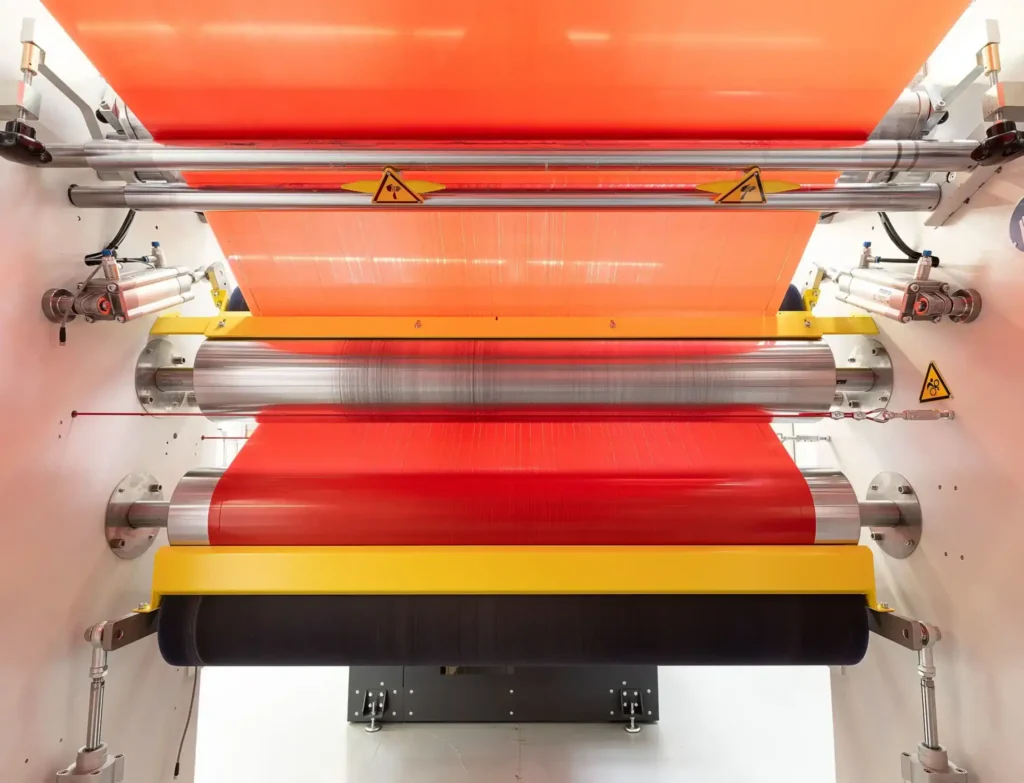
Definition and Naming — What are Poly Woven Bags?
What do Poly Woven Bags actually encompass in the retail and grocery ecosystem? At their core, they are textile-like containers made by weaving drawn polymer tapes—most commonly polypropylene—into a tough, low‑mass fabric and then converting that fabric into sacks or totes. In daily practice they appear in two visible forms. First, the shopper‑facing reusable tote: a laminated woven construction with stiff panels, wipe‑clean surfaces, and sturdy web handles. Second, the supply‑facing sack: an open‑mouth or valve‑style package for rice, flour, sugar, seeds, and pet food that endures pallets, forklifts, and stacked transport. In trade parlance they are also called woven PP bags, raffia woven bags, woven polypropylene sacks, and woven poly. Across names and niches, the DNA is the same—oriented tapes, plain weave, optional coating or laminate, high‑contrast artwork, cut‑to‑length conversion, and robust stitching.
The attraction is part engineering, part merchandising. Uncoated fabric breathes, which helps grains and seeds that naturally respire. Coated or laminated constructions resist moisture and scuff, carry photo‑quality graphics, and keep their composure on shelf. Few formats survive a humid warehouse and still look crisp under store lighting; Poly Woven Bags do. A package that serves as both workhorse and billboard may sound paradoxical—until one notices how frequently Poly Woven Bags appear in club stores, supermarkets, farm co‑ops, and e‑commerce fulfillment.
Constituent Materials — The Material of Poly Woven Bags
The backbone of Poly Woven Bags is polypropylene (PP). Pellets are melted, cast into a thin film, slit into narrow ribbons, and drawn through heated rolls so polymer chains align. Orientation amplifies tensile strength while reducing mass per unit area; hence the enduring appeal: high load capacity without weight penalties. Homopolymer PP is common for its stiffness and tensile performance; random or impact copolymers appear when low‑temperature toughness or repeated folding resistance is a priority. Typical tape extrusion windows use melt flow rates in the ~2–6 g/10 min (230 °C/2.16 kg) range—fast enough for line throughput, viscous enough to tolerate high draw ratios without neck‑in or stress whitening.
Supporting actors serve specific, local roles:
- UV stabilizers (HALS and synergists): Slow photo‑oxidation for outdoor storage and yard logistics; dosed in tapes and coatings where sunlight strikes first.
- Primary/secondary antioxidants: Protect polymer during tape extrusion and any downstream extrusion coating or lamination, preserving ductility and color.
- Slip/antiblock packages: Tune coefficient of friction for denesting from magazines, smooth conveyor transfer, and stable pallets.
- Antistatic additives: Dissipate charge and reduce dust cling—useful for fine powders and dry environments typical of retail backrooms.
- Mineral masterbatch (e.g., CaCO₃): Adds stiffness, improves opacity, and reduces resin cost per square meter when responsibly loaded to avoid embrittlement.
- Pigment masterbatch: Dope‑dyes tapes or contributes brand colors in print systems while maintaining migration safety where food contact is in scope.
Around the woven core, additional layers and inserts tailor function:
- Extrusion coating (PP or PE, ~15–40 µm): Raises moisture resistance and provides a consistent, printable plane.
- BOPP laminate (12–25 µm): Reverse‑printed film protects inks, elevates graphics, and stiffens the mouth for faster denesting and easier checkout loading.
- PE liners (LDPE/HDPE, 20–60 µm): Loose‑inserted or mouth‑stitched for hygiene‑critical powders, sugars, and flours.
- Threads and webbings: Polypropylene or polyester sewing threads and PP web handles transfer loads safely and define hand‑feel.
Cost logic follows mass. Resin dominates ex‑works cost, so light‑weighting—so long as drop and stack tests still pass—is the most reliable lever. Conversion cost rises with draw ratio, picks per inch (PPI), coating weight, and print complexity. Artwork drives the swing factor: gravure cylinders and laminates impose fixed costs yet return scuff‑proof, retail‑grade visuals; high‑rub flexographic systems on coated fabric offer lower fixed cost for industrial SKUs. Additives are minor by weight but major in consequence; omitting UV or slip packages often reappears as claims, downtime, or broken pallets.
Woven fabric (load core) → optional PP/PE extrusion coat (moisture + print plane) → optional BOPP laminate (graphics + scuff shield + mouth stiffness) → optional PE liner (hygiene & sifting control). Each layer solves a failure mode and adds a dial the specifier can tune.
Resin mass sets the floor; GSM and PPI shape strength; coating and laminate weights tune barrier and mouth behavior; graphics platform (flexo vs. gravure) sets fixed cost and scuff immunity for Poly Woven Bags.
| Component | Material | Common Range | Primary Function | Cost Sensitivity |
|---|---|---|---|---|
| Woven fabric | PP tapes (600–1200 denier) | 55–120 g/m² | Load‑bearing, tear resistance | High |
| Extrusion coating | PP or PE | 15–40 µm | Moisture control, print plane | Medium |
| Laminate | BOPP film | 12–25 µm | Graphics, scuff resistance, mouth stiffness | Medium–High |
| Liner | LDPE/HDPE | 20–60 µm | Hygiene, sifting barrier | Low–Medium |
| Threads/handles | PP or PET thread; PP webbing | Ticket 20–60; web 25–40 mm | Seam integrity and ergonomics | Low–Medium |
Distinctive Qualities — What is the Features of Poly Woven Bags
Five qualities set Poly Woven Bags apart, not as isolated claims but as a mutually reinforcing system.
- Strength‑to‑weight efficiency: Drawn tapes provide high modulus; stitched folds spread load; gussets stabilize geometry. High drop performance and safe stacking arrive without excess mass.
- Tunable breathability and barrier: Uncoated fabric vents; coated fabric blocks ambient moisture; laminates resist scuff and provide superior print fidelity. One platform, many air/moisture settings.
- Brand elevation without fragility: Reverse‑printed BOPP hides ink behind film, protecting art while adding mouth stiffness for quicker denesting.
- Line friendliness: Predictable mouth width and hem rigidity allow magazines, spouts, and grippers to work with fewer mis‑picks; tote panels nest neatly for front‑end replenishment.
- Reuse economics and lifecycle leverage: Reusable totes withstand dozens of trips; sacks resist humidity in backrooms better than paper. Unit waste goes down as practicality goes up.
Secondary factors turn uptime from good to great: coefficient of friction tuned for both denesting and pallet stability; UV packages for yard storage; antistats for dusty powders; overprint varnishes on surface‑printed flexo jobs. The orchestration, not a single metric, yields durable performance.
Orientation multiplies strength per gram; seams and gussets translate it into real‑world drop and stack safety for Poly Woven Bags.
Choose uncoated for venting, coated for damp control, laminated for retail polish and scuff immunity.
Reverse‑printed BOPP preserves artwork through distribution while stiffening the mouth for better handling.
Manufacture and Controls — What is the Production Process of Poly Woven Bags
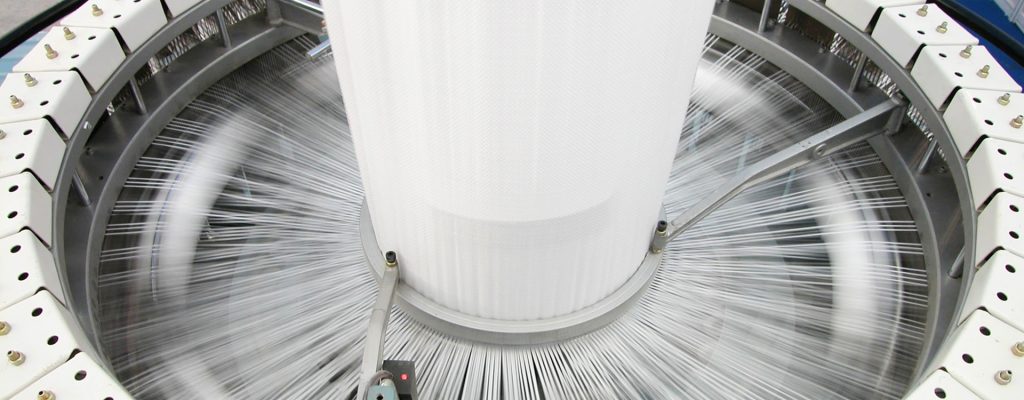
A conversion map looks linear—extrude, weave, treat, print, convert—but performance depends on discipline at each gate. A small drift in draw ratio becomes brittle tapes; a small drift in dyne level becomes a large rub‑off complaint.
- Tape extrusion & drawing: Control temperatures, draw ratios, and tape dimensions; verify tensile/elongation per shift and manage regrind policy.
- Weaving: Hold GSM and PPI with SPC; track broken ends and floats; keep loom hygiene high to avoid pinholes and weak spots.
- Surface preparation: Corona treat to ≥38 dyn/cm; if coating, hold coat weight; if laminating, validate peel and registration.
- Printing: Use high‑rub flexo systems on coated fabric or reverse‑printed gravure on BOPP; confirm color ΔE and barcode performance under glare.
- Conversion: Cut, gusset, bottom fold & sew (lockstitch or chainstitch), prep mouth hem, add EZ‑open where required; for totes, attach web handles with bartack patterns and edge bindings.
- QA and packing: Check cut length, mouth width, seam strength; run sample drop and stack tests; pack in bales or cartons with traceability labels.
Usage Spectrum — What is the Application of Poly Woven Bags
The same woven backbone powers two archetypes across retail and grocery, with adjacent roles upstream in agriculture and processing.
- Reusable grocery totes: Laminated, wipe‑clean panels with web handles carry 15–25 kg, hold themselves open at checkout, and double as mobile billboards.
- Consumer and supply sacks: Open‑mouth woven PP sacks for rice, flour, sugar, pet food, seeds, and horticultural products; liners for hygiene; laminates for shelf‑facing art; uncoated options for breathable transit packs; sandbags for flood control because sewing is fast and performance is predictable.
Behind the scenes, Poly Woven Bags enable farmers, millers, and distributors to protect product integrity long before shoppers see a shelf. The value is cumulative: fewer tears, fewer damp complaints, fewer packaging returns.
Poly Woven Bags: The Versatility in Retail and Grocery Markets — Structured Reasoning
Versatility is not a slogan; it is the intersection of disciplines. Materials science meets human factors, print technology meets warehouse physics, regulatory compliance meets brand narrative. To make this intersection practical, divide the challenge into sub‑problems and then recombine them as a coherent specification for Poly Woven Bags.
Select PP grades for draw stability; document 21 CFR §177.1520 and EU 10/2011 where food contact applies; keep inks behind BOPP when possible.
Calibrate denier, GSM, and PPI to drop/stack targets; dimensional repeatability prevents magazine and pallet issues.
Flexo for value SKUs; gravure‑BOPP for photo‑quality; manage ΔE and barcode legibility under gloss.
Mouth stiffness, hem width, handle geometry, and bag cubing determine comfort and speed at checkout.
Mono‑material PP designs simplify recycling where PP5 streams exist; reuse rates dominate tote footprint.
Map lab tests (tensile, seam, tear, drop/stack, CoF, rub, haze) to warehouse and store realities.
Recombination yields usable specifications. A retail pet food sack prioritizes photo‑quality graphics, mouth stiffness, and scuff immunity; a grocery tote prioritizes handle ergonomics, panel alignment, and wipe‑clean durability. Both ride on the same platform and benefit from the same process control.
Quantitative Maps — Parameters, Options, and Tests
| Parameter | Typical Range | Design Intent |
|---|---|---|
| Tape denier | 600–1200 | Scale with abrasion and load |
| Fabric GSM | 55–120 g/m² | Meet drop/stack targets with margin |
| Picks per inch (PPI) | 8–14 | Dimensional repeatability |
| Extrusion coating | 15–40 µm | Moisture control + print plane |
| BOPP laminate | 12–25 µm | Graphics fidelity + mouth stiffness |
| Feature | Options | Operational Impact |
|---|---|---|
| Side geometry | Flat or gusseted | Pallet cubing and shelf alignment |
| Bottom seam | Single/double fold; lockstitch/chainstitch | Seam efficiency vs. speed |
| Top closure (sacks) | Sewn; EZ‑open | User convenience + line speed |
| Handles (totes) | Woven webbing; variable drop | Ergonomics and load transfer |
| Surface texture | Gloss / matte / anti‑slip | Shelf glare and pallet stability |
| Property | Method / Framework | Purpose |
|---|---|---|
| Fabric tensile | ASTM D5034/D5035 | Baseline strength and orientation quality |
| Seam strength | ISO 13935‑2 | Stitch integrity under live load |
| Laminate tear | ISO 6383‑2 | Film toughness for scuff‑proof graphics |
| Drop/stack | ASTM D5276/D4577 | Handling and warehouse stability |
| Coefficient of friction | ASTM D1894 | Denesting behavior and pallet safety |
| Haze / gloss | ASTM D1003 | Visual fidelity for retail lighting |
| Print rub | ASTM D5264 | Scuff resistance for surface‑printed jobs |
Cross‑Functional Tensions — Resolving Tradeoffs
Designing Poly Woven Bags is an exercise in making vectors align instead of cancel. Branding versus abrasion? Reverse‑printed laminates hide ink and add mouth stiffness, settling both at once. Stiffness versus machinability? If the laminate over‑stiffens and mouths curl, adjust laminate thickness or hem geometry. Breathability versus moisture control? Vent with uncoated fabric for grains; add coatings or liners where shelf life demands it. Weight versus safety? Light‑weighting is powerful but must be re‑earned through stitch and PPI engineering. Cost versus speed? Upfront cylinder cost is rational when SKUs are long‑running and retail‑facing; coated‑flexo is sensible for short runs.
Program Design — From Idea to Aisle
Execution details make or break front‑of‑store programs and back‑of‑store sacks alike. Observe checkout behavior to set mouth widths that hold open; tune handle drop lengths to shoulder or cart carry; select base geometry that stabilizes boxes and bottles. Proof artwork under retail lighting to manage glare and barcode scan reliability. Build pilots with multiple handle widths and lengths; measure packing time per basket and comfort. Pull‑test handles, rub‑test prints, and run drop tests. Package replenishment units so staff can restock without untangling handles or fighting straps. Post‑launch, measure reuse rates, sell‑through, damages, and satisfaction—and publish care guidance so totes live longer.
Supplier Integration — Upstream Discipline
Standardize widths and gussets, hold dyne and CoF targets, and synchronize changeovers with fillers. Keep a housekeeping checklist: mouth width SPC, stitch density verification, lamination peel checks. Share weekly dashboards covering GSM, PPI, dyne, CoF, and incidents. When suppliers practice this discipline, packer OEE rises and cost volatility falls—quietly but measurably—for Poly Woven Bags.
Nuances that Pay Off — Practical Tweaks
- Align EZ‑open paths so tears are clean, safe, and free of stray fibers.
- Add anti‑slip varnish to laminates to curb pallet creep without muting graphics.
- Balance hem stiffness for reliable pickup with minimal curl; validate with line operators.
- Reserve quiet zones for codes and place registration marks where sensors see them consistently.
- Prevent needle cutting with appropriate stitch length and thread pairing; seam strength is an outcome, not only a number.
Specifications in Context — Retail and Grocery Examples
70 g/m² woven PP; 20 µm BOPP laminate; matte front/back; gloss gussets; 32 mm web handles at 600 mm drop; baseboard insert. Pull test to 25 kg for 60 s; edge binding for abrasion resistance.
80 g/m² tubular fabric; 25 µm PP coat + 20 µm gloss BOPP (reverse‑print); double‑fold lockstitch; loose 35 µm LDPE liner; EZ‑open tear tape; stack simulation to warehouse dwell.
75 g/m² gusseted fabric; anti‑slip matte over‑varnish; gravure with high‑saturation inks; mouth width tolerance ±2 mm; dyne ≥ 38 dyn/cm; CoF tuned for pallets.
Procurement and Governance — Checklists that Prevent Drift
- Dual‑source PP grades within overlapping melt‑flow windows; qualify inks from at least two vendors for brand colors.
- Implement SPC on GSM, PPI, dyne, and CoF; review weekly with partners supplying Poly Woven Bags.
- Agree on regrind policy (internal trims only, validated percentages); avoid visual contamination.
- Maintain spare gravure cylinders/plates for top SKUs to buffer artwork downtime.
From Strategy to Day‑One Settings — Making It Real
Turn decisions into shop‑floor numbers: tape temperature bands and draw ratios; loom PPI setpoints; coating thickness gauges; lamination nip temperature/pressure windows; press speeds and ink tack; sewing thread counts and stitch length; CoF targets and check frequency; dyne tests at receiving and pre‑print; drop/stack cadences per lot. When these travel with the work order, variability recedes—and customer complaints go with it. That is how Poly Woven Bags turn potential into performance.
- Definition and Naming — What are Poly Woven Bags?
- Constituent Materials — The Material of Poly Woven Bags
- Distinctive Qualities — What is the Features of Poly Woven Bags
- Manufacture and Controls — What is the Production Process of Poly Woven Bags
- Usage Spectrum — What is the Application of Poly Woven Bags
- Poly Woven Bags: The Versatility in Retail and Grocery Markets — Structured Reasoning
- Quantitative Maps — Parameters, Options, and Tests
- Cross‑Functional Tensions — Resolving Tradeoffs
- Program Design — From Idea to Aisle
- Supplier Integration — Upstream Discipline
- Nuances that Pay Off — Practical Tweaks
- Specifications in Context — Retail and Grocery Examples
- Procurement and Governance — Checklists that Prevent Drift
- From Strategy to Day‑One Settings — Making It Real
“Why are poly woven bags dominating retail and grocery packaging?”
Ray, CEO of VidePak, gestures emphatically during a recent industry summit. “The answer lies in three pillars: unmatched durability, brand customization potential, and sustainability. At VidePak, we’ve harnessed cutting-edge printing technologies and material innovations to make these bags indispensable for modern retailers.”
This bold statement captures the transformative role of poly woven bags in a sector where packaging is no longer just functional—it’s a branding tool and sustainability statement. With the global poly woven bag market projected to grow at a 4.8% CAGR through 2033, reaching $8.3 billion, retailers are prioritizing solutions that balance cost, aesthetics, and environmental responsibility.
1. Market Dynamics: The Rise of Poly Woven Bags
The retail and grocery sectors account for 35% of poly woven bag demand, driven by their lightweight yet robust structure, which reduces shipping costs by 20–30% compared to rigid packaging. Key drivers include:
- E-Commerce Boom: Cross-border e-commerce logistics require packaging that survives 5+ handling cycles. VidePak’s tear-resistant PP bags (≥18 kgf burst strength) reduce split incidents by 70%.
- Brand Differentiation: A 2025 Nielsen study found 68% of consumers associate high-quality packaging with brand credibility. Poly woven bags support vivid, high-resolution printing—VidePak’s Starlinger-powered presses achieve 1200 dpi clarity, enabling Pantone-matched branding.
- Regulatory Shifts: The EU’s 2024 Single-Use Plastics Directive incentivizes reusable solutions. VidePak’s recyclable PP bags comply with ISO 14064 and achieve 98% post-consumer recyclability.
2. Technological Excellence: Printing and Surface Customization
VidePak’s 30+ years of expertise and partnerships with Austrian Starlinger and German W&H enable unmatched customization:
2.1 Advanced Printing Techniques
Starlinger’s 8-color flexographic printers and W&H’s digital UV inkjet systems allow:
- Single to Multi-Color Printing: Ideal for budget-conscious SMEs or luxury brands requiring gradients and metallic finishes.
- Surface Effects: Matte finishes reduce glare on supermarket shelves, while glossy coatings enhance vibrancy for seasonal promotions.
Technical Specifications:
| Parameter | Starlinger Flexo | W&H Digital UV |
|---|---|---|
| Resolution | 600 dpi | 1200 dpi |
| Colors Supported | 8 | 12 |
| Print Speed | 200 bags/min | 150 bags/min |
| Finish Options | Glossy, Matte | Glossy, Matte, Texture |
A case study with a U.S. organic grocery chain showed a 40% sales increase for products in VidePak’s matte-finished, eco-printed bags, which emphasized natural branding.
2.2 Structural Adaptability
- Gusseted Designs: Expandable side panels accommodate irregularly shaped items like bulk cereals or apparel.
- Reinforced Handles: Ergonomically designed handles with anti-slip textures support 25 kg loads, reducing worker strain in warehouses.
3. Sustainability: Beyond Recyclability
VidePak’s EcoFlex line addresses circular economy demands:
- Material Efficiency: Ultra-thin 85gsm PP fabric (vs. industry-standard 100gsm) reduces raw material use by 15% without compromising tensile strength (≥55 N/cm²).
- Carbon-Neutral Production: Solar-powered facilities in Vietnam offset 10,000 tons of CO₂ annually, aligning with the Science-Based Targets initiative (SBTi).
- Closed-Loop Recycling: Partnering with TerraCycle, VidePak ensures 95% of returned bags are reprocessed into pelletized PP for new products.
4. VidePak’s Competitive Edge
With 526 employees and $80M annual revenue, VidePak combines scale with agility:
- Production Capacity: 100+ circular looms and 30+ lamination machines produce 15 million bags monthly, including custom sizes like 10L “grab-and-go” retail totes.
- Certifications: FSSC 22000 for food safety and BRCGS AA+ for retail compliance.
- Speed-to-Market: 10-day lead time for custom orders of up to 500,000 units, supported by in-house design teams and AI-driven prototyping tools.
FAQs: Addressing Retailers’ Top Concerns
Q: How do poly woven bags compare to reusable cotton totes?
A: PP bags are 50% lighter, 3x more tear-resistant, and 40% cheaper to produce. They also require 90% less water to manufacture than cotton.
Q: Can these bags withstand freezer temperatures?
A: Yes. VidePak’s cold-chain bags use ethylene-vinyl alcohol (EVOH) barriers, maintaining flexibility at -25°C and blocking condensation.
Q: Are customized prints cost-effective for small businesses?
A: VidePak’s modular pricing allows SMEs to order 5,000 units with 2-color prints at $0.12/bag—70% cheaper than traditional screen printing.
5. Future Trends: Smart Packaging and Beyond
VidePak’s 2026 roadmap includes:
- IoT Integration: QR codes linked to dynamic content (e.g., recipes, sustainability metrics) via custom-printed interactive bags.
- Bio-Based PP: 30% plant-derived resin trials show identical performance with a 25% lower carbon footprint.
- Anti-Microbial Coatings: Silver-ion liners reduce bacterial growth by 99.7%, extending produce shelf life by 5 days.
Conclusion
Poly woven bags are redefining retail packaging through durability, brand versatility, and eco-innovation. As Ray summarizes, “Our bags don’t just carry products—they carry brand stories and environmental commitments.” Retailers seeking competitive differentiation should explore solutions like high-definition retail-ready packaging and sustainably engineered designs to future-proof their supply chains.
This report integrates data from FMI’s Polywoven Bags Market Analysis (2023), industry whitepapers, and VidePak’s production metrics. For technical validation, refer to ISO 22434:2025 standards on packaging performance.