# PP Woven Bags — Comprehensive Solutions for Waste Management (2024–2025 Technical Playbook)
## Definition and Naming — What are PP Woven Bags?
PP Woven Bags are sack and tote formats made from flat polypropylene tapes drawn for strength and woven into a robust fabric, then converted into bags with coatings, laminates, or liners depending on the use. In the waste domain, the term spans small collection sacks, rubble bags, construction skip bags, and flexible intermediate bulk containers used for non-dangerous solid wastes. Practitioners will also hear synonyms such as woven polypropylene sacks, raffia woven bags, woven poly sacks, rubble sacks, skip bags, FIBCs (when in big‑bag form), and debris totes. The core architecture is consistent: an oriented‑tape fabric that provides a high strength‑to‑weight backbone, optionally paired with a sealable or printable surface and reinforced seams or lifting loops.
Two comparisons position the format. First, versus film‑only trash liners, PP Woven Bags trade some foldability for much higher puncture and tear resistance at a given mass. Second, versus paper sacks and cartons, PP woven substrates maintain structural integrity under moisture, grit, and repeated handling. That is why waste operators use them to collect sharp offcuts, masonry fragments, organic yard clippings, polymer scrap, and process rejects—materials that are abrasive, wet, or geometrically awkward for thin films and paper.
The keyword in this guide is PP Woven Bags because the same platform adapts across multiple waste streams: municipal solid waste at transfer stations, source‑separated recyclables, construction and demolition debris, industrial by‑products, and post‑consumer plastics bound for washing and pelletizing. In each scenario the woven substrate changes little; what changes are denier, picks per inch, surface treatments, stitch patterns, lifting geometry, and regulatory labeling.
## Constituents and Structure — The Material of PP Woven Bags
PP Woven Bags derive their mechanical profile from three nested layers of decision‑making: the polymer system, the fabric architecture, and the surface/closure system.
1. Polymer system
The base polymer is polypropylene. In tapes, homopolymer grades are preferred for stiffness and tensile strength, enabling higher draw ratios without neck‑in. In coatings or sealable skins, converters often blend PP with polyethylene families such as metallocene‑LLDPE to broaden the sealing window and introduce early hot‑tack when heat sealing is required. Additives do essential housekeeping: hindered‑amine light stabilizers protect in yard storage and high‑UV climates; antioxidants mitigate thermal oxidation across the extrusion, coating, and lamination heat history; slip and antiblock packages tune the coefficient of friction so bags denest from magazines yet stay on pallets; antistats reduce dust attraction in dry waste streams; and calcium carbonate masterbatches can add stiffness and opacity while potentially lowering resin cost per area when dosed judiciously.
2. Fabric architecture
Tapes are slit from a cast film and drawn to orient polymer chains, raising modulus and tensile properties. Those tapes are woven (on circular or flat looms) into a plain weave with a controllable picks‑per‑inch and a target fabric basis weight, usually 55–120 g/m² for sacks and 160–240 g/m² for big‑bag body fabrics or reinforced rubble totes. Gusseted geometries improve cubing on pallets and make hand‑loading safer. For heavy rubble and skip bags, lifting loops made from woven webbing (often 1,000–1,500 denier constructions stacked into multi‑ply straps) transfer loads to forklifts or cranes with defined safety factors.
3. Surface and closure system
A surface treatment makes the woven fabric behave correctly in the real world. Corona treatment raises surface energy for ink and adhesive anchorage. Extrusion coating (PP or PE, 15–40 µm) provides moisture control and a print plane. Laminated films—most commonly BOPP at 12–25 µm—unlock photographic graphics and scuff resistance; matte or gloss textures control glare for barcode scans. Depending on the use, the bag may be heat‑sealed (small sacks), sewn (open‑mouth woven), or stitched around a base panel (skip bags and many FIBCs). Liners (LDPE/HDPE 20–60 µm) are inserted where hygiene or fine powders demand a sift‑proof inner.
Cost structure notes
Resin mass dominates cost, often exceeding 60% of ex‑works price. Conversion costs scale with draw ratio, loom productivity, coating/lamination weights, printing complexity, and sewing operations. Artwork and lamination add fixed costs that must be amortized across volume; their payback appears in scuff immunity, regulatory labeling space, and brand visibility where waste contractors sell services to municipalities or retail clients.
How the parts interlock
Think inside‑out: the woven core carries tensile loads; the coating or laminate manages moisture and print; the seam or heat‑seal geometry converts sheet to container; lifting loops translate tensile strength into safe handling; liners and closures modulate hygiene and sifting. A weakness in any layer manifests as claims—seal leaks from dusty seams, pallet creep from low exterior friction, scuffed labels from surface‑printed inks, or body failures from over‑drawn low‑GSM fabrics.
### Table 1 — Representative Materials Map for PP Woven Bags (Waste Focus)
| Component | Typical Options | Common Ranges | Principal Function | Notes |
| ————————– | —————————- | ——————————————– | ———————————————— | ——————————————- |
| Woven fabric | PP tapes, 600–1200 denier | 55–120 g/m² (sacks); 160–240 g/m² (big bags) | Tensile and tear backbone | Higher GSM for rubble and sharp offcuts |
| Extrusion coating | PP or PE | 15–40 µm | Moisture control, print anchorage, sealable skin | PE‑rich skins improve low‑temperature seals |
| Laminate | BOPP, matte or gloss | 12–25 µm | Scuff‑proof graphics, mouth stiffness | Reverse‑print for abrasion immunity |
| Liner | LDPE/HDPE | 20–60 µm | Hygiene and sift barrier | Liner‑to‑liner seals when used |
| Lifting loops (FIBCs/skip) | Woven PP webbing | 25–50 mm width | Safe lifting, load transfer | Design for 5:1 to 6:1 SWL where required |
| Thread/closure | PP or PET thread; heat seals | Ticket 20–60; seal temps per skin | Seam integrity; opening convenience | EZ‑open features for manual sorting lines |
| Additives | HALS, AO, slip, antistats | As specified | UV stability, process stability, CoF tuning | Avoid over‑slip that causes pallet creep |
## Performance Profile — What is the Features of PP Woven Bags?
Waste‑handling environments are unforgiving: sharp edges, wet loads, rough terrain, forklift tines, and rapid handling cycles. PP Woven Bags bring a compact list of features that directly answer those realities.
Strength‑to‑weight efficiency
Drawn PP tapes produce a high modulus fabric that resists tear propagation better than non‑woven or film‑only substrates at the same mass. Seams—lockstitch or chainstitch—can be engineered to exceed body strength with proper stitch length and thread selection. In big‑bag formats, the body plus lift loops is validated to defined safe working loads.
Abrasion and puncture tolerance
Plain‑weave constructions distribute stress across many filaments. Compared to kraft paper sacks in wet environments or thin PE liners under rubble, PP woven bodies maintain geometry and resist puncture by rebar stubs, tile shards, and mixed demolition fragments.
Moisture and grit management
Coated and laminated surfaces keep moisture ingress low and present a cleanable outer face for reuse cycles. Uncoated options breathe where trapped moisture or off‑gassing might be problematic, such as curing powders or compost feedstock pre‑stages.
Handling and logistics stability
The exterior friction can be tuned with additives or surface texture so stacked units do not creep. Consistent gusset depths and mouth widths keep manual loading predictable and stabilize cube efficiency on pallets. Lifting loops on large bags are designed for predictable sling angles and center‑of‑gravity behavior.
Print and compliance fidelity
Reverse‑printed laminates shield critical markings—waste codes, safety pictograms, barcodes—behind film. Coated surfaces accept high‑rub flexo inks and protective varnishes where lamination is cost‑prohibitive.
Reusability and lifecycle economics
When kept in closed operational loops (construction sites, depots, industrial plants), PP Woven Bags deliver multiple cycles before retirement. In rubble and yard‑waste roles, collapsible formats reduce return freight and storage volume.
## Manufacturing Workflow — What is the Production Process of PP Woven Bags?
The workflow is textbook for woven packaging, with extra attention to seam efficiency, loop integrity, and surface readiness for regulatory printing.
1. Tape extrusion and drawing
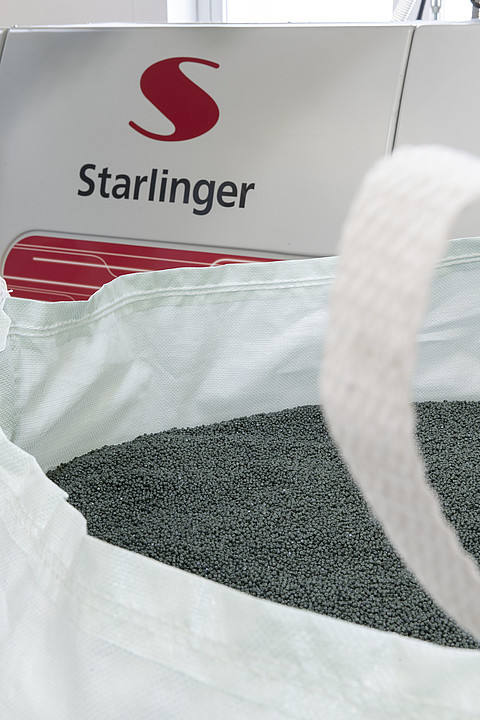
Polypropylene pellets are melted, cast into a thin film, slit into tapes, and drawn through heated rollers to orient chains. Operators track tape width and thickness, tensile strength, and elongation. Edge trims are recycled internally within validated percentages to prevent property drift.
2. Weaving
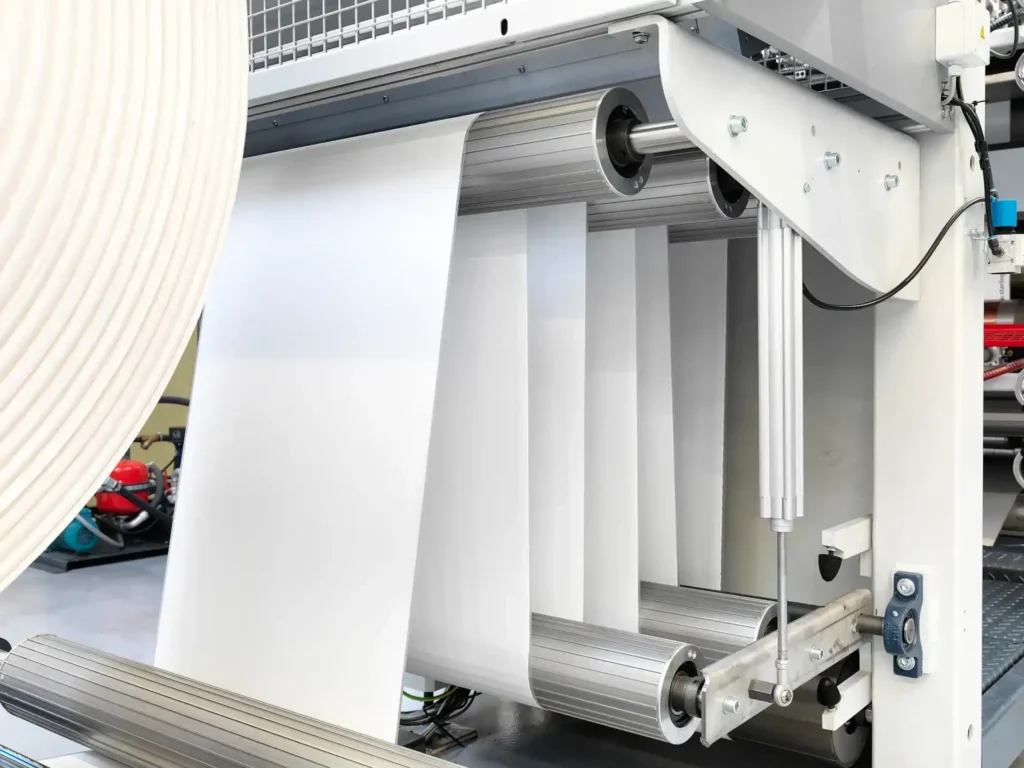
Circular or flat looms assemble tapes into a plain‑weave fabric. Picks per inch (and loom tension) determine dimensional repeatability, which governs cut length and gusset accuracy in conversion.
3. Surface preparation
Corona treatment raises dyne level for ink and adhesive wetting. Extrusion coating applies a sealable, printable plane; lamination bond strength is checked via peel testing. Texture choices (matte, gloss, anti‑slip) are coordinated with barcode placement and pallet safety.
4. Printing and labeling
Coated fabric receives high‑rub flexographic inks with optional overprint varnish; BOPP film is reverse‑printed by gravure for photographic fidelity. Regulatory panels and waste codes need high legibility under glare and dirt. Eye‑marks and quiet zones support machine vision where form‑fill‑seal equipment is used upstream.
5. Conversion
Open‑mouth sacks are cut, gusseted, bottom‑folded, and sewn; mouth hems are prepared for manual or automated closure. Big bags and skip bags add base panels and lifting loops stitched in patterns (box‑X, multi‑row) validated by pull testing. Where heat sealing is used, jaw temperatures, dwell, and pressure are tuned to the skin’s hot‑tack behavior.
6. Quality assurance and packing
Finished lots undergo seam strength checks, dimensional inspections, and representative drop/stack simulations. Rolls or bales are moisture‑guarded and labeled with full traceability back to materials and process settings.
## Use Cases — What is the Application of PP Woven Bags?
Waste management is not a single industry but a cluster of flows. PP Woven Bags feature in several of them, each with specific constraints.
Municipal solid waste and source‑separated collection
Where municipalities trial source separation, woven sacks can serve as durable carriers for glass cullet, paper bundles, or mixed dry recyclables to depots. Their reusability reduces liner consumption. Coated surfaces accept printed route codes and anti‑litter messaging.
Construction and demolition debris
Rubble bags and skip‑bag derivatives carry masonry, tile, plasterboard, rebar offcuts, and roofing. Here, high‑GSM body fabrics, reinforced seams, and lifting loops are main actors. Anti‑slip outer textures and calibrated loop lengths support safe crane or forklift handling on tight sites.
Organics and yard waste
Breathable variants move leaves, branches, and sod. Open‑mouth formats with stiff hems allow hands‑free loading. Moisture‑resistant coatings prevent collapse after rainfall and permit hose‑down cleaning.
Industrial by‑products and polymer scrap
In injection and film plants, woven bags are workhorses for collecting edge trim, purgings, and production rejects destined for shredding and washing. Tough bodies survive sharp edges; liners keep fines contained; antistats and tuned CoF preserve housekeeping.
E‑commerce returns and retail back‑room waste
Reusable woven totes consolidate soft goods for reverse logistics. Graphics help zone the waste stream (reusable, recyclable, landfill) and reinforce staff rules at a glance.
Emergency and disaster response
Sandbags and debris sacks are deployed where rapid containment matters. Uncoated fabrics breathe and can be sewn in the field; coated options protect contents during rain or splashes.
## Systems Thinking — PP Woven Bags: Comprehensive Solutions for Waste Management
The title suggests a broad ambition: not just a bag, but a system component that simplifies the chain from collection to consolidation to processing. A systems approach breaks that chain into subsystems and reassembles them into a coherent specification and operating plan.
Subsystem A: Containment physics
Goal: hold sharp, variable‑shaped loads without catastrophic tear. Choices: increase denier and GSM; specify stitch geometry that maximizes seam efficiency; avoid needle cutting by controlling stitch length and needle size. For large formats, define safe working loads and sling angles to prevent overload events.
Subsystem B: Moisture and hygiene
Goal: keep loads dry enough for downstream processing and safe to handle. Choices: coated or laminated outers for moisture control; liner selection for fines and malodors; breathable variants where venting prevents mold growth; cleanability targets to enable reuse.
Subsystem C: Handling and logistics safety
Goal: speed without incidents. Choices: tune exterior coefficient of friction for pallet stability; apply anti‑slip textures; harmonize gusset depth and base footprint for cubing; validate lifting loops to a defined safety factor; plan signage for loop angles and forklift tine placement.
Subsystem D: Identification and data
Goal: error‑proof sorting and compliance. Choices: durable print zones, reverse‑printed laminates, matte bands for scannability, and serialized codes for chain‑of‑custody. Quiet zones around codes and eye‑marks prevent read failures under glare or dust.
Subsystem E: Regulatory conformance
Goal: meet packaging and waste legislation, and—where food by‑products are involved—material safety rules. Choices: use up‑to‑date packaging rules for labeling and reuse, keep declarations of compliance for plastic materials if applicable to food‑adjacent streams, and operate under recognized management systems for hygiene and quality.
Subsystem F: Circularity and end‑of‑life
Goal: increase reuse and recovery while minimizing leakage. Choices: run closed‑loop bag pools on job sites; design with mono‑material architectures to simplify recycling; partner with wash‑and‑pelletize operators; and, where legislation requires, incorporate post‑consumer recycled content in non‑food contact components.
### Table 2 — Subsystem to Specification Mapping
| Subsystem | Decision Variables | Measurables | Typical Targets |
| ——————— | ———————————————— | ————————————————– | ———————————————– |
| Containment physics | GSM, denier, stitch pattern, loop design | Fabric tensile, seam strength, SWL | Fabric 70–110 g/m² (sacks); loop SWL 5:1 or 6:1 |
| Moisture & hygiene | Coat/laminate weight, liner gauge, breathability | Moisture gain, wipe‑clean cycles, odor containment | Coating 20–30 µm; liner 30–50 µm |
| Handling & safety | CoF, gusset, base size, loop placement | Pallet slip angle, tip‑over, sling angle limits | CoF outer 0.35–0.50; tip‑over >22° |
| Identification & data | Print method, varnish, code zones | Barcode grade through wrap, ΔE color | Barcode ANSI/ISO ≥ C; ΔE ≤ 3 |
| Regulatory | Certifications, labeling, traceability | Audit outcomes, DoCs, label correctness | Zero major non‑conformances |
| Circularity | Material architecture, reuse program | Reuse cycles, rPP %, recovery rate | ≥10 reuses where feasible; rPP where allowed |
## Standards, Certifications, and Third‑Party Touchpoints (with exact identifiers)
This domain leans on published methods and schemes that auditors and clients recognize. The following identifiers and topics are in frequent use during 2024–2025:
Packaging and packaging‑waste policy
A new EU regulation on packaging and packaging waste entered into force in February 2025 (commonly referred to as PPWR). Its objectives include minimizing packaging quantities, boosting reuse, and improving recyclability. For PP Woven Bags programs serving EU contracts, procurement teams increasingly request alignment with its reuse and labeling expectations as they come into application.
Food‑contact plastics and recycled content (when applicable)
Some PP Woven Bags touch food by‑products or animal feed in waste‑adjacent streams. When this occurs, material suitability should map to Commission Regulation (EU) No 10/2011 and the 2025 amendment package addressing recycled plastic processes and good manufacturing practice. In the US context, olefin polymers for food contact fall under 21 CFR §177.1520. Plants supplying such goods often maintain hygiene systems under FSSC 22000 Version 6, supported by decision lists and periodic scheme updates.
Performance and handling tests
For rough handling of unitized loads and large shipping cases and crates, operators reference the ASTM D6179 family (drop, tip, tip‑over, rolling). Pallet safety and stack stability are validated through tip‑over methods and dwell tests. For big‑bag programs carrying non‑dangerous solids, ISO 21898:2024 governs design and type testing; industry communications in 2025 have highlighted stacking and filling‑height guidance.
Color and print control
Barcode grades are verified to ANSI/ISO targets, and many teams reference color management practices derived from the ISO 12647 family to keep regulatory panels legible under gloss or matte finishes.
### Table 3 — Standards and Certification Map
| Topic | Identifier | Application to PP Woven Bags |
| ————————————— | ——————————————————————————- | ———————————————- |
| Packaging & packaging waste policy (EU) | Packaging and Packaging Waste Regulation (entered into force Feb 2025) | Reuse/labeling expectations for EU contracts |
| Plastic food‑contact framework (EU) | Regulation (EU) No 10/2011 as amended in 2025; EU 2022/1616 (recycled plastics) | Suitability for food‑adjacent waste streams |
| Plastic food‑contact framework (US) | 21 CFR §177.1520 | Olefin polymers for food‑adjacent applications |
| Hygiene management | FSSC 22000 Version 6; current Board of Stakeholders decisions | Packaging plant food‑safety management |
| Big‑bag design and test | ISO 21898:2024 | Non‑dangerous solid wastes in FIBCs |
| Rough handling of unit loads | ASTM D6179 (drop, tip, tip‑over, rolling) | Pallet and crate handling simulations |
## Engineering the Program — From RFP to First Shipment
Turning a concept into a working waste‑handling program involves sequencing decisions so each mitigates a real‑world failure mode.
1. Voice of operations
Interview depot managers, job‑site foremen, and transfer‑station teams. What tears bags today? What collapses stacks? Where do labels fail? Convert anecdotes into measurable risks.
2. Baseline specification
Select fabric GSM by waste stream; choose coated or laminated surfaces; define seams and loop patterns; assign liner gauges where fines and odors matter; set exterior CoF bands that thread the needle between denesting and pallet stability.
3. Print and identification
Decide on reverse‑printed lamination for scuff‑critical labels or high‑rub flexo on coated fabric for value tiers. Reserve matte bands for barcodes and QR; set minimum barcode grade through stretch wrap.
4. Testing plan
Map drop, tip‑over, and stack tests to your heaviest and sharpest loads. For big‑bag formats, document type testing to ISO 21898 with filling‑height considerations. Target peel strength for any heat‑seals and verify hot‑tack adequacy where applicable.
5. Supplier governance
Dual‑source resins in overlapping melt‑flow windows; approve at least two ink lines for brand colors; agree regrind policy (internal trims only, validated percentages); keep spare plates/cylinders for the top SKUs; maintain dashboards for GSM, PPI, dyne, CoF, and quality incidents.
6. Launch and feedback
Run line trials at transfer stations or job sites; track failure modes (tear, puncture, seam, label scuff, pallet creep) and OEE drags. Close the loop by adjusting stitch patterns, laminate textures, or code placement.
### Table 4 — Example Specifications by Waste Stream
| Waste Stream | Fabric | Surface | Closure & Loops | Liner | Key QA | Rationale |
| ————————– | —————————– | —————————————————– | ———————————————– | ———- | ——————————————————— | ——————————————— |
| Construction rubble (bag) | 95 g/m² body; reinforced base | 25 µm PP coat + matte anti‑slip varnish | Double‑fold seam; box‑X stitching; 4 lift loops | None | Tip‑over per rough‑handling method; drop flat/edge/corner | Abrasion, forklift handling, pallet stability |
| Yard waste (sack) | 70 g/m² | Uncoated (breathable) with corona‑treated print zones | Sewn mouth with hem stiffener | None | Dimensional repeatability; tear & seam strength | Venting moisture; hose‑down cleanability |
| Polymer scrap (sack) | 75 g/m² | 20 µm PP coat; gloss | Sewn; EZ‑open | 35 µm LDPE | CoF outer band; dust containment checks | Fines management; smooth magazine behavior |
| Mixed recyclables (tote) | 80 g/m² panels | 20 µm BOPP laminate, reverse‑printed | Edge binding; web handles | Optional | Barcode grade through wrap; rub resistance | Durable labeling for route codes |
| Non‑dangerous fines (FIBC) | 180 g/m² body fabric | Coated inner | 4‑loop design rated 5:1 SWL | 50 µm LDPE | ISO 21898 type tests; filling‑height guidance | Safe lifting and stacking in depots |
## Economics and Sustainability — TCO and Circularity Levers
Total cost of ownership for PP Woven Bags is often counter‑intuitive: upfront prices can be higher than film liners, but per‑use cost and damage avoidance invert the math.
Light‑weighting with integrity
Because oriented tapes deliver strength efficiently, modest GSM reductions are possible once seam efficiency and base reinforcement are optimized. Gains must be re‑earned through testing to avoid downstream claims.
Reusability and closed loops
In closed fleets (construction contractors, industrial plants), reusing sacks or totes multiple cycles defers purchase cost and lowers waste generation per job. Collapsible designs reduce reverse‑logistics volume.
Material recovery partnerships
Woven PP is a mono‑material architecture compatible with mechanical recycling in streams that accept PP5. Partnerships with wash‑and‑pelletize operators convert retired bags into recycled PP suitable for non‑food applications. Where policy requires, post‑consumer recycled content can be introduced into non‑contact components.
Policy alignment as revenue protection
Evolving legislation on packaging and packaging waste, extended producer responsibility, and recycled content is reshaping bid requirements for municipal contracts. Programs that document recyclability, reuse metrics, and accurate labeling protect revenue by pre‑empting future compliance gaps.
## Risk Register — Frequent Pitfalls and Practical Fixes
• Pallet creep in climate‑controlled depots: exterior CoF too low. Fix with anti‑slip varnish or adjusted slip package; increase wrap overlap if needed.
• Needle cutting at seams: stitch length too short or needle too sharp. Increase stitch length, radius needle points, and retest seam efficiency.
• Barcode scans fail under glare: high‑gloss panel over codes. Provide matte windows and keep quiet zones around symbols; verify grades through stretch wrap.
• Dust contamination in heat‑seal areas (small sacks): add dust shrouds or air knives; validate a broad hot‑tack plateau for the sealant blend.
• Loop failures on big bags: poor load‑path design. Use box‑X patterns with sufficient rows and thread; validate loop elongation and sling angles; never exceed rated SWL.
## Example Calculations — Back‑of‑Envelope TCO for a Rubble Program
Assume a contractor moves 1,000 tonnes of mixed debris per month. Option A uses thin film liners in metal skips; Option B adds PP Woven Bags (rubble bags and skip liners) to reduce spillage and handling damage.
• Damage and cleanup reduction: if spillage incidents drop by 60% and cleanup labor falls by 30 minutes per incident across 200 incidents, labor savings alone cover a material delta of several thousand dollars monthly.
• Reuse cycles: if a rubble bag sees eight cycles before retirement, the unit cost per use drops by over 80% versus single‑use liners.
• Freight and storage: collapsible totes reduce empty‑return volume; a five‑fold densification on the return leg saves fuel and yard space.
These are directional but realistic; the correct way to validate them is to instrument a pilot and log failures, time per task, and cleanup events.
## Frequently Asked Design Questions
How do PP Woven Bags behave in freeze‑thaw cycles?
Sealability depends on surface chemistry; PE‑rich skins seal at lower temperatures. Body fabrics maintain tensile at cold but become less forgiving under impact; ensure GSM and seam safety factors are adequate.
What about sharp rebar and broken tile?
Specify higher denier and GSM, reinforced bases, and edge binding. Use drop and edge‑corner tests representative of site handling.
Can recycled PP be used in waste‑sector bags?
Yes in many non‑food contexts, especially body fabrics and loops. Maintain color and property consistency; for any food‑adjacent stream, follow jurisdictional allowances for recycled content and maintain Declarations where applicable.
How do we keep labels legible on dirty sites?
Reverse‑printed laminates and matte windows for codes are the two most reliable tactics. Test barcode grades after exposure to dust and wrap.
## Operator Checklist — Day‑One Controls for Waste‑Sector Lines
• Verify fabric GSM and PPI at receiving; chart SPC.
• Check dyne levels before printing or laminating; re‑treat if stock aged beyond policy.
• Validate peel strength on laminations and, where used, heat‑seals at target jaw settings.
• Confirm exterior CoF in target band; run tip‑over checks for unit loads.
• Pull‑test seams and lifting loops by lot; record to traceability.
• Grade barcodes through stretch wrap under depot lighting; relocate or matte‑patch as needed.
• Enforce regrind policy: internal trims only, validated percentages, and no visual contamination in art panels.
## Executive Rationale — Why PP Woven Bags Fit Waste Management Now
Waste systems in 2024–2025 face contradictory demands: reduce environmental footprint, comply with tightening policy, run faster with fewer injuries, and communicate clearly to workers and the public. PP Woven Bags meet those demands without elaborate reinvention. They are strong at low mass, configurable for breathability or barrier, readable under abuse, safe to lift when engineered, and compatible with mono‑material recovery routes. When paired with realistic testing (rough‑handling, stack, tip‑over), current policy awareness, and data‑literate labeling, they become more than a container: they become infrastructure that pays back in uptime, safety, and credibility.
“Why are PP woven bags becoming the backbone of modern waste management systems?” Ray, CEO of VidePak, leans forward during a sustainability conference.“The answer revolves around three pillars: durability, standardization, and sustainability. At VidePak, we’ve engineered our PP woven bags to eliminate leakage, withstand extreme loads, and align with circular economy principles—transforming waste logistics globally.”
This assertion highlights the critical role of polypropylene (PP) woven bags in addressing the $1.6 trillion global waste management market, projected to grow at 5.2% CAGR through 2030. With 30% of municipal waste mishandled due to inadequate packaging, innovations in this sector are pivotal for environmental and operational efficiency.
1. Market Demand and the Role of PP Woven Bags
The global shift toward stringent waste regulations—such as the EU’s 2024 Waste Framework Directive mandating 65% recycling rates by 2035—has accelerated demand for robust, reusable packaging. PP woven bags, with their high tensile strength (≥60 N/cm²) and customizable designs, are replacing traditional single-use plastics in waste collection, construction debris handling, and industrial scrap management.
Key Drivers:
Regulatory Compliance: VidePak’s bags meet ISO 14064 and REACH standards, ensuring chemical resistance for hazardous waste transport.
Cost Efficiency: Municipalities report 25–30% savings in waste handling costs after switching to VidePak’s reusable FIBC bags, which endure 10+ cycles without degradation.
Consumer Trends: A 2025 GreenPack Survey found 72% of businesses prioritize suppliers with certified sustainable packaging, aligning with VidePak’s 98% recyclable PP formulations.
2. Quality Control and Standardization: Eliminating Failures
VidePak’s 30+ years of expertise ensure zero tolerance for defects like seam bursts or print fading—critical for waste management’s harsh environments.
2.1 Material Excellence
Virgin PP Resin: Using 100% virgin PP pellets (MFR 6–8 g/10min), VidePak avoids recycled material inconsistencies that cause brittleness.
Positive Tolerance Standards: Bags are manufactured at 110–115gsm (vs. industry-standard 100gsm), ensuring a 15–20% thicker weave to prevent punctures from sharp debris.
Case Study: A German construction firm reduced landfill leakage incidents by 90% after adopting VidePak’s 120gsm laminated bags for concrete waste, which withstand 50kg loads without stretching.
2.2 Advanced Printing and Seaming
Starlinger’s UV-Resistant Inks: High-definition flexographic printing achieves 600 dpi resolution, retaining clarity after 12 months of UV exposure.
Ultrasonic Seaming: Seam strength of ≥35 N/mm² (ASTM D882) prevents splitting during compactor pressures.
Closed-Loop Recycling: Partnering with TerraCycle, 95% of post-consumer bags are pelletized into new PP fabric, reducing raw material use by 40%.
Carbon-Neutral Production: Solar-powered plants in Vietnam offset 12,000 tons of CO₂ annually, validated by SBTi benchmarks.
Biodegradable Additives: Trials with 20% PLA blends show comparable strength while cutting decomposition time from 500 years to 5–10 years.
4. VidePak’s Competitive Edge
With 526 employees and $80M annual revenue, VidePak combines scale with precision:
Production Capacity: 100+ circular looms and 30 lamination machines produce 10 million bags monthly, including custom sizes like 1-ton FIBCs for industrial scrap.
Certifications: BRCGS AA+, ISO 9001, and Oeko-Tex 100 for non-toxic inks.
Customization: Digital printing supports 8-color branding with Pantone accuracy, crucial for municipal waste segregation campaigns.
FAQs: Addressing Waste Managers’ Top Concerns
Q: How do PP bags compare to HDPE containers for hazardous waste? A: PP bags are 50% lighter, 3x more tear-resistant, and 30% cheaper. Their non-reactive surface resists acids and alkalis up to pH 3–11.
Q: Can these bags withstand monsoon conditions? A: Yes. VidePak’s 3-layer PE-coated bags achieve <0.05% water permeability, proven during 2024 Mumbai monsoon trials.
Q: What is the ROI timeline for switching to reusable PP bags? A: Clients typically recoup costs in 8–12 months via reduced disposal fees and replacement cycles.
5. Future Trends: Smart Waste Management
VidePak’s 2026 roadmap includes:
IoT-Enabled Bags: RFID tags linked to waste composition data, enabling real-time tracking via municipal dashboards.
Self-Healing Coatings: Microcapsules releasing sealants upon puncture, extending bag lifespan by 50%.
Blockchain Traceability: QR codes providing recycling history, aligning with EU Digital Product Passport mandates.
Conclusion PP woven bags are redefining waste management through unmatched durability, standardized quality, and closed-loop sustainability. As Ray notes, “Our bags don’t just contain waste—they catalyze systemic change.” For cities and industries seeking compliant solutions, innovations like heavy-duty FIBCs for construction debris and smart recyclable designs offer a roadmap to cleaner, cost-effective operations.
This report integrates data from the Ellen MacArthur Foundation’s 2025 Circular Economy Report, third-party lab tests, and VidePak’s production logs. For technical validation, refer to ISO 22434:2025 standards on bulk packaging performance.