
What are Woven Poly Bags and why the market keeps choosing them?
Across industrial and agricultural supply chains, Woven Poly Bags have become the practical shorthand for strength, legibility, and cost discipline in flexible packaging. They are not a single bag but a configurable platform: oriented polypropylene tape yarns are woven into a fabric, skins and liners are added to tune moisture and sealing behavior, and the finished body is shaped into valve or open‑mouth formats that run fast on modern filling lines. The result is a workhorse that can lift 10–50 kg again and again, shrugging off fork nicks and the scuffs of warehouse life while presenting clear, durable instructions at the point of use.
Because practice varies by region and machine platform, the same archetype appears under different names. Keeping a compact alias map prevents confusion when comparing quotations or reading specifications.
- PP woven bags
- WPP sacks
- Polypropylene woven sacks
- Woven PP valve bags
- Woven PP open‑mouth bags
- Block‑bottom woven polypropylene bags
- BOPP‑laminated woven poly sacks
- Coated woven PP bags
What materials build a Woven Poly Bag and how does the structure function?
Every layer inside Woven Poly Bags has a job. When you understand what those jobs are—and how they trade off—you can turn the right dials for your product and route instead of over‑engineering or under‑protecting.
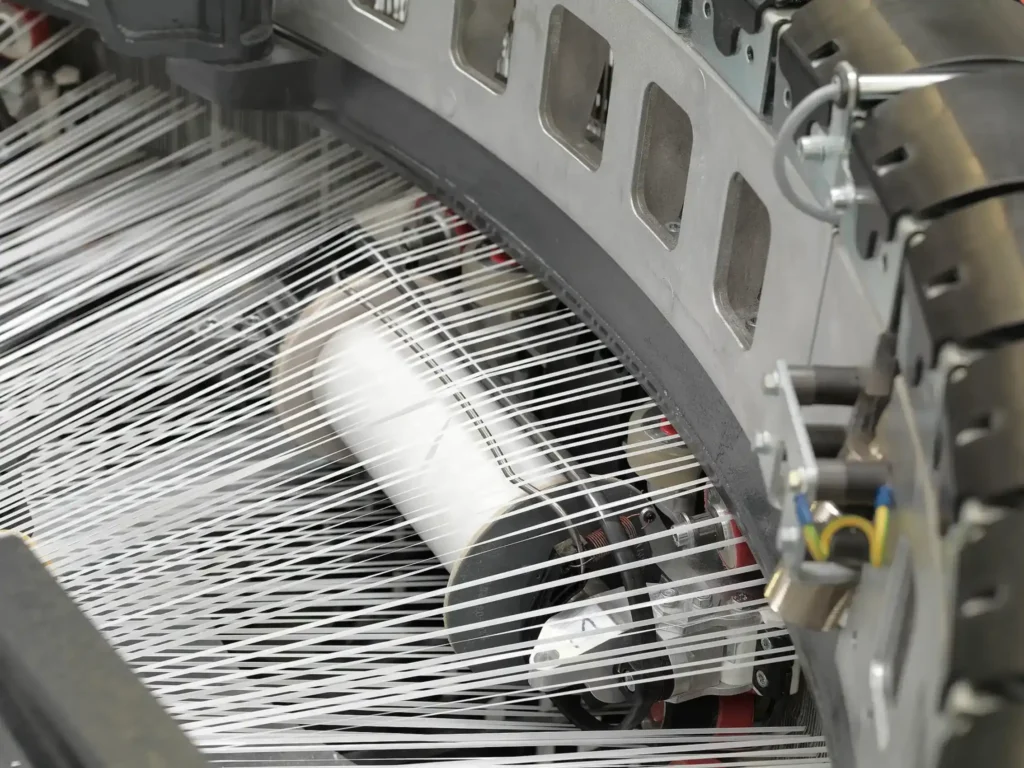
Extruded PP is slit into tapes and drawn 5–7× to build tenacity. Tapes (≈800–1500 denier) are woven at 10–12 tapes/cm in warp and weft to form a fabric that resists puncture and tear while holding a geometric shape for pallets. UV‑stabilizer packages (200–1600 h) keep the fabric from embrittling during outdoor dwell.
When high‑fidelity graphics, small icons, and multi‑language panels matter, reverse‑printed BOPP is laminated to the fabric so inks sit safely under a glossy or matte lens. Cost‑sensitive SKUs often use a thin PP/PE coating for sealability and dust discipline with simpler print routes.
A thin PP or PE seal coat gives clean pinch or heat seals. Hygroscopic powders can justify detachable PE liners or coextruded mini‑liners to lower water‑vapor transmission while preserving a mono‑material polyolefin story. Micro‑/macro‑perforation maps regulate air release during high‑speed filling.
Solventless polyurethane adhesives dominate film‑to‑fabric lamination for bond strength and efficiency. Laydown accuracy, nip temperature, and cure windows prevent curl and delamination while preserving fold performance where the bottom is formed.
Film‑optimized flexo or gravure inks carry regulatory icons, batch/QR codes, and directions. Overprint varnishes (OPV) tune rub resistance and coefficient of friction (COF) so bags flow through machines and build stable pallets without smearing text.
Think of the structure as a negotiation: the fabric wants strength, the film wants clarity, the liner wants hygiene, and the adhesive wants peace. Get the negotiation right and Woven Poly Bags feel effortless on line and on site.
What are the defining features of Woven Poly Bags in real operations?
Teams do not judge bags by marketing claims; they judge them by behaviors on docks and jobsites. The features below consistently move the scoreboard.
- High strength‑to‑weight due to oriented tapes; resistance to fork nicks and corner abrasion.
- Moisture‑tolerant surfaces by way of coatings, liners, or BOPP; better than uncoated fiber in humid lanes.
- Block‑bottom conversions that produce brick‑like stance and safer, denser pallets.
- Controlled de‑aeration so powders densify fast without dust plumes; cleaner scales and floors.
- Vivid, durable labeling—especially when reverse‑printed film protects small text and QR codes.
- Polyolefin mono‑material pathways that align with PP recycling where collection exists.
- UV‑stabilized options for outdoor storage; anti‑skid OPV bands to tame tall stacks.
How are Woven Poly Bags produced from resin to pallet‑ready?
Production is a choreography where each station either solves problems for the next or quietly creates them. The modern route looks like this:
- PP is cast, slit, and oriented to target tenacity; winding quality shows up later as loom uptime.
- Circular or flat looms interlace tapes at a chosen pick count to balance stiffness and foldability; inline coaters reduce porosity or add sealability.
- If a BOPP laminate is chosen, tenter‑line film is reverse‑printed via gravure or HD flexo; for coated fabric, direct print uses ink systems tuned to the coating’s chemistry.
- Printed film is bonded to fabric with solventless PU; nip/temperature/cure windows deliver bond strength without curl and preserve bottom‑forming behavior.
- Laminates or coated fabrics are formed into tubes; print‑to‑cut registration keeps panels aligned after bottoming.
- Block‑bottom folders, pinch preparations, or valve insertions define geometry that later governs pallet stability and fill speed.
- Micro/macro perf maps tune venting for specific powders to avoid ballooning while keeping weighments true.
- Tensile, tear, drop, stack, WVTR, UV exposure, and seal tests validate performance; camera systems verify registration and code readability.
- Bundles are pattern‑wrapped with corner boards; accompanying documentation helps warehouses build stable stacks.
Where do Woven Poly Bags excel and how should teams select them?
Selection is not ideology; it is physics and route mapping. Woven Poly Bags are particularly persuasive when the product dislikes moisture, traps air during filling, abrades edges, and requires clear instructions at the point of use.
Cement, dry mortars, gypsum, and plasters benefit from water tolerance, tuned de‑aeration, and durable print. Valve variants allow high bags‑per‑minute with low dust.
Silica, limestone, calcium carbonate, barite, and pigments demand abrasion resistance; UV‑stable fabrics tolerate uncovered yards.
Grains, seeds, and animal nutrition require robust handling and precise labeling; custom branding supports retail‑visible SKUs.
Pelletized or granular materials exploit the strength and print surface; hazardous goods may require different certified formats.
Woven Poly Bags: Versatile Packaging with Custom Labeling Solutions
Labeling is not decoration; it is a safety system. On Woven Poly Bags, labeling must survive transport, warehousing, and jobsite handling while remaining immediately legible. The right labeling route depends on surface, risk profile, and portfolio dynamics.
BOPP printed on the inner face and laminated to the fabric protects inks from scuff and weather. It supports photographic images, fine text, and variable data windows—ideal for long outdoor dwell or heavy handling.
For cost‑sensitive SKUs with simpler graphics, direct flexo on a compatible coating can carry instructions and brand marks. Ink choice must align with coating chemistry to keep rub resistance high.
When languages or regulatory panels change frequently, applied patches or barcoded sleeves deliver agility without re‑engraving cylinders or plates. COF bands can be placed to stabilize pallets while keeping labels visible.
Serialized QR, microtext, and covert taggants deter diversion and enable batch recalls. Glossy film keeps such features legible even after abrasion that would erase unprotected ink on paper.
System view: decompose the decision, then integrate a plan
Good specifications arise from systems thinking. Break the decision into subsystems, solve each with clear constraints, and then synthesize an integrated playbook that operations can run.
PSD, bulk density, oil/fat content, and hygroscopicity set perforation, liner, and seal choices.
Spout geometry, seal modules, magazine design, and palletizer define feasible formats; self‑sealing valves can remove a manual station.
Drop heights, stack durations, and compression loads dictate denier, weave density, and corner reinforcements.
WVTR for route climate and dwell drives film gauge or liner presence; maritime lanes justify desiccants and pallet hoods.
Reverse‑printed lamination for premium durability; direct print for cost control; applied patches for frequent language swaps.
Prefer PP‑only structures, label for recycling, and maintain ink/adhesive documentation for destination markets.
Specify UV packages for yard exposure, COF bands for pallet stability, and traceability features for high‑value SKUs.
Track rejects, cleanup, and changeovers; tune perforation, valve sleeves, COF, and film gauge to the route.
Synthesis: profile product and route (A, D), lock line constraints (B), set mechanical targets (C), choose print/barrier path (E, D), embed stewardship and compliance (F), address risks (G), pilot and validate for OEE (H).
Technical tables: practical numbers, targets, and levers
| Printing & Labeling Metric | Typical Target/Range | Why It Matters | Lever |
|---|---|---|---|
| Surface energy (film) | 38–42 dynes | Ink wetting and adhesive bond for labels/laminates | Re‑treat windows; storage controls; dyne testing |
| Print method | Gravure or HD flexo (4–8 colors) | Resolution and consistency, makeready economics | Reverse print for durability; expanded‑gamut to cut wash‑ups |
| COF on outer panels | 0.25–0.45 | Pallet stability and machine flow | OPV bands; additive tuning |
| Barcode/QR readability | ≥99% scan rate after handling | Traceability and compliance | Contrast control; reverse print; inspection cameras |
| Mechanical & Barrier Metric | Typical Range | Why It Matters | Lever |
|---|---|---|---|
| Denier (tape yarn) | 800–1500 | Tensile/tear and abrasion behavior | Adjust denier and picks; reinforce corners |
| Weave density | 10–12 × 10–12 tapes/cm | Stiffness vs foldability | Tune picks for stackability vs conversion ease |
| Film/liner gauge | 15–35 μm (film); thin PE liners optional | WVTR and scuff resistance | Raise for humid/maritime lanes; lower for dry domestic |
| UV stabilization | 200–1600 h | Outdoor dwell tolerance | Higher package for equatorial seasons |
| WVTR target | <1–10 g/m²·day (38 °C/90% RH eq.) | Moisture ingress control | Pair film/inner coats with pallet hoods/desiccants |
| Operations & OEE Metric | Typical Observation | Why It Matters | Lever |
|---|---|---|---|
| Fill rate (BPM) | +3–5% with tuned venting/valves | Throughput and labor | Perforation map; sleeve geometry; COF bands |
| First‑pass yield | >98% goal | Rework and cleanup | Seal dwell discipline; web handling control |
| Changeover time | 10–30 minutes saved with EG | Capacity unlocked | Expanded‑gamut workflows; plate/cylinder strategy |
Comparative lens: when alternatives are smarter
Multiwall paper sacks align perfectly with fiber‑only recovery streams and perform well in temperate domestic routes using coated fiber. Heavy‑duty PE film bags deliver ultra‑low WVTR and FFS speed but lack the woven skeleton’s puncture resistance and the block‑bottom’s stackability unless gusseted. FIBCs dominate above ~500 kg. For 20–50 kg powders and granules in humid, rough‑handled chains, Woven Poly Bags deliver the pragmatic balance.
Economics and risk: dials that actually change the P&L
Unit cost feels important; uptime is decisive. In Woven Poly Bags, the quiet profit killers are rejects, dust cleanup, moisture‑related returns, and changeover drag. A reverse‑printed label that never scuffs, a perforation map that vents without dusting, or a self‑sealing valve that removes a station can beat a small gram reduction every single day.
- Adopt expanded‑gamut color to cut wash‑ups and keep color stable across regions.
- Standardize valve geometry across SKUs to reduce changeovers and training complexity.
- Specify a film‑gauge safety band so procurement cannot drift below functional limits during price spikes.
- Map lanes by humidity and dwell; pair higher gauges and pallet hoods for ocean routes; validate lighter structures on short, dry lanes.
Scenario cards: turning variables into specifications
18–20 μm BOPP // 900–1000 denier woven PP; CI‑flexo with expanded gamut; barcoded sleeves; OPV matte‑gloss registers for premium cues. Rationale: fast art changes without sacrificing readability.
25 μm gloss BOPP (reverse print) // 1200 denier; internal self‑seal valve; micro‑perf P3; UV 800 h; pallet hooding. Rationale: speed and moisture defense for monsoon seasons.
30 μm BOPP // 1200 denier; inner seal coat; macro‑perf on upper panel only; desiccant protocol; gravure for photographic branding. Rationale: lower WVTR plus controlled venting.
Matte BOPP for glare‑free instructions; anti‑skid bands for shelf stability; applied label patches for regional languages. Rationale: visibility and agility.
Copy‑ready checklist for specifications
powder/granule; PSD; bulk density; moisture sensitivity; oil/fat content if relevant. block‑bottom valve (internal/external) or block‑bottom open‑mouth; gusseted retail variants as needed. BOPP 15–35 μm (matte/gloss, reverse print) // woven PP 800–1500 denier (UV 200–1600 h) // optional inner seal coat or detachable liner. sleeve length/diameter to match spout; self‑seal if available; dwell X s @ Y °C. pattern ID and placement; target de‑aeration curve. reverse‑printed film vs direct print vs applied patch; QR/batch readability target ≥99%. drop Z orientations; stack 24–72 h @ load; WVTR target; UV hours. mono‑material PP marking; take‑back notes where applicable.
Internal link for context (encyclopedia‑style)
For terminology alignment and adjacent formats relevant to Woven Poly Bags, see this concise overview of polypropylene woven bags for materials and conversion routes.
A human cadence to end (no formal conclusion)
Write as if a Monday shift will inherit your decision. Ask the blunt questions: what fails first—the seam, the corner, or the print? If you shave two grams of film, do you gain cents or lose pallets? Are UV hours matched to reality or to wishful forecasts? If a properly labeled sack prevents one mishandled batch, how much did it save? The dials on Woven Poly Bags—denier, picks, film gauge, COF bands, perforation, valve geometry—are simple to turn and rigorous to validate. Turn one. Test. Observe. Adjust. Document so the next crew inherits skill, not luck.
- What are Woven Poly Bags and why the market keeps choosing them?
- What materials build a Woven Poly Bag and how does the structure function?
- What are the defining features of Woven Poly Bags in real operations?
- How are Woven Poly Bags produced from resin to pallet‑ready?
- Where do Woven Poly Bags excel and how should teams select them?
- Woven Poly Bags: Versatile Packaging with Custom Labeling Solutions
- System view: decompose the decision, then integrate a plan
- Technical tables: practical numbers, targets, and levers
- Comparative lens: when alternatives are smarter
- Economics and risk: dials that actually change the P&L
- Scenario cards: turning variables into specifications
- Copy‑ready checklist for specifications
- Internal link for context (encyclopedia‑style)
- A human cadence to end (no formal conclusion)
- 1. The Critical Role of Woven Poly Bags in Food Ingredient Packaging
- 2. Product-Specific Packaging Requirements and Solutions
- 3. Engineering Custom Labeling Solutions
- 4. Compliance and Cost Optimization Strategies
- 5. FAQs: Navigating Complex Requirements
- 6. Future Innovations: Smart Packaging and Sustainability
A Conversation with Ray, CEO of VidePak:
Client: “We need packaging solutions for food ingredients like flour and spices that meet strict safety standards but also allow vibrant branding. How do woven poly bags address these needs?”
Ray: “Woven poly bags offer unmatched versatility—combining FDA-compliant materials, customizable HD printing, and load capacities up to 50kg. At VidePak, our Starlinger machines produce bags with 99.9% seal integrity, reducing food spoilage by 25% while enabling full-color branding that lasts. Let me break down how we optimize these bags for your specific products.”
1. The Critical Role of Woven Poly Bags in Food Ingredient Packaging
Woven polypropylene (PP) bags have become the backbone of dry food ingredient logistics, offering a balance of strength, cost efficiency, and regulatory compliance. Designed for products ranging from flour and sugar to food additives, these bags achieve tensile strengths of 35–60 N/cm² and moisture vapor transmission rates (MVTR) as low as 0.5 g/m²/day, outperforming paper and PE alternatives in humid environments.
VidePak’s global footprint—supported by 100+ circular looms and 30+ printing machines—enables annual production of 60 million bags, with customization options spanning 10-color HD prints to specialized barrier coatings. The company’s ISO 22000 certification and compliance with FDA 21 CFR 177.1520 ensure food-grade safety for ingredients like spices and additives.
2. Product-Specific Packaging Requirements and Solutions
2.1 Comparative Analysis of Food Ingredients
| Product | Key Challenges | Recommended Parameters | Certifications Required |
|---|---|---|---|
| Flour | Moisture absorption, pest resistance | 100–120 g/m² fabric + PE inner liner (40µm) | FDA, EU 10/2011 |
| Sugar | Caking, UV degradation | UV-stabilized BOPP lamination (25µm) | BRCGS Packaging Materials |
| Spices | Aroma retention, light blocking | Aluminum foil composite + 3-layer lamination | ISO 22000, FSSAI |
| Food Additives | Chemical reactivity | Anti-static coatings, FDA-approved inks | REACH, USP <661> |
Case Study: VidePak’s Flour Packaging for a Bakery Chain
A client required bags to withstand 85% humidity during maritime transport. VidePak engineered a 5-layer structure:
- Outer PP fabric (110 g/m²) with anti-microbial treatment.
- BOPP film (20µm) for moisture barrier.
- PE liner (50µm) with desiccant pockets.
Result: Reduced moisture ingress by 92% and extended shelf life by 6 months, compliant with EU Regulation 1935/2004.
3. Engineering Custom Labeling Solutions
3.1 Advanced Printing Technologies
| Technique | Resolution | Color Depth | Durability (Abrasion Cycles) | Compliance |
|---|---|---|---|---|
| Flexographic | 150 lpi | 8 colors | 3,000+ | FDA, EU |
| Gravure | 300 lpi | 12 colors | 5,000+ | ISO 2836 |
| Digital | 600 dpi | Unlimited | 1,500 | REACH |
VidePak’s ColorLock Pro® system uses water-based inks tested for heavy metal content (<1 ppm Pb/Cd), ensuring compliance with China GB 9685-2016. For spice brands requiring olfactory marketing, scented inks with ≤0.01% VOC emissions are available.
3.2 Structural Customization
- Valve Bags for Powders: Precision filling with ±0.2% weight accuracy, minimizing dust emission (tested per ISO 6978-1).
- Gusseted Bags for Bulk Additives: 50% higher stacking strength vs. flat bags, certified for 1,000kg pallet loads (EN 15512).
- Transparent Windows: BOPP windows (≥85% clarity) for visual inspection without compromising barrier properties.
4. Compliance and Cost Optimization Strategies
4.1 Regulatory Alignment
| Region | Key Standards | VidePak’s Compliance Measures |
|---|---|---|
| North America | FDA 21 CFR 177.1520, FTC Green Guides | Non-phthalate plastisol, 3rd-party lab tests |
| EU | EU 10/2011, REACH SVHC | Migration testing <10 mg/kg |
| Asia | China GB 4806.7-2016, India FSSAI | Heavy metal screening (Pb < 0.5 ppm) |
4.2 Cost-Benefit Analysis
- Material Savings: 120 g/m² bags with PE liners reduce material use by 15% vs. standalone liners.
- Logistics Efficiency: Standardized 50cm x 80cm sizes lower palletization costs by 20%.
- ROI Timeline: 18–24 months for high-end configurations (e.g., RFID-enabled bags).
5. FAQs: Navigating Complex Requirements
Q1: How do we prevent spice oils from degrading bag materials?
A: Our aluminum foil-PP laminates (tested per ASTM F1927) resist oil penetration for 12+ months.
Q2: Can bags withstand -20°C freezer storage?
A: Yes. Cold-crack-resistant PP (tested to -30°C per ASTM D746) maintains flexibility.
Q3: What’s the minimum order for custom-printed bags?
A: MOQ starts at 50,000 units, with 15-day lead times using Starlinger’s automated workflows.
6. Future Innovations: Smart Packaging and Sustainability
VidePak is pioneering:
- Edible QR Codes: Soy-based inks printed with nutritional data, compliant with EU 1169/2011.
- Bio-Based PP: 30% sugarcane-derived resin blends, reducing carbon footprint by 45% (ISO 14067).
External Resources:
- For insights into high-barrier food packaging, explore Multi-Wall Woven Bags: Ensuring Safety in Food Packaging.
- Learn about sustainable production in Recyclable PP Bags: Advanced Production with Starlinger Equipment.
Conclusion
Woven poly bags are redefining food ingredient packaging through precision engineering and branding versatility. By leveraging VidePak’s Starlinger-powered infrastructure and compliance expertise, manufacturers can achieve operational excellence while meeting evolving consumer and regulatory demands—proving that durability and design need not be mutually exclusive.