

- Orientation: placing SOM PP Bags and fine fiber technology into a modern packaging playbook
- What are SOM PP Bags? definitions, scope, and everyday aliases
- The materials of SOM PP Bags: substrates, fibers, coatings, threads, and liners
- Feature set: what SOM PP Bags do better and why it matters
- Production flow: from resin to printed, stitched carriers
- Applications by sector: matching structures to use-cases
- Health, safety, and regulatory cues
- System thinking: decomposing constraints and recombining into a program
- Technical parameters and tables
- Decision trees by sector
- Troubleshooting and continuous improvement
- Keyword plan and natural long-tail variants
- A worked specification blueprint
- From the title outward: SOM PP Bags — the benefits of fine fiber technology
Orientation: placing SOM PP Bags and fine fiber technology into a modern packaging playbook
Across minerals, ingredients, agri-inputs, food staples, and building-supply logistics, few formats are as quietly indispensable as SOM PP Bags. The acronym stands for sewn open mouth, a closure style that feels old-school until one examines the state-of-the-art weaving, coating, printing, and sewing controls behind it. In 2024–2025, the conversation is being reshaped by two forces: steadily tighter performance expectations (dust, shelf legibility, pallet stability) and the adoption of fine fiber—fine-denier slit-film tapes that let converters densify the weave without simply adding grams. This document reframes SOM PP Bags as engineered systems, not generic sacks: tapes and looms, coatings and films, stitches and threads, inks and varnishes, all tuned to the physics of the payload and the reality of the lane.
What are SOM PP Bags? definitions, scope, and everyday aliases
SOM PP Bags are heavy-duty woven polypropylene sacks that are filled through an open mouth and then closed by industrial sewing. The structural substrate is a fabric woven from oriented PP slit-film tapes; the closure is a stitched seam that may include crepe or tear tape for cleaner opening. Depending on the lane, the fabric can be left uncoated to breathe, extrusion-coated to limit dust and moisture egress, or laminated with films for high-fidelity graphics and scuff resistance. The central storyline in recent deployments is fine fiber: narrower tapes and tighter weaves that produce smoother panels and reduced porosity at a given areal weight, changing how these bags print, seal (when liners are used), and behave on pallets.
Everyday aliases (bolded) used by plants, distributors, and procurement teams:
- Sewn Open Mouth Woven Polypropylene Bags
- SOM Woven PP Sacks
- Stitched-Mouth PP Heavy-Duty Sacks
- Sewn Open Mouth Poly Sacks
- Woven Polypropylene SOM Bags
- SOM Poly Woven Packaging
- Sewn-Top PP Sacks
- Sewn-Mouth PP Valve Alternatives
The materials of SOM PP Bags: substrates, fibers, coatings, threads, and liners
The anatomy of SOM PP Bags is a layered negotiation between toughness, barrier, machinability, and print. Fine fiber changes one layer—the fabric—but its effects cascade across the rest. The table below summarizes roles and tradeoffs.
Feature set: what SOM PP Bags do better and why it matters
Buyers do not purchase substrates; they purchase outcomes: safer lifts, cleaner floors, fewer returns, clearer labels, less repacking. The value stack of SOM PP Bags with fine fiber technology rests on a cluster of performance gains that keep surfacing in plant trials.
- Strength-to-weight efficiency from oriented tapes and denser interlacing; seams anchor into fabric structure for predictable closure strength.
- Dust control due to reduced porosity at the same gram weight; lower housekeeping burdens around packers and at customer sites.
- Print clarity on smoother panels; smaller fonts and high-density codes remain legible after handling.
- Closure versatility—sewn, sewn-through-liner, or pinch-sew hybrids—matched to hygiene and speed requirements.
- Pallet stability through uniform anti-slip coatings; consistent COF reduces topple risk and improves cube utilization in transport.
- Credible down-gauging that maintains drop and puncture margins while trimming resin use.
Production flow: from resin to printed, stitched carriers
While every converter has proprietary tricks, the choreography for SOM PP Bags is widely shared. Understanding the flow allows teams to set realistic lead times and non-negotiable quality gates.
- Tape extrusion and drawing—polypropylene is extruded into a thin film, slit into narrow tapes, and drawn to orient chains. Fine fiber demands tight slitting and controlled draw ratios to preserve tenacity.
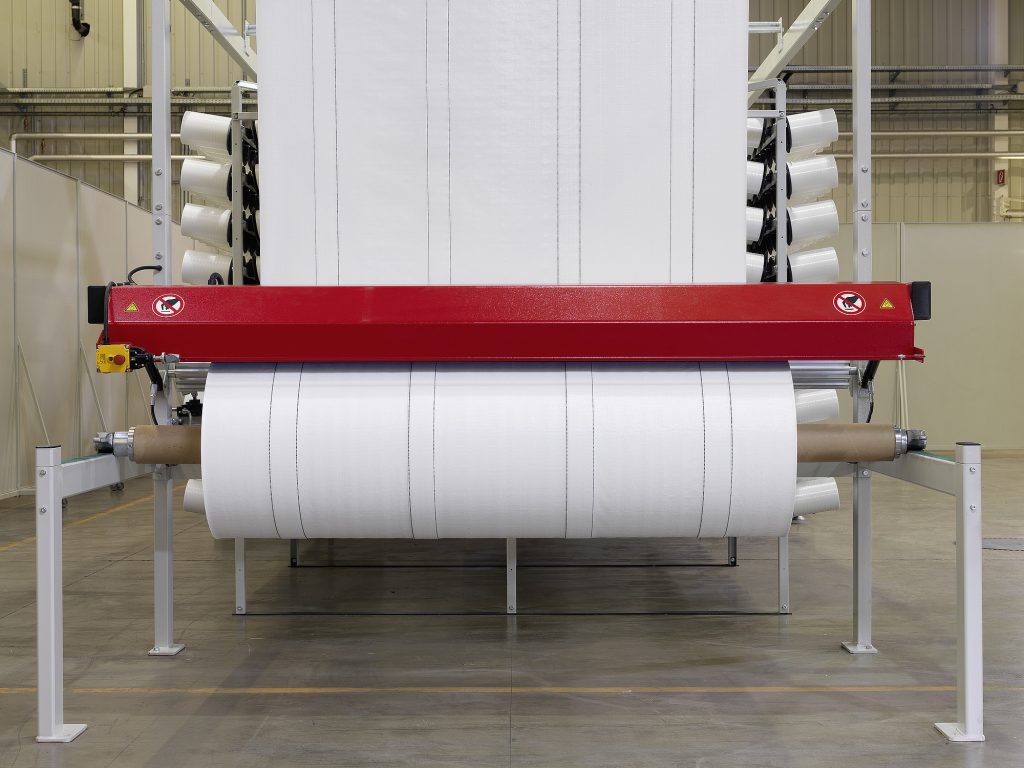
- Weaving—circular or flat looms interlace tapes into fabric. With finer tapes, picks per inch rise; loom tension and take-up are tuned to avoid fibrillation.
- Coating/lamination—extrusion coatings close the weave and prep for print; for high-graphic SKUs, BOPP or PET laminations enable reverse printing and scuff control.
- Printing—water- or solvent-based flexo on coated fabric, or gravure under a film laminate; matte windows may be reserved for scanners.
- Cutting and sewing—panels cut, liners inserted if specified, seams sewn to a defined SPI; tear/crepe tapes added for easy-open performance.
- Quality checks—seam tensile and burst, drop tests, print AQL, COF of contact faces, liner leak tests when used.
- Palletization and conditioning—bundles wrapped and stored within moisture bands that keep paper labels and coated panels flat.
Applications by sector: matching structures to use-cases
Use cases reveal the design logic behind SOM PP Bags. The aim is not one universal build, but a set of patterns tuned to payload physics and lane abuse.
- Minerals and aggregates—calcium carbonate, silica sand, alumina, pellets. Coated SOM controls dust; fine fiber resists seam run-out under vibration.
- Agricultural inputs—fertilizers, soil amendments, seed, feed premixes. Print legibility and puncture resistance matter; optional liners for hygroscopic blends.
- Food ingredients—flours, sugar, pulses. SOM with liners delivers moisture control and strong handling on docks.
- Chemicals—resin pellets, salts, additives. Smooth panels aid labeling; denser weave resists pinholing.
- Retail garden & DIY—mulch, soil, aggregates. Graphics must survive outdoor merchandising; anti-slip faces stabilize pallets.
Health, safety, and regulatory cues
Health and safety in SOM PP Bags focus on three interfaces: the polymer fabric (and any coatings), the sewn seam, and, if present, the liner or laminate in food-facing roles. Programs over the past year have emphasized:
- Migration discipline—keep inks on the outside of films where used; for coated-direct print, use compliant ink systems and verify curing and rub resistance.
- Dust exposure control—fewer perforations and tighter weaves reduce airborne fines around packers; seams with crepe tape limit leakage paths.
- Worker safety—needle and thread choices that minimize heat-cut and broken filaments; anti-slip surfaces to reduce pallet incidents.
System thinking: decomposing constraints and recombining into a program
The right choice emerges when you break the decision for SOM PP Bags into five smaller questions and then recombine answers into a spec you can test.
- Barrier and moisture risk—what is the worst-case RH and dwell time? Choose coated-only vs. liner; with fine fiber, you may reduce coat weight while holding WVTR and dust targets.
- Mechanical abuse—what drop heights and corner contacts? Increase PPI or fabric mass; add reinforcement where pallets rub.
- Filling line reality—air vs. impeller, target BPM, powder aeration. Tune micro-perf density locally near the mouth; keep global perf count low.
- Brand and readability—barcode windows, matte/gloss balance, minimum font sizes on coated fabric vs. film laminate.
- End-of-life and optics—confirm local No. 5 options for mono-PP builds; communicate reuse and return schemes where curbside access is limited.
Integrate these answers into a measurable spec: fabric mass and PPI; coating/lamination type and weight; liner gauge if used; seam SPI and thread choice; print method and varnish; QC thresholds for drop, seam, COF, and dust loss. Then pilot with real pallets across target climates.
Technical parameters and tables
Numbers anchor programs. The following colored tables gather practical targets used in many SOM PP Bags specifications.
Decision trees by sector
Not every buyer faces the same constraints. These compact trees collapse debates into choices for SOM PP Bags.
Minerals and aggregates
- If sifting is the issue, raise PPI before raising coat weight; then add localized perforation only near the mouth.
- If corners split on pallets, add reinforcement patches and check seam SPI; consider a heavier fabric mass only after these steps.
Agri-inputs
- If branding scuffs, migrate to a film-laminated face with reverse print; keep matte windows for codes.
- If humidity drives caking, insert liners and reduce global perf counts; verify seal-through-contamination.
Food ingredients
- If hygiene is paramount, choose SOM + liner and audit seam cleanliness; consider pinch-sew hybrids where lines allow.
- If docks are rough, tune anti-slip and base patching; check drop and burst at rated masses.
Troubleshooting and continuous improvement
Every program encounters friction. The following patterns recur in field feedback on SOM PP Bags, with levers that solve them without ballooning cost.
- Skip stitches—verify needle profile and size; adjust SPI; ensure consistent fabric feed. Fine-fiber fabrics typically reduce skipping.
- Ballooning at fill—increase local perfs near the mouth; tune packer air; keep total perf count low to protect barrier.
- Delamination (if laminated)—raise tie-layer coat weight, correct nip pressure, and complete cure before conversion.
- Scanning failures—reserve matte print windows and adjust ink laydown; denser weaves support small, high-contrast codes.
Keyword plan and natural long-tail variants
Primary phrase: SOM PP Bags. Supporting vocab used organically: sewn open mouth polypropylene bags; sewn mouth woven PP sacks; stitched-mouth PP bags; SOM poly woven packaging; fine-fiber SOM sacks; fine-denier woven PP bags; coated SOM bags; laminated SOM bags; SOM bags with liners; heavy-duty sewn poly bags.
A worked specification blueprint
Objective: Launch a fertilizer family using SOM PP Bags across humid, mixed-mode lanes with high shelf legibility and fewer pallet losses.
- Fabric—90 g/m² fine-fiber woven PP at higher PPI.
- Coating—16–20 g/m² PP extrusion coat.
- Closure—SOM with crepe tape; SPI tuned after line trials.
- Liner—25–30 µm LLDPE; localized perfs only.
- Print—water-based flexo with matte code windows; optional film laminate for premium SKUs.
- QC—seam tensile fails in fabric; 8/10 drops @ 1.2 m; COF tuned to wrap; AQL on print; dust loss targets.
Integrate this blueprint with pallet-scale pilots, logging dust at the packer, seam behavior under vibration, scanner pass rates, and pallet stability in target climates. Iterate coating weight, SPI, and anti-slip until performance and cost converge.
From the title outward: SOM PP Bags — the benefits of fine fiber technology
Reasoning path: begin with payload physics (particle size, density, hygroscopicity). Map lane abuse and climate (drop heights, corner impacts, RH/temperature). Align fabric and weave (fine-denier tapes to raise PPI without mass penalties). Choose barrier strategy (coating, liner) proportional to risk, not habit. Engineer print surfaces and code windows (matte where scanners struggle). Validate closure at speed (SPI, needle, thread) and tune perforation for deaeration. Communicate end-of-life honestly; leverage down-gauging as the first environmental lever. Follow this sequence and SOM PP Bags built on fine fiber technology deliver durable, legible, and cleaner performance—often at equal or lower total mass—while keeping options open for mono-material recovery where infrastructure exists.
- Orientation: placing SOM PP Bags and fine fiber technology into a modern packaging playbook
- What are SOM PP Bags? definitions, scope, and everyday aliases
- The materials of SOM PP Bags: substrates, fibers, coatings, threads, and liners
- Feature set: what SOM PP Bags do better and why it matters
- Production flow: from resin to printed, stitched carriers
- Applications by sector: matching structures to use-cases
- Health, safety, and regulatory cues
- System thinking: decomposing constraints and recombining into a program
- Technical parameters and tables
- Decision trees by sector
- Troubleshooting and continuous improvement
- Keyword plan and natural long-tail variants
- A worked specification blueprint
- From the title outward: SOM PP Bags — the benefits of fine fiber technology
“Why should fertilizer manufacturers switch to multi-wall woven bags?” asked a procurement director at a recent agricultural trade show. “Because they combine unmatched durability, moisture resistance, and branding flexibility while reducing logistics costs by up to 30%,” answered Ray, CEO of VidePak. This exchange highlights the critical advantages of multi-wall woven bags in an industry where packaging integrity directly impacts product quality and supply chain efficiency.
Chemical fertilizers, prone to caking, moisture absorption, and degradation, demand packaging solutions that balance protection, sustainability, and cost. Multi-wall woven bags—constructed from layered polypropylene (PP) fabrics and functional liners—have emerged as the gold standard. For manufacturers like VidePak, a global leader in woven bag production since 2008, the challenge lies in optimizing material science and manufacturing precision to meet diverse agricultural needs. This report explores how multi-wall woven bags address these challenges, supported by technical insights, case studies, and VidePak’s proprietary innovations.
1. Technical Advantages of Multi-Wall Woven Bags
1.1 Structural Integrity and Material Science
Multi-wall woven bags typically comprise three layers:
- Outer Layer: PP woven fabric (90–120 gsm) with a tensile strength of 800–1,200 N/5 cm, resistant to abrasion and punctures.
- Middle Layer: Laminated BOPP film (15–20 µm) acting as a moisture barrier (water vapor transmission rate <5 g/m²/day).
- Inner Layer: Polyethylene (PE) liner (30–50 µm) to prevent chemical interactions and static buildup.
A 2024 study by the International Journal of Agricultural Packaging found that triple-layer designs reduce fertilizer caking by 45% compared to single-wall bags, particularly in humid climates like Southeast Asia.
1.2 Case Study: Urea Packaging in Vietnam
VidePak’s 120 gsm multi-wall bags with PE liners reduced moisture-induced clumping from 12% to 3% for a Vietnamese fertilizer producer. The bags’ UV-resistant coating also extended outdoor storage life from 3 to 8 months.
2. Functional Design for Agricultural Applications
2.1 Material Selection and Performance Metrics
| Parameter | PP Woven Fabric | BOPP Lamination | PE Liner |
|---|---|---|---|
| Tensile Strength | 1,100 N/5 cm (ASTM D5034) | 25 MPa (ASTM D882) | 18 MPa (ASTM D882) |
| Moisture Barrier | N/A | 0.8 g/m²/day (ASTM E96) | 0.2 g/m²/day (ASTM E96) |
| Chemical Resistance | Moderate | High | Excellent |
VidePak’s use of virgin PP resin ensures compliance with FDA and EU regulations for food-grade secondary packaging.
2.2 Customization for Niche Applications
- Fertilizers with High Salinity: Anti-corrosive PE liners prevent salt crystallization, a common cause of bag failure.
- Organic Fertilizers: Breathable mesh panels reduce anaerobic degradation, preserving microbial activity.
- Retail Packaging: 8-color flexographic printing enables high-resolution branding, with Pantone color accuracy ΔE < 2.
3. Manufacturing Excellence: The VidePak Edge
3.1 Precision Production Workflow
VidePak’s 100+ Starlinger circular looms and 30 lamination machines ensure:
- Weave Density: 14×14 strands per inch, achieving 98% puncture resistance (ISO 2231-2).
- Lamination Integrity: Peel strength ≥3.5 N/15mm (ASTM F88), critical for multi-layer adhesion.
- Printing Precision: 120-line/inch resolution for OSHA-compliant hazard labels and QR codes.
3.2 Quality Control Protocols
| Stage | Test Method | Acceptance Criteria |
|---|---|---|
| Extrusion | Melt Flow Index (ASTM D1238) | 3–5 g/10min |
| Weaving | Warp/Weft Alignment (ISO 2231) | ±1° tolerance |
| Lamination | Bond Strength (ASTM F88) | ≥3.5 N/15mm |
| Final Inspection | Burst Strength (ASTM D3786) | ≥35 psi |
4. Logistics and Sustainability Benefits
4.1 Supply Chain Optimization
- Stackability: Block-bottom designs increase pallet density by 25%, reducing shipping costs.
- Reusability: UV-stabilized bags withstand 3–5 reuse cycles, cutting packaging expenses by 40%.
4.2 Environmental Compliance
VidePak’s 30% recycled PP blends align with the EU’s Circular Economy Action Plan, reducing carbon footprint by 35% compared to virgin plastic. A 2025 lifecycle analysis by Packaging World confirmed that multi-wall bags generate 60% less landfill waste than single-use alternatives.
5. Parameter Selection Guide
5.1 Key Considerations
| Application | Fabric Weight (gsm) | Coating | Inner Liner |
|---|---|---|---|
| Granular Fertilizer | 100–120 | BOPP | 30µm PE |
| Powdered Fertilizer | 120–150 | Anti-static BOPP | 50µm PE with vent |
| Liquid Additives | 150+ | PE extrusion coating | Aluminum foil |
5.2 Cost-Benefit Analysis
- Non-laminated bags: Ideal for dry climates, saving $0.10/bag.
- Multi-layer laminates: Justify a 25% price premium in humid regions by reducing spoilage losses.
6. Industry FAQs
Q1: How does BOPP lamination enhance performance vs. standard PP?
A: BOPP-laminated bags offer 5x better moisture barrier properties and 60% higher print clarity due to the film’s smooth surface.
Q2: Are these bags compatible with automated filling systems?
A: Yes. VidePak’s Form-Fill-Seal (FFS) bags integrate with Bosch and Siemens systems, achieving 120 bags/minute throughput.
7. Future Trends: Smart and Sustainable Innovations
VidePak is piloting biodegradable PP blends (50% plant-based resin) and RFID-tagged bags for real-time moisture tracking—technologies projected to capture 15% of the fertilizer packaging market by 2027.
External Resources
- Discover how multi-wall laminated woven bags ensure safety in chemical packaging.
- Explore sustainable practices aligning with global ESG standards.
For fertilizer producers navigating regulatory complexity and climate volatility, multi-wall woven bags are not just containers—they are strategic assets. By marrying Austrian engineering with agro-industry expertise, VidePak continues to redefine packaging efficiency, one layer at a time.

ppp