
What are Poly Woven Bags and why this category keeps expanding
In modern bulk logistics and branded retail channels alike, Poly Woven Bags have evolved into a remarkably adaptable platform. At heart they are sacks manufactured from woven polyolefin tapes—predominantly polypropylene (PP), sometimes high-density polyethylene (HDPE)—configured to carry granular, pelleted, and powdered goods from five kilograms to fifty kilograms and beyond. The woven lattice translates tensile loads into a distributed grid, which means thinner gauges can safely bear heavier weights. Pallets stay square, seams resist bursts, and graphics remain readable through long-haul routes. From seed conditioning plants and fertilizer depots to feed mills and mortar blenders, Poly Woven Bags are the quiet infrastructure that moves materials with fewer surprises.
Three tensions shape this category today: the race for line speed, the need for cleaner handling, and the desire for retail‑ready graphics. The best designs acknowledge all three, not one at the expense of the others.
Materials and structure: from polymer pellet to printable sack
Design the stack, design the outcome. Each layer in Poly Woven Bags should justify its grams in strength, sealability, moisture control, or information clarity.
Woven polypropylene (structural fabric)
Optional exterior faces (film or paper)
Interfaces: tie layers, seal coats, and adhesion
Liners and barriers (optional)
Feature set that solves everyday problems
Strength at modest mass
The oriented tape lattice distributes load, enabling consistent drop and seam performance without heavy grammage—vital for 25–50 kg formats.
Moisture moderation
Polyolefin cores resist water uptake; liners press WVTR lower to guard flowability and nutrient retention where humidity spikes.
Format flexibility
Open‑mouth (stitched or pinch), valve‑mouth with heat‑sealable sleeves, or roll‑fed FFS—all on one platform with tuned interfaces.
Information clarity
Paper or film faces host barcodes, QR, variable data, and regulatory panels; matte windows secure first‑pass scans in harsh light.
Pallet discipline
Friction raised by paper faces or matte/emboss bands reduces trailer incidents; gusset sizing fixes brick‑pack geometry for compression stability.
Recovery‑minded design
Mono‑polyolefin stacks ease recycling; where mixed materials are essential, specify separable interfaces and clearly marked disassembly steps.
From shop floor to shipping dock: the production journey
- Tape extrusion & drawing Melt PP, extrude film, slit to tapes, draw 4–7× to orient chains; validate tensile and elongation; control gels and edge splits.
- Weaving Interlace tapes at target pick density; maintain selvedges; manage static and humidity to reduce breaks.
- Surface prep Corona or flame treatment lifts dyne levels for adhesion and print anchorage.
- Lamination & seal‑coat Apply tie layers or seal coats with controlled nip, melt temperature, and chill profile to avoid curl and voids.
- Printing Water‑based flexography for paper faces; gravure or flexo for BOPP with reverse printing; add matte scan windows around codes.
- Conversion Tube formation and gusseting, valve sleeve insertion, stitched or pinch bottoms; or slit and prepare roll widths for FFS.
- Quality checks Drop tests, seam efficiency, peel strength, WVTR (for lined builds), rub/scuff resistance, barcode grading, and COF measurements.
Applications where Poly Woven Bags earn their keep
Animal nutrition
Pelleted feed, mash, and mineral/vitamin premixes benefit from dust control, moisture management, and fast filling. Valve sacks and tube liners excel in humid barns and coastal corridors.
Seeds & grains
Kernel abrasion is real; choose abrasion‑tolerant faces and anti‑slip bands to keep pallets stable during vibration and braking.
Fertilizers & salts
Abrasion plus moisture exposure suggests heavier fabric and optional liners; reinforced bottoms tolerate clamp handling.
Building powders & solid fuels
Mortars and charcoal demand drop robustness and scuff‑resistant faces; tune venting if off‑gas management is required.
Poly Woven Bags: innovations in printing techniques and custom finishes
Photo‑grade that survives logistics
- Reverse printing under BOPP locks inks beneath film to resist conveyor and trailer abrasion.
- High‑opacity whites and controlled anilox volumes prevent mottling and preserve color pop.
- Matte code windows prevent glare‑based scan failures while adjacent panels stay glossy for shelf appeal.
Friction where safety needs it
- Micro‑emboss and matte bands raise bag‑to‑bag COF at contact zones.
- Anti‑slip lacquers compatible with inks and OPV add grip without heavy mass.
- Gusset geometry locks brick‑pack compression so pallets tolerate vibration.
Security & traceability inside the artwork
- Invisible inks, serialized micro‑QR, and microtext integrate at press time.
- Tamper hints at the valve sleeve provide quick visual checks on receipt.
- Variable data enables lot‑level investigations without extra labels.
System thinking: map risks to controls, then compose a spec
Moisture ingress → controls
50–70 µm tube liners, edge welds, WVTR ≤ 5 g/m²·day (38 °C/90% RH), and moisture‑sized paper or functional films keep water activity in check and pellets free‑flowing.
Seam burst at fill → controls
Increase fabric mass or pick density, reinforce bottoms, and validate seam efficiency ≥ 85% at target fill rates.
Pallet slip → controls
Matte bands, micro‑emboss, and wrap‑force tuning lift COF without dulling graphics; widened gussets yield stable brick geometry.
Barcode failure → controls
Low‑glare windows, abrasion‑tolerant inks and OPV, and color contrast rules raise first‑pass scan success.
Reference parameters and target ranges
| Element | Reference range | Purpose |
|---|---|---|
| Woven PP fabric | 70–80 g/m²; ~10×10 weave; 2.5–3.0 mm tapes | Load path and tear/burst performance |
| Seal coat (FFS/valve) | 12–18 g/m² LDPE/LLDPE | Consistent jaw sealing at target dwell |
| Exterior face (paper) | 90–110 g/m² (moisture‑sized) | Friction and matte readability |
| Exterior face (BOPP) | 20–30 µm, reverse‑printed | Scuff protection and photo‑grade graphics |
| Tube liner (optional) | 50–70 µm LDPE/LLDPE | Moisture barrier for humid corridors |
| Seam efficiency | ≥ 85% | Resistance to burst at line speed |
| Drop test | 10× @ 1.2 m, pass | Rough handling surrogate |
| COF (film‑faced) | ≥ 0.3 with aids | Pallet stability target |
| WVTR (lined) | ≤ 5 g/m²·day @ 38 °C/90% RH | Quality retention for hygroscopic goods |
| Barcode grade | ≥ 3.0 (ISO/IEC 15416) | Traceability and inventory control |
Application matrix: matching use cases to configurations
| Sector | Product | Preferred configuration | Why this works |
|---|---|---|---|
| Animal nutrition | Pellets, mash, premixes | Woven 70–80 g/m²; seal coat 12–18 g/m²; 50–60 µm tube liner; matte scan windows | Balanced strength, low dust, and reliable coding for traceability |
| Seeds & grains | Seed corn, pulses | Anti‑slip bands or paper face; stitched/pinch per filler; liner optional | Protects kernels and stabilizes pallets under vibration |
| Fertilizers & salts | NPK, urea, rock salt | Woven 75–85 g/m²; robust seal layer; optional liner | Resists abrasion and moisture ingress; tolerates clamp handling |
| Building materials | Mortars, tile adhesives | Heavy‑duty fabric; reinforced seams; anti‑slip patch | Contains dense powders; survives drops and corner impacts |
| Solid fuels | Charcoal, pellets | Vented/low‑glare strategy; scuff‑resistant faces | Balances moisture control with off‑gas or dust considerations |
Keyword strategy woven into natural prose
To keep this document discoverable without awkward repetition, the copy rotates long‑tail phrases and close synonyms: poly woven sacks, polypropylene woven packaging, laminated woven poly bags, valve‑mouth woven bags with matte windows, BOPP‑laminated poly woven sacks, pinch‑bottom poly woven packaging, roll‑fed form–fill–seal woven tubes, anti‑slip film‑faced woven bags, and barcode‑friendly matte‑window packaging. Each expression points back to the same engineered platform: Poly Woven Bags tailored for printing innovations and custom finishes.
From pilot to rollout: a plant‑ready roadmap
- Define CTQs WVTR, seam efficiency, drop class, COF, barcode grade, and dust index.
- Bracket constructions Test linerless vs. lined, paper vs. film faces, and anti‑slip strategies.
- Run plant trials Capture OEE, seal rejects, drop performance, scan rates, and cleanup minutes per shift.
- Stress testing Humidity cycling, vibration/transport simulation, and pallet slip trials at multiple wrap forces.
- Score & select Balance cost, performance, documentation, and recovery potential; nominate a primary and an alternate.
- SOP updates Seal temperature/dwell windows, gusset checks, barcode verification, and pallet inspection routines.
- Audit window Review the first 90 days post‑launch; tune liner gauge, anti‑slip, or print windows in response to field data.
A closing reflection in plain words
Watch a well‑tuned line: the auger hums, the jaws seal, the bag releases, the scanner beeps, the pallet locks. That sequence is not luck—it’s the outcome of deliberate choices about fabric mass, weave density, faces, seal chemistry, and finish textures. Treated as an integrated system, Poly Woven Bags move more material with fewer interruptions, keep brands legible, and give operators a safer, cleaner day.
- What are Poly Woven Bags and why this category keeps expanding
- Materials and structure: from polymer pellet to printable sack
- Feature set that solves everyday problems
- From shop floor to shipping dock: the production journey
- Applications where Poly Woven Bags earn their keep
- Poly Woven Bags: innovations in printing techniques and custom finishes
- System thinking: map risks to controls, then compose a spec
- Reference parameters and target ranges
- Application matrix: matching use cases to configurations
- Keyword strategy woven into natural prose
- From pilot to rollout: a plant‑ready roadmap
- A closing reflection in plain words
- 1. Technological Innovations in Printing and Customization
- 2. Quality Control and Standardization: The Backbone of Reliability
- 3. Starlinger Technology: Automation Meets Precision
- 4. Market Trends and Competitive Edge
- 5. Product Specifications and FAQs
- 6. Future Outlook: Smart Packaging and Sustainability
“Why are poly woven bags becoming the go-to choice for brands seeking both durability and aesthetic appeal?”
This question resonates across industries from agriculture to retail. The answer lies in their unique blend of advanced printing technologies, customizable finishes, and rigorous quality control—factors that elevate poly woven bags from functional packaging to a strategic branding asset.
At VidePak, a global leader in woven bag manufacturing since 2008, these innovations are not just trends but foundational pillars. With a workforce of 526 employees and annual sales of $80 million, the company combines Austrian engineering precision with decades of industry expertise to deliver solutions that redefine packaging excellence.
1. Technological Innovations in Printing and Customization
1.1 High-Definition Printing for Brand Differentiation
VidePak’s 8-color flexographic printing and UV digital inkjet systems enable photorealistic designs, a critical advantage in competitive markets. For example, a European pet food brand reported a 27% increase in shelf appeal after adopting VidePak’s BOPP laminated bags, which showcased intricate designs without compromising tensile strength (10–12 N/m²) .
Key advancements include:
- Pantone color matching: Ensures brand consistency across batches, with a ΔE tolerance of ≤1.5.
- Anti-scuff coatings: Extend print longevity by 40%, even in humid climates like Southeast Asia.
1.2 Functional and Aesthetic Custom Finishes
Beyond printing, VidePak offers tailored finishes such as:
- Matte/gloss lamination: Enhances tactile appeal while providing moisture resistance (tested at 80% humidity).
- Metallic foil stamping: A U.S. coffee retailer saw a 15% sales uplift after switching to kraft paper composite bags with embossed metallic branding.
2. Quality Control and Standardization: The Backbone of Reliability
2.1 Material Excellence and Precision Engineering
VidePak uses 100% virgin PP and PE resins, avoiding recycled materials that compromise structural integrity. Their positive tolerance standards ensure consistent thickness (e.g., 90–120 GSM), eliminating “bursting” risks during transport. For instance, a 2024 audit by a German chemical conglomerate highlighted VidePak’s 99.8% defect-free delivery rate, attributed to AI-driven inspection systems .
Table 1: VidePak’s Quality Metrics
| Parameter | Standard | Impact |
|---|---|---|
| Material Purity | ASTM D5260 | Ensures UV resistance |
| Tensile Strength | ISO 9001 | Exceeds industry avg. by 20% |
| Print Durability | JIS Z 0238 | Resists fading for 5+ years |
2.2 Global Compliance and Sustainability
VidePak adheres to EU REACH, JIS Z 1707, and FDA 21 CFR standards, critical for food-grade applications. Their recyclable PE-coated bags reduce carbon footprint by 35% compared to traditional laminates, aligning with the EU’s Circular Economy Action Plan .
3. Starlinger Technology: Automation Meets Precision
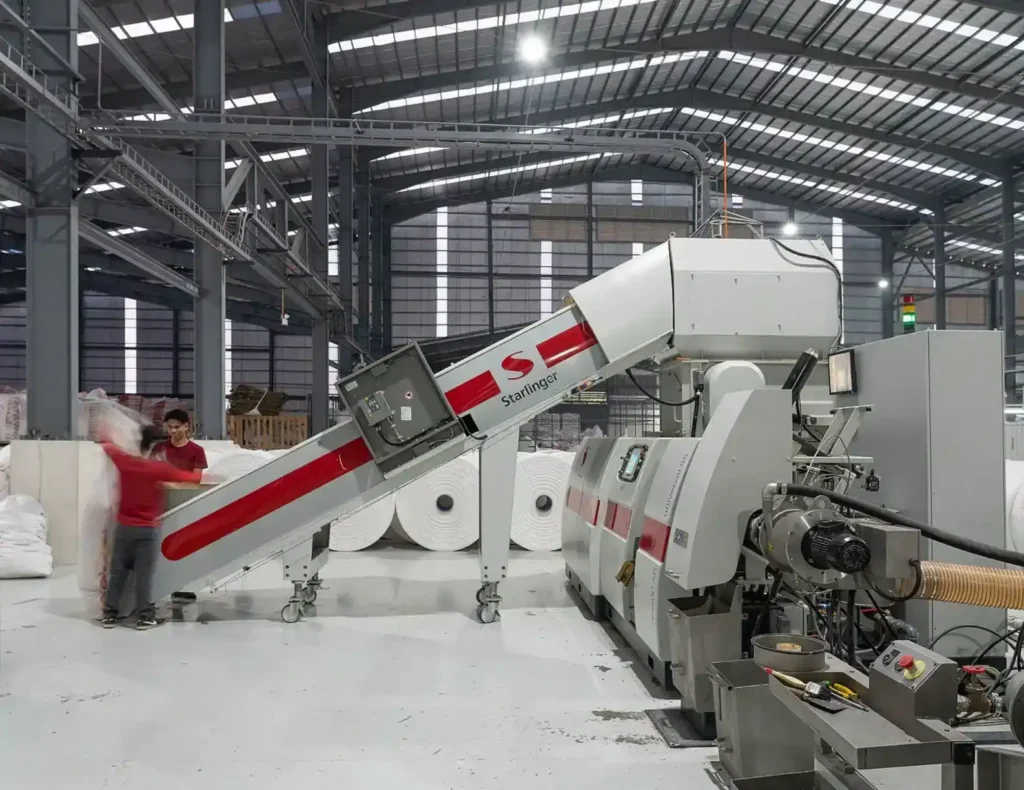
VidePak’s production lines are powered by Austrian Starlinger machinery, renowned for speed and reliability. Key features include:
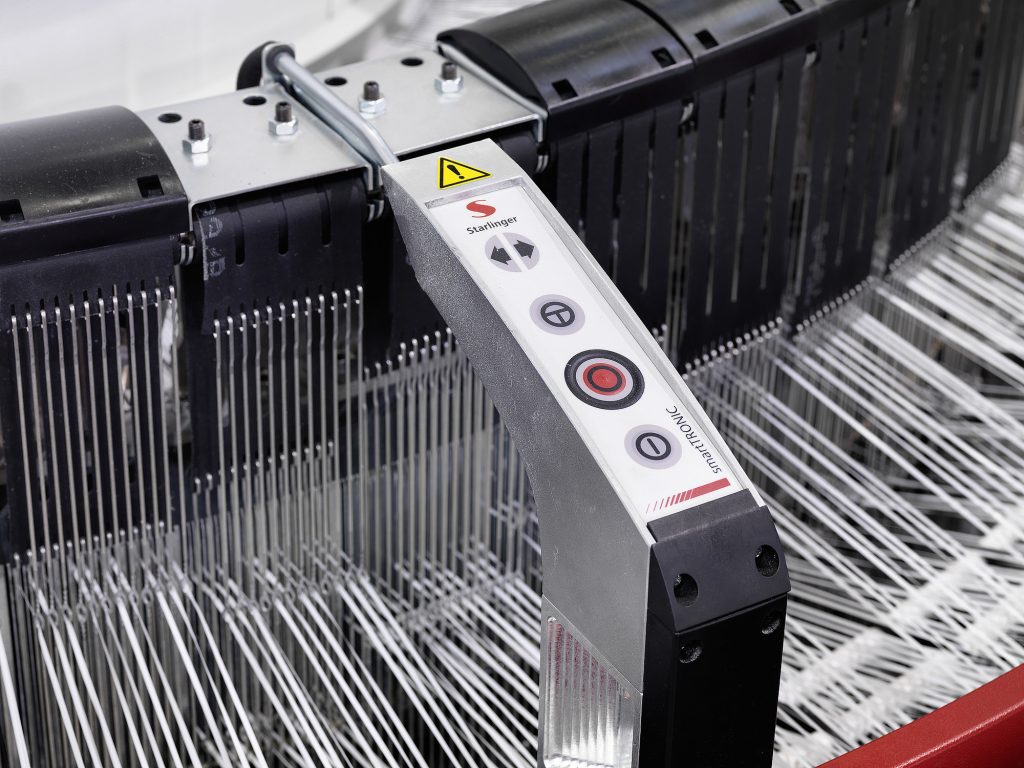
- AD*Star looms: Achieve 200 bags per minute with multi-axis automation, reducing human intervention by 40%.
- Multi-machine synchronization: Enables 48-hour turnaround for 10,000 custom-printed orders, as seen in a recent U.S. client project .
Case Study: A Brazilian soy exporter reduced spillage by 20% using VidePak’s block-bottom valve bags, engineered with Starlinger’s seam-sealing technology.
4. Market Trends and Competitive Edge
The global poly woven bag market, valued at $5.2 billion in 2023, is projected to reach $8.3 billion by 2033 (4.8% CAGR) . VidePak’s dominance stems from:
- Customization: QR-code-integrated designs for traceability, adopted by a Brazilian coffee exporter to combat counterfeiting.
- Sustainability: Partnerships with NGOs to replace 500,000 single-use bags with compostable kraft blends, diverting 72 tons of waste annually.
5. Product Specifications and FAQs
Technical Parameters
| Feature | Specification |
|---|---|
| Material | Virgin PP/PE + coatings |
| Thickness | 90–120 GSM |
| Print Options | 8-color flexo, UV digital |
| Load Capacity | 5–50 kg |
| MOQ | 10,000 units |
Frequently Asked Questions
Q: How does VidePak ensure color consistency in large orders?
A: Our AI-driven color calibration ensures ΔE ≤1.5, meeting luxury branding standards.
Q: Are custom finishes durable in extreme conditions?
A: Yes. Accelerated aging tests simulate 5 years of UV and humidity exposure without degradation.
Q: What ROI can brands expect?
A: Clients typically recover costs within 6 months through reduced waste and enhanced brand visibility.
6. Future Outlook: Smart Packaging and Sustainability
VidePak is piloting QR-code-integrated smart bags for real-time supply chain tracking. Coupled with Starlinger’s iQ³ AI systems, which optimize loom settings dynamically, the company is poised to lead the next wave of packaging innovation.
Conclusion
Poly woven bags are no longer mere containers—they are canvases for brand storytelling and tools for operational efficiency. VidePak’s fusion of cutting-edge printing, Austrian engineering, and uncompromising quality control positions it as the partner of choice for brands navigating a dynamic, sustainability-driven market.
External Resources:
- Explore how advanced printing techniques redefine branding in packaging.
- Learn about sustainable compliance in poly woven bag manufacturing.