
What are Block Bottom Valve Bags?
Block Bottom Valve Bags are square‑profile industrial sacks that marry a rigid, self‑standing base with a compact filling interface, the valve sleeve. When powders or granules are dosed at speed, the geometry holds a near‑rectangular footprint that stacks straight, cubes containers densely, and keeps aisles tidy. The design integrates form stability, de‑aeration pathways, and swift closure into a single packaging component that behaves like a small, predictable container rather than a soft, bulging pillow.
In practical terms, Block Bottom Valve Bags are built from a woven polypropylene backbone—often laminated for graphics and moisture control—with a square bottom created by precision creasing and folding. The valve (friction, heat‑sealable, or ultrasonic‑sealable) couples to a filler spout to move product quickly while minimizing dust plumes. Because the bag stands “square,” pallet loads remain inside their intended footprint, reducing wrap use and topple risk during transport.
Also known as (aliases):
- PP woven block‑bottom valve sacks
- Square‑bottom valve bags
- Form‑stable woven valve sacks
- AD*STAR‑type valve bags
- BOPP‑laminated woven valve bags
- Paper‑laminated woven valve sacks
The materials of Block Bottom Valve Bags
If a bag is a system, then every layer is a subsystem. The stack in Block Bottom Valve Bags exists to put strength where it belongs, barrier where it helps, friction where it matters, and print where it persuades. Below, each layer’s role, trade‑offs, and cost levers are unpacked.
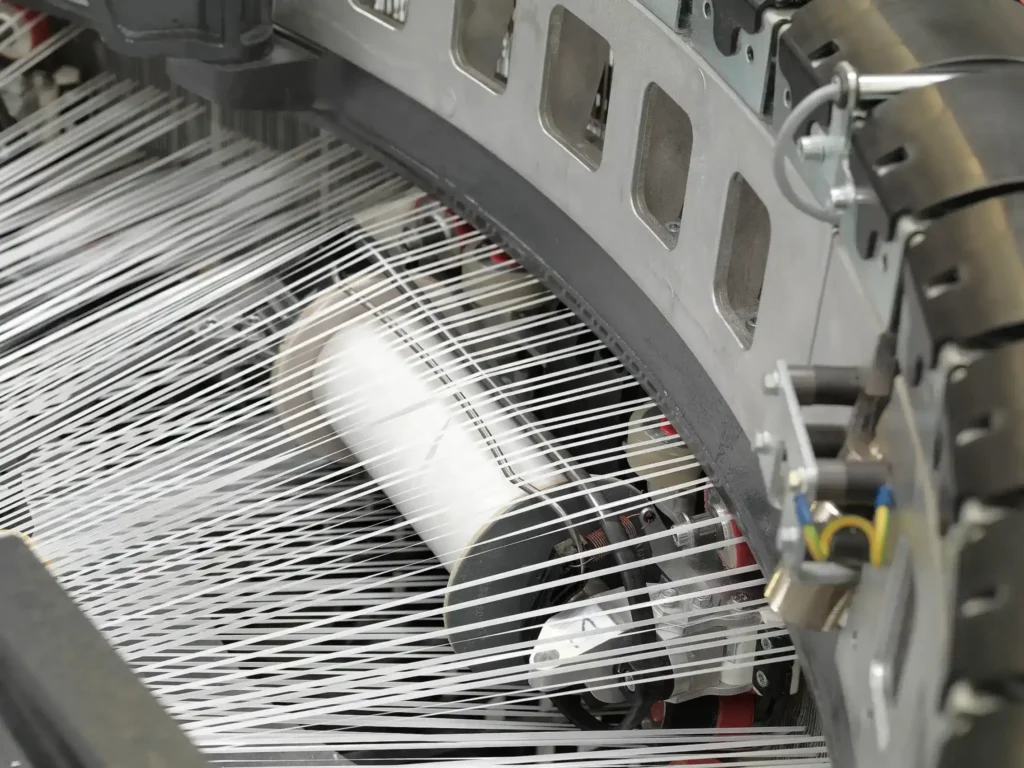
1) Woven polypropylene (PP) fabric — structural backbone
Polypropylene pellets are melted, cast as a thin film, slit into tapes, and drawn to align polymer chains. Those oriented tapes are woven into fabric on circular or flat looms. For 25–50 kg formats, body fabric commonly ranges 80–115 g/m²; bottom and corner zones may run heavier for edge‑drop survival. Why PP tapes? Because they deliver high tensile‑to‑weight, robust tear resistance, and excellent flex‑crack endurance on conveyors—while taking up little moisture. With UV stabilizers, staged pallets tolerate sun exposure far better than paper‑only sacks.
Cost levers: resin index, tape denier (yield), loom productivity, waste capture, and additive packages (UV, slip). Heavier GSM improves drop performance but adds tare; striking the balance depends on bulk density, route roughness, and stack height.
2) Exterior faces — film laminate or paper laminate
Film route (BOPP 18–35 µm): Biaxially oriented polypropylene laminated to the fabric enables high‑definition graphics and a low‑permeability splash barrier. Gloss favors shelf appeal; matte and anti‑slip finishes add friction and scuff resistance, a boon for pallet stability and label longevity.
Paper route (kraft 60–100 g/m²): A tactile, high‑friction paper face laminated to woven PP is preferred when handlers want grip and a paper look/feel. It squares up stacks and accepts flexographic inks well, though it complicates plastic‑only recycling unless fiber‑plastic separation exists.
Cost levers: film gauge and color count for BOPP; basis weight and varnish/anti‑scuff for paper. Rich artwork raises ink coverage but can support premium product lines by carrying detailed regulatory text and crisp branding.
3) Valve sleeve and mouth components
Valve sleeves are typically PP/PE films or coated woven PP. Designs range from self‑closing (friction) to heat‑ or ultrasonic‑sealable (hermetic). Extensions, tabs, and petal/flap elements tailor the seal, while vent channels accelerate de‑aeration. Sleeve geometry must match spout design and product flow—impeller fillers for cement behave differently from auger fillers for premixes.
Cost levers: sleeve film gauge and length, sealing hardware (if specified), and conversion time to fit and align sleeves consistently.
4) Inner liners and coatings — moisture & dust control
LDPE/LLDPE liners (30–80 µm) reduce moisture vapor transmission and contain fines. Skirted or duffle mouths enable hermetic closure with minimal needle holes. Woven fabric may also carry thin PP/PE extrusion coatings to curb sifting through the weave and to present weldable interfaces at the mouth or bottom.
Cost levers: liner gauge, anti‑block/slip additives, and whether liners are attached (cleaner, faster) or loose (cheaper, flexible).
5) Functional additives and finishes
- UV stabilizers in PP tapes for outdoor staging resilience.
- Anti‑slip textures/varnishes on exteriors to hit a target coefficient of friction (COF).
- Micro‑perforations or breathable valve patches for controlled venting at speed.
- Antistatic packages in liners/faces when combustible dusts are plausible.
- Easy‑open tear tapes for job‑site ergonomics.
In Block Bottom Valve Bags, structure, barrier, friction, and print are orchestrated. The aim is not a maximalist stack, but a tuned stack that meets your climate, dwell, and speed—no more, no less.
Square‑bottom valve bags; AD*STAR style sacks; BOPP‑laminated woven valve sacks; paper‑laminated valve sacks; 25–50 kg construction bags; moisture‑moderated valve packaging.
What are the features of Block Bottom Valve Bags?
Features only matter if they change outcomes—throughput, safety, cleanliness, cost. The signature traits of Block Bottom Valve Bags are mapped to the problems they solve.
- Form stability → taller stacks, safer aisles. Flat faces and a square base keep loads inside the pallet edge, reducing creeping layers and wrap consumption.
- Valve‑enabled speed → fewer stoppages. Spout engagement is quick; de‑aeration is controlled; closures are fast. Ballooning and mouth reseats plummet.
- Moisture moderation → fewer caking claims. Laminates and liners lower MVTR, while sealed valves remove stitch‑hole wicking—a stealth moisture path in sewn formats.
- Print fidelity → readable labels after abuse. BOPP supports fine, regulatory text and barcodes; matte/anti‑scuff finishes keep panels legible after miles of conveyors.
- Friction control → lower wrap and less topple risk. Target COF means layers align with less film, fewer corner boards, and fewer emergency re‑stacks.
- Design‑for‑recycling → simpler end‑of‑life. Mono‑PP builds fit polymer streams where available; paper‑laminated variants suit regions with paper‑poly separation.
| Feature | Operational outcome | Metric to track |
|---|---|---|
| Square bottom & face stiffness | Straighter stacks; improved cube | Max safe layers; payload per container |
| Valve sleeve w/ vent strategy | Higher sustained bags/min; less dust | BPM at peak; dust extractor load |
| Laminate + liner | Lower humidity ingress | Caking/returns; laminate MVTR coupons |
| Matte/anti‑slip exterior | Less wrap; fewer leaning pallets | Wrap grams/pallet; leaning returns |
| Rub‑resistant print | Readable labels after handling | Barcode scan rate; rub test passes |
What is the production process of Block Bottom Valve Bags?
From pellets to pallet‑ready sacks, the flow is a chain of tolerances. Where variation creeps in, failures show up later as seam bursts, mouth reseats, or leaning stacks. Here is a process map with the failure modes it actually prevents.
- Tape extrusion & drawing. Melt PP, slit, and draw tapes to a target denier. Control here prevents weak tapes that underperform in seams and drops.
- Weaving. Looms set GSM and mesh density. Tighter meshes limit sifting but can slow de‑aeration unless venting is planned elsewhere.
- Coating/lamination. Extrusion coatings reduce sifting and create weldable interfaces; BOPP or paper laminates add print fidelity and surface properties.
- Printing. Apply artwork and regulatory panels on the web pre‑combine for crispness. Reserve quiet zones for QR/lot codes away from high‑scuff paths.
- Tube forming & block‑bottom conversion. Gusset, crease, fold, and weld/stitch the bottom. Dimensional accuracy here drives pallet stability.
- Valve sleeve insertion & finishing. Fit, align, and, if specified, prep for ultrasonic or heat sealing. Add dust skirts or petal closures where hygiene is paramount.
- Liner fitment (optional). Loose liners are inserted and aligned; attached liners are tacked to prevent slip during fill.
- Quality control. Verify tensile/tear, seam strength, drop tests, compression dwell, COF, print rub, and valve leak rate. Traceability marks close the loop.
What is the application of Block Bottom Valve Bags?
Block Bottom Valve Bags earn their keep in categories where density is high, dust is abrasive, and stacks are tall. The following use‑cases illustrate why the geometry and valve matter as much as material choice.
- Cement & blended cements. Fast impeller filling; high pallet stability; excellent container cube. Coastal lanes favor liners and sealed valves to moderate humidity.
- Dry mortar & tile adhesive. Angular fillers punish weak faces—matte BOPP or paper faces with heavier bottoms thrive. Valve sleeves matched to impeller flows maintain speed.
- Gypsum & plaster. Fine, dusty products benefit from antistatic measures and tuned venting. High‑contrast label zones stay legible in chalky environments.
- Fertilizers & soil amendments. Hygroscopic urea and NPK blends call for liners and sealed valves in humid climates. Square geometry prevents leaning on tall stacks.
- Mineral salts & abrasives. Reinforced corners and scuff‑resistant faces reduce edge wear; friction‑tuned exteriors lower wrap consumption.
- Agro‑feeds & grains. When legibility, speed, and pallet stability outrank the last cent of unit price, valve formats outperform sewn open‑mouth sacks.
| Product profile | Recommended format | Body GSM | Exterior face | Liner strategy | Closure | Notable options |
|---|---|---|---|---|---|---|
| Portland cement (export, humid) | Square block‑bottom valve | 95–110 g/m² | Matte BOPP | Attached LLDPE 40–60 µm | Ultrasonic‑sealable valve | Desiccants; UV package |
| Portland cement (domestic, dry) | Block‑bottom valve | 85–100 g/m² | Matte BOPP | Optional seasonal loose liner | Self‑closing valve | Micro‑perfs tuned for speed |
| Dry mortar & tile adhesive | Block‑bottom valve | 95–115 g/m² | Scuff‑resistant matte BOPP or paper | Optional liner | Sealed valve | Reinforced bottom; wear patches |
| Gypsum/plaster | Block‑bottom valve or gusseted | 80–95 g/m² | Smooth/matte | Attached co‑ex tube | Heat‑sealed top or sealed valve | Antistatic package; dust skirt |
| Urea/NPK (hygroscopic) | Block‑bottom valve | 90–110 g/m² | Matte BOPP | Attached liner; skirted mouth | Sealed valve | Reduced micro‑perfs; sealed seams |
| Mineral salts (angular) | Block‑bottom valve | 100–120 g/m² | Matte BOPP or paper‑laminated | Optional liner | Self‑closing or sealed valve | High‑friction layer sheets |
Block Bottom Valve Bags: design → technology → applications (reasoned pathway)
The title points to a three‑part logic: how we design, how we make and run, where we deploy. Thinking like this prevents accidental trade‑offs.
Square base; stiff faces; tuned COF; laminate/liner to hit MVTR; valve style to suit spout and cleanliness goals. Geometry dictates stacking; venting dictates speed.
Conversion lines with precise creasing; sealing tech (heat/ultrasonic); fill heads matched to valves; palletizers and wrap recipes aligned to COF and stack height.
Cement and dry mixes; plaster and gypsum; fertilizers and salts; select agro‑feeds. The common requirement is square stability under load and controlled dust at the spout.
Systems analysis & synthesis (turn dials deliberately)
Break the decision into six sub‑problems; solve each with specific parameters; then recombine into one specification for Block Bottom Valve Bags.
- Integrity (moisture, caking, dust). MVTR targets, liners, and sealed valves suppress humidity ingress and sift paths. Place micro‑perfs where they vent during fill but don’t invite rain splash.
- Mechanics (drop, stack, puncture). Body GSM, bottom reinforcement, and corner wear patches survive drops and racking compression. Matte faces prevent layer creep.
- Operations (throughput, ergonomics). Mouth presentation, sleeve geometry, vent channels, and dust skirts are the banishers of reseats and broom‑and‑vac time.
- Compliance (marking, traceability). High‑contrast panels, rub‑resistant inks, and protected barcode zones preserve regulatory readability after conveyor abuse.
- Sustainability (recyclability, r‑content). Mono‑PP stacks simplify polymer recovery; paper‑laminated routes fit fiber‑plastic separation markets. rPP belongs in non‑critical layers first.
- Cost to serve (system, not unit). Model cube gains, wrap reductions, loss avoidance, and labor changes. In many lanes, geometry economics swamp small unit‑price deltas.
| Spec dial | Typical window | Why it matters |
|---|---|---|
| Bag‑to‑bag COF | 0.35–0.55 | Stack stability vs. handling friction |
| Laminate/liner MVTR | As required by climate/dwell | Anti‑caking; shelf‑life |
| Seam strength | ≥ 300 N/10 cm (program target) | Conveyor drops; corner impacts |
| Valve leak rate | E.g., <0.5% sift/24 h | Pallet hygiene; loss control |
| QC step | Check | Failure it prevents |
|---|---|---|
| Drop testing | Flat/edge/corner at set heights | Seam bursts; bottom splits |
| Compression dwell | Stack load & time profile | Lean; layer creep |
| Print rub | Post‑conveyor readability | Illegible labels; audit issues |
| Valve leak | Sift % after closure | Dusty pallets; customer complaints |
Comparative positioning (alternatives and trade‑offs)
Against pillow‑style open‑mouth woven sacks, Block Bottom Valve Bags win on cube and cleanliness, often tying on unit weight when GSM is optimized. Against multi‑wall paper valve bags, they resist scuff and wet handling better, although paper can be advantageous in regions with strong fiber recovery. Against heavy‑duty PE valve bags, they trade a bit of hermeticity for better puncture resistance unless film gauges are raised. And compared with FFS tubular film, they give up some automation speed but gain stack geometry in abrasive powder lanes.
For background on filling interfaces and variants, see this concise overview of valve bags, which situates square‑bottom formats among related mouth designs.
Failure modes & fixes (symptom → cause → action)
- Leaning pallets → COF too low; bulge past pallet edge; wrap recipe off → raise COF (matte/varnish); tighten geometry; tweak wrap layers and tension; add corner boards.
- Mouth reseats & dust plumes → valve mis‑match to spout; vent too tight → resize sleeve; add vent channels or micro‑perfs; verify clamp pressure.
- Bottom blowouts → bottom GSM too light; fold seam weak → heavier bottom; hybrid weld+stitch; corner reinforcements.
- Label smudge → inks/varnish not rub‑resistant; text in scuff path → switch systems; move critical text to protected zones.
- Caking after coastal export → MVTR too high; stitch wicking; excessive micro‑perfs → attached liners; sealed valves; lower perf density; desiccant plan.
- Valve sift leaks → sleeve too short; no closure reinforcement → extend; add ultrasonic seal; petal/flap closures; verify leak rate in QA.
Worked examples (geometry pays for itself)
Container cube with cement. A shipper loading 40‑foot containers with 50‑kg cement moved from pillow‑style open‑mouth sacks to Block Bottom Valve Bags. Two extra layers fit at the same footprint—roughly a 20% payload bump. Freight per tonne fell by double digits, erasing the modest unit‑price premium.
Wrap and housekeeping. A dry‑mortar plant switched to matte‑face square‑bottom valve sacks and saw an 18% reduction in stretch‑wrap grams per pallet. Sealed valves and better vent tuning cut broom‑and‑vac time by ~40% around fill spouts.
Implementation roadmap (from RFQ to standard work)
- Define lanes & materials: bulk density; particle size; hygroscopicity; humidity/dwell; target stack height; containerization strategy.
- Select geometry & mouth: square block‑bottom as baseline; sleeve dimensions; sealing method (self‑closing vs. ultrasonic) matched to spout and cleanliness goals.
- Choose materials: body GSM; bottom reinforcements; exterior face (matte BOPP vs. paper); liner gauge and mouth (plain/duffle/skirted); UV package.
- Engineer venting: micro‑perfs or vent patches tuned to aeration; place away from rain splash; verify that MVTR targets hold.
- Artwork & traceability: high‑contrast regulatory panels; quiet zones for QR/lot; rub‑resistant systems validated after conveyor rub.
- Pilot across seasons: drop/stack tests; observe BPM, reseats, dust load, wrap usage, container payloads; iterate sleeve and vent geometry.
- End‑of‑life path: mono‑PP builds for polymer streams; paper‑laminated where fiber‑plastic separation exists; mark disposal clearly.
- Lock SOPs & train: visual work instructions; sealing/wrapping/inspection recipes; monthly audits through stabilization.
FAQ (engineer‑level, practical)
Are Block Bottom Valve Bags heavier than pillow sacks? Not inherently. Conversion and a valve sleeve add components, but optimized GSM can keep tare near parity while delivering better cube and stability.
Do valves slow filling? With properly sized sleeves and vent strategy, sustained bags‑per‑minute typically increase because ballooning and reseats are eliminated.
Is a liner mandatory? Climate and dwell decide. Dry inland routes with fast turnover can run tight laminates without liners; coastal export and monsoon storage favor attached liners and sealed valves.
Does a paper face hurt recyclability? In polymer‑only regions, mono‑PP is cleaner. Paper‑laminated routes fit markets that support fiber‑plastic separation. State the disposal path clearly on pack.
Can we standardize a footprint? Yes. A common L×W×H simplifies pallets, reduces plate changes, and improves container planning.
How about combustible dusts? Specify antistatic components and follow site procedures. Valve formats reduce dust escape, but static risk assessment still governs the operation.
Copy/paste RFQ checklist
- Format: Block Bottom Valve Bags — square bottom; valve sleeve (self‑closing / ultrasonic‑sealable).
- Size: L × W × H: ____ × ____ × ____ mm; nominal capacity ____ kg.
- Body fabric: ____ g/m²; bottom: ____ g/m²; UV package ____ h.
- Exterior face: BOPP gloss/matte or paper‑laminated; anti‑slip yes/no.
- Valve sleeve: inner/outer; length ____; sealing method ____; vent channels yes/no.
- Liner: loose/attached; gauge ____ µm; mouth (plain/duffle/skirted).
- Venting: micro‑perfs density ____; vent patch yes/no.
- Printing: ____ colors; QR/lot quiet zone; rub‑resistant varnish yes/no.
- Tests: drop; seam strength; compression dwell; valve leak; MVTR coupon; print rub.
- End‑of‑life: mono‑PP where possible; recycling marks; rPP target ____%.

- What are Block Bottom Valve Bags?
- The materials of Block Bottom Valve Bags
- What are the features of Block Bottom Valve Bags?
- What is the production process of Block Bottom Valve Bags?
- What is the application of Block Bottom Valve Bags?
- Block Bottom Valve Bags: design → technology → applications (reasoned pathway)
- Systems analysis & synthesis (turn dials deliberately)
- Comparative positioning (alternatives and trade‑offs)
- Failure modes & fixes (symptom → cause → action)
- Worked examples (geometry pays for itself)
- Implementation roadmap (from RFQ to standard work)
- FAQ (engineer‑level, practical)
- Copy/paste RFQ checklist
- 1. Design and Functional Advantages of Block Bottom Valve Bags
- 2. Global Market Dynamics and Regional Preferences
- 3. Competitive Edge of Chinese Manufacturers
- 4. Technological Innovations Driving Market Growth
- 5. Applications Across Industries
- 6. FAQs: Addressing Critical Concerns
- 7. Future Trends and Strategic Recommendations
“Why are block bottom valve bags increasingly replacing traditional packaging in industries like chemicals and construction?” This question, posed by a logistics manager at a recent trade conference, highlights the growing demand for efficient, durable, and sustainable packaging solutions. The answer lies in their unique structural design, advanced manufacturing technologies, and adaptability to global supply chain requirements—all of which are exemplified by VidePak’s expertise in producing high-performance block bottom valve bags.
1. Design and Functional Advantages of Block Bottom Valve Bags
Block bottom valve bags are characterized by their flat-bottomed, self-standing structure and integrated filling valve, which enable rapid filling, stacking stability, and dust-free discharge. This design is particularly suited for granular or powdered materials like cement, fertilizers, and feed additives.
- Structural Innovation:
The “block bottom” is created through heat-sealing or gluing, forming a rigid base that prevents deformation under heavy loads (up to 50 kg). VidePak’s bags, for instance, utilize Austrian Starlinger machines to achieve seam strengths exceeding 35 N/mm², ensuring leak-proof performance even during long-haul transportation. - Valve Mechanism:
The valve, often made of reinforced polyethylene (PE), allows for automated filling without manual intervention, reducing labor costs by 30% compared to open-mouth bags.
2. Global Market Dynamics and Regional Preferences
Block bottom valve bags are tailored to meet diverse regional demands:
2.1 North America and Europe: Quality and Sustainability
- Regulatory Compliance:
EU and U.S. markets prioritize certifications like FDA and REACH. For example, 78% of European buyers demand recyclable materials, driving manufacturers to adopt bio-based PP/PE blends. - Case Study:
VidePak’s BOPP laminated valve bags comply with EU Directive 94/62/EC, featuring UV stabilization for outdoor storage—a critical requirement for U.S. agricultural clients.
2.2 Asia: Cost Efficiency and Scalability
- Price Leadership:
Chinese manufacturers dominate the global supply chain, offering bags at $0.15–0.25 per unit, 20–30% cheaper than European counterparts. - Rapid Production:
Companies like Shandong Fengji Package Co., Ltd. leverage 14 million bags/month capacity using German Windmöller & Hölscher (W&H) machinery, ensuring 15-day lead times for bulk orders.
3. Competitive Edge of Chinese Manufacturers
China’s dominance in block bottom valve bag production stems from four pillars:
| Factor | Advantage | VidePak’s Implementation |
|---|---|---|
| Quality | ISO 9001-certified PP resins and multi-layer lamination for tear resistance. | Uses Starlinger’s circular looms for uniform weave density. |
| Price | Economies of scale and subsidized raw materials (e.g., PP granules at $1,200/ton). | Maintains 25% cost savings vs. U.S. competitors. |
| Lead Time | Integrated supply chains (e.g., 72-hour turnaround for custom prints). | Operates 100+ looms and 30+ printing machines. |
| Global Reach | 60% export share to 50+ countries, supported by logistics hubs like Qingdao. | Ships 20,000+ tons annually to Europe and Southeast Asia. |
4. Technological Innovations Driving Market Growth
- Automation:
VidePak’s Starlinger AD 7330 line achieves 300 bags/hour, reducing human error by 90%. - Sustainability:
30% of VidePak’s PP is recycled, cutting carbon emissions by 15% (verified by Life Cycle Assessments). - Smart Packaging:
RFID tags embedded in bags enable real-time tracking, adopted by 12% of global chemical firms.
5. Applications Across Industries
| Industry | Use Case | Key Requirement |
|---|---|---|
| Chemicals | Packaging corrosive powders (e.g., titanium dioxide). | PE-coated inner liner for chemical resistance. |
| Agriculture | Livestock feed storage in humid climates. | Moisture permeability <5 g/m²/day (tested via ASTM E96). |
| Construction | Cement transport in jumbo bags (up to 2,000 kg capacity). | High tensile strength (40 MPa) and UV stabilization. |
6. FAQs: Addressing Critical Concerns
Q1: How do block bottom bags compare to FIBCs for bulk storage?
A: While FIBCs handle larger volumes (1–2 tons), block bottom bags offer better stackability and are 40% cheaper for mid-sized loads (25–50 kg).
Q2: Can these bags withstand maritime shipping conditions?
A: Yes. VidePak’s bags pass ISTA 3E testing, surviving 14-day humidity cycles and 6-foot drop tests.
Q3: Are custom printing options fade-resistant?
A: High-definition flexographic printing retains 95% color vibrancy after 1,000 handling cycles.
7. Future Trends and Strategic Recommendations
- Biodegradable Materials:
VidePak is piloting PLA-PP hybrid bags targeting 50% biodegradability by 2026. - Digital Integration:
Partnerships with IoT platforms like Sigfox enable end-to-end supply chain visibility.
External Resources:
- Explore how block bottom valve bags enhance construction waste management through robust design.
- Learn about sustainable production using Starlinger technology.
Conclusion
Block bottom valve bags represent a convergence of engineering precision, material science, and supply chain agility. Chinese manufacturers like VidePak lead this market through relentless innovation, cost efficiency, and adherence to global sustainability standards. As industries prioritize automation and eco-consciousness, VidePak’s expertise positions it as a pivotal player in reshaping global packaging paradigms.