
What are PP Woven Bags?
PP Woven Bags are engineered industrial sacks crafted from polypropylene tapes that are slit from a cast or blown film, thermally drawn to orient polymer chains, and woven into a fabric before conversion into open‑mouth or valve formats. In modern warehouses, this family of sacks operates where strength, stack stability, moisture moderation, and automation readiness intersect. Unlike rigid corrugates that impose their own geometry, PP Woven Bags conform to contents and pallet patterns, reducing void space while preserving edge stability. They are printable, resilient under abrasion, and compatible with high‑speed filling—an appealing combination when facilities run tight takt times and lean inventories.
In everyday buying and specification, the same platform is referenced by several market names. To help procurement and engineering teams align language, the following aliases are commonly used for PP Woven Bags:
- Woven Polypropylene Bags
- WPP Sacks
- Woven PP Bags
- Laminated PP Woven Sacks
- BOPP‑Laminated Woven Bags
- Block‑Bottom Valve Bags
- Open‑Mouth Woven Poly Bags
- Polypropylene Woven Sacks
- Heavy‑Duty Woven Poly Sacks
- Woven Polypropylene Packaging
Constituent Materials: Resin, Architecture, and Interfaces
The anatomy of PP Woven Bags is a deliberate layering of functions. Each gram, each micron, each stitch solves a specific problem—load‑bearing at the corner of a pallet, moisture ingress during an ocean leg, dust leakage at a valve, rub resistance along a conveyor. Precision lives in the details, so the details deserve precision.
Polypropylene resin (base polymer)
Most tape lines run homopolymer polypropylene for stiffness and a higher melting point; random copolymers appear when low‑temperature flexibility is a priority. Typical melt flow rates fall near 2–4 g/10 min for a balance of drawability, neck‑in control, and throughput. During drawing, semicrystalline regions align to create tapes with an enviable strength‑to‑weight ratio. The polymer’s non‑polar nature means low moisture uptake, broad chemical tolerance, and stability under cycles of heat and cold commonly seen in warehouses and trailers.
- Role: mechanical ceiling of the woven substrate; resistance to humidity and many salts, fertilizers, and minerals.
- Where used: warp and weft tapes that make the woven fabric.
- Cost notes: resin is the dominant BOM driver; dual‑source grades with overlapping windows to reduce volatility risk.
Additives, stabilizers, and color packages
Performance and aesthetics hinge on grams of chemistry. UV stabilizers extend outdoor life for stacks that dwell in yards; slip and anti‑block packages set the coefficient of friction, which matters for both pallet stability and robotic grippers; masterbatches establish base color and opacity so prints pop and barcodes scan. Carbon black boosts UV stability yet may invite heat build‑up; titanium dioxide lifts opacity yet can alter draw behavior if loaded aggressively. Moderation is not optional; it is the secret.
Tape and fabric architecture
Tapes are slit from a chilled film and drawn in staged ovens. Denier sets potential drop strength; draw ratio converts potential into reality; picks per inch (weave density) governs sifting and stiffness. Common constructions run about 10×10 to 12×12 tapes per inch. Powder products favor tighter weaves to curb dust; aerated fills favor micro‑vented coatings and carefully tuned porosity. The fabric’s grammage—often ~75–110 gsm—sits behind most debates in project meetings because it is where many performance gains and cost savings can be found.
Surface systems: coatings, laminations, and treatments
Some PP Woven Bags ship uncoated. Many do not. A thin extrusion coating of PP or PE (typically 20–40 μm) smooths the exterior for print, narrows water vapor transmission, reduces sifting, and enables heat‑seal closures on pinch‑bottom designs. Corona or flame treatment elevates surface energy for inks without adding thickness. Overprint varnishes (matte or gloss) tame rub in high‑friction conveyors and protect brand graphics through to the point of use.
Closures, valves, and liners
Open‑mouth sacks close with chainstitch or lockstitch seams; pinch‑bottom variants seal with hot‑melt across a clean, retail‑friendly top. Valve sacks integrate sleeves—internal or external—that mate with filling nozzles. For oily feeds or odor‑sensitive powders, loose or attached PE liners (about 15–30 μm) extend barrier without sacrificing the woven body’s strength.
Feature Set: Capabilities that Change Warehouse Outcomes
Features matter only when they move the needle on the dock. When a bag resists a corner snag, a spill does not happen. When a stack stays square, a forklift driver does not rework a pallet. When de‑aeration is fast, a filler does not slow. Translate capability into consequences—that is the test of value.
- High strength at modest mass: oriented tapes distribute load so that drops, drags, and bumps do not become ruptures.
- Moisture moderation: polypropylene’s low affinity for water, plus coating, restrains caking in humid lanes.
- Sift resistance: sealed seams and tight weaves keep fines inside, pallets clean, and conveyors free of dust.
- Print acceptance: treated or coated faces take water‑based flexographic inks for crisp branding and regulatory text.
- Stack stability: block‑bottom geometries behave like bricks, building dense, low‑lean unit loads.
- Automation readiness: repeatable friction and compressibility aid robotic palletizers and sack clamps.
- Option breadth: from open‑mouth to valve, from uncoated to BOPP‑laminated, from plain to EZ‑open—choices map to use‑cases.
Production Process: From Pellet to Pallet
Great sacks are manufactured, not declared. The choreography is melt → slit → draw → weave → treat → coat (optional) → print → convert → verify. A drift at any step becomes tomorrow’s customer complaint, so process windows must be explicit, controlled, and recorded.
- Extrusion and slitting: polypropylene pellets melt and flow through dies to form film; chill rolls lock thickness; razor slitting yields tapes with clean edges. Inline gauges watch for drift to avoid basis‑weight creep.
- Drawing (orientation): staged ovens stretch tapes to align chains; draw ratios couple to resin MFR to avoid embrittlement; tension control prevents neck‑in variability.
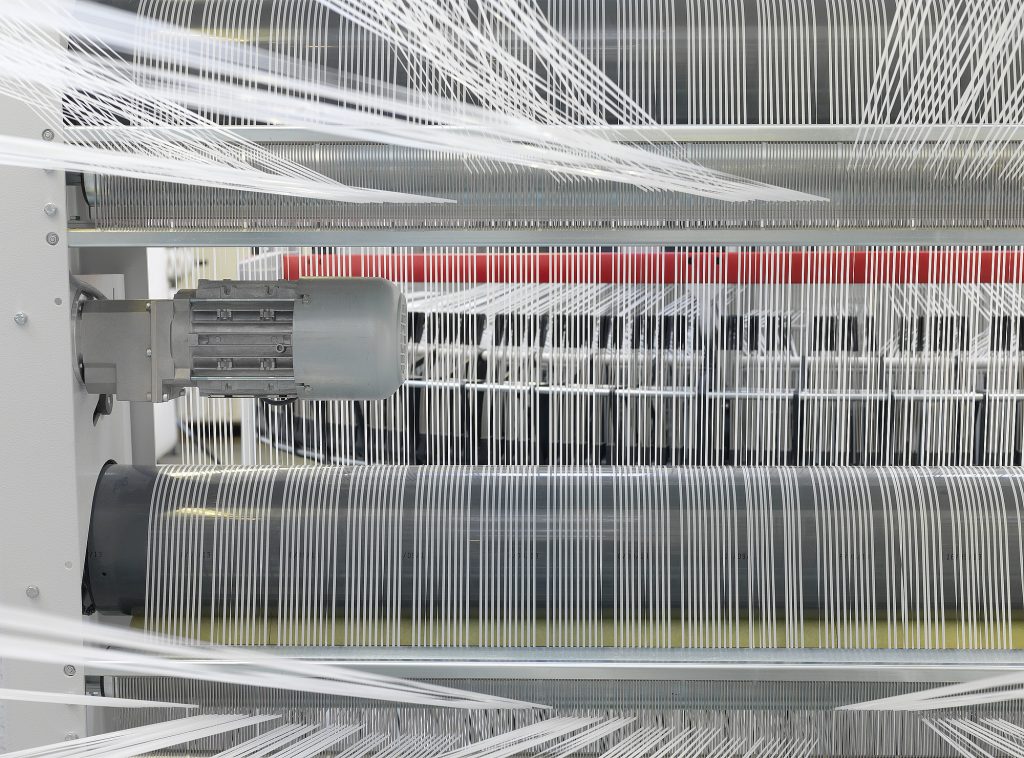
- Weaving: circular or flat looms interlace warp and weft to a target density; monitors flag broken ends and pick variation—defects here become seam failures later.
- Surface preparation: corona or flame treatment elevates surface energy; primers may follow when heavy prints or coatings are planned.
- Coating / lamination (optional): a 20–40 μm layer of PP or PE smooths the web, moderates WVTR, and enables heat‑seal closures. Nip pressure and temperature must be paired—separate them and bond weakness or gloss change appears.
- Printing: water‑based flexographic inks deliver color; overprint varnishes defend graphics from conveyor rub.
- Conversion: tubes form; bottoms fold and seal for block‑bottom valves; open‑mouth tops sew or pinch‑seal; valves are sized to nozzles and may be heat‑sealable.
- Quality checks: drop tests, seam efficiency, WVTR checks, dimensional audits, rub tests, and traceability codes that tie performance back to machine parameters.
Application Scenarios: Where the Format Excels
Labeling markets is easy; preventing failures is harder. Frame applications as scenarios with risks, then map bag features to neutralize those risks.
Cement and dry mortar: dusty powders, pneumatic filling, and humid coastal lanes. Valve formats with tuned sleeves, micro‑venting to release trapped air, coated exteriors for moisture moderation, and anti‑slip stripes for pallet stability.
Fertilizer and seed: granular abrasion plus outdoor UV. A UV package, heavier seam construction, tight weaves for small seed loss, and high‑coverage print zones for regulatory labeling.
Animal feed and pet food: light oils and aroma management for retail aisles. Thin PE liners, pinch‑bottom closures for neat tops, and varnished prints for shelf endurance.
Resins, salts, and pigments: fines, static potential, and cleanliness constraints. Sift‑tight seams, optional antistatic features, and precise dimensions for robotic palletizers.
Reusable carry and agricultural tote: abrasion cycles dominate. Reinforced hems, heavier edge tapes, and prints designed to withstand repeated handling.
- Dusty powders → block‑bottom valve sacks with controlled venting.
- Retail‑facing → pinch‑bottom open‑mouth with EZ‑open options and varnished print.
- Legacy lines → sewn open‑mouth with crepe tape and strong hem folds.
Why They Matter in Modern Warehousing
The headline promises importance; the floor demands proof. Where do PP Woven Bags alter warehouse physics and economics?
Unit‑load design: brick‑like block‑bottom layers reduce lean and edge crushing, often trimming stretch‑wrap usage and damage write‑offs. Automation compatibility: predictable friction and compressibility support robotic palletizers and sack clamps. Ergonomics: fewer reworks mean fewer risky manual lifts. Compliance: clear, scuff‑resistant print areas host barcodes and multilingual labels that scan at intake. Sustainability: mono‑material PP systems—woven body plus PP coating—align with many design‑for‑recycling frameworks and, more importantly, prevent loss of product, which is the biggest hidden footprint in bulk goods.
System Thinking: From Sub‑Problems to a Single Spec
Good specifications synthesize. They start with outcomes, decompose into decisions, then recombine into a coherent, testable document. For PP Woven Bags, the decomposition looks like this:
- Product physics: powder vs granule; bulk density; oil content; hygroscopicity → weave density, liner need, seam technology.
- Filling line: gravity or pneumatic; nozzle geometry; target BPM; de‑aeration time → valve type, sleeve diameter, micro‑perforation plan.
- Distribution climate: humidity cycles; temperature swings; ocean legs; dwell time → coating thickness, UV package, anti‑slip features.
- Regulatory and claims: food/feed declarations; language count; recycling marks consistent with local law → ink system, varnish, artwork areas.
- User and retailer experience: opening method; reclose; rub resistance; barcode legibility; shelf neatness → closure selection, tear tapes, print finishes.
Synthesis: set targets first—drop matrix, WVTR limit, seam efficiency, dust‑loss at the filler. Then choose resin, fabric gsm, coating μm, and closure so the bag clears each target with margin.
Tables: Parameters, Options, and Targets
| Subsystem | Typical Options | Range / Notes |
|---|---|---|
| Woven PP fabric | Flat or circular loom; 10×10–12×12 tapes/in | ~75–110 gsm; denier and draw ratio set strength |
| Coating / lamination | PP or PE extrusion | ~20–40 μm; enables heat‑seal; improves print and barrier |
| Surface treatment | Corona or flame | Raises surface energy for inks without added thickness |
| Valve geometry | Internal or external sleeve | Diameter matched to nozzle; heat‑sealable variants |
| Liner | Loose or attached PE | 15–30 μm; oils, odor, oxygen control |
| Closure | Pinch‑bottom; chainstitch; lockstitch | Choose for hermeticity vs cost vs legacy equipment |
| Printing | Water‑based flexo up to 8 colors | Add matte or gloss OPV to resist rub and scuff |
Application‑tuned examples
| Use Case | Capacity | Fabric (gsm) | Coating (μm) | Format | Notes |
|---|---|---|---|---|---|
| Cement / Mortar | 25–50 kg | 90–110 | 30–40 | Block‑bottom valve | Micro‑venting; anti‑slip; sift‑tight seams |
| Fertilizer / Seed | 25–50 kg | 85–100 | 25–35 | Valve or sewn OM | UV package; large label panels |
| Animal Feed | 10–25 kg | 80–95 | 20–30 | Pinch‑bottom OM | EZ‑open strip; optional liner |
| Rice / Sugar | 10–25 kg | 75–90 | 20–30 | Pinch‑bottom OM | High‑coverage print; shelf neatness |
| Resins / Pigments | 20–25 kg | 90–110 | 30–40 | Pinch‑bottom or valve | Antistatic options; sift‑tight seams |
Performance benchmarks (align during trials)
| Test | Typical Target | Purpose |
|---|---|---|
| Drop | ≥10 drops @ 1.0–1.2 m (25 kg) | Transit robustness |
| Seam efficiency | ≥85% | Avoid seam failures |
| WVTR | Meet climate‑specific limit | Caking control |
| Dust loss at filler | ≤ line‑specific grams | Sift resistance |
| Rub (print) | Pass specified cycles | Graphic durability |
Keyword Architecture and a Single Helpful Link
Integrate natural phrases your buyers actually type, and place them where they clarify decisions rather than clutter copy: PP Woven Bags; woven polypropylene bags; WPP sacks; laminated woven PP bags; BOPP‑laminated woven sacks; block‑bottom valve sacks; open‑mouth woven poly bags; moisture‑resistant woven polypropylene packaging; heavy‑duty woven poly sacks for cement; fertilizer‑grade PP woven packaging; reusable woven poly sacks; recyclable mono‑material woven PP bags; ISO‑aligned woven polypropylene sacks. For a concise overview that many teams use as a shared glossary, see woven polypropylene bags.
From Headline to Outline to Finished Page: How This Was Composed
The title cue—PP Woven Bags in modern warehousing—shaped the method. First, define the product and reconcile naming. Next, connect materials to functions. Then translate features into outcomes that matter on the dock. After that, walk the manufacturing sequence with its control points. Finally, stitch the parts into decision tables and scenario heuristics that teams can apply. Short sentences sit beside long ones; declaratives beside questions; parallel clauses add rhythm; contrasts add clarity. The aim is not ornament; the aim is operational usefulness.
- What are PP Woven Bags?
- Constituent Materials: Resin, Architecture, and Interfaces
- Feature Set: Capabilities that Change Warehouse Outcomes
- Production Process: From Pellet to Pallet
- Application Scenarios: Where the Format Excels
- Why They Matter in Modern Warehousing
- System Thinking: From Sub‑Problems to a Single Spec
- Tables: Parameters, Options, and Targets
- Keyword Architecture and a Single Helpful Link
- From Headline to Outline to Finished Page: How This Was Composed
- 1. Introduction: The Critical Role of PP Woven Bags in Sustainable Warehousing
- 2. Technical Advantages of PP Woven Bags
- 3. Sustainability and Regulatory Compliance
- 4. Waste Management and Government Policies
- 5. VidePak’s Technological Edge
- 6. FAQs: Addressing Industry Concerns
- 7. Future Trends: Smart Warehousing
- 8. Conclusion: Strategic Benefits for Modern Logistics
“Our logistics hub in Singapore handles 10,000 tons of goods monthly, but traditional packaging often tears under heavy loads and contributes to landfill waste. How can we improve efficiency while meeting sustainability goals?” asks a supply chain manager at a global logistics firm.
The answer lies in VidePak’s PP woven bags—engineered with recyclable polypropylene (PP) resins, advanced automation, and compliance with global ESG standards—delivering unmatched durability, cost savings, and a 70% reduction in plastic waste compared to conventional packaging.
1. Introduction: The Critical Role of PP Woven Bags in Sustainable Warehousing
The global warehousing industry, valued at $626 billion in 2024, faces mounting pressure to balance operational efficiency with environmental responsibility. Polypropylene (PP) woven bags have emerged as a cornerstone of modern logistics, offering tensile strengths exceeding 1,800 N/cm² while aligning with circular economy principles. VidePak, leveraging 30+ years of expertise and Austrian Starlinger machinery, produces 80 million PP bags annually, serving industries from agriculture to pharmaceuticals. This report examines the technical, regulatory, and environmental advantages of PP woven bags in warehousing, with a focus on recyclability and compliance.
Woven Fabric PP Bags Features
Discover the durable, storage-friendly features of PP woven bags that improve efficiency and safety in modern warehousing.
Check More →Breathable PP Woven Bags
High-quality breathable PP woven bags ideal for bulk goods storage, circulation and daily warehouse management.
Check More →Heat-Sealed PP Woven Bags
Reinforced heat-sealed PP woven bags, reliable for stacking, handling and long-term warehousing storage scenarios.
Check More →PP Woven Bags Specifications
Complete size and parameter specifications of PP woven bags to meet standardized modern warehousing packaging needs.
Check More →2. Technical Advantages of PP Woven Bags
2.1 Durability and Load Capacity
PP woven bags are designed to withstand rigorous warehousing conditions:
- Tensile Strength: Starlinger looms produce fabrics with 14×14 threads/cm² density, achieving 1,800–2,200 N/cm² tensile strength—ideal for 50–2,000 kg loads.
- Abrasion Resistance: PP’s molecular structure resists wear from pallet movement, reducing tear rates by 40% compared to jute or paper bags.
Case Study: A Brazilian coffee exporter reduced packaging losses by 35% after switching to VidePak’s UV-stabilized PP bags for outdoor storage.
2.2 Customization and Automation Compatibility
- Printing Precision: VidePak’s 10-color gravure printing ensures high-resolution branding, critical for retail compliance (e.g., FDA, EU 10/2011).
- Valve Designs: Heat-sealed valves enable automated filling at 120 bags/minute, cutting labor costs by 30%.
3. Sustainability and Regulatory Compliance
3.1 Recyclability and Circular Economy
PP woven bags are 100% recyclable, with post-consumer recycled (PCR) content up to 30%. VidePak’s closed-loop recycling program recovers 85% of production waste, reducing virgin PP consumption by 12,000 tons annually.
Table 1: Environmental Impact Comparison
| Parameter | PP Woven Bags | Traditional Jute Bags |
|---|---|---|
| Recyclability | 100% (ISO 14021) | <20% |
| Carbon Footprint | 1.2 kg CO2/bag | 3.5 kg CO2/bag |
| Landfill Waste | 5% (recycled) | 95% |
3.2 Global Regulatory Alignment
- EU EN 13432: Mandates biodegradability and <0.1% heavy metals—met by VidePak’s PCR PP blends.
- US ASTM D5638: Requires 8:1 safety factor for load capacity; VidePak’s bags exceed 10:1 ratios.
- China GB/T 8946: Certifies UV and moisture resistance for humid climates.
4. Waste Management and Government Policies
4.1 Recycling Infrastructure
Governments incentivize PP recycling through tax breaks (e.g., India’s EPR framework) and landfill bans (EU Single-Use Plastics Directive). VidePak partners with global recyclers to process 20,000 tons of PP annually, transforming waste into construction materials and automotive parts.
4.2 Legislative Drivers
- Extended Producer Responsibility (EPR): Requires manufacturers to manage post-consumer waste. VidePak’s take-back programs cover 15+ countries.
- Carbon Tax Policies: PP’s lower carbon footprint (vs. PVC or PET) reduces levies by 25% in regulated markets.
5. VidePak’s Technological Edge
5.1 Starlinger Automation
VidePak’s 100+ Starlinger AD*Star looms enable:
- Precision Weaving: ±0.1 mm filament width control for fine (1.5–2.5 mm) and coarse (3–5 mm) threads, optimizing strength-to-weight ratios.
- Energy Efficiency: 25% lower energy consumption vs. conventional looms, aligning with ISO 50001.
5.2 Innovation in Recycled PP
- PCR Blends: 30% post-industrial PP reduces costs by 18% without compromising strength.
- Additives: UV stabilizers (HALS) and antioxidants (Irgafos 168) extend bag lifespan by 50% in tropical climates.
6. FAQs: Addressing Industry Concerns
Q1: How do PP bags compare to FIBC jumbo bags in cost?
A: PP woven bags cost 20–30% less than FIBCs for loads <1,000 kg, with comparable durability.
Q2: Can recycled PP meet food-grade standards?
A: Yes. VidePak’s FDA-compliant PCR PP is used for grain and sugar packaging, tested per EU 10/2011.
Q3: What is the ROI of switching to PP bags?
A: A German retailer saved $120,000 annually via reduced waste fees and 40% lower replacement costs.
7. Future Trends: Smart Warehousing
By 2030, 60% of warehouses will adopt IoT-enabled PP bags with RFID tags for real-time inventory tracking. VidePak’s pilot projects integrate NFC chips, reducing stock discrepancies by 15%.
8. Conclusion: Strategic Benefits for Modern Logistics
VidePak’s PP woven bags empower businesses to:
- Enhance Efficiency: Automated compatibility cuts handling time by 30%.
- Meet ESG Goals: 100% recyclability aligns with UN SDG 12 (Responsible Consumption).
- Reduce Costs: Lower waste fees and tax incentives improve margins by 18–25%.
As CEO Ray states: “In warehousing, sustainability isn’t an option—it’s the backbone of resilience.”
External Links:
- Explore VidePak’s sustainable PP solutions in Recyclable Woven Bags for Transport.
- Learn about global compliance standards in PP Bags Meeting Regulatory Demands.
This report integrates data from ASTM/EN/GB standards, client case studies, and VidePak’s production analytics, positioning PP woven bags as indispensable tools for modern, sustainable warehousing.