

What are Poly Woven Bags?
Poly Woven Bags are industrial sacks built from interlaced polypropylene (PP) tapes that are slit from a cast or blown film, thermally drawn to orient polymer chains, and woven into a robust fabric before conversion into open‑mouth or valve formats. In transportation and logistics networks, Poly Woven Bags stand at the intersection of strength, pallet efficiency, and automation readiness: they bend without breaking, stack like bricks yet flex like cloth, and tolerate drops, abrasion, and humidity swings that defeat more fragile formats. Their textile‑like body distributes point loads; their polymer chemistry resists moisture; their surfaces accept print for tracking and compliance. In short, they are the pragmatic workhorses for powders, granules, and produce that must move fast, far, and safely.
Because different vendors and regions use different labels, the same platform appears under multiple names. To align cross‑functional vocabulary across procurement, engineering, and 3PL partners, here are common aliases for Poly Woven Bags:
- Woven Polypropylene Bags
- WPP Sacks
- Woven PP Bags
- Poly Woven Packaging
- Laminated PP Woven Sacks
- BOPP‑Laminated Woven Bags
- Block‑Bottom Valve Bags
- Open‑Mouth Woven Poly Sacks
- Heavy‑Duty Woven Poly Sacks
- Ventilated Woven PP Bags (for produce and respiration‑sensitive cargo)
The Materials of Poly Woven Bags
A Poly Woven Bag is not a single substance; it is a layered system. Each layer exists to remove a specific failure mode: a seam tear on the dock, a caked powder after an ocean leg, a dust plume at the filler, a barcode rubbed to gray on a conveyor. Materials therefore are chosen by function, then tuned by cost and manufacturability.
Polypropylene resin (base polymer)
Homopolymer polypropylene is the workhorse because drawn PP tapes deliver high tensile strength at modest mass while maintaining a low affinity for water. Typical melt flow rates near 2–4 g/10 min balance drawability and throughput; higher MFR grades can increase line speed at the price of narrower draw windows, while lower MFR grades stabilize film during slitting. During drawing, semicrystalline domains align to yield tapes that endure repeated bending, stacking compression, and point impacts—exactly the stresses common to trailers, railcars, and forklift aisles.
- Role: mechanical ceiling, chemical resistance, and dimensional stability across climate cycles.
- Where used: warp and weft tapes across the woven substrate.
- Cost levers: resin price dominates; dual‑sourcing equivalent grades hedges volatility.
Additives and color packages
Grams of chemistry shape months of performance. UV stabilizers extend outdoor life for pallets staged in yards; slip and anti‑block agents tune the coefficient of friction—critical for robotic picks and stacked stability; white masterbatch boosts opacity so small text and data‑matrix codes scan reliably; carbon black raises UV stability but increases solar heat absorption. The trick is balance: too much slip and pallets slide; too little and palletizers fight the pick.
Tape and fabric architecture
Film is chilled and slit into tapes; tapes are drawn, then woven. Denier sets potential drop strength; draw ratio converts potential into reality; weave density—often around 10×10 to 12×12 tapes per inch—governs stiffness, sifting, and de‑aeration. Powder applications prefer tighter weaves (and sometimes micro‑venting) to contain fines; granules permit slightly looser constructions that prioritize flexibility and cost. Fabric grammage typically falls near 75–110 gsm and is the second‑largest bill‑of‑materials lever after resin.
Surface systems: coatings, laminations, and treatments
Some Poly Woven Bags ship uncoated, but retail‑facing sacks, high‑speed valve lines, and humidity‑exposed routes benefit from a thin extrusion coating of PP or PE (≈20–40 μm). Coatings smooth the print surface, temper water vapor transmission, and enable heat‑seal closures such as pinch‑bottom. Surface treatment (corona or flame) raises surface energy for inks; overprint varnishes (matte or gloss) protect graphics from conveyor rub and pallet friction. BOPP laminations show up where brand gloss and scuff resistance are strategic.
Closures, valves, and liners
Open‑mouth designs close by chainstitch, lockstitch, or heat‑sealed pinch‑top. Valve sacks integrate sleeves sized to the filler nozzle—internal or external, friction‑fit or heat‑sealable—to accelerate clean filling while venting trapped air. For oily feeds or aroma‑sensitive powders, a thin PE liner (≈15–30 μm), loose or attached, provides an additional barrier without forfeiting the woven body’s strength.
What are the Features of Poly Woven Bags?
Features matter only when they create outcomes you can measure: higher fill rate, stable pallets, intact product, safer docks. Translate capability into consequences—that is the test of value.
- Strength at low mass: oriented tapes distribute load and resist puncture, turning drops, drags, and corner knocks into non‑events.
- Moisture moderation: PP’s low moisture uptake, paired with thin coatings, helps prevent caking in humid lanes without sealing in air.
- Sift resistance and clean filling: tight weaves, sealed seams, and micro‑vent options keep fines inside while allowing de‑aeration on pneumatic fillers.
- Readable, durable print: treated faces take water‑based flexo; varnishes defend graphics; BOPP layers elevate gloss where brand presence matters.
- Stack stability: block‑bottom formats build dense, brick‑like layers that resist lean and reduce stretch‑wrap usage.
- Automation readiness: predictable friction and compressibility support robotic palletizers and sack clamps.
- Pathways to circularity: mono‑material PP designs (woven body + PP coating + PP valve) avoid foreign layers and align with emerging recyclability frameworks.
What is the Production Process of Poly Woven Bags?
Great sacks are manufactured, not declared. The choreography is melt → slit → draw → weave → treat → coat (optional) → print → convert → verify. Drift at any stage becomes tomorrow’s claim, so process windows must be explicit, controlled, and recorded.
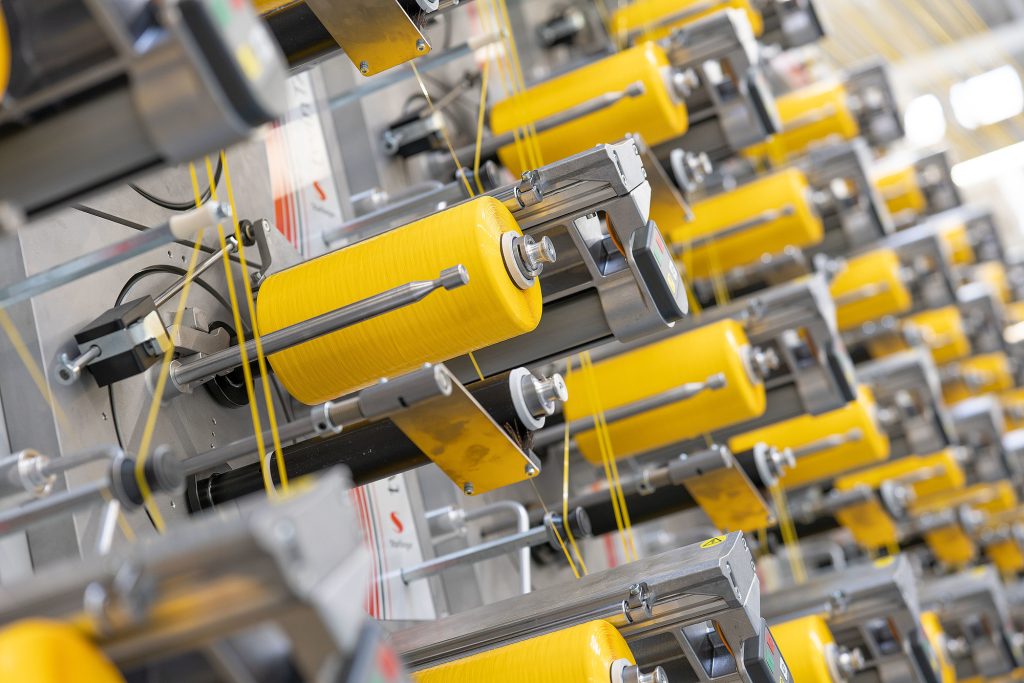
- Extrusion and slitting: polypropylene pellets melt and flow through dies to form film; chill rolls lock thickness; razor slitting yields tapes with clean edges. Inline gauges catch basis‑weight creep early.
- Drawing (orientation): staged ovens stretch tapes to align chains; draw ratio couples to resin MFR and line speed; tension control prevents width drift that would compromise weaving and seams.
- Weaving: circular or flat looms interlace warp and weft to a target density; broken ends and pick variation are monitored since defects here become seam stress risers later.
- Surface preparation: corona or flame treatment raises surface energy; primers may precede coatings or heavy print.
- Coating / lamination (optional): a 20–40 μm layer of PP or PE smooths the surface, moderates WVTR, and enables heat‑seal contours. Nip pressure and melt temperature must be tuned together to avoid paper‑like curl or weak bonds.
- Breathability engineering (if required): needle or laser micro‑perforations deliver vent rates for valve formats; ventilated stripes or mesh windows support produce and bio‑based fuels.
- Printing: water‑based flexographic inks supply graphics; overprint varnishes protect against rub on conveyors and pallets.
- Conversion: tubing; bottom formation (block‑bottom or pinch‑bottom); valve insertion or hem prep; sewing or heat sealing; sleeve geometry matched to filler nozzles.
- Quality checks: drop testing, seam efficiency, WVTR/air‑permeability, dimensional audits, rub resistance, and traceability to machine parameters.
What is the Application of Poly Woven Bags?
Rather than reciting markets, consider failure modes and map solutions to them. Each scenario tells you what to specify.
Cement and dry mortar: dusty powders, pneumatic filling, humid coastal lanes. Valve formats with tuned sleeves, micro‑venting to release trapped air, coated exteriors for moisture moderation, anti‑slip emboss for pallet stability.
Fertilizer and seed: granular abrasion and UV exposure. UV‑stabilized fabric, heavier seam construction, tight weaves for small seed loss, high‑coverage print zones for regulations.
Animal feed and pet food: light oils and aroma control for retail. Thin PE liners, pinch‑bottom closures for neat tops, varnished prints for shelf endurance.
Resins, salts, pigments: fines, static potential, cleanliness. Sift‑tight seams, optional antistatic measures, precise dimensions for robotic palletizers, robust lot coding for traceability.
Produce and bio‑based fuels: airflow required. Vent‑strip bulk bags (FIBC) or ventilated woven sacks promote convective airflow for potatoes, onions, and similar goods.
- Dusty powders → block‑bottom valve sacks with controlled venting.
- Retail‑facing → pinch‑bottom open‑mouth with EZ‑open features and varnished print.
- Legacy lines → sewn open‑mouth with crepe tape and strong hem folds.
Poly Woven Bags: Role in Transportation and Logistics
The headline invites a practical audit: where, exactly, do Poly Woven Bags change freight physics and network economics? The answers cluster around unit‑load density, automation compatibility, risk reduction, climate resilience, and compliance.
Unit‑load density and cube efficiency
Square‑ended sacks (block‑bottom) pack tighter than pillow‑shaped bags and deform less than plain film. That translates into higher container load density and fewer edge‑crush events. In intermodal chains, this means fewer reworks, fewer toppled pallets, and fewer write‑offs. In other words: more volume shipped per unit of freight cost, less waste, more predictability.
Compatibility with automated handling
Robotic palletizers and sack clamps prefer predictable friction and compressibility. Coated woven PP surfaces, paired with brick‑like geometry, present reliable pick points and stable compression profiles—critical to lights‑out palletizing on night shifts and to consistent layer formation under high takt.
Risk and safety on the dock
Where manual handling remains, the safest lift is the one that doesn’t happen. By keeping stacks square and seams intact, Poly Woven Bags reduce rework cycles that expose operators to repetitive strain and awkward movements. Clean filling and sealed seams reduce dust, which in turn improves visibility and air quality around packers and pickers.
Climate‑ready storage, policy‑ready design
Outdoor staging, long ocean legs, and humidity swings are the rule in many lanes. Woven PP’s low moisture uptake, UV‑stabilized grades, and thin coatings help hold product quality until consumption. On the policy side, emerging rules in multiple regions favor designs that are recyclable and resource‑efficient; mono‑material PP (woven body + PP coating + PP valve) avoids foreign layers and aligns more easily with such trajectories, while also enabling recycled content strategies that lower footprint without sacrificing performance.
Circularity without compromising performance
Woven‑sack lines increasingly advertise capacity for high‑PCR content and tight process control to maintain drop and seam performance. The pragmatic lesson: it is now possible to specify recycled content while staying within the same performance envelope, provided control charts and incoming QC are treated as non‑negotiable.
System Thinking: From Sub‑Problems to a Single Solution
Good specifications synthesize. They start with outcome targets, decompose into decisions, then recombine into a coherent, testable document. For Poly Woven Bags, break the problem down as follows:
- Product physics: powder vs granule; bulk density; oil/fat content; hygroscopic behavior → weave density, coating need, liner use, seam technology.
- Filling line: gravity or pneumatic; nozzle geometry; target BPM; de‑aeration window → valve type, sleeve diameter, micro‑perforation plan.
- Distribution climate: humidity cycles; temperature swings; ocean legs; dwell time → coating thickness, UV package, anti‑slip features.
- Regulatory & claims: food/feed declarations; label language count; recycling marks that match local law → ink system, varnish, artwork zones.
- Warehouse automation & safety: end‑effector friction; compressibility; bag geometry tolerance; maximum manual lift → block‑bottom vs gusseted, anti‑skid stripes, dimensional tolerances.
Synthesis rule: set the outcomes first—drop matrix, WVTR or air‑permeability band, seam efficiency, dust‑loss at the filler, pallet lean incidents per 1,000. Then choose resin, fabric gsm, coating μm, and closure so the bag clears each target with margin.
Tables: Parameters, Options, and Targets
| Subsystem | Typical Options | Range / Notes |
|---|---|---|
| Woven PP fabric | Flat/circular loom; 10×10–12×12 tapes/in | ~75–110 gsm; denier and draw ratio set strength |
| Coating / lamination | PP or PE extrusion | ~20–40 μm; enables heat‑seal; improves print and barrier |
| Surface treatment | Corona or flame | Raises surface energy for inks without added thickness |
| Valve geometry | Internal or external sleeve | Diameter matched to nozzle; heat‑sealable variants |
| Liner | Loose or attached PE | 15–30 μm; oils, odor, oxygen control |
| Closure | Pinch‑bottom; chainstitch; lockstitch | Choose for hermeticity vs cost vs legacy equipment |
| Printing | Water‑based flexo up to 8 colors | Add matte or gloss OPV to resist rub and scuff |
Application‑tuned examples
| Use Case | Capacity | Fabric (gsm) | Coating (μm) | Format | Notes |
|---|---|---|---|---|---|
| Cement / Mortar | 25–50 kg | 90–110 | 30–40 | Block‑bottom valve | Micro‑venting; anti‑slip; sift‑tight seams |
| Fertilizer / Seed | 25–50 kg | 85–100 | 25–35 | Valve or sewn OM | UV package; large label panels |
| Animal Feed | 10–25 kg | 80–95 | 20–30 | Pinch‑bottom OM | EZ‑open strip; optional liner |
| Rice / Sugar | 10–25 kg | 75–90 | 20–30 | Pinch‑bottom OM | High‑coverage print; shelf neatness |
| Resins / Pigments | 20–25 kg | 90–110 | 30–40 | Pinch‑bottom or valve | Antistatic options; sift‑tight seams |
Performance benchmarks (align during trials)
| Test | Typical Target | Purpose |
|---|---|---|
| Drop | ≥10 drops @ 1.0–1.2 m (25 kg) | Transit robustness |
| Seam efficiency | ≥85% | Avoid seam failures |
| WVTR / Air‑permeability | Climate/line‑specific | Caking control or fill speed |
| Dust loss at filler | ≤ line‑specific grams | Sift resistance; worker safety |
| Rub (print) | Pass specified cycles | Graphic durability |
RFQ Checklist (Editable)
Product: Poly Woven Bags; target capacity __ kg
Format: □ block‑bottom valve □ pinch‑bottom OM □ sewn OM
Dimensions: W __ × G __ × H __ mm; pallet pattern __ × __; layers __; target pallet height __ mm
Fabric: __ gsm; weave density __ × __; UV package __ h; recycled content __%
Coating: __ μm (PP/PE); anti‑skid emboss? Y/N
Liner: Y/N; thickness __ μm; loose/attached
Venting: micro‑perfs count __; location __; target de‑aeration time __ s
Valve: internal/external; sleeve __ mm; heat‑seal? Y/N
Printing: flexo __ colors; OPV type __; barcode grade target __
Performance: Drop __× @ __ m; seam efficiency ≥ __%; WVTR/air‑permeability __; dust loss ≤ __ g
Compliance: food contact? Y/N; labeling languages __; recycling mark set __
Keyword Architecture and a Single Helpful Link
Use terms buyers actually type—sparingly, where they clarify decisions: Poly Woven Bags; woven polypropylene bags; WPP sacks; laminated woven PP bags; BOPP‑laminated woven sacks; block‑bottom valve sacks; open‑mouth woven poly bags; ventilated FIBC bulk bags; micro‑perforated woven PP valve bags; moisture‑resistant poly woven packaging; recyclable mono‑PP sacks for cement and fertilizer. For a compact glossary and adjacent formats, see woven polypropylene bags.
From Headline to Finished Page
The prompt—Poly Woven Bags: role in transportation and logistics—shaped the structure. First, define the platform and reconcile naming. Second, connect materials to the failures they prevent. Third, translate features into outcomes that change freight physics. Fourth, document the manufacturing choreography with the control points that matter. Fifth, frame applications as risk maps, not market labels. Finally, condense trade‑offs into tables and a checklist so teams move from discussion to specification. Long sentences sit beside short ones; questions challenge claims; parallel clauses add cadence; contrasts add clarity. The goal is operational usefulness, not ornament.
- What are Poly Woven Bags?
- The Materials of Poly Woven Bags
- What are the Features of Poly Woven Bags?
- What is the Production Process of Poly Woven Bags?
- What is the Application of Poly Woven Bags?
- Poly Woven Bags: Role in Transportation and Logistics
- System Thinking: From Sub‑Problems to a Single Solution
- Tables: Parameters, Options, and Targets
- RFQ Checklist (Editable)
- Keyword Architecture and a Single Helpful Link
- From Headline to Finished Page
- 1. Introduction: The Critical Role of Poly Woven Bags in Feed Logistics
- 2. Advantages of Poly Woven Bags in Feed Packaging
- 3. Technical Specifications: Tailoring Bags to Feed Types
- 4. Quality Assurance: Testing PP and PE Resins
- 5. Sustainability and Regulatory Compliance
- 6. FAQs: Addressing Industry Concerns
- 7. Future Trends: Smart Packaging and Automation
- 8. Conclusion: Strategic Value for Feed Producers
“Our poultry feed supplier in Thailand faces frequent spoilage due to humidity and pests during transit. How can your packaging solutions ensure both durability and freshness?” asks a procurement manager at a leading agricultural conglomerate.
The answer lies in VidePak’s poly woven bags—engineered with high-tensile polypropylene (PP), customizable barrier layers, and advanced breathability—delivering 50kg+ load capacity, 98% microbial resistance, and a 40% reduction in spoilage rates for feed products.
1. Introduction: The Critical Role of Poly Woven Bags in Feed Logistics
The global animal feed market, valued at $460 billion in 2024, demands packaging that balances cost efficiency, durability, and biosecurity. Poly woven bags, reinforced with PP fabrics and specialized coatings, have become indispensable for transporting pet, poultry, and livestock feed. VidePak, leveraging 30+ years of expertise and Austrian Starlinger machinery, produces 80 million bags annually, serving clients in 50+ countries. This report analyzes the technical advantages of poly woven bags in feed logistics, focusing on material science, regulatory compliance, and customization strategies.
2. Advantages of Poly Woven Bags in Feed Packaging
2.1 Cost Efficiency and Load Capacity
Poly woven bags offer a 20–30% cost advantage over traditional jute or paper bags due to PP’s lightweight nature (80–150 GSM) and high tensile strength (1,200–1,800 N/cm²). For example, a Vietnamese poultry farm reduced packaging costs by 25% while increasing load capacity to 55 kg/bag using VidePak’s block-bottom valve bags (explore valve bag solutions).
2.2 Biosecurity and Freshness Preservation
- Antimicrobial Properties: PP resins blended with silver-ion additives inhibit bacterial growth, achieving 98% reduction in Salmonella and E. coli contamination (tested per ISO 22196).
- Moisture Control: LDPE liners (20–30 µm) reduce water vapor transmission to <5 g/m²/day, critical for humid climates.
- Breathability: Controlled weave density (12×12 threads/cm²) prevents condensation, reducing mold growth by 60% in poultry feed storage.
Case Study: A Brazilian cattle feed producer cut spoilage rates from 12% to 3% using VidePak’s UV-stabilized bags with ventilated panels.
3. Technical Specifications: Tailoring Bags to Feed Types
3.1 Parameter Selection Guide
| Feed Type | Key Requirements | Recommended Specifications |
|---|---|---|
| Pet Food | Aroma retention, pest resistance | 90 GSM PP + 25µm BOPP laminate |
| Poultry Feed | High breathability, stackability | 14×14 weave + PE-coated valve design |
| Livestock Feed | Puncture resistance, UV stability | 120 GSM PP + 30µm LDPE inner liner |
3.2 Customization Strategies
- Outer Layer: BOPP lamination enhances printability for branding and regulatory labels (e.g., FDA 21 CFR).
- Inner Liners: Food-grade PE or aluminum foil for moisture-sensitive feeds like fishmeal.
- Closure Systems: Heat-sealed valves for automated filling (120 bags/minute) or stitched mouths for manual handling.
4. Quality Assurance: Testing PP and PE Resins
VidePak’s ISO 17025-certified labs conduct rigorous tests to ensure raw material compliance:
- Physical Properties:
- Melt Flow Index (MFI): 8–12 g/10min (ASTM D1238) for uniform extrusion.
- Density: 0.90–0.91 g/cm³ (ISO 1183) to balance strength and flexibility.
- Mechanical Performance:
- Tensile Strength: ≥30 MPa (ASTM D638) for 50kg+ loads.
- Impact Resistance: ≥500 g/mil (ASTM D1709) for PE liners.
- Thermal Stability:
- Heat Deflection Temperature: 100–120°C (ASTM D648) to withstand tropical climates.
5. Sustainability and Regulatory Compliance
- Recyclability: 100% recyclable PP/PE blends align with EU EN 13432 and China GB/T 8946 standards.
- Carbon Footprint: VidePak’s closed-loop recycling program reduces virgin plastic use by 12,000 tons/year.
- Certifications: FDA, ISO 22000, and GMP+ for feed safety.
6. FAQs: Addressing Industry Concerns
Q1: How do poly woven bags compare to FIBCs for bulk feed transport?
A: Poly bags cost 40% less for loads <1,000 kg and offer superior breathability, reducing spoilage risks in grains.
Q2: Can these bags withstand abrasive feed ingredients like minerals?
A: Yes. VidePak’s heavy-duty woven bags (1,800 N/cm² tensile strength) integrate anti-abrasion coatings, validated in Australian mineral feed trials.
Q3: Are customized printing options available for regional regulations?
A: VidePak’s 10-color gravure printing ensures compliance with EU allergen labels and China’s GB 4806.7 food-contact standards.
7. Future Trends: Smart Packaging and Automation
By 2030, 70% of feed mills will adopt IoT-enabled bags with QR codes for traceability. VidePak’s R&D team is piloting biodegradable PP-kraft hybrids and RFID-tagged bags for real-time moisture monitoring.
8. Conclusion: Strategic Value for Feed Producers
VidePak’s poly woven bags empower the feed industry to:
- Reduce Losses: 40% lower spoilage via moisture control and antimicrobial barriers.
- Enhance Efficiency: Automated compatibility cuts labor costs by 30%.
- Meet ESG Goals: 100% recyclability supports UN SDG 12 (Responsible Consumption).
As CEO Ray states: “In feed logistics, every gram saved from spoilage is a step toward global food security.”
External Links:
- Explore livestock feed packaging innovations in Kraft-PP Solutions for Feed.
- Learn about automated filling systems in FFS Roll Bags for Pet Food.
This report synthesizes data from ASTM/ISO standards, client case studies, and VidePak’s production analytics, positioning poly woven bags as a linchpin of modern feed supply chains.