

What are Multi-Wall Woven Bags?
Multi-Wall Woven Bags are engineered sacks built around a woven polyolefin shell—most commonly polypropylene raffia tapes for strength-to-weight efficiency, sometimes high-density polyethylene tapes for extra stiffness—combined with one or more internal walls that tailor barrier, hygiene, and handling behavior. Those inner walls may be polyethylene liners, coextruded films, or laminated plies, arranged to meet demanding duty cycles in waste management, recycling collection, municipal transfer, construction debris handling, and industrial by-product consolidation. In a single package you get the mechanical backbone of woven fabric and the moisture/dust protection of a film system: armor on the outside, a shield on the inside.
Across RFQs and catalogs, the same concept is described by a cluster of aliases. For clarity—and better supplier searches—here is a compact list of commonly used names for Multi-Wall Woven Bags:
- Multi-wall woven sacks
- Multi-layer PP woven bags
- Reinforced woven polypropylene sacks
- Multi-ply woven waste bags
- Heavy-duty woven refuse sacks
- Multi-wall FIBC (liner + outer) assemblies
Material Architecture of Multi-Wall Woven Bags
Materials decide performance; process only reveals it. To understand why Multi-Wall Woven Bags succeed in rough routes and humid climates, we need to examine each layer, its properties, its cost drivers, and its contribution to the whole.
Outer woven fabric (shell)
The shell is typically polypropylene raffia woven from oriented tapes. Tapes start as an extruded film, are slit, then drawn to align polymer chains—trading elongation for tensile strength and modulus. Denier (for example 600–1200), weave density (for example 8×8 to 12×12 picks per inch), and loom type (circular vs flat) determine tear propagation, seam hold, surface texture, and stack shape. HDPE tapes appear in stiffness-led applications or where abrasion is extreme. Cost-wise, resin mass (GSM × area) dominates; line speed and scrap rates decide whether a plant can compete on landed cost.
Inner walls (liners and barrier films)
Internal walls are usually polyethylene. LDPE/LLDPE liners emphasize toughness and heat-sealability; HDPE liners lower water-vapor transmission and add stiffness. Gauges for 10–50 kg formats commonly run ~60–120 μm, rising for sharp granulates, glass-laden fines, or long/humid journeys. In waste and recycling service, these liners slow humidity ingress, reduce sifting of fines through the weave, and maintain hygiene and odor discipline.
Coupling method
Liners can be left loose (easier separation at end-of-life), tacked at the mouth (faster fill; fewer liner “swallow” events), or laminated via extrusion coating (creating a composite). Each approach carries trade-offs among line efficiency, recyclability narratives, and risk of delamination. Mono-polyolefin stacks (PP shell + PE wall) simplify labeling conversations even when curbside acceptance varies by region.
Additives and treatments
HALS/UV absorbers protect outdoor-stored bags from embrittlement; slip and antiblock aid handling; pigments differentiate material streams; antistats control tribo effects in dusty environments; corona treatment lifts surface energy so prints and barcodes remain legible after long routes and stretch-wrap glare.
Seams, closures, and lift features
Single vs double fold, stitch density, thread choice, and heat-affected width are decisive in drop survival. Valve sleeves (for powdery streams) are often polyethylene-based to preserve mono-material logic. In bulk formats, certified lift loops, safe working loads, and fill-height ratios are specified—logic that meaningfully informs smaller sacks stacked high.
Features and Field Behavior
The real test for Multi-Wall Woven Bags is not in a brochure but in the yard: wet mornings, rough aprons, clamp trucks, and hurried crews. Below are the attributes that repeatedly separate reliable systems from “good on paper” experiments.
- Strength-to-weight efficiency. Oriented tapes deliver high tensile and tear at modest GSM, supporting 10–50 kg fills and scaling to bulk where needed.
- Moisture and sifting control. Polyethylene walls reduce water-vapor uptake and plug the interstices that otherwise allow fines to leak.
- Form stability and stackability. Stiffer shells, antiskid textures, and disciplined fill heights yield stable stacks through transport and storage.
- Printability and traceability. Treated or coated faces carry barcodes and route IDs that remain scannable in cold, dust, and glare.
- Service-life flexibility. In closed loops, shells can be reused with fresh liners, balancing hygiene against material throughput.
- Policy-aware design. Mono-polyolefin construction supports accurate on-pack guidance even where curbside acceptance is variable; drop-off or take-back channels can be specified for film-rich formats.
Production Process of Multi-Wall Woven Bags
From pellets to pallets, the process is a chain where each link must hold. Deviate at the tape line and the seam will confess it later. Overheat a lamination nip and pinholes will appear after the first truck ride. Here is a practitioner’s map, with control points that matter:
- Tape extrusion and slitting. Polyolefin resin is plastified and cast into a thin film, then slit into tapes. Gauge uniformity governs denier consistency; edge quality sets up clean weaving.
- Drawing (orientation). Tapes are drawn to align chains, boosting tensile and modulus while trimming elongation. Too high a draw creates brittle folds; too low leaves fabric limp.
- Weaving. Circular looms produce tubular fabric; flat looms yield sheets later back-seamed. Pick density is tracked with SPC; tension drift is the quiet thief of quality.
- Coating/lamination (optional). LDPE/LLDPE coating adds a smoother print face and modest barrier. Many builds keep the shell uncoated and rely on an inner liner for moisture control.
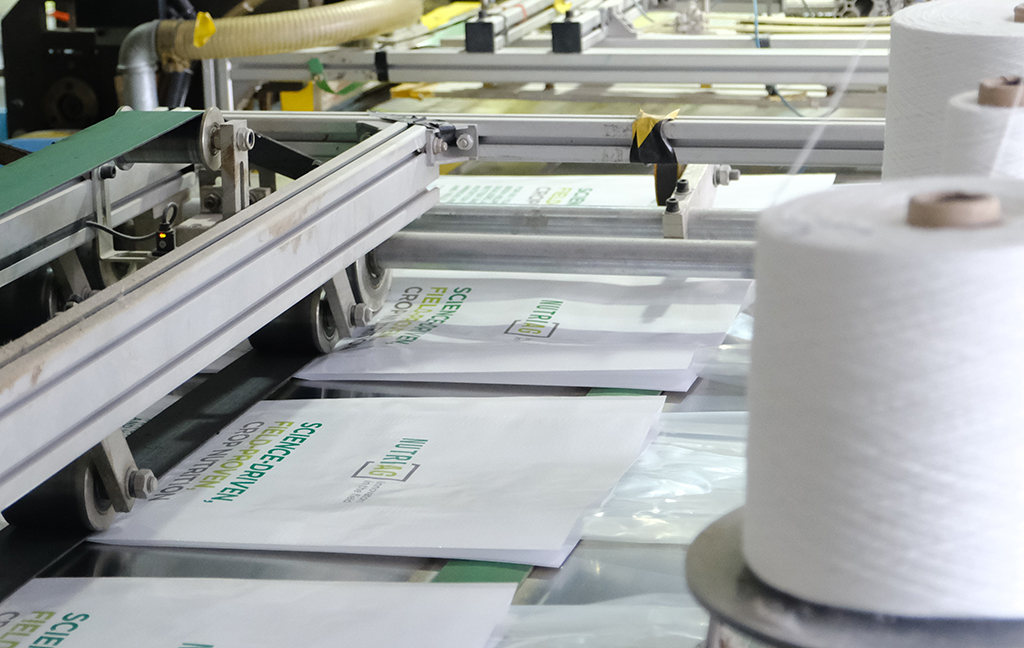
- Conversion: cutting, folding, stitching. Cut-length accuracy, bottom-fold geometry, and stitch density determine seam efficiency; these parameters make or break drop performance.
- Liner insertion and sealing. Loose inserts, tacked liners, or full sleeves are introduced; seal temperature/pressure/dwell control pinhole incidence and peel strength.
- Printing and coding. Flexographic plates, ink rheology, and surface energy govern print fidelity and barcode grade after conveyors and wrap glare.
- Testing and release. Films face tensile/impact tests; sacks undergo conditioned drops; bulk variants add stacking/tilt protocols. Field trials are the final truth serum.
A question worth repeating: in your duty cycle, what fails first—seam, wall, or moisture control? Without that answer, you do not have a specification; you have a wish.
Applications and Use-Case Patterns
Use cases cluster where toughness, moisture discipline, and logistics predictability intersect. The versatility of Multi-Wall Woven Bags derives not from a one-size-fits-all spec, but from dialing each layer to the product and route.
- Municipal solid waste and recycling routes. Source-separated organics, glass-containing fines, and mixed recyclables need abrasion resistance, leak resistance, and readable codes from curb to MRF.
- Construction and demolition (C&D). Sharp rubble, gypsum, and wet sands call for puncture-resistant shells and heavier liners; bulk versions move aggregates and fines efficiently.
- Industrial residues and by-products. Fly ash, lime, metal fines, and filter cakes benefit from low-dust filling, moisture control, and stable pallet behavior.
- Food-related streams and agriculture. Off-spec grains, sugar residues, and salt are consolidated hygienically with clean graphics for routing.
- Events, campuses, and closed-loop programs. Reusable shells paired with replaceable liners keep hygiene high and set-up fast.
From the Title to the Plan — Exploring a Sustainable Solution
Read the phrase carefully and let it structure the work: exploring (test, learn, adjust), multi-wall woven bags (the artifact), sustainable (environmental + economic + compliance outcomes), solution (fit-for-purpose, verifiable), waste management and recycling (the system it must serve). This framing prevents buzzwords from substituting for design. You do not merely buy a bag; you specify an architecture, a test protocol, and an end-of-life path that match reality.
Three vectors carry the sustainability burden for Multi-Wall Woven Bags in 2024–2025 market conditions: durability (fewer ruptures and re-bags), operational efficiency (fewer line stoppages; safer stacking; predictable scanning), and an honest end-of-life story (where and how each wall is actually recovered). A specification that lifts all three vectors simultaneously earns its keep.
Systems Analysis and Synthesis
Break the problem into sub-systems, solve each with evidence, then re-compose the whole. Below is a structured map that technical buyers and municipal teams can apply immediately.
Subsystem A — Material stack
Multi-Wall Woven Bags typically use a PP woven shell (600–1200 denier tapes; 8×8–12×12 weave) paired with a PE liner (~60–120 μm). Coated print faces are reserved for routes needing high-fidelity graphics or harsh abrasion. Loose liners maximize separability at end-of-life; bonded walls accelerate filling and keep liners in place.
Subsystem B — Manufacturing discipline
Hold draw ratio and pick density within bounded windows; verify seal windows on the actual liner film; measure seam efficiency, not just fabric tensile. Track SPC charts by shift to surface slow drifts in tension and temperature.
Subsystem C — Policy and labeling
Claims must match actual acceptance in your geography. Mono-polyolefin stacks support accurate on-pack guidance, but many film-rich structures route through drop-off or take-back rather than curbside. Align artwork and disposal instructions with the latest guidance and accepted-materials lists.
Subsystem D — MRF and end-market reality
Before making circularity claims, contract with recovery partners. Pilot bales through a willing MRF; record yields, contamination, and bale specs. In parallel, track regional upgrades that expand PP capture capacity.
Subsystem E — Economics and carbon logic
Price the whole system: bag, expected failure rate, cleanup labor, route interruptions, injury risk from unstable stacks, and label compliance exposure. Durable multi-wall designs often win once failure externalities are counted.
Synthesis: specify layer purposes in writing, tie tests to those purposes, validate on the real line, and publish clear end-of-life instructions. That four-step loop turns Multi-Wall Woven Bags from a commodity into a solution.
Technical Test Matrix and Controls
Claims are easy; tests are proof. The following matrix maps common questions to practical methods and acceptance thinking. Use it as a starting point for RFQs and line trials.
Parameter Tables for RFQs
The following parameter ranges are not commandments; they are launch pads. Tune them to your product density, abrasiveness, humidity profile, and handling risks.
Procurement and Deployment Framework
Procurement fails when specs read like poetry. It succeeds when every claim maps to a test, every layer maps to a purpose, and every disposal instruction maps to an accepted path. The following six-step framework keeps teams honest.
- Define the duty cycle. Quantify: humidity range, temperature range, drop heights, stack heights, abrasion severity, fill-line speed, clamp handling.
- Choose the architecture. Start mono-polyolefin (PP shell + PE liner). Add coatings only if print fidelity demands it. Document why each wall exists.
- Validate on the real line. Pilot with the actual filler and route. Measure seal peel, liner dart impact, seam efficiency, drop survival, and scan grade after wrap.
- Align claims and labels. Match on-pack guidance to accepted-materials lists; disclose drop-off or take-back if curbside is out.
- Close the loop where possible. Contract for film/PP recovery partners and document bales and yields.
- Price the system, not the bag. Add failure costs, cleanup labor, route delays, and compliance exposure to the spreadsheet; re-evaluate unit price in that context.
Repeat the essentials: specify in numbers, not adjectives; test under real humidity and real drops; keep claims accurate; prefer mono-polyolefin designs for simpler downstream handling. That is how Multi-Wall Woven Bags stay safe, reliable, and economical.
Risk Register — Common Defects and Preventive Actions
Defects are not random; they are signatures of specific lapses. Use this register as an inspection and troubleshooting guide for Multi-Wall Woven Bags.
Keywords and Long-Tail Phrases
To keep scope clear (and to help readers land on the right terminology), this article intentionally uses and intermixes the following phrases: Multi-Wall Woven Bags; multi-wall woven sacks; multi-layer PP woven bags; reinforced woven polypropylene bags; heavy-duty woven waste sacks; woven recycling collection bags; mono-polyolefin multi-wall bags; PP woven shells with PE liners; municipal recycling woven bags; construction waste woven sacks; reusable woven refuse bags; drop-off recyclable PP woven packaging; stacking guidance for bulk woven bags; labeling guidance for polyolefin bags.
- What are Multi-Wall Woven Bags?
- Material Architecture of Multi-Wall Woven Bags
- Features and Field Behavior
- Production Process of Multi-Wall Woven Bags
- Applications and Use-Case Patterns
- From the Title to the Plan — Exploring a Sustainable Solution
- Systems Analysis and Synthesis
- Technical Test Matrix and Controls
- Parameter Tables for RFQs
- Procurement and Deployment Framework
- Risk Register — Common Defects and Preventive Actions
- Keywords and Long-Tail Phrases
Ray, CEO of VidePak, gestures toward a prototype during a client meeting:
“The durability of multi-wall woven bags isn’t accidental—it’s engineered. Choosing the right seaming technology and bag design can reduce waste leakage by 40% while lowering carbon footprints. At VidePak, we achieve this through Starlinger’s ultrasonic welding and precision valve designs, tailored for industries from construction to recycling.”
1. Introduction
Multi-wall woven polypropylene (PP) bags have emerged as a cornerstone of sustainable industrial packaging, combining strength, reusability, and recyclability. VidePak, a global leader with $80 million annual revenue and 526 employees, exemplifies innovation in this sector. Equipped with 100+ Starlinger circular looms and 30 lamination machines, the company produces over 50 million bags annually, serving industries like construction waste management and bulk recycling. This report analyzes critical manufacturing techniques—seaming methods, material selection, and bag mouth designs—and their impact on performance, sustainability, and cost efficiency.
2. Seaming Technologies: Balancing Strength and Sustainability
The choice of seaming technology directly impacts a bag’s load capacity, leak resistance, and lifecycle. VidePak employs three primary methods, each suited to specific applications:
2.1 Stitched Seams
- Thread Material: Polyester or nylon threads dominate, with polyester offering UV resistance (ideal for outdoor storage) and nylon providing higher tensile strength (35–40 MPa) for heavy loads.
- Stitch Density: Standardized at 8–10 stitches per inch (SPI) for general use, but increased to 12 SPI for FIBC bags holding 1–2 tons. A 2024 Packaging Technology & Science study found that 12 SPI reduces seam failure rates by 18% compared to 8 SPI.
- Applications: Cost-effective for open-mouth bags in agriculture (e.g., grain storage) but less suitable for fine powders due to potential leakage.
2.2 Heat Sealing
- Process: PP layers are fused at 160–180°C, creating a seamless bond. VidePak’s Starlinger machines achieve sealing speeds of 20 meters/minute, ideal for high-volume orders.
- Advantages: Waterproof and dustproof, critical for chemicals or construction debris. For example, heat-sealed EcoSeal bags reduced moisture ingress by 95% in a UAE cement transport trial.
- Limitations: Higher energy consumption (15% more than stitching) and incompatible with heat-sensitive liners.
2.3 Ultrasonic Welding
- Mechanism: High-frequency vibrations melt PP fibers, forming a bond without adhesives. This method reduces material waste by 12% compared to stitching.
- Performance: Welded seams withstand 50% higher cyclic loads (per ASTM D5265 testing), making them ideal for reusable FIBCs in recycling plants.
- VidePak’s Edge: The company’s 16 extrusion lines produce custom laminated films optimized for ultrasonic welding, enhancing bond consistency.
3. Bag Mouth Designs: Functionality Meets Customization
Bag mouth configurations dictate usability, sealing efficiency, and sector-specific compliance.
| Design | Process | Applications | Strength |
|---|---|---|---|
| Valve | Heat-sealed or stitched | Powders (cement, flour) | Prevents spillage; 99% dust containment |
| Heat-Sealed | Thermal fusion | Chemicals, moist materials | Waterproof; >40 N/15mm peel resistance |
| Sewn Open Mouth | Polyester stitching | Agricultural products, bulk waste | Cost-efficient; 6–8 SPI standard |
| Block Bottom | Folded and glued | Retail packaging, flood control | Self-standing; 200% base reinforcement |
Client Selection Guide:
- Construction Waste: Valve bags with PE liners for dust control (e.g., PE-coated valve bags).
- Recyclables: Sewn mouths with 10 SPI for repeated use.
- Food Grade: Heat-sealed mouths complying with FDA 21 CFR 177.1520.
4. VidePak’s Technological Integration
Leveraging 30+ years of expertise, VidePak optimizes production through:
- Starlinger’s Circular Looms: Produce 200 bags/hour with <1% defect rates.
- Multi-Wall Lamination: 3–5 PP layers combined with Kraft paper or aluminum foil for enhanced barrier properties. A 2023 case study showed laminated bags extended food product shelf life by 30%.
- Custom Printing: 8-color flexography for branding, compliant with EU REACH regulations.
5. Sustainability Metrics and Market Alignment
- Recyclability: VidePak’s bags achieve 98% PP recovery rates via pyrolysis, aligning with the EU’s 2030 Circular Economy targets.
- Market Demand: The global FIBC market will grow at 7.2% CAGR through 2030, driven by construction waste regulations (Grand View Research, 2024).
- Case Study: A German recycling firm reduced landfill costs by $120,000/year by switching to VidePak’s reusable FIBCs.
6. FAQs: Addressing Industry Pain Points
Q1: How to choose between stitched and welded seams?
A: Stitching suits budget-conscious, single-use scenarios; welding excels in reusable, high-stress environments like construction waste management.
Q2: Are biodegradable threads viable for sewn mouths?
A: Current PLA threads degrade prematurely under UV exposure. VidePak recommends UV-stabilized polyester for outdoor use.
Q3: What design minimizes leakage for fine powders?
A: Cross-bottom valve bags with ultrasonic welding, achieving <0.1% particle loss (per ISO 21898).
7. Conclusion
Multi-wall woven bags represent a synergy of engineering precision and environmental stewardship. VidePak’s mastery of seaming technologies and adaptive designs—buttressed by Starlinger’s automation—positions the company as a leader in sustainable industrial packaging. As Ray summarizes, “Every stitch and seal isn’t just a process—it’s a pledge to planetary and operational efficiency.”
For insights into advanced FIBC designs, explore our solutions for construction waste management and multi-wall laminated innovations.