
Orientation • What exactly are SOM PP Fabric Bags and why do they matter now?
The packaging world is full of trade-offs: reduce weight and you risk strength; add graphics and you may sacrifice durability; chase moisture control and you could increase cost. Against this backdrop, SOM PP Fabric Bags have emerged as a pragmatic, adaptable answer for powders, granules, and dense goods moving through demanding, multi‑node supply chains. Constructed from oriented polypropylene tapes interlaced into a woven fabric, then optionally coated or laminated with biaxially oriented polypropylene, these bags combine low mass with remarkable tensile and seam performance, a surface suitable for premium artwork, and mechanical stability that sustains pallet heights without excessive over‑wrap. They are tough yet presentable, industrial yet brand‑ready.
When teams ask for a container that is lighter than paper multi‑wall, more dimensionally stable than monolithic film, and more retail‑friendly than conventional sacks, they are—often without naming it—describing the performance envelope of SOM PP Fabric Bags.
Also known as
- Woven polypropylene bags (WPP bags)
- Polypropylene woven sacks
- Raffia bags (woven PP/HDPE raffia fabric)
- BOPP‑laminated woven PP bags
- Block‑bottom valve sacks for powders and cement
- Open‑mouth woven PP bags with or without gussets
- Extrusion‑coated woven PP sacks
Core idea in one line
Orient the polymer chains for strength, weave for stability, coat/laminate for barrier and print quality. The rest is tuning: denier, weave density, coating weight, and seam architecture.
Typical fills
Rice and grains, flour and sugar, fertilizers and seeds, compound feed and premixes, cement and minerals, plastic resins, pet litter, and other granular or powdery materials in the 5–50 kg band.
Material science • What is in the fabric and why it works
At the heart of SOM PP Fabric Bags is isotactic polypropylene (PP), usually in homopolymer or block‑copolymer form. The polymer’s relatively high melting point, low density, and chemical resistance let it be extruded into thin films, slit into tapes, and drawn to high orientation ratios. Orientation is not a trivial cosmetic; it is the act of aligning long molecular chains so that load is borne along them. As chains align, tensile strength rises, creep falls, and the fabric’s strength‑to‑weight improves. This is why a well-drawn 70 g/m² fabric can outperform a poorly drawn 85 g/m² alternative. Less mass; more performance. The logic is structural rather than magical.
But PP alone is not enough. The real craft lies in the supporting cast of masterbatches and surface layers. A UV package—often hindered amine light stabilizers coupled with absorbers—must survive not only sunlight but chemistry from contents such as sulfur‑bearing fertilizers or amines that can interact with stabilizers. White masterbatches using titanium dioxide influence opacity and temperature (reflectivity mitigates heat softening in yard storage). Slip and antiblock agents tune coefficient of friction for stacking stability versus machinability on form‑fill‑seal or high‑friction conveyors. Even trace amounts change behavior drastically, so quality and dispersion matter as much as nominal dosage.
Architecture options radiate from these constituents. Uncoated woven fabric is breathable and economical; extrusion‑coated fabric reduces permeability and permits hot‑air welding; a BOPP‑laminated stack elevates print quality and abrasion resistance for retail‑exposed SKUs. Each layer is a lever. The art is in pulling the fewest levers necessary to achieve performance metrics while safeguarding cost and operational simplicity.
Signature qualities • What stands out when teams adopt SOM PP Fabric Bags?
Robust yet agile—that is the paradox. The woven substrate distributes load through warp and weft, while oriented tapes shoulder tensile stress efficiently. Moisture and dust management improve with coating or lamination, and—crucially for brands—reverse‑printed BOPP protects inks from scuff, maintaining shelf presence after rough handling. Seams are not an afterthought: chain/lock stitches or hot‑air welds are engineered to reach at least 80 percent of fabric tensile, closing the loop between material strength and bag security.
Mechanical efficiency
Higher tensile per gram via orientation means less resin achieves the same safety factor. That translates directly into cost and carbon advantages.
Barrier and cleanliness
Coating weights suppress sifting of fine powders; well‑bonded laminates resist abrasion and moisture ingress during transport cycles.
Brand protection
Reverse printing keeps graphics behind film; matt/gloss combinations shape perceived quality without inviting scuff.
Stacking and stability
Tuned COF on the outer face helps tall pallets survive cornering and braking without resorting to heavy wrap recipes.
A recurring remark from operations leaders: once COF is dialed in and gussets are consistent, pallets built with SOM PP Fabric Bags can safely reach ambitious heights, reducing warehouse footprint and freight cost per unit.
From resin to pallet • A practical walk through the manufacturing pathway
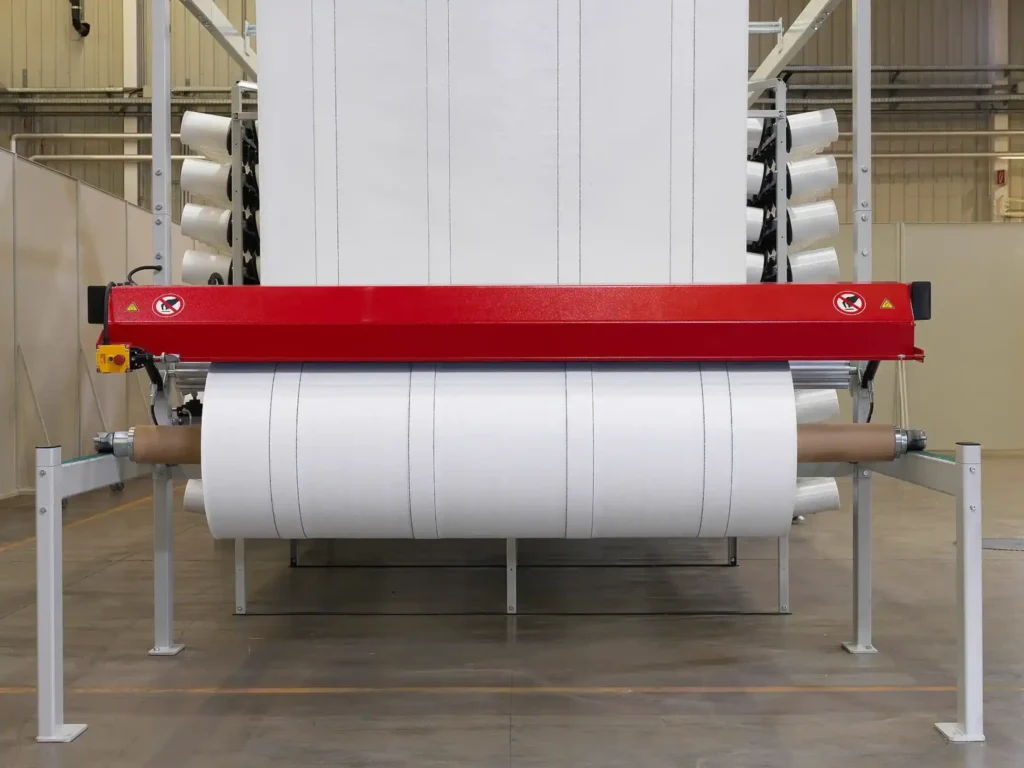
Great products begin before the first pellet reaches a hopper. Resin selection defines melt flow ranges suited to tape extrusion; approved supplier lists and certificates of analysis anchor lot‑to‑lot stability. Then the physical journey starts: a thin cast sheet, slit into narrow ribbons, drawn hot to align polymer chains, set to lock in orientation, and wound into bobbins. These tapes head to circular or flat looms where warp and weft interlace at densities such as 10×10 to 14×14 ends/picks per inch. The woven tube or sheet—already strong—can be coated to close pores or laminated with BOPP for graphics and scuff performance. Finally, conversion lines cut, fold, and close: open‑mouth with hemmed tops; block‑bottom valve sacks with angular precision; welded seams when coatings allow.
- Incoming assurance — verify MFR, ash, moisture; audit masterbatches for active content and dispersion; check BOPP thickness and treatment levels.
- Tape extrusion and draw — tune melt temperature, chill conditions, slit width, and draw ratio to target tensile vs. elongation.
- Weaving — balance warp tension and picks per inch; manage bobbin change SOPs; control GSM within tight bands.
- Coating — apply 18–40 g/m² to block sifting, improve wet rub, and enable welding; verify adhesion and curl behavior.
- Printing + BOPP lamination — reverse print for artwork longevity; measure peel; run scuff/rub tests on finished panels.
- Conversion — precision cutting, gusset forming, stitching or hot‑air welding; verify seam efficiency against target.
- Release testing — tensile/tear, seam, COF, drop/stack on filled samples; migration and UV aging where applicable.
Equipment choice is not branding fluff; it is the skeleton of repeatability. High‑tolerance mechanics and closed‑loop controls keep coat weight, lamination peel, and cut length within narrow ranges, so field complaints remain low and process windows broad. That is why premium European platforms are favored where consistency at speed is non‑negotiable.
Use cases • Where SOM PP Fabric Bags show outsized value
From farms to factories, from ports to retail aisles, the same substrate adapts with small shifts in construction. Shopping for solutions is easier when we map content chemistry, logistics stress, and branding needs to fabric GSM, coating weight, and seam style.
Agro inputs and seeds
Dust control and UV retention drive choices. Laminated constructions protect labels in sun‑exposed storage; welded bottoms reduce stitch perforation paths for fine fertilizers.
Staple foods
Rice, flour, pulses, and sugar benefit from reverse‑printed BOPP for brand fidelity; coating weights and seam choices balance hygiene with cost.
Animal nutrition
Laminated substrates protect lipids and flavors; gusset discipline improves cubing; COF tuning helps tall pallet stability in warm warehouses.
Industrial minerals and cement
Block‑bottom valve sacks with hot‑air welded corners form brick‑packs that stay square; delamination and COF are watched closely to preserve pallet geometry.
Quality assurance • How the right controls convert design into reliability
Reliability is a behavior, not a slogan. It emerges when procedures align with measurable targets and when sampling strategies expose variance before customers do. For SOM PP Fabric Bags, four threads tie efforts together: standards alignment, prime materials, capable equipment, and layered inspection.
Standards‑aligned testing
Strip/grab tensile on fabric; seam efficiency vs. warp tensile; COF per ASTM/ISO; drop/stack on filled sacks; migration for food‑contact lines; UV aging matched to climate.
Materials discipline
Virgin PP grades, qualified masterbatches, and documented declarations; recycled content limited to allowed layers with traceability when used.
Equipment capability
Precision tape lines and looms; coating/lamination with controlled nip and corona; conversion stations that hold stitch density and cut length at speed.
Layered inspection
Incoming COA checks; in‑process camera systems; destructive testing; SPC dashboards; complaint loops translating field signals into parameter tweaks.
System thinking • Break the challenge into subsystems, solve, recombine
When designers approach SOM PP Fabric Bags as a system, seven subsystems stand out: materials, tape mechanics, surface engineering, conversion and seams, compliance, logistics behavior, and sustainability. Each has a primary lever, a measurable KPI, and a failure mode that must be caught early. The solution is not merely the sum of pieces; it is the pattern produced by their constraints.
Design space • The adjustable dials behind performance and cost
Think of SOM PP Fabric Bags as a set of dials: fabric GSM, tape denier, weave density, coating weight, BOPP thickness, seam style, COF. Turning any dial nudges two curves at once—performance and cost. The trick is to make smart moves, not merely large ones.
- Fabric GSM — increases tensile and tear but raises resin usage; sometimes better to raise draw ratio than to add mass.
- Weave density — tighter weaves reduce porosity and improve tear propagation resistance but demand cleaner tapes and higher loom tension control.
- Coating weight — lowers sifting and enables welding; too much produces curl and stiffness that harm conversion.
- BOPP thickness — adds scuff resistance and visual depth; excessive thickness can hamper fold quality on small SKUs.
- COF tuning — a Goldilocks variable; 0.35 is a commonly safe middle, but conveyors and pallet wood species can shift the sweet spot.
Selection guide • Match the bag to content, filling, and travel
Selection begins with content sensitivity and ends with the warehouse. Start by asking three questions: what must be kept in (fines, aroma, oils), what must be kept out (moisture), and what the bag must endure (filling speeds, conveyors, palletization heights, climate). Then chart a short list of constructions that achieve those outcomes without complexity creep.
Questions engineers ask • Brief, candid answers
Why does draw ratio dominate tensile? Because the longer the chains are aligned, the more load travels along them rather than across them. When should welding displace stitching? When coated or laminated webs allow it and when sifting sensitivity makes perforations unacceptable. How do teams avoid delamination? Control corona, temperature, and nip pressure; verify peel strength and run scuff panels. Why do some pallets lean? COF too low or gussets too wide. How do you protect UV packages near sulfur? Pick stabilizers evidence‑proven against inhibition and validate with aging representative of climate and chemistry.
Scenarios • Translating versatility into concrete SKUs
A rice brand shifts from coated‑and‑flexo to BOPP‑laminated; stiffness from the laminate allows a small GSM reduction while maintaining drop and seam targets. A cement producer increases pallet height by combining hot‑air‑welded block‑bottom corners with tuned COF around 0.35. A fertilizer packed for yard storage retains at least 70 percent of tensile after weathering because the UV package was chosen with sulfur exposure in mind. Each scenario is not a miracle; it is an engineered consequence.
Implementation • From first brief to the first pallet at your dock
Start with discovery. Translate marketing language into load cases, moisture tolerances, and print ambitions. Build a parameterized bill of materials. Run a pilot that strikes at the weak points: seam, drop, peel, COF, and UV. Only then commit to tooling, artwork, and a run‑at‑rate that proves not just quality but stability at speed. Retain samples, document control plans, and prepare a feedback loop that turns complaints into learning rather than noise.
For readers exploring premium graphics on woven PP, a helpful reference on laminated options can be found here: laminated BOPP woven bags for retail branding.
Extended parameters • Practical ranges, controls, and fixes
The following parameters capture typical windows used for SOM PP Fabric Bags. Numbers are indicative; robust programs validate on the final construction, not just the components.
Risk register • Anticipate failure modes and prepare responses
Regulatory notes • Food contact, migration, and paperwork discipline
Food‑contact projects using SOM PP Fabric Bags require a paperwork chain and testing aligned to destination markets. That means polymer and additive declarations, migration testing on the final construction (not just component sheets), and retention of records that auditors can follow. Non‑food applications still benefit from document hygiene; clarity prevents delays and de‑lists.
Sustainability • Practical measures that move the needle
Mono‑polyolefin designs—PP fabric with PP or BOPP surfaces—simplify recycling streams. For non‑food SKUs, recycled polypropylene can be integrated into non‑critical layers such as coating cores when color and variability are masked by graphics. GSM reduction, seam‑efficiency gains, and OEE improvements often reduce impact more than marketing changes do. Real progress lives in grams saved, defects avoided, and pallets stabilized.
Myths and realities • Short rebuttals to common objections
“Aren’t woven PP bags too slippery for tall pallets?” Only if COF is ignored. COF tuning and wrap recipes solve most cases. “Isn’t BOPP lamination expensive?” The premium often pays for itself by preventing scuff and freight‑time damage to artwork. “Can recycled content be used?” Yes, with layer discipline and application limits. “Will welded seams always beat stitching?” Not always—uncoated webs still reward well‑executed stitching.
Glossary • Quick reference for cross‑functional teams
- Denier — mass in grams per 9000 m of tape; correlates with tensile and hand.
- GSM — grams per square meter; useful proxy for resin mass.
- COF — coefficient of friction; driver for pallet stability and machinability.
- WVTR — water vapor transmission rate; barrier indicator.
- HALS — light stabilizers that quench radicals during UV exposure.
- BBVS — block‑bottom valve sack, a high‑speed filling format for powders.
2025-10-23
- Orientation • What exactly are SOM PP Fabric Bags and why do they matter now?
- Material science • What is in the fabric and why it works
- Signature qualities • What stands out when teams adopt SOM PP Fabric Bags?
- From resin to pallet • A practical walk through the manufacturing pathway
- Use cases • Where SOM PP Fabric Bags show outsized value
- Quality assurance • How the right controls convert design into reliability
- System thinking • Break the challenge into subsystems, solve, recombine
- Design space • The adjustable dials behind performance and cost
- Selection guide • Match the bag to content, filling, and travel
- Questions engineers ask • Brief, candid answers
- Scenarios • Translating versatility into concrete SKUs
- Implementation • From first brief to the first pallet at your dock
- Extended parameters • Practical ranges, controls, and fixes
- Risk register • Anticipate failure modes and prepare responses
- Regulatory notes • Food contact, migration, and paperwork discipline
- Sustainability • Practical measures that move the needle
- Myths and realities • Short rebuttals to common objections
- Glossary • Quick reference for cross‑functional teams
Polypropylene (PP) fabric bags, particularly Sewn Open Mouth Bags (SOM Bags), have become a versatile and essential product in industries ranging from agriculture to chemicals. SOM PP fabric bags are defined by their open-mouth structure and sewn closure, making them highly practical for bulk packaging. These bags, combined with innovative designs such as PE inner linings and BOPP lamination, allow for various industry applications.
This article explores the intricacies of Sewn Open Mouth Bags, their design features, material options, and applications in diverse environments. By examining both the foundational aspects of SOM bags and their customizations, industries can make informed choices based on storage conditions, product requirements, and environmental factors.
What are Sewn Open Mouth (SOM) PP Fabric Bags?
SOM bags or Sewn Open Mouth sacks are a type of woven polypropylene bag that is open on one end, with the other end sealed through stitching or sewing. The open mouth allows easy filling, while the sewn closure ensures secure packaging. These bags are well-suited for handling various bulk materials, including grains, fertilizers, and chemicals, where durable and flexible packaging is required.
Woven polypropylene (PP) bags are made from PP fabric, a lightweight, durable, and moisture-resistant material. They offer high tensile strength, which is critical for holding large volumes or heavy weights, and their woven structure provides added flexibility and breathability.
Sewn Open Mouth Woven Bags are often customizable to fit specific storage conditions, adding elements such as inner linings, lamination, or additional sealing features to enhance their utility in various industries.
Key Features of SOM PP Fabric Bags
- Durability: Woven PP offers significant strength, making SOM bags suitable for bulk products.
- Customizable Design: SOM bags can be produced in various sizes and with added features like PE inner linings or BOPP lamination.
- Environmental Resistance: PP fabric’s resistance to moisture and chemicals makes it ideal for challenging environments.
- Easy Handling: The open-mouth design simplifies filling and packaging, especially for automated processes.
- Cost-Effectiveness: Compared to other packaging materials like paper or plastic, PP fabric provides an affordable yet durable solution for industrial packaging.
| Product Feature | Description |
|---|---|
| Material | Woven Polypropylene (PP) |
| Design | Sewn open mouth, customizable sizes |
| Additional Features | Inner PE lining, BOPP lamination, UV resistance |
| Primary Applications | Bulk storage for grains, fertilizers, chemicals, etc. |
| Strength | High tensile strength, ideal for handling heavy loads |
| Environmental Resistance | Moisture and chemical resistant, suitable for outdoor or harsh environments |
| Cost Efficiency | Affordable packaging option for large-scale industrial use |
| Custom Printing | Full-surface, high-definition printing available, customizable to client needs |
Customization Options: Design and Materials
One of the most significant advantages of Sewn Open Mouth Woven Bags is their customizable design. Depending on the use case, industries can choose various material options, coatings, and linings to enhance the bag’s functionality.
1. FFS PP Bags (Form-Fill-Seal Bags)
FFS bags are a popular choice in automated packaging processes where the bag is filled and sealed in one continuous operation. FFS PP Bags are typically tubular, which minimizes the need for side seams and further enhances the bag’s durability. When integrated with SOM bag design, the combination offers versatility for industries requiring fast and efficient packaging solutions.
Advantages of FFS PP Bags:
- Seamless integration into automated systems.
- Reduced labor and time due to the continuous process.
- High efficiency in large-scale production settings.
2. PE Inner Lining for Enhanced Protection
In environments where moisture control and protection against contamination are crucial, SOM PP bags with a PE inner lining are a go-to solution. The polyethylene (PE) lining acts as an additional barrier to protect the contents from external elements such as humidity, dust, and chemical exposure.
PE-lined SOM bags are ideal for industries like chemicals, fertilizers, and food packaging, where the contents must remain free from contamination and moisture.
Applications for PE Inner-Lined Bags:
- Food products like grains and rice.
- Chemical and pharmaceutical industries requiring sterile environments.
- Fertilizers, powders, and other moisture-sensitive materials.
3. BOPP Lamination for Superior Aesthetics and Durability
BOPP (Biaxially Oriented Polypropylene) laminated bags combine aesthetics with durability. These laminated bags are more resistant to abrasion and provide an attractive appearance, which is crucial for consumer-facing products like pet food or retail items.
Benefits of BOPP-Laminated SOM Bags:
- High-quality, full-color printing capabilities for branding and product information.
- Increased durability and resistance to physical wear and tear.
- Waterproofing properties that protect the contents and enhance shelf life.
BOPP-Laminated Bags are ideal for products that require attractive packaging in addition to durability, such as animal feed, seeds, or construction materials like cement.
Applications of Sewn Open Mouth Bags
Open Mouth Bags are used across numerous industries, from agriculture and construction to chemicals and retail. Each application benefits from the flexibility, strength, and cost-efficiency of woven polypropylene material, which can be tailored to specific needs.
- Agriculture and Food Packaging:
SOM bags are extensively used in agriculture for packaging grains, seeds, flour, and other food-related products. Their high tensile strength and environmental resistance protect agricultural products during transport and storage. - Chemicals and Fertilizers:
For bulk chemicals or fertilizers, SOM bags provide the necessary durability and resistance to contamination. The optional PE inner lining enhances protection, making these bags well-suited for moisture-sensitive chemicals. - Construction Materials:
Industries handling heavy-duty materials such as sand, gravel, cement, or plaster commonly use SOM woven bags. The woven structure ensures strength, while BOPP lamination adds moisture protection and abrasion resistance.
Advantages Over Other Packaging Solutions
Compared to other packaging materials such as plastic (PE) or paper, SOM PP bags offer distinct advantages that make them the preferred choice in many industries:
- Strength and Durability: Woven polypropylene provides a higher level of tensile strength compared to traditional plastic or paper bags. This durability makes SOM bags suitable for heavy loads and rough handling conditions.
- Environmental Resistance: Woven PP is moisture-resistant and, when laminated or lined, can protect products from the elements. This makes them superior to paper bags in applications requiring moisture protection.
- Customization: SOM bags can be manufactured to precise specifications, including size, weight, lining, and printing. This level of customization is difficult to achieve with other packaging options.
- Cost-Efficiency: Despite their strength and customization options, SOM bags remain one of the most affordable packaging options for industrial-scale use.
Choosing the Right SOM Bag Design
Selecting the appropriate SOM bag design involves considering several factors, including the product’s weight, moisture sensitivity, and intended storage conditions. Key elements to consider include:
- Bag Thickness: For heavier or denser products, a thicker PP fabric ensures the bag can handle the load.
- Coatings and Linings: Adding a PE inner lining or BOPP lamination can provide extra protection, particularly for moisture-sensitive products.
- Printing Needs: For consumer-facing products, full-surface printing with high-definition designs may be required to enhance branding and visibility.
Parameters to Consider When Choosing SOM Bags
| Parameter | Description |
|---|---|
| Bag Thickness | Determines the load-bearing capacity; thicker bags for heavier materials |
| Lamination | BOPP lamination for moisture resistance and durability |
| Inner Lining | PE inner lining for additional moisture protection |
| Printing | Customizable printing with options for CMYK, Pantone, or RAL color systems |
| Bag Size | Customizable based on product volume and handling requirements |
| Sealing Type | Sewn closure for security and durability |
Conclusion
Sewn Open Mouth Bags provide the perfect balance between durability, customization, and cost-effectiveness. With innovations like BOPP lamination and PE inner linings, industries can tailor SOM bags to their specific needs. As industries evolve, the demand for high-quality, versatile packaging like SOM sacks and Sewn Open Mouth Woven Bags will continue to rise, making them a vital component in global supply chains.