
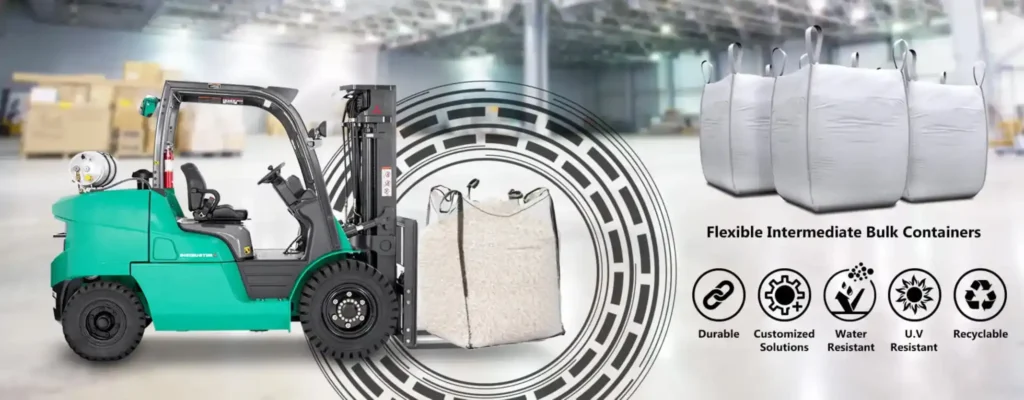
What Are FIBC Bags?
FIBC bags are flexible intermediate bulk containers designed to unitize and transport flowable solids—powders, granules, pellets, and small aggregates—at scales typically ranging from several hundred kilograms to about a metric ton per package. They function as collapsible bulk units whose structural strength derives from high‑tenacity woven polyolefin fabrics and whose versatility comes from a palette of tops, bottoms, liners, and lifting geometries. In factories, terminals, and warehouses, FIBC bags behave like modular, portable silos: they condense many manual handling cycles into a small number of forklift moves, synchronize inbound material supply with production tempo, and reduce the cumulative risk of spills, tears, and cross‑contamination that plague small‑sack logistics.
To reduce confusion across sectors and regions, it helps to list the aliases that refer to the same core architecture. The names change; the physics does not.
- Bulk bags
- Big bags
- Jumbo bags
- Super sacks
- Flexible Intermediate Bulk Containers
- PP woven bulk bags
- Polypropylene FIBC
- 1‑ton bags
- UN FIBC (when certified for hazardous goods)
Each alias points to a collapsible bulk package with engineered lifting capacity, tuned barrier options, and a compelling total cost of ownership compared with drums, boxes, or small sacks.
The Material System of FIBC Bags
The sustainability promise and operational reliability of FIBC bags are rooted in their materials. The structural chassis is the woven fabric; the functional layers are films, liners, coatings, and additives; the load path is defined by slings, loops, and seams. When these parts are specified coherently—based on product chemistry, route severity, and handling practice—the result is a package that lifts safely, protects product, and minimizes waste.
Polypropylene Woven Fabric
Polypropylene is extruded into tapes, drawn to align chains, and woven into a mesh with high tensile and tear performance at low mass. Its low density (~0.90 g/cm³), chemical resistance to many salts and bases, and potential for UV stabilization make it the dominant fabric for FIBC bags.
Polyethylene Liners
LDPE/LLDPE liners provide moisture barriers, product purity, and sealability at modest temperatures. Coextruded options can tailor oxygen and aroma control. Liners are the quiet heroes when materials are hygroscopic or dust‑forming.
Additives and Functionals
UV stabilizers extend outdoor life; antistatic agents tame charge in powder atmospheres; color masterbatches enable SKU traceability; tie layers and coatings improve dusting performance and laminate adhesion where films are applied.
| Component | Material | Role | Cost Profile | Placement |
|---|---|---|---|---|
| Body fabric | PP woven | Primary tensile chassis | Base cost | Tubular or 4‑panel body |
| Liner | LDPE/LLDPE | Moisture and purity | Low to moderate | Loose or attached inside |
| Coating/film | Polyolefin coatings | Dust control, printability | Moderate | Outer or inner surface |
| Slings/loops | PP or polyester webbing | Lifting and load paths | Moderate | Stitched to panels |
| Thread | High‑tenacity yarn | Seam integrity | Low | All seam lines |
| Additives | UV, antistatic | Durability & safety | Low | Resin or coating |
Principal Features and Why They Matter
A feature is a capability under stress. FIBC bags are persuasive not because they are novel but because they are practical: they reduce touches, minimize packaging mass per delivered ton, clean up filling rooms, and collapse flat when empty. In a landscape of rigid bins and small sacks, these flexible containers occupy a middle ground that solves for speed, cleanliness, and safety at the same time.
5:1 and 6:1 are common ratings for single‑use and re‑usable designs respectively, with 8:1 available in some re‑use loops. This headroom makes lifting predictable and reduces emergency incidents.
Replace pallets of small sacks with compact bulk units. Fewer labels to print, fewer seams to fail, fewer chances for human error.
From unlined breathability to sealed moisture protection, liners and coatings convert one platform into many use‑cases without re‑platforming.
| Attribute | Indicative Window | What Tunes It |
|---|---|---|
| Safe working load | 500–2000 kg | Denier, GSM, sling geometry |
| Fabric GSM | 140–240 g/m² | Denier and weave density |
| UV stability | 200–400 h QUV | Stabilizer package |
| Liner thickness | 50–120 μm | Barrier needs and sealing |
The Production Process of FIBC Bags
The credibility of FIBC bags is built on process discipline: choosing appropriate resins, weaving uniform fabrics, controlling coatings and laminations, sewing robust seams, and verifying quality with tests that simulate real routes. In this chain, equipment stability is a silent multiplier. VidePak emphasizes best‑in‑class platforms from Austria and Germany to lock in narrow process windows across extrusion, lamination, film handling, and conversion.
Front‑End: Raw Materials and Incoming QA
- Virgin PP pellets with controlled melt flow, ash, and odor; documented certificates of analysis and traceability.
- LDPE/LLDPE liner grades tuned for seal temperature and slip; optional barrier layers where oxygen exposure matters.
- High‑tenacity webbing and thread with consistent denier and finish so stitch patterns hold under load.
- Incoming sampling for MFI, tensile, dyne level on films, and moisture on papers/liners.
Each Process Segment and Its Controls
| Segment | Primary Goal | Control Points | Why it matters |
|---|---|---|---|
| Extrusion & draw | Uniform tapes | Melt temperature, quench, draw ratio | Strength vs brittleness balance |
| Weaving | Stable fabric | Picks per inch, loom tension, broken ends map | Tear resistance and uniformity |
| Coating/lamination | Adhesion & dust control | Nip temp/pressure, coat weight | Peel strength and curl control |
| Printing & labels | Readable identity | Registration, color ΔE, barcode contrast | Traceability and safety |
| Cutting & sewing | Dimensional & seam integrity | Cut tolerance, stitch density/pattern | Lift safety and leakage control |
| Liner insertion | Barrier & cleanliness | Gauge, seal parameters | Moisture and dust control |
| Palletizing | Transit stability | Bale compression, strap tension, wrap spec | Damage prevention |
Back‑End: Quality Inspection and Release
- In‑process checks: denier, fabric defect maps, peel adhesion, stitch pull‑out, spout dimensions, liner seal trials.
- Final tests: tensile (warp/weft), burst, top‑lift and drop, dimensional AQL, pallet compression where routes demand it.
- Traceability: batch IDs linking materials, machine settings, and operators to every lot; corrective actions on non‑conformances.
The Application Landscape of FIBC Bags
Because FIBC bags are configurable, one platform serves many industries. The selection logic is simple to state and subtle to execute: specify the outer fabric and GSM for handling severity, choose the top and bottom for filling and discharge behavior, select liners for barrier and cleanliness, and fit the sling geometry to lifting equipment and pallet patterns.
| Sector | Preferred Build | Key Gains |
|---|---|---|
| Food & feed ingredients | Spout top + liner | Hygiene, cross‑contamination prevention |
| Fertilizers | UV‑stable fabric + liner | Caking reduction, field durability |
| Chemicals & minerals | Type C/D static control | Explosion risk mitigation, dust control |
| Resins & polymers | Coated fabric + spout | Pellet loss reduction, clean transfer |
| Biomass & fuels | Duffle top + discharge | Bulk flow compatibility, warehouse safety |
| Construction materials | Heavy‑duty base + loops | Site durability, fewer bag failures |
For sourcing context and adjacent options, see this related resource: trusted FIBC bulk bags supplier. It complements the configuration logic outlined here with supply perspectives.
How VidePak Controls and Guarantees the Quality
Quality is not inspection; it is prevention first, control second, and verification last. VidePak’s approach to FIBC bags rests on four mutually reinforcing steps.
Step 1 — Standards‑anchored production and tests
Design, manufacturing, and testing align with internationally recognized methods (ISO, ASTM, EN, JIS) and applicable national standards for woven packaging. Procedures are documented; equipment is calibrated; changes are controlled.
Step 2 — 100% virgin raw materials from major producers
PP, PE, films, and webbing are sourced from vetted suppliers with certificates and lot IDs. Resin variability is limited before it reaches production, reducing noise in downstream processes.
Step 3 — Best‑in‑class equipment
Starlinger and W&H lines stabilize thermal and mechanical setpoints. Narrow distributions on denier, peel adhesion, and layflat reduce reject rates and improve field performance.
Step 4 — Layered inspections: incoming, in‑process, final, sampling
From MFI and dyne checks to seam strength and drop tests, plus retention samples for aging audits, the inspection stack catches drift and confirms conformance before shipment.
Extending the Sustainable Packaging Argument
The central claim—FIBC bags play a decisive role in sustainable packaging—becomes persuasive when tested against operations, not just ideals. Material efficiency, logistics consolidation, reuse potential, recyclability, and risk reduction together create a portfolio of gains that add up to real impact.
Material efficiency
Replacing dozens of small sacks with a single bulk unit slashes packaging mass per delivered ton. Less mass means less embodied energy and a smaller waste stream at end of life.
Logistics consolidation
Fewer touches reduce losses, contamination, and injuries. Forklift cycles drop. Pallets stabilize. Warehouse maps simplify with fewer SKUs of packaging.
Reuse and recycling
Where hygiene and regulation permit, re‑use models with elevated safety factors extend service life. Where reuse is impractical, mono‑polyolefin designs support recycling streams where available.
System Thinking: Sub‑Arguments and Integration
Complex choices yield better outcomes when decomposed and then recomposed. For FIBC bags, the system can be broken into solvable parts and then rebuilt into a coherent specification that is both cost‑effective and reliable.
Strength vs weight vs cost
Run a design of experiments on denier, weave density, and stitch patterns against the true load case and route severity; settle on minimum mass that still passes with margin.
Moisture control vs breathability
Hygroscopic products need liners and seals; some goods benefit from limited venting to prevent condensation. Validate with moisture‑gain trials and flow checks.
Filling speed vs seal integrity
Bigger spouts and looser seals are faster but leak under vibration. Tune spout geometry and clamp routines; verify with vacuum/pressure tests.
Abrasion resistance vs print quality
High‑coverage prints can scuff on severe conveyors without adequate hardness or adhesion. Adjust film gauges and over‑lacquers; test with simulated routes.
Technical Reference: Parameters, Types, and Options
The following tables consolidate common engineering markers for FIBC bags so teams can compare specifications with clarity.
| Attribute | Common Window | Governed by |
|---|---|---|
| SWL | 500–2000 kg | Fabric GSM, sling geometry |
| Safety factor | 5:1 single‑use, 6:1 re‑use | Standards and intended service |
| Dimensions | 850–1100 mm footprint; 800–1400 mm height | Pallet patterns and fillers |
| Static type | A, B, C, D | Powder class and environment |
| Static Type | Control Method | Typical Use |
|---|---|---|
| A | No special control | Non‑flammable atmospheres |
| B | Low breakdown voltage | Fine powders without flammable vapors |
| C | Groundable conductive threads | Flammable zones with reliable grounding |
| D | Dissipative fabric | Flammable zones where grounding is impractical |
| Zone | Variants | When to choose |
|---|---|---|
| Top | Open, duffle, spout | Open for simplicity; duffle for flexibility; spout for closed systems |
| Bottom | Flat, spout, conical | Flat for disposal; spout for controlled discharge; conical for sticky powders |
Production Flow and Control Windows
| Stage | Control point | Typical setpoint/check | Why it matters |
|---|---|---|---|
| Tape extrusion | Melt temperature, draw ratio | 240–270 °C; 5.5:1–7.5:1 | Mechanical strength without brittleness |
| Weaving | Picks per inch, tension | 10–14 PPI; vendor‑specific tensions | Uniformity and tear resistance |
| Coating/lamination | Nip temp/pressure, coat weight | Optimized by laminate | Peel adhesion, curl control |
| Printing | Registration, color ΔE | ≤ ±0.2 mm; per spec ΔE | Legibility and code scanning |
| Sewing | Stitch density/pattern | Per sling and seam spec | Lift safety and leakage |
| Liner insertion | Gauge, seal integrity | μm per spec; pressure/visual | Moisture, purity, flow |
| QA release | AQL, top‑lift/drop | As per ISO/ASTM/EN/JIS | Shipment‑ready confidence |
Procurement Playbook and Implementation
Selecting FIBC bags is not a catalog exercise; it is an engineering decision dressed as purchasing. A concise playbook keeps teams aligned.
- Define the load case, route severity, and hygiene constraints.
- Choose outer fabric GSM and sling geometry to match lifting equipment.
- Select top/bottom constructions based on fillers and discharge equipment.
- Decide on liner thickness and material based on moisture sensitivity.
- Align test methods and acceptance criteria with recognized standards.
- Audit suppliers for equipment caliber, SOP discipline, and SPC dashboards.
- Pilot on actual lines, collect speed and rejection data, and iterate.
- Freeze the specification; set review cadences and field‑performance audits.
Risk Management and Route Simulation
Even a strong bag can fail a harsh route. That is why route simulation—vibration, drop, compression—belongs in qualification. Where failures surface, strengthen that link rather than overbuilding everything. In many cases, smarter pallet patterns and strap recipes win more than thicker fabrics. For FIBC bags, resilience is designed; it is not an accident.
Workforce, Training, and the Human Factor
Machines hold tolerances, but people hold the line. Clear SOPs, skill training that explains the why behind the what, and feedback loops that operators actually use transform compliance into craftsmanship. Teams that understand the system behavior of FIBC bags make sharper on‑line decisions and write better corrective actions when the system hiccups.
Looking Ahead: Practical Innovation
Expect incremental improvements with compounding benefit: tie layers with lower volatile content, liners that seal at lower temperatures, fabrics with tuned textures that resist scuffing without adding mass, registration systems that tighten color drift in real time. Each advance strengthens the case for FIBC bags in sectors where product loss is expensive and brand reputation is fragile.
Frequently Raised Questions
Why select FIBC instead of small sacks? Unitization reduces touches, errors, and injuries; packaging mass per delivered ton drops; cleanliness improves when liners are used.
Are FIBC recyclable? Mono‑polyolefin designs are technically compatible with polyolefin streams where infrastructure exists; liners should be polyolefin for compatibility.
When should Type C or Type D static control be specified? Choose Type C with reliable grounding in flammable zones; choose Type D where grounding is impractical but dissipation is still required.
What drives cost most strongly? Fabric GSM and sling geometry dominate unit cost. Equipment stability and yield protect cost by minimizing scrap and rework.
What is the most common field failure? Specifications mismatched to route severity and filler behavior—solved by piloting on actual lines and iterating.
Keyword and Phrase Map
For clarity and discoverability, this article deliberately interleaves related phrases alongside the core keyword. The anchor remains FIBC bags, repeated where context warrants, supported by natural variants: bulk bags big bags jumbo bags super sacks polypropylene FIBC PP woven bulk bags 1‑ton bags UN FIBC industrial packaging for fertilizer powder handling containers moisture‑proof bulk containers.
2025-10-26
- What Are FIBC Bags?
- The Material System of FIBC Bags
- Principal Features and Why They Matter
- The Production Process of FIBC Bags
- The Application Landscape of FIBC Bags
- How VidePak Controls and Guarantees the Quality
- Extending the Sustainable Packaging Argument
- System Thinking: Sub‑Arguments and Integration
- Technical Reference: Parameters, Types, and Options
- Production Flow and Control Windows
- Procurement Playbook and Implementation
- Risk Management and Route Simulation
- Workforce, Training, and the Human Factor
- Looking Ahead: Practical Innovation
- Frequently Raised Questions
- Keyword and Phrase Map
- Understanding FIBC Bags
- Environmental Impact and Economic Benefits
- Conclusion
Flexible Intermediate Bulk Containers (FIBC Bags), commonly known as bulk bags, have become an integral part of various industries, providing an efficient means of transporting and storing bulk materials. At VidePak, we specialize in producing high-quality FIBC Bags with unique features such as cross and square bottom reinforcements, ensuring they can handle significant weight and pressure. This article explores the importance of FIBC Bags in the context of environmental sustainability and economic benefits, emphasizing the use of recyclable polypropylene (PP) materials and future trends in eco-friendly packaging.
Understanding FIBC Bags
FIBC Bags are designed for the transportation of dry bulk materials such as grains, powders, and chemicals. Their structure allows them to carry large volumes while remaining lightweight and easy to handle. The design features, including cross and square bottom reinforcements, provide stability and prevent sagging, making them ideal for heavy loads.
Advantages of FIBC Bags
- High Load Capacity: FIBC Bags can typically hold between 500 kg to 2000 kg, depending on the design and materials used. This high capacity reduces the need for multiple smaller bags, optimizing transportation efficiency.
- Durability: Made from woven polypropylene, these bags are resistant to tearing and puncturing, ensuring that the contents are protected during transit and storage.
- Versatility: FIBC Bags can be used in various industries, including agriculture, construction, and pharmaceuticals, making them a versatile packaging solution.
- Cost-Effectiveness: By reducing shipping costs through their high load capacity and lightweight design, FIBC Bags present a cost-effective solution for businesses.
- Recyclability: One of the most significant benefits of using FIBC Bags is that they are made from recyclable materials. This not only supports environmental initiatives but also aligns with growing consumer demand for sustainable practices.
Table: Key Features of FIBC Bags
| Feature | Description |
|---|---|
| Load Capacity | Up to 2000 kg |
| Material | Woven polypropylene (PP) |
| Design | Cross and square bottom reinforcements |
| Durability | Tear and puncture-resistant |
| Recyclability | Fully recyclable materials |
Environmental Impact and Economic Benefits
Social Responsibility
The production and use of FIBC Bags can significantly impact environmental sustainability. By using recyclable PP materials, companies can minimize their carbon footprint while maintaining product quality. The social responsibility of manufacturers, including VidePak, emphasizes the importance of environmentally friendly practices that align with global sustainability goals.
Economic Efficiency
Adopting FIBC Bags not only provides a sustainable option but also enhances economic efficiency. Businesses can reduce packaging waste and costs by using fewer, more durable bags. Furthermore, companies that prioritize sustainability often see improved brand loyalty and customer trust, which can lead to increased sales.
Future Trends in Environmental Protection
As industries continue to evolve, the demand for sustainable packaging solutions will likely grow. Here are some future trends expected to influence the development of FIBC Bags:
- Development of Comprehensive Recycling Systems: Establishing structured recycling systems will become increasingly important. This involves collaboration between manufacturers, consumers, and recycling facilities to ensure that used bags are properly collected and recycled.
- Innovative Biodegradable Materials: There is a growing interest in developing biodegradable alternatives to traditional polypropylene. Research into materials that can decompose more easily will contribute to reducing plastic waste.
- Consumer Awareness and Demand: As consumers become more environmentally conscious, the demand for sustainable packaging solutions will rise. Companies that prioritize eco-friendly practices will have a competitive advantage in the marketplace.
- Regulatory Changes: Governments worldwide are implementing stricter regulations regarding packaging waste. Companies that proactively adopt sustainable practices will be better prepared to comply with these regulations.
Table: Future Trends in FIBC Bag Development
| Trend | Description |
|---|---|
| Recycling Systems | Establishing structured systems for bag recycling |
| Biodegradable Materials | Development of innovative biodegradable alternatives |
| Consumer Demand | Increased demand for sustainable packaging |
| Regulatory Compliance | Adapting to stricter packaging waste regulations |
Conclusion
The importance of FIBC Bags in today’s packaging landscape cannot be overstated. With their high load capacity, durability, and recyclability, these bags offer a practical and environmentally friendly solution for various industries. At VidePak, we are committed to sustainability by utilizing recyclable polypropylene materials and adhering to stringent quality standards.
As the market continues to evolve, the integration of innovative recycling systems and biodegradable materials will shape the future of packaging. Companies that prioritize these trends will not only contribute positively to environmental protection but also enhance their economic viability and brand reputation. The choice of FIBC Bags represents a step towards a more sustainable future, aligning with both social responsibility and economic efficiency.
References
- “Sustainable Packaging: Trends and Innovations” by Johnson, R.
- “The Role of FIBC Bags in Modern Logistics” by Wang, L.
- “Environmental Impact of Packaging Materials” by Chen, H.