
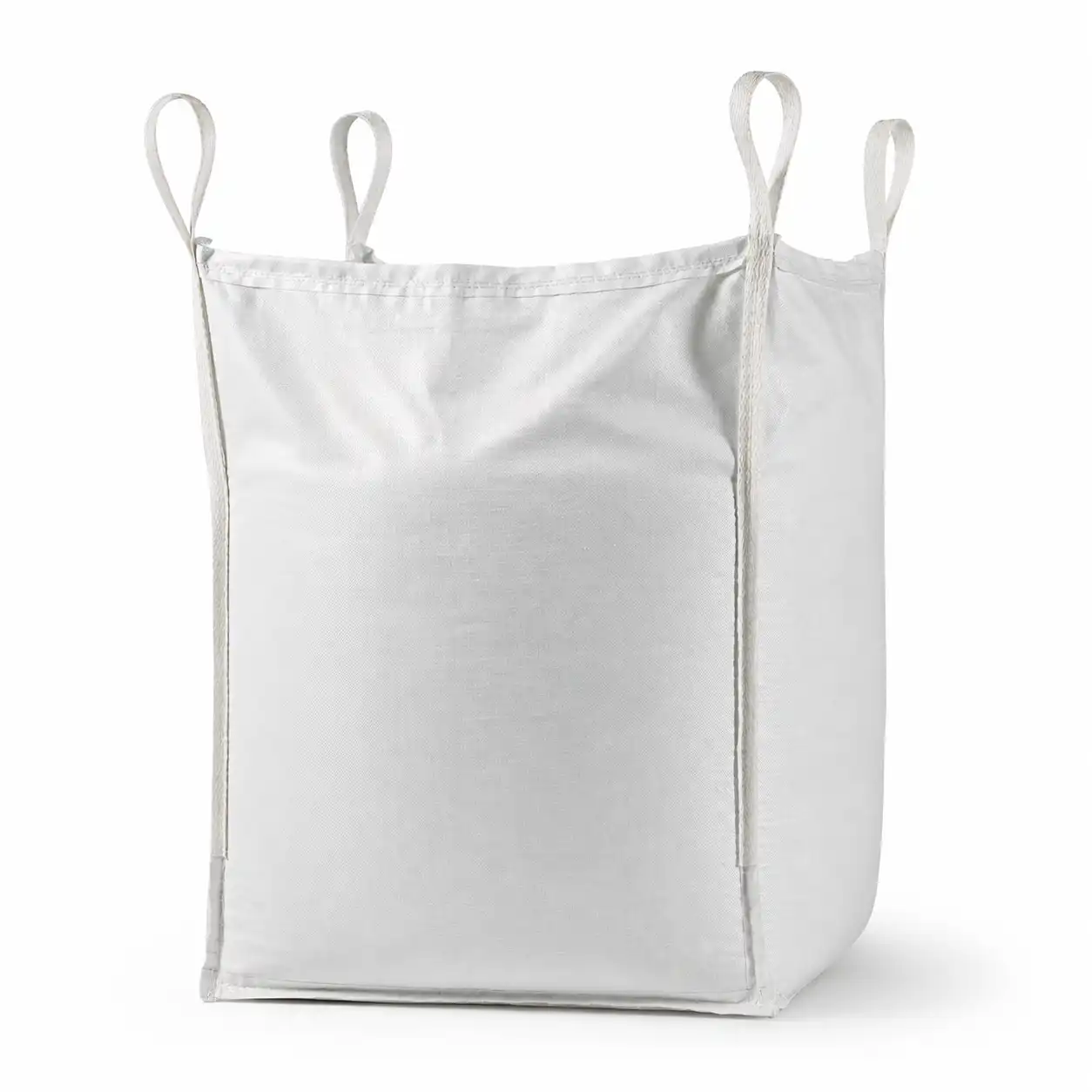
VIDEPAK FIBC bulk bags: Engineered Bulk Packaging Built Around Your Product, Process, and Supply Chain
Bulk packaging looks simple until the bag reaches the filling station. Then every detail begins to matter: the powder may create dust, the granules may push against the sidewalls, the product may absorb moisture, the liner may twist during filling, the discharge outlet may not match the customer’s equipment, and a bag that looked square while empty may become round and unstable after it is filled. This is why VIDEPAK approaches FIBC bulk bags not as oversized sacks, but as engineered packaging systems in which woven polypropylene fabric, lifting construction, top and bottom geometry, seam design, liner structure, and handling conditions must work together. Current international guidance likewise treats FIBCs as engineered containers with defined material, construction, design, testing, and marking requirements rather than as simple fabric bags.
VIDEPAK offers FIBC bulk bags for dry powders, granules, pellets, agricultural materials, minerals, chemical products, food ingredients, construction materials, fertilizers, plastic resins, recycling materials, and other bulk solids. Depending on the application, the package can combine different body constructions, lifting loops, filling openings, discharge systems, coated or uncoated fabric, sift-resistant details, a custom PE Liner, or internal Baffle liners. VIDEPAK’s published FIBC range includes open, duffle and spout tops; flat and discharge bottoms; U-panel, circular, four-panel and baffle constructions; and several lifting-loop arrangements.
VIDEPAK DESIGN PRINCIPLE: Do not begin with the question, “Which bag is cheapest?” Begin with: “What must the complete packaging system do?” The right FIBC bulk bags should match product density, particle size, filling equipment, dust-control needs, moisture and oxygen sensitivity, discharge method, lifting method, transport route, storage environment, and regulatory requirements. A professional Supplier turns these requirements into one coherent specification rather than adding isolated features one by one.
A Complete FIBC bulk bags Platform, Not One Standard Bag
The starting point for reliable FIBC bulk bags is the woven polypropylene shell. Polypropylene tapes are formed and woven into a flexible load-bearing fabric; the finished container then receives the top, bottom, lifting components, seams, liner system, printing, labels, and other required features. VIDEPAK publishes FIBC solutions for approximately 500 kg to 2,000 kg bulk applications, while the exact safe working load must always be defined and validated for the final construction rather than assumed from bag size alone. Industry terminology defines Safe Working Load as the load an FIBC is designed to carry and commonly describes safety factors such as 5:1 or 6:1 according to the intended construction and use.
Body Construction: Shape Begins with the Fabric Architecture
VIDEPAK can engineer circular, U-panel, four-panel and baffle-style FIBC bulk bags. A circular body is woven as tubular fabric and therefore eliminates the main vertical seams along the body sides. U-panel and four-panel designs use cut fabric sections assembled into the required shape. Each construction has a different balance of production efficiency, filled shape, seam placement and customization flexibility. When greater dimensional control is required, the design can move beyond the basic shell and incorporate internal baffles or Baffle liners.
Circular Construction
Well suited to many general-purpose bulk products. Tubular woven fabric reduces vertical body seams and offers an efficient foundation for customized top, bottom and lifting options.
U-Panel and Four-Panel Construction
These panel-based FIBC bulk bags give the engineering team additional control over panel dimensions, seam locations and filled geometry, making them useful when the package must closely match pallet or handling requirements.
Baffle and Form-Stable Construction
Internal restraint limits excessive sidewall expansion so that filled FIBC bulk bags remain closer to a square footprint. The same concept can be incorporated into purpose-designed Baffle liners, allowing the liner to support barrier performance and shape control at the same time. VIDEPAK identifies baffle construction as one of its FIBC customization options.
Top, Bottom, and Lifting Options
The top opening determines how material enters the package. VIDEPAK can configure open tops for simple loading, duffle or skirt tops when a wide flexible opening is preferred, and fill-spout tops when the bag needs to interface more closely with a filling chute or clamping system. Industry guidance defines a fill spout as the inlet designed to fit the customer’s filling chute, while open, duffle, conical and spout tops are established FIBC filling choices.
The bottom controls the next stage: discharge. Flat-bottom FIBC bulk bags are suitable when the customer intends to empty by cutting, tipping, vacuum removal or another process that does not require a reusable outlet. A discharge spout creates a controlled outlet for gravity discharge and can be equipped with ties and other closure details. Broader openings such as full-dump or duffle-style bottoms can be considered when very rapid emptying is the priority. The correct choice should follow the product’s flow behavior and the customer’s equipment, not a standard drawing used for every project.
The PE Liner System: Where Barrier Engineering Becomes Product Protection
For many customers, the most important component inside FIBC bulk bags is the component that is almost invisible from the outside: the PE Liner. The woven polypropylene shell carries the mechanical load, while the liner creates a more continuous inner layer between the product and the external environment. This division of work is important. Fabric gives strength. The PE Liner adds containment, cleanliness and barrier functions. One should not be expected to replace the other. Industry FIBC guidance recognizes both basic tubular liners and form-fit liners, with the latter shaped around the body, top and bottom of the container.
LDPE, LLDPE and Multi-Layer Co-Extrusion
VIDEPAK can engineer liner films using LDPE, LLDPE and combinations of polyethylene grades according to the required flexibility, sealing behavior, toughness and process conditions. Instead of treating film simply as “plastic of a certain thickness,” multi-layer co-extrusion allows different layers to perform different jobs within one film structure. VIDEPAK’s published technical material describes LDPE/LLDPE liner structures and multi-layer polyethylene production, with optional high-barrier layers where the application requires more than conventional polyethylene protection.
This is where EVOH can become valuable. In an engineered co-extruded structure, an EVOH layer can substantially increase resistance to oxygen transmission, while surrounding polyethylene layers help provide moisture protection, mechanical flexibility and heat-sealing functionality. Polymer technical guidance confirms that EVOH is commonly combined with polyethylene in multilayer packaging because it provides strong oxygen-barrier performance, while polyethylene protects the moisture-sensitive barrier layer and contributes sealability.
IMPORTANT: A thicker PE Liner is not automatically a better liner. Thickness influences mechanical robustness, but barrier performance also depends on resin selection, the number and arrangement of co-extruded layers, seal quality, pinhole control, liner geometry, seams and actual storage conditions. A professional Supplier therefore selects the complete film structure around the product risk instead of selling thickness alone. VIDEPAK technical guidance similarly links liner selection to moisture, oxygen, hygiene and handling needs.
Five Practical Thickness Options
VIDEPAK can develop PE Liner projects around thicknesses such as 40 μm, 60 μm, 80 μm, 100 μm and 150 μm, subject to the final resin structure, liner dimensions, filled product and validation plan. These gauges give buyers a useful engineering range from lighter inner containment to more robust heavy-duty liner constructions. VIDEPAK’s published FIBC guidance identifies LDPE/LLDPE liners across approximately the 40–150 μm range in relevant applications, while other VIDEPAK technical pages discuss 50–150 μm and 60–120 μm liner structures depending on design and duty.
The table is a selection guide, not an automatic application rule. The same nominal thickness can perform differently when resin composition, layer distribution or manufacturing conditions change. This is why VIDEPAK recommends combining film gauge with the required functional structure and confirming the final PE Liner through project-specific sampling or filling trials. Published industry design guidance similarly treats liner film, barrier function, insertion method and liner style as separate specification decisions.
Loose, Secured, Sewn and Form-Fit Liners
A basic loose PE Liner is inserted inside the outer bag without permanent attachment. It is simple and economical, but it may move, fold or rise with the product when conditions are not well controlled. A secured liner can be attached through tabs, ties, glue or equivalent methods. VIDEPAK can also design a liner so that selected points are sewn together with the outer FIBC bulk bags, helping the liner stay aligned with the body rather than behaving like a separate loose sleeve. Industry terminology specifically recognizes loose and secured insertion systems, including attachment by tabs and similar methods.
For more demanding applications, VIDEPAK can make the PE Liner follow the geometry of the outer bag. A form-fit design can include a flat base, shaped top, filling neck and discharge outlet positioned to correspond with the outer FIBC. Industry guidance describes form-fit liners as structures made to take the shape of the FIBC and notes that their shaped top, bottom and spouts can support improved filling and more complete discharge compared with a simple straight tube.
From Flat Bottom to Spouts: A PE Liner Can Follow the Entire Bag
The outer bag and inner liner should behave like one packaging system. That means the PE Liner does not have to stop at a simple open tube. VIDEPAK can design liner geometry around the same operating features used in the outer FIBC bulk bags: filling spout, discharge spout, flat bottom and other project-specific forms. A form-fit liner can therefore place polyethylene where the product actually flows, rather than forcing a generic cylinder into a shaped outer container.
Fill-Spout PE Liner
When the outer FIBC bulk bags use a filling spout, the liner can be produced with a matching inlet neck. This creates a cleaner interface with the filling system and allows the liner opening to be positioned where product enters the bag. For fine powders, this can be especially useful because the outer woven shell, liner and filling equipment can be specified as one dust-management system. VIDEPAK’s engineering guidance discusses filling-spout configurations for fine powders and form-fit liners aligned to the spout geometry.
Discharge-Spout PE Liner
Where controlled emptying is needed, the PE Liner can include its own discharge spout positioned inside the outer outlet. Product therefore moves through a defined liner path rather than having to escape from a closed liner into the woven discharge section. This is particularly relevant for fine powders, clean applications and products where residual material trapped in folds is undesirable. FIBC terminology defines the discharge spout as the bottom outlet, while form-fit liner guidance specifically recognizes liner spouts shaped to complement the FIBC filling and discharge openings.
Flat-Bottom PE Liner
For flat-bottom FIBC bulk bags, VIDEPAK can use a liner with a corresponding closed base. The objective is not merely to make the liner larger; it is to distribute the film around the actual internal volume with controlled folds and enough freedom for filling. A liner that is too loose can form excessive wrinkles, while a liner that is too tight can be stressed by the expanding product. Correct dimensions matter. Correct attachment matters. Correct positioning matters.
VIDEPAK Liner Engineering Flow
Product Analysis
Bulk density → particle size → moisture sensitivity → oxygen sensitivity → dust → flow behavior
↓
Film Structure
LDPE / LLDPE → monolayer or multi-layer co-extrusion → optional EVOH barrier → selected gauge
↓
Liner Geometry
Straight tube → form-fit → fill spout → discharge spout → flat bottom → Baffle liners
↓
Attachment Strategy
Loose → tabbed → tied → glued → sewn/secured to selected points of the outer bag
↓
Validation
Dimensions → film integrity → seal performance → filling trial → discharge behavior → final specification
This sequence reflects established FIBC design practice: liner film, liner style, insertion method, filling interface and discharge interface must be specified together.
Baffle liners: Barrier Protection Meets Cubic Efficiency
Conventional FIBC bulk bags naturally tend to bulge as loose material pushes outward against the sidewalls. This does not automatically mean the bag is defective; it is a result of flexible packaging responding to internal pressure. However, when buyers need a squarer footprint for pallet patterns, warehouse lanes or shipping containers, that outward expansion becomes an important logistics variable. Baffle liners are designed to address both the inner-barrier requirement and the filled-shape requirement. VIDEPAK’s FIBC engineering material identifies internal baffle systems as a method for limiting side bulge and maintaining a more box-like shape.
Inside Baffle liners, internal panels connect the liner walls and restrain excessive expansion. Openings in the baffle structure allow product to move across the interior during filling and discharge, so the liner can control shape without dividing the package into sealed chambers. Proper opening geometry is important: the material must still distribute evenly, and the baffle arrangement must be compatible with the product’s flow properties.
SHAPE IS A LOGISTICS FEATURE: Better dimensional control can make FIBC bulk bags easier to organize within a fixed pallet or container footprint. The value of Baffle liners is therefore not only visual. When the application is suitable, a more predictable shape can improve space planning, pallet presentation and handling consistency. The exact stacking and transport benefit must still be validated for the customer’s product, bag dimensions and loading pattern.
Why Combine Baffles and a PE Liner?
A conventional fabric-baffle FIBC may solve the bulging problem while a separate PE Liner solves the containment problem. Baffle liners allow these functions to be integrated more closely. For customers handling fine powders, sensitive ingredients or materials requiring cleaner product contact, this creates an attractive architecture: woven polypropylene outside for load-bearing strength, engineered film inside for containment and barrier needs, and internal liner baffles for geometric control. One package, several jobs. Strength outside; protection inside. Flexibility in handling; discipline in shape.
VIDEPAK can further combine Baffle liners with a filling spout, discharge spout or form-fit body according to the intended process. The design should consider product density and flowability because a very free-flowing pellet behaves differently inside Baffle liners than a cohesive powder. Openings, baffle position, film thickness, weld or attachment design and outer-bag dimensions should therefore be treated as connected variables. VIDEPAK’s technical guidance makes the same point: the baffle openings must permit product flow, and the liner must not obstruct the filling or discharge path.
Matching FIBC bulk bags to the Real Application
Industrial packaging should be selected from the product outward. A low-density powder may require a physically larger FIBC bulk bags design for the same filled weight than a dense mineral. A hygroscopic ingredient may place greater importance on the PE Liner. A dusty powder may favor a closely matched filling spout and sift-resistant construction. A free-flowing resin pellet may prioritize controlled discharge and clean liner geometry. A warehouse with strict dimensional limits may benefit from Baffle liners. The application name tells us where to start; the product data tells us how to finish.
Coated Fabric, Uncoated Fabric and Sift Control
A liner is only one part of containment. Uncoated woven fabric remains more breathable, while coated or laminated fabric reduces the open paths through the weave and can help control sifting and incidental moisture entry. Fine powders can also escape through sewing lines, which is why sift-resistant construction may add filler cord or specialized seam details. The correct design may therefore combine coating, seam control and a PE Liner instead of expecting one feature to solve every leakage path.
Electrostatic Requirements Must Be Treated Separately
Some products and filling environments require electrostatic risk assessment. Industry practice classifies FIBCs as Types A, B, C and D according to electrostatic behavior, and the current IEC framework covers classification, testing and safe use of both FIBCs and inner liners in relevant hazardous explosive atmospheres. Type C designs require proper grounding during use; other classifications have different operating conditions. The important point is that a conventional PE Liner cannot simply be added to an electrostatic FIBC without checking compatibility, because the liner itself is part of the electrostatic system.
SAFETY NOTE: Never choose an electrostatic FIBC type from a website description alone. The packed product, minimum ignition energy, filling and discharge environment, presence of flammable gases or vapors, grounding arrangements, inner liner, equipment and local requirements all affect the selection. IEC 61340-4-4:2018 specifically includes requirements for FIBCs and their inner liners in hazardous explosive environments.
Current Performance Framework
For non-dangerous goods, ISO 21898:2024 is the current international standard covering materials, construction, design requirements, type testing and marking for FIBCs intended for solid materials in powder, granular or paste form and designed to be lifted from above. The standard also provides guidance on selection and safe use. This reinforces an essential buying principle: the final specification matters more than a generic catalog description.
VIDEPAK’s own product information emphasizes customization, production control and finished-bag testing rather than presenting every FIBC as interchangeable. Published VIDEPAK manufacturing information describes checks associated with load performance, seam strength, dimensions and other project requirements, while its wider manufacturing platform uses advanced extrusion, weaving, converting and quality-control equipment. VIDEPAK also states that it exports packaging products to more than 70 countries, providing the company with experience across different product, logistics and market requirements.
Why Work with VIDEPAK as Your Supplier?
A serious Supplier of FIBC bulk bags should do more than quote width, height and capacity. It should ask how the product behaves, how the customer fills, how the bag is lifted, how it travels, how it is stored and how it is emptied. It should understand why a customer requests an 80 μm PE Liner rather than simply repeating “80 μm” on a purchase order. It should know when a form-fit liner can reduce unwanted folds, when a discharge-spout liner can simplify product flow, when Baffle liners may improve geometry, and when a proposed feature creates a new risk somewhere else in the packaging system. Industry buyer guidance follows exactly this application-led approach.
VIDEPAK Connects Outer-Bag Engineering with In-House Film Knowledge
This integration is especially useful for projects involving a sophisticated PE Liner. VIDEPAK’s wider manufacturing portfolio includes multi-layer co-extruded polyethylene packaging as well as woven polypropylene products, enabling liner discussions to extend beyond simple purchased tube film. Published VIDEPAK information describes multi-layer PE structures based on LDPE/LLDPE combinations and optional functional barrier layers, while its FIBC guidance specifically recognizes co-ex barrier liners and form-fit designs.
That means a buyer can discuss the complete system with one Supplier: outer fabric architecture, bag dimensions, safe working load, top style, discharge method, lifting loops, coating, printing, seam control, liner material, liner gauge, EVOH option, liner attachment, spout alignment and Baffle liners. The advantage is not simply convenience. It is engineering consistency. When liner geometry changes, the outer bag may also need adjustment. When the discharge spout changes, both layers should still align. When Baffle liners are introduced, filling behavior and internal flow paths should be reviewed again.
Specify the Product
Share filled weight, bulk density, particle size, flow characteristics, moisture sensitivity, oxygen sensitivity, temperature, dust level and relevant chemical or food-contact requirements.
Specify the Process
Share filling-head dimensions, filling speed, available height, air-displacement strategy, lifting equipment, pallet pattern, discharge equipment and required discharge rate. These factors are explicitly recognized in established FIBC design guidance.
Build the Packaging System
VIDEPAK can then combine the appropriate FIBC bulk bags construction with a 40 μm, 60 μm, 80 μm, 100 μm or 150 μm PE Liner, a multi-layer barrier structure, spout geometry, liner attachment method or Baffle liners according to the actual project.
Validate Before Scale-Up
Dimensions, liner fit, seam construction, lifting details, filling behavior, discharge behavior and relevant performance requirements should be confirmed before a large production program is locked. ISO 21898:2024 itself places testing and marking within the FIBC performance framework, reinforcing the value of specification-based validation.
One Bag Specification, Many Details, One Clear Objective
The most effective FIBC bulk bags are rarely the bags with the longest option list. They are the bags in which every selected option has a reason. A filling spout should match the filler. A discharge outlet should match the unloading process. The lifting loops should match the handling method. The fabric should carry the specified load. The PE Liner should address the real barrier and containment requirement. Baffle liners should be used because shape control brings measurable operational value, not simply because they sound more advanced.
This is the difference between buying a commodity and developing industrial packaging. Thin where thin is enough. Thick where extra robustness is justified. Simple where simplicity works. Engineered where the product demands more. VIDEPAK can supply straightforward FIBC bulk bags for general dry materials, yet the same manufacturing platform can move toward form-fit PE Liner systems, multi-layer LDPE/LLDPE structures, EVOH barrier technology, liner filling spouts, liner discharge spouts, secured or sewn liner attachment, and advanced Baffle liners when the application requires them. VIDEPAK’s published FIBC and liner portfolio supports this modular approach.
THE VIDEPAK VALUE: Strong woven construction outside. An engineered PE Liner inside. Baffle liners when shape matters. Customized filling and discharge when process efficiency matters. Testing and specification control when repeatability matters. As a professional Supplier of FIBC bulk bags, VIDEPAK focuses on connecting these choices so that the finished package works not only on a specification sheet, but through filling, lifting, storage, transportation and final discharge.
- VIDEPAK FIBC bulk bags: Engineered Bulk Packaging Built Around Your Product, Process, and Supply Chain
- A Complete FIBC bulk bags Platform, Not One Standard Bag
- The PE Liner System: Where Barrier Engineering Becomes Product Protection
- From Flat Bottom to Spouts: A PE Liner Can Follow the Entire Bag
- Baffle liners: Barrier Protection Meets Cubic Efficiency
- Matching FIBC bulk bags to the Real Application
- Why Work with VIDEPAK as Your Supplier?
- One Bag Specification, Many Details, One Clear Objective
- What are FIBC Bulk bags? What are the aliases, defining features, manufacturing steps, and uses?
- Why design choice at the top opening governs line behavior
- References
FIBC Bulk bags are not just sacks scaled up; they are engineered containers where fabric architecture, liner chemistry, and top/bottom geometry converge to move powders and granules safely, cleanly, and cost‑effectively. Readers who manage production lines, QA audits, sourcing, or logistics will find this rewrite goes beyond definitions to ask: What happens on the line? Which design avoids rework? Why do some bags stack beautifully while others bow and buckle? Let’s unpack the answers with a systems lens.
What are FIBC Bulk bags? What are the aliases, defining features, manufacturing steps, and uses?
Definition and aliases. FIBC Bulk bags—Flexible Intermediate Bulk Containers—are large capacity containers made primarily from woven polypropylene (PP) designed to carry roughly 500–2,000 kg of dry bulk solids. In warehouse parlance they are also known as jumbo bags, big bags, bulk container bags, ton bags, and, when form‑stabilized, Q‑bags or cube bags (sometimes called form‑stable FIBCs). The terminology varies by region, the engineering intent does not: a safe working load at a specified safety factor with predictable behavior during filling, lifting, stacking, and discharge.
Key features that matter in operations. The anatomy includes a PP woven shell (coated or uncoated), lifting loops (side‑seam or cross‑corner), and a top/bottom interface that must match the line (open mouth, duffle/skirt, flap/cover, or a cylindrical filling spout; flat base, conical base, or discharge spout). Where cube efficiency and stack stability matter, buyers specify baffle liners—internal baffles or a perforated baffle film that limits side bulge. For static‑sensitive or regulated applications, the shell may be Type A/B/C/D per industry practice, and dangerous goods variants carry UN performance codes 13H1–13H4.
Manufacturing—in plain terms and in process controls. PP resin is extruded into tapes, drawn for strength, and woven (circular looms or panel construction). Fabric is cut and, if required, laminated. Liners (LDPE/LLDPE, sometimes EVOH barrier or foil) are extruded or laminated separately. In a baffle‑liner design, reinforcing film panels with die‑cut apertures are welded or sewn to create controlled cross‑flow paths. The bag is assembled (body panels or circular body, top and bottom assemblies, loops), the liner is inserted and tacked, and labeling is applied. Quality checks align to ISO 21898: fabric grammage (GSM), seam and loop tensile tests, dimensional checks, top lift and cyclic lift tests; food‑grade lines layer on foreign body control, metal detection, and hygiene documentation.
What do they do—really? FIBC Bulk bags move solids without drama: powders, pellets, prills, flakes. Typical uses include chemicals (pigments, catalysts, polymer resins), food ingredients (sugar, flour, starches, lactose, whey), minerals (cement, calcium carbonate, silica), agriculture (seeds, grain, fertilizer), recycling (shredded plastics, rubber crumb), and construction (aggregates, rubble). The point is not merely containment; the point is predictable behavior—from the moment the spout meets the filling head to the second the discharge ties are untied.
FIBC Bags with Reinforced Bottom
Heavy-duty FIBC bulk bags with reinforced structures for superior load capacity.
Check More →FIBC Bulk Bags Global Market
Professional FIBC bulk bag solutions with global supply chain and competitive advantages.
Check More →Type A B C D FIBC Jumbo Bags
Full range of certified FIBC bulk bags for diverse industrial packaging applications.
Check More →Anti-Static FIBC Bags for Food Industry
Safe and compliant FIBC bulk bags specialized for food and industrial use.
Check More →Why design choice at the top opening governs line behavior
If the mouth of the container is where your product meets the bag, it is also where risk meets reality. Choose poorly and you get dust escapes, under‑fills, or stoppages; choose well and the rest of the process clicks.
Open top — fast, forgiving, but not a dust solution
The question many plants ask: “Our feed is irregular, sometimes dumped by front‑loader—do we really need a spout?” When the flow is coarse and hygiene demands are modest, open tops excel. Operators have maximum target area; no clamps, no adapters, no alignment choreography.
Hidden cost? Emissions. Fine powders breathe, and an open throat lets them. If audits or respiratory exposure limits matter, this design pushes you toward liners and external shrouds, and even then you’ll rely on housekeeping to finish the job.
Operational result. Lowest unit price, fastest physical loading, highest exposure to dust in fine materials.
Data‑backed insight. Where plants moved from open mouth to duffle or spout on starch or titanium dioxide, air sampling at the filler head typically drops sharply (site‑specific, but the trend is consistent). That reduction is not magic; it is airflow control.
Duffle (skirt) top — the practical middle ground
Why do so many sites end up here? Because a duffle top is flexible. The skirt accommodates varying inflow diameters; operators gather and tie it post‑fill to reduce dust egress. It offers a wide “catch basin” during fast fills and plays nicely with imperfect alignment.
Limitation. It is only as dust‑tight as the tying practice is disciplined. In audited food zones, a sloppy tie equals a finding.
When it shines. Mixed SKU environments (seeds today, granules tomorrow), moderate dust materials, frequent changeovers.
Comparative angle. Against spout fill, duffle is faster to set up; against open top, it is cleaner; against flap top, it contains better during handling and transit.
Flap (cover) top — protection without process change
A cover flap is a compromise that says: “We need post‑fill protection—rain, debris, casual contact—but we don’t want to install spout clamps.” It closes quickly, shields the product, and suits internal transfers and low‑dust granules. Expect less containment than a skirt or spout; expect faster closure than a skirt; expect simple training.
Filling spout — hygiene, metering, containment
The question to answer is not ‘Is a spout expensive?’ but ‘What does dust cost?’ With a cylindrical spout—commonly Ø 35–50 cm by 45–75 cm—clamped to a filling head with aspiration, displaced air and fines are captured. Metering improves because the product column is controlled; QA loves it because audit trails show fewer deviations.
Trade‑off. You must have compatible equipment and a habit of using it. For coarse lumps, spout diameter or pre‑screening becomes the bottleneck.
References
ISO 21898:2004. Packaging—Flexible Intermediate Bulk Containers (FIBCs) for Non‑Dangerous Goods.
IEC 61340‑4‑4. Electrostatics—Standard Test Methods for Electrostatic Properties of Flexible Intermediate Bulk Containers.
ISO 9001:2015; ISO 14001:2015; ISO 45001:2018. Management Systems Standards Applicable to Packaging Manufacturers.
ISO 22000:2018; FSSC 22000 (v6). Food Safety Management Systems Relevant to Food‑Contact Packaging.
BRCGS Packaging Materials, Issue 6. Global Standard for Packaging and Packaging Materials.
EU 10/2011. Plastic Materials and Articles Intended to Come into Contact with Food.
FDA 21 CFR 177.1520. Olefin Polymers—Regulatory Requirements for Food‑Contact Polyolefins.
EFIBCA (European Flexible Intermediate Bulk Container Association). Code of Conduct and Food Safety Guidance Documents.
SGS, TÜV Rheinland, Bureau Veritas. UN Performance Testing Services for FIBCs (test catalogues and methods).