
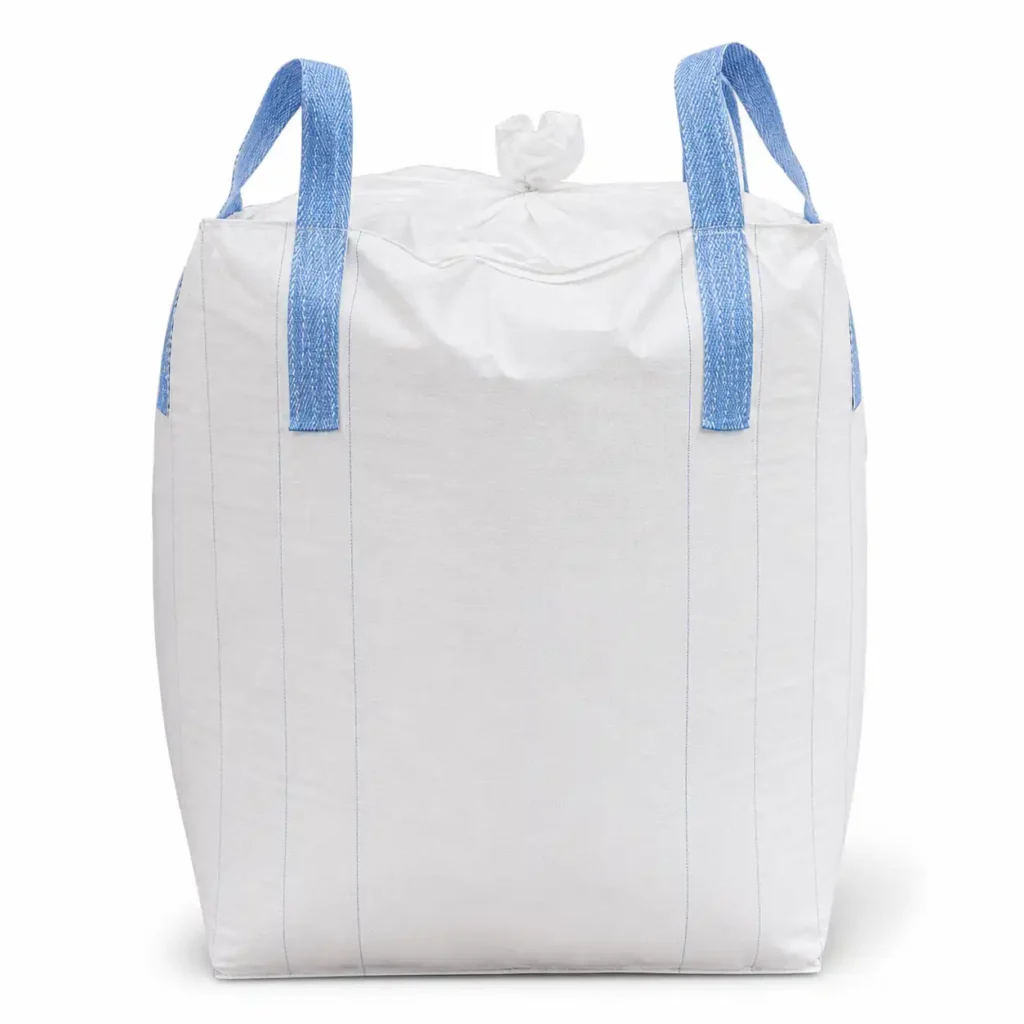
VIDEPAK Product Analysis: FIBC Bulk Bags
Flexible intermediate bulk containers have become a central part of modern material handling because they combine high carrying capacity, low packaging weight, compact empty storage and flexible filling or discharge options. They can carry powders, granules, flakes and selected paste-like products while being lifted from above by permanently attached loops or straps. Current ISO 21898:2024 covers the materials, construction, design, type testing, marking, selection and safe use of FIBCs for non-dangerous goods.
Yet a bulk bag should never be treated as a simple woven sack. It is a connected load-handling system. Fabric carries tension; seams transfer forces; lifting loops connect the load to handling equipment; liners control moisture and cleanliness; and body geometry determines whether the filled package remains stable, stacks neatly and uses warehouse space well. A professional FIBC Bulk Bags Manufacturer must therefore design the complete system rather than merely increase fabric weight.
The central purchasing principle
The best FIBC is not the bag with the most fabric, the most seams or the highest number of accessories. It is the bag whose body construction, lifting system, filling method, discharge design, barrier level and safety classification match the product, plant and transport route. More material can add cost. Better engineering adds value.
Market Role and Product Engineering Logic
Why FIBCs remain commercially important
An empty FIBC normally folds flat, yet the same package can move a large industrial payload when filled. Integrated lifting loops may also allow handling without a separate pallet in suitable operations. This strong package-to-product ratio reduces empty-package storage, return volume and packaging weight compared with many rigid intermediate containers. FIBC can also be customized by size, capacity, inlet, outlet, barrier system and handling feature, allowing one packaging platform to serve minerals, chemicals, food ingredients, agricultural products, resins and construction materials.
The global buyer is therefore not purchasing fabric alone. The buyer is purchasing filling speed, lifting confidence, controlled discharge, pallet stability, product protection and predictable arrival. A weak loop can stop a warehouse lift. A poor seam can release dust. An unstable body can waste container space. A badly selected liner can slow discharge or trap residue. Small design decisions create large operational effects.
Strength per package
Woven polypropylene tapes provide high tensile performance at a relatively low package weight, supporting efficient bulk movement.
Configuration freedom
Body style, loops, filling top, discharge bottom, coating and liner can be combined around one use case.
Logistics efficiency
Stable dimensions and controlled bulging help improve pallet planning, warehouse organization and container loading.
Typical VIDEPAK product design window
VIDEPAK presents customizable FIBC with four main body constructions—U-Panel, Circular, 4 Panel and Baffle—and with lifting arrangements that include 4 loops and tunnel lifting. Commercial specifications must be confirmed for each project, but the following ranges provide a useful starting point for discussion.
Ranges are design references rather than universal guarantees. Final performance depends on the complete bag construction and validated testing.
Detailed Analysis of FIBC Construction Types
Construction type describes how the body fabric is formed, cut and sewn. It affects seam position, load distribution, bulging, print layout, manufacturing complexity, pallet shape and the way lifting forces travel through the package. No single structure is automatically best. Each one answers a different combination of product and logistics needs.
U-Panel Construction
A U-Panel bag uses one continuous main panel to form two opposite walls and the bottom, creating a U-shaped load path. Two separate side panels close the remaining sides. Industry terminology identifies the U-shaped piece as the main fabric and explains that the two side panels are attached to it to complete the body.
The continuous bottom section is the main structural advantage. Because the bottom and two walls are formed from one piece, the design reduces the number of seams directly across those load-bearing transitions. When properly dimensioned, the fabric carries weight upward from the base into the side walls, while the attached panels stabilize the remaining faces. This makes the U-Panel format a practical choice for dense powders, minerals, fertilizer, seeds, aggregates and many general industrial products.
The design also provides clear front and rear surfaces for printing, handling instructions and product identification. However, a standard U-Panel body can become rounded after filling, especially when the product is free-flowing and the bag is tall. It normally provides better rectangular definition than a basic tubular body, but less shape control than a well-made Baffle design.
Best fit: Select U-Panel construction when the project requires a strong, versatile body, clear print panels and a balanced relationship between manufacturing cost and filled-bag stability.
Circular Construction
A Circular FIBC, also called a tubular construction, begins as woven fabric produced in a continuous tube. The tube is cut to the required body height and joined to separate top and bottom components. Because the main body has no vertical side-panel seams, the structure simplifies body assembly and removes four potential side seam lines.
Fewer vertical seams can be useful for fine products because each removed seam is one less possible path for sifting. The format can also be efficient to manufacture in large volumes and is widely suitable for grains, salts, resins, pellets, fertilizer and other free-flowing materials. Coating, a liner or sift-resistant sewing may still be necessary when the product contains very fine particles; a seam-free body does not remove leakage risks at the top, bottom, spout or loop attachment areas.
The key limitation is shape. A tubular body naturally tends to become round under internal pressure. That curve can create pallet overhang, larger gaps between adjacent bags and less predictable contact with stretch wrapping or racking systems. For operations in which cost, high-volume output and reduced side seams matter more than a sharp square profile, Circular construction offers strong value. Where warehouse cube and straight stacking dominate, a Baffle version may be more suitable.
Best fit: Choose Circular construction for efficient production, a body without vertical panel seams and applications where moderate side bulging is operationally acceptable.
4 Panel Construction
A 4 Panel FIBC is assembled from four individual side panels plus separate top and bottom pieces. The panel edges meet at four vertical corners, creating well-defined faces and clear corner lines. Industry terminology distinguishes this structure from the U-Panel format by noting that four separate side pieces form the body.
The primary benefit is dimensional control. Each face can be cut to a precise width, and the corner seams help the unfilled bag open into a recognizable rectangle. Large, flat panels are also convenient for multi-side printing, warning information and identification systems. These qualities make 4 Panel construction attractive for food ingredients, specialty chemicals, branded agricultural products and applications where appearance, pallet alignment or print presentation is commercially important.
The trade-off is sewing complexity. Four vertical seams create additional production steps and additional locations that must be controlled for stitch density, seam allowance, filler cord and thread tension. More seams do not automatically mean lower strength; properly engineered seams can distribute load effectively. They do, however, increase the importance of disciplined cutting, sewing and inspection.
A conventional 4 Panel bag usually holds a square shape better than a basic Circular bag, although free-flowing contents can still push the center of each wall outward. It is therefore a strong platform for Baffle conversion when near-cubic geometry is required.
Best fit: Use 4 Panel construction when defined faces, print flexibility, corner formation and controlled dimensions are more important than achieving the lowest possible sewing complexity.
Baffle Construction
A Baffle FIBC is not simply a fifth outer-body pattern. It is normally a U-Panel, Circular or 4 Panel body fitted with internal fabric pieces across the corners. These baffles restrain outward expansion, improve squareness, stabilize the filled load and use storage or shipping space more efficiently. Openings in the baffles allow product to flow into the corners during filling.
This structure converts uncontrolled radial pressure into a more disciplined box-like profile. The commercial effect can be significant: straighter pallet edges, reduced overhang, better use of warehouse rows, more consistent stretch wrapping and easier container planning. Baffle bags are especially valuable for fine, free-flowing materials such as starches, food ingredients, powdered chemicals, mineral powders and plastic granules that would otherwise create strong side bulging.
Baffles add internal seams, material and assembly time. Their openings must be matched to product behavior. Openings that are too small can slow filling or prevent even corner distribution; openings that are too large can weaken shape control. Cohesive powders may bridge around the internal panels, while hygiene-sensitive applications require clean cutting, controlled thread ends and a liner design that follows the internal geometry.
Baffle construction should therefore be purchased for measurable logistics value, not for appearance alone. When a customer ships high volumes, a small improvement in footprint control can multiply across every pallet, truck and container. When the shipping route is short and space is not limited, the additional construction cost may offer less benefit.
Best fit: Select Baffle construction when pallet footprint, stack alignment, container cube, wrapping stability and a near-rectangular filled profile are central performance targets.
Construction comparison
| Construction | Body formation | Main strength | Main limitation | Typical application logic |
|---|---|---|---|---|
| U-Panel | One panel forms the bottom and two walls; two side panels complete the body | Balanced strength, versatility and cost | Moderate bulging with free-flowing products | Minerals, fertilizer, seeds, building products and general industrial goods |
| Circular | Tubular woven body without vertical side seams | Efficient assembly and reduced side-seam paths | Greater tendency to form a rounded profile | Pellets, grains, salts and high-volume free-flowing materials |
| 4 Panel | Four separate walls with independent top and bottom | Defined faces, printing area and dimensional control | More cutting and vertical seam operations | Food ingredients, specialty products and presentation-sensitive programs |
| Baffle | Base body plus internal corner-control panels | Near-cubic geometry and logistics efficiency | Higher complexity and product-flow considerations | Container-sensitive, automated and high-volume supply chains |
Construction definitions and functions align with industry terminology and VIDEPAK’s published product range.
Lifting Loop Types, Features and Manufacturing Methods
Loop terminology can cause confusion because “four-loop” describes the number of lifting points, while Cross Corner Loop and Corner Loop describe loop position and orientation. Tunnel lifting describes a sleeve-like handling system. In every case, the loop must transfer force into reinforced body fabric without cutting, peeling or concentrating stress at one short stitch line.
4 loops: the standard four-point system
A conventional 4 loops system provides one lifting loop near each top corner. The loops are generally made from high-strength woven webbing and sewn down the body over a calculated attachment length. Reinforced fabric zones, belt patches, additional warp tapes or multiple rows of stitching may be used to spread the load. Industry guidance defines the lift belt as the component supporting the Safe Working Load during handling and identifies the reinforced attachment section as an important contributor to bag strength.
The system is flexible and widely compatible with forklifts, cranes and lifting frames, provided all lifting points are engaged as intended. Loop height and opening must match the customer’s fork thickness, fork spacing and available headroom. Longer loops improve access but add webbing and may allow more bag movement. Shorter loops support compact stacking but can be harder for an operator to pick up.
The phrase 4 loops alone is not a complete specification. The buyer must also define whether the loops are standard upright, Cross Corner Loop, full-belt, stevedore-assisted or another arrangement. Safe handling guidance emphasizes correct engagement of the lifting elements and warns against gathering ordinary loops onto one hook unless the design specifically includes an approved single-point lifting strap.
Tunnel lifting
Tunnel lifting uses wide fabric or webbing sleeves that create channels for forklift tines. Instead of guiding each tine through a separate small loop, the operator inserts the forks through the tunnels. The design can reduce manual loop positioning, speed repetitive warehouse movements and support more consistent fork placement.
Manufacturing requires the tunnel material to be cut, folded and attached across a broad reinforced area. The sewing pattern must resist both vertical lifting force and local abrasion from the fork surfaces. Tunnel width, clear opening, spacing and height must be coordinated with the actual forklift fleet. A tunnel that is strong but too narrow for the customer’s tines is commercially useless.
Tunnel lifting is especially attractive for resins, minerals, food ingredients and other products moved repeatedly in controlled plants. Its limitations include extra material, reduced top access in some designs and less flexibility when different sites use widely different forklift dimensions. Fork edges should be smooth and correctly spaced because sharp or tilted tines can damage any lifting system. Safe-handling instructions should remain part of the packaging specification.
Cross Corner Loop
A Cross Corner Loop is attached across the corner rather than lying only in the vertical corner seam direction. The diagonal orientation helps the loop stand open and presents a larger target to forklift tines. This can improve pickup speed when bags are closely arranged, when access is possible from more than one direction or when operators need to engage loops with minimal manual assistance.
The sewing process normally fixes each end of the webbing to adjacent body faces or reinforced corner zones. This spreads the attachment across the corner but also introduces forces in more than one fabric direction. Accurate placement is essential: mismatched loop lengths can tilt the load, while inconsistent angles can change the way force enters the body. The production team must control loop length, webbing alignment, stitch rows, sewing overlap and reinforcement position as one connected assembly.
A Cross Corner Loop is a strong choice for container stuffing, high-frequency forklift handling and operations seeking easier tine entry. It often pairs well with U-Panel and 4 Panel constructions because their corner zones provide clear attachment locations. Compatibility with Baffle bodies is also possible when the internal and external seam plans are coordinated.
Corner Loop
A standard Corner Loop is positioned in line with, or immediately beside, the vertical corner seam. Its webbing generally follows the body downward, allowing lifting force to travel along the reinforced corner area. This straightforward load path supports broad application coverage and efficient production.
During manufacturing, the webbing is placed against the reinforced fabric zone and secured with parallel or patterned stitching over a defined attachment length. The seam, loop and body fabric must be treated as one structural unit. Increasing loop tensile strength without strengthening its attachment can merely move the failure point from the webbing to the bag wall.
The standard Corner Loop is typically economical and performs well in operations where workers or automated systems can reliably present the loops to the forks. Compared with a Cross Corner Loop, it may lie flatter against the bag and require more careful tine positioning. In exchange, it offers a direct, familiar construction and can occupy less space around the top perimeter.
| Loop system | Handling advantage | Production focus | Best operational fit |
|---|---|---|---|
| 4 loops | Universal four-point lifting concept | Equal loop height, reinforced attachments and balanced stitching | General forklift, frame or crane handling |
| Tunnel lifting | Fast fork insertion with less individual loop positioning | Tunnel clearance, abrasion resistance and broad load distribution | Repeat movements in controlled forklift fleets |
| Cross Corner Loop | Open presentation and easier multi-direction access | Diagonal alignment and equal force transfer to adjacent faces | Container loading and high-frequency pickup |
| Corner Loop | Direct corner load path and familiar operation | Vertical reinforcement, attachment length and seam integration | Cost-controlled, conventional handling systems |
Matching Construction and Loops to Applications
Selection should begin with the material, not the bag catalogue. Bulk density determines the relationship between volume and payload. Particle size influences sifting risk. Moisture sensitivity determines coating or liner needs. Flow behavior affects inlet, discharge and Baffle openings. The filling station defines spout diameter and loop access, while the transport route defines UV, abrasion and stacking requirements.
| Application | Primary risks | Recommended construction direction | Recommended lifting direction |
|---|---|---|---|
| Dense minerals and aggregates | Abrasion, base loading and rough handling | Reinforced U-Panel or 4 Panel; Baffle where footprint control matters | Heavy-duty 4 loops or Corner Loop system |
| Fine chemical powders | Sifting, moisture and possible electrostatic hazards | Coated Circular or Baffle body with sift-resistant seams and suitable liner | Cross Corner Loop for frequent handling |
| Food and feed ingredients | Hygiene, traceability and residue control | 4 Panel or Baffle construction with food-contact liner as required | Clean-finish 4 loops or tunnel lifting |
| Resins and plastic granules | Static charge, clean discharge and warehouse speed | Circular or Baffle body; electrostatic classification selected by hazard assessment | Tunnel lifting or Cross Corner Loop |
| Fertilizer, seed and grain | Moisture, outdoor exposure and stacking | U-Panel or Circular, with coating, liner or UV stabilization according to route | Corner Loop or Cross Corner Loop |
For combustible powders or explosive atmospheres, body construction alone does not establish electrostatic safety. IEC 61340-4-4:2018 sets classification, labeling, test, design and safe-use requirements for FIBCs and liners used in hazardous explosive environments. Type C systems require the specified conductive construction and grounding discipline, while Type D systems use dissipative behavior under qualified conditions. The correct category must come from a formal process-hazard assessment, not a general product label.
Dangerous goods also require compliance with the applicable transport rules, approved packaging code, design type and testing provisions. The United Nations Model Regulations cover the construction, testing and approval framework for dangerous-goods packaging and intermediate bulk containers. A standard industrial FIBC must not be presented as suitable for regulated dangerous goods without the required qualification.
VIDEPAK Manufacturing and Quality-Control Framework
VIDEPAK was founded in 2008 and reports more than 500 employees, over 100 weaving machines, 16 extrusion lines and more than 30 lamination and printing machines, with products supplied to over 70 countries. Its stated production system uses virgin raw materials and equipment selected for precision in extrusion, weaving, coating and printing.
From tape properties to finished-load behavior
Polypropylene resin is melted, formed into film, slit into tapes and drawn to orient the polymer structure. The tapes are woven into body fabric and webbing. Process consistency matters because variation in tape width, tensile strength, elongation or weave tension can create weak zones that become visible only during lifting. Coating may then be applied to reduce moisture entry and product sifting, although coating also reduces breathability and must be matched to filling speed.
Cutting establishes the final geometry. A dimension error at this stage can change volume, loop spacing, spout position and filled-bag symmetry. Sewing then converts separate components into one force-transmitting structure. Critical controls include seam allowance, stitches per unit length, thread condition, webbing overlap, reinforcement placement and consistent loop height.
Finished inspection should verify dimensions, fabric and component identity, seam construction, loop attachment, inlet and outlet operation, liner installation, labeling and visual cleanliness. Performance qualification must follow the applicable design and intended-use standard. ISO 21898:2024 specifically covers type testing and marking for non-dangerous-goods FIBCs, while periodic comparison testing can help determine whether stored bags remain suitable after environmental exposure.
Quality is cumulative
Uniform tape, stable weave, accurate dimensions, disciplined sewing and balanced loops may look like separate production details. During lifting, they act as one system. Reliability is not added at final inspection; it is built into every previous step.
Commercial Value Beyond the Bag Price
Unit price is visible, but operational cost is distributed across the supply chain. A lower-priced bag that fills slowly, leaks powder, requires workers to position every loop, overhangs the pallet or traps saleable product may cost more than a correctly engineered alternative. A capable FIBC Bulk Bags Manufacturer should therefore evaluate total packed cost rather than fabric cost alone.
Filling economics
Correct inlet diameter, air-release behavior and body opening reduce line delays, dust and manual correction.
Handling economics
Appropriate loop height and orientation help operators engage forks quickly and move loads with fewer interventions.
Logistics economics
Stable body geometry improves pallet alignment, wrapping consistency, warehouse planning and transport-cube use.
Sustainability follows the same system logic. Preventing product loss is often more valuable than saving a small amount of packaging material. After safety and product protection are secured, fabric weight can be optimized, unnecessary components can be removed and compatible polymers can simplify recovery. FIBCs are commonly recyclable where collection and processing systems accept them, and their low package-to-product weight can reduce material use per tonne shipped.
Reuse must never be assumed from visual appearance. Single-trip and multi-trip designs have different performance requirements, and environmental exposure, product contamination, handling damage and storage conditions can change suitability. The applicable design category, inspection protocol and test evidence must control the decision.
Specification Roadmap and VIDEPAK Product Position
A practical RFQ sequence
- Define the product: name, bulk density, particle size, moisture sensitivity, abrasiveness, flow behavior and electrostatic characteristics.
- Define the payload: required volume, Safe Working Load, intended safety factor and single-trip or qualified multi-trip use.
- Select the body: choose U-Panel, Circular, 4 Panel or Baffle construction according to load path, seam preference and shape-control needs.
- Select handling: specify 4 loops, tunnel lifting, Cross Corner Loop or Corner Loop, including dimensions taken from the actual handling equipment.
- Define filling and discharge: chute diameter, filling method, dust collection, outlet size, closure system and required discharge rate.
- Define protection: coated or uncoated fabric, liner type, moisture barrier, cleanliness level, UV exposure and sift-resistant sewing.
- Validate the system: approve drawings, trial the bag on real equipment, complete applicable testing and freeze the bill of materials and inspection plan.
VIDEPAK’s product position is based on configuration depth rather than a one-design-fits-all offer. The ability to combine four principal body architectures with multiple filling, discharge, liner and lifting options allows the package to be designed around real plant conditions. The company’s published manufacturing scale, international supply experience and quality-management focus support projects that require repeatable specifications across continuing orders.
For general industrial use, the U-Panel format offers a balanced starting point. For efficient tubular production and reduced vertical seams, Circular construction is attractive. For defined faces and print presentation, 4 Panel provides greater control. For pallet and container efficiency, Baffle construction delivers the clearest geometric advantage. Likewise, standard 4 loops provide broad handling compatibility, tunnel lifting supports rapid fork entry, a Cross Corner Loop improves loop presentation, and a conventional Corner Loop provides a direct and economical lifting path.
VIDEPAK product commitment
The correct FIBC must be strong where it carries, controlled where it expands, open where it fills, secure where it closes and accessible where it lifts. That is the difference between selling a bag and engineering a bulk-packaging solution—and it is the standard expected from a professional FIBC Bulk Bags Manufacturer.
- VIDEPAK Product Analysis: FIBC Bulk Bags
- Market Role and Product Engineering Logic
- Detailed Analysis of FIBC Construction Types
- Lifting Loop Types, Features and Manufacturing Methods
- Matching Construction and Loops to Applications
- VIDEPAK Manufacturing and Quality-Control Framework
- Commercial Value Beyond the Bag Price
- Specification Roadmap and VIDEPAK Product Position
In today’s packaging industry, FIBC Bulk Bags (Flexible Intermediate Bulk Containers) play a crucial role in transporting and storing bulk materials across various sectors. These bags, often referred to as Jumbo Bags or Ton Bags, offer versatile designs tailored to meet specific needs, including custom loading and unloading features. This article explores the characteristics of FIBC Bulk Bags, the competitive landscape across different countries, and the unique advantages that Chinese manufacturers bring to the global market.
FIBC Bulk Bags Versatility
Discover the diverse styles, functional advantages and global application value of standard FIBC bulk bags.
Check More →FIBC Bags Manufacturer
Professional production of high-quality FIBC jumbo bags with stable supply chain and global market competitiveness.
Check More →FIBC Jumbo Bags Production
In-depth analysis of FIBC production processes, product strengths and core competitive edges in international trade.
Check More →Heavy-Duty Woven Bags Guide
Complete guide for heavy-duty woven bulk bags including FIBC models, market demand and industrial competitiveness.
Check More →Understanding FIBC Bulk Bags
FIBC Bulk Bags are large, flexible bags designed for the safe and efficient handling of bulk materials. They are widely used in industries such as agriculture, construction, chemicals, and food processing. Here are some key features:
- Customizable Design: FIBC bags can be tailored with various designs for loading and unloading, including large openings and valve-type closures. This adaptability ensures that they meet the specific requirements of different materials, whether granular, powdery, or liquid.
- Material Strength: Made from woven polypropylene, these bags are designed to withstand heavy loads and harsh environmental conditions. Their durability makes them ideal for transporting a wide range of products.
- Reusability and Sustainability: Many FIBC bags are designed for multiple uses, contributing to sustainability efforts in packaging. Their recyclability adds an eco-friendly aspect to their utility.
The Competitive Landscape of FIBC Bulk Bags
The global market for FIBC Bulk Bags is characterized by diverse manufacturers, each with unique strengths. Understanding the dynamics in different regions can provide insights into market trends and consumer preferences.
- North America: In the U.S. and Canada, the demand for FIBC bags is driven by the agricultural and construction sectors. Manufacturers focus on compliance with stringent safety regulations, ensuring high-quality standards. Local production often emphasizes quick delivery times and customization options to meet client needs.
- Europe: European manufacturers prioritize sustainability and eco-friendliness, often using recycled materials in their FIBC bag production. The market is competitive, with many established brands focusing on innovation, such as incorporating advanced printing technologies for branding.
- Asia-Pacific: Countries like India and Japan are significant players in the FIBC market. Indian manufacturers are known for their cost-effective production methods, while Japanese companies emphasize precision and quality. The region has a growing demand for customized solutions that cater to diverse industries.
- Middle East and Africa: The Middle East’s construction boom has increased the demand for bulk bags, particularly in the oil and gas sectors. Manufacturers in this region are adapting to local needs, focusing on specialized designs and robust construction to withstand environmental challenges.
Advantages of Chinese Manufacturers
Chinese manufacturers have established a formidable presence in the FIBC Bulk Bags market, and their advantages stem from several key factors:
- Quality Control: Chinese manufacturers often adhere to international quality standards, implementing strict quality control measures throughout the production process. This focus on quality ensures that FIBC bags meet the rigorous demands of various industries.
- Cost-Effectiveness: Lower labor costs and economies of scale allow Chinese manufacturers to offer competitive pricing without sacrificing quality. This cost advantage makes them attractive to global buyers seeking affordable packaging solutions.
- Short Lead Times: With extensive production capacities, Chinese manufacturers can fulfill large orders quickly. This ability to meet tight deadlines is crucial for businesses that rely on just-in-time inventory systems.
- Global Supply Chain: China’s well-developed logistics infrastructure supports efficient distribution channels. This enables manufacturers to reach international markets effectively, providing timely delivery and reliable service.
Key Features of FIBC Bulk Bags
The following table summarizes the key features and benefits of FIBC Bulk Bags, showcasing their versatility and adaptability in various applications:
| Feature | Description | Benefits |
|---|---|---|
| Customizable Designs | Various loading and unloading options | Tailored solutions for different materials |
| Durability | Made from woven polypropylene | High strength and resistance to harsh conditions |
| Reusability | Designed for multiple uses | Contributes to sustainability efforts |
| Compliance | Meets international safety standards | Ensures reliability and safety in handling |
| Cost-Effectiveness | Competitive pricing due to lower production costs | Attractive for global buyers |
Future Trends in FIBC Bulk Bags
As the demand for FIBC Bulk Bags continues to grow, several trends are shaping the future of this packaging solution:
- Sustainability Initiatives: Manufacturers are increasingly focusing on producing eco-friendly bags, including those made from recycled materials. This trend aligns with global efforts to reduce plastic waste.
- Technological Advancements: Innovations in manufacturing techniques, such as automated production lines and advanced quality control systems, are enhancing the efficiency and reliability of FIBC bag production.
- Customization and Flexibility: As customer needs become more diverse, manufacturers will need to offer tailored solutions that cater to specific industry requirements. This trend will drive the development of new designs and features in FIBC bags.
- Regulatory Compliance: With the rise of global trade, adherence to international regulations and standards will become increasingly important for manufacturers. This will ensure that FIBC bags meet safety and quality requirements across different markets.
Conclusion
FIBC Bulk Bags are essential tools for the efficient handling and transportation of bulk materials across various industries. Their customizable designs, durability, and reusability make them invaluable in meeting the demands of a dynamic market.
As the competitive landscape continues to evolve, understanding the characteristics of different markets and the strengths of various manufacturers will be crucial. Chinese manufacturers, with their focus on quality, cost-effectiveness, short lead times, and robust global supply chains, are well-positioned to lead in the FIBC market.
As sustainability and customization trends shape the future of packaging, the adaptability and innovation inherent in FIBC Bulk Bags will ensure their continued relevance in a rapidly changing industry.
References
- A. Smith, “The Future of Flexible Packaging: Trends and Innovations,” Journal of Packaging Technology, 2022.
- J. D. Lee, “Global Market Analysis of FIBC Bulk Bags,” International Journal of Packaging Science, 2023.
- R. K. Gupta, “Sustainability in Packaging: Opportunities and Challenges,” Journal of Environmental Management, 2021.
This comprehensive analysis of FIBC Bulk Bags highlights their significance in the packaging industry, the competitive landscape across various regions, and the strengths of Chinese manufacturers, providing valuable insights into current trends and future developments.