
What Are FFS Woven Bags?
FFS Woven Bags — the shorthand for Form‑Fill‑Seal woven sacks — are heat‑sealable packaging units built on a woven polypropylene (PP) substrate that is extrusion‑coated and, when specified, laminated to behave like a film on automated lines while preserving the mechanical margin of a textile. They are tailored for construction‑grade powders and aggregates that demand both speed and strength: a roll or tubular web feeds an FFS machine, the bag is formed on the collar, charged with product, and sealed in one continuous motion. In contrast to stitched PP sacks, the closure is a thermal seal rather than thread, which unlocks dust containment, leak control, and higher line throughput.
Different sectors refer to the same architecture with different labels. The following near‑synonyms are common in RFQs and purchasing portals, and all map to substantially similar constructions:
- Form‑Fill‑Seal Woven Sacks
- FFS PP Woven Bags
- Heat‑Sealable Woven Poly Sacks
- Automated FFS Woven Packaging
- Coated Woven FFS Bags
- Laminated Woven FFS Sacks
- FFS‑Ready Woven PP Bags
- Woven FFS Valve‑Style Alternatives
The Material Stack of FFS Woven Bags
Eco‑efficiency does not mean material‑agnostic, it means material‑appropriate. The bill of materials of FFS Woven Bags is a purposeful stack where each layer has a job: strength, sealability, de‑aeration, print durability, friction control, and weathering. When the layers are tuned as a system, the result is high throughput with fewer rejects.
Signature Features of FFS Woven Bags
- High‑speed machinability: Forming tubes track, gussets stay crisp, seals repeat. The web behaves predictably under tension, so changeovers shrink and OEE climbs.
- Construction‑grade durability: Woven cores outperform comparable‑mass films on puncture and tear. Bags arrive intact after chute impacts, edge rubs, and forklift brushes.
- Moisture moderation and dust control: Sealable inner coats, continuous edges, and engineered venting deliver cleaner aisles and cleaner pallets.
- Pallet stability: Tuned COF and squared geometry reduce topple risk and film wrap consumption.
- Graphic legibility: Reverse‑printed laminates preserve artwork through vibration, stacking, and handling.
- Weather readiness: UV‑stable composites hold up in open yards; edge‑wicking is contained by continuous coats.
- Sustainability levers: Mono‑polyolefin stacks aid sortation, downgauging is credible because structure comes from orientation and weave, and reject rates fall under tight process windows.
Production Process: From Resin to Pallet
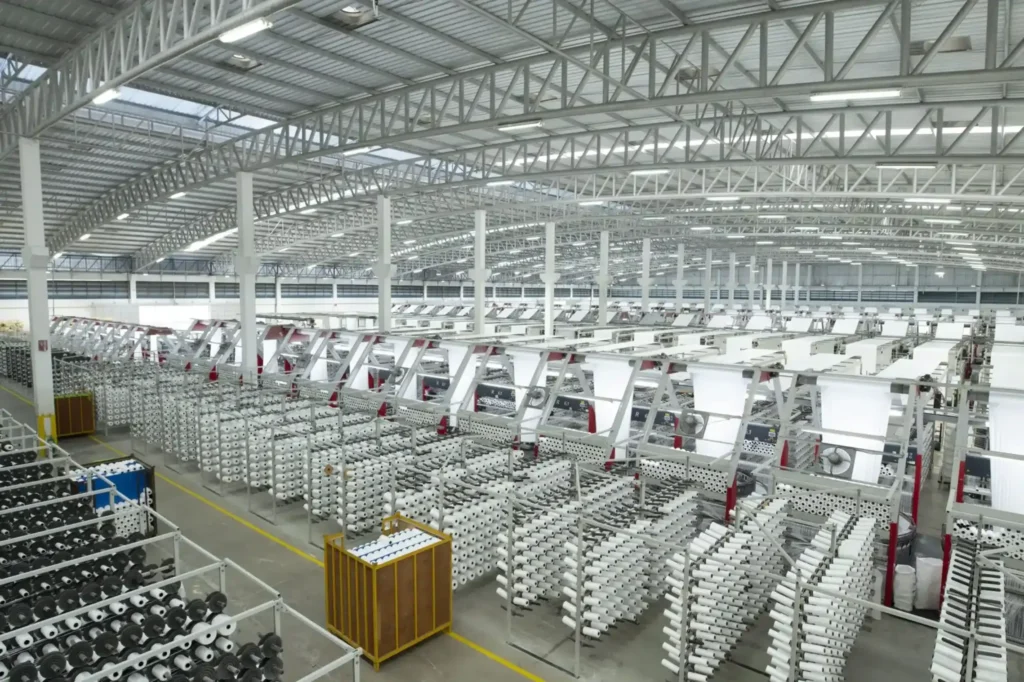
Performance is earned in a chain of small, controlled steps. VidePak anchors that chain with precision equipment sourced from Austria (Starlinger‑class PP‑woven technology) and Germany (W&H‑class film and printing), so tolerances are repeatable at scale.
- PP resin for raffia tapes: verify MFI, moisture (Karl Fischer), ash, and color/yellowness index. For yard storage SKUs, confirm HALS/UVA packages.
- Coating and tie resins: confirm MI, density, seal initiation temperature, hot‑tack retention. Screen peel at flat and creased zones.
- BOPP/matte films (if used): profile thickness and haze; check surface energy for ink and adhesive anchorage; specify COF bands.
- Inks/primers/over‑lacquers: control viscosity; align colorimetry (ΔE) to brand targets; validate rub/tape adhesion at varied humidity.
- Additives: tune slip/antiblock to hit COF; load antistatic for low‑RH seasons.
- Tape extrusion and orientation (Starlinger‑class): extrude → slit → draw to target tenacity and modulus; monitor thickness via online gauging and hourly tensile pulls.
- Weaving (Austrian pedigree): set EPI/PPI and GSM; log pinholes and laid‑flat width; keep skew minimal to preserve seal geometry.
- Extrusion coating/lamination: hold coat weight within tolerance; manage chill/nip to avoid curl; audit T‑peel at flats and creases.
- Micro‑perforation/venting: laser or mechanical perf patterns validated on an airflow bench to ensure de‑aeration without fines escape.
- Printing (German register control): reverse‑print on BOPP or surface‑print on coated fabric; verify ΔE and rub cycles; apply selective over‑lacquer to high‑rub zones.
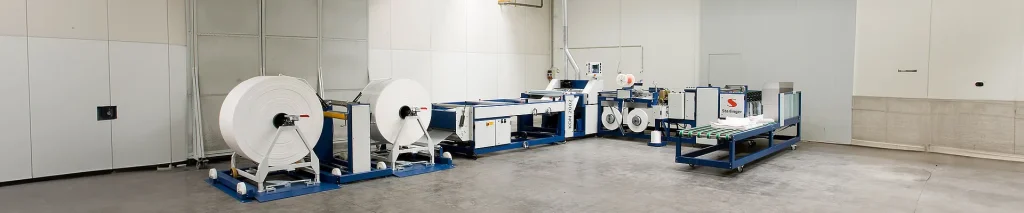
- Slitting/gusseting: prepare straight edges and set crease memory for FFS machines; gusset formers induce repeatable folds.
On the filler, three checkpoints govern successful runs:
- Forming: the web becomes a tube around a forming collar; fin or overlap geometry must align with sealing jaws; crease memory prevents winged corners.
- Filling: entrained air must escape through vent corridors; perf density and location are product‑specific.
- Sealing: jaw temperature, dwell, and pressure are matched to seal initiation and hot‑tack curves; double‑seal geometries are used on higher‑risk SKUs.
- Mechanical: grab tensile, tongue/Elmendorf tear, puncture (dart), drop at multiple temperatures; seal burst/peel at fin and flats.
- Surface/print: dynamic/static COF, rub resistance, ΔE color checks, scuff after vibration cycles.
- Barrier & sifting: fluorescing‑powder leak mapping at seams and gusset roots.
- Dimensional/visual: width, length, gusset symmetry, squareness, curl, coat uniformity.
- Sampling/traceability: ANSI/ASQ Z1.4 plans, tighten/relax rules, lot codes back to resin and web rolls, retained samples archived.
Use Cases: Where FFS Woven Bags Shine
The construction ecosystem is the native habitat of FFS Woven Bags, but closely related powders benefit as well. Below is a compact mapping paired with design nudges.
| Product | Typical Mass | Preferred Features | Notes |
|---|---|---|---|
| OPC and blended cements | 25–50 kg | Micro‑perfs, robust fin seal, UV‑stable outer, COF ~0.30–0.38 | High ballooning risk; perf corridors essential |
| Dry mortar and tile adhesives | 20–25 kg | Tight seals, matte face, concealed venting | Very fine powders; verify leak paths under vibration |
| Gypsum and plaster | 20–30 kg | Moderate perf, smooth sealing, bright print | Lower abrasion; dust potential high |
| Sand and fine aggregates | 25–50 kg | Heavier fabric, anti‑slip exterior, high puncture | Consider exterior textures for pallet grip |
| Lime and specialty binders | 20–30 kg | Continuous coating, edge protection | Manage edge wicking; monitor pH interactions |
How VidePak Controls and Guarantees Quality
VidePak runs a four‑pillar method that converts customer risks into measurable specifications and steady outputs.
- Standards‑aligned methods: align film/fabric tests to mainstream protocols (tensile, dart, tear, seam, COF, drop, vibration) and enforce sampling (AQL) with tighten/relax rules.
- Virgin inputs for primary load paths: use virgin PP in tapes and core coatings; introduce PIR/PCR judiciously in non‑critical layers with transparent declarations.
- Equipment pedigree: tape lines, looms, and coaters/laminators from Austria; printing and tension systems from Germany; the combination stabilizes tenacity, weave regularity, peel strength, and register.
- Comprehensive testing: incoming verification → in‑process SPC → end‑of‑line audits with CAPA tied to lot codes; retain seal curves and COF panels per order.
Systems Thinking for FFS Programs
Complexity becomes manageable when the problem is decomposed into coherent subsystems and then recombined with explicit cross‑checks. For FFS Woven Bags, five subsystems cover most real‑world variability.
| Subsystem | Design Levers | Objective KPI |
|---|---|---|
| Structure | GSM, EPI×PPI, coat continuity | Drop/stack pass at minimum mass |
| Sealability | Inner coat recipe, jaw geometry, dwell/pressure | Burst/peel above threshold; wide seal window |
| De‑aeration | Perf diameter/density/placement | No ballooning at target fill rate; dust below limit |
| Machinability | COF, crease memory, dimensional control | Higher OEE; fewer stoppages per 10k bags |
| Sustainability | Mono‑polyolefin, downgauging, scrap control | Grams polymer per tonne delivered; rejection ppm |
Engineering Focus: Critical Levers and Practical Fixes
Comparative Reasoning: Alternatives and Trade‑offs
- Versus PE film FFS bags: woven cores deliver better puncture/tear at comparable mass and look presentable after rough handling; film may seal at lower energy and can fit different recycling streams depending on region.
- Versus paper valve sacks: paper breathes and is widely recognized in recovery systems, but it scuffs, absorbs water, and loses strength when wet; FFS Woven Bags hold up in open yards and long truck hauls.
- Versus block‑bottom PP valve sacks: valve sacks shine on dedicated valve packers and block‑bottom pallets; FFS Woven Bags win where high‑speed, roll‑fed automation or flexible format changes dominate.
RFQ Playbook: Translating Risks into Specifications
- Performance: drop height at temperature X; vibration and stack compression profiles; acceptable dust mass per pallet; seal burst/peel thresholds at flat and creased zones.
- Geometry: finished width/length, gusset depth, fin vs. overlap seam, easy‑open features, handling aids.
- Materials: fabric GSM, coating/laminate type and weight, micro‑perf pattern, UV package, antistatic requirements.
- Friction: static/dynamic COF targets, test method, and panel preparation.
- Printing: color counts, matte/gloss map, ΔE tolerances, rub cycles for high‑contact zones.
- QA/Sampling: AQL, tighten/relax rules, failure classes that trigger 100% inspection or CAPA.
- Traceability: lot coding from resin to pallet; retained samples and access to seal curves and COF panels.
Scenarios and Corrective Actions
Metrics Dashboard (Program Health)
| Metric | Target Band | Why it matters |
|---|---|---|
| Outer dynamic COF | 0.25–0.40 | Balances conveyor flow with pallet grip; enables wrap reduction. |
| Seal burst (fin seam) | > threshold value per SKU | Protects against manual peel‑opens and vibration‑induced failures. |
| Perf airflow | Pass on airflow bench; no visible fines escape | Ensures de‑aeration without dust release. |
| Scrap rate | Trending down month‑over‑month | Lower embodied emissions per delivered tonne. |
Glossary (Quick Reference)
- Form‑Fill‑Seal: an automated sequence that forms a bag from a web, charges it with product, and seals it in one pass.
- Raffia tapes: oriented PP strips used to weave the fabric core.
- Hot‑tack: seal strength while still hot; critical on fast lines.
- Micro‑perforation: tiny vents that let trapped air escape while retaining fines.
- Tie layer: functional resin bridging dissimilar layers for durable adhesion.
- Crease memory: the tendency of a web to retain folds; improves geometry and pack density.
- What Are FFS Woven Bags?
- The Material Stack of FFS Woven Bags
- Signature Features of FFS Woven Bags
- Production Process: From Resin to Pallet
- Use Cases: Where FFS Woven Bags Shine
- How VidePak Controls and Guarantees Quality
- Systems Thinking for FFS Programs
- Engineering Focus: Critical Levers and Practical Fixes
- Comparative Reasoning: Alternatives and Trade‑offs
- RFQ Playbook: Translating Risks into Specifications
- Scenarios and Corrective Actions
- Metrics Dashboard (Program Health)
- Glossary (Quick Reference)
- Opening Dialogue: Addressing Key Client Questions
- 1. FFS Woven Bags: Core Features and Construction Applications
- 2. Sustainable Production: Solar Energy and Green Manufacturing
- 3. Customization for Construction Needs
- 4. Quality Assurance with Starlinger Technology
- 5. Global Compliance and Industry Standards
- FAQs: Addressing Procurement Concerns
- References
Opening Dialogue: Addressing Key Client Questions
Client: “We need durable, high-capacity packaging solutions for construction materials. How do FFS woven bags ensure both efficiency and sustainability in demanding environments?”
VidePak Specialist: “FFS (Form-Fill-Seal) woven bags combine automated packaging precision with unmatched durability, ideal for transporting cement, sand, and aggregates. At VidePak, our 2MW solar-powered facilities and ISO-certified production lines deliver bags with 50 kg load capacity, UV resistance, and 100% recyclable PP materials—reducing carbon footprints while aligning with global green energy initiatives. Let’s explore how we elevate your construction logistics.”
1. FFS Woven Bags: Core Features and Construction Applications
FFS woven bags are engineered for seamless integration into automated packaging systems, offering airtight sealing and structural resilience. Their polypropylene (PP) construction ensures resistance to abrasion, moisture, and UV degradation, critical for outdoor storage and transportation in construction.
Key Functional Advantages
- Automated Efficiency:
- FFS technology enables rapid filling and sealing, reducing manual labor by 60% and boosting productivity on high-volume sites.
- Example: A UAE construction firm reduced packaging downtime by 40% using VidePak’s FFS ProSeries Bags for cement transport.
- Load-Bearing Capacity:
- 120–150 GSM PP fabric with double-stitched seams supports 25–50 kg loads, exceeding ASTM D5638 standards for construction materials.
- Weather Resistance:
- BOPP lamination blocks 99% UV rays, preventing material degradation during prolonged outdoor storage.
Table 1: VidePak FFS Woven Bag Specifications
| Parameter | Standard Series | HeavyDuty Series | EcoGuard Series |
|---|---|---|---|
| Material | 120 GSM PP | 150 GSM PP + BOPP | 100% Recycled PP |
| Load Capacity | 30 kg | 50 kg | 25 kg |
| UV Resistance | 3 years | 5 years | 3 years |
| Customization | Valve ports, handles | Anti-static coating | Biodegradable additives |
| Compliance | ISO 9001, ASTM D5265 | EN 13432, OSHA 1910 | EU REACH, ASTM D6400 |
2. Sustainable Production: Solar Energy and Green Manufacturing
VidePak’s commitment to sustainability is embedded in its production processes:
- 2MW Solar Power System: Generates 2.4 GWh annually, covering 70% of factory energy needs and supplying surplus to the grid, reducing CO₂ emissions by 1,200 tons/year.
- Circular Economy: 98% PP scrap recycled into new bags, minimizing landfill waste.
Case Study: Zero-Waste Initiative
A German construction partner achieved 30% cost savings by switching to VidePak’s EcoGuard Series, which uses 30% post-industrial recycled PP and solar-powered production.
3. Customization for Construction Needs
VidePak’s modular design approach addresses diverse project requirements:
Tailored Solutions
- Valve Ports & Handles:
- Heat-sealed valves for dust-free cement filling, compliant with EU EN 277.
- Reinforced handles tested for 10,000+ lift cycles (ASTM D5265).
- Shape & Size Flexibility:
- Die-cut designs for irregular items like steel bolts or PVC pipes.
- Custom dimensions (e.g., 90×50 cm for sandbags) optimize pallet space utilization.
- Anti-Static & Moisture Barriers:
- HDPE liners prevent moisture ingress in humid environments, critical for gypsum and lime.
4. Quality Assurance with Starlinger Technology
VidePak’s Austrian Starlinger machinery ensures precision and consistency:
- Extrusion Control: PP fibers extruded at 230–250°C (±2°C) for uniform tensile strength (≥2,500 N/cm²).
- Weave Density: AI-driven looms maintain 12×12 threads/cm² (±3%), enhancing puncture resistance by 20% vs. industry averages.
Case Study: A Brazilian infrastructure project reported zero bag failures over 12 months using Starlinger-produced HeavyDuty Bags for gravel transport.
5. Global Compliance and Industry Standards
VidePak’s FFS bags meet rigorous international benchmarks:
- EU EN 13432: Compostable options for organic waste management on eco-conscious sites.
- OSHA 1910.178(c): Anti-static bags for flammable material storage.
FAQs: Addressing Procurement Concerns
Q1: Can FFS bags withstand maritime shipping conditions?
A: Yes. Our MarineShield Series passes ISO 2233 salt spray tests, ideal for 60-day sea voyages.
Q2: What’s the MOQ for custom-printed bags?
A: 10,000 units, with 15-day turnaround using 30+ printing machines.
Q3: How does solar energy reduce bag costs?
A: Solar power cuts energy expenses by 25%, enabling competitive pricing without compromising quality.
References
- VidePak Company Profile. https://www.pp-wovenbags.com/.
- International Standards: ISO 9001, ASTM D5265, EU REACH.
- Email: info@pp-wovenbags.com
External Links
- Explore our FFS tubular bag solutions for automated packaging efficiency.
- Learn about sustainable packaging innovations.
VidePak: Building Tomorrow’s Infrastructure with Sustainable Precision.