
What Are Moisture‑Proof Woven Bags and Waterproof Woven Bags? Definitions, Boundaries, and Where Each One Wins
Moisture‑Proof Woven Bags and Waterproof Woven Bags are two closely related, often-confused families of industrial sacks built upon a woven polypropylene (PP) fabric spine. The difference is not a matter of adjectives; it’s a matter of physics. Moisture‑proof targets water vapor transmission (WVTR): these bags slow humidity ingress to protect powders, mixes, and dry debris from ambient moisture. Waterproof targets liquid ingress under hydrostatic head: these bags resist rain, splash, standing water, and hose‑down scenarios around the load. Choosing between them is not semantics. It is an operating decision with visible consequences on docks, trucks, and job sites.
- Moisture‑Proof PP Woven Bags
- Waterproof PP Woven Bags
- Moisture‑Resistant Woven Sacks
- Water‑Resistant Woven Debris Bags
- BOPP‑Laminated Waterproof Woven Bags
- PE‑Coated Moisture‑Proof Woven Bags
- Construction Waste Woven Bags (Waterproof Grade)
- WVTR‑Tuned Moisture‑Proof Woven Sacks
- Storm‑Duty Waterproof Woven Bags
- Rain‑Safe Waterproof Woven Sacks
Why should site supervisors, operations managers, or EHS leads care? Because Moisture‑Proof Woven Bags are typically lighter, more flexible, and optimized for humidity control during storage and transit, while Waterproof Woven Bags command a premium to survive direct contact with liquid water. Pick the wrong one and you invite caking cement, sludged pallets, dust plumes at fill, and rejected loads. Pick correctly and you cut housekeeping, lift scanning reliability, and protect what really matters—the product or debris stream itself.
Material Architecture: The Spine, the Skin, and the Seams
High‑performing Moisture‑Proof Woven Bags and Waterproof Woven Bags share a structural backbone—woven PP tapes—but diverge in surface engineering, seam logic, and liner strategy. The configuration is not arbitrary; it is a system. Each layer must earn its place by delivering measurable performance with minimal trade‑offs in cost and recyclability.
1) Fabric Spine: Oriented Polypropylene Tapes
- Polymer family: PP homopolymer is the workhorse; impact‑copolymer grades add cold‑weather toughness. Recycled PP (rPP) may be introduced where validated.
- Tape making: Resin → cast sheet → slit → draw 4–7×. Draw ratio governs tensile strength and elongation; consistent heat profiles create stable, clean‑weaving tapes.
- Weave construction: Circular looms make tubular bodies; flat looms make panels for block‑bottom sacks. Ends × picks per centimeter balance porosity, tear paths, and printing smoothness.
- Basis weight: Typical 60–120 g/m² for 10–50 kg programs; heavier picks for sharp rubble or tall stacks.
2) Surface Engineering: Tuning Vapor vs Liquid
- Extrusion coating (PP/PE): Thin coats (≈15–30 g/m²) seal interstices and reduce WVTR while maintaining flexibility—ideal for Moisture‑Proof Woven Bags.
- BOPP lamination: 18–25 µm film adds scuff resistance, wipe‑clean faces, and photo‑grade print; with edge‑seal control it underpins Waterproof Woven Bags.
- PET/specialty films: Extend chemical resistance and elevated‑temperature tolerance for harsh corridors.
- Functional coats: Polyurethane or fluoropolymer finishes lift hydrostatic head for sustained wet exposure.
3) Mouth, Valve, and Liner Logic
- Liners: Loose or form‑fit LDPE/LLDPE (20–120 µm) decouple moisture performance from the outer bag; coextruded liners are rare in construction debris but relevant for sensitive powders.
- Open mouth vs valve: Moisture‑proof builds can run either; waterproof builds often push toward heat‑sealable valves or sealed open‑mouths to prevent wick paths.
- Seams: Sewn seams suit moisture‑proof designs; heat‑sealing or welding minimizes stitch‑hole wicking for waterproof grades.
4) Additives: Small Doses, Big Effects
- UV stabilizers (HALS) prevent embrittlement during yard storage.
- Antistatic agents cut dust cling and stabilize weighers.
- Slip/anti‑block tune magazine feed and pallet friction without harming ink adhesion.
- Color masterbatch supports site‑visible hues while preserving barcode contrast windows.
- Moisture‑Proof stack: PP woven 80 g/m² (UV) + PP/PE coat 18 g/m²; internal valve sleeve PE 100 µm; micro‑perfs near mouth; anti‑slip stripes.
- Waterproof stack: PP woven 100 g/m² (UV) + BOPP 20 µm reverse‑printed; heat‑sealed seams; sealed open mouth or heat‑seal valve; matte barcode windows.
Feature Set: Behaviors That Change Site Outcomes
Features are meaningful only if they show up as cleaner aisles, faster fills, straighter stacks, and fewer scan retries. The hallmark behaviors of well‑specified Moisture‑Proof Woven Bags and Waterproof Woven Bags include:
Vapor vs Liquid Discrimination
Moisture‑proof designs minimize WVTR for humidity control; waterproof builds resist hydrostatic head. Humidity is a slow thief; liquid is a blunt attack. Both must be managed, but they are not the same battle.
Mechanical Resilience
Oriented PP tapes deliver high tensile per gram. Laminated faces in waterproof grades distribute impact and add puncture resistance; thinner coats in moisture‑proof grades keep flexibility for high‑speed magazines.
Stack Stability
Block‑bottom geometry yields brick‑like pallets. Stiffer, waterproof faces often favor columnar patterns; more compliant, moisture‑proof faces often favor interlocking patterns that settle into vibration.
Information Survivability
Matte windows under codes, disciplined ΔE control, and scuff‑resistant faces keep labels legible after route vibration, dust, and wrap abrasion. Waterproof faces wipe clean at the dock.
De‑aeration & Fill Speed
Moisture‑proof webs accept micro‑perforation maps to vent entrained air for fast, clean fills. Waterproof laminates require engineered vent pathways or temporary patches to reach similar rates without dust plumes.
Weather Readiness
UV‑stabilized webs and tuned surfaces ride out dew cycles. When splash, standing water, or hose‑down is routine, waterproof builds add critical insurance.
- Wrong grade → caked powder, sludged pallets, rejected loads, overtime.
- Right grade → stable OEE, cleaner aisles, reliable scans, lower CO₂e per shipped tonne.
Production Process: From Pellets to Pallets (Why Equipment Pedigree Matters)
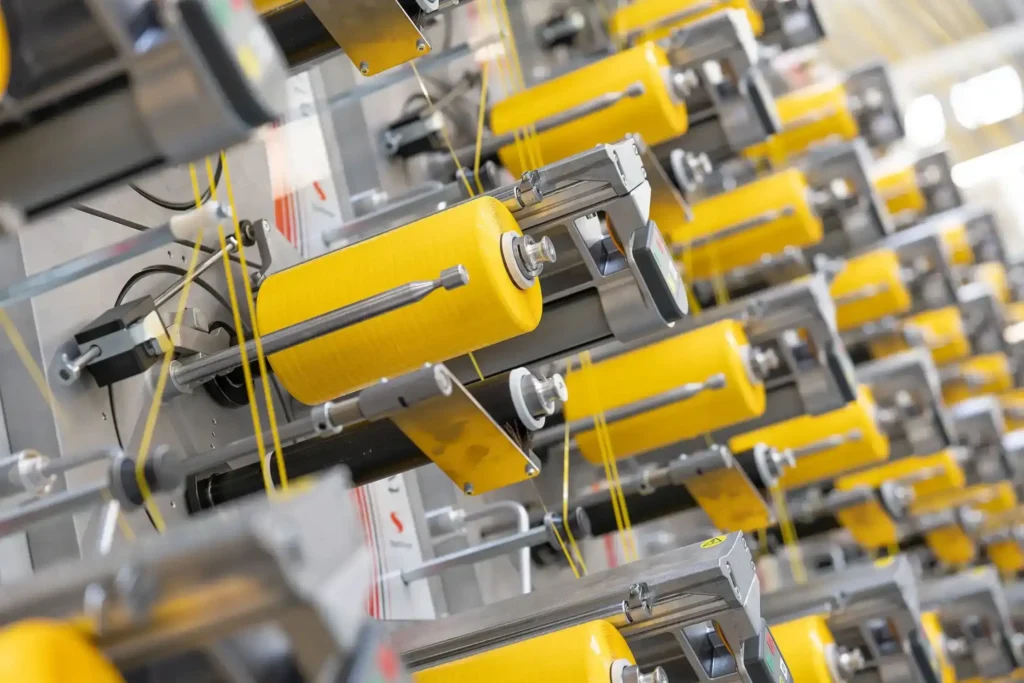
Reliable sacks are built upstream. VidePak structures manufacturing into three quality gates and runs end‑to‑end on Austrian Starlinger (extrusion, tape, weaving, coating/lamination) and German W&H (Windmöller & Hölscher) platforms (printing, web handling, converting). This equipment pedigree compresses variation: steadier web paths, tighter basis‑weight, crisper registration, and more predictable seams.
Gate A — Front‑End Raw Materials and Incoming Tests
- Polymer lots: Melt flow index, moisture, ash; spectral sort data for any rPP; resin dried to spec to prevent gels that trigger tape breaks.
- Additives: UV package dose verification, antistatic efficacy under ambient humidity, masterbatch color within ΔE window.
- Films, coats, papers: Gauge uniformity, dyne level, haze/gloss, peel/bond strength; WVTR/hydrostatic benchmarks aligned to moisture‑proof vs waterproof targets.
- Inks & adhesives: Compliance for use case; rub/heat resistance for yard abuse.
- Valve & liner components: Sleeve friction matched to spout and powder physics; liner gauge and seal recipes tuned to dew cycles.
Gate B — Mid‑Stream Conversion
- Tape extrusion & orientation: Control draw ratio, width, thickness, fibrillation index, and break ratio with SPC.
- Weaving: Ends × picks per cm; broken‑end alarms; porosity balance for de‑aeration vs print smoothness.
- Surface engineering: Extrusion coating for Moisture‑Proof Woven Bags; BOPP/PET lamination for Waterproof Woven Bags. Validate coat weight, pinholes, dyne, peel strength; reserve matte code windows.
- Printing: CI flexo on coated faces or reverse gravure under BOPP; control registration, dot gain, and ΔE drift; verify barcode grade on production stock.
- Cutting & paneling: Hot‑knife edges to prevent fray; programmable cutting stabilizes bottom formation.
- Bottom formation: Block‑bottom or pinch‑bottom with tuned glue pattern, platen temperature, and pressure.
- Valve insertion: Internal/external/tuck‑in/heat‑seal; sleeve overlap and length define self‑seal behavior and dust capture.
- Sewing/closing: High‑tenacity thread maps for moisture‑proof builds; heat‑seal or weld logic for waterproof seams.
- Liner insertion: Loose or form‑fit with verified gauge and seal recipe.
Gate C — Back‑End QA and Release
- Mechanical: MD/CD tensile, seam/valve pull, burst, drop matrices by fill mass and height, topple tests for pallet stability.
- Functional: De‑aeration time, dust index snapshots; WVTR for Moisture‑Proof Woven Bags and hydrostatic head for Waterproof Woven Bags.
- Visual & dimensional: Width/length/gusset tolerances; registration, ΔE, scuff/rub resistance; barcode grade.
- Traceability & documentation: Lot coding from resin to finished bag; AQL sampling aligned with ISO/ASTM/EN/JIS reference methods; retained samples for audit.
Starlinger’s basis‑weight control and W&H’s web handling/registration are not marketing decals; they are variance killers. Less scatter upstream means fewer weak zones, cleaner codes, and lower NCR rates downstream.
Use‑Cases: Matching Water Threats to Bag Behaviors
Different jobs, different moisture profiles. Use‑cases come into focus when you match humidity vs liquid, exposure time, and handling intensity to a bag’s behavior.
Construction Demolition & Site Debris
Dry gypsum dust, grout powders, and cement fines thrive in Moisture‑Proof Woven Bags with micro‑perfs for fast filling. Rain‑soaked rubble, slurry, and hose‑down environments require Waterproof Woven Bags with sealed seams and laminated faces.
- Dry debris → moisture‑proof; wet debris → waterproof.
- Mixed loads → hybrid: moisture‑proof outer + liner, or waterproof outer + engineered vents.
Renovation, Abatement, and Cleanup
Plaster and joint compound are humidity‑sensitive → choose Moisture‑Proof Woven Bags. Flood cleanup and mold remediation produce wet, contaminated debris → specify Waterproof Woven Bags to reduce cross‑contamination and truck cleanouts.
- Matte code windows preserve scanning even when surfaces are dirty or wet.
Aggregates & Landscaping
Dry topsoil and fertilizers need humidity control with UV‑stable exteriors—classic Moisture‑Proof Woven Bags. Dew‑soaked sand and wet mulch risk pallet staining and leakage—use Waterproof Woven Bags.
- Anti‑slip finishes tame vibration in open‑deck hauls.
Municipal & Industrial Waste
Street sweep fines and dredge residue lean wet—waterproof grades pay for themselves in fewer truck cleanouts. Dry ash or kiln dust programs leverage moisture‑proof designs with tuned WVTR.
- Block‑bottom geometry and consistent dimensions keep pallets square.
How VidePak Controls and Guarantees Quality
- Standards‑aligned production & testing: Specifications and QA methods reference ISO/ASTM/EN/JIS across tensile/tear, drop/burst/topple, WVTR (for Moisture‑Proof Woven Bags) and hydrostatic head (for Waterproof Woven Bags), plus barcode grading and scuff/rub.
- Virgin raw materials from major suppliers (with vetted rPP options): Tight MFI and cleanliness improve tape strength and seam performance; controlled rPP streams introduce circularity without drifting variability.
- Equipment pedigree: Starlinger and W&H: Tight basis‑weight, stable web paths, and crisp registration reduce process scatter and field failures.
- Closed‑loop inspection: Incoming COAs → in‑process gsm/peel/ΔE/seam/valve checks → final AQL sampling with functional tests (WVTR/hydrostatic head, drop, burst, de‑aeration). RCCA closes the loop on non‑conformances.
Decision Frameworks: Three Quick Tests to Nail the Spec
1) Moisture Profile
Is the threat mostly humidity or mostly liquid? If humidity during storage dominates, specify Moisture‑Proof Woven Bags. If splash, rain, or hose‑down dominates, specify Waterproof Woven Bags.
2) Handling Intensity
High‑rate filling needs flexible webs (moisture‑proof coats). Heavy, sharp debris benefits from laminated faces and sealed seams (waterproof builds) for puncture resistance and cleanliness.
3) Identification & Compliance
Do hazard panels and codes need to survive wet docks? Favor laminated waterproof faces with matte windows. Dry debris with disciplined ΔE control can run moisture‑proof faces.
Engineering Tables: Side‑by‑Side Comparisons and Control Points
Case Narratives: Real‑World Corridors, Real‑World Lessons
- Rain‑Exposed Demolition Waste: A coastal contractor saw repeated load rejections due to slurry leakage from standard sacks during pop‑up showers. Switching to Waterproof Woven Bags (BOPP‑laminated, heat‑sealed seams) eliminated truck bed cleanouts and stabilized loads. Bag cost rose; overtime fell; net savings accrued within two billing cycles.
- Interior Renovation Debris: An interiors firm hauling gypsum dust complained about dust plumes and slow fills. Adopting Moisture‑Proof Woven Bags with micro‑perf maps and self‑sealing internal valves shortened de‑aeration time and cut housekeeping in half.
- Street Sweep Fines: Municipal crews handling damp fines tried a hybrid approach—Waterproof Woven Bags with temporary vent patches during filling, then heat‑tacked shut. Barcode windows remained matte; pallets stayed clean after depot wash‑downs.
Palletization and Unit‑Load Engineering
CAD drawings do not ride trucks. Pallets do. Engineer the unit load with bag behavior in mind: columnar stacks for stiffer, laminated Waterproof Woven Bags; interlocking stacks for more compliant Moisture‑Proof Woven Bags. Align anti‑slip finishes with wrap tension. Add interleaf for long vibration corridors. Validate with lean snapshots after 24‑hour dwell. Confirm scan grades post‑route simulation.
Printing Strategy and Information Survivability
Graphics are not vanity; they are logistics tools. A bag that will not scan will not ship without drama. Proof on production substrates (coated PP, laminated BOPP), not lab swatches. Reserve quiet zones and matte windows. Keep codes off valve folds and corner stress risers. Track ΔE per lot; verify ink adhesion with cross‑hatch (≥ 4B) and rub tests.
Environmental Accounting: Grams vs Gallons
The biggest environmental win of Moisture‑Proof Woven Bags and Waterproof Woven Bags is not the packaging itself; it is the avoidance of product loss and site contamination. A few extra grams of film can prevent liters of contaminated runoff or keep cement powder from hydrating in the sack. Right‑size the fabric gsm, choose the thinnest credible coat or laminate, and maintain information fidelity to avoid rework. Where PP recycling streams exist, favor monomaterial polyolefin stacks for simpler end‑of‑life. Where hybrids are unavoidable, specify bonds that are mechanically peelable or separable in known regional facilities.
Procurement Checklists You Can Actually Use
Moisture‑Proof Woven Bags
- WVTR target and method
- Fabric gsm and weave density (ends × picks)
- Extrusion coat weight and dyne level
- Micro‑perf density and mouth geometry
- Barcode grade and matte window locations
- UV package vs yard dwell expectation
Waterproof Woven Bags
- Hydrostatic head target and method
- Laminate type (BOPP/PET) and gauge
- Seam seal recipe (heat, dwell, pressure)
- Mouth closure (heat‑seal valve vs sealed open mouth)
- Chemical splash expectations & overprint durability
- Pallet pattern and wrap tension guidelines
System Thinking: From Contradictions to a Cohesive Spec
At first glance, the brief is contradictory: more moisture protection but less stiffness; brighter graphics but zero barcode glare; faster filling but less dust. The path forward is to decompose the challenge into sub‑problems, assign levers, and then recompose a spec validated on the real line.
Sub‑Problems and Levers
- Mechanical containment: fabric gsm, seam/seal maps, corner reinforcements.
- Moisture behavior: WVTR vs hydrostatic head via coat/laminate weight and film choice.
- Throughput: de‑aeration via micro‑perfs or vent patches; sleeve friction windows.
- Identification: ΔE, barcode grades, matte windows, quiet zones.
- Sustainability: resin per unit function; recyclability path; design‑for‑disassembly.
- Economics: unit price vs total delivered cost (breakage, rework, delay).
Integrated Pattern
- Profile the water threat (humidity vs liquid) and handling intensity.
- Pick surface system (coat vs laminate) and seam logic.
- Fix fabric gsm and bottom geometry for drop/topple spec.
- Reserve matte code windows; lock ΔE targets and art quiet zones.
- Run line trials; measure OEE, dust index, scan grade, pallet lean.
- Freeze spec with data; review quarterly against corridor changes.
Frequently Asked Questions
- Do I always need micro‑perforation? Not for waterproof laminates; vents may be temporary and closed post‑fill. Moisture‑proof webs benefit from tuned micro‑perfs around the mouth.
- Are laminated sacks recyclable? Monomaterial polyolefin stacks (PP fabric + PP coat + BOPP) align with PP streams where available. Avoid mixed, inseparable families when the local sortation cannot support them.
- What seam style should I specify? Sewn for moisture‑proof; heat‑sealed/welded for waterproof—unless your risk profile and filler hardware push you toward a hybrid.
- How much does waterproof cost more? Enough to matter per unit; less to matter per job when failure risks are high. Price the corridor, not the piece.
Related Resource for Lamination Strategy
For a deeper dive into print‑ready laminates that also enhance wipe‑clean performance and water resistance, see this illustrated guide to printed BOPP woven bags. The lamination logic there aligns closely with the Waterproof Woven Bags scenarios discussed in this playbook.
October 30, 2025
- What Are Moisture‑Proof Woven Bags and Waterproof Woven Bags? Definitions, Boundaries, and Where Each One Wins
- Material Architecture: The Spine, the Skin, and the Seams
- Feature Set: Behaviors That Change Site Outcomes
- Production Process: From Pellets to Pallets (Why Equipment Pedigree Matters)
- Use‑Cases: Matching Water Threats to Bag Behaviors
- How VidePak Controls and Guarantees Quality
- Decision Frameworks: Three Quick Tests to Nail the Spec
- Engineering Tables: Side‑by‑Side Comparisons and Control Points
- Case Narratives: Real‑World Corridors, Real‑World Lessons
- Palletization and Unit‑Load Engineering
- Printing Strategy and Information Survivability
- Environmental Accounting: Grams vs Gallons
- Procurement Checklists You Can Actually Use
- System Thinking: From Contradictions to a Cohesive Spec
- Frequently Asked Questions
- Related Resource for Lamination Strategy
- 1. Material Science: Polypropylene’s Role in Construction Packaging
- 2. Application-Specific Solutions for Construction Materials
- 3. Selecting Optimal Parameters: A Data-Driven Approach
- 4. Case Study: Reducing Waste Costs in European Demolition Projects
- FAQs: Addressing Procurement Concerns
- Why Choose VidePak?
Imagine a construction site manager asking: “How do I choose between moisture-proof and waterproof woven bags for cement and plaster powder storage?” The answer hinges on three critical factors: material science, environmental exposure, and load-bearing requirements. Moisture-proof bags resist humidity to preserve material integrity, while waterproof bags create impermeable barriers against liquid ingress. At VidePak, our polypropylene (PP) woven bags are engineered to exceed ASTM, ISO, and EU standards, ensuring optimal performance for construction waste management across global markets.*
1. Material Science: Polypropylene’s Role in Construction Packaging
1.1 Strength and Durability of PP Woven Bags
Polypropylene’s molecular structure provides exceptional tensile strength (≥45 N/mm²) and abrasion resistance, making it ideal for heavy-duty applications like cement and gypsum powder transport. VidePak’s PP resin selection aligns with regional standards:
- ASTM D4101 (US): Homopolymer PP (MFI 8–12 g/10min) for high-stress environments.
- EN ISO 1874 (EU): Copolymer PP with -20°C impact resistance for cold climates.
- GB/T 8946 (China): UV-stabilized PP for outdoor storage in humid regions.
For example, our 150 GSM PP woven bags with 200-micron lamination withstand 1,500 kg static loads, preventing seam failure during crane lifting of construction debris.
1.2 Moisture Proof vs. Waterproof: Technical Distinctions
| Feature | Moisture-Proof Bags | Waterproof Bags |
|---|---|---|
| Barrier | LDPE coating (20–50 microns) | BOPP lamination (80–120 microns) |
| Water Resistance | Blocks 85–90% humidity | Impermeable to liquid water (IPX7) |
| Applications | Cement, dry mortar, plaster powder | Wet concrete, chemical slurries |
| Cost Efficiency | 15–20% lower than waterproof | Higher initial cost, longer lifespan |
For instance, moisture-proof bags with 30 GSM LDPE coating are ideal for storing gypsum powder in humid Southeast Asian climates, reducing clumping by 70% compared to uncoated bags.
2. Application-Specific Solutions for Construction Materials
2.1 Cement Storage: Balancing Breathability and Protection
Cement requires moisture-proof bags to prevent premature hydration while allowing minimal air circulation. VidePak’s ventilated PP bags feature micro-perforations (5–10 µm pores) to reduce internal condensation, extending shelf life by 6–8 months.
2.2 Plaster and Joint Compounds: Tear Resistance
Fillers like joint compound demand bags with ≥18 N/5cm tear strength. Our triple-layered PP-Kraft paper composites achieve 25 N/5cm, validated by ISO 13937-2 testing.
2.3 Chemical Slurries: Waterproofing Imperatives
For liquid adhesives or epoxy resins, waterproof BOPP-laminated bags with HDPE liners (0.2–0.5 mm thickness) prevent leakage under 50 kPa pressure, complying with UN packaging standards.
3. Selecting Optimal Parameters: A Data-Driven Approach
3.1 Thickness and Grammage Guidelines
| Material | Thickness (Microns) | Grammage (GSM) | Load Capacity |
|---|---|---|---|
| Standard PP | 80–120 | 90–130 | 500–1,000 kg |
| Laminated PP | 150–200 | 140–180 | 1,500–2,000 kg |
| Kraft-PP Composite | 220–300 | 200–250 | 2,500–3,000 kg |
For heavy debris like broken concrete, we recommend 180 GSM laminated bags with 4-loop FIBC designs, achieving a 6:1 safety factor.
3.2 Inner Liners and Customization
- HDPE Liners: Essential for waterproofing hazardous liquids (e.g., solvents).
- Anti-Static Layers: Carbon-coated liners for flammable powder transport (resistivity ≤10^9 Ω/sq).
- Printing: UV-resistant inks for outdoor hazard warnings (Pantone-matched).
4. Case Study: Reducing Waste Costs in European Demolition Projects
A German contractor reduced moisture-related cement waste by 40% after switching to VidePak’s 160 GSM moisture-proof bags with LDPE coating. The bags’ 120 threads/dm² weave density prevented particulate leakage during pneumatic filling, aligning with EU Directive 94/62/EC on packaging waste.
FAQs: Addressing Procurement Concerns
Q1: How does lamination affect recyclability?
VidePak’s BOPP laminates use solvent-free adhesives, enabling 95% PP recovery via NIR sorting—exceeding EU Circular Economy targets.
Q2: What bag size suits 25 kg plaster packs?
A 60 cm × 90 cm bag with 120 GSM PP and 30-micron LDPE coating optimizes cost and durability.
Q3: Can bags withstand monsoon rains?
Yes. Our waterproof series with 100-micron BOPP lamination passes 72-hour immersion tests (ASTM D751).
Why Choose VidePak?
Founded in 2008 under CEO Ray Chiang, VidePak combines 30+ years of expertise with Austrian Starlinger technology to deliver 8,000 MT/month of certified packaging. Our 568-member team serves 50+ countries, ensuring compliance with REACH, FDA, and ISO 9001 standards.
References
- VidePak Corporate Profile: https://www.pp-wovenbags.com/
- Email: info@pp-wovenbags.com
- ASTM International Standards for Flexible Packaging (2024)
- EU Circular Economy Package 2030: Technical Guidelines
External Resources
- Explore our FIBC bulk bags for construction waste management, designed for heavy debris handling.
- Learn about customizable laminated solutions for wet industrial materials.
At VidePak, we engineer resilience—because every grain of cement deserves uncompromised protection.