
VIDEPAK Printed BOPP Woven Sacks, BOPP Woven Sacks and BOPP Laminated Woven Sacks: A Complete Product Guide for Modern Dry-Bulk Packaging
Packaging has to do more than hold a product. It has to protect the product during filling, survive stacking and transport, communicate clearly at the point of sale, and work smoothly with the customer’s packing line. That is why BOPP Woven Sacks have become an important packaging format for rice, grains, seeds, animal feed, pet food, fertilizer, sugar, salt, minerals and many other dry products. By combining a load-bearing woven polypropylene structure with a printable BOPP surface, BOPP Woven Sacks can bring industrial strength and retail presentation into the same package.
At VIDEPAK, we approach this category as a system rather than as one standard bag. A customer may need simple BOPP Woven Sacks, highly graphic Printed BOPP Woven Sacks, enhanced-barrier BOPP Laminated Woven Sacks, or a specific conversion such as block bottom, Open Mouth or Pinch bottom. Each choice changes filling behavior, sealing, pallet shape, product protection and the way the package looks in front of the final buyer. VIDEPAK’s current PP woven range supports multiple opening and bottom constructions and serves packaging programs broadly ranging from 5 kg to 50 kg.
One simple way to understand the VIDEPAK range: the woven PP fabric carries the load; the BOPP film carries the brand; the opening controls how the bag is filled; the bottom controls how the bag closes, stands and stacks. Strong inside. Clear outside. Efficient from filler to pallet to shelf.
Why BOPP Woven Sacks Have Become a Powerful Packaging Platform
Strength and presentation no longer need to be separate
Traditional woven polypropylene sacks are valued because woven PP tapes form a strong, lightweight fabric that can tolerate demanding handling. BOPP Woven Sacks build on that mechanical base by adding a biaxially oriented polypropylene film surface. In a typical construction, the woven layer supplies tensile and puncture resistance, while the BOPP layer supplies a smoother surface, improved print quality, better resistance to dirt and moisture exposure, and a more controlled appearance.
This dual character explains why BOPP Woven Sacks work in two very different environments. In a warehouse, buyers care about seam integrity, lifting, stacking, abrasion and product loss. In a retail store, they care about color, clean logos, product photography, readable information and brand recognition. BOPP Woven Sacks speak to both audiences. They can be workhorses and billboards at the same time.
Mechanical Backbone
Woven PP fabric gives BOPP Woven Sacks the load-bearing structure needed for dry-bulk filling, handling and transport.
Brand Surface
BOPP film gives Printed BOPP Woven Sacks a smooth surface suitable for sharp graphics, photographic designs and strong shelf recognition.
Configurable Structure
block bottom, Open Mouth, Pinch bottom, gussets, liners, micro-perforation and anti-slip treatment allow one family to serve very different packing conditions.
Understanding the terminology before requesting a quotation
The market often uses BOPP Woven Sacks, BOPP Laminated Woven Sacks and Printed BOPP Woven Sacks as closely related terms, but there is value in separating them. BOPP Woven Sacks is the broad commercial expression for woven PP packages using a BOPP-facing structure. BOPP Laminated Woven Sacks describes the construction more directly: BOPP film is laminated onto woven polypropylene fabric. Printed BOPP Woven Sacks emphasizes the graphic system, normally involving BOPP film printed before it is laminated to the woven substrate.
This distinction matters when purchasing. The product name alone does not define film thickness, fabric GSM, liner, dimensions, gusset depth, printing method or closure. Two BOPP Laminated Woven Sacks may look similar but behave very differently if one is designed for rice on a moderate distribution route while another is designed for abrasive minerals. Good specifications describe the layers and functions, not simply the category name.
Printed BOPP Woven Sacks: Turning Industrial Packaging into Brand Packaging
How the printed surface works
The commercial advantage of Printed BOPP Woven Sacks begins with the film. In a common production route, artwork is printed on the inner side of transparent BOPP film and the printed side is then laminated toward the woven fabric. The consumer sees the image through the clear film. Because the ink sits beneath the outer surface rather than directly on top of it, the graphic is better protected against rubbing during converting, pallet handling and distribution. VIDEPAK’s published technical guidance describes this reverse-printing and lamination workflow as a central feature of the product family.
That makes Printed BOPP Woven Sacks especially useful when the package itself must communicate quality. Rice grains can be shown beside a brand story. Pet food can use detailed ingredient photography. Seed packaging can carry strong color coding across several varieties. Fertilizer packaging can combine branding with clear dosage and safety information. The package does not merely arrive; it announces itself.
Typical printing and material planning
VIDEPAK’s published printing guidance describes reverse rotogravure as a mainstream option for detailed BOPP graphics, with high-definition flexographic printing available for selected designs. A practical planning level of up to eight ink colors is common in the published guidance, although the right number depends on artwork, white ink, spot colors, coatings and press configuration. More colors are not automatically better: stable registration, controlled drying and repeatable brand color are more important than simply maximizing the number of printing stations.
Important: “More laminate” and “more colors” do not automatically mean a better sack. The best Printed BOPP Woven Sacks use enough fabric, film, ink and finishing to meet the real distribution route without unnecessary material or process complexity. Specification should follow risk, not decoration.
Gloss, matte, windows and anti-slip surfaces
Printed BOPP Woven Sacks can be developed with glossy or matte visual effects. Gloss can increase brightness and visual impact, while matte surfaces can reduce glare and create a more restrained appearance. Anti-slip treatment can improve friction between filled sacks on a pallet, while a transparent window can allow buyers to inspect rice, beans, seeds, pellets or other visible products without opening the package. These options change both appearance and logistics performance, so they should be planned together rather than added independently.
For example, premium pet food Printed BOPP Woven Sacks may benefit from detailed reverse printing, a matte surface and strong pallet friction. Rice Printed BOPP Woven Sacks may combine bright graphics with a transparent area that lets the grain itself become part of the design. Fertilizer Printed BOPP Woven Sacks may place greater emphasis on UV options, durable instructions and anti-slip performance. Same material family. Different priorities. Different solutions.
BOPP Laminated Woven Sacks: Where Protection, Structure and Appearance Meet
The laminate is not simply decoration
BOPP Laminated Woven Sacks use woven polypropylene as the structural base and BOPP film as the laminated facing. The woven fabric carries mechanical loads; the laminate provides a smoother external surface and improves resistance to splash, dirt and surface abrasion while giving the package a better printing platform. This is why BOPP Laminated Woven Sacks sit comfortably between industrial and consumer packaging: they are designed to travel like sacks but communicate more like printed retail packs.
The distinction between moisture resistance and a completely sealed moisture barrier is important. Lamination can substantially improve the outside protection of BOPP Laminated Woven Sacks, but the complete package also includes seams, perforations, mouths and bottoms. A sewn seam introduces needle holes; micro-perforations intentionally allow air movement; an open top must still be closed after filling. Where highly moisture-sensitive powders or hygiene-sensitive products require additional containment, an inner liner or more controlled sealed construction may be specified.
Why buyers choose BOPP Laminated Woven Sacks
The strongest reason is balance. BOPP Laminated Woven Sacks can combine comparatively low package weight with woven strength, attractive graphics and multiple converting choices. Depending on the project, they can be flat or gusseted, sewn or sealed, fitted with a window, treated for anti-slip performance, supplied as Open Mouth sacks, converted to block bottom geometry, or developed around a Pinch bottom construction.
Think in systems: product protection comes from the complete package, not from the film alone. In BOPP Laminated Woven Sacks, fabric GSM, BOPP gauge, lamination, liner, perforation, seam type, Open Mouth closure and either block bottom or Pinch bottom geometry must work together.
PP-based material logic and recyclability
Because BOPP is polypropylene and the woven substrate is also polypropylene, BOPP Woven Sacks can be designed around a PP-based material system. Industry equipment technology also demonstrates that reverse-printed BOPP-laminated PP woven fabric can be converted into single-material pinch-style packaging when compatible PP-based joining methods are used. However, real recyclability depends on the complete construction—including tie layers, liners, inks and closures—as well as collection and recycling systems in the destination market. It is therefore more responsible to discuss “design for recycling” and material compatibility than to promise universal recyclability.
Choosing the Right Geometry: block bottom, Open Mouth and Pinch bottom
Material defines what a sack can withstand; geometry defines how it behaves. The same family of BOPP Woven Sacks can produce very different results depending on whether the customer selects block bottom, Open Mouth or Pinch bottom. These terms should never be treated as decorative product labels. They are functional decisions linked directly to filling equipment, product flow, closure, pallet stability and end-user experience.
block bottom: built to stand and stack
A block bottom creates a flat, rectangular base instead of allowing the filled sack to remain primarily pillow-shaped. Once filled, block bottom BOPP Woven Sacks can stand more upright and form a more regular package. This can support better pallet cube use, more controlled stacking and cleaner retail presentation. VIDEPAK identifies upright stability and space efficiency as key reasons for using this construction. Industry technology also confirms that woven PP block bottom sacks can be designed as valve versions or as open-top versions with a formed rectangular bottom.
For branded products, the value of block bottom goes beyond logistics. A more rectangular pack creates broad front, back and side surfaces that make artwork easier to organize. For pet food, feed, specialty grain or fertilizer, this gives Printed BOPP Woven Sacks a disciplined shelf shape while preserving the woven structure underneath. The pack stands better; the image reads better; the pallet looks better. Form supports function, and function supports brand.
A block bottom is not automatically the correct answer for every product. Bottom bonding or welding, venting, filled-bag density, drop performance and compression behavior still need to be validated. Powders that trap large amounts of air may require carefully planned de-aeration. Very irregular products may not form the same neat rectangular body as free-flowing granules. Good block bottom design therefore begins with the product and filling process, not with appearance alone.
Open Mouth: maximum filling flexibility
An Open Mouth sack is supplied with the bottom already closed while the upper end remains fully open for filling. That large opening is one reason Open Mouth remains one of the most versatile configurations for grains, pellets, feed, seeds, salt, sugar and similar dry materials. Depending on the selected structure, the filled Open Mouth bag can later be sewn, heat sealed, pinch sealed or equipped with another closing system.
For customers operating manual or semi-automatic lines, Open Mouth BOPP Woven Sacks can be especially practical because operators can easily present a wide mouth to the filling spout. VIDEPAK’s current range specifically includes sewn Open Mouth solutions as well as hemmed and gusseted opening configurations. The familiar filling logic can make Open Mouth suitable for plants processing many SKUs or products with different flow characteristics.
The main question with Open Mouth is not how the bag opens; it is how the bag will finally close. Coarse grains may work well with a sewn closure. Fine powder may require a liner, seam tape or another sealed approach because stitching creates small needle passages. A premium retail Open Mouth bag may use a more finished hem, easy-opening feature or pinch-seal system. Flexibility is the advantage, but the closure must be engineered with equal care.
Pinch bottom: a clean answer for containment and presentation
A Pinch bottom construction uses prepared folding and bonded or compatible welded sealing rather than depending only on a conventional sewn line. In a pinch-style open-mouth design, one end is factory closed and the other remains available for filling before the final closure is activated. Because a bonded Pinch bottom does not rely on a row of needle holes at the sealed area, it is attractive when better sift resistance, cleaner presentation or finer dry products are involved.
Modern Pinch bottom technology is particularly relevant to BOPP Laminated Woven Sacks. Commercially proven systems use polypropylene woven fabric laminated with reverse-printed BOPP film for rice, pet food, sugar, flour, cereals, seed and fertilizer applications. Recent technology also demonstrates hot-air welded PP Pinch bottom construction without conventional adhesive, showing how this format can combine strong sealing, attractive BOPP graphics and PP-oriented material design.
The trade-off is process control. Pinch bottom sealing depends on properly prepared surfaces, accurate fold geometry, suitable activation settings and stable converting conditions. For this reason, a buyer asking simply for “Pinch bottom” should also define the actual drawing, seal type, film and fabric structure, fill weight and filling-line requirements. A name begins the conversation; a specification finishes it.
Matching Printed BOPP Woven Sacks to Products, Filling Lines and Markets
Rice, grains and seeds
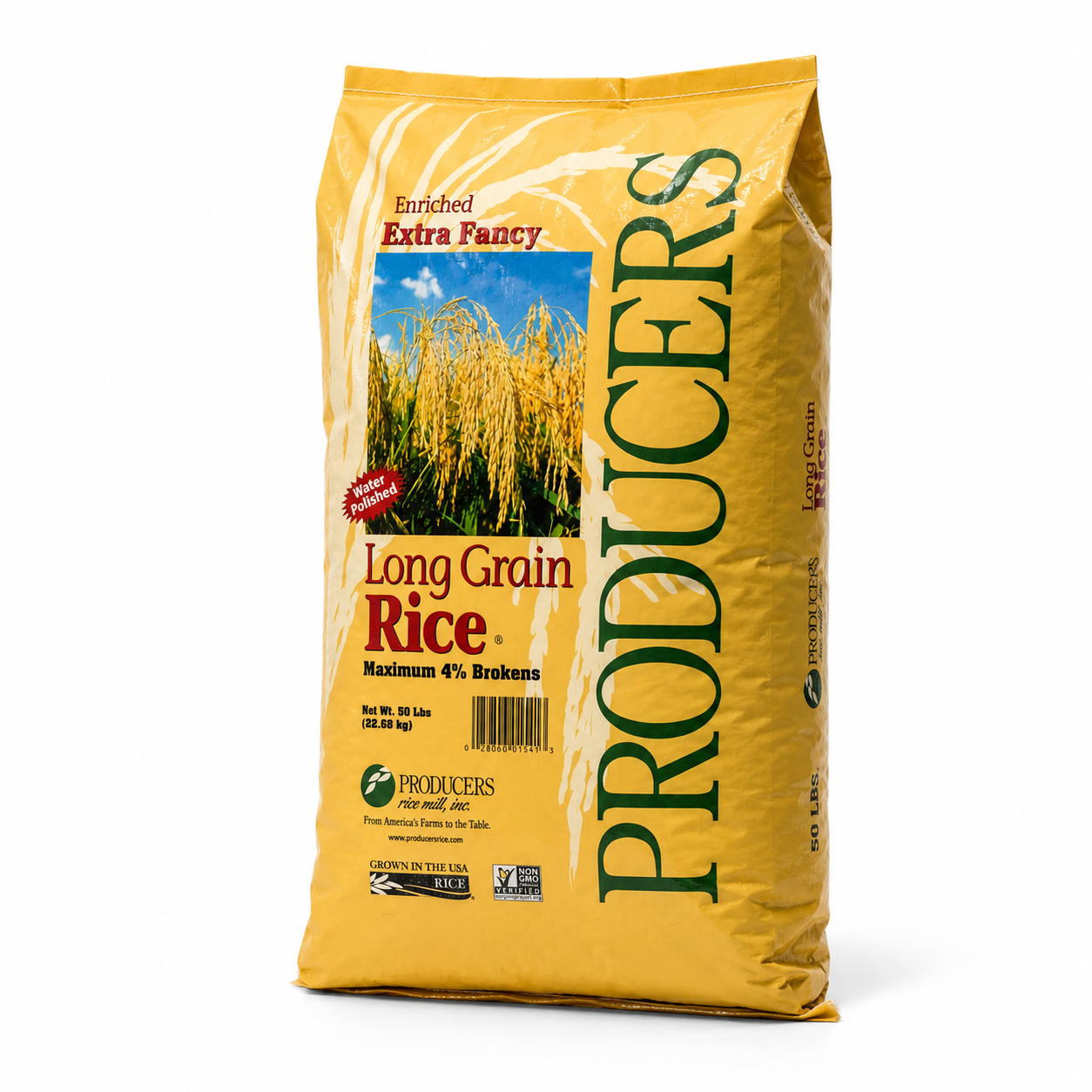
Rice and grains are natural applications for BOPP Woven Sacks because the products need mechanical protection while the brand often needs strong consumer visibility. Printed BOPP Woven Sacks can carry detailed origin information and product images, while transparent windows can give buyers direct visual access to grain size and appearance. An Open Mouth design can support straightforward gravity filling; gussets can help create a more regular body; a block bottom can support a cleaner standing pack when presentation is especially important.
Animal feed and pet food
Animal nutrition demands durability, readable instructions and strong identification. Premium pet food adds another layer: emotional branding. This makes Printed BOPP Woven Sacks particularly relevant. High-quality photography and clear feeding information can be protected beneath the BOPP face, while block bottom geometry can improve shelf posture and Pinch bottom formats can offer a cleaner closed appearance. VIDEPAK’s product guidance specifically identifies block bottom and pinch-style directions for pet food and animal feed programs.
Fertilizer, chemicals and minerals
For industrial products, appearance still matters, but containment and logistics move to the front of the decision. BOPP Laminated Woven Sacks can provide durable warning graphics and improved external moisture resistance. Anti-slip surfaces can assist pallet stability, and optional liners can be considered when finer powders or stronger moisture control demand them. For granulated fertilizer, Open Mouth may provide simple filling flexibility; for fine materials, tighter sealed structures or Pinch bottom designs may be more appropriate; for regular stacking, block bottom deserves consideration.
One selection matrix instead of one “best bag”
From Product Requirement to Finished BOPP Woven Sacks: A Practical Specification Flow
Successful packaging development becomes much easier when each decision follows the one before it. Buyers sometimes begin with a bag photograph or a target price, but the more reliable approach begins with the product itself. What is its bulk density? Is it granular or powdery? Does it contain sharp particles? Does it absorb moisture? Does it trap air during filling? Only after those questions are answered should the design move toward Open Mouth, block bottom, Pinch bottom, lamination, liner and print choices.
Powder, granule, grain, pellet, abrasive or hygroscopic
Manual, semi-automatic or automatic
Select Open Mouth or another filling interface
Choose sewn, block bottom or Pinch bottom
BOPP, liner, matte, gloss, anti-slip, window or perforation
Artwork, dimensions, test targets and production sample
This flow reflects the real engineering logic of Printed BOPP Woven Sacks and BOPP Laminated Woven Sacks: product behavior affects filling; filling affects opening; opening and logistics affect closure; closure and handling affect material requirements; and only then should the final graphics and cost structure be locked.
Useful RFQ information for faster development
A strong request for quotation should include target fill weight, bulk density, product type, desired finished dimensions, existing filling equipment, pallet pattern, expected transport conditions, required printing, preferred surface finish and any regulatory or food-contact requirements. For Printed BOPP Woven Sacks, artwork complexity and target colors should be included. For Open Mouth bags, the intended post-fill closure should be defined. For block bottom bags, filled dimensions and pallet shape matter. For Pinch bottom designs, the sealing system and filling-line compatibility need to be confirmed.
Quality should be measurable
Quality control for BOPP Woven Sacks should follow measurable parameters such as fabric GSM, dimensions, lamination integrity, tensile behavior, seam performance, printing appearance and filled-bag performance rather than relying only on visual inspection. VIDEPAK states that its quality approach covers incoming materials, in-process monitoring and finished-product testing, while its published company information states alignment with ISO 9001:2015 quality management and production references that include ASTM, JIS, EN and ISO standards according to project requirements.
Why VIDEPAK for Printed BOPP Woven Sacks and BOPP Laminated Woven Sacks
VIDEPAK was established in Shanghai in 2008 and today positions its business around industrial packaging including PP woven bags, BOPP Woven Sacks, valve sacks and other heavy-duty packaging formats. Current company information reports more than 500 employees, exports to more than 70 countries, more than 100 circular looms, 16 extrusion lines and more than 30 lamination and printing machines. The company’s main website also states an annual production capability of up to 800 million pieces across its bag operations.
Scale matters, but scale alone does not create the right package. The more important advantage is the ability to move from material selection to weaving, lamination, printing and conversion while keeping the final application in view. A successful program of Printed BOPP Woven Sacks is not just a printing job. A successful program of BOPP Laminated Woven Sacks is not just a lamination job. And choosing block bottom, Open Mouth or Pinch bottom is not simply choosing a shape. Each step is connected to the next.
The VIDEPAK Product Principle
Choose Printed BOPP Woven Sacks when branding must be as strong as the bag. Choose BOPP Laminated Woven Sacks when woven strength, a laminated surface and flexible conversion must work together. Choose Open Mouth when filling flexibility leads the decision. Choose block bottom when standing shape and pallet discipline matter. Choose Pinch bottom when cleaner sealing and refined presentation move higher on the priority list. Then tune the fabric, film, liner, printing and finishing around the real product—not around a generic specification.
For the market, the value proposition is clear. BOPP Woven Sacks are strong without having to look basic. Printed BOPP Woven Sacks are visually powerful without giving up the woven structure underneath. BOPP Laminated Woven Sacks bring material strength, surface protection and brand communication together. block bottom adds structure. Open Mouth adds filling flexibility. Pinch bottom adds a clean sealing option. Different functions, one coordinated packaging platform.
That is the way VIDEPAK develops modern woven packaging: not one sack for every customer, but the right BOPP Woven Sacks for each product, route and market. For commodity grains, the answer may be practical Open Mouth BOPP Laminated Woven Sacks. For premium pet food, it may be photo-quality Printed BOPP Woven Sacks with Pinch bottom sealing. For a product that must stand square and stack cleanly, block bottom BOPP Woven Sacks may be the stronger direction. The goal is not complexity for its own sake. The goal is fit: fit for the product, fit for the machine, fit for the pallet and fit for the brand.
VIDEPAK Printed BOPP Woven Sacks, BOPP Woven Sacks and BOPP Laminated Woven Sacks are best understood as a configurable packaging system: engineered around product behavior, customized around filling and sealing, strengthened through the right block bottom, Open Mouth or Pinch bottom structure, and finished to help the packaged product arrive safely and present itself confidently.
- VIDEPAK Printed BOPP Woven Sacks, BOPP Woven Sacks and BOPP Laminated Woven Sacks: A Complete Product Guide for Modern Dry-Bulk Packaging
- Why BOPP Woven Sacks Have Become a Powerful Packaging Platform
- Printed BOPP Woven Sacks: Turning Industrial Packaging into Brand Packaging
- BOPP Laminated Woven Sacks: Where Protection, Structure and Appearance Meet
- Choosing the Right Geometry: block bottom, Open Mouth and Pinch bottom
- Matching Printed BOPP Woven Sacks to Products, Filling Lines and Markets
- From Product Requirement to Finished BOPP Woven Sacks: A Practical Specification Flow
- Why VIDEPAK for Printed BOPP Woven Sacks and BOPP Laminated Woven Sacks
- What are Printed BOPP Woven Bags, what are they also called, what are their features, how are they made, and where are they used?
- How many colors can Printed BOPP Woven Bags support, and what really limits color?
- References
What are Printed BOPP Woven Bags, what are they also called, what are their features, how are they made, and where are they used?
Printed BOPP Woven Bags marry billboard‑grade graphics with warehouse‑grade toughness. A biaxially oriented polypropylene (BOPP) film is reverse‑printed for high color fidelity, then laminated to a woven polypropylene (PP) fabric that provides tensile strength and tear resistance. In trade catalogs you may see the aliases BOPP‑laminated woven sacks, reverse‑printed BOPP PP bags, BOPP back‑seam bags, multi‑color BOPP rice/feed bags, and BOPP laminated PP woven bags—different names for the same idea: image under film, fabric under load.
Features of Printed BOPP Woven Bags
• Photographic visuals sealed beneath BOPP: inks are protected from scuff and moisture.
• High strength‑to‑weight: woven PP fabric resists tear and creep under 5–50 kg loads.
• Moisture tolerance: the laminate sheds splash; optional inner liners push barrier further.
• Flexible finishes: high‑gloss or anti‑glare matte; anti‑slip emboss; UV stabilization for yard storage.
• Process agility: gravure or high‑definition flexo; fast changeovers; repeatable brand colors.
BOPP vs PP Woven Bags Difference
Clear comparison of printed BOPP woven bags and standard PP woven bags for packaging selection.
Check More →Localized BOPP Woven Bags
Custom printed and localized BOPP woven bags for brand and market packaging needs.
Check More →BOPP Laminated PP Woven Bags
High-quality printed BOPP laminated woven bags with waterproof and glossy surface.
Check More →BOPP Laminated PP Bags Solutions
Complete custom printing solutions for BOPP laminated PP woven packaging bags.
Check More →How Printed BOPP Woven Bags are made (condensed workflow)
- Prepress — separate artwork into CMYK + spot; decide coatings; create cylinders (gravure) or plates (flexo).
- Reverse printing on BOPP — lay the image on the film’s inner face; after lamination, the viewer sees the art through the film.
- Extrusion lamination — a molten LDPE/LLDPE or PP tie layer bonds film to woven fabric; bond is tuned by melt temperature, air gap, and nip pressure.
- Conversion — cut, gusset, seam (tubular or back‑seam), and close the bottom (fold‑and‑stitch or block‑bottom).
- Finishing & QA — add micro‑perfs, easy‑open tape, handles; verify GSM, peel strength, COF, drop and rub resistance.
Where Printed BOPP Woven Bags are used (primary uses)
Rice & grains, animal feed/pet food, fertilizers & seeds, sugar & salt, flour & pulses, industrial minerals, even charcoal/biomass in some markets—any product that benefits from premium shelf appeal, splash resistance, and robust stacking. For a product family overview, see Printed BOPP Woven Bags.
Picture on the outside; performance on the inside. That’s the compact promise of Printed BOPP Woven Bags.
How many colors can Printed BOPP Woven Bags support, and what really limits color?
Everyone asks “How many colors—six, eight, ten?” A better question: How many stations can we allocate once we reserve slots for white, primers, and varnish? Most commercial gravure lines for Printed BOPP Woven Bags comfortably deliver up to 8 ink colors, and some plants run 9–10 stations when the press includes dedicated coaters.
Data reinforcement. Presses are physical budgets: station count (6–10), web width (≈800–1,350 mm), dryer capacity (kW and air throughput), and register tolerance (±0.2–0.3 mm typical on film). A glossy rice brand poster with CMYK + two spot colors + matte OPV already consumes seven positions; add a white back and you are at eight.
Case analysis. A pet‑food range re‑separated hero SKUs from 7‑color to 8‑color to gain a corporate green and a metallic accent while maintaining a matte coat. A minerals line reduced from 8 to 6 colors by shifting a tone to a spot white underprint—registration stability improved and scrap dropped.
Comparative study. Rotogravure vs. HD‑flexo: gravure holds photographic vignettes and large solids on smooth BOPP with fewer artifacts; HD‑flexo catches up on simpler graphics and wins on plate‑change agility. Either way, “more colors” is not a virtue if dryers saturate or register wobbles.
Takeaway. Plan artwork for up to 8 colors on Printed BOPP Woven Bags as a pragmatic ceiling, unless you have access to 9–10 station presses and a strong case for additional spot/functional layers.
References
• ISO 12647 series — Process control for halftone printing.
• ASTM D882 / D1709 families — Tensile and impact for plastic films.
• ASTM D1894 — Coefficient of friction for plastic films.
• ASTM F88 / F904 families — Seal/peel strength for flexible laminates.
• BRCGS Packaging Materials (Issue 6/7) — Artwork, change control, and packaging safety expectations.
• EU 10/2011 and 21 CFR 177.1520 — Plastics for food contact (where applicable).
• GS1 Digital Link & Sunrise 2027 resources — 2D codes carrying GTIN + lot/expiry for traceability.
• Trade catalogs from woven PP and BOPP film suppliers — Typical thicknesses, GSM ranges, and color‑station capabilities for Printed BOPP Woven Bags.