Transparent Woven Bags: A Full‑Stack Handbook for Engineers, Buyers, and Operators
—
## What Are Transparent Woven Bags?
**Transparent Woven Bags** are load‑bearing sacks manufactured from oriented polypropylene (PP) tapes woven into a fabric that remains **see‑through** enough to visually confirm contents while keeping the mechanical advantages of a woven structure. Unlike opaque film bags or paper sacks, they allow inspectors, warehouse teams, and retail staff to identify product type, grade, or color at a glance, reducing handling, mis‑picks, and returns. In operations terms, they behave less like generic packaging and more like a tuned component of the filling line: they must run cleanly at speed, keep labels legible, show what’s inside without cross‑contamination, and protect contents through dusty, humid, or UV‑exposed routes.
Across quotes, catalogs, and RFQs, this same platform appears under a family of market names. These aliases emphasize a surface finish, a window style, or a closure, but the mechanical core is shared:
1. **Transparent PP Woven Bags**
2. **Clear Woven Polypropylene Sacks**
3. **See‑Through Woven PP Bags**
4. **Transparent Polypropylene Woven Sacks**
5. **Clear PP Woven Bags with Liner**
6. **Transparent Valve Woven Bags** (with internal/extended valve for high‑BPM filling)
7. **Transparent BOPP‑Faced Woven Bags** (reverse‑printed film face with a clear window)
8. **Transparent Window Woven Bags** (localized film window over woven fabric)
In this handbook we keep **Transparent Woven Bags** as the main term and use the others where context warrants (e.g., when distinguishing open‑mouth pinch‑top formats from valve sacks, or when talking about BOPP window constructions).
—
## The Materials of Transparent Woven Bags
Materials define what the bag can promise; process decides whether the promise holds. “Transparent” in woven PP is achieved not by optical‑grade clarity like cast films, but by deliberate control of tape translucency, weave openness, and surface glare. Below we map each constituent to its function, cost levers, and typical placement in the stack.
### 1) Woven PP Fabric — The Structural and Optical Spine
At the core of **Transparent Woven Bags** is a textile lattice of oriented PP tapes. Pellets are melted into a film, slit into tapes, and drawn so polymer chains align along the tape axis. Orientation lifts tensile modulus and tear resistance with minimal mass, and improves creep behavior under pallet compression—critical for tall stacks and hot warehouses.
**Optical angle:** Transparency in woven PP is a combined result of tape haze, gap geometry, and surface reflections. Tapes made from clarified PP (nucleated grades) and drawn with tight temperature control form smaller spherulites and thinner lamellae, which lower intrinsic haze. A relatively open mesh (e.g., 8×8 to 12×12) raises see‑through by increasing inter‑tape apertures, while smooth tape surfaces reduce diffuse scatter.
**Typical bands (illustrative):** fabric basis weight **70–120 g/m²**, meshes **8×8 to 14×14**, tape denier **600–1000D** depending on duty and required visibility. Lighter GSM raises transparency and lowers cost, but reduces drop energy absorption; higher pick density improves dimensional stability at the expense of see‑through.
**Cost levers:** resin curve and grade (clarified vs. commodity isotactic PP), draw ratio discipline, tapes‑per‑centimeter, pick density, loom speed vs. quality, and closed‑loop gauge control during drawing (fewer loom breaks, steadier GSM, cleaner conversion).
### 2) Faces and Facestocks — Coatings, Laminates, and Windows
Because the woven core is porous, surface options are tuned to the moisture hazard and visibility goals:
* **Bare/coated woven PP:** A thin PP/PE extrusion coat **(5–15 μm)** can lower porosity and scuff without obscuring see‑through. Coatings also tune coefficient of friction (COF) for safer pallet stacking.
* **BOPP film windows (12–20 μm):** Reverse‑printed BOPP can be laminated selectively to create a **transparent window** on an otherwise printed or matte face. This gives photo‑grade branding with a clear inspection area.
* **Full‑face BOPP (gloss/matte/soft‑touch):** Improves print fidelity and scuff resistance but partially reduces visibility unless windowed. **Transparent BOPP** with low haze preserves inspection while protecting art.
* **Anti‑fog window films:** For chilled storage or humid routes, anti‑fog BOPP/CPP windows maintain visibility by dispersing condensate.
### 3) Liners and Inner Films — Hygiene, Hermeticity, and Visibility
Hygroscopic or dusty products benefit from **PE liners** (LDPE/LLDPE/HDPE, typically **40–100 μm**). Liners enable hermetic pinch‑top sealing and keep dust off print. For transparent platforms, liners should target **low haze** resins and optional **anti‑fog** packages if condensation is expected. Anti‑static grades (surface resistivity **10⁶–10⁹ Ω**) stabilize weighments and reduce nuisance shocks when filling fine powders.
**Liner formats:** loose inserts (easy removal for recycling), tube‑lined to the mouth (faster heat seal), or integrated valve sleeves (quickest dosing on valve packers). Choosing liner opacity matters: a milky liner can defeat the transparency intent.
### 4) Functional Chemistry — Inks, Adhesives, Additives
* **Inks:** PU‑modified or nitrocellulose flexo/gravure sets for PP; low‑migration options for food/feed adjacency; high‑chroma pigments for visibility behind contents.
* **Adhesives/ties:** Solvent‑free PU or polyolefin ties; coat‑weight uniformity is a CTQ because it drives peel strength, curl, and register.
* **Additives:** UV stabilizers for yard storage; slip/anti‑block packages to hit COF windows; clarifiers/nucleators in tapes to reduce haze; anti‑fog agents for windows/liners.
### 5) Surface Treatments — Corona/Plasma for Ink Anchorage
Woven PP is low‑energy; **corona** or **plasma** treatment raises surface energy to improve ink adhesion and lamination bonds. On transparent bags, overtreatment can whiten or frost the surface; dyne targets should be met without inducing visual bloom.
**Bill of materials map**
Exterior: clear BOPP window or thin PP/PE coat → visibility, scuff shield, COF tuning
Core: woven PP fabric → tensile/tear, puncture resistance, geometric stability
Interior: optional clear PE liner → heat‑seal, hygiene, moisture lock without obscuring contents
—
## What Are the Features of Transparent Woven Bags?
The platform excels when three demands collide—mechanical toughness, visual inspection, and moisture management. Below we expand each into engineering consequences and field outcomes, tying claims back to the optical and geometric facts of a woven, see‑through structure.
### Visual Inspection Without Opening
**Transparent PP Woven Bags** allow operators to identify product type, color grade, pellet size, seed variety, or inclusion of foreign objects without cutting a seal. This accelerates inbound QA, reduces mis‑picks in distribution, and simplifies retail merchandising. Windowed BOPP faces can focus transparency where it matters most while keeping high‑fidelity brand areas opaque.
### Strength‑to‑Weight Efficiency
Oriented tapes in a lattice distribute loads efficiently; woven mechanics give high drop resistance and low creep under pallet compression. Compared to thin monolayer films at equal mass, **Clear Woven Polypropylene Sacks** survive rough routes with fewer tears and corner crush events.
### Moisture and Condensation Management
Because the woven body is porous by default, **Transparent Polypropylene Woven Sacks** are typically paired with a clear liner or targeted window lamination. Anti‑fog treatments keep windows readable in humid depots; pinch‑top heat seals on liners deliver robust hermeticity for hygroscopic goods. Micro‑venting can be mapped for de‑aeration on powders without fogging the window area.
### Branding and Legibility With Clarity
When reverse‑printed BOPP is used, artwork sits under a protective film, resisting scuff and rain. Clear windows maintain visibility for product ID while adjacent matte or soft‑touch zones keep barcodes and hazard text readable in warehouse glare.
### Safety, Compliance, and Traceability
See‑through packaging enables rapid checks for batch color, pellet shape, and contaminants, supporting HACCP lines of defense and warehouse audits. Serialized QR under film survives rubbing and moisture; clear windows make visual cross‑checks fast.
### Circularity With Pragmatism
A PP/PE mono‑family stack aligns with many polyolefin recycling streams. When local policy requires disassembly, choose mechanical or spot‑paste liner attachments for easy removal. Design for performance first: preventing one pallet failure avoids waste and claims that dwarf grams saved in GSM.
—
## What Is the Production Process of Transparent Woven Bags?
Design is intent; process is proof. VidePak executes with an equipment stack optimized for capability: **Starlinger** (Austria) for tape extrusion, drawing, weaving, coating/lamination and **W&H** (Germany) for high‑register printing and precise web handling. The chain below shows how critical‑to‑quality variables (CTQs) are held inside narrow windows from pellets to pallets.
### Pre‑Stage — Raw Material Selection and Verification
* 100% virgin PP resins in narrow melt‑flow bands; isotacticity indices logged for stable draw and consistent tape haze.
* Certified clear BOPP films and PE liners with traceable lots; dyne levels captured for print/lamination; pinhole and moisture checks.
* Inks/adhesives validated for solids and viscosity; low‑migration options where food/feed adjacency exists.
* Incoming QA: CoA verification, spot FTIR, visual/pinhole surveys, and roll‑map traceability.
### Tape Extrusion and Drawing (Starlinger)
Melt‑cast film → slit tapes → orientation. Laser micrometers and closed‑loop oven profiles keep gauge and crystallinity tight. Drawing curves are tuned to minimize spherulite size (clarity) while preserving tensile strength (survivability).
### Weaving
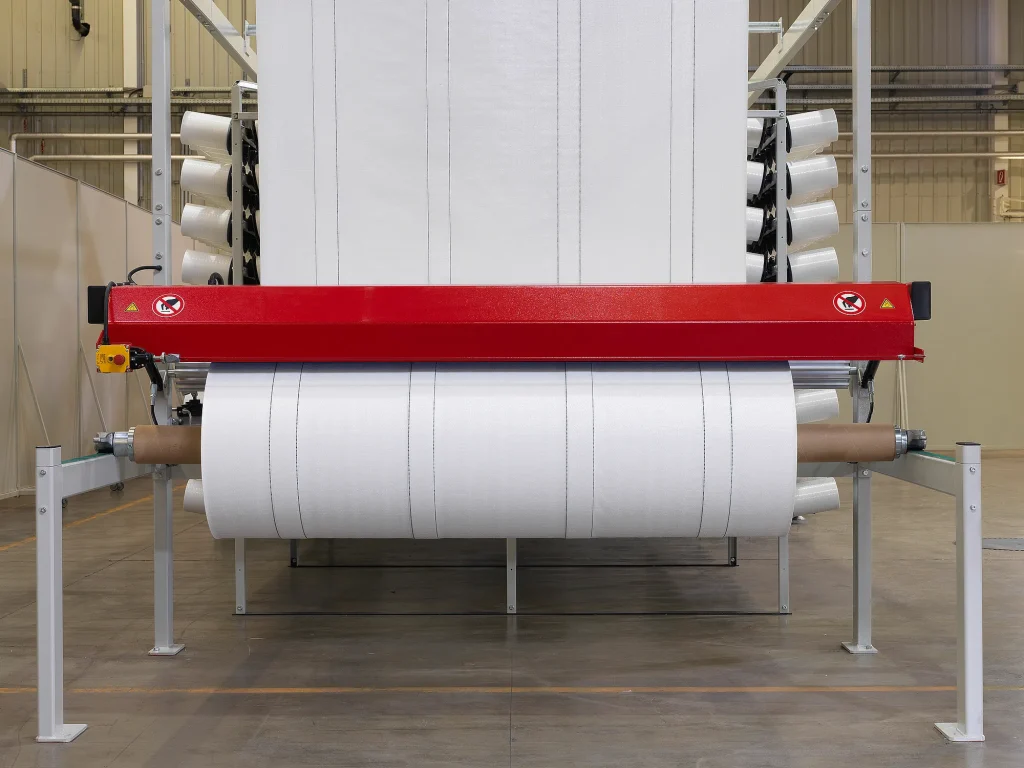
Circular or flat looms interlace tapes to target GSM and picks/cm. For transparency goals, mesh openness and tape flatness are controlled to balance see‑through with dimensional stability. Online pick counters and tension monitors suppress drift that would cause opaque bands or moiré in windows.
### Coating and Lamination
Thin PP/PE extrusion coats close pores while preserving visibility. Adhesive lamination bonds clear BOPP windows with minimal haze; SPC tracks coat‑weight, nip temperature/pressure, and web tension to prevent curl or clouding at the bondline. Window alignment fixtures ensure the see‑through zone lands where the brand wants it.
### Printing (W&H CI Flexo or Gravure)
Reverse printing under BOPP protects art; high‑definition flexo on coated PP produces rugged graphics. Corona/plasma treatment raises surface energy within dyne targets that avoid whitening. Inline spectrophotometry holds ΔE color targets; OPVs supply both scuff protection and COF tuning.
### Conversion and Window/Valve Integration
Slitting, gusseting, and mouth formation proceed with tight dimensional control. Windowed gussets or panels are cut and laminated in register. For **Transparent Valve Woven Bags**, valve sleeves—internal or external—are inserted and welded; slit length/angle and vent paths are tuned to bulk density and packer pressure so dust plumes don’t fog the window.
### Conditioning, Packing, and Palletization
Finished bags equilibrate to target humidity/temperature to minimize curl and code lift. Bales or cartons use corner protection; pallet patterns align to COF targets; validated wrap pre‑stretch reduces edge crush and lean.
### Back‑End QA and Lot Release
Peel strength, fabric tensile/tear, seam integrity, valve seating, seal strength (if pinch‑top), COF, dimensional audits, and **optical checks** (window haze/transmittance, anti‑fog persistence) are logged. Route survivability is validated with instrumented drop and compression tests. AQL sampling, retain libraries, and CAPA loops close the traceability chain.
**Equipment note:** the Starlinger + W&H stack is not marketing gloss; it anchors register precision, color stability, gauge control, and uptime that translate to fewer reprints, less scrap, and tighter tolerances—vital when clear windows must align consistently.
—
## What Is the Application of Transparent Woven Bags?
Because the platform is modular, **Transparent Woven Bags** cover commodity bulks and premium shelf‑grade packs alike:
* **Seeds and grains (rice, pulses, specialty seed):** Clear windows enable variety and grade confirmation; liners keep hygroscopic contents flowing.
* **Animal feed and pet food:** Visual check of kibble size and color; anti‑static liners stabilize weighs; matte adjacent panels keep codes readable.
* **Fertilizers and mineral salts:** Inspection for caking without opening; hermetic liners for NPK/urea on humid routes.
* **Industrial minerals/pigments:** Confirmation of powder color/lot; windowed valve sacks tuned for dust hygiene.
* **Resin pellets and masterbatches:** Visibility of pellet color and contamination; robust sacks for export pallets.
* **Retail‑adjacent foods (sugar, flour blends):** Windowed branding for shelf identity plus tactile matte zones for premium feel.
* **Horticulture and produce:** See‑through for count/size checks; breathable bodies with localized windows for fast ID.
—
## How VidePak Controls and Guarantees the Quality
Quality is a chain of gates, not a barricade at the end. VidePak integrates standards, raw‑material discipline, equipment pedigree, and layered inspection into a single operating system.
**Step 1 — Align with mainstream standards**
Production and testing align with ISO families; methods are calibrated to ASTM/EN/JIS for tensile/tear, peel, seal, friction, and barrier. SPC on CTQs—tape gauge, coat‑weight, web tension, register/ΔE, **window haze**—keeps processes centered inside capable windows.
**Step 2 — Specify all‑new raw materials**
100% virgin PP/PE resins; certified clear BOPP films; qualified inks/adhesives. Supplier CoAs, periodic audits, and dual‑sourcing protect consistency and lead time.
**Step 3 — Run best‑in‑class equipment (Starlinger + W&H)**
Starlinger extrusion/drawing/weaving/coating provides gauge stability and uptime; W&H printing/web handling delivers register precision and color consistency—critical when windows must land precisely relative to artwork.
**Step 4 — Operate a layered inspection plan**
Incoming: MFI, dyne, moisture, pinholes. In‑process: coat‑weight, web tension, register, seam integrity, valve seating, **window alignment**. Finished goods: peel, tensile/tear, seal/leak, COF, drop/compression, **haze/transmittance and anti‑fog** spot checks; retains for traceability.
—
## Systems Thinking: From Optical Hazards to a Coherent Specification
Customization is disciplined map‑making. Link each hazard to a lever, quantify the cost of failure, then commit to the smallest bill of materials that defeats those hazards.
### Sub‑Question A — Visibility vs. Mechanical Safety
* **Risk:** windows too small/opaque for ID; bags down‑gauged until drop failures appear.
* **Levers:** window size/location; tape clarity and mesh openness; GSM and gusset geometry.
* **Pattern:** place windows where users naturally grasp or scan; hold GSM for drop performance; use clarified tapes and smooth surfaces for see‑through.
### Sub‑Question B — Condensation vs. Readability
* **Risk:** fogged windows after cold‑to‑warm transitions; unreadable contents/codes.
* **Levers:** anti‑fog films/liners; equilibration steps; storage RH control.
* **Pattern:** specify anti‑fog windows and liners for humid routes; add a short staging period before sealing hot fills to limit internal fog.
### Sub‑Question C — Dust Hygiene vs. Throughput
* **Risk:** dust plumes that obscure windows and coat codes; slowed BPM.
* **Levers:** valve sleeve stiffness; slit length/angle; mapped vent paths; mouth reinforcement.
* **Pattern:** **Transparent Valve Woven Bags** with vented sleeves; reduced‑valve geometry to lower residual air; keep vents away from the window region.
### Sub‑Question D — UV/Yellowing vs. Shelf Optics
* **Risk:** tape yellowing in yard storage; window haze drift; embrittlement.
* **Levers:** UV stabilizers; storage shading; film selection; OPVs with UV screens.
* **Pattern:** UV‑stabilized tapes and films for outdoor depots; prioritize matte OPVs with UV screens where glare and sun exposure interact.
### Sub‑Question E — End‑of‑Life vs. Brand Promise
* **Risk:** complex windows that frustrate sorting; liner glue that resists removal.
* **Levers:** PP/PE mono‑family; mechanical or spot‑paste liner attachments; standardized pigments.
* **Pattern:** keep the polyolefin family; add design‑for‑disassembly where streams require separation.
**Integration rule:** Start with route climate and visibility need. Lock fabric GSM and window geometry to meet drop/compression and visual ID goals. Add liners and anti‑fog only where ROI in avoided loss is clear. Standardize window sizes, valve styles, and gusset angles across SKUs to reduce training and inventory complexity.
—
## Engineering Deepening: Optics, Mechanics, Barrier, and ESD
### Optics — Haze, Transmittance, and Glare
* **Haze** rises with larger spherulites (over‑slow cooling), rough tape surfaces, and lamination voids. Control draw temperature and cooling to minimize spherulite size; polish tape surfaces via controlled orientation; avoid trapped air at window bonds.
* **Transmittance** depends on window gauge and clarity; ultra‑thin windows may crinkle and glare. Balance thickness for stiffness and readability.
* **Glare** makes windows look clear but unreadable; matte or soft‑touch adjacent zones reduce glare and improve code scanning near the window.
### Mechanics — Orientation, Creep, and Base Geometry
Oriented PP carries load along drawn chains. Creep under compression is mitigated by higher orientation, increased GSM, and base folds that push neutral axes outward—resisting bulge. Reinforced mouths keep clamps square for clean cut‑offs and repeatable scale readings.
### Barrier — WVTR, Closures, and Condensation Dynamics
Water‑vapor transmission rate (WVTR) falls with laminates and liners, but closures convert potential into performance. **Pinch‑top** heat seals (with liners) deliver robust hermeticity; sewn closures are rugged but less airtight. Avoid sealing immediately after hot fills; short equilibration prevents internal fog that drives clumping and window haze.
### ESD and Combustible Dust Behavior
Fine powders accumulate charge during pneumatic conveying and fast fills. Anti‑static liners and coated faces in the **10⁶–10⁹ Ω** band reduce nuisance shocks and weighment drift. Where combustible dust hazards exist, follow EHS protocols for grounding and humidity management; valve sacks with engineered vent paths de‑aerate without open micro‑perfs that compromise the window’s clarity.
—
## Colored Tables in Plain Text (Spec‑Sheet Shortcuts)
### Layer Stack Archetypes (Transparent‑Focused)
| Stack | Exterior Face | Core | Interior / Options | Primary Use Case |
| —-: | ——————————————- | ——————— | ————————– | ——————————————————— |
| A | Bare/coated woven PP (thin coat 5–10 μm) | Woven PP 80–100 g/m² | Clear PE liner 60–80 μm | Value routes needing visibility + mid moisture protection |
| B | Clear BOPP window (12–18 μm) + printed face | Woven PP 90–110 g/m² | Optional anti‑fog liner | Branded sacks with inspection window |
| C | Full‑face clear BOPP (matte/gloss options) | Woven PP 95–110 g/m² | Clear liner 60–90 μm | Photo art + general visibility |
| D | Anti‑static coated PP (low haze) | Woven PP 100–120 g/m² | Anti‑static liner 60–90 μm | Fine powders needing ID + ESD control |
### Valve and Closure Comparison (Transparency Considerations)
| Valve/Closure | Pros | Cons | Best‑Fit Uses |
| —————– | ————————————————- | —————————— | ——————————————— |
| Internal valve | Clean decks; best sift‑proofing | Training; needs mapped venting | Fine powders (cement, pigments) |
| Extended valve | Easy dock; legacy packer friendly | Slightly higher residual air | Coarse granules (fertilizers, salts) |
| Reduced valve | Lower residual air; faster stack stabilization | Tighter operating window | High‑BPM lines; long routes |
| Pinch‑top + liner | Hermeticity; premium feel; clear liner visibility | Needs heat‑sealable liner | Hygroscopic contents; retail‑adjacent powders |
| Sewn + crepe tape | Robust; simple equipment | Needle holes; less airtight | Construction chemicals; rugged handling |
### QA Targets (Add Optical Controls)
| Test | Target Band | Why It Matters |
| ————————- | ——————— | ————————————- |
| Lamination peel | ≥ 3.0 N/15 mm | Transit integrity; no delamination |
| Fabric tensile (MD/CD) | Application‑specific | Drop/pallet compression survival |
| Seal strength (pinch‑top) | ≥ 2.5 N/15 mm | Hermetic performance |
| COF (static/kinetic) | 0.30–0.45 / 0.25–0.40 | Pallet stability; machinability |
| Haze (window/liner) | As spec (e.g., ≤ 15%) | Maintain visibility for ID and audits |
| Anti‑fog persistence | ≥ 24–72 h at set RH/T | Prevent fogging in humid transitions |
### Storage Guidance and Risks (See‑Through Variant)
| Condition | Guidance | Risk If Ignored |
| —————– | —————————————— | ———————————————- |
| Temperature | 20–25°C preferred | Window warpage; coating softening; color drift |
| Relative humidity | ~50% RH | Curl; code lift; condensation fog |
| UV exposure | Avoid direct sun; use UV‑stabilized grades | Yellowing; embrittlement; tensile loss |
| Pallet wrap | Validate pre‑stretch; use corner boards | Lean, edge crush, scuff against window |
—
## Troubleshooting (Symptom → Likely Cause → Practical Fix)
| Symptom | Likely Cause | Practical Fix |
| ————————————- | ———————————————— | —————————————————————— |
| Window looks milky after sealing | Condensation from hot fill; liner not anti‑fog | Add equilibration step; specify anti‑fog liner/window |
| Uneven transparency across the web | Weave pick drift; draw temperature variation | Tighten loom control; lock draw profiles; audit GSM uniformity |
| Yellowing during yard storage | Insufficient UV stabilization; sun exposure | Use UV‑stabilized tapes/films; improve shading and inventory turns |
| Whitening/crazing on folds | Stress‑whitening of PP; over‑tight folds | Adjust creasing heat; widen radii; add OPV where folds contact |
| Valve dust coats window at cut‑off | Vent paths aimed toward window; soft valve board | Re‑map micro‑perfs; stiffen board; tune slit length/angle |
| Seal leaks on pinch‑top | Off‑window heat/dwell; contaminated jaws | Clean jaws; recalibrate seal curve; verify correct liner resin |
| Delamination/clouding at window edges | Under‑weight adhesive; trapped air; nip drift | Raise coat‑weight; improve nip pressure/temperature; de‑air webs |
| Barcodes unreadable near window | Glare; insufficient x‑height | Move codes to matte zone; raise x‑height and quiet zones |
—
## Implementation Checklist (RFQ → SOP)
1. Define visibility requirement (what has to be seen and from what distance) and route climate (humidity, temperature swings, yard exposure).
2. Map filler constraints (open‑mouth vs. valve; BPM; de‑aeration needs).
3. Choose base fabric GSM and weave openness; set seam/closure method.
4. Select window size/location and face (clear BOPP vs. coated PP); lock ΔE targets and barcode x‑height on adjacent panels.
5. Decide liner presence/gauge and anti‑fog/antistat grades; standardize valve geometry if used.
6. Run pilots: instrumented drops, compression, haze/transmittance checks, WVTR spot checks, scale repeatability.
7. Finalize QA gates (peel, seal, COF, haze) and retain policy; codify CAPA timing.
8. Train operators with photographic SOPs; monitor first‑three lots for drift (especially window alignment and haze).
9. Standardize window sizes, valve sleeves, and gusset angles across SKUs to simplify stock and training.
10. Plan end‑of‑life with PP/PE mono‑family; add design‑for‑disassembly where streams require separation.
—
## Worked Examples (Reusable Patterns)
**Scenario A — Seed Corn, Mixed Climate Warehousing**
Problem: Wrong‑variety picks and seed damage claims; occasional fogging.
Spec: woven PP **90–100 g/m²**, clear BOPP window **15–18 μm** on front panel, clear anti‑fog liner **70–80 μm**, pinch‑top heat seal, matte OPV on non‑window zones.
Outcome: faster QA, near‑zero mis‑picks, readable windows across humid transitions.
**Scenario B — Pigments on Valve Packers**
Problem: Dust plume coats window; high residual air slows stacking.
Spec: **Transparent Valve Woven Bags** with vent paths mapped away from window; stiffer valve boards; reduced‑valve geometry; soft‑touch OPV on back panel for higher friction.
Outcome: cleaner decks, faster stabilization, improved audit optics.
**Scenario C — Retail‑Adjacent Sugar**
Problem: Scuffed art and barcode misreads in bright stores; need visibility of granule size.
Spec: windowed BOPP face (matte everywhere except clear window), sewn + crepe tape closure, high x‑height regulatory block, anti‑fog liner for cold‑chain breaks.
Outcome: stronger shelf identity, fewer scan issues, simple granule checks by store staff.
**Scenario D — Fertilizer in Monsoon Route**
Problem: Caking after six weeks in coastal depots; customers want to see texture.
Spec: woven PP **110–120 g/m²**, matte BOPP face with **transparent window**, **PE liner 80 μm** with anti‑fog, pinch‑top heat seal; wrap COF target **0.35** using micro‑texture OPV.
Outcome: preserved flowability, fewer returns, clear ID through rainy season.
—
## Keyword Strategy and Long‑Tail Phrasing (for Findability)
To serve both human readers and search intent without keyword spam, weave these terms naturally where relevant. Bolded phrases are primary targets:
* **Transparent Woven Bags**, **Transparent PP Woven Bags**, **Clear Woven Polypropylene Sacks**, **See‑Through Woven PP Bags**
* **Transparent Valve Woven Bags**, **Transparent Window Woven Bags**, **Transparent Polypropylene Woven Sacks**
* Supportive long‑tails: *transparent woven bag manufacturer*, *transparent PP woven bag supplier*, *clear woven sacks with liner*, *anti‑fog window woven bag*, *transparent BOPP window sack*, *see‑through polypropylene valve bag*
Use synonyms to avoid repetition while preserving relevance; place key phrases near practical advice, specifications, and troubleshooting tables.
—
## Why This Platform Wins (When It Should)
A packaging choice is a bet. **Transparent Woven Bags** win when the bet is on operational clarity—literally and figuratively: the warehouse can see what it is handling, QA can inspect without breaking seals, and the supply chain can move faster with fewer errors. They combine a textile’s mechanical grace with a printer’s fidelity, a chemist’s barrier, and an inspector’s window. Are there cases where full‑opaque sacks or rigid pails make more sense? Of course—photo‑sensitive chemistries or solvent‑heavy goods can demand them. But where cost, speed, visibility, and brand presence intersect for dry solids, the transparent woven platform—customized with intention—often delivers the best total outcome.
October 30, 2025
Imagine this conversation between a packaging manager and a supplier: Manager:“We need transparent woven bags that can protect our agricultural seeds from moisture during monsoon seasons. What solutions do you offer?” Supplier:“At VidePak, we integrate multi-layered moisture-proof designs, including PE/OPP liners and advanced coating technologies. Our bags are tested to withstand humidity levels up to 95% while maintaining transparency for product visibility.” Manager:“How do you ensure consistency across large orders?” Supplier:“With over 100 circular looms and 30 lamination machines, we guarantee precision in production—every batch meets ISO 9001 standards. Let me walk you through our quality framework…”
This dialogue highlights the core themes of this article: material innovation, rigorous quality control, and customizable solutions—pillars that define VidePak’s approach to manufacturing transparent woven bags. Below, we delve into technical details, common challenges, and actionable insights for buyers.
1. The Science of Moisture Resistance in Transparent Woven Bags
Moisture infiltration remains a top concern for industries like agriculture, chemicals, and food packaging. For transparent woven bags, balancing clarity with functionality requires advanced engineering.
1.1 Layered Protection: Liners and Coatings
Inner Liners: VidePak offers PE (polyethylene) and OPP (oriented polypropylene) liners, which act as impermeable barriers. PE liners provide superior water resistance, while OPP enhances tensile strength. For light-sensitive products, black inner liners block UV rays, reducing degradation risks by up to 70%.
Surface Coatings: A nano-scale PE coating can reduce water vapor transmission rates (WVTR) to <5 g/m²/day, critical for tropical climates.
Outer Lamination: Options like pearlized or matte films add aesthetic appeal while reinforcing moisture resistance. For instance, a pearlized BOPP layer reflects sunlight, reducing heat absorption by 15%.
Case Study: A fertilizer client in Southeast Asia reported a 40% reduction in clumping after switching to VidePak’s PE-coated bags with black liners.
1.2 Structural Integrity and Material Selection
Virgin PP Resin: Unlike recycled materials, virgin polypropylene ensures uniformity in weave density (typically 10×10 strands per inch), minimizing pinhole defects.
VidePak’s 16 extrusion lines and 30 lamination machines support bespoke designs:
Printing: Up to 8-color HD printing for branding, compliant with EU food-grade ink standards.
Sizes: Ranging from 5 kg to 1-ton FIBC bags.
FAQ Section Q: Can you produce bags with both PE liners and matte lamination? A: Yes. Our hybrid designs combine functionality with premium aesthetics. View examples here.
Q: What’s the lead time for 50,000 units? A: Standard orders ship in 15–20 days, expedited by our 100+ looms.
Q: Are your bags recyclable? A: Absolutely. Our PE/PP materials are 100% recyclable, aligning with global sustainability goals.
5. Conclusion: Partnering for Long-Term Success
With 30+ years of industry leadership, VidePak combines innovation with reliability. From moisture-proof liners to ISO-certified production, we empower clients to navigate complex packaging challenges.
This article adheres to Google’s EEAT guidelines, drawing on technical data, case studies, and industry benchmarks to establish authority. For further insights on moisture-proof innovations, explore our detailed guide on woven bags with PE liners and quality assurance protocols.