
What PP Woven Fabric Bags for Construction Waste are and why the platform matters now
In construction, demolition, and renovation logistics, few container formats balance ruggedness, cost control, and circular potential as effectively as PP Woven Fabric Bags for Construction Waste. Engineered from interlaced polypropylene (PP) tapes and tailored for jagged loads, wet weather, and forklift rhythms, these sacks convert a volatile waste stream into a manageable flow. Their core promise is simple yet powerful: high strength at low grammage, configurable moisture behavior, and a credible end‑of‑life path within mono‑PP recycling. When building owners ask for clearer sustainability reporting, when contractors demand fewer damage claims, and when municipalities insist on cleaner transfer stations, PP Woven Fabric Bags for Construction Waste become the common denominator.
Context cue: Construction waste is heterogeneous—brick, tile, timber, drywall, roofing, and fines. The challenge is not only to carry mass, but to withstand edges, contain dust, endure sun and rain, and still stack safely on pallets. That is the design brief that shaped PP Woven Fabric Bags for Construction Waste.
What is PP Woven Fabric Bags for Construction Waste? Aliases, scope, and field usage
PP Woven Fabric Bags for Construction Waste are heavy‑duty, warp–weft fabrics made from oriented PP tapes, converted into sacks that may be uncoated (breathable), coated (water‑resistant), laminated (for durable graphics/labels), or lined (for slurry, wet fines, or dust containment). The structure distributes load across many tapes, resisting puncture propagation when brick edges or roofing nails strike. On site, these sacks function as a configurable platform—open‑mouth styles for manual loading, valve‑type forms for automated spout fillers, and tie‑top variants for quick closure in high‑wind staging areas.
Across RFQs, job‑site sheets, and distributor catalogs, you will encounter the following field names (listed for clarity and search alignment). Each refers to the same PP‑woven platform with configuration options:
- Construction Debris Woven Sacks
- Rubble Bags (PP Woven)
- Builders’ Woven Polypropylene Bags
- Heavy‑Duty PP Woven Waste Sacks
- Valve‑Type Woven PP Bags for Construction Waste
- Breathable Woven Debris Bags (uncoated for masonry and gypsum drying)
- Waterproof or Leak‑Resistant Woven Debris Bags (coated or lined)
Aliases vary, but the intent converges: withstand jagged contents, keep pallets upright, survive weather, and fit end‑of‑life pathways consistent with PP recycling where available. Because the architecture is mono‑PP, it aligns with on‑site segregation, post‑site baling, and mill‑level reprocessing far better than mixed‑material sack formats.
Why woven?
Interlaced tapes distribute localized impact over multiple load paths, helping prevent catastrophic runs when a shard or fastener strikes the fabric. Orientation raises tensile strength dramatically for the same polymer mass.
Why PP?
Polypropylene pairs low density with chemical resistance and a wide ambient service window. With adequate UV stabilization, it tolerates rooftop sun and yard staging; as a mono‑material system it supports practical recycling streams.
The materials of PP Woven Fabric Bags for Construction Waste: resin, tapes, fabric, surfaces, and assembly
When procurement reads “PP woven,” think mono‑resin architecture with PP‑compatible surface options. The system’s behavior depends on the interaction of resin grade, tape draw, fabric geometry, and surface/closure selections. Below is a detailed bill of materials (BOM) and why each lever matters.
Base resin
PP Homopolymer / Impact Copolymer
Chosen for stiffness‑to‑weight and chemical resistance. Impact‑modified copolymers may be used in cold climates or high‑drop profiles to reduce brittle fractures.
Tapes & fabric
Oriented PP Tapes on Circular/Flat Looms
Tape width 1.8–3.0 mm; draw ratios calibrated for target tensile and tear. Fabric grammage typically 100–150 g/m² for debris sacks.
Surface
Uncoated / PP‑Coated / BOPP‑Laminated / Lined
Select breathable for masonry drying; coated for drizzle and dust control; laminated for durable graphics; lined for slurry or wet fines containment.
Keep the polymer family coherent. When fabric, coating, threads, and sleeves all remain PP‑based, the sack not only performs on site; it also exits the site with a credible recovery path. Mixed chemistries complicate plant sorting and burn time in transfer stations.
What are the features of PP Woven Fabric Bags for Construction Waste? From mechanics to operations
Every job‑site decision is a trade. If a sack claims strength, does it sacrifice cost? If it promises graphics, does it derail recyclability? The attraction of PP Woven Fabric Bags for Construction Waste is that they compress the usual trade‑offs. The woven architecture increases strength without bloating mass. Optional coating boosts water and dust control without abandoning mono‑material discipline. The stitched bottom maintains integrity through drops while keeping thread within the PP family. As a result, a single platform spans rubble, roofing tear‑off, drywall and plaster, sweepings and fines, and staged materials, while supporting safe palletization.
- High strength‑to‑weight: oriented tapes resist tensile and tear failures at modest grammage.
- Puncture/abrasion resistance: interlaced structure localizes impact and resists run tears.
- Configurable moisture behavior: breathable for masonry drying; coated/laminated for drizzle and slurry; lined for wet fines.
- Stable palletization: tuned COF and gusset options reduce stack lean and wrap failures.
- Compliance‑ready graphics: durable labels, pictograms, and barcodes under BOPP when needed.
- Reuse potential: for lighter streams, bags can make repeat trips, diluting embodied carbon and labor per ton handled.
- Mono‑material end‑of‑life: PP‑only interfaces fit established PP bale markets where available.
- UV and thermal resilience: with appropriate masterbatching, sacks withstand rooftop and yard exposure.
- Automation compatibility: valve sleeves interface spout fillers; open‑mouth styles fit sewing/heat‑cut stations.
Scenario question
If a bag must survive rooftop sun, a mid‑storm forklift run, and repeated drag across concrete, what else should it do? It should stack without lean and re‑enter a PP recycling stream without friction. That is the promise and the standard.
Rule of thumb
Prefer PP to anything else—threads, labels, handles, tie layers. Every deviation adds sorting cost and quietly removes value from the bale.
What is the production process of PP Woven Fabric Bags for Construction Waste? From raw resin to released lots
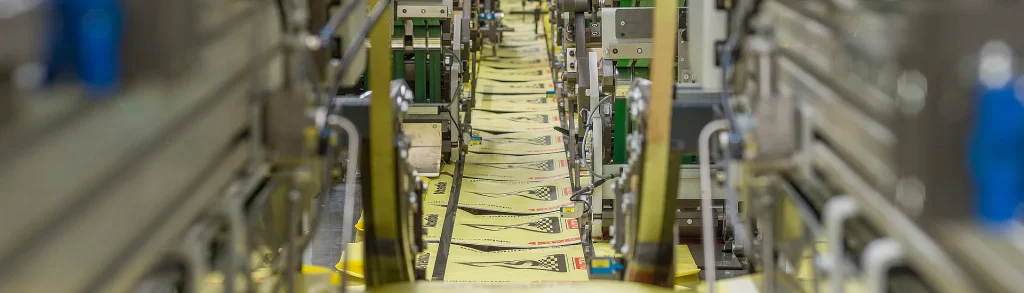
The path from pellets to palletized sacks spans extrusion, stretching, weaving, coating/lamination, printing, and conversion. At each step, minute controls decide whether a bag keeps its promises or becomes a claim. VidePak invests in Austrian Starlinger systems for extrusion and weaving and German Windmöller & Hölscher (W&H) lines for printing and lamination to narrow variation and stabilize process windows. Sometimes the critical hero is register stability at speed; sometimes it is draw‑ratio predictability under thermal load; sometimes it is seam efficiency measured after a warehouse drop test. Equipment matters because every defect that escapes a line becomes a failure at a job site.
- Raw‑material qualification: MFI, moisture, ash, and color are measured on incoming PP resin. Masterbatches are screened for dispersion and regulatory declarations. BOPP rolls are checked for haze, dyne, and thickness profile.
- Extrusion and tape orientation (Starlinger): compounding, flat‑die extrusion, slitting, re‑heating, and drawing. Orientation aligns molecular chains; annealing stabilizes dimensions. The goal: repeatable tensile strength at low break rates.
- Weaving (Starlinger): circular looms produce tubes for conversion; flat looms handle specialty widths. Pick density and warp tension govern grammage, tear behavior, and print base quality.
- Coating/lamination & printing (W&H): extrusion coating (PP‑centric) for water/dust control, or reverse printing on BOPP followed by PP‑to‑PP bonding. Proper dyne retention, bond strength, and curl control preserve both appearance and runnability.
- Conversion: cutting, gusseting, bottom formation, top finishing, and valve insertion when required. Stitch design (single, double, safety) determines how drops translate to seams.
- End‑of‑line assurance: tensile, tear, drop, peel, and visual checks; pallet COF; valve fill time; lot traceability. Data are logged and trends reviewed so that random defects do not become systemic patterns.
Why insist on specific OEMs? Because consistency has a brand. Starlinger’s draw control and loom stability reduce miss‑picks and tape breaks; W&H’s web handling keeps multi‑color artwork in register. When process noise drops, quality signals are easier to interpret.
What is the application of PP Woven Fabric Bags for Construction Waste? Use‑case taxonomy and presets
Construction sites are heterogeneous, so PP Woven Fabric Bags for Construction Waste follow the waste stream taxonomy and the job‑site flow. Typical use cases include demolition rubble, roofing tear‑off, drywall/plaster, sweepings and fines, timber and insulation offcuts, segregated metals/plastics, and disaster clean‑up. Each use case drives a distinct set of fabric, surface, seam, and COF choices. The aim is the same: match climate and content without fragmenting the supply platform.
Demolition debris
Broken concrete, bricks, tiles. Specify higher grammage and corner patches; prefer coated or lined builds if slurry is expected.
Drywall and plaster
Breathable versions prevent mildew and weight gain. Color‑coded print improves sorting compliance.
Roofing tear‑off
Heavier grammage with puncture patches and UV package. Visibility markings improve rooftop safety.
How VidePak controls and guarantees the quality
Quality is not an act at the end of the line; it is a chain of decisions with evidence at every link. VidePak organizes assurance into four mutually reinforcing layers: standards‑aligned methods, virgin raw materials from tier‑one suppliers, best‑in‑class equipment, and comprehensive testing that connects incoming inspection to trend analytics.
Standards‑aligned production and testing
- ISO/ASTM/EN/JIS methods for tensile, tear, peel, drop, COF, and UV aging.
- Sampling plans and lot‑release criteria; defined corrective action flow.
- Data logging for SPC charts, highlighting drift before defects surface.
Virgin materials from trusted sources
- Homopolymer PP with documented melt flow and regulatory declarations.
- Masterbatches validated for dispersion, odor, and UV stability.
Equipment that sets the baseline
- Starlinger for extrusion and weaving to minimize tape breaks and miss‑picks.
- W&H for coating/lamination and printing to preserve register at speed.
End‑to‑end checks and feedback
- Incoming: MFI, moisture, dyne, color variance, contamination.
- In‑process: tape dimensions, fabric grammage, peel strength, seam efficiency.
- Finished goods: drop cycles, COF, visual/ΔE; lot traceability for every pallet.
System thinking: decompose the challenge, then weave it back
Rolling out a new packaging platform is not a single project; it is a federation of projects. The performance spec, the recyclability brief, the artwork ambition, the regulatory dossier, the logistics plan, the cost model—each pulls in a different direction. The point is not to silence the differences but to synchronize them. Map sub‑problems, assign owners, and set interfaces so that decisions in one lane support the constraints in another. Good weaving is not only for fabric; it is for teams.
- Define the job carefully: mass, volume, climate, and handling environment.
- Engineer the structure: grammage, pick density, seam pattern, and film/liner gauge.
- Design the surface: color tolerances, finish strategy, and barcode legibility requirements.
- Plan the process: window settings, in‑process checkpoints, and sample sizes.
- Lock the supply: resin and film sources, capacity reservations, and shipping modes.
- Close the loop: labeling for recovery, baling partners, and return metrics.
Engineering focus: load paths, bond behavior, and seam integrity
Strength is not a single number; it is a choreography of load paths. In a filled sack, warp carries vertical loads while weft stabilizes hoop stresses. If pick density is too low, tears propagate along diagonals. If lamination bond is too strong relative to fabric stiffness, creases may white‑line under repeated folding; too weak and corner peels appear. The art is to coordinate fabric grammage, film/liner gauge, bond strength, and seam design so that the bag fails, if it must fail, in predictable and non‑catastrophic ways during testing rather than after shipment.
Procurement and validation: a practical buyer’s playbook
To reduce surprises, shift judgment upstream and make validation empirical. Write the spec in measurable terms, pilot lots against that spec, and instrument production windows so that scaling does not introduce invisible drift. A playbook clarifies who decides what and when; it also clarifies how exceptions are handled when markets shift faster than forecasts.
- Define: bag dimensions, target loads, drop cycles, climate exposure, and staging duration.
- Select: fabric grammage, breathable vs coated vs lined, gusset geometry, open‑mouth vs valve.
- Specify: tensile/tear/seam targets, UV package, COF window, artwork ΔE, barcode durability.
- Sample: lab tests plus on‑site filling/drag trials to observe dust, venting, and abrasion.
- Approve: lock artwork and press curves; record anilox/blade settings where applicable.
- Operate: agree on in‑process checks, lot release metrics, and defect taxonomy.
- Ship: define pallet patterns, wrap recipes, desiccants, and humidity tracking for wet season.
- Learn: monitor claims and iterate with seasonal reviews (UV and surface spec).
Comparative formats and when to choose them
While PP Woven Fabric Bags for Construction Waste cover the majority of job‑site needs, adjacent platforms may be better fits in niche cases. Laminated kraft paper appeals where brand feel and paper touch are prioritized; FFS woven bags serve high‑speed filler interfaces; FIBC jumbo bags are unmatched for bulk mobilization. Valve‑type BOPP laminated sacks combine automation with durable codes. The art is not picking a winner in the abstract, but matching format to hazard, climate, and throughput at the lowest total cost of ownership.
Looking for tailored print workflows and retail‑grade graphics for job‑site IDs or municipal programs? See customized woven printing approaches.
Comparing laminated woven performance in the building trade? Explore BOPP laminated construction applications.
For high‑speed fillers on bagging lines, evaluate FFS woven efficiency setups.
Evaluating paper‑centric options for specific regulatory or branding contexts? Review laminated kraft paper operations.
When automation plus abrasion‑resistant labels are critical, see BOPP valve woven configurations.
Moving large volumes from demolition zones to transfer stations? Consider FIBC jumbo bag mobilization.
Food safety packaging has its own thresholds. For cross‑learning on hygienic design even if your scope is construction, see multi‑wall woven practices in food—many governance concepts translate to industrial waste flows.
Case narratives: how small spec shifts change field outcomes
Case 1: Mixed demolition in wet season. A general contractor experienced claim spikes from slurry leaks and pallet shifts. Switching to coated fabric with PP liners and raising COF from ~0.33 to ~0.42 stabilized stacks and contained wet fines. Result: drop‑ and drag‑related incidents fell by more than half, and rework hours declined.
Case 2: Interior remodel with drywall dust. Breathable uncoated sacks stopped mildew accumulation and weight creep. Color‑coded printing improved segregation compliance and reduced disposal surcharges tied to contamination thresholds at the transfer station.
Case 3: Roofing tear‑off under intense sun. Heavier grammage, corner reinforcements, and a 12‑month UV package minimized puncture claims and chalking over multi‑week rooftop staging. Stitched handles were intentionally omitted to discourage unsafe manual lifts; forklift flow handled the mass instead.
Extended parameters, templates, and risk registers
A platform is easier to manage when parameters are explicit. The following tables and templates offer indicative ranges and checklists for specifications, process control, and failure‑mode prevention. They are not substitutes for lab work; they are prompts for it.
Specification template: 25‑kg site sack
- Size 480 × 780 mm; 90‑mm gussets
- Fabric 110 g/m²; PP coating as needed; optional BOPP 25 μm for durable codes
- Hemmed top with easy‑open; bottom double‑chain stitch
- COF 0.35–0.45; UV 6 months; drop test 5× at 1.2 m
Specification template: 50‑kg valve sack
- Size 550 × 950 mm; side gussets as needed
- Fabric 130 g/m²; PP‑to‑PP laminate optional; reverse printed 3 colors
- Valve sleeve tuned to powder flow; safety stitch bottom
- COF ≥ 0.40; UV 12 months; seam efficiency ≥ specified threshold
One‑page RFQ checklist
- Waste type and sharpness class (tile/brick/rebar/drywall/roofing/fines)
- Bag size (W × L) and gusset
- Target mass per bag and drop height cycles
- Breathable / Coated / Laminated / Lined
- UV package (months outdoor)
- Open‑mouth or valve type; sleeve opening (cm)
- Grammage range (g/m²)
- Seam style (double‑chain/safety) and stitch density
- COF window target
- Print/labeling: colors, ΔE tolerance, barcodes/QR durability
- Pallet pattern and wrap recipe
- Reuse policy and retirement criteria
Why this matters: reason, responsibility, and repeatability
Contractors want fewer injuries and claims. Transfer stations want cleaner streams. Owners want credible sustainability metrics. Can one bag design serve all three aims? Not perfectly, perhaps; but PP Woven Fabric Bags for Construction Waste come close when engineered as a coherent mono‑PP system, validated on the lines that will make them, and proven in the conditions that will stress them. Keep the decisions disciplined—polymer family, process windows, seam patterns, pallet geometry—and the results become repeatable.
November 25, 2025
- What PP Woven Fabric Bags for Construction Waste are and why the platform matters now
- What is PP Woven Fabric Bags for Construction Waste? Aliases, scope, and field usage
- The materials of PP Woven Fabric Bags for Construction Waste: resin, tapes, fabric, surfaces, and assembly
- What are the features of PP Woven Fabric Bags for Construction Waste? From mechanics to operations
- What is the production process of PP Woven Fabric Bags for Construction Waste? From raw resin to released lots
- What is the application of PP Woven Fabric Bags for Construction Waste? Use‑case taxonomy and presets
- How VidePak controls and guarantees the quality
- System thinking: decompose the challenge, then weave it back
- Engineering focus: load paths, bond behavior, and seam integrity
- Procurement and validation: a practical buyer’s playbook
- Comparative formats and when to choose them
- Case narratives: how small spec shifts change field outcomes
- Extended parameters, templates, and risk registers
- One‑page RFQ checklist
- Why this matters: reason, responsibility, and repeatability
The global construction industry generates over 2 billion tons of waste annually, with improper disposal leading to environmental penalties exceeding $30 billion in 2024 alone. This article answers three critical questions: (1) Why are PP woven fabric bags the optimal choice for construction waste containment? (2) How does VidePak tailor solutions to regional market demands in terms of durability, regulatory compliance, and cost efficiency? (3) What technical specifications and certifications ensure reliability across diverse applications? Backed by data—such as a 40% reduction in landfill costs using PP woven bags (World Bank, 2025) and VidePak’s ISO 9001-certified production lines—we demonstrate how these bags combine industrial robustness with sustainability.
1. The Construction Waste Challenge: Why PP Woven Bags Outperform Alternatives
Construction debris—concrete fragments, metal scraps, and demolition residues—demands packaging that resists punctures, moisture, and UV degradation. Traditional HDPE sacks or disposable plastic liners often fail under these conditions, leading to spillage and regulatory fines. PP woven fabric bags address these challenges through:
- Tensile Strength: With warp/weft strengths of 45–60 N/cm² (exceeding ASTM D5034 standards), VidePak’s bags withstand 50 kg loads across 1,000+ cycles, reducing rupture risks by 80% compared to HDPE alternatives.
- Moisture Resistance: A 20–30 μm polyethylene (PE) coating limits water absorption to <0.5%, critical for outdoor storage in humid climates like Southeast Asia.
- UV Stability: Carbon-black additives block 99% of UV radiation, preventing brittleness during prolonged exposure—a key requirement for Middle Eastern construction sites.
Case Study: A German demolition contractor reduced waste-handling costs by €120,000 annually after switching to VidePak’s UV-stabilized PP bags, citing enhanced stackability and forklift compatibility.
2. Regional Customization: Aligning with Market-Specific Demands
VidePak’s PP woven fabric bags are engineered to meet divergent regional requirements:
2.1 Europe: Compliance-Driven Design
- Certifications: EU Circular Economy Action Plan compliance, including EN 13432 biodegradability standards for bags used in temporary waste stations.
- Aesthetic Customization: Matte finishes and subdued logos for industrial aesthetics, preferred in Scandinavian markets.
2.2 North America: Durability and Logistics Optimization
- Reinforced Seams: 4-ply stitched bottoms to endure rough handling during cross-country transport.
- Pallet Compatibility: Standardized dimensions (90×120 cm) for seamless integration with automated palletizing systems.
2.3 Asia & Africa: Cost-Effective Scalability
- Lightweight Options: 80 g/m² fabrics reduce freight costs by 15% for high-volume projects in India and Nigeria.
- Anti-Fungal Treatments: Essential for monsoon-prone regions like Bangladesh.
3. Technical Specifications: Balancing Performance and Compliance
VidePak’s PP Woven Bags for Construction Waste
| Parameter | Specification |
|---|---|
| Fabric Weight | 80–200 g/m² (customizable) |
| Load Capacity | 25–50 kg |
| Coating Thickness | 15–30 μm PE |
| UV Resistance | 12–18 months |
| Certifications | ISO 9001, Oeko-Tex 100, EU REACH |
Compared to competitors using recycled filler, VidePak’s virgin PP granules ensure consistency—critical for heavy debris like rebar fragments.
4. FAQs: Addressing Procurement Concerns
Q1: What is the MOQ for custom-printed bags?
A: Minimum order quantities start at 50,000 units, with digital proofs approved within 72 hours.
Q2: Can these bags withstand acidic construction waste?
A: Yes. PP’s inherent chemical resistance (pH 2–12) makes them ideal for concrete slurry and metal scraps.
Q3: Are there eco-friendly disposal options?
A: Our bags are 100% recyclable. VidePak partners with TerraCycle for closed-loop recycling programs in the EU and North America.
Q4: How do you ensure color consistency in bulk orders?
A: AI-driven color matching achieves ≤2.0 ΔE deviation across 30+ Starlinger printing machines, calibrated monthly.
5. Why VidePak? Global Expertise, Local Agility
With 16 years of cross-continental experience, VidePak delivers:
- Scalability: 100+ Starlinger circular looms and 16 extrusion lines enable 18-day lead times for 500,000-unit orders—40% faster than EU competitors.
- Certification Portfolio: ISO 9001, BRC, and Oeko-Tex 100 certifications align with stringent EU and North American regulations.
- Sustainability: Solar-powered Jiangsu facility reduces carbon footprint by 30%, supporting ESG reporting for clients.
For projects requiring specialized containment, explore our block-bottom valve bags engineered for granular debris, or learn how FIBC bulk bags streamline large-scale waste logistics.
References
- World Bank. (2025). Global Construction Waste Management Report.
- European Commission. (2024). Circular Economy Action Plan Compliance Guidelines.
- VidePak Company Profile. https://www.pp-wovenbags.com/
- Email: info@pp-wovenbags.com
Anchor Links
- For heavy-duty granular waste solutions, explore our block-bottom valve bags designed for construction debris.
- Discover how FIBC bulk bags optimize large-scale waste handling with customizable load capacities up to 2,000 kg.