
What Are Food‑Grade Woven Fabric Bags?
Food‑Grade Woven Fabric Bags are engineered flexible packages designed to hold edible powders and granules under demonstrable food‑safety controls while still delivering industrial‑class strength. They are built around an oriented polypropylene (PP) woven fabric backbone and complemented by cleanable faces, migration‑safe inks/adhesives, and validated food‑contact liners. Unlike general‑purpose raffia sacks, Food‑Grade Woven Fabric Bags are specified, manufactured, and audited under hygiene frameworks (for example: HACCP, GMP, and ISO 22000‑style systems) to reduce the risks of chemical migration, physical contamination, and microbiological carryover. That discipline enables the safe, repeatable movement of bulk ingredients such as flours and starches, sugars and salts, pulses and grains, dairy powders and proteins, beverage premixes, seasonings, nutraceutical blends, and animal‑nutrition bases across climates and audit regimes.
Why spec this format?
Because it reconciles two worlds that rarely shake hands: stringent food‑contact expectations and unforgiving industrial logistics. The result is high mechanical reliability at modest mass, disciplined barrier control, and barcodes that still grade under condensation and abrasion.
Also known as (aliases):
- Food‑Safe Woven PP Bags
- Food‑Contact Polypropylene Woven Bags
- Hygienic Woven Fabric Sacks
- Food‑Approved Woven Poly Bags
- Sanitary Woven Polypropylene Packaging
- GMP‑Converted Woven PP Bags
- Barrier‑Lined Food‑Grade Woven Bags
The Materials of Food‑Grade Woven Fabric Bags
A Food‑Grade Woven Fabric Bag is not a single sheet; it is a purposeful stack. Each layer must earn its place by contributing strength, cleanliness, barrier, and documentable safety. The baseline assembly—woven PP fabric + clean faces + food‑grade liner—can be tuned with adhesives, tie layers, seam aids, and anti‑sift features to meet climate and route severity while keeping total cost of ownership in check.
Structural backbone — woven polypropylene fabric
Oriented PP tapes (raffia) are extruded from virgin, food‑contact‑compliant resin, slit, drawn, and woven on circular or flat looms. Typical fabric mass windows: 60–120 g/m² for 20–50 kg sacks; 140–230 g/m² for FIBC panels when the same discipline is extended to big‑bag formats. This backbone provides tensile, tear, puncture, and drop resilience at low mass, remaining usable after splash events that would debilitate paper multi‑wall sacks.
Hydrophobic faces — coatings and laminates
Extrusion coats (PP/PE) lay down continuous skins that shed dust, improve print anchorage, and simplify wipe‑downs. Film laminates (commonly BOPP matte/gloss) deliver photo‑grade branding and rub resistance. Both routes reduce porosity; therefore, de‑aeration must be engineered via hot‑needle or laser micro‑perforations positioned away from spill paths and code windows.
Food‑contact liners — the clean interior
PE, PP, or co‑ex films (25–70 μm) set WVTR/OTR performance for hygroscopic or oxidation‑sensitive ingredients, isolate aroma/grease, and provide a sealable inner surface. Formats include loose‑insert liners for sewn open mouth, form‑fit liners for block‑bottom, and tube liners with heat‑sealed spouts.
Inks, adhesives, and tie layers — small mass, high scrutiny
Low‑migration inks and solventless adhesive systems are validated for residuals and bond strength. PP‑friendly tie layers support lamination to the raffia core. Because these chemistries are often the tightest regulatory bottlenecks, viscosity control, curing discipline, and retained‑sample archives are non‑negotiable.
Threads, seam aids, and valve sleeves matter as much as headline layers. Needle selection, stitch density (stitches per inch), hem depth, and crepe/hot‑melt seam tapes determine whether a bag breathes during filling and stays leak‑tight afterward. For valve formats, sleeve ID/length, stiffness, and closure method (thermal/ultrasonic/hot‑melt) govern dust discipline, hygienic sealing, and reclose behavior during in‑process sampling.
| Subsystem | Material choices | Role in food safety & performance | Cost lens |
|---|---|---|---|
| Woven fabric | Virgin PP raffia, 60–120 g/m² | Tensile/tear backbone; survives drops and humidity cycles | Resin and loom time dominate; right‑gauging beats over‑gauging |
| Faces | PP/PE extrusion coat; BOPP laminate (matte/gloss) | Cleanability, print fidelity, reduced porosity | Coats economical; laminates premium optics and rub resistance |
| Liners | PE/PP/co‑ex 25–70 μm; antistatic as needed | WVTR/OTR control; sealable interior; aroma/grease isolation | Strong ROI vs value at risk; avoid unnecessary over‑gauging |
| Chemistries | Low‑migration inks; solventless PU; PP‑friendly ties | Residue control; bond stability; audit readiness | Small mass, high impact; process discipline is crucial |
Key Features of Food‑Grade Woven Fabric Bags
Documented food‑contact safety
Materials and processes are chosen and proven against regional frameworks, with migration tests, CoAs, and retained samples. The package is not only strong; it is appropriately inert for its intended food‑contact scenario.
Mechanical reliability at modest mass
The woven PP backbone yields high tensile/tear performance with a fraction of the mass of paper multi‑wall. That means fewer in‑route ruptures and more stable pallets, especially in humid regimes.
Hygiene‑friendly exteriors and interiors
Smooth coated/laminated faces resist scuff and allow wipe‑downs; liners provide clean, sealable interiors that preserve sensory profiles.
Configurable breathability versus barrier
Perforation maps, deaeration patches, and selectable liner gauges align fill‑room speed with in‑service protection.
Electrostatic risk management
Antistatic liners and grounded filling stations reduce nuisance shocks and dust plumes; conductive or dissipative FIBC regimes apply in larger food formats.
Sustainability levers
Mono‑polyolefin assemblies simplify downstream recycling where streams exist; right‑gauging and strong seams reduce material without undermining safety.
Production Process at VidePak — From Resin to Audit‑Ready Bags
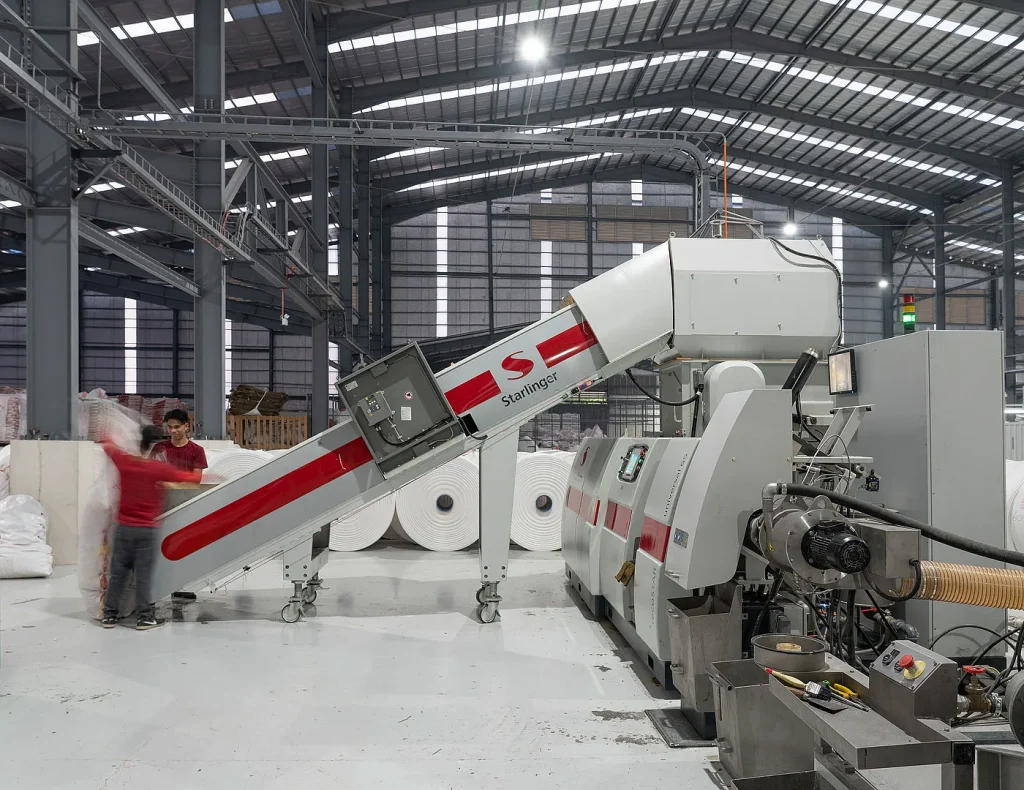
VidePak anchors its manufacturing with Austrian Starlinger extrusion/weaving lines and German W&H (Windmöller & Hölscher) converting/printing/lamination assets. The machinery matters: Starlinger’s closed‑loop controls stabilize denier and pick rates; W&H’s register and nip control protect microtype, bond strength, and color across long runs. Around this hardware, VidePak implements HACCP hazard analysis, GMP conversion practices, allergen and pest controls, sanitation standard operating procedures (SSOPs), and mock‑recall drills to backstop traceability.
Stage A — Pre‑material selection and incoming testing
- Virgin PP resin: MFI, isotacticity, ash, odor, moisture (Karl Fischer), gel count, food‑contact declarations.
- Films/liners: Gauge, WVTR/OTR, SIT, dart impact, antistatic decay; migration data against intended simulants/time/temperature.
- Inks/adhesives/ties: Viscosity windows, solids %, residual solvent/monomer thresholds; low‑migration stacks verified by swatches and retention samples.
- Threads, webbing, tapes: Fiber identity, tensile, abrasion, and particulate cleanliness checks.
- Documentation: Every lot bar‑coded for cradle‑to‑pallet traceability; quarantine protocols on out‑of‑tolerance results.
Stage B — Core unit operations (Starlinger + W&H)
- Tape extrusion/drawing (Starlinger). PP pellets are plastified, cast, slit, drawn, and annealed. Instruments watch denier uniformity, tape width, crystallinity (DSC), and tensile/elongation. Clean‑downs occur on shift changes to avoid foreign matter.
- Weaving (Starlinger). Target GSM and picks/inch are held while broken‑end rates and defect maps are logged. Fabric designated for food‑grade builds is segregated to avoid cross‑mixing.
- Surface treatment. Corona/plasma lifts dyne to ≥38 dyn/cm for ink/tie anchorage; treater logs corroborate energy delivery and speed.
- Coating/lamination (W&H). Extrusion coating with PP/PE ties or solventless adhesive lamination bonds films to fabric. In‑line controls ensure bond strength, curl control, and low residuals.
- Printing (W&H). High‑contrast graphics and coding are applied on coated/laminated faces; matte barcode windows are reserved; color ΔE targets are locked by a managed ink kitchen.
- Cutting, gusseting, and mouth prep. Mouth folds and bevel trims are set to distribute loads and reduce notch starters; gussets form square, brick‑like units.
- Seam/closure formation. Sewn + tape with crepe/hot‑melt, pasted pinch bottom, or thermal/ultrasonic valve seals—selected per hygiene and leak criteria.
- Liner insertion and sealing. Loose‑insert or form‑fit liners are placed; spouts heat‑sealed at SIT; peel tests verify integrity; antistatic properties validated.
- De‑aeration engineering. Hot‑needle or laser micro‑perfs are positioned away from spill paths and code windows, tuned to powder flow and BPM.
- In‑line inspection and controlled baling. Vision systems verify register, code legibility, seam integrity; automatic counting and compression balers produce labeled, traceable bales.
Stage C — End‑of‑line QA and food‑safety compliance
- Mechanical: Tensile/tear/burst, multi‑orientation drop tests (e.g., 5× at 0.8–1.2 m) matched to route severity.
- Functional: Leak/tightness, COF window (0.30–0.45), stack‑creep limits, WVTR/OTR validation under climate cycles; liner seal peels.
- Hygiene: Swab tests in hygienic cells; allergen/pest controls; migration tests for the final stack; retained samples and color swatches archived per shelf life.
- Traceability: Cradle‑to‑pallet digital trail links resin/ink/film lots to bale IDs; mock recalls verify retrieval time.
Applications — Where Food‑Grade Woven Fabric Bags Excel
Food‑Grade Woven Fabric Bags thrive where ingredient safety and mechanical reliability must co‑exist. The list below is representative, not exhaustive; the common thread is disciplined barrier control, clean handling, and stable pallets.
- Dry baking inputs: flour, sugar, salt. Controlled deaeration at the filler, linerized interiors to curb moisture uptake and caking, matte code windows for reliable scans in chilled rooms.
- Starches and dairy powders: antistatic liners, tight valve closures, laminated faces for rub resistance in cold chains, migration‑safe chemistries.
- Pulses, grains, rice: coated faces resist abrasion; optional vent panels; square block‑bottom formats tame pallet slump on export routes.
- Sugars and sweeteners: low‑migration inks, antistatic liners, seam architectures that survive settling impacts; COF tuned to reduce load creep in humid storage.
- Seasonings and premixes: aroma/grease isolation through liners; leak targets ≤0.5% mass loss; microtype fidelity protected by register control.
- Pet‑food bases and animal nutrition: retail‑adjacent optics via BOPP lamination; form‑fit liners; tamper‑evident closures; square pallets for mixed warehouse floors.
- Nutraceuticals and beverage powders: tight barrier stacks, serialization for traceability, and disciplined hygienic conversion.
Related reading (internal):
- Tailored woven packaging for chemical products
- BOPP printed woven bags for waste‑handling systems
- Multiwall paper bags for chemical powders
- Laminated kraft paper options for optimized packaging
- PE‑coated valve woven bags for fertilizers
- FIBC bulk bags and ESG alignment
- FFS roll bags that enhance packaging efficiency
How VidePak Controls and Guarantees the Quality
VidePak’s quality architecture rests on four pillars, each designed to make performance predictable and audits routine rather than theatrical. The philosophy is simple: design against recognized standards, source clean raw materials, run world‑class equipment, and test what matters at the right moments.
- Design, manufacture, and verify to mainstream standards (ISO/ASTM/EN/JIS). We align tensile/tear/burst, drop/topple, COF, WVTR/OTR, print adhesion, and seal/peel tests to recognized methods. Sampling follows AQL discipline with CAPA backstops; PPAP‑like validations are available for new launches.
- Use virgin, big‑brand raw materials (and qualified PCR only in non‑contact zones when specified). Virgin PP resins, certified food‑contact liners, low‑migration inks/adhesives, and approved additives are the default. Lots are bar‑coded and traceable from silo or roll to bale ID; out‑of‑tolerance lots are quarantined.
- Run best‑in‑class equipment — all Austrian Starlinger and German W&H. Starlinger extrusion/tape/loom lines minimize denier drift and broken‑end rates; W&H presses/laminators hold register and bond strength across long runs, protecting microtype and low‑residual targets.
- Complete test coverage: incoming → in‑process → outgoing. Incoming checks on resin/film/ink/adhesive/liner lots; in‑process vision and seam audits (metal detection on request); outgoing functional checks (drop/leak/COF/WVTR/OTR, seal peels) plus dimensional audits and hygiene swabs. Retained samples travel with the BoM for forensic reference.
| Gate | Methodology | Examples |
|---|---|---|
| Incoming | COA checks; moisture/dyne; gauge; residuals | MFI, dyne ≥ 38, WVTR/OTR baselines, low residuals |
| In‑process | Vision register; seam peel; online length/weight | SPI audits; code grade; defect Pareto tracking |
| Outgoing | Drop/leak/COF/WVTR/OTR; dimensions; seal/peel | AQL sampling; pallet compression tests |
| Hygiene | Swabs; pest/allergen logs; sanitation verification | SSOP sign‑offs; retained samples/swatches |
Systems Thinking — Decompose the Food‑Safety Problem, Recombine the Specification
Engineering the “right” Food‑Grade Woven Fabric Bags is not about copying a neighbor’s spec. It is a multi‑variable exercise where powder physics, climate, warehouse regime, sanitation, and branding intertwine. The practical path forward is to break the decision into sub‑problems, define measurable targets for each, then synthesize a build you can pilot, scale, and audit.
Sub‑problem A — Powder physics and line behavior
Inputs: angle of repose, loose/tapped bulk density, PSD, hygroscopicity, oil/odor content, dust explosion characteristics (MIE), bags‑per‑minute targets. Decisions: top geometry (open vs valve), bottom style (pinch vs sewn), liner gauge for WVTR/OTR, perforation density for deaeration, stitch type/SPI/needle and seam‑aid strategy.
Sub‑problem B — Hygiene, compliance, and documentation
Inputs: target markets and auditor expectations; labeling/traceability (barcodes/QR), serialization. Decisions: low‑migration ink/adhesive stacks, migration tests for the final laminate + liner system, retained‑sample policy, matte code windows and varnish maps, mock‑recall cadence.
Sub‑problem C — Warehouse, logistics, and climate
Inputs: stack height, wrap recipe, floor COF, aisle widths, container cube, outdoor dwell, humidity/temperature cycles, UV hours. Decisions: block‑bottom geometry, COF windows, interlayers for glossy faces, WVTR/OTR validation under climate cycles, UV stabilization level.
Integrated path — step by step
- Intake constraints: product physics + compliance/audit + warehouse/climate + brand/traceability.
- Concept shortlist: (a) coated fabric + loose‑insert liner + sewn/taped seam; (b) laminated face + form‑fit liner + pinch bottom; (c) valve build with thermal closure + antistatic liner.
- DFMEA: rank failure modes — seam pull‑through, needle‑hole sifting, delamination, code glare, stack slump, moisture caking.
- Pilot: 500–2,000‑bag runs on the real filler; instrument BPM, dust ppm, leak % at set pressure/time, WVTR/OTR, scan grades, pallet creep under wet/dry cycles.
- Finalize: lock GSM, face (coat/lam), liner gauge, mouth/closure, perf map, COF, UV hours, QA plan.
- Scale: SPC on denier/picks, bond strength, register, seam tensile, seal peels; AQL sampling; retained swatches/samples archived.
- Review: quarterly down‑gauging trials, recycled‑content pilots (non‑contact layers), UV‑hour updates, artwork governance.
Technical Parameters and Targets
These windows reflect common starting points for Food‑Grade Woven Fabric Bags. Final targets should be validated against your actual product, filler, warehouse, and route severity.
| Attribute | Typical range | Why it matters |
|---|---|---|
| Capacity | 5–50 kg (25/50 kg dominate) | Aligns with filler tooling and pallet plan |
| Fabric mass (GSM) | 60–120 g/m² (small sacks); higher for FIBC panels | Balances drop survival and cost |
| Coating/laminate gauge | 18–35 μm (single‑side coat) / 30–60 μm (double‑side) | Barrier vs stiffness trade‑off |
| Liner gauge | 25–70 μm PE/PP/co‑ex | WVTR/OTR control; seal integrity |
| COF (static/kinetic) | 0.30–0.45 window | Conveyor flow vs pallet stability |
| Drop performance | 5× at 0.8–1.2 m (corner/edge/flat) | Transit survival under real handling |
| Barcode grade | ISO/IEC 15416 grade B or better | Intake automation reliability |
Case‑Style Scenarios — Problem → Intervention → Outcome
Refrigerated intake scan failures
Condensation films and glare lower barcode grades. Intervention: reserve matte windows; lock ΔE ≤ 2; apply high‑build varnish only to edges. Outcome: stable grade B or better scanning across shifts and lighting.
Sugar caking in coastal humidity
Moisture drives clumps and slow discharge. Intervention: raise liner gauge from 35 to 50 μm; validate WVTR under climate cycles; switch to thermal valve closure; tune COF to 0.35–0.40. Outcome: lower caking, faster discharge, fewer claims.
Flour dust plumes and nuisance shocks
Fine dust clings and shocks operators. Intervention: antistatic liner, grounded filling spouts, adjusted micro‑perf pattern, SPI/needle retune. Outcome: cleaner rooms, reduced shocks, better hygiene metrics.
Seam pull‑through during drop tests
Failures cluster at the mouth fold. Intervention: increase hem depth to 35–40 mm; add crepe tape under seam; migrate to pinch bottom on critical SKUs. Outcome: passes 5× drop matrix without raising fabric GSM.
Sizing, Palletization, and Logistics Discipline
Size should be calculated backward from product physics (bulk density × target mass) while reserving headspace for deaeration and closure geometry. Brick‑like pallets come from block‑bottom shapes, tuned COF, and wrap recipes that maintain stack geometry through wet/dry cycles. Containerization models must include realistic dimensional tolerances; small footprint shifts (90 → 95 cm) often unlock full rows. Keep barcode windows matte and free of varnish; retain swatches to maintain ΔE across seasons and plants.
Purchasing Checklist — What VidePak Needs to Nail the Spec
- Product physics: PSD, angle of repose, bulk density (loose/tapped), hygroscopicity, MIE, oil/odor.
- Filling/closing: nozzle OD, target BPM, deaeration method, acceptable dust ppm, preferred closure.
- Warehouse/container: pallet size, racking, max stack height, wrap recipe, container cube goals.
- Climate/route: UV hours, humidity/temperature cycles, outdoor dwell, handling shocks.
- Compliance/brand: food‑contact frameworks, migration plan, color tolerances (ΔE), barcode/QR specs, serialization.
- Hygiene: HACCP links, swab/cleaning cadence, allergen/pest controls.
- Sustainability: mono‑PP claim, down‑gauging targets, recycled‑content pilots (non‑contact only).
- Performance windows: WVTR/OTR caps, drop/leak/COF, seal/peel strength, barcode grade.
Troubleshooting Matrix — Symptoms → Likely Causes → Fixes
| Symptom | Likely cause | Corrective action |
|---|---|---|
| Barcode scan failures | Gloss glare; color drift; condensation film | Matte windows; lock ΔE; edge varnish only; relocate placement |
| Seam wicking/sifting | Needle holes; inadequate seam tape | Add crepe/hot‑melt; switch to pinch/weld for critical SKUs |
| Pallet slippage | COF too low; glossy face + wrap synergy | Tune wrap; add texture stripes; interlayers; COF 0.35–0.40 |
| Dust during filling | Weak deaeration; SPI/needle mismatch | Add micro‑perfs; retune SPI; change needle system |
| Caking after storage | WVTR too high; liner too thin | Increase liner gauge; improve seals; validate WVTR under climate |
| Aroma loss/cross‑transfer | OTR too high; poor spout seal | Co‑ex barrier liner; heat‑seal spouts; add QA peel tests |
Example Integrated Specifications
Use Case A — 25 kg flour, high‑throughput mill, refrigerated intake
- Body: woven PP 80–90 g/m²; coated face; matte code windows.
- Mouth/seam: sewn with crepe tape; 9–10 SPI chainstitch; bevel trims at gusset pivots.
- Liner: food‑grade PE 45–50 μm, antistatic; heat‑sealed spout; peel strength validated.
- Venting: micro‑perfs away from code windows.
- QA: drop 5× at 1.0 m; barcode ≥ B; WVTR to target; hygiene swabs per SSOP.
Use Case B — 25 kg sugar, coastal humidity, export containerization
- Body: laminated BOPP 25–30 μm over woven PP 90–100 g/m²; high‑build edge varnish.
- Mouth/closure: pinch‑bottom paste; thermal valve closure.
- Liner: PE 50–60 μm form‑fit; antistatic.
- QA: WVTR verified under climate cycles; COF 0.35–0.40; barcode ≥ B.
Use Case C — 20 kg dairy powder, dust‑sensitive filling, strict audits
- Body: woven PP 85–95 g/m²; coated face with matte code windows.
- Valve closure: ultrasonic; leak ≤ 0.3% at set pressure/time.
- Liner: co‑ex barrier with oxygen control; tamper‑evident ties.
- QA: GMP documentation; migration within limits; serialized QR; mock recall success < 2 h.
Use Case D — 50 kg rice/pulses, rough routes, mixed storage
- Body: woven PP 100–110 g/m²; coated face; optional vent panels.
- Mouth/seam: sewn + tape; turned hem at 35–40 mm.
- Liner: optional 35–45 μm depending on humidity.
- QA: drop/topple tests; pallet creep ≤ 3% at 30 days; barcode ≥ B.
Why VidePak
Equipment pedigree (Starlinger for extrusion/tape/loom; W&H for printing/lamination/converting), experienced cross‑functional teams (process, QA, graphics), and a culture of SPC + DFMEA + color‑management make VidePak’s Food‑Grade Woven Fabric Bags repeatable on paper and durable in the field. Collaboration is practical: pilot on your filler, iterate before scale, govern artwork and materials via change control, and protect continuity through preventive maintenance and safety stocks on the materials that matter.
November 26, 2025
- What Are Food‑Grade Woven Fabric Bags?
- The Materials of Food‑Grade Woven Fabric Bags
- Key Features of Food‑Grade Woven Fabric Bags
- Production Process at VidePak — From Resin to Audit‑Ready Bags
- Applications — Where Food‑Grade Woven Fabric Bags Excel
- How VidePak Controls and Guarantees the Quality
- Systems Thinking — Decompose the Food‑Safety Problem, Recombine the Specification
- Technical Parameters and Targets
- Case‑Style Scenarios — Problem → Intervention → Outcome
- Sizing, Palletization, and Logistics Discipline
- Purchasing Checklist — What VidePak Needs to Nail the Spec
- Troubleshooting Matrix — Symptoms → Likely Causes → Fixes
- Example Integrated Specifications
- Why VidePak
Multiwall laminated woven bags are engineered to protect bulk commodities like fertilizers, chemicals, and agricultural products under extreme conditions. At VidePak, we guarantee unmatched quality through a four-tier raw material control system: vetting ISO-certified suppliers, sourcing premium PP/PE resins from BASF and Sinopec, enforcing ASTM/EN-compliant inspections, and integrating real-time data into our Quality Management System (QMS). Since 2015, this approach has reduced material-related defects by 92%, ensuring our bags withstand 1,000+ transport cycles with ≤0.5% seam failure rates.
1. The Structural Superiority of Multiwall Laminated Woven Bags
Multiwall laminated bags combine 2–3 layers of polypropylene (PP) fabric with BOPP or PE coatings, achieving tensile strengths of 14–18 N/cm²—40% higher than single-layer alternatives. For instance, a Brazilian fertilizer company reported zero leaks during transatlantic shipping after switching to VidePak’s 3-ply laminated bags, which endure 50 kg dynamic drops (tested per ISO 2244).
Core Advantages:
- Barrier Properties: Lamination reduces moisture ingress by 95% (tested at 38°C/90% RH for 30 days).
- Customizability: Up to 8-color printing (200 DPI) for hazard labels, QR codes, or brand logos.
- Reusability: 70% of VidePak’s clients reuse bags 3–5 times, cutting packaging costs by 35%.
2. VidePak’s Four-Pillar Raw Material Quality Framework
Pillar 1: Supplier Vetting
We audit suppliers against 12 criteria, including:
- Certifications: ISO 9001, ISO 14001, and Responsible Care® compliance.
- Production Capacity: Minimum 10,000 MT/year PP resin output.
- Market Reputation: ≥4.5/5 score on Alibaba Supplier Ratings.
Case Study: After disqualifying 3 suppliers for inconsistent MFI values in 2023, VidePak secured exclusive contracts with BASF (MFI: 3.2±0.1 g/10 min) and Sinopec, stabilizing raw material costs despite market fluctuations.
Pillar 2: Premium Polymer Sourcing
We use virgin PP resins with:
- MFI: 3–5 g/10 min (ASTM D1238).
- Tensile Strength: ≥35 MPa (ISO 527-2).
- UV Stabilizers: 1.5–2.0% additive concentration for 2,000-hour weatherability.
Pillar 3: Incoming Material Inspections
Every batch undergoes 7+ tests:
| Test | Standard | Acceptance Criteria |
|---|---|---|
| Melt Flow Index (MFI) | ASTM D1238 | 3.0–5.0 g/10 min |
| Ash Content | ISO 3451 | ≤0.1% |
| Color Consistency | Pantone QC-22 | ΔE ≤1.5 |
| Granule Uniformity | ISO 1133 | 95% within 2–3 mm |
Defective batches are rejected immediately, with a 0.02% tolerance threshold.
Pillar 4: QMS Integration
Inspection data feeds into our SAP-based QMS, enabling:
- Traceability: Scan QR codes to view resin origin, test reports, and production dates.
- Predictive Analytics: AI identifies MFI drift trends, triggering preemptive supplier audits.
3. Technical Specifications and Customization
Product Parameters Table
| Parameter | VidePak’s Specification | Industry Average |
|---|---|---|
| Layers | 2–3 laminated layers | 1–2 layers |
| Fabric Weight | 90–130 g/m² | 70–100 g/m² |
| Load Capacity | 25–50 kg | 20–40 kg |
| Seam Strength | ≥300 N/5cm (ISO 13935-2) | 200–250 N/5cm |
| Print Durability | 4/5 on AATCC Gray Scale | 3/5 |
FAQs for Procurement Managers
Q: How do you ensure laminate adhesion in humid climates?
A: Our BOPP films undergo corona treatment (48–52 dynes/cm) and are bonded at 180–200°C, achieving peel strengths of 3.8 N/15mm (vs. industry 2.5 N/15mm).
Q: Can bags be recycled?
A: Yes. Mono-material PP construction allows 100% recyclability under EPR schemes.
Q: What’s the MOQ for custom sizes?
A: 20,000 bags, with a 15-day turnaround for designs involving ≤4 colors.
4. VidePak’s Manufacturing Edge
Our Jiangsu facility features:
- Austrian Starlinger Looms: 100+ machines weaving 1.8-meter-wide fabric at 200 rpm.
- Extrusion Lines: 16 lines applying 18–25 µm BOPP coatings with ±0.5 µm precision.
- Eco-Efficiency: 30% lower energy consumption than competitors via heat recovery systems.
Example: A Kenyan coffee exporter reduced packaging waste by 60% using our 25 kg multiwall bags with tear-notches for easy opening.
5. Sustainability and Compliance Leadership
VidePak aligns with global ESG mandates through:
- Recycled Content: Offering 20–30% post-industrial PP blends (GRS-certified).
- Carbon Reporting: Annual disclosures verified by SGS, showing a 15% emissions cut since 2020.
- Circular Economy: Partnering with TerraCycle® for bag recovery programs in the EU.
Competitive Insight: While 80% of Chinese manufacturers rely on mixed-grade resins, VidePak’s 100% virgin PP policy ensures FDA and EU 10/2011 compliance for food-adjacent applications.
6. Why VidePak?
- Experience: 30+ years of industry expertise under CEO Ray.
- Scale: 568 employees and 120 million bags produced annually.
- Certifications: ISO 9001, BRCGS, and Sedex SMETA audited.
References
- VidePak Official Website: https://www.pp-wovenbags.com/
- Email: info@pp-wovenbags.com
- Standards: ASTM, ISO, EN, and FDA regulations.
External Resources:
- Discover how BOPP lamination enhances barrier performance in industrial packaging.
- Explore our methodologies for ensuring polypropylene quality from raw materials to finished products.
VidePak redefines reliability in multiwall laminated woven bags, merging rigorous science with scalable solutions to safeguard your goods—and your brand—globally.