
1. Reframing the identity of recyclable PP bags
Discussions about sustainable logistics often turn quickly to load planning, routing software, or alternative fuels. Yet long before a truck leaves the depot, another decision has already shaped the environmental and economic profile of a shipment: the choice of packaging. In this context, recyclable PP bags have emerged as a distinct family of industrial sacks, engineered not only to carry heavy products safely but also to re-enter polypropylene recycling streams once their first life is over.
Unlike mixed-material sacks that blend paper, polyethylene, and other polymers, recyclable PP bags are intentionally simplified. Their walls, coatings, and most accessories are built from polypropylene so that, after use, the entire bag can be shredded, washed, and converted back into reusable PP granules. In other words, these are mono-material recyclable polypropylene woven bags designed from day one to align with real-world recycling infrastructure rather than merely claiming environmental benefits in theory.
From a distance, these sacks may resemble traditional woven packages: rectangular forms, block bottoms, perhaps a valve in one corner, familiar graphics on the outside. The difference lies beneath the surface. In high quality recyclable PP woven bags, every structural layer belongs to the same polyolefin family. The woven chassis, the laminated films, the sealing layers, and even most threads and labels are chosen to stay within the polypropylene spectrum. That design discipline turns a complex logistics workhorse into a packaging system that can take part in circular material flows.
A practical way to describe recyclable polypropylene bags is simple: they are heavy-duty, mono-material polypropylene sacks that combine a woven fabric core with PP-compatible films and accessories, making them ready for recovery alongside other PP packaging.
Because different industries and regions adopt their own naming traditions, the same basic concept appears under multiple alternative labels. Engineers and buyers may talk about recyclable polypropylene woven sacks, mono-PP woven bags, recyclable PP valve bags, or recyclable woven polypropylene packaging bags. Each phrase highlights a slightly different angle: the resin family, the woven structure, the valve, or the recycling ambition. Yet all of them point to the same underlying idea: use polypropylene as the single, unifying material for strength, sealing, print surfaces, and end-of-life processing.
Seen from a systems perspective, recyclable PP bags sit at the intersection of four agendas that are not always easy to reconcile. They must be strong enough to handle abrasive powders and rough forklifts, visually attractive enough to carry brand messaging, cost-efficient enough to compete with established formats, and simple enough in material composition to meet new expectations around recyclability and extended producer responsibility. That balancing act is what makes this packaging family more than just a minor variant of conventional woven sacks.
2. Material system and mono-polypropylene construction
If the defining attribute of recyclable PP bags is their mono-material character, the logical next question is: how does one actually build a complex industrial sack almost entirely from polypropylene? The answer involves a careful orchestration of different PP-based components, each selected for a specific role in the overall structure.
Polypropylene resin as the structural backbone. At the heart of recyclable polypropylene woven bags lies PP resin in granular form. These granules are extruded into thin sheets, slit into tapes, and drawn to create high-strength strands. When woven together into fabric, these strands form a chassis that delivers an impressive strength-to-weight ratio. The resulting fabric can carry tens of kilograms of product while remaining relatively light and flexible, a combination that directly benefits both transport efficiency and manual handling.
Woven fabric as the invisible chassis. The woven PP layer is where raw material becomes actual mechanical performance. Designers adjust tape denier, weaving density, and fabric weight to match the risk profile of the application. Heavy, abrasive minerals demand higher fabric weights and denser weaves; lighter agricultural products may be safely handled by more economical constructions. In all cases, the woven structure provides resistance to tears, punctures, and edge impacts that would quickly defeat many monolithic film bags.
BOPP and cast PP films as functional skins. To transform a rough woven surface into a smooth, printable shell with additional barrier properties, converters add biaxially oriented polypropylene films or cast PP films. These films remain within the PP family, preserving recyclability, but change the interface between bag and environment. BOPP laminates offer high gloss, dimensional stability, and excellent print quality, while cast PP layers can deliver strong heat-sealing performance and a softer feel. By bonding these skins to the woven core, recyclable PP woven bags gain both aesthetic appeal and improved moisture resistance.
PP-based coatings and tie layers. Classic laminates often rely on mixed polymers or complex adhesive systems. The mono-material logic of recyclable PP bags instead favours PP-based extrusion coatings and PP-compatible tie resins. Thin coatings fill the gaps between woven tapes, reduce porosity, and provide a film-like surface without introducing foreign polymers that could disrupt recycling. Tie layers secure BOPP or cast PP films to the fabric while still belonging to the polypropylene chemical family.
Accessories that follow the same material philosophy. The small details often determine whether a sack can really be treated as mono-material in practice. For genuinely recyclable polypropylene packaging bags, designers specify PP sewing threads, PP webbing for handles, PP valves, and PP label films where possible. Pigments and inks are chosen with attention to their behaviour in recycling streams, favouring systems that remain compatible with PP reprocessing.
Typical layer stack in a recyclable polypropylene woven bag
- Outer BOPP or cast PP film delivering gloss, print quality, and surface protection.
- PP extrusion coating or tie resin bonding the film to the woven fabric.
- Woven polypropylene chassis carrying mechanical loads during filling and transport.
- Optional inner PP film layer or coating for enhanced moisture and dust control.
- PP accessories such as threads, handles, and valves to maintain mono-material integrity.
From the recycler’s point of view, this architecture has one powerful implication. Even though the sack looks and behaves like a sophisticated laminate, it still belongs to a single polymer type. Once compacted into bales, shredded, and washed, recyclable PP bags become a relatively clean PP feedstock. That makes it easier for recyclers to turn post-consumer sacks into useful recyclate rather than downcycling them into low-value mixed-plastic products.
3. Functional advantages in demanding logistics environments
Material choices are only meaningful if they translate into tangible advantages on the ground. The real reason companies adopt recyclable PP bags is that they help solve persistent logistics challenges while contributing to sustainability objectives. Strength, moisture resistance, shelf presence, and end-of-life options all interact to create value across the supply chain.
High strength at low packaging weight. Because woven polypropylene tapes are oriented and interlocked, they produce fabrics with very high tensile strength and tear resistance for a given mass. This allows recyclable polypropylene woven bags to carry heavy loads using thin walls, reducing the ratio of packaging weight to product weight. Over large volumes, that reduction translates into fewer pallets of packaging coming in, more product per truck going out, and lower transport emissions per ton shipped.
Robust protection against moisture and contamination. Many of the goods that travel in recyclable PP woven bags – fertilizers, grains, seeds, cement, industrial minerals – are highly sensitive to moisture. PP fabrics and films have inherently low water absorption and low water vapour transmission compared with paper-based alternatives. When combined with lamination and inner film layers, they create a shell that resists humidity, brief rain exposure, and condensation cycles in unconditioned warehouses. At the same time, the closed surfaces minimise dust leakage, improving cleanliness and safety in trucks and storage areas.
Strong printability and brand visibility. BOPP and cast PP films present smooth, consistent surfaces ideal for flexographic and gravure printing. As a result, recyclable polypropylene bags can carry vivid, multicolour graphics, regulatory icons, and machine-readable codes. Pallets of product become large-format brand carriers. This is particularly important in competitive markets such as livestock feed, where solutions similar to BOPP laminated woven feed bags show how visual quality and barrier performance support premium positioning.
Designed-in recyclability and alignment with circular goals. Packaged goods producers increasingly face regulations and voluntary commitments that reward recyclable designs and penalise mixed-material solutions. Because recyclable PP bags remain within the polypropylene family, they align with these emerging frameworks. They do not guarantee that collection or recycling will occur – that still depends on infrastructure and behaviour – but they eliminate major design obstacles and offer a credible path into circular polypropylene streams.
In practice, the attraction of recyclable PP woven bags lies in their ability to combine what used to be competing priorities: tough mechanical performance, powerful graphics, operational efficiency on automated lines, and a realistic route into recycling at the end of life.
4. Production ecosystem and precision engineering
The performance of recyclable PP bags is not only a function of materials, but also of the equipment and processes used to transform pellets and films into finished sacks. Leading manufacturers rely on tightly controlled production chains where each step – from tape extrusion to final bag forming – is measured, monitored, and optimised.
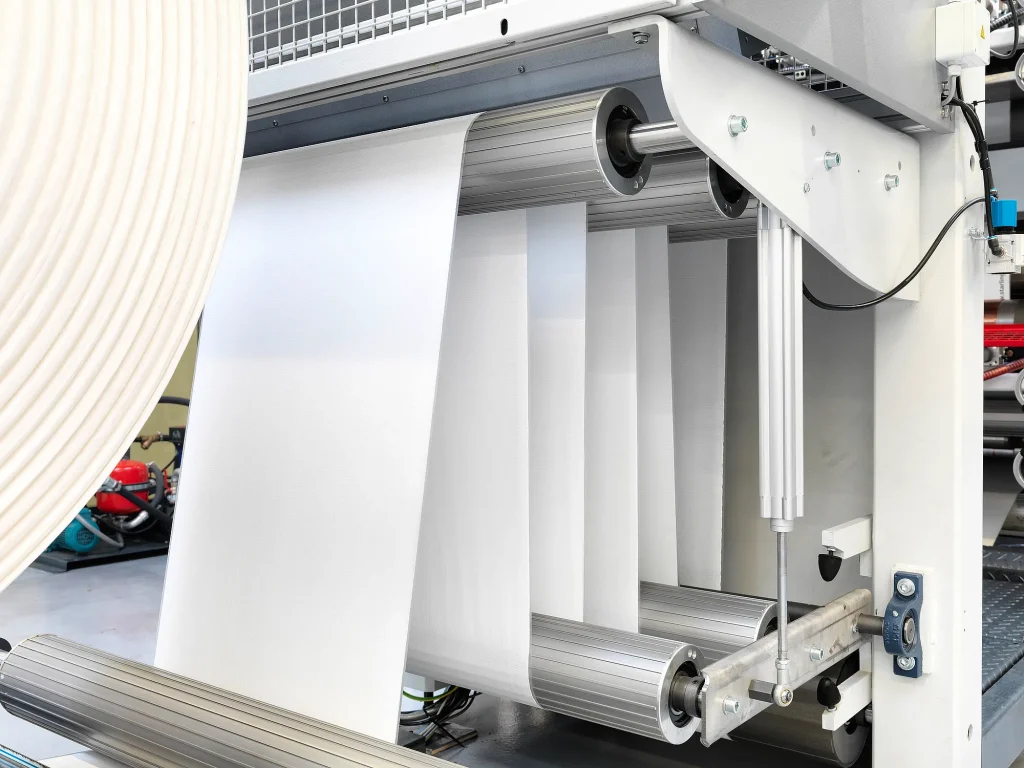
At the beginning of this chain, polypropylene granules are melted and extruded into sheets, then slit into narrow tapes and drawn at carefully controlled ratios. Starlinger tape extrusion and weaving systems are widely regarded as benchmarks in this realm, providing accurate control over draw ratios, tape widths, and loom tensions. When precision-engineered lines like those described for custom woven bags built on Starlinger technology are used, the resulting fabric exhibits very consistent strength and dimensional characteristics – which, in turn, stabilise bag behaviour on high-speed filling lines.
Once woven, fabric rolls move to coating and lamination. Woven PP is porous by nature; to produce recyclable polypropylene woven bags with good barrier performance and print quality, converters apply PP coatings or bond BOPP films using extrusion lamination on sophisticated lines. Equipment from German specialist W&H is often chosen for these tasks because it allows highly controlled coating weights, web tensions, and nip pressures. These parameters decide whether laminates remain flat and stable or curl, wrinkle, and delaminate during conversion.
Printing follows. Flexographic or gravure presses lay down graphics, batch information, and regulatory content in multiple colours. Registration accuracy must be high; artwork should line up with valve openings, fold lines, and bottom panels. For recyclable PP bags targeting retail or dealer-facing applications, this stage is as important for commercial success as fabric strength is for safety.
Finally, converting lines cut, fold, and close the material into complete sacks. This may involve forming tubes for block-bottom or pillow-shaped bags, inserting and shaping valves, creating gussets, and sewing or heat-sealing seams. Each operation adds potential variability: too much tension can distort dimensions, poor cutting can fray edges, inaccurate valve placement can slow down packers. Well-designed production ecosystems treat these stages as a single continuous system rather than disconnected islands.
Key process-control priorities for recyclable PP woven bag producers
- Stable tape denier and fabric GSM to guarantee predictable strength and elongation.
- Uniform coating and lamination layers to minimise pinholes and delamination risk.
- Accurate colour, register, and drying conditions during printing.
- Consistent valve dimensions and positions for fast, low-dust filling.
- Dimensional accuracy in finished bags to match pallet patterns and robotic systems.
Behind every pallet of recyclable polypropylene bags that arrives in a warehouse lies this network of extrusion, weaving, coating, printing, and converting steps. Advanced equipment from suppliers such as Starlinger and W&H does more than increase throughput; it provides the control needed to make high-performance, mono-material sacks repeatable at industrial scale.
5. Application landscape: where recyclable PP bags create value
Because recyclable PP woven bags can be tuned to different strengths, barrier levels, and formats, they appear across a wide spectrum of industries. In each case, the same underlying material system is configured differently to reflect local risks, regulations, and market expectations.
Agriculture and food chains. Seeds, grains, rice, pulses, flour, and processed agricultural commodities often travel in recyclable polypropylene woven bags. Farmers and millers need packaging that protects against humidity, resists rough handling, and remains manageable for manual lifting. Where brand differentiation matters – for example in premium rice or flour – laminated surfaces carry high-impact graphics. In feed mills, similar technology underpins solutions like livestock feed bags based on BOPP-coated woven PP, which are explored in resources on optimised BOPP laminated woven feed packaging.
Fertilizers and soil amendments. Granular and powdered fertilizers are heavy, abrasive, and hygroscopic. They tend to cake in humid environments and can attack unsuitable films or threads. Recyclable PP bags with robust woven fabrics, carefully specified coatings, and optional UV-stabilised layers help preserve product flowability from plant to field. Clear printed panels and colour-coding simplify product identification and reduce the risk of misapplication.
Construction and industrial minerals. Cement, dry mortar, plaster, tile adhesives, and industrial minerals such as carbonates and oxides demand tough packaging. Here, recyclable PP woven bags compete with or complement specialised pasted valve sacks used in construction, as discussed in analyses of pasted valve bags for the construction sector. The choice between these formats depends on filling equipment, expected pallet stacking heights, climate, and desired recyclability.
Chemicals and additives. Many powdered chemicals, pigments, and additives are both high value and tightly regulated. They may require anti-static or high-barrier versions of recyclable polypropylene bags, still based on the same woven chassis but enhanced with specialist films or coatings. Hazard symbols, handling instructions, and traceability markings must remain legible throughout the bag’s journey, which favours the stable print surfaces offered by BOPP-laminated PP sacks.
Intermediate formats in mixed portfolios. In numerous supply chains, recyclable PP woven bags coexist with other packaging types. Bulk shipments may move in FIBC containers, like those highlighted in discussions of versatile FIBC bags for agricultural packaging, while downstream distribution uses smaller recyclable PP sacks. Very small consumer units may then rely on film pouches or small paper bags. The woven PP format occupies the middle of this spectrum, bridging bulk logistics and retail.
Illustrative mapping of recyclable PP bag applications
| Sector | Typical products | Key functions of recyclable PP bags |
|---|---|---|
| Agriculture and food | Grains, seeds, rice, flour, animal feed | Moisture control, stack stability, attractive branding, manageable bag weights. |
| Fertilizers and agrochemicals | NPK blends, urea, soil conditioners | Abrasion resistance, humidity protection, clear labeling for safe usage. |
| Construction and minerals | Cement, dry mortar, limestone, pigments | High drop resistance, tolerance to clamp trucks, strong print identification. |
| Chemicals and additives | Specialty powders, catalysts, pigments | Custom barrier levels, anti-static options, detailed regulatory information. |
Across all these sectors, the same core proposition recurs. Recyclable PP bags protect product quality, streamline handling, and support traceability while providing a credible route toward circular polypropylene use.
6. Quality assurance and testing as foundations of reliability
No matter how promising a packaging concept sounds, its long-term success depends on consistent performance in the real world. That is why reputable producers of recyclable PP bags treat quality assurance and material testing as non-negotiable pillars, not optional extras.
Testing polypropylene resins and tapes. For the woven chassis, key properties start at the resin stage. Melt flow index, density, and additive packages are measured to ensure that PP grades will behave predictably in extrusion and drawing. Test tapes are then produced and subjected to tensile and elongation tests. If they show signs of brittleness, insufficient strength, or unusual elongation, resin batches can be rejected or re-routed before they compromise full-scale production of recyclable polypropylene woven bags.
Evaluating film performance and bond strength. BOPP and cast PP films used as skins or inner liners undergo dart impact tests, puncture resistance measurements, and seal-strength evaluations. Laminated samples are checked for peel resistance and resistance to cracking under bending. These tests are particularly important for applications where moisture or oxygen barriers are critical, or where the product is abrasive. Alternatives such as aluminum foil composite bags may be selected for extremely sensitive goods, but for many bulk products, well-tested PP films offer a strong balance between performance, cost, and recyclability.
Verifying finished bag behaviour. Completed recyclable PP bags are sampled for drop tests, stacking tests, seam strength, and valve integrity. Pallets may be subjected to vibration cycles that simulate long-distance transport. Bags designed for valve filling face specific tests around dust emission, filling speed, and closure reliability, often drawing on the same design logic explored in resources covering different valve opening designs and customisation options.
Reliable recyclable polypropylene bags are not simply the product of good ideas. They are the outcome of disciplined testing regimes that link resin batches, process settings, and field performance in a continuous feedback loop.
This quality philosophy is mirrored in related packaging categories. FIBC containers, multiwall sacks, and high-barrier laminates all rely on similarly structured test frameworks to protect businesses from the high costs of packaging failures. For recyclable PP woven bags, this means that sustainability claims are backed by robust engineering data rather than aspirational slogans.
7. System thinking: recyclable PP bags within circular logistics
Packaging decisions are rarely isolated; they ripple through logistics networks, cost structures, and environmental metrics. When companies adopt recyclable PP bags, they are making a choice that touches multiple nodes in the system – from warehouse planning to waste management.
On the logistics side, bag dimensions, stiffness, and coefficient of friction influence how pallets are built and how they behave on conveyors and in trucks. Well-designed recyclable polypropylene woven bags stack neatly, resist sliding, and support stable pallet patterns. That stability reduces the need for excess stretch wrap, minimises damage during transit, and enables reliable robotic palletising.
On the environmental side, mono-material construction aligns with the growing emphasis on circular economy principles. Woven polypropylene is not biodegradable, but when it replaces more problematic composites and enters established PP recovery streams, its impact can be significantly lower than that of non-recyclable alternatives. This is especially true if companies put systems in place to recover empty sacks from distributors, farms, or construction sites.
At the interface with other formats, recyclable PP bags often act as a bridge. For long-distance bulk transport or on-farm storage, FIBC containers might take the lead, as noted in analyses of versatile FIBC solutions in agriculture. At the other end of the spectrum, highly automated plants may use tubular film systems, including FFS roll bags in agricultural processing, to achieve maximum filling speeds. Recyclable woven PP sacks sit between these extremes, providing manageable units for dealers and end users.
System-level roles of recyclable PP woven bags
- Intermediate packaging between bulk FIBC containers and small consumer packs.
- Logistics-friendly units that align with pallet patterns and manual handling limits.
- Data carriers via printed codes supporting digital traceability across the chain.
- Material reservoirs feeding polypropylene recycling streams after use.
When viewed through this lens, recyclable polypropylene bags are not merely containers. They are functional nodes in a network that connects extraction, processing, distribution, consumption, and material recovery.
8. Technical parameters and configuration guidelines
For engineers and buyers, high-level concepts must eventually become concrete specifications. To implement recyclable PP woven bags successfully, they need a vocabulary of parameters and typical ranges that can be adapted to each project.
Indicative design ranges for recyclable polypropylene woven bags (10–50 kilogram segment)
| Parameter | Typical range | Functional impact on recyclable PP bags |
|---|---|---|
| Bag width | Approximately 350 to 600 millimetres | Defines cross-section and pallet pattern; affects stability and layer count. |
| Bag length | Approximately 500 to 1100 millimetres | Influences stack height, ergonomics of manual handling, and visual proportions. |
| Woven PP fabric weight | Roughly 55 to 110 grams per square metre | Drives tensile strength, puncture resistance, and drop-test performance. |
| Film thickness (BOPP or cast PP) | Around 15 to 35 micrometres | Balances print quality, gloss, stiffness, and moisture barrier. |
| Extrusion coating thickness | Approximately 10 to 30 micrometres | Controls porosity and bond strength between fabric and film. |
| Bag capacity | Typically 10 to 50 kilograms | Linked to product density, filling equipment, and manual handling norms. |
| Valve or open-mouth style | Internal valve, external sleeve, or classic open-mouth | Defines filling speed, dust control, and compatibility with existing packers. |
| Surface friction (bag outside) | Coefficient of friction approximately 0.25 to 0.45 | Important for pallet stability, de-palletising, and conveyor behaviour. |
These ranges are starting points, not rigid rules. A premium animal feed may call for high-gloss film, thick laminates, and additional tear-resistance features reminiscent of specialist laminated feed packaging. A commodity mineral filler might rely on heavier fabric but more modest graphics. The central idea remains constant: configure recyclable PP bags to match the actual loads, hazards, and communication needs of each supply chain.
9. Comparisons with alternative packaging formats
When operations teams consider a transition to recyclable polypropylene bags, they rarely do so in isolation. They compare them to paper sacks, composite laminates, polyethylene form-fill-seal systems, FIBC containers, and foil-based solutions. Each format has strengths and weaknesses; the goal is to understand where recyclable woven PP fits best.
Versus multi-ply paper valve sacks. Paper valve sacks offer an appealing natural surface and are easily understood by many recycling systems when they are pure fibre. However, they lose strength in high-humidity environments and are more vulnerable to rough handling. Recyclable PP woven bags outperform them in mechanical durability and moisture resistance, though they do rely on synthetic polymers. In climates with frequent rain or in supply chains involving clamp-truck handling, the woven PP option usually provides a safer margin.
Versus mixed-material laminates. Composite sacks that combine paper with films or multiple polymers can be visually impressive and offer strong barrier properties. Their weakness lies in end-of-life complexity. Separating layers is often impractical, and mixed polymers may not satisfy stricter recyclability requirements. By contrast, recyclable PP bags mimic many of the functional benefits of these laminates while preserving a mono-material core. For extremely sensitive products, packaging engineers may still select high-barrier aluminium foil composites like those described in analyses of aluminum foil composite bags, but for a large share of bulk powders and granules, PP-based mono-material sacks are sufficient.
Versus PE form-fill-seal systems. Polyethylene form-fill-seal systems built on FFS rolls excel in highly automated plants, particularly in petrochemical and resin packaging. However, thin PE films can be more prone to puncture and creep under long-term stacking loads. Woven recyclable PP woven bags bring higher rigidity and puncture resistance at the cost of slightly more complex converting. Companies may therefore use both: FFS systems for certain products and lines, recyclable woven PP for others, especially where stacking heights are greater or manual handling remains important.
Versus FIBC jumbo bags. FIBC containers move hundreds or thousands of kilograms at a time and are indispensable for bulk logistics. They are not, however, a replacement for smaller unit packs. Instead, they share space with recyclable PP bags in multi-level packaging strategies: FIBC for inter-plant transfers and storage, woven PP sacks for dealer distribution and end-user handling. The interplay between these two formats is increasingly important as agriculture and construction firms optimise both bulk and last-mile packaging.
There is no single universal winner among packaging formats. Instead, recyclable polypropylene woven bags take their place in a portfolio, chosen where their combination of strength, printability, and recyclability aligns best with operational and regulatory demands.
10. Implementation roadmap for brand owners and shippers
Recognising the benefits of recyclable PP bags is one thing; implementing them in real supply chains is another. Successful transitions usually follow a structured roadmap that integrates technical, operational, and organisational perspectives.
Step one: analyse current packaging performance. Companies begin by mapping existing formats, failure modes, and waste streams. Where do bags rupture? How often do pallets lean or collapse? How much packaging waste ends up in incineration or landfill? This diagnostic phase provides both the business case and the design constraints for new recyclable polypropylene woven bags.
Step two: co-design new bags with experienced suppliers. Packaging engineers then work with suppliers to tune fabric weights, film structures, bag dimensions, and valve configurations. At this stage it is helpful to learn from adjacent formats, such as advanced valve designs or block-bottom geometries described for specialised industrial sacks. The aim is not to copy another product line but to borrow proven elements and adapt them to a new mono-material PP construction.
Step three: run integrated line trials. Before a full switch, recyclable PP woven bags should be tested on real filling lines, palletising systems, and transport routes. Trials normally cover spout engagement, filling speed, dust levels, seal consistency, pallet stability, and bag opening at the point of use. Feedback flows both ways: operations teams share their experience, and suppliers adjust parameters accordingly.
Step four: build or strengthen recycling pathways. For recyclability to move from promise to reality, companies need systems for collecting empty sacks. They might collaborate with distributors and farmers, link into regional PP collection schemes, or work with specialist recyclers. The mono-material nature of recyclable polypropylene bags simplifies these efforts, but collection logistics still require deliberate planning.
Step five: monitor performance and iterate. After rollout, ongoing monitoring is essential. Are damage rates down? How do customers perceive the new packaging? What proportion of empty sacks is actually recovered? Answers to these questions inform further optimisation. Because the technology platform is flexible, companies can progressively adjust bag designs to further reduce material use, add recycled content where appropriate, or upgrade graphics to support new communication goals.
11. Emerging trends and future directions for recyclable PP packaging
The story of recyclable PP bags does not end with current practice. As regulations tighten, consumer expectations rise, and logistics systems become more automated and data-driven, the design space for polypropylene woven packaging continues to evolve.
One trend is towards even more resource-efficient constructions. Lightweighting efforts aim to maintain mechanical performance while reducing grammage in fabrics and films. Progress in resin technology and process control makes this feasible: better-oriented tapes, more uniform coatings, and stronger laminations can allow thinner structures without sacrificing reliability.
Another trend involves exploring hybrid portfolios that balance mono-material logic with specialised high-barrier solutions. For example, a manufacturer may use primarily recyclable polypropylene woven bags for standard products, while reserving advanced formats – such as foil-based composites or highly customised valve sacks – for particularly demanding applications. Understanding the characteristics of such formats, as illustrated by resources on specialised valve designs, FFS systems, and composite structures, helps organisations choose the right pack for each job instead of chasing a one-size-fits-all ideal.
Automation is also reshaping constraints. As more plants move toward robotic palletising, automated guided vehicles, and high-speed filling equipment, the tolerance for variation in bag dimensions and stiffness shrinks. Recyclable PP woven bags must therefore meet not only classical packaging tests but also new expectations around repeatability, friction behaviour, and compatibility with sensors and gripping tools. This is where learnings from high-spec industrial formats and finely tuned valve constructions become increasingly valuable.
Finally, digital traceability expands the communicative role of packaging. Smooth PP film surfaces are ideal platforms for QR codes, data matrices, and other machine-readable identifiers that connect physical goods to digital records. In such a scenario, every sack becomes a touchpoint in a data-rich system, linking raw material origins, production conditions, transport histories, and recycling instructions. Recyclable polypropylene bags fit naturally into this vision because they offer both durable surfaces for codes and a material story that aligns with circular economy narratives.
2025-11-28
- 1. Reframing the identity of recyclable PP bags
- 2. Material system and mono-polypropylene construction
- 3. Functional advantages in demanding logistics environments
- 4. Production ecosystem and precision engineering
- 5. Application landscape: where recyclable PP bags create value
- 6. Quality assurance and testing as foundations of reliability
- 7. System thinking: recyclable PP bags within circular logistics
- 8. Technical parameters and configuration guidelines
- 9. Comparisons with alternative packaging formats
- 10. Implementation roadmap for brand owners and shippers
- 11. Emerging trends and future directions for recyclable PP packaging
The primary answer this article provides is: Recyclable polypropylene (PP) woven bags reduce supply chain carbon footprints by 40–60% compared to single-use plastics, while specialized designs—ventilated (air permeability >500 L/m²/h), gas-blocking (<0.5% O₂ transmission), anti-static (surface resistivity <10^6 Ω), and antimicrobial (99.9% bacterial reduction)—address industry-specific challenges. VidePak’s ISO-certified production lines deliver 100% recyclable PP bags with 8–12 reuse cycles, trusted by global leaders in agriculture, chemicals, and pharmaceuticals.
Introduction
As global logistics emissions approach 8.1 gigatons CO₂ annually, industries face mounting pressure to adopt sustainable packaging without compromising functionality. Recyclable PP woven bags are emerging as a dual-purpose solution: reducing plastic waste through closed-loop recycling while incorporating advanced engineering for sector-specific performance. Whether transporting hygroscopic grains, volatile chemicals, or sterile medical supplies, modern PP bags balance ecological responsibility with technical precision—a duality perfected over VidePak’s 30+ years of R&D.
Founded in 2008, VidePak operates 100+ Starlinger circular looms and 30 lamination machines to produce 200 million PP bags annually. Our patented technologies, including nano-coated anti-static weaves and microperforated ventilation systems, serve Unilever, Bayer, and Cargill across 50+ countries, driving a $80 million annual revenue anchored in sustainability.
Sector-Specific Engineering: Beyond Basic Recycling
1. Ventilated Designs for Agricultural Logistics
- Microperforation Tech: Laser-drilled 0.5–1.0 mm pores enable airflow of 500–800 L/m²/h, reducing grain moisture by 15% during tropical transit.
- Case Study: A Vietnamese rice exporter cut spoilage rates from 8% to 1.2% using VidePak’s 140 g/m² ventilated bags with HDPE liners.
2. Gas & Moisture Barrier Systems
- Multi-Layer Lamination: BOPP/EVOH/Aluminum composites achieve:
- Oxygen Transmission Rate (OTR): <0.5 cm³/m²/day (vs. 1,200 for standard PP).
- Water Vapor Transmission Rate (WVTR): <0.1 g/m²/day.
- Application: Nitrogen-flushed coffee beans retain freshness for 18+ months.
3. Anti-Static Solutions for Hazardous Environments
- Carbon Fiber Weaves: Surface resistivity reduced to 10^5–10^6 Ω (vs. 10^12 Ω for standard PP), meeting IEC 61340-4-4 standards.
- Conductive Coatings: Graphite-doped PE layers dissipate charges in <2 seconds.
4. Antimicrobial Protection
- Silver Ion Integration: AgNPs (50–100 ppm) inhibit E. coli and S. aureus by 99.9% (ISO 22196).
- FDA-Compliant Coatings: Triclosan-free formulations for food/pharma use.
Technical Specifications by Application
| Application | Design | Key Parameters | Certifications |
|---|---|---|---|
| Grains | Ventilated | 140 g/m², 600 L/m²/h airflow | FDA 21 CFR 177.1520 |
| Chemicals | Anti-Static | 180 g/m², 10^6 Ω resistivity | IEC 61340-4-4, UN Certified |
| Pharmaceuticals | Antimicrobial | 120 g/m², AgNP 75 ppm | ISO 13485, USP Class VI |
| Electronics | Moisture-Blocking | 0.08 mm AlOx coating, WVTR <0.05 g/m²/day | JEDEC MSL 1 |
Recyclability & Lifecycle Analysis
- Closed-Loop Recycling: VidePak’s PP bags achieve 95% material recovery via Starlinger RECO granulators.
- Carbon Savings: Each reused bag reduces emissions by 1.2 kg CO₂ vs. virgin plastic.
- Case Data: A German automaker saved €480,000/year using VidePak’s 8-cycle PP totes for parts transport.
FAQs: Addressing Sustainable Procurement
Q1: How many reuse cycles do PP bags withstand?
VidePak’s 180 g/m² bags endure 12+ cycles (ISO 22442), with <5% tensile strength loss per cycle.
Q2: Are antimicrobial additives food-safe?
Yes. Our silver-ion coatings comply with EU 10/2011 and FDA CFR 175.300 for direct food contact.
Q3: Can ventilated bags withstand -20°C storage?
PP remains flexible at -30°C, but microperforations may ice over. Use <500 L/m²/h airflow for sub-zero environments.
Q4: What certifications validate recyclability?
UL ECOLOGO, EU REACH SVHC <0.1%, and APR Design® for Plastics Recyclability.
VidePak’s Manufacturing Excellence
- Starlinger Technology: 16 extruders produce 2.4-meter-wide PP fabric with ±0.05 mm thickness tolerance.
- Circular Economy: 30% post-industrial recycled content, UL-certified.
- Custom Printing: 10-color HD flexo with Pantone ±0.5 ∆E accuracy.
References
- VidePak Corporate Profile: https://www.pp-wovenbags.com/
- Industry Standards: ISO 22442, IEC 61340-4-4, FDA 21 CFR 175.300.
- Research: PP Recycling in Closed-Loop Systems (Plastics Europe, 2024).
For inquiries, contact info@pp-wovenbags.com.
External Resources:
- Explore anti-static packaging innovations: Anti-Static FIBC Bags: Health and Safety Performance Evaluation.
- Learn about advanced recycling systems: Sustainable FIBC Bulk Bags: Compliance and Ethical Practices.
Authored by VidePak’s Sustainability Engineering Team | Updated: March 2025