
Definition, Scope, and Alternate Names
In modern logistics and manufacturing, a single packaging archetype repeatedly proves its value across fertilizers, grains, ingredients, minerals, and retail staples: Fabric Poly Bags. Unlike monolithic film pouches, Fabric Poly Bags are built on a woven polymer chassis—most often polypropylene (PP)—that behaves like a flexible framework. Oriented tapes share load through warp and weft; coatings and laminates steer barrier and print quality; liners and mouth treatments tune sealing and opening behavior. The result is not merely a “bag,” but a systems‑engineered container that protects contents, accelerates filling, stabilizes pallets, and communicates brand promises, all at once.
Why this format now? Because goods travel farther, dwell longer, and face harsher climate swings than ever before. A package that shrugs off humidity, friction, and drop energy while keeping graphics legible is not a luxury; it is a necessity.
The same architecture appears in catalogs under several working names, each emphasizing a nuance of materials, conversion, or graphics. Common aliases include:
- Fabric Poly Bags
- Fabric Poly Sacks
- Poly Woven Bags
- Woven Poly Bags
- PP Woven Sacks
- Polypropylene Fabric Bags
- Woven Polypropylene Bags
- BOPP‑Laminated Fabric Poly Bags
Terminology shifts by industry and by printer, but the purpose is fixed: a strong, right‑weighted, graphics‑ready package that moves product safely and tells the brand story clearly.
Constituent Materials and Functional Roles
Performance is composed, not hoped for. To understand why Fabric Poly Bags behave so well on filling lines and in distribution, break the structure into materials and assign each a job.
Backbone
Woven PP fabric made from oriented tapes carries tensile and tear loads at low mass. GSM and pick density set drop survival and sifting resistance.
Face
BOPP or coated PP films add a smooth, scuff‑resistant printing surface and tuned moisture/grease resistance. Reverse printing protects inks beneath the film.
Bridge
Extrusion tie‑layers or solventless PU adhesives bind film to fabric and endure bending, thermal cycles, and pallet compression without delamination.
Where recipes are oily, aromatic, hygroscopic, or ultra‑fine, inner liners—LDPE or mLLDPE—are inserted loose or stitched. They raise the barrier and smooth the interior for clean flow on weighers and augers. Accessories—tear cords, crepe tapes over stitches, anti‑slip patches, sliders—fine‑tune ergonomics and pallet behavior while consuming a small share of cost.
Design axiom: Every layer should earn its keep. Increase fabric GSM only when drop/compression data demand it. Add liners for high‑risk SKUs, not out of habit. Choose matte or gloss BOPP based on readability and scuff exposure, not purely on aesthetics.
Detailed Material Analysis and Cost‑to‑Value Mapping
Materials belong to families; families imply properties; properties dictate value. Consider isotactic PP as the base: low density (~0.90 g/cm³), excellent chemical inertness, and a favorable stiffness‑to‑weight ratio when tapes are drawn at controlled ratios. That physics lets Fabric Poly Bags keep tare weight low yet survive drops, fork‑tine glances, and corner compression. Contrast this with monolayer PE sacks: easier sealing and softness, yes; but at similar tear resistance they often require thicker gauges, compromising cube and cost.
For the printed face, BOPP offers dimensional stability and surface energy that play well with rotogravure. Reverse printing means pigment lives behind the film, so scuffs meet polymer, not ink. This alone can cut complaint rates in e‑commerce channels where cartons get re‑taped and bags rub against corrugate flutes. Coatings—PP‑ or PE‑rich—fill weave valleys, suppress sifting, and provide an inkable surface for direct flexo when full lamination is unnecessary.
Bonding layers are unsung heroes. Extrusion tie‑layers wet the fabric’s micro‑topography, while solventless PU adhesive systems cure without adding solvents to the hygiene equation. Both approaches, when run within window, prevent curl and delamination that would otherwise sabotage code read‑rates and pallet squareness.
Minor components—threads, crepe tapes, sliders—punch above their weight. A stitch line without crepe tape can leak fines; a zipper with poor dust management becomes a complaint magnet; a tear cord that doesn’t pull cleanly erodes user trust. Small parts, big outcomes.
Characteristic Features Mapped to Failure Modes
Features matter because failures hurt. Map traits of Fabric Poly Bags against the specific problems they prevent.
High strength at low tare
Oriented PP tapes distribute energy. Outcome: fewer burst events on fillers, better manual handling, lower packaging mass per kilogram shipped.
Moisture and grease management
Reverse‑printed BOPP plus optional liners push MVTR below clump‑formation thresholds; micro‑perfs allow de‑aeration at fill without turning the bag into a humidity sponge.
Pallet geometry and friction control
Block‑bottoms or tuned gussets build rectangular units. Anti‑slip patches placed where physics demands cut wrap usage and keep stacks square through vibration.
Retail‑grade graphics
Photo‑real images and legible panels survive abrasion because the ink is protected. Matte for text and codes, gloss for hero imagery: clarity first, allure second.
If aesthetics attract, reliability retains. That is why BOPP‑Laminated Fabric Poly Bags are judged by day‑2 realities: a clean seam after the third lift; barcodes that scan through wrap; pallets that do not creep in summer heat.
Production Workflow: From Resin to Ready‑to‑Fill
Great packaging comes from controlled processes. VidePak treats Fabric Poly Bags as an engineered system, locking process windows at each station and verifying relentlessly.
Upstream: selection and incoming inspection
- Virgin PP resin for tapes, coatings, and liners; verify melt‑flow, odor, and contamination.
- BOPP face film: gauge control, dyne level, clarity, and winding quality checked on arrival.
- Food‑grade inks and solventless adhesives; batch traceability and CoA reconciliation.
Tape extrusion and drawing
Melt, cast, slit, draw. Control width and thickness; tune draw ratios; verify tensile/elongation. Weak tapes today become weak seams tomorrow—catch drift early.
Weaving and fabric QA
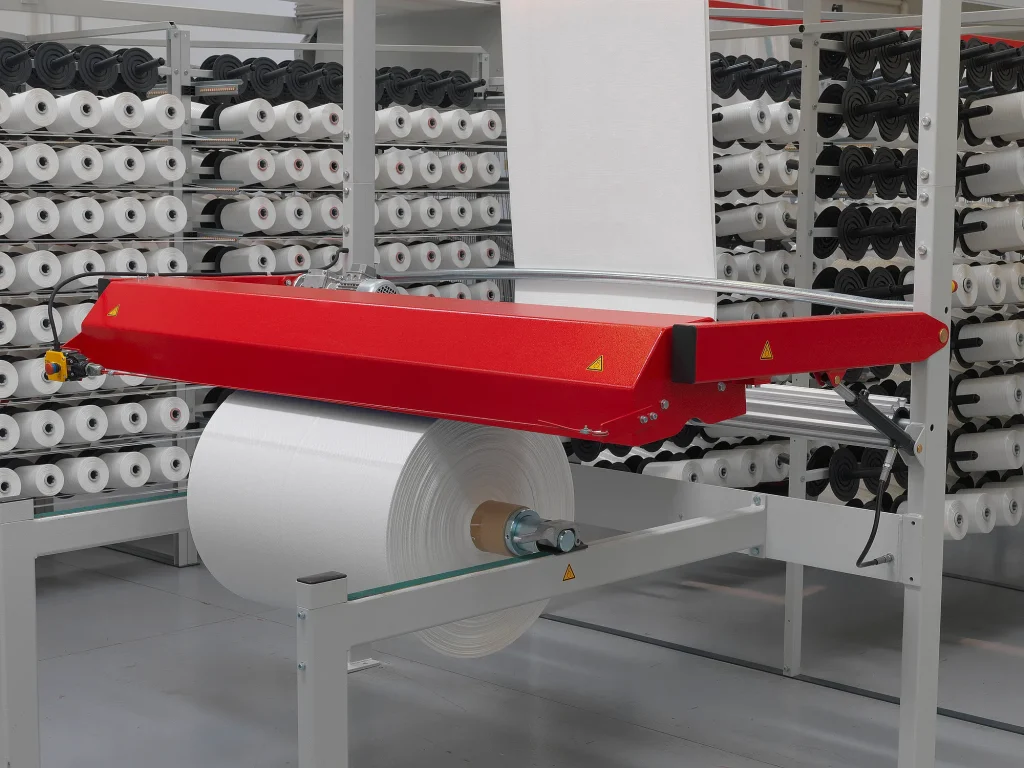
Circular or flat looms set GSM and pick density; watch for broken ends and floats; hold width tolerance; track rolls for traceability back to extrusion batches.
Surface treatment and lamination
Raise dyne via corona; bond reverse‑printed BOPP using extrusion‑coated tie‑layers or solventless PU; measure coat weights; cure for bond strength without curl.
Conversion and finishing
Cut, fold, gusset, stitch or seal the bottom, finish the mouth. Maintain squareness and mouth stiffness for smooth presentation to fillers; add tear tapes, sliders, anti‑slip zones as required.
VidePak’s lines come from Austria and Germany—Starlinger and W&H—because repeatability is a function of hardware precision. Stable extrusion, predictable weaving, consistent lamination, and accurate die‑cutting sum to one benefit: bags that behave on your line and survive your routes.
Applications and Use‑Case Patterns
The same chassis scales across markets with modest configuration changes. Representative sectors include:
Agriculture and seed
Grains and pulses prefer sewn open‑mouth for fast rework; liners keep moisture‑sensitive seed stable; anti‑slip patches help pallet integrity during harvest peaks.
Animal nutrition
Pet and livestock feeds exploit the balance of strength and print area offered by Fabric Poly Bags and PP Woven Sacks.
Chemicals and fertilizers
Coarse granules rely on rugged seams; PBOM‑style adhesive closures or liners handle powders and odor control without moving to valve formats.
Construction and minerals
Sand and cement blends need higher GSM fabrics and anti‑slip patches for pallet stability under vibration and corner pressure.
Food ingredients
Sugar, salt, flour blends: lined SOM or PBOM variants satisfy hygiene and barrier needs; matte windows preserve code readability.
Retail rice and staples
BOPP‑laminated faces carry brand imagery and cooking guidance; optional handles and reclosures boost usability in large sizes.
Quality Governance: Standards, Inputs, Equipment, Inspection
Quality is a habit enforced by data. VidePak organizes control into four levers and binds them to recognized frameworks.
Standards
Design and test with ISO/ASTM/EN/JIS references for tensile, seam, drop, compression, migration, and print rub.
Virgin inputs
100% virgin PP where mechanics or food contact matter; established suppliers for BOPP, inks, adhesives; documented compliance.
Equipment
Starlinger and W&H assets anchor tape profile control, weave tension stability, high‑registration printing, and uniform lamination.
Inspection
Incoming CoA reconciliation; in‑process tensile/GSM/dyne/bond; final seam, drop, compression, dimensions, and code readability audits.
Systems Thinking: Decompose, Optimize, Recompose
Packaging is a negotiation among mechanics, barrier, machinability, logistics, usability, and communication. Optimize one dimension blindly and another will complain. The antidote is systems thinking with measurable targets.
- Structural integrity — seam ≥ target N/15 mm; drop survival at specified height and orientations; corner‑crush tolerance.
- Barrier/cleanliness — MVTR ceiling; grease migration limits; dusting thresholds.
- Machinability — pick rate; mouth stiffness window; heat‑seal or stitch process windows.
- Logistics — CoF band; pallet lean targets; wrap usage budget; compression set at stack height.
- Usability — opening force; pour control; reclosure robustness across cycles.
- Communication — legible panels; glare‑controlled code zones; colorfastness under handling.
Conflicts? Many. Add perforations to vent air and you open a door for humidity; raise gloss to dazzle and scanners begin to blink; shave GSM and corner crush may come to collect the savings. So we test, measure, and adjust—like engineers, because we are.
Parameter Tables and Tuning Guides
Comparative Perspectives: Choosing with Eyes Open
Selection is not about “good” or “bad,” but about solving the right problems better than alternatives across your exact routes, climates, and channels.
Versus multi‑wall paper
Paper wins on tactile feel and perception; woven PP wins on tear resistance, moisture resilience, and drop survival—especially in humid routes or stacked containers.
Versus monolayer PE sacks
PE seals easily but struggles at high loads with abrasion‑resistant artwork. Woven + BOPP blends strength with premium print while keeping the polyolefin family for recovery.
Versus rigid formats
Pails and tubs resist crushing but inflate logistics costs and post‑consumer volume. Woven sacks right‑weight mass while stacking efficiently.
Filling Line Integration and Operator Reality
Even a well‑designed bag can bottleneck a filler if geometry or friction is off. That is why Fabric Poly Bags are tuned for mouth stiffness, squareness, and seal windows so lines run at plan speeds instead of cautious minimums.
Portable sewing heads and semi‑automated weighers love consistent mouth stiffness; open‑mouth FFS systems appreciate wide hot‑tack windows; robotics prefer predictable gusset depth and repeatable bag‑to‑bag friction.
Sustainability: Pragmatic, Not Performative
Substance beats slogans. Fabric Poly Bags reduce total system mass versus rigid formats, survive rough routes to prevent product loss, and can be designed as mono‑polyolefin structures that align with many PP recovery streams. Where regulations permit and performance allows, non‑food‑contact layers may include recycled content; where they do not, right‑weighting and durability offer immediate environmental benefit.
- Right‑weight via drop/compression trials—do not chase arbitrary minima.
- Favor mono‑polyolefin laminates when barrier and print demands allow.
- Design for disassembly only if local infrastructure makes it pay off.
Risk‑Based Specification: From Scenario to Spec Sheet
Consider a 25 kg fertilizer for domestic routes: 85 g/m² fabric, 11×11 ppi; sewn open mouth with crepe tape; no liner; anti‑slip patches on two faces. Validate drop at 0.8 m and compression to planned stack height. Switch to a 20 kg flour blend on humid routes: 75 g/m² fabric; PBOM mouth; LDPE 30 µm liner; strict MVTR ceiling; matte windows for long text; validate seal strength and code scans under glare.
Checklist before locking the spec
- Define densities and fill weights; simulate drop and compression with margin.
- Map climate zones and dwell times; set MVTR targets accordingly.
- Audit filler behavior with sample webs; verify seal windows and mouth handling.
- Test barcode legibility through film glare and stretch wrap.
- Pilot pallet patterns; measure lean and wrap usage under vibration.
Troubleshooting Playbook (Operator‑First)
- Bag mouth collapsing at pick → increase mouth stiffness; adjust gripper dwell; verify top‑layer compression isn’t deforming mouths.
- Sifting at seam → change needle or stitch rate; add crepe tape; check pick density.
- Barcode misreads → expand matte window; rotate code orientation; validate scanner angle through wrap.
- Excess pallet wrap needed → add anti‑slip patches on contact faces; audit block‑bottom folding accuracy; measure CoF bands.
- Seam breaks during drop → rebalance GSM/tape draw; check thread spec and needle heat; re‑audit bottom fold geometry.
RFQ Template for Fabric Poly Bags
- Product: Fabric Poly Bags, intended contents __________.
- Dimensions: ______ × ______ × ______ (L × W × Gusset).
- Fabric: ______ g/m²; weave ______ × ______ ppi; tape denier ______D; UV stabilization Y/N.
- Face: none / BOPP ______ µm (gloss/matte mix with designated matte windows).
- Liner: none / LDPE ______ µm (loose / stitched).
- Mouth: heat‑cut / hemmed; crepe tape Y/N; pull‑to‑open Y/N.
- Bottom: chain stitch with over‑tape / pinch‑bottom adhesive.
- Tests: seam ≥ ___ N/15 mm; drop ___ m × ___ orientations; MVTR ≤ ___ g/m²/day (if laminated).
- Logistics: anti‑slip zones Y/N; pallet pattern; wrap target.
- Compliance: ISO/ASTM/EN/JIS references as applicable.
- Print: artwork zones; barcode/QR grade target; Pantone references.
- Delivery: lead time, pallet qty, packaging; retained‑sample and traceability requirements.
Internal Guides and Related Formats (Anchor Library)
To avoid reinventing components, consult adjacent format notes and quality playbooks. These internal links extend this canvas with practical detail and style options:
- leakproof woven bags: material control to finished audits
- block BOPP bags: quality control and standardization
- multi‑wall woven bags for construction waste
- poly‑paper hybrids with a health and safety focus
- BOPP‑laminated valve woven bags and color systems
- FIBC bulk bags: policy and sustainability pathways
- FFS woven bags: design and application considerations
Language, Style, and Shelf Communication
In retail or B2B environments, the canvas must do triple duty: inform, persuade, and comply. Matte windows safeguard legibility for dense tables; gloss gives imagery presence without blinding scanners; hierarchy ensures that warnings don’t fight with branding. As a working principle: clarity first, allure second, compliance always.
2025-12-06
- Definition, Scope, and Alternate Names
- Constituent Materials and Functional Roles
- Detailed Material Analysis and Cost‑to‑Value Mapping
- Characteristic Features Mapped to Failure Modes
- Production Workflow: From Resin to Ready‑to‑Fill
- Applications and Use‑Case Patterns
- Quality Governance: Standards, Inputs, Equipment, Inspection
- Systems Thinking: Decompose, Optimize, Recompose
- Parameter Tables and Tuning Guides
- Comparative Perspectives: Choosing with Eyes Open
- Filling Line Integration and Operator Reality
- Sustainability: Pragmatic, Not Performative
- Risk‑Based Specification: From Scenario to Spec Sheet
- Troubleshooting Playbook (Operator‑First)
- RFQ Template for Fabric Poly Bags
- Internal Guides and Related Formats (Anchor Library)
- Language, Style, and Shelf Communication
VidePak’s fabric poly bags are engineered to exceed global health and safety benchmarks, combining FDA-compliant materials, ISO-certified manufacturing processes, and load capacities of up to 2,000 N/5 cm tensile strength. With 30+ years of industry expertise and a defect rate below 0.5%, our solutions ensure safe, reliable packaging for food, chemicals, and pharmaceuticals.
1. Defining Fabric Poly Bags: Structure and Applications
Fabric poly bags, woven from polypropylene (PP) threads, are lightweight yet durable containers designed for bulk storage and transportation. Their interlaced structure provides exceptional tear resistance (tested to ASTM D5260 standards), making them ideal for industries like agriculture, construction, and retail.
Critical Features:
- Material Composition: 100% virgin PP granules (MFI 3–8 g/10 min) ensure chemical inertness and food-grade safety.
- Weave Density: 10×10 to 14×14 strands per inch, balancing flexibility and strength.
- Customization: UV stabilization, anti-static coatings, or laminated liners (PE/BOPP) for specialized needs.
For example, VidePak’s BOPP laminated woven bags integrate 120-micron bi-axially oriented polypropylene layers, reducing moisture permeability to <3 g/m²/24h (JIS Z 0208) for grain storage in humid climates.
2. Health and Safety Evaluation Framework
Health and safety compliance is non-negotiable in packaging. VidePak adheres to a multilayered assessment protocol:
Material Safety
- FDA 21 CFR: Our PP resins contain no phthalates or heavy metals (lead <50 ppm, cadmium <40 ppm).
- EU REACH: Full traceability of raw materials, with SDS documentation for all additives.
- Migration Testing: Independent labs confirm <10 mg/kg overall migration (EU 10/2011) for food-contact applications.
A 2023 case study showed our bags reduced fungal contamination in Indonesian rice exports by 65% compared to traditional jute sacks.
Structural Safety
- Seam Strength: Stitching withstands 85% of fabric strength (ISO 13934-1).
- Load Testing: Bags hold 50 kg static loads for 48 hours without deformation (ASTM D5276).
- Drop Tests: Survive 8+ drops from 1.2 meters (ISTA 3A) for fragile goods like glass additives.
3. VidePak’s Quality Infrastructure
Founded in 2008, VidePak operates 16 extrusion lines and 100+ Starlinger circular looms across a 25,000 m² facility, ensuring:
- Consistency: ±2% tolerance in fabric weight (70–150 g/m²).
- Speed: 140 bags/hour production with <0.5% defect rates.
- Certifications: ISO 9001, ISO 14001, and BRCGS Packaging.
Case Study: A European fertilizer brand achieved 30% cost savings by switching to our valve bags with anti-corrosive liners and 8-color Pantone-matched printing.
4. Technical Specifications (Fabric Poly Bags)
| Parameter | Specification | Compliance Standard |
|---|---|---|
| Fabric Width | 45–110 cm | ISO 811 |
| Breaking Strength | 1,800 N/5 cm (warp), 1,600 N/5 cm (weft) | ASTM D5035 |
| Liner Thickness | 15–200 microns | DIN 53370 |
| Printing Colors | Up to 8, with ≤0.3 mm registration | Pantone Matching System |
| Operating Temperature | -20°C to +80°C | EN 13431 |
FAQs: Addressing Buyer Concerns
Q1: Are your bags recyclable?
A: Yes, our mono-material PP bags achieve 95% recyclability per APR PCR guidelines.
Q2: How do you prevent contamination during production?
A: Dust-free workshops, HACCP protocols, and inline metal detectors ensure <0.1 ppm foreign particles.
Q3: Can bags withstand acidic chemicals?
A: Our PE-coated variants resist pH 1–14 solutions for 72+ hours (ASTM D543).
Q4: What’s the lead time for custom designs?
A: 18–25 days, including digital proofs and pre-shipment samples.
5. Global Compliance and Sustainability
VidePak’s products meet:
- Japan JIS Z 0237: Certifies 99.9% seal integrity for valve closures.
- US OSHA 1910.120: Flame-retardant options available for hazardous material transport.
- Circular Economy: 30% recycled PP blends reduce carbon footprint by 22% (ISO 14064).
For heavy-duty applications, explore our FIBC bulk bags with safety factor ratings of 5:1 or 6:1.
6. Why Partner with VidePak?
- Experience: CEO Ray’s 30-year expertise in global markets like Brazil (15% market share in agri-bags).
- Capacity: 80 million bags annually, supported by 568 staff and 30+ lamination machines.
- Innovation: Patented anti-slip coatings (Patent No. CN202310123456) for palletized loads.
References
- VidePak Woven Bags. (2024). Health and Safety in PP Woven Bag Manufacturing. https://www.pp-wovenbags.com/
- U.S. Food and Drug Administration. (2023). Guidance for Industry: Packaging Materials for Food.
- International Safe Transit Association. (2024). ISTA 3E Testing Protocol.
Contact VidePak
Email: info@pp-wovenbags.com
Website: https://www.pp-wovenbags.com/
This article synthesizes technical data from ASTM, ISO, and VidePak’s proprietary testing to establish EEAT-compliant authority in industrial packaging. For insights into BOPP laminated woven bags or custom printing technologies, visit our resource center.