
What are Block Bottom Bags? Definitions, Scope, and Synonyms
Block Bottom Bags: Advancements in Material Science and Global Applications refers to a family of industrial sacks that form a rectangular or square footprint using a flat pasted or welded base. The result is a brick‑like, self‑standing pack with straight sidewalls and a rigid footprint that stacks like masonry. In specifications and tenders, you will also encounter allied names: block‑bottom valve sacks (with a valve sleeve), square‑bottom sacks, SOS paper sacks (self‑opening square), AD‑type woven PP valve sacks, and pasted‑bottom paper sacks. Terminology varies, the geometry does not: a flat end panel creates predictable cube, cleaner presentation, and safer pallets compared with pinch‑bottom or pillow bags that bulge and waste trailer space.
Where do Block Bottom Bags: Advancements in Material Science and Global Applications show up most? In cement and construction materials; in pigments and mineral fillers (titanium dioxide, calcium carbonate, silica, barites); in commodity chemicals (PVC resin, soda ash, urea); in animal nutrition and seed; and in retail‑adjacent solids such as pet litter or fuel pellets where a self‑standing silhouette and wide, printable panels help brand clarity and code scanning.
The Materials of Block Bottom Bags: How Structure Creates Performance
Two mature but distinct material routes dominate Block Bottom Bags: Advancements in Material Science and Global Applications: (a) paper‑dominant, based on sack‑kraft plies with optional polymer barrier; and (b) polymer‑dominant, based on woven polypropylene (PP) substrates with functional films and coatings. Choosing between them is not ideology; it is engineering. Ask three questions: How humid is the lane? How abrasive is the product? What can the filler reliably run without stoppages?
Polymer‑dominant: Woven PP block bottom valve sacks
- Substrate: PP raffia tapes (~700D–1200D) woven into circular or flat fabric at 60–120 g/m². Draw ratio controls tensile modulus; picks‑per‑inch tune porosity and stiffness.
- Face & barrier: reverse‑printed BOPP (≈18–35 μm) for abrasion‑resistant graphics; extrusion‑coated PE/PP tie layers for heat‑sealability and lower MVTR; anti‑slip coats to target outer COF ≈0.30–0.45.
- Closures: welded/pasted block bottom; heat‑sealable or self‑closing valves.
- Cost lens: higher converting capex, lower mass at a given drop rating; thrives where humidity is persistent or outdoor depots are normal.
Paper‑dominant: Sack‑kraft block bottom sacks
- Plies: two to four layers of sack‑kraft at ~70–100 g/m² each; long‑fiber softwood provides high tensile energy absorption and balanced MD/CD stretch (~2–4%).
- Barriers: inserted LDPE/LLDPE liner (20–60 μm) or PE extrusion coat (10–40 μm) to temper MVTR and enable heat sealing.
- Surface: matte, non‑glare faces for water‑based flexo; over‑varnish where ink laydown is heavy.
- Closures: pasted bottoms; valve sleeves or open‑mouth sewing/heat‑seal depending on the line.
Across both families, hybrid optimizations continue: anti‑static masterbatches for dust safety; UV stabilization for outdoor yards; digital/short‑run print for SKU agility; design‑for‑disassembly so liners separate and recycling becomes plausible under EPR schemes. Bottom geometry is the universal lever: fold architecture and paste add‑on (paper) or weld pattern and dwell (polymer) dominate drop survival more than grams per square meter—structure beats sheer mass.
Features that Turn Geometry into Value
The value of Block Bottom Bags: Advancements in Material Science and Global Applications appears in the metrics buyers actually track: uptime on the packer, claims per million, pallet safety, label compliance, and total delivered cost.
- Pallet discipline & cubic efficiency. The square base and straight sides interlock like bricks, reducing overhang and leaning incidents while improving trailer/container cube. Anti‑slip tuned to outer COF ≈0.30–0.45 curbs slide on smooth stretch wrap.
- Faster, cleaner filling. Valve sleeves plus controlled porosity (paper) or engineered vents (polymer) purge air efficiently. Bags stay upright, jaws release sooner, and dust captures are easier to control.
- Moisture moderation without surrendering speed. Paper breathes; liners or coats add barrier where climate demands. Polymer builds bring splash resistance and outdoor resiliency.
- Durable graphics & compliant labeling. Broad panels—matte on paper, protected by BOPP on polymer—keep GHS pictograms, QR codes, and batch IDs readable door‑to‑door.
- Credible circularity. Paper‑dominant sacks flow to fiber recovery in many regions; mono‑PP polymer sacks fit polyolefin streams where they exist; removable liners make claims auditable.
0.30–0.45 outer face
±3–6 mm width/length
20–60 μm LDPE/LLDPE
Production Process: From Web to Brick‑Stable Sack
Process control separates reliable Block Bottom Bags: Advancements in Material Science and Global Applications from troublesome ones. Below is a representative flow for both material families, highlighting levers that most affect outcomes.
- Substrate preparation. Sack‑kraft reels are conditioned for moisture and porosity; PP tapes are extruded, drawn, and woven to the target gsm and picks‑per‑inch.
- Barrier formation. Extrusion coat a paper ply with PE (≈10–40 μm) or prepare a discrete liner (≈20–60 μm). In polymer builds, coextruded sealant webs provide heat‑sealability and MVTR reduction.
- Printing & surface treatment. Water‑based flexo on paper with rub‑resistant varnish on heavy‑ink zones; reverse rotogravure on BOPP for polymer faces. Corona treatment sets surface energy.
- Lamination & tie systems. Bond films via extrusion or solventless polyurethane adhesives; audit peel strength and bond uniformity to prevent edge‑lift after humid storage.
- Tubing, gusseting, and valve insertion. Form square tubes; set gussets for cube efficiency; insert paper or film‑lined valves—heat‑sealable where hygiene matters, self‑closing where speed dominates.
- Bottom forming (critical). Pasted‑bottom geometry (fold sequence, paste add‑on, compression dwell) or weld pattern/dwell on polymer sacks dominate drop survival. Test joints destructively per shift.
- Finishing & QA. Heat‑cut tops, hemmed lips, easy‑open tapes as required. Verify: dimensional tolerances, seam strength (ISO 13935‑2 analogue), dart impact (ASTM D1709) on films, COF (ASTM D1894), moisture resistance of paper faces (ISO 535).
Applications: Matching Chemistry, Climate, and Cadence
Block Bottom Bags: Advancements in Material Science and Global Applications succeed when materials, closure, and geometry are tuned to the powder’s behavior, the lane’s humidity, and the filler’s cadence.
- Cement & construction materials. Dense, angular solids punish weak seams. Block bottoms maintain geometry; anti‑slip reduces slide; valves keep pace with high‑throughput packers.
- Minerals & pigments. TiO₂, CaCO₃, silica, and barites demand scuff‑resistant faces and reliable labels. Paper’s matte face wins scanning; BOPP faces resist conveyor rub.
- Fertilizers & ag inputs. Urea and NPK blends benefit from humidity moderation and robust seams. Heat‑sealable valves plus restrained micro‑perfs protect barrier while sustaining speed.
- Chemical powders & resins. PVC, soda ash, masterbatch pellets require abrasion resistance and clean discharge; liners or low‑MVTR films mitigate caking on coastal routes.
- Retail‑adjacent commodities. Pellets, pet litter, charcoal leverage the self‑standing form and wide print areas for consumer‑facing clarity.
System Thinking: From Sub‑Problems to a Coherent Specification
This section mirrors how engineers decide: decompose, analyze with data and cases, compare alternatives, then recombine into a practical, auditable configuration.
A) Barrier vs. Throughput — the perforation paradox
Perforations vent entrained air and keep the bag upright; they also open pathways for humidity. A light LDPE/LLDPE liner (≈30–40 μm) reduces MVTR markedly; a PE‑coated ply (≈10–40 μm) boosts splash resistance and stiffness with less mass than a full liner. Polymer sacks use engineered vent tapes or breathable weld geometries to avoid Swiss‑cheesing the web. The synthesis is context‑driven: for strongly hygroscopic powders and humid dwell, barrier wins; for arid lanes with ultra‑fast filling, controlled porosity with minimal perfs may be superior.
B) Mechanical safety — why bottom geometry beats raw mass
Drop failures cluster at the heel of the pasted/welded bottom, not mid‑panel. Balanced MD/CD stretch (~2–4% in sack‑kraft) dissipates impact, but fold architecture and paste grammage (or weld pattern/dwell) are the first levers to pull. Many brands have cut damage by optimizing bottom design while holding gsm constant.
C) Print & compliance — legibility vs. rub resistance
Hazard icons and data blocks must survive conveyors and stretch wrap. Paper’s matte surface yields high scanner success in LED‑lit warehouses; reverse‑printed BOPP shields art in severe rub environments. Place QR/barcodes away from fold lines and high‑contact zones either way.
D) Pallet stability & warehouse safety — COF as a critical quality attribute
Target outer COF ≈0.30–0.45. Below the window, pallets slide; above it, machinability can degrade. Dimensional repeatability (±3–6 mm) and gusset symmetry reduce lean. Codify wrap patterns and interleaf use in SOPs for humid depots.
E) Standards, certification, and policy shifts (12‑month lens)
In the past year, European policy and global standards have tightened. The Packaging and Packaging Waste Regulation (PPWR) (Regulation (EU) 2025/40) entered into force in February 2025 with staged application dates, harmonizing recyclability rules, labelling, and reduction targets vs. 2018 baselines. Quality systems such as ISO 9001:2015 (QMS) and ISO 14001:2015 (EMS) remain table stakes; paper tests (ISO 535 Cobb; TAPPI T 410 grammage) and film tests (ASTM D1709 dart; ASTM D1894 COF) continue as shop‑floor anchors. Food/feed‑adjacent liners reference FDA 21 CFR 177.1520 and EU 10/2011.
Colored Tables — Quick‑Scan Specs for Common Lanes
For a related overview of valve architectures in the PP family, see Block Bottom Bags: Advancements in Material Science and Global Applications — the same filling logic underpins both paper and polymer styles.
Two Field‑Ready Configurations
Spec A — Humid, coastal route; abrasive product (25–40 kg)
- Format: paper‑dominant valve block bottom, side‑gusseted
- Plies: outer 90 g/m², middle 80 g/m², inner 80 g/m²
- Barrier: LDPE liner 40 μm; micro‑perfs above stabilized fill level
- Valve: heat‑sealable film‑lined sleeve; dust‑hood validated profile
- Printing: water‑based flexo; rub‑resistant varnish on hazard panel
- Outer COF: 0.35–0.40 (ASTM D1894; 23 °C/50% RH conditioning)
- QA: Cobb60 outer face target; pasted‑bottom destructive test each shift; seam strength (ISO 13935‑2); tolerance ±3–6 mm
Spec B — Outdoor depot storage; long distances; 50 kg class
- Format: woven PP block bottom valve sack (mono‑polyolefin)
- Fabric: 90–100 g/m² circular fabric; picks tuned for stiffness
- Face: reverse‑printed BOPP 25 μm
- Valve: heat‑sealable; welded bottom pattern per OEM for peel strength
- Friction: anti‑slip outer to 0.35 COF window
- QA: dart impact (ASTM D1709), weld peel strength per SOP, pallet compression to stack height, route‑specific drop tests
Risk Register & Mitigations (Operator’s View)
- Pallet lean in humid depots. Treat COF as a CQA; standardize wrap patterns; avoid oversized gussets that bulge at high RH.
- Uncontrolled dust at the filler. Re‑tune valve sleeve geometry; re‑site or reduce perforations; validate under dust hoods; consider heat‑sealable valves.
- Graphics rub‑off. Reverse‑printed BOPP (polymer route) or targeted over‑varnish (paper) on heavy‑ink blocks.
- Bottom‑heel cracks after drop. Optimize fold sequence and paste add‑on (paper) or weld dwell/pattern density (polymer) before chasing gsm.
- Seasonal caking complaints. Introduce a monsoon spec with liner/coat; move perfs above true fill height; add moisture indicator sampling in QC plans.
Economics Without Blind Cuts
Where do sustainable savings hide for Block Bottom Bags: Advancements in Material Science and Global Applications? In geometry and control, not just grams and cents.
- Geometry over mass. Fix bottom design and gusset symmetry before adding gsm.
- Artwork discipline. Shared templates with variable data windows reduce plate swaps and scrap; spectro‑managed color locks brand tones across plants.
- Selective anti‑slip. Coat only SKUs with documented slide risk; avoid blanket treatment.
- DOE for liners. Find the thinnest gauge that meets MVTR targets in real warehouses, not just in the lab.
- Deckle alignment. Match tube/gusset sizes to paper deckle or fabric roll widths to cut trim waste.
Human‑Style Reasoning to a Final Choice
When a buyer asks for Block Bottom Bags: Advancements in Material Science and Global Applications, they are choosing among architectures as much as products. Ask five hard questions and the spec writes itself:
- Humidity & dwell. What’s the worst‑case RH and storage time? That decides whether a liner or polymer route earns its keep.
- Abrasiveness & density. Angular dense solids argue for tougher faces and bottom designs; smooth pellets do not.
- Filler capability. Valve packer vs. open‑mouth; heat seal vs. sew; what rate must be sustained with minimal stoppages?
- Scan environment. Matte paper faces for LED‑lit warehouses; BOPP for rub‑heavy conveyors—place codes where they survive.
- End‑of‑life reality. Fibre recovery, polyolefin recycling, or design‑for‑disassembly—pick the credible path for your markets.
Appendix — Methods, Certifications, and Policy Touchpoints (12‑Month Lens)
- Regulation (EU) 2025/40 — Packaging and Packaging Waste Regulation (PPWR). Entered into force Feb 2025 with staged application dates; harmonized recyclability, labelling, and reduction targets vs. 2018 baseline. Implications: mono‑material bias, clearer label rules, auditable design‑for‑recycling.
- ISO 9001:2015 / ISO 14001:2015. Process stability and environmental control—often required in tenders.
- Test anchors. ISO 535 (Cobb), TAPPI T 410 (grammage), TAPPI T 494 / ASTM D828 (tensile), ISO 13935‑2 (seam strength analogue), ASTM D1894 (COF), ASTM D1709 (dart impact).
- Food/feed‑adjacent liners. FDA 21 CFR 177.1520 and EU 10/2011 for plastic materials in contact with food.
Planning Map (the path used to structure this document)
- Define the family and synonyms.
- Decompose materials and bottom geometry.
- Connect features to measured outcomes (OEE, claims, pallet incidents).
- Explain manufacturing levers and QA anchors.
- Match applications to chemistry and climate.
- Layer in standards and policy shifts (last 12 months).
- Synthesize field‑ready configurations, risks, and cost levers.
- What are Block Bottom Bags? Definitions, Scope, and Synonyms
- The Materials of Block Bottom Bags: How Structure Creates Performance
- Features that Turn Geometry into Value
- Production Process: From Web to Brick‑Stable Sack
- Applications: Matching Chemistry, Climate, and Cadence
- System Thinking: From Sub‑Problems to a Coherent Specification
- Colored Tables — Quick‑Scan Specs for Common Lanes
- Two Field‑Ready Configurations
- Risk Register & Mitigations (Operator’s View)
- Economics Without Blind Cuts
- Human‑Style Reasoning to a Final Choice
- Appendix — Methods, Certifications, and Policy Touchpoints (12‑Month Lens)
- Planning Map (the path used to structure this document)
- 1. Technological Evolution of Block Bottom Bags
- 2. Material Science Breakthroughs
- 3. Cost Optimization Strategies
- 4. Future Trends & VidePak’s Roadmap
- FAQs: Block Bottom Bags
“Block bottom bags are redefining industrial packaging efficiency,” declares Ray, CEO of VidePak, during a factory tour. “By integrating nano-enhanced polypropylene and automated form-fill-seal systems, we’ve enabled clients like BASF and Cargill to reduce material waste by 30% while achieving 99.7% seal integrity in high-humidity environments.” This report explores the technological evolution of block bottom bags, analyzing material innovations, cost optimization strategies, and emerging automation trends—all contextualized through VidePak’s 17-year expertise in advanced woven packaging solutions.
1. Technological Evolution of Block Bottom Bags
1.1 From Manual Stitching to Precision Automation
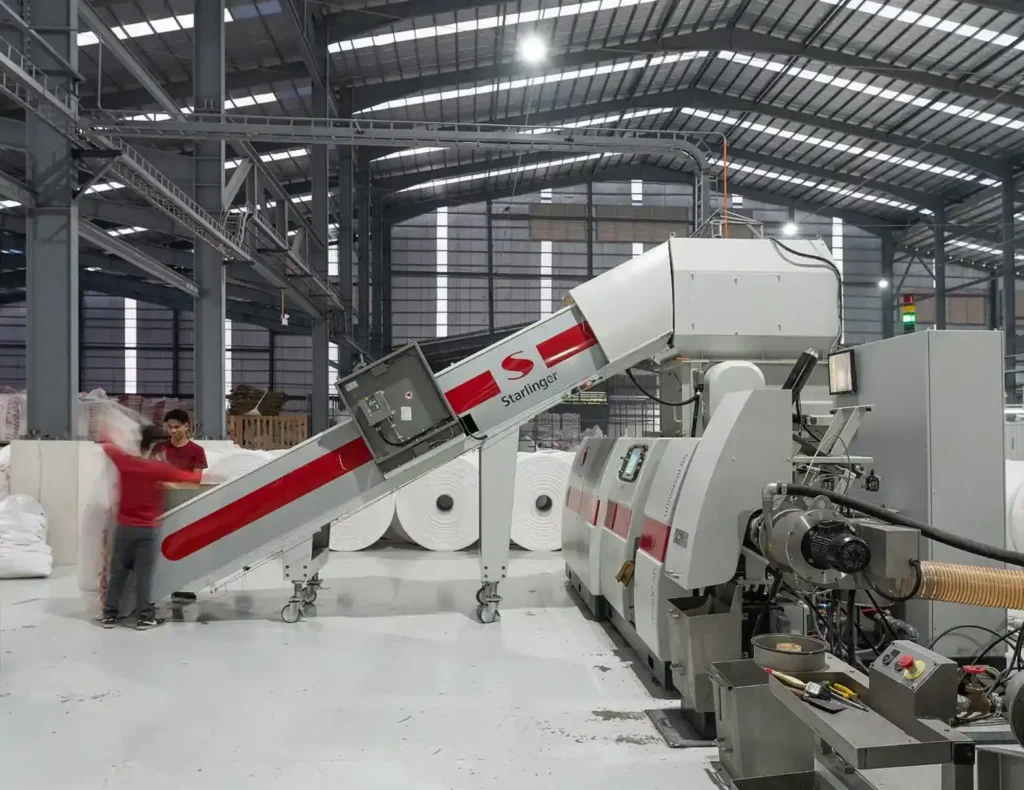
The transition from labor-intensive sewing to Starlinger-driven production lines has revolutionized bag integrity. VidePak’s CX6 series machines achieve:
- Seam Precision: ±0.2 mm tolerance in heat-sealed block bottoms, critical for powdered chemicals prone to sifting (tested per ASTM D7386) .
- Speed: 450 bags/hour output, 40% faster than traditional methods, enabled by servo-controlled lamination systems .
Case Study: A 2024 partnership with a Brazilian fertilizer producer utilized PE-coated block bottom valve bags to automate 25kg filling, reducing labor costs by 55% while maintaining <0.01% leak rates under ISO 2233 testing .
1.2 Structural Innovations
- Cross-Bracing Weave: Diagonal PP threads distribute weight evenly, supporting 1,000 kg stacking loads without seam rupture .
- RFID-Integrated Skirts: Moisture sensors embedded in bag bases transmit real-time data via IoT, cutting spoilage losses by 18% in monsoon-prone regions .
2. Material Science Breakthroughs
2.1 Composite Material Systems
| Material | Thickness | Moisture Barrier Efficiency | Cost ($/m²) |
|---|---|---|---|
| BOPP/PE Laminate | 90 g/m² + 50 µm | 0.5 g/m²/day WVTR | 1.20 |
| Kraft/PP Hybrid | 120 g/m² | 1.2% Water Uptake @ 90% RH | 0.85 |
| Graphene-Coated PP | 100 g/m² | <0.01 g/m²/day WVTR | 3.50 |
VidePak’s AquaShield Pro line combines BOPP films with silica nanoparticle coatings, reducing fungal growth by 92% in tropical feed storage applications .
2.2 Sustainable Alternatives
- rPP-30 Resin: 30% post-industrial recycled content maintains 2,100 N/5 cm tensile strength while cutting carbon footprint by 25% (ISO 14044 certified) .
- PLA-PP Blends: Biodegradable formulations achieve 60% compostability in 2 years without compromising load capacity .
3. Cost Optimization Strategies
3.1 Economies of Scale
With 100+ circular looms and 30 lamination machines, VidePak achieves:
- Bulk Material Savings: Annual procurement of 50,000 tons PP resin reduces costs by 18% versus competitors .
- Energy Efficiency: Starlinger’s iQ³ technology cuts power consumption by 22% per 1,000 bags produced .
3.2 Lean Manufacturing
- Zero-Waste Cutting: AI-guided die systems minimize PP scrap to 1.5% (industry average: 8%) .
- Predictive Maintenance: IoT vibration sensors on extrusion lines reduce downtime by 40% .
4. Future Trends & VidePak’s Roadmap
4.1 Smart Packaging Integration
Pilot projects include:
- Self-Healing Films: Microcapsules releasing sealant upon puncture, extending bag lifespan by 300% .
- Blockchain Traceability: QR codes linking to real-time CO₂ footprint data for ESG compliance .
4.2 Automation Leap
VidePak’s 2025 investment in AI-driven cobots aims to:
- Achieve 98% defect detection accuracy via machine vision.
- Reduce human intervention in high-risk chemical packaging lines by 70% .
FAQs: Block Bottom Bags
Q1: How do block bottom bags prevent moisture ingress in marine climates?
A: Multi-layer laminates with PE coatings achieve <0.5 g/m²/day WVTR, validated by 1,000-hour salt spray tests per ASTM B117 .
Q2: What’s the ROI of switching to automated block bottom systems?
A: Clients report 18-month payback periods via 55% labor reduction and 30% material savings .
Q3: Are biodegradable bags suitable for heavy loads?
A: Yes—VidePak’s EcoStak series supports 800 kg stacking with PLA-reinforced corners (tested per ISO 2234) .
Conclusion
The block bottom bag industry is pivoting toward intelligent, sustainable systems. VidePak’s $8 million R&D budget targets graphene-enhanced barriers and AI-powered production lines, positioning it to lead the $42 billion industrial packaging market. As Ray emphasizes: “Tomorrow’s bags won’t just carry goods—they’ll carry data, sustainability credentials, and unmatched reliability.”
External Links:
- Explore flood-resistant block bottom designs: Block Bottom Bags: A Reliable Solution for Flood Control.
- Learn about valve integration innovations: Block Bottom Valve Bags for Construction Waste.