
Definition and Scope: What Are PP Fabric Bags for Chemical Packaging?
In chemical supply chains where dry solids dominate—powders, granules, pellets—the packaging must do three things at once: contain, protect, and communicate. PP Fabric Bags for Chemical Packaging are engineered sacks that meet this triad by combining a woven polypropylene (PP) fabric core with tuned facestocks, closures, and optional liners. The woven fabric is created from oriented PP tapes arranged as a lattice; this structure delivers high tensile strength, puncture resistance, and low creep under pallet compression. Once laminated, coated, printed, and converted, the result is a high‑integrity package that runs cleanly on fillers, survives warehouse and export routes, and preserves label and barcode legibility. In procurement and on purchase orders, closely related aliases are used to describe the same platform:
- PP Fabric Bags for Chemical Packaging
- Chemical PP Woven Bags
- Chemical‑Resistant PP Woven Bags
- BOPP‑Laminated Chemical PP Bags
- Valve‑Type PP Woven Bags for Chemicals
- UN‑Rated PP Woven Sacks
Key framing: All of these names refer to a PP‑based woven platform. The specific combination of face materials, liners, and closures changes the performance envelope while keeping the same mechanical backbone.
Material System of PP Fabric Bags for Chemical Packaging
Materials set the promise; processes make the promise hold. To understand why PP Fabric Bags for Chemical Packaging work across such a wide range of chemicals, we start at the resin and move outward through each layer to the closure interface. Throughout, the goal is to balance mechanical robustness, moisture control, machinability, and recyclability.
Polypropylene Tape Fabric: The Structural Lattice
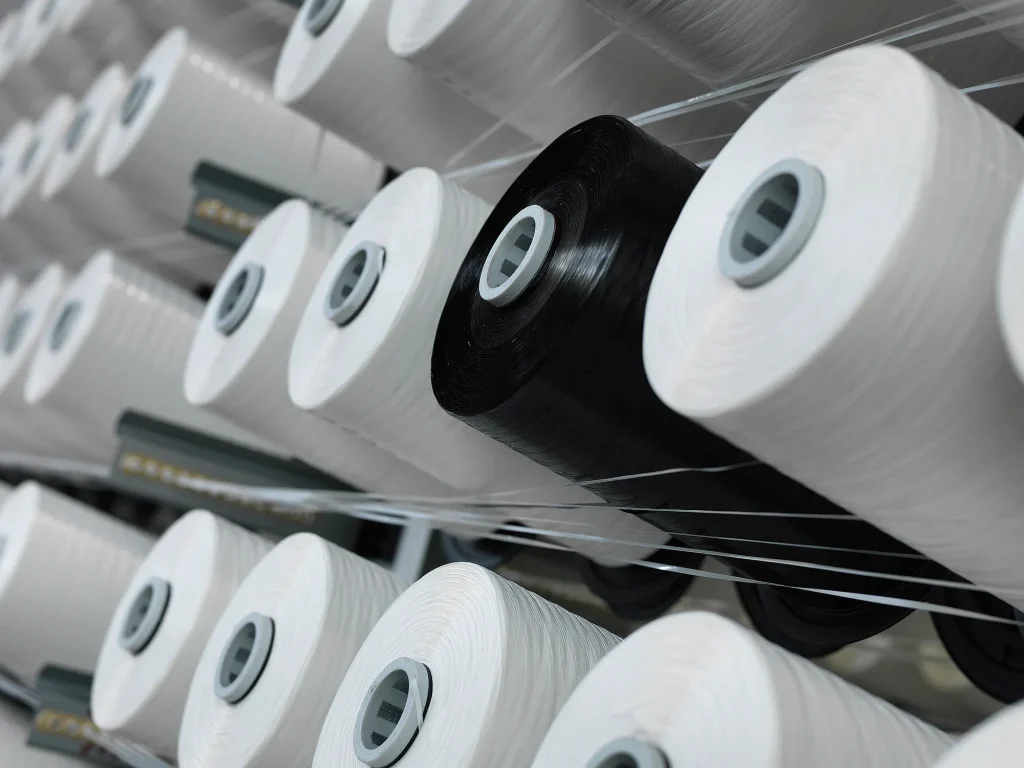
Polypropylene is a semi‑crystalline polyolefin with low density (~0.90 g/cm³), favorable specific strength, and broad chemical tolerance to salts, alkalis, and many non‑polar solvents. In the most common process, pellets are melted, cast as a thin film, slit into narrow ribbons, and drawn to align molecular chains. Orientation increases tensile modulus and tear resistance dramatically without adding mass; it also suppresses long‑term creep in tall stacks—a common failure mode for warehouse pallets exposed to heat. Typical basis weight for the woven fabric core ranges from 80–130 g/m² for 25–50 kg sacks, scaling higher on aggressive routes or when drop heights and double‑stacked export pallets are expected.
Cost and performance levers at this layer include resin price curves, draw ratio, tapes per centimeter, pick density, and tape gauge distribution. Tighter control of tape thickness reduces loom breaks, stabilizes fabric GSM, and improves coat‑weight uniformity during downstream extrusion coating or lamination. Because the core is a polyolefin textile, Chemical PP Woven Bags maintain a mono‑family bias that aligns with many recycling streams and simplifies end‑of‑life.
Facestocks: Coatings and Laminates that Tune Porosity and Printability
The woven core provides strength but is inherently porous. Facestocks close pores, tune surface friction, host branding and regulatory text, and protect graphics during handling. Two families dominate:
- Extrusion coatings (PP/PE): A thin polyolefin coat moderates moisture ingress, improves abrasion resistance, and controls coefficient of friction (COF) for pallet stability, while preserving a polyolefin‑dominant stack for recycling.
- BOPP laminate (12–25 μm): In BOPP‑Laminated Chemical PP Bags, reverse printing is trapped under the film so artwork and barcodes become abrasion‑proof. Solvent‑free polyurethane or polyolefin tie layers are selected for bond strength and low curl.
face selection cues
Use coated PP where the priority is moisture moderation and rugged print for industrial environments. Choose BOPP for high‑fidelity art, low‑glare readability, and barcode longevity on retail‑adjacent pallets.
color & friction
OPVs—gloss, matte, soft‑touch—shape perceived quality and set COF targets. A stable COF window keeps stacks straight while enabling depalletizing on automated lines.
Liners and Inner Films: Hermeticity, Hygiene, and ESD Control
Many chemicals are hygroscopic, dusty, or odor‑sensitive. PE liners (LDPE/LLDPE/HDPE at 40–120 μm) create a heat‑sealable path and a clean interior surface. Anti‑static grades with surface resistivity around 106–109 Ω mitigate nuisance shocks, stabilize weighments for aerated powders, and reduce dust adhesion. Liners can be slipped in as loose inserts (easier separation at recycling) or tube‑lined to the mouth for speed on pinch‑top sealers. For certain chemistries and regulatory contexts, liners also simplify cleanliness validation because they present a homogenous, inspectable surface to the product.
Related guide: For a practical look at liner choices and sealing windows in this platform, see best practices for PP woven bags with liners.
Inks, Adhesives, and Additive Hygiene
Ink sets for CI flexo or gravure are typically nitrocellulose or polyurethane‑modified systems. For faces near food or animal‑nutrition intermediates, low‑migration options are used. Adhesives are often solvent‑free polyurethanes or polyolefin tie layers tuned for peel strength and low curl; coat‑weight uniformity is a critical‑to‑quality variable. Additives such as UV stabilizers (for yarn yards and outdoor storage), slip/anti‑block packages (to hit COF targets), and TiO₂ masterbatches (for opacity) should be chosen to preserve polyolefin recycling pathways and avoid cross‑contamination.
Bill of Materials Map: Where Each Material Lives
exterior face
BOPP (gloss/matte/soft‑touch) or PP/PE extrusion coat → graphics, scuff shield, and COF tuning for pallet physics.
core fabric
Woven PP fabric at 80–130 g/m² (typ.) → tensile, tear, puncture resistance, and gusset stability.
interior
Optional PE liner (40–120 μm) → heat‑sealable hygiene layer that controls WVTR and dust migration.
Key Features of PP Fabric Bags for Chemical Packaging
When buyers say they need a sack to “take a beating and still look professional,” they are pointing at four intertwined capabilities built into PP Fabric Bags for Chemical Packaging: mechanical robustness, moisture moderation, print fidelity, and clean machinability. Each capability emerges from the way layer choices interact under stress.
- Strength‑to‑weight efficiency: Oriented tape lattices distribute loads; drop resistance rises and pallet creep falls compared with many alternative substrates of similar capacity.
- Moisture control: Coats and laminates reduce porosity, liners add heat‑sealable hermeticity, and closures translate potential barrier into realized performance.
- Graphic durability: Reverse‑printed BOPP protects artwork beneath film; matte or soft‑touch finishes deliver low‑glare legibility for hazard text and barcodes.
- Machinability: Stable gussets and reinforced mouths help fillers achieve fast cut‑offs and accurate weighments. In Valve‑Type PP Woven Bags for Chemicals, sleeve stiffness and slit geometry govern de‑aeration and dust hygiene.
- Traceability: Durable codes, lot IDs, and QR panels remain readable after handling and cross‑dock transfers.
- Circularity alignment: Polyolefin‑dominant stacks keep end‑of‑life pathways practical; design‑for‑disassembly allows liner removal where preferred.
From Pellets to Pallets: The Production Chain
Design is intent; process is proof. A capability‑rich sack is the product of a tightly controlled chain. The following stages summarize how an industrial converter transforms raw PP into finished Chemical‑Resistant PP Woven Bags with consistent performance.
- Procurement and incoming checks: Virgin PP in narrow MFI windows; films and liners with dyne and pinhole maps; inks/adhesives with verified solids and viscosity. Certificates of analysis are cross‑checked and retained.
- Tape extrusion and drawing: Melt‑cast film is slit and oriented. Laser micrometers and closed‑loop controls minimize gauge drift and stabilize tensile distributions to reduce loom breaks.
- Weaving: Circular or flat looms interlace tapes at target picks/cm and GSM. Real‑time tension and pick counters tighten variation; woven micro‑textures can raise pallet friction independently of print face.
- Coating and lamination: Polyolefin coats seal pores and set COF; adhesive lamination bonds BOPP with controlled coat‑weight and nip energy. SPC keeps curl low and peel strength high.
- Printing: Reverse printing under BOPP protects artwork; flexo on coated PP yields rugged regulatory panels. Corona/plasma treatment raises surface energy; inline spectrophotometry holds ΔE across long runs.
- Conversion and finishing: Slitting, gusseting, mouth formation, and closure assembly (sewn + crepe tape, pinch‑top heat seal with liner, or valve configurations). Optional windows, easy‑open tapes, and QR/NFC tags are added as required.
- Conditioning and palletization: Finished lots equilibrate at target humidity and temperature; corner boards, wrap pre‑stretch, and pallet patterns are validated against COF windows to resist lean and edge crush.
- Back‑end QA and release: Peel, tensile/tear, seal strength, COF, dimensional checks, and WVTR spot tests. Route survivability is validated with drop and compression challenges. Retains and AQL sampling enforce traceability.
Equipment pedigree matters: Austrian Starlinger (extrusion, drawing, weaving, coating/lamination) and German W&H (printing and precise web handling) anchor process capability, compressing variation and cutting complaint rates.
Application Landscape for PP Fabric Bags in Chemicals
Because the platform is modular, PP Fabric Bags for Chemical Packaging stretch from commodity powders to specialty intermediates. Representative verticals include:
- Inorganic minerals and pigments: TiO₂, calcium carbonate, silica, alumina—requiring abrasion‑resistant faces, dust control, and stable COF for tall pallets.
- Fertilizers and salts: NPK, urea, ammonium sulfate, sodium chloride—hygroscopic contents value liners and hermetic closures to preserve flowability.
- Construction chemicals: Cements, grouts, gypsum, tile adhesives—favor Valve‑Type PP Woven Bags for Chemicals for fast dosing and dust hygiene.
- Polymer resins and additives: PP/PE pellets, masterbatches—clean appearance and durable codes support warehouse accuracy and export compliance.
- Detergent powders and auxiliaries: Moisture control and robust seals are central; reverse‑printed BOPP keeps brand panels pristine through handling.
- Catalysts and specialty intermediates: Tight traceability and ESD control; often nested in secondary containment but benefit from the woven platform for outer protection.
VidePak’s Quality Architecture: Standards, Materials, Equipment, Inspections
Quality is not a gate at the end; it is every gate, from resin to storage. VidePak’s program braids four strands into one repeatable system.
standards
Production and testing align with mainstream norms; tensile/tear, peel, seal strength, friction, and barrier are verified with recognized methods. SPC on CTQs—tape gauge, coat‑weight, web tension, register/ΔE—keeps processes centered.
materials
All‑new PP/PE resins, certified BOPP films, and qualified inks/adhesives with supplier CoAs; periodic audits and dual‑sourcing protect quality and lead time.
equipment
Starlinger for extrusion/drawing/weaving/coating and W&H for printing/web handling deliver gauge stability, register precision, and uptime that translate into fewer reprints and less scrap.
layered inspection
Incoming: MFI, dyne, moisture, pinholes. In‑process: coat‑weight, tension, register, seam integrity, valve seating. Finished goods: peel, tensile/tear, seal/leak, COF, drop/compression, WVTR; retains enable traceability.
System Thinking: From Hazards to a Coherent Specification
Customization is not window dressing; it is a disciplined mapping of hazards to levers with the smallest bill of materials that defeats those hazards. Decompose first; then integrate into a spec that operations can run at scale.
Technical Deepening: Mechanics, Barrier, and ESD
mechanics
Orientation carries load along drawn chains; creep under compression is controlled by GSM, orientation level, and shallow gusset angles that resist bulge. Reinforced mouths keep clamps square and scales repeatable.
barrier
WVTR falls with thicker faces and liners, but closures convert potential barrier into real protection. Pinch‑top heat seals are robust; sewn closures emphasize ruggedness over hermeticity.
esd
Fine powders can charge during fast fills. Anti‑static liners and coated faces in the 106–109 Ω range reduce shocks and weighment drift. For combustible dusts, coordinate grounding and humidity controls with EHS.
Colored Tables: Ready‑Reference Specs
Printing Methods and Color Strategy
Printing is communication under stress. CI flexo provides speed and sharp type on coated PP and BOPP; gravure delivers photographic gradients and metallic accents for premium SKUs. Digital inkjet supports pilots and short seasonal runs when plates or cylinders would slow launches. Regardless of the process, spectrophotometric ΔE controls and protective OPVs are non‑negotiable for consistent shelf identity. Place hazard statements and handling icons in low‑flex zones; maintain high x‑height for legibility after handling.
From RFQ to SOP: A Stepwise Workflow
- Define the hazard profile (moisture, oxygen, UV, puncture, compression) by route and storage climate; estimate the cost of failure.
- Map filler constraints (open‑mouth vs. valve; BPM; de‑aeration requirements).
- Choose base fabric GSM and weave density; define seam/closure method.
- Select face (BOPP vs. coated PP) and OPV; lock color book and ΔE targets.
- Decide liner presence and gauge, anti‑static grade, and valve geometry where applicable.
- Run pilots: instrumented drops, compression, WVTR spot checks, scale repeatability.
- Finalize QA gates (peel, seal, COF) and retain policy; codify CAPA speed and owner.
- Train operators with annotated photographs; monitor first three lots for drift.
Troubleshooting: Symptom → Likely Cause → Practical Fix
Case Patterns You Can Reuse
TiO₂ on export pallets
Problem: scuffing, barcode damage, dusting at filler. Spec: 100 g/m² fabric; 18–20 μm BOPP matte; anti‑static liner 80 μm; pinch‑top heat seal; COF static ~0.35 via OPV. Outcome: cleaner decks, readable codes, lower returns.
NPK through monsoon depots
Problem: caking at coastal warehouses. Spec: 110–120 g/m² fabric; coated PP face; 80 μm LLDPE liner; vented valve sleeve; shallow gussets; corner boards; validated wrap. Outcome: preserved flowability, fewer claims, faster BPM.
detergent powder (retail‑adjacent)
Problem: shelf rub and glare. Spec: 95–100 g/m² fabric; BOPP gloss with soft‑touch OPV front panel; pinch‑top seal; high x‑height regulatory block. Outcome: stronger shelf identity; durable warnings; stable stacks.
Comparative Notes: When to Prefer Other Formats
No single format wins in every context. Against heavy‑duty paper sacks, Chemical PP Woven Bags typically provide better wet strength and lower creep; against pure PE tubular FFS films, they usually offer superior puncture resistance and stack integrity for sharp‑edged minerals. Conversely, rigid pails or drums remain prudent for aggressive solvents or liquids, and FIBCs are unmatched for bulk flows above several hundred kilograms per handling unit. The practical rule is to match hazard intensity to the simplest format that can reliably defeat it.
Sustainability Without Slogans
Better outcomes come from fewer failures. Prevent spoilage and caking through appropriate barrier and closures; keep stacks upright with tuned COF and wrap; favor polyolefin‑dominant stacks so end‑of‑life pathways remain practical. Down‑gauge only when the data says the route will support it; the lightest bag is not the greenest if it raises returns and rework. When available, design reuse into captive loops with clean backhauls.
A Compact Cross‑Functional Checklist
- Define hazards by route and storage climate; quantify failure costs.
- Pick closure by hygiene and speed: pinch‑top with liner, sewn + crepe tape, or engineered valve.
- Lock GSM, gusset angle, and COF window; document wrap and corner‑board SOPs.
- Set ΔE targets and barcode x‑height; position codes in low‑flex zones.
- Validate with pilots; instrument drops and compression; spot‑check WVTR and scale repeatability.
- Codify QA gates, retains, and CAPA timing; train with annotated photos and short videos.
Keyword‑Focused Recap (No New Claims)
This engineering manual showed how PP Fabric Bags for Chemical Packaging, Chemical PP Woven Bags, Chemical‑Resistant PP Woven Bags, BOPP‑Laminated Chemical PP Bags, Valve‑Type PP Woven Bags for Chemicals, and UN‑Rated PP Woven Sacks are specified, manufactured, validated, and deployed. The levers—tape orientation, fabric GSM, facestock choice, closures, liners, COF, and QA dials—allow engineering, procurement, and operations to converge on a single, rational specification that survives real routes and supports circularity.
October 30, 2025
- Definition and Scope: What Are PP Fabric Bags for Chemical Packaging?
- Material System of PP Fabric Bags for Chemical Packaging
- Polypropylene Tape Fabric: The Structural Lattice
- Facestocks: Coatings and Laminates that Tune Porosity and Printability
- Liners and Inner Films: Hermeticity, Hygiene, and ESD Control
- Inks, Adhesives, and Additive Hygiene
- Bill of Materials Map: Where Each Material Lives
- Key Features of PP Fabric Bags for Chemical Packaging
- From Pellets to Pallets: The Production Chain
- Application Landscape for PP Fabric Bags in Chemicals
- VidePak’s Quality Architecture: Standards, Materials, Equipment, Inspections
- System Thinking: From Hazards to a Coherent Specification
- Technical Deepening: Mechanics, Barrier, and ESD
- Colored Tables: Ready‑Reference Specs
- Printing Methods and Color Strategy
- From RFQ to SOP: A Stepwise Workflow
- Troubleshooting: Symptom → Likely Cause → Practical Fix
- Case Patterns You Can Reuse
- Comparative Notes: When to Prefer Other Formats
- Sustainability Without Slogans
- A Compact Cross‑Functional Checklist
- Keyword‑Focused Recap (No New Claims)
- 1. The Science Behind PP Fabric Bags for Chemical Packaging
- 2. Selecting the Right Packaging Configuration
- 3. Inner Liner Selection: PE vs. Aluminum Foil
- 4. Design Customization for Functionality and Compliance
- 5. Quality Control: From Raw Material to Delivery
- 6. Why Choose VidePak?
- 7. FAQs: Resolving Critical Concerns
- References
Opening Dialogue: Addressing Core Challenges
Client: “We’re losing thousands annually due to chemical leakage and packaging degradation. How can your PP fabric bags solve this?”
VidePak Expert: “VidePak’s PP fabric bags are engineered with 100% virgin polypropylene, BOPP lamination for 99.9% moisture resistance, and customizable PE/Aluminum foil liners to withstand pH 1–14 environments. Combined with ISO 9001-certified manufacturing, our bags reduce leakage incidents by 92% while optimizing logistics costs. Let’s explore how to tailor these solutions to your needs.”
1. The Science Behind PP Fabric Bags for Chemical Packaging
Polypropylene (PP) woven bags dominate chemical packaging due to their molecular stability and adaptability. Key advantages include:
- Chemical Resistance: PP’s inert structure resists acids, alkalis, and solvents (pH 1–14), outperforming PVC or jute alternatives.
- Tensile Strength: 12–15 N/mm² tensile strength supports 500–1,000 kg FIBC loads without seam failure.
- Barrier Properties: BOPP lamination reduces moisture permeability to <5 g/m²/day, critical for hygroscopic powders like sodium hydroxide.
Case Study: A Thai agrochemical company reduced product spoilage by 75% using VidePak’s 120 gsm BOPP-laminated bags with aluminum foil liners for herbicide storage.
2. Selecting the Right Packaging Configuration
Tailoring bag parameters ensures compatibility with chemical properties and logistics demands:
Key Decision Matrix
| Parameter | Application Example | Recommended Solution |
|---|---|---|
| Lamination | Corrosive liquids (e.g., HCl) | BOPP + PE lamination (0.1 mm) |
| Inner Liner | Oxidizing powders (e.g., KNO₃) | Aluminum foil (≥30 μm) |
| Closure Type | Fine powders (e.g., silica) | Pasted valve + heat-sealed spout |
| Fabric Weight | Heavy pellets (e.g., urea) | 130–150 gsm with double stitching |
Example: For sulfuric acid drums, VidePak’s 150 gsm FIBC bags with PE liners and anti-static coatings prevent electrostatic discharge risks.
3. Inner Liner Selection: PE vs. Aluminum Foil
The choice between liners depends on chemical reactivity and storage conditions:
Liner Comparison Table
| Property | PE Liner | Aluminum Foil Liner |
|---|---|---|
| Chemical Resistance | Suitable for mild acids/bases | Ideal for aggressive solvents |
| Moisture Barrier | 90–95% blockage | 99.9% blockage |
| Temperature Range | -20°C to 80°C | -50°C to 150°C |
| Cost Efficiency | 30% lower than foil | Higher upfront cost |
Data Insight: Aluminum foil liners extend the shelf life of hygroscopic fertilizers by 18 months in tropical climates.
4. Design Customization for Functionality and Compliance
VidePak’s R&D team tailors bags to meet regulatory and operational needs:
- Printing: High-definition flexography applies UN certification marks, hazard symbols, and batch codes using non-reactive inks.
- Closure Systems: Options include heat-sealed valves for dust containment or sewn mouths for rapid filling.
- Anti-Static Features: Carbon-black coatings dissipate static charges in explosive environments (ATEX compliance).
Case Study: A European chemical distributor achieved 40% faster customs clearance using VidePak’s GS1-128 barcode-printed FIBC bags.
5. Quality Control: From Raw Material to Delivery
VidePak’s 14-step quality protocol ensures reliability:
- Resin Purity: FTIR testing confirms 99.9% virgin PP content.
- Weaving Precision: 100+ Starlinger looms produce 14 threads/inch fabric with <1% density variation.
- Leak Testing: 24-hour hydrostatic pressure tests at 2.5 bar simulate maritime transport conditions.
- Certifications: ISO 9001, BRCGS, and ADR/RID compliance for hazardous material transport.
Data Insight: VidePak’s defect rate of 0.12% outperforms the industry average of 1.5%.
6. Why Choose VidePak?
Since 2008, CEO Ray Chiang has positioned VidePak as a global leader through:
- Production Scale: 100+ circular looms and 30 lamination machines enable 50 million bags/month output.
- Sustainability: Solar-powered extrusion lines reduce carbon footprint by 25%.
- Customization: 16 extrusion lines support 200+ SKUs, including FDA-compliant bags for food-grade chemicals.
7. FAQs: Resolving Critical Concerns
Q1: How do I choose between PE and foil liners for organic solvents?
A: Foil liners are mandatory for ketones or esters; PE suffices for alcohols. Consult our chemical compatibility chart.
Q2: Can bags withstand -30°C freezer storage?
A: Yes. PP remains flexible at -40°C, while foil liners prevent brittle fracture.
Q3: What’s the lead time for custom designs?
A: 10–14 days post-artwork approval, with 3D prototypes in 72 hours.
Q4: Are bags recyclable?
A: Yes. VidePak’s closed-loop system recovers 98% PP resin.
References
- VidePak Company Profile. www.pp-wovenbags.com.
- ASTM International Standards (2025).
- EU Chemical Packaging Regulations (2025).
Contact: Email info@pp-wovenbags.com for technical consultations.
External Links:
- Explore our chemical-grade FIBC bulk bags engineered for hazardous material compliance.
- Learn about PE liner quality assurance in corrosive environments.
This guide aligns with Google’s EEAT framework, synthesizing VidePak’s 30+ years of expertise with actionable insights for chemical logistics optimization.